

Innovative Public Space Design in China: The Floating Courtyard Renovation
This article explores The Floating Courtyard renovation in Suzhou, showcasing innovative public space design in China by Deep Origin Lab.


The Floating Courtyard, a transformative renovation project in Suzhou's Science and Technology City, exemplifies the future of innovative public space design in China. Orchestrated by Deep Origin Lab, this project redefines the entrance plaza of an underground parking lot, integrating it seamlessly into the urban fabric of Fashion Waterfront Longfor Starry Street.


Conceptualizing The Floating Courtyard
A Vision for Urban Connectivity
Deep Origin Lab's vision was to bridge spatial relationships within the urban environment through a design that balances openness with intimate spaces. By employing strategies of "Contexture" and "Patch", the renovation enhances the landscape from the ground up, creating an experiential place that transcends traditional public space design in China.


The Olive-Shaped Plaza
The unique olive-shaped geometry of the original sunken plaza presented both a challenge and an opportunity. The design team's innovative approach extended the existing stairway and divided the open interface of the parking lot into three distinct doorways, each leading to the plaza's new centerpiece: the floating courtyard.


Structural Innovation and Aesthetic Integration
The Jellyfish Canopy
Dominating the plaza is a translucent fabric membrane structure, floating above like a jellyfish, with a suspended landscape garden nestled beneath. This membrane serves multiple functions: it acts as a canopy, creating a sense of enclosure while allowing glimpses of the sky, guides pedestrian flow, and connects key outdoor nodes. The design cleverly minimizes structural intrusion, with steel columns emerging from the original concrete bases to support this delicate balance of suspension and support.


The Landscape Garden: A Continuous Surface Layer
As part of the "patch repair" approach, the landscape garden unifies the plaza space, merging the upper and lower layers into a cohesive landscape form. Planting beds, railings, and cave-like window shapes interact to form discrete gardens, defining the plaza's activity areas while offering multiple scenic views. This innovative public space design in China demonstrates how functional elements can become integral components of the aesthetic and experiential landscape.


Illumination and Interaction
An Immersive Lighting Atmosphere
The facade, constructed from wood-textured translucent glass, and the terrazzo surface transform under the night sky, creating a spectacle of light and shadow. Integrated lighting within the planting beds and column lights turn the membrane surface into a canvas for illumination, fostering an immersive and interactive lighting environment. This interplay of light erases material boundaries, casting the underground entrance plaza as a luminous stage in the urban nightscape.


Setting New Benchmarks for Public Spaces
The Floating Courtyard project by Deep Origin Lab sets a new benchmark for innovative public space design in China. Through architectural ingenuity and a commitment to creating engaging, functional environments, this renovation challenges conventional notions of what urban spaces can be. As cities evolve, projects like The Floating Courtyard pave the way for future innovations in public space design, blending form, function, and beauty into the fabric of urban life.


All the photographs are work of Dong Image, Hao Chen, Qinrong Liu


Popular Articles
Popular articles from the community

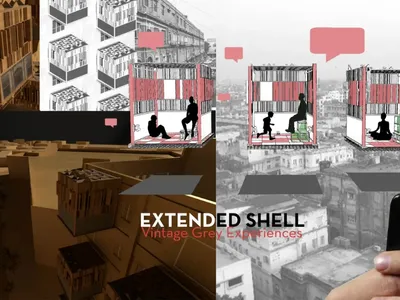
Extended Shell: Retrofitting Kolkata's Balconies as Living Urban Thresholds
A modular retrofit system recovers the social and environmental intelligence of Kolkata's historic verandas for contemporary Park Street residents.
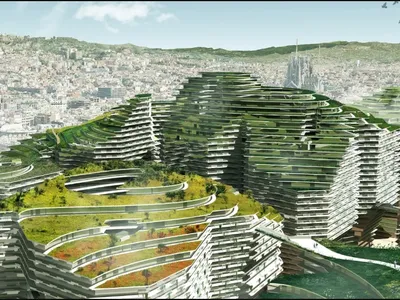
Manzana Morphosis: Stretching Barcelona's Grid into a Living Landscape for 2050
A radical reworking of the Eixample manzana turns density into a tool for generous public space, vertical ecology, and environmental performance.
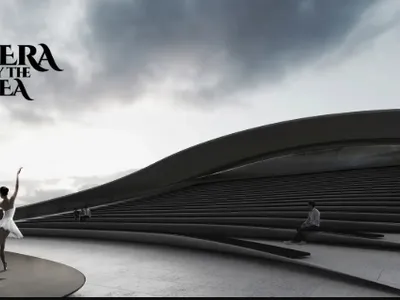
Opera by the Sea Estonia: Three Shells Dissolving Architecture into Tallinn's Coastline
A winning opera house proposal replaces monumental form with interconnected shells that blur the boundary between building, park and Baltic Sea.
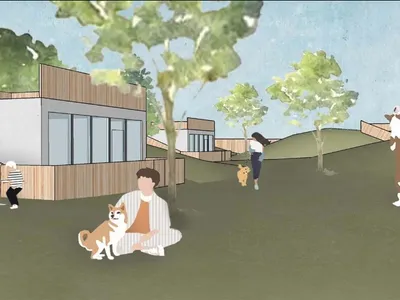
Temporary Home for Dogs: A Reversed Zoo Rethinks Animal Shelter Architecture
In Bucharest, a sinuous corridor and freed landscape flip the logic of containment, designing a shelter that works to make itself unnecessary.

Similar Reads
You might also enjoy these articles


Hodi-Mandai Geram
Project Function: Preservation and revitalization of the Intangible heritage and socio-spatial identity of the Hodi by Housing, Cultural Memory Center, Sacred Grove, landscape, local tourism economy


Olio Towers: A Mid-Rise for Performers That Fuses Housing, Rehearsal, and Stage
Located blocks from Houston's Theater District, this modular tower stacks living units around a central performance atrium.

Oasis: Modular Green Housing Carved into Dhaka's Urban Fabric
A shortlisted Plugin Housing entry reclaims unauthorized settlements in Dhaka with stepped concrete volumes, green roofs, and ventilation-driven design.

Black Hole: A Floating Megastructure for the Post-Physical Era
Emiliano Mazzarotto envisions a spherical, self-scaling arena where e-sports, digital hotels, and holographic stadiums replace traditional public space.

Explore Sunken Courtyard Competitions
Discover active competitions in this discipline

Challenge to reimagine the Iron Throne

Photograph architecture without architects

Illustrate the lost glory of Angkor Wat - Render Challenge

Design challenge to reuse E-waste
Comments (0)
Please login or sign up to add comments
No comments yet. Be the first to comment!