

Block Connected: A Residential Complex Built on the Logic of Bricklaying
Stacking living units like bricks and binding them with public space to create a mixed-use urban community along the waterfront.


What if you treated every apartment the way a mason treats a brick? In Block Connected, individual living units become solid modules stacked and shifted like coursework masonry, while corridors, courtyards, and commercial spaces act as the mortar binding them together. The analogy is not merely metaphorical: it drives the massing, the section, and the social logic of a mixed-use complex that folds residence, commerce, and office into a single interconnected structure.
Designed by Wang Chunxing and 伟 王, the project was shortlisted in the Hustle Hub 2019 competition. Targeted at urban professionals who need compact yet highly efficient living solutions, Block Connected proposes a building that refuses to segregate its programme into isolated zones. Instead, every shift in the block arrangement creates an opportunity for shared space, natural light, or street-level activation.
A Planted Atrium at the Heart of Stacked Volumes

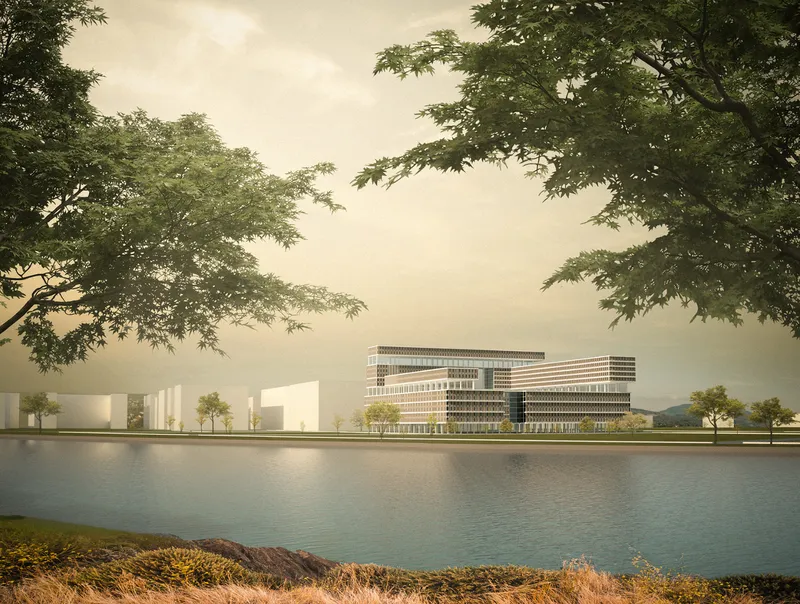
The interior atrium is the project's most convincing space. Floor-to-ceiling glazing wraps around a central planted tree, and mezzanine levels step back to let light reach the lower floors. Exposed brick walls anchor the space in the bricklaying concept that generated the form, while the generous vertical void ensures that even the deepest units share a visual connection to greenery. From the waterfront, the building reads as a series of horizontal layers, with overhanging trees softening a facade that could otherwise feel monolithic. The layered profile is a direct consequence of the concave and convex block formations the designers use to vary unit depths and orientations.
Elevations That Register the Stacking Logic
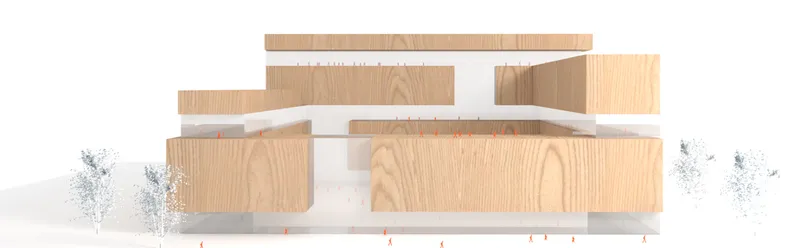
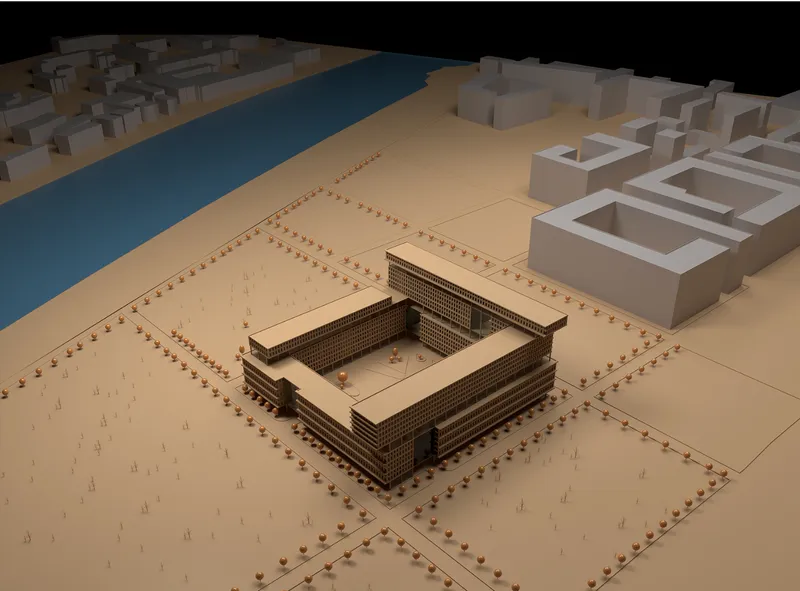
The elevation drawing reveals timber-clad volumes stacked with deliberate irregularity, each module offset just enough to create terraces, overhangs, and recessed balconies. Scattered trees drawn into the snow reinforce the seasonal reality of a site exposed to weather, and the composition suggests that the designers were thinking about how the building would age alongside its landscape. The physical model, meanwhile, makes the courtyard legible as the primary organizing device. Surrounded by a plaza and set against a river context, the building wraps around a shared open space rather than turning its back on it.
Courtyard as Connective Tissue


At the ground floor, a glass wall dissolves the boundary between interior and courtyard. People gather outside in the planted enclosure, visible from the commercial and communal zones inside. The two site plan drawings unpack this relationship further: one shows a central courtyard with structured planted beds and trees arranged on axis, while the other scatters trees more loosely and maps programmed blocks around the perimeter. Together they illustrate how the designers calibrated formality and informality within a single open space, allowing the courtyard to serve both as a quiet retreat and a social hub.
Section and Facade: Reduced Heights, Deeper Light


The long elevation drawing shows the building's patterned brick facades stretched along the street, with trees at grade breaking the horizontal run into human-scaled intervals. The section drawing cuts through the interior levels and reveals a taller tower element punctuating the otherwise low-slung massing. Critically, the designers reduced floor-to-floor heights in specific zones to increase the number of levels that receive direct natural light, a sustainability move that also compresses the overall building height and keeps the street wall proportionate to its context.
Why This Project Matters
Block Connected succeeds because its central metaphor does real architectural work. The bricklaying analogy is not a surface treatment or a storytelling device pinned to an otherwise conventional building. It generates the massing strategy, explains the interplay between private and public space, and produces the concave-convex variations that give each unit its own relationship to light and air. For a competition brief asking designers to rethink urban living, that level of conceptual coherence is exactly what stands out.
Wang Chunxing and 伟 王 demonstrate a clear understanding of how mixed-use buildings can foster community without sacrificing privacy. By treating the courtyard and connective corridors as the binding agent that holds individual units together, they propose a residential complex that is genuinely more than the sum of its parts. The project's shortlisted status at Hustle Hub 2019 confirms that the jury recognized its potential to reshape how we think about density, programme, and the spaces between.
View the Full Project
About the Designers
Designers: Wang Chunxing, 伟 王
Enter a Design Competition on uni.xyz
uni.xyz runs architecture and design competitions year-round that reward proposals with spatial conviction and real site intelligence.
Project credits: Block Connected by Wang Chunxing, 伟 王 Hustle Hub 2019 (uni.xyz).


Popular Articles
Popular articles from the community


Singing Woman: An Opera House That Performs Before the Curtain Rises
Ovidiu Cristian Pavel's conceptual opera house translates Estonia's choral identity into a sculpted waterfront landmark facing the Baltic Sea.

Manzana Morphosis: Stretching Barcelona's Grid into a Living Landscape for 2050
A radical reworking of the Eixample manzana turns density into a tool for generous public space, vertical ecology, and environmental performance.
Tsunami Convergenics: Turning Catastrophic Ocean Forces into Underwater Housing Infrastructure
A speculative underwater settlement off the coast of Onagawa, Japan, treats tsunamis and typhoons as energy sources rather than threats.
Opera by the Sea Estonia: Three Shells Dissolving Architecture into Tallinn's Coastline
A winning opera house proposal replaces monumental form with interconnected shells that blur the boundary between building, park and Baltic Sea.

Similar Reads
You might also enjoy these articles

Shakur's House: Exposed Brick as an Interior Organiser in a 168 m² Mashhad Residence
Brick moves indoors in this Mashhad residence, where masonry walls, glass partitions and teal planes sequence a compact home without closing it off.

Day and Night Park: A Time-Based Urban Newsstand in Beijing
A temporary urban newsstand in Beijing blending travel, light, and reading through poetic colors, compact form, and community-focused design.

Modernist Patio Renovation in El Masnou, Barcelona by Oliver Segura Arquitectura + Cebrià Arquitectura
Modernist patio renovation blending tradition and innovation with a movable pool, leveled floors, and Catalan materials in El Masnou.

Alto Residencial Coop: Cooperative Housing Development in Santiago de Compostela by Carbajo Barrios Arquitectos
A linear cooperative housing complex blending white volumes and perforated metal façades, enhancing community living, natural light, privacy, and urban integration.

Comments (0)
Please login or sign up to add comments
No comments yet. Be the first to comment!