

Designing a classroom upgrade kit to promote DIY learning
Inside the box - Result Story


Overview
In-classroom learning in the past few decades have seen significant changes, but not like the one it saw a few months ago. Online learning and offline learning had different value propositions and levels of acceptance in our day-to-day life. But the year 2020, the scale of change turned so huge that it brings the entire offline way of tuition under serious doubt.
When entire academic institutions were resistant to change, the times have moved the most resistant teachers to deliver lectures online tells a lot about these times. And similar stigma which was held earlier, mainly of students learning everything 'digital' or 'technological' are now being appreciated and rewarded in many ways. What does this mean for our existing classrooms?
The design of existing classrooms (K12 Systems) is based on the antiquated means of book-based learning. They arrange pupils in rows and columns as a way to efficiently deliver a static way of learning courtesy to our past from the world over. Not everything about this structuring is bad, but the limited options to education are visible due to not embracing technology in earlier phases of life. But instead of being a rift, the way online learning embraced every academic class - can the reverse happen to prepare students for this rampantly shifting?
Can old school designs be upgraded more than a projector screen by giving more personal control to children on what and how to learn, using current and upcoming technologies to build more cohesive delivery models?
Challenge
The problem statement looked at a classroom upgrade kit that included new furniture design, classroom layout methods, the inclusion of taught and DIY learning, with equipment that helped deliver a more robust and fun way of learning than today. The budget was not a constraint, but the size of the classroom was. Will it involve expert installation? Or can it be set up manually by the class itself?
What devices or teaching systems are possible in this kit? What age group are you designing this for? What safety precautions may arise with such a new teaching apparatus?
The solution finding looked at traditional schools and their classrooms at large all around the world as target sites. The user group looked at 30 students and 2 teachers in any (one or multiple) of the K12 classes.
The jury for the competition consisted of esteemed designers, professionals, and academicians from around the world. The Lead Jurors for the competitions were as follows:
Peter Anderson, Principal, Anderson Architecture, United States
Yuriko Yagi, Co-founder, Architect, PAN-PROJECTS, Denmark
Kazumasa Takada, Co-founder, Architect, PAN-PROJECTS, Denmark
Shi Chieh Lu, Director, CJ STUDIO, Taiwan

Some of the Best of competition projects are:
Winning Project: COOL K!DS
By: DaiYing yang, 吳采愉, 任乙天 & 駱俊宇
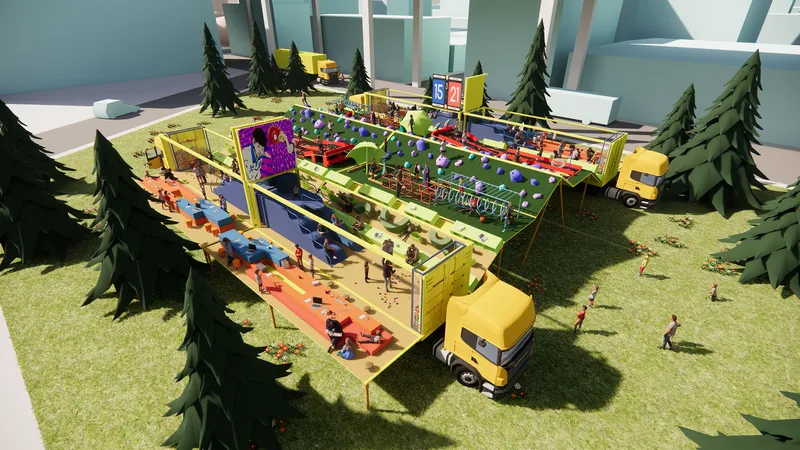
Fig: 1 Cover image
Description: A school which is outside the box but in THE BOX.
------------------
People’s Choice: Purpose-Built Classroom
By: Joshua Kevin, Abigael Mar & Freddy Samuel

Fig: 2 Perspective Section and key plan
Description: Adaptive classroom with modular furniture as an improvement from the conventional classroom.
-----------------------
Follow us on social media: Facebook | Instagram | LinkedIn | Twitter | Youtube
References (3)


Popular Articles
Popular articles from the community


Manzana Morphosis: Stretching Barcelona's Grid into a Living Landscape for 2050
A radical reworking of the Eixample manzana turns density into a tool for generous public space, vertical ecology, and environmental performance.

Temporary Home for Dogs: A Reversed Zoo Rethinks Animal Shelter Architecture
In Bucharest, a sinuous corridor and freed landscape flip the logic of containment, designing a shelter that works to make itself unnecessary.

Cloaked Colonization: A Mobile Underwater Habitat That Moves Like a Fish
Micah Abaya's shortlisted EHC Pacific entry reimagines ocean settlement as a dispersed network of self-sustaining architectural organisms.

Tsunami Convergenics: Turning Catastrophic Ocean Forces into Underwater Housing Infrastructure
A speculative underwater settlement off the coast of Onagawa, Japan, treats tsunamis and typhoons as energy sources rather than threats.

Similar Reads
You might also enjoy these articles

The Amber Palace Opera: A Geological Fiction Surfaces on Tallinn's Baltic Waterfront
Pierre Brillard reimagines a Baltic legend as a public landscape, opera house, and waterfront promenade rooted in Tallinn's coastal identity.
Dynamic Modules Shelter: A Telescopic Ring for Mountain Pilgrimage
A circular modular framework of steel, bamboo, and fabric grows vertically with demand, wrapping communal ground in adaptable shelter.

Singing Woman: Contemporary Architecture Inspired by Estonia’s Voice and the Sea
Singing Woman turns Estonia’s song culture into flowing opera house architecture, blending public life, landscape, sea, and national memory.

HYPERBLOCK: Flexible Urban Design for Barcelona’s Future City
HYPERBLOCK reimagines Barcelona as flexible urban design, layering density, daylight, public space and adaptable housing above Cerdà’s grid.


Comments (0)
Please login or sign up to add comments
No comments yet. Be the first to comment!