

InsideOut: A Stadium That Dissolves Into the City Grid
A grid-based adaptive stadium replaces hard boundaries with porous public space, weaving sport, retail, and community life into one system.


What happens when a stadium stops pretending to be a fortress? InsideOut answers by dismantling the most stubborn convention in sports architecture: the sealed perimeter. Instead of a monolithic bowl surrounded by dead parking lots six days a week, the project proposes a grid-based structure that radiates outward from the pitch, generating a continuous field of public program. Food courts, fitness centers, spa facilities, retail, open markets, concert zones, and indoor sports halls occupy a perimetral ring that functions with or without a match on the schedule. The stadium becomes less an event and more a neighborhood.
Designed by Stefan Padurariu, Alexandru Ambrosa, Andra Panait, and Florin Pîndici, InsideOut treats the football pitch's foundational geometry as a site-wide organizing principle. A radiating grid extends from the central field outward, structuring not only seating tiers but an entire ecosystem of peripheral functions. The result is a spatial hierarchy that is intentionally blurred: non-spectators can inhabit the site for a weekend stroll, a local festival, or a weekday workout, never needing a ticket to cross its porous thresholds.
A Tensile Canopy Over a Sunken Bowl

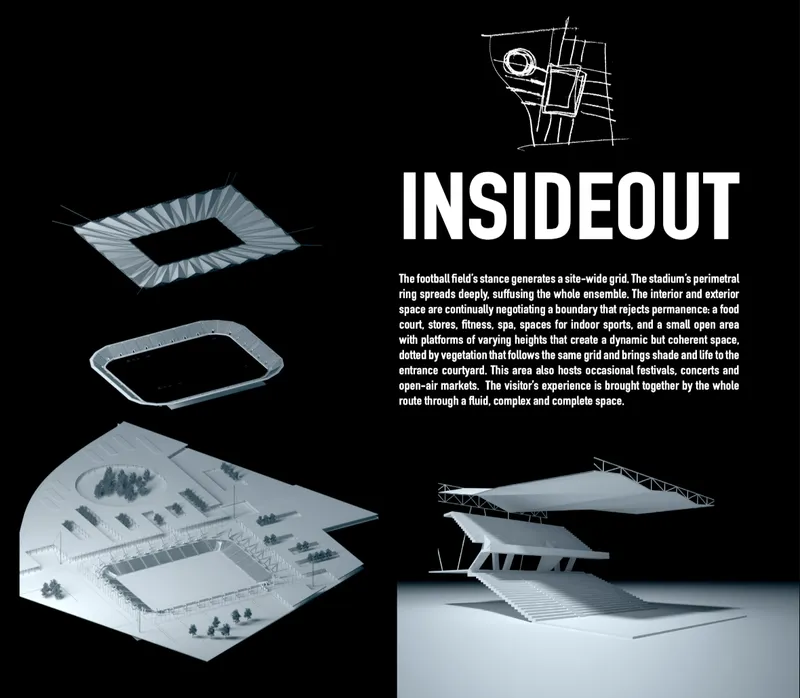
The physical model reveals a suspended tensile roof structure hovering above a sunken stadium bowl, its lightness contrasting with the mass of the stepped terrain below. By pushing the seating volume into the ground, the designers keep the surrounding plazas at grade, preserving sightlines and pedestrian flow across the site. The roof itself reads as a canopy rather than a lid, sheltering the event space without enclosing it. Surrounding plazas spill outward from this central depression, establishing the logic of continuity that defines the entire project.
The accompanying presentation board breaks down the system through axonometric diagrams that map how the pitch geometry generates the broader grid. Each axon peels back a layer: structure, circulation, program, landscape. The diagrammatic clarity reinforces the project's core argument, that the stadium is not a building with an edge but a gradient that transitions smoothly from sport to city.
Radial Ribs and the Diamond Plan
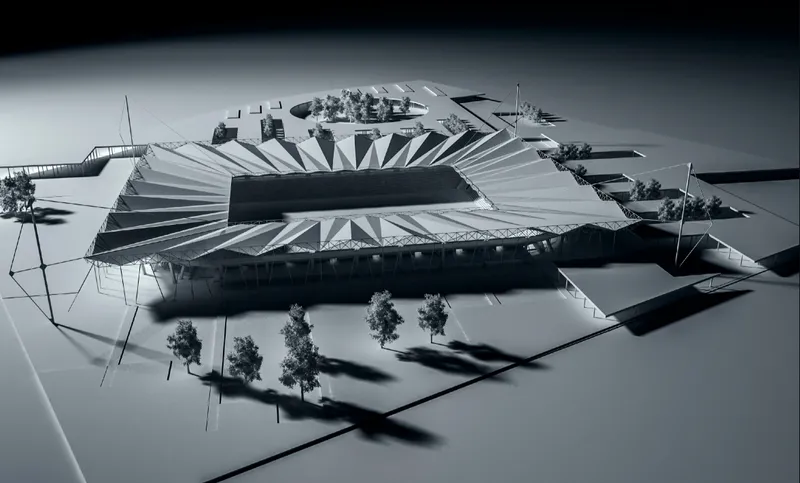
Seen from above, the structural logic becomes unmistakable. The aerial view of the physical model shows a radial roof structure with ribs fanning outward from the central bowl, casting long shadows across the perimeter ramps. These ribs do double duty: they carry the tensile membrane above while organizing the circulation below, directing movement from the outer edge of the site toward the pitch. The ramps visible under the shadow of the canopy are not afterthoughts bolted onto a facade; they are embedded in the structural order of the project.
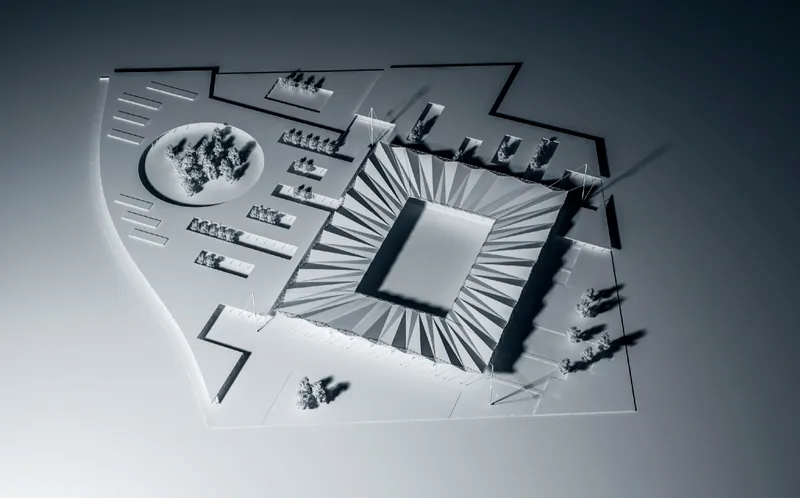
The top-down site model confirms a diamond-shaped stadium center, its geometry rotated against the surrounding context to maximize corner entries and create four distinct approach sequences. Radiating structural ribs extend beyond the bowl's footprint, dissolving into the landscape and framing the perimetral ring of amenities. The diamond orientation also opens up triangular interstitial zones at the corners, spaces the designers fill with open markets and community gathering areas rather than leaving them as leftover geometry.
Inside the Perimeter Ring: Ramps, Ribs, and Concourses
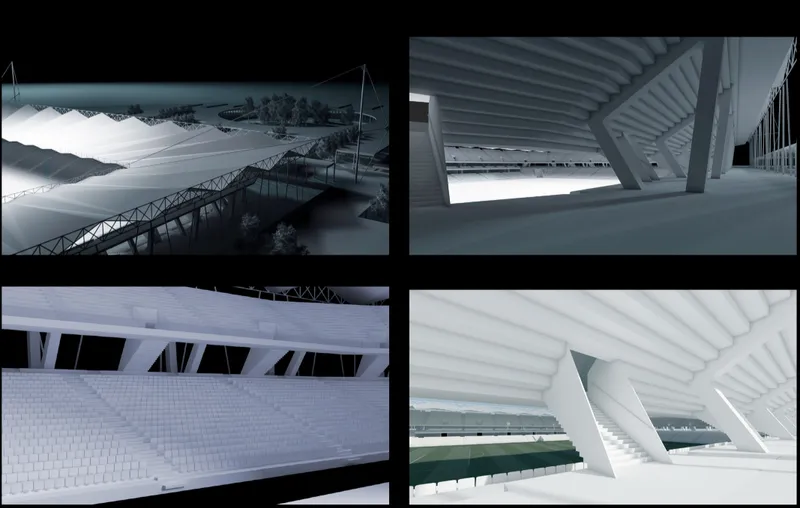
Four close-up model photographs zoom into the spatial quality of individual moments: an entrance ramp that doubles as a public promenade, a ribbed ceiling detail that reveals the structural rhythm, stepped seating that terraces down into the bowl, and an interior concourse perspective that could easily pass for a commercial gallery or cultural hall. These are the spaces that give InsideOut its real ambition. Platforms at varying heights introduce visual interest and multifunctionality, while interconnected vegetation provides natural shading and softens the transitions between hard infrastructure and open air.
The concourse perspective is especially telling. It shows a generous, daylit interior that feels nothing like the concrete tunnels of conventional stadiums. Skylights pull light into the lower levels, and the proportions suggest these spaces could host student activities, temporary installations, or communal events with equal ease. Underground parking is folded beneath the site to free the ground plane entirely for pedestrians. The infrastructure here is designed for afterlife, not just opening day.
Porosity as an Urban Strategy
The most radical decision in InsideOut is not formal but operational: the deliberate erosion of the ticketed boundary. By allowing the perimetral ring to function independently of match-day programming, the designers transform the stadium from an episodic venue into a sustained urban presence. Commercial galleries, multi-purpose annexes, fitness centers, and retail stores all face outward, engaging the street as much as the pitch. Events that range from local festivals to casual weekend strolls can occupy the site without requiring a gate or a credential.
This porosity is not just a diagram. It is embedded in the section: open-air platforms at different levels, ramps that connect to surrounding streets, and a spatial grid that remains legible but fluid enough to absorb shifting use patterns over time. The project's sensitivity to urban continuity is its greatest strength, turning what could be a dead zone between matches into an active, inhabited piece of city.
Why This Project Matters
Stadiums remain some of the most wasteful typologies in contemporary architecture. Massive in footprint, expensive to build, and empty for the vast majority of their lifespan, they represent a fundamental misallocation of urban land. InsideOut confronts this problem directly, not with vague rhetoric about flexibility but with a concrete spatial strategy: a radiating grid that distributes program across the site, a perimetral ring that operates on its own schedule, and a sectional logic that keeps the ground plane public and permeable.
What Padurariu, Ambrosa, Panait, and Pîndici propose is a stadium that earns its place in the city every day, not just on game day. The project is a clear-eyed argument that sports architecture can grow organically within urban fabric rather than standing apart from it. In a discipline that too often celebrates spectacle over sustained use, InsideOut offers a welcome counter-position: architecture that is as useful on a Tuesday afternoon as it is on a Saturday night.
View the Full Project
About the Designers
Designers: Stefan Padurariu, Alexandru Ambrosa, Andra Panait, Florin Pîndici
Enter a Design Competition on uni.xyz
uni.xyz runs architecture and design competitions year-round that reward proposals with spatial conviction and real site intelligence.
Project credits: InsideOut by Stefan Padurariu, Alexandru Ambrosa, Andra Panait, Florin Pîndici.


Popular Articles
Popular articles from the community


ETEH Reworks the Shared Spaces of São Domingos School in Brazil Around Timber, Color and Hanging Plants
At São Domingos School in Brazil, 436 m² of hall, refectory and library are recast with timber joinery, a yellow and blue code and trailing greenery.

FCC Arquitectura Expands a Portuguese Granite House with a Board-Marked Concrete Wing
In Portugal, JV House pairs a cleaned-up whitewashed and granite dwelling with a timber-shuttered concrete extension, courtyards and a garden pool.


Aquadapt: An Underwater Habitat That Rewrites Its Rooms by the Hour
Curved modules ring the seabed while one shell shifts from breakfast room to cinema, farm and football pitch as residents' needs change.

Opera on the Sea: Driftwood Logic Shapes a Timber Opera House on Estonia's Coast
Trevor Orgill's opera house translates the entangled drift of floating timber into a civic building where wood, water, and music converge.

Similar Reads
You might also enjoy these articles

Vereda Arquitetos Renovates a 40-Square-Meter Apartment Inside Niemeyer's Copan Building
A compact unit in São Paulo's most iconic residential tower gets a material overhaul that pairs exposed concrete with bold blue Formica.

Shakur's House: Exposed Brick as an Interior Organiser in a 168 m² Mashhad Residence
Brick moves indoors in this Mashhad residence, where masonry walls, glass partitions and teal planes sequence a compact home without closing it off.

Day and Night Park: A Time-Based Urban Newsstand in Beijing
A temporary urban newsstand in Beijing blending travel, light, and reading through poetic colors, compact form, and community-focused design.

Modernist Patio Renovation in El Masnou, Barcelona by Oliver Segura Arquitectura + Cebrià Arquitectura
Modernist patio renovation blending tradition and innovation with a movable pool, leveled floors, and Catalan materials in El Masnou.

Explore Stadium Competitions
Discover active competitions in this discipline

Challenge to design a barrier free sports center

Challenge to design an outdoor ice-rink and park
Comments (0)
Please login or sign up to add comments
No comments yet. Be the first to comment!