

Inverted House Turns Tbilisi's Fence Culture Inside Out
TIMM's single-family residence in Okrokana replaces the suburban perimeter wall with a sawtooth facade that absorbs privacy into its very architecture.


In Tbilisi's suburban fringe, the fence is king. Residential plots in neighborhoods like Okrokana are defined less by the houses they contain than by the tall, opaque barriers that surround them, each property turning its back on the street. TIMM, the studio led by Nikoloz Lekveishvili, looked at this condition and asked an obvious but potent question: what if the house itself became the boundary? The result is the Inverted House, a 1,010 m² residence completed in 2025 that folds its enclosure into its architecture, eliminating the fence entirely while achieving more privacy than any wall could offer.
The key move is a sawtooth facade of vertical timber fins that wraps the building's exterior. From the street, it reads as a continuous, opaque surface. From inside, the angled planes open up to controlled views and generous daylight. It is an old trick, borrowed from industrial architecture and privacy screens, but deployed here at the scale of a whole house it produces something genuinely new for Tbilisi's residential landscape. The fence disappears because the house is the fence.
The Sawtooth Facade
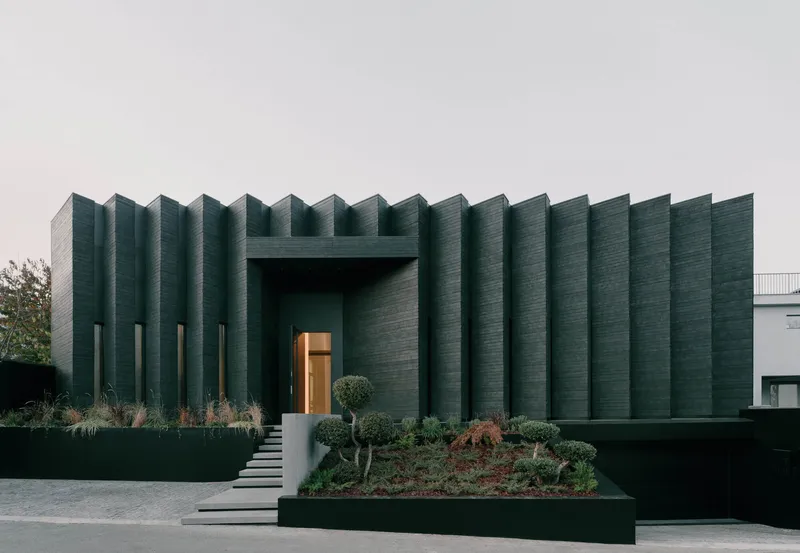
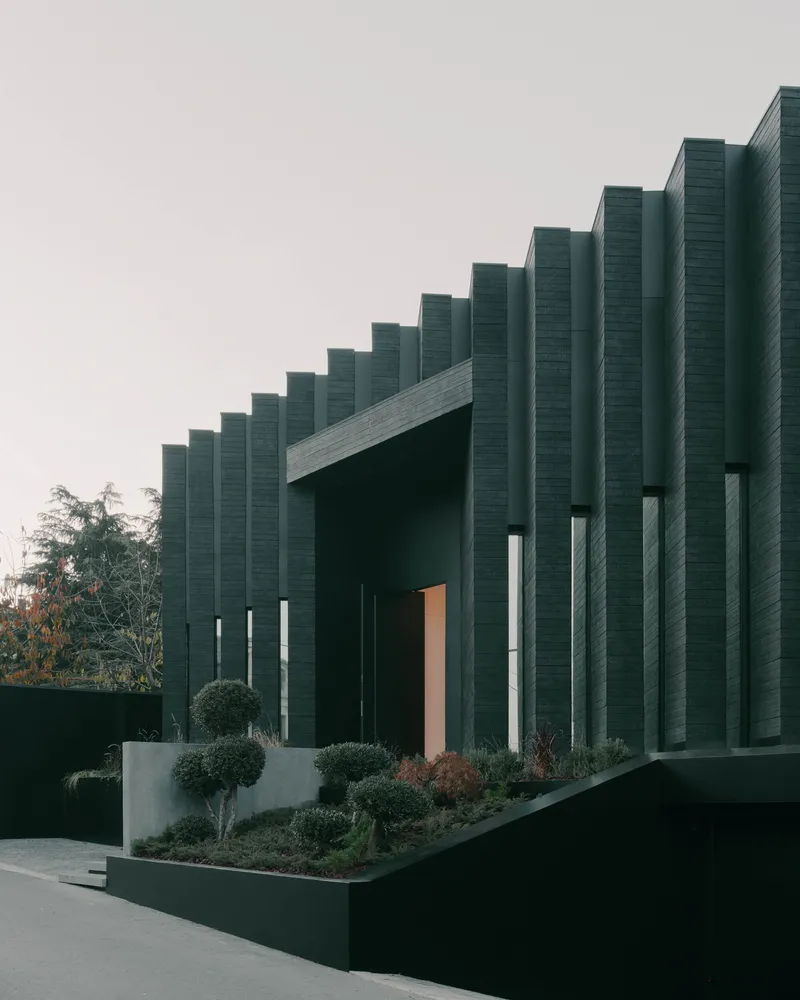
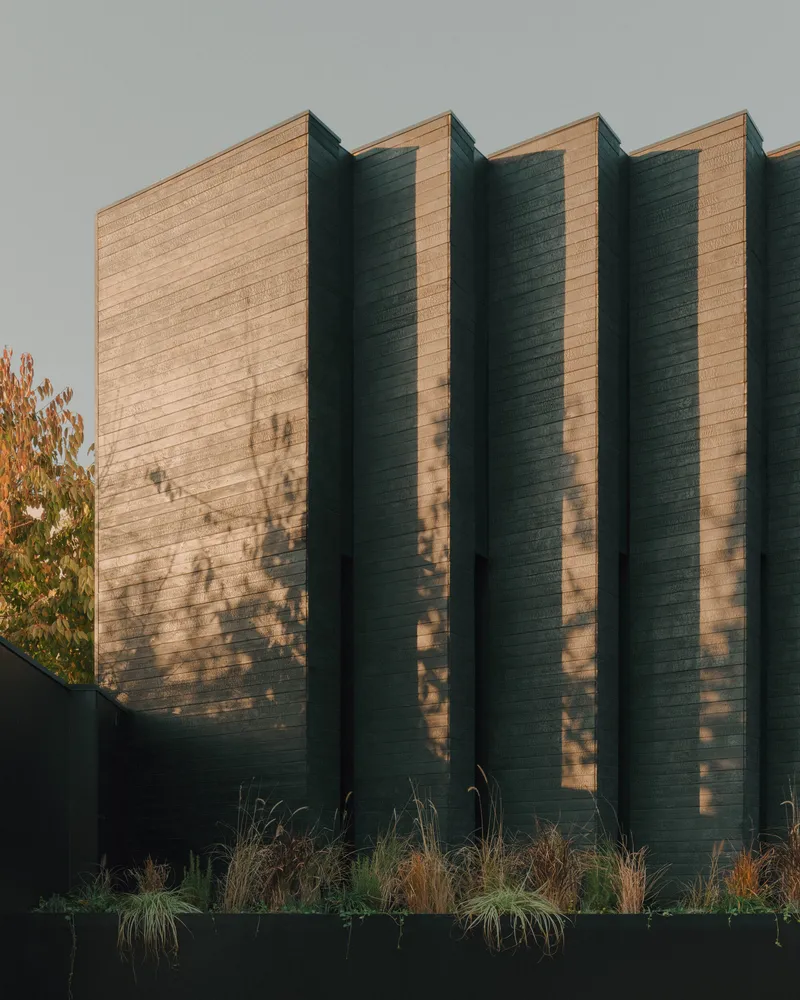
The building's street presence is dominated by a rhythm of vertical fins, clad in horizontal timber, that create a continuously modulated surface. Under overcast skies the facade flattens into a monolithic screen of repeating lines. At golden hour, the sawtooth geometry comes alive, each angled plane catching or rejecting light to produce alternating bands of warmth and deep shadow. The effect is almost textile: a woven screen rather than a solid wall.
At street level, planted beds soften the concrete base and provide a green datum that ties the building to the sloped terrain. The entry is recessed, barely signaled, which reinforces the inward logic. You don't approach this house so much as slip behind its surface.
Materiality and Detail
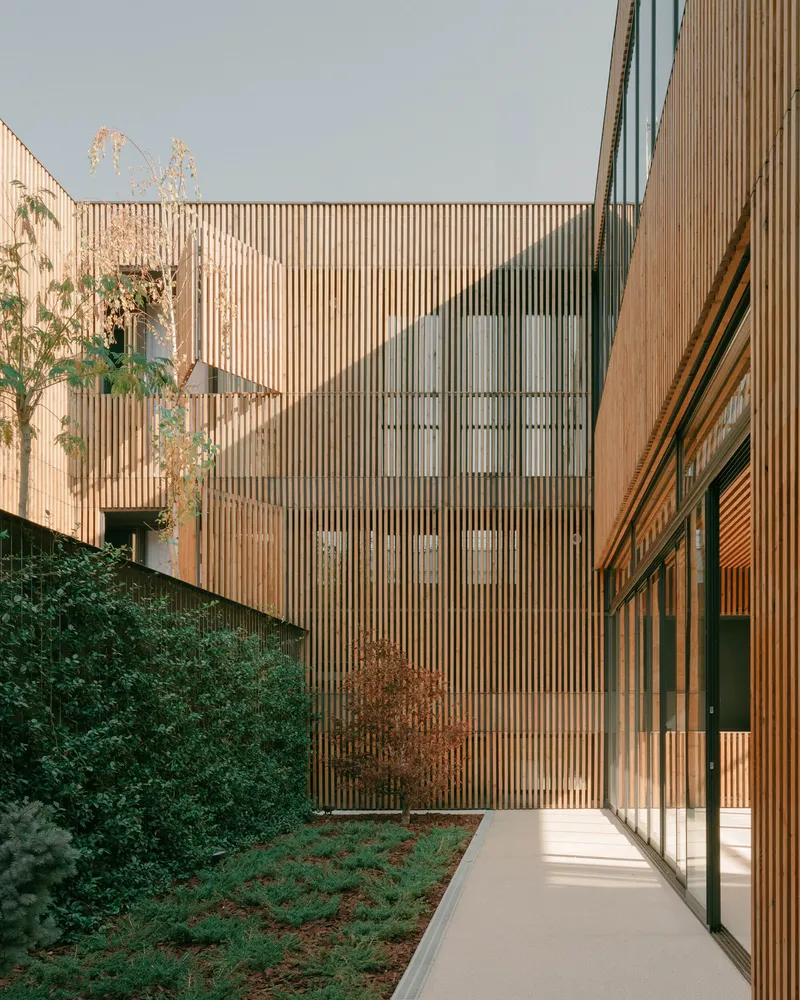
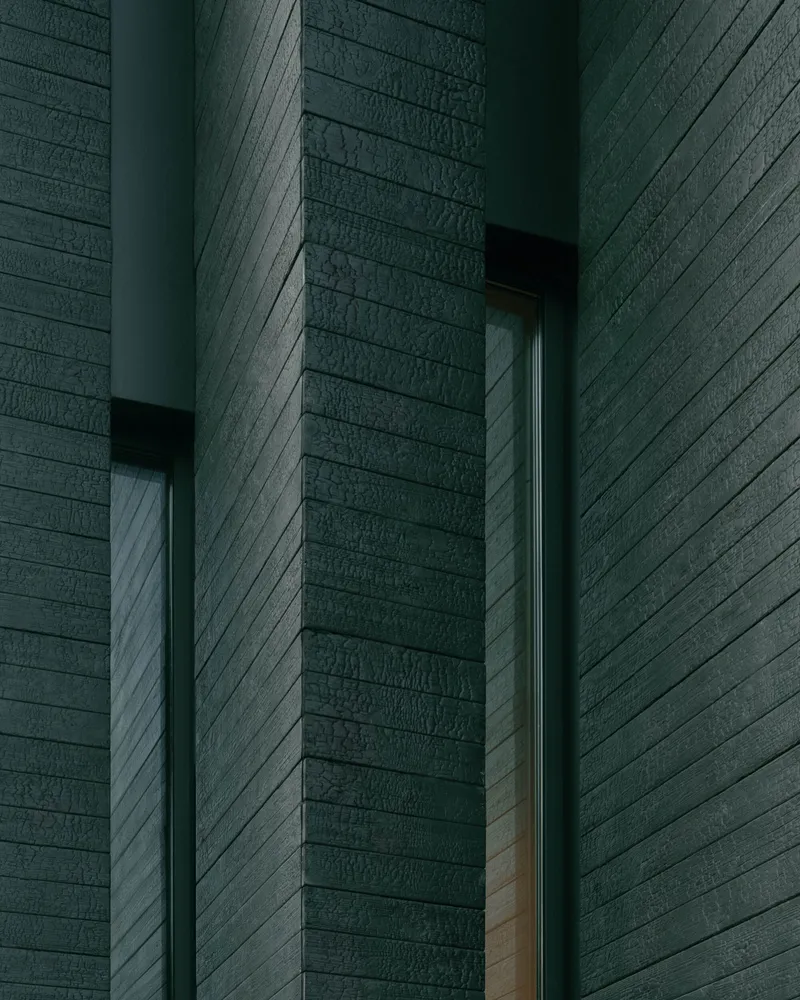
TIMM keeps the material palette tight: horizontal timber cladding on the exterior, corrugated metal in the courtyard, polished concrete and white plaster inside. The timber boards are laid with deliberate precision, meeting at recessed corners to form clean, shadow-defining joints. Narrow window openings punch through these surfaces sparingly, turning each aperture into a framed event rather than a default gesture.
The glazed corridor along the planted slope reveals the secondary circulation strategy. Rather than a single monolithic volume, the house is composed of interlocking wings connected by transparent passages. Where timber meets glass, the contrast is total: opacity against transparency, warmth against reflection. It is a simple opposition, but the architects exploit it consistently.
The Interior Courtyard
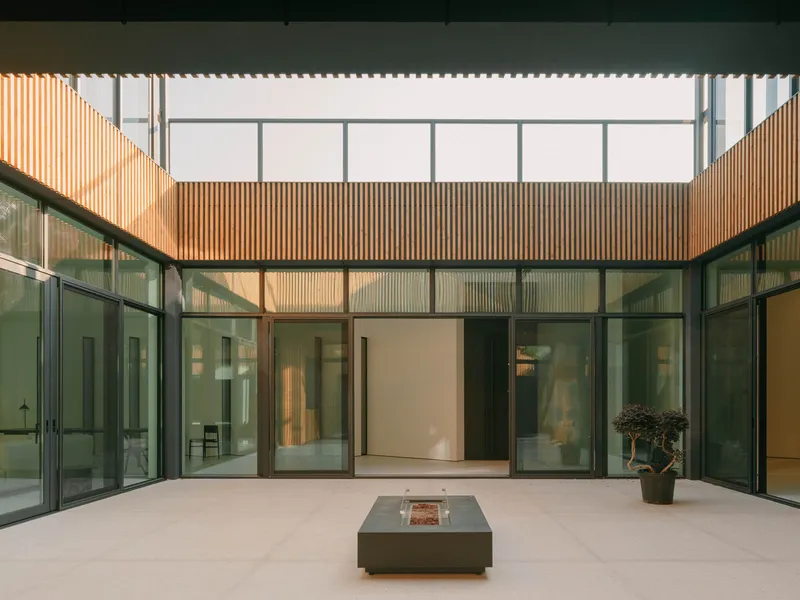
If the exterior facade is the project's public argument, the internal courtyard is its private reward. Wrapped in corrugated metal cladding and floor-to-ceiling glass, the courtyard serves as both a light well and a social anchor. A fire feature at its center suggests that outdoor life here is not seasonal but year-round, with the sheltered enclosure offering protection from Tbilisi's wind while maintaining an open sky above.
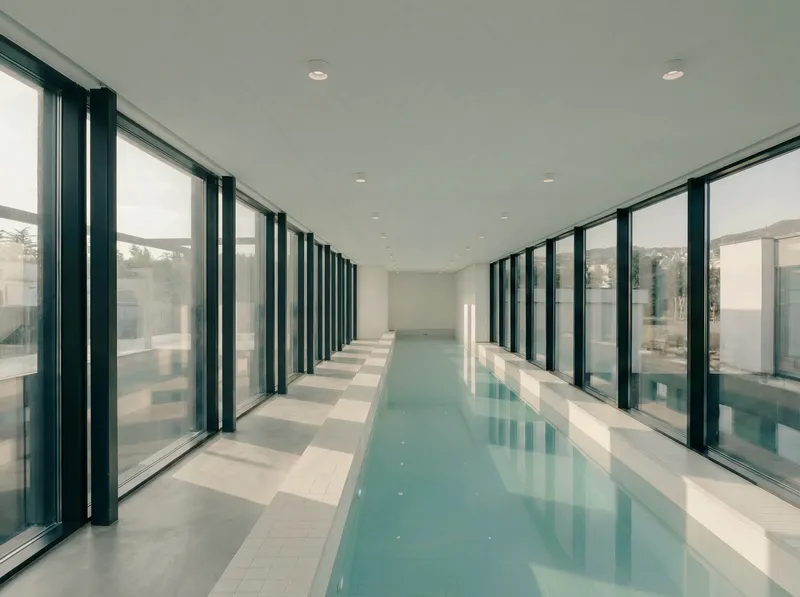
Adjacent to the courtyard, the indoor pool occupies what might be the most striking room in the house. Flanked by glass walls with dark metal frames and lit by recessed ceiling fixtures, the pool space reads as a continuation of the courtyard rather than a separate amenity. The boundary between inside and out is deliberately thin.
Living Spaces and Light Control
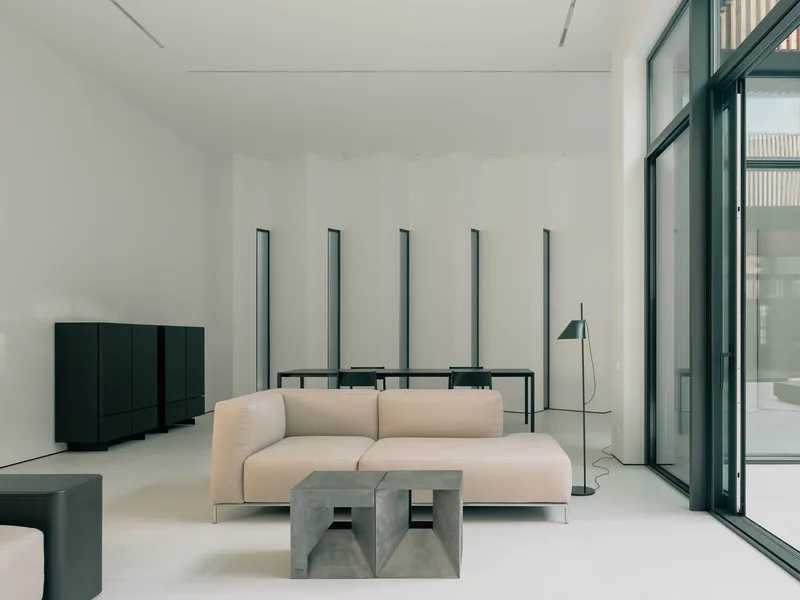
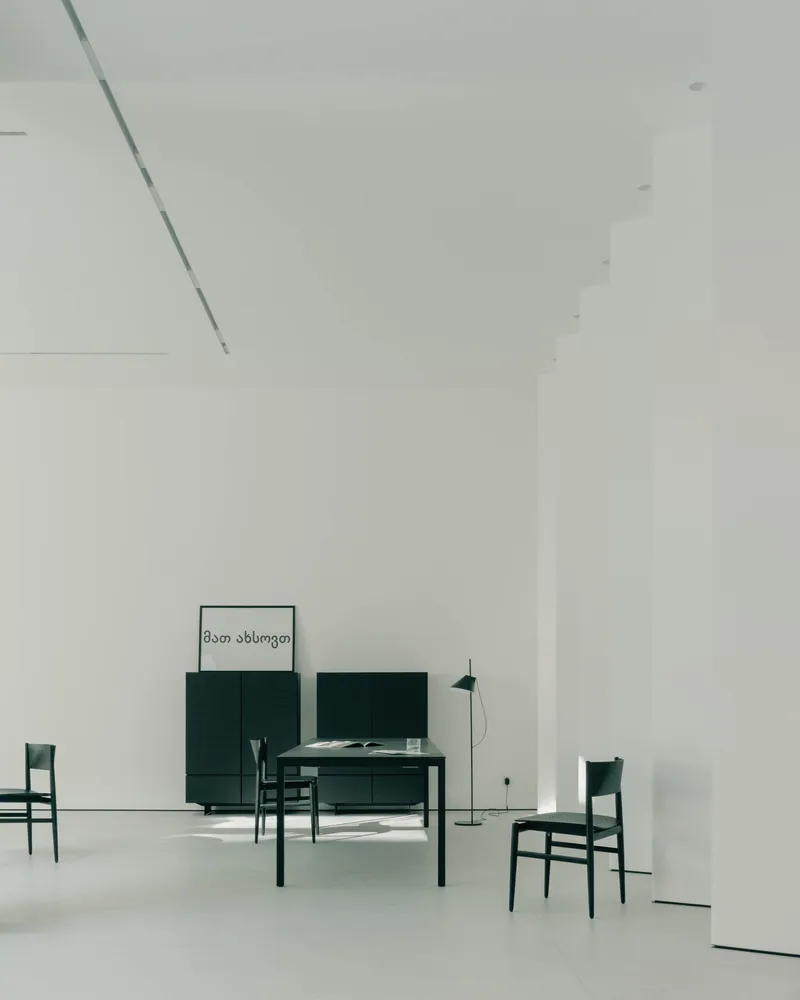
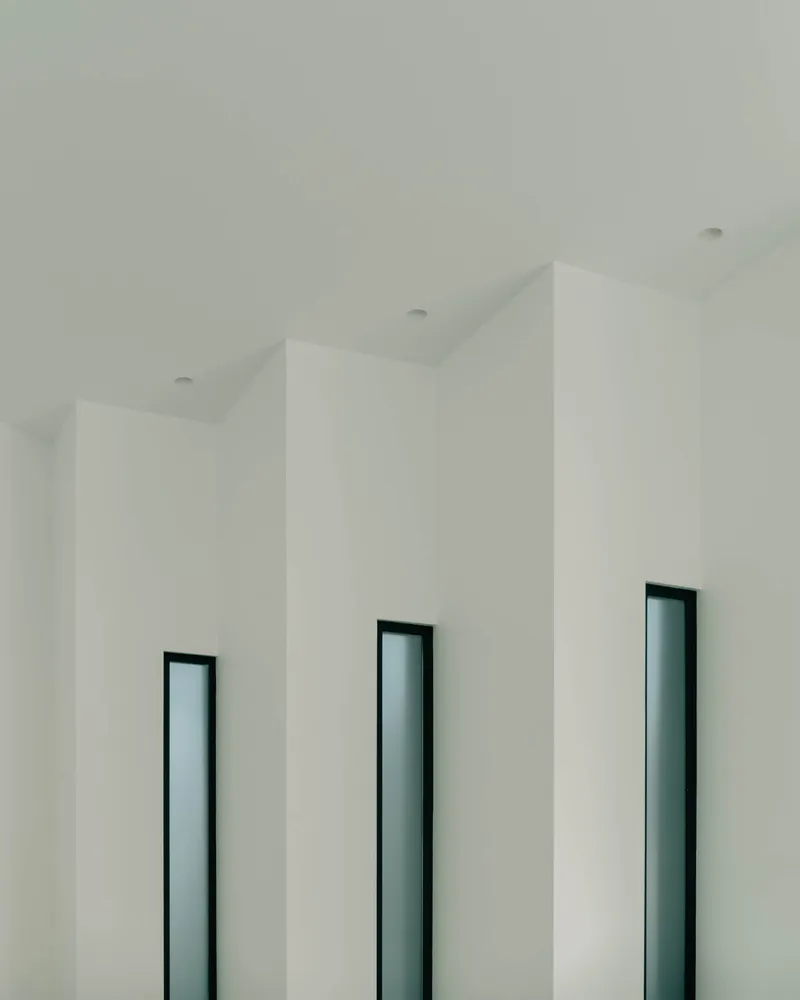
Inside, the sawtooth logic translates into tall, narrow window slits that carve light into precise vertical bands across polished concrete floors. The double-height living space receives illumination from these slots, producing an interior atmosphere that shifts dramatically with the time of day. Morning light enters as thin, sharp lines; afternoon sun washes entire wall planes.
The folded ceiling planes in the upper living areas are a detail worth noting. White surfaces angle to follow the roofline geometry, creating a sculptural canopy that channels the eye toward the window openings. It is an intentional choreography of attention: the architecture tells you where to look.
Domestic Warmth Within a Rigorous Shell
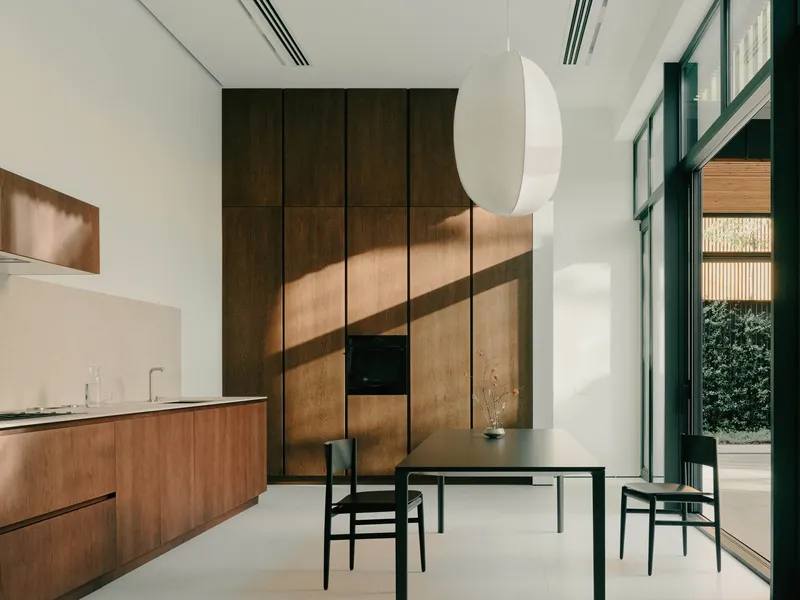
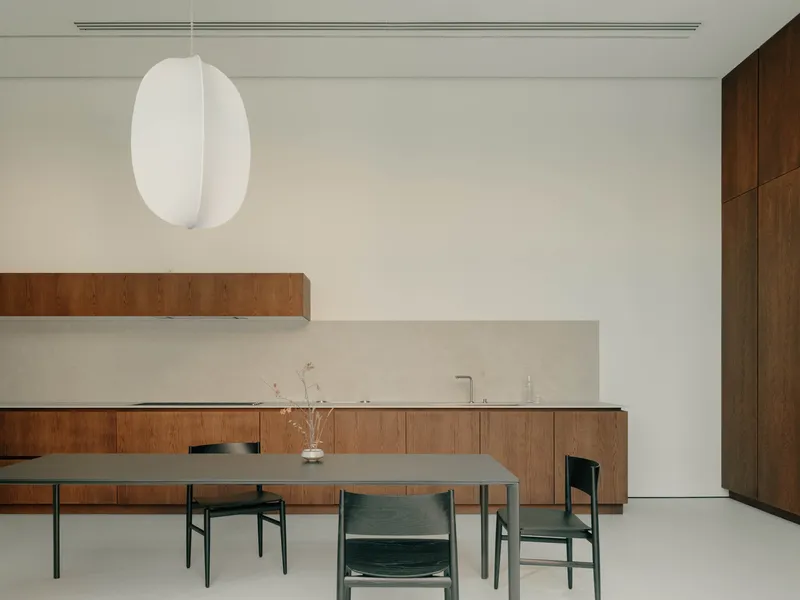
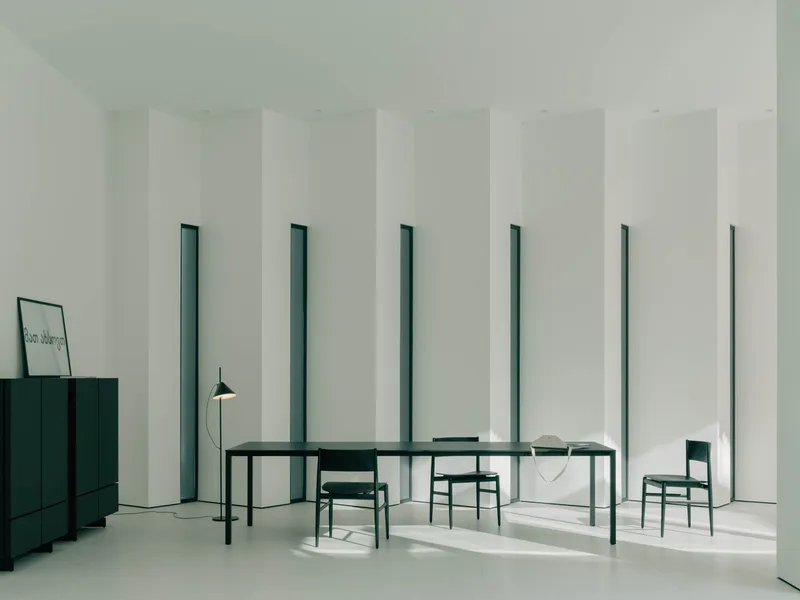
For all its formal discipline, the Inverted House is not austere. The dining areas, rendered in walnut cabinetry and furnished with dark green tables and pendant lights, feel genuinely inhabited. Sunlight streams through tall glazed doors in one dining zone, while the other relies on the rhythmic window slots to create a moodier, more controlled atmosphere. The furniture selections, while restrained, introduce curves and soft textures that counterbalance the angular architecture.
The material shift from concrete and metal on the exterior to warm timber joinery on the interior is not just cosmetic. It signals a deliberate inversion of expectation: tough outside, generous inside. The house protects its occupants not by hiding behind a fence but by absorbing them into a space that is simultaneously sheltered and luminous.
Plans and Drawings
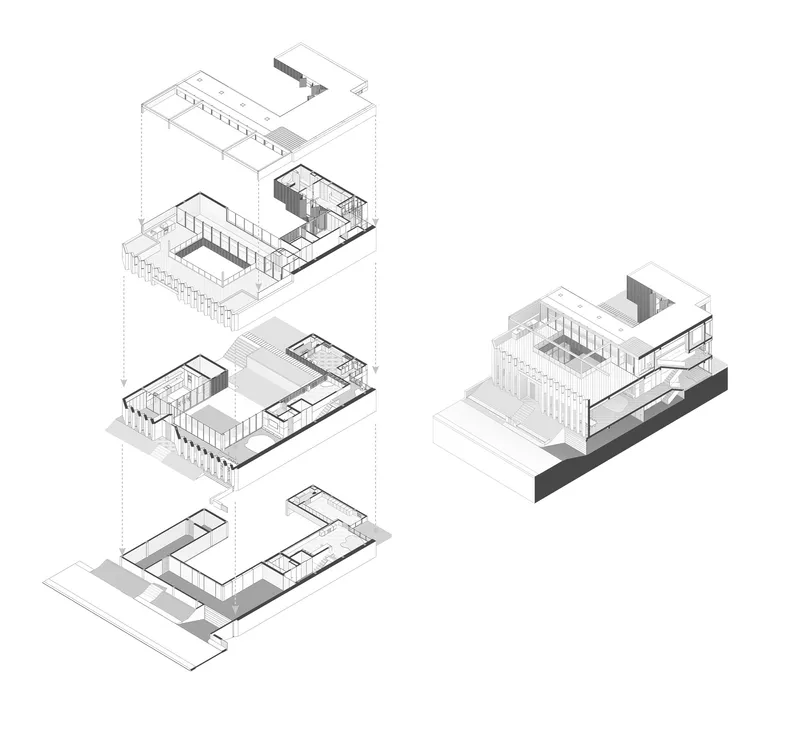
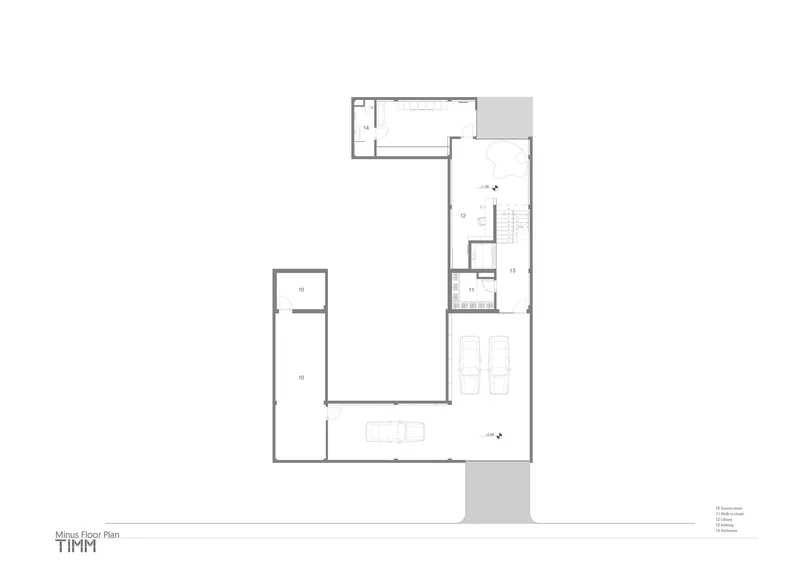
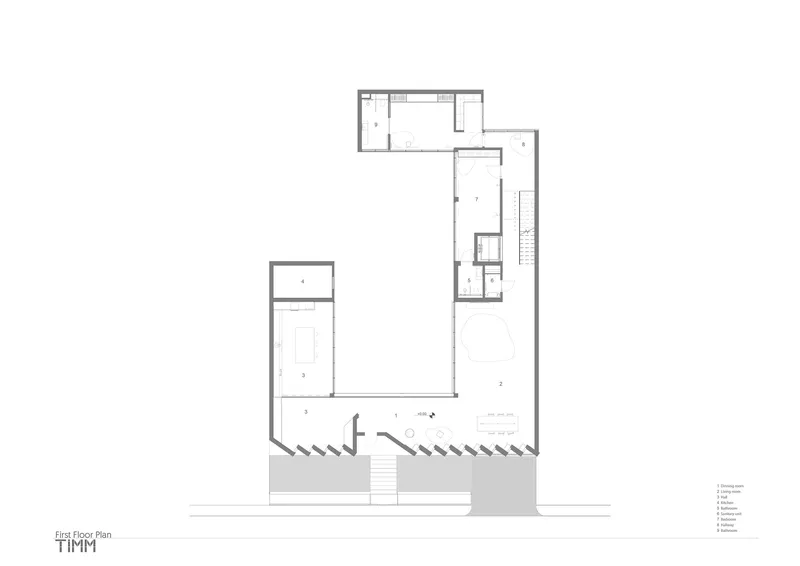
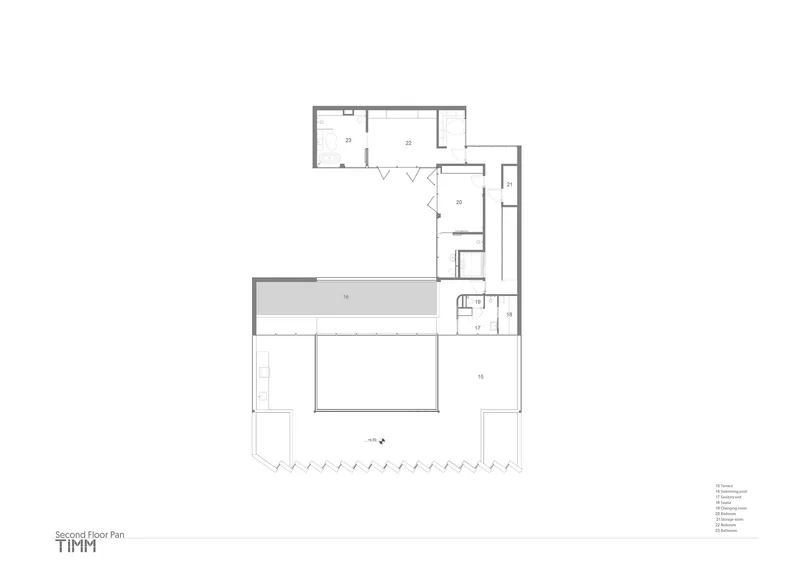
The axonometric drawing reveals the project's organizational logic with clarity: an L-shaped footprint wraps around the courtyard, with each floor stepping back to create cantilevered terraces on the upper levels. The ground floor accommodates the garage and service spaces in one wing, while the main living areas occupy the first floor, elevated to capture views across the sloped site. The second floor is given over to bedrooms arranged along a central corridor, with a rooftop terrace completing the vertical sequence.
What the plans confirm is that the sawtooth facade is not applied decoration. The zigzag geometry is structural, generating the deep window reveals and angled walls that define every room. Plan, section, and elevation are all consequences of a single spatial idea, which is the mark of a project where the concept has been carried through with conviction.
Why This Project Matters
The Inverted House is a direct response to a specific urban condition, and that specificity is what makes it valuable. TIMM did not import a generic courtyard house typology and drop it into Tbilisi. They studied the logic of the fence, understood what it was trying to achieve, and then argued that architecture itself could do the job better. The result is a house that contributes to the street while fiercely guarding the privacy of its inhabitants, a resolution that most suburban houses in the region never attempt.
Beyond the local argument, the project offers a broader lesson about enclosure and transparency. In an era when residential architecture often defaults to either hermetic boxes or fully glazed pavilions, the Inverted House demonstrates that the interesting territory lies in between. Its sawtooth facade is simultaneously open and closed, private and public, solid and permeable. That ambiguity, sustained across 1,010 square meters without ever feeling like a gimmick, is a genuine achievement.
Inverted House by TIMM (Lead Architect: Nikoloz Lekveishvili), Tbilisi, Georgia. 1,010 m². Completed 2025. Photography by Grigoriy Sokolinsky.
About the Studio
Share Your Own Work on uni.xyz
If projects like this are the kind of work you want to make, uni.xyz is a place to publish your own, find collaborators, and enter design competitions.


Popular Articles
Popular articles from the community


Singing Woman: An Opera House That Performs Before the Curtain Rises
Ovidiu Cristian Pavel's conceptual opera house translates Estonia's choral identity into a sculpted waterfront landmark facing the Baltic Sea.

Faces of the Soviet Avant-Garde: Turning Moscow's Street Names into an Open-Air Museum
A network of sculptural installations across a Moscow residential district transforms forgotten architect names into spatial encounters with cultural memor

The Amber Palace Opera: A Geological Fiction Surfaces on Tallinn's Baltic Waterfront
Pierre Brillard reimagines a Baltic legend as a public landscape, opera house, and waterfront promenade rooted in Tallinn's coastal identity.

Temporary Home for Dogs: A Reversed Zoo Rethinks Animal Shelter Architecture
In Bucharest, a sinuous corridor and freed landscape flip the logic of containment, designing a shelter that works to make itself unnecessary.

Similar Reads
You might also enjoy these articles

Pixel Gardens: One Repeated Module Stacked Into a Terraced Social Housing Tower for Famagusta
Salem Bader's shortlisted housing tower builds a vertical neighbourhood from one repeated module, offsetting units to carve terraces, light and air.

Bao Huynh Watercolor Atelier: A Serene Art Retreat in Hội An
Bao Huynh Watercolor Atelier in Hội An blends multifunctional art spaces, sustainable design, local materials, and family-friendly living in a serene environment.

Atelier Macri Concept Store Interior Design by CASE-REAL
Atelier Macri store features a "ko" counter, walnut wood details, cork displays, blending retail, gallery, and seamless customer experiences.

Manuel Vargas Izquierdo Stadium and High-Performance Sports Center: Architectural Excellence in Jalpa de Méndez
The Manuel Vargas Izquierdo Stadium blends sustainable design, inclusive sports facilities, and cultural-inspired architecture, revitalizing Jalpa de Méndez’s public spaces.


Comments (0)
Please login or sign up to add comments
No comments yet. Be the first to comment!