
Nikken Sekkei Carves Diagonal Atriums Through a Tokyo Office to Let the Building Breathe
A stepped roofline in Itabashi-ku channels natural ventilation through six floors, earning ZEB Ready certification for a precision-scale manufacturer.

Wedged between high-rise condominiums, a national highway, and an expressway in Tokyo's Itabashi-ku, the ISHIDA TOKYO Regional Headquarters occupies the kind of site most architects would treat as a constraint. Nikken Sekkei treated it as a prompt. Completed in 2021 for the Kyoto-based weighing equipment manufacturer Ishida, the 9,282-square-meter building stacks six office levels and a penthouse under a stepped, sloped roof that does far more than comply with height limits. Each step opens a diagonal atrium linking the third through sixth floors, creating a continuous gravity ventilation pathway that lets conditioned and ambient air flow upward along ceiling surfaces and exit through roof-mounted top lights. The result is a building that can switch, span by span, between radiant and convection cooling, and that consumes just 6.5 watts per square meter of lighting power while holding 600 lux at desk level.
What makes the project genuinely interesting is the way it splits the interior into two contrasting work environments and then stitches them together with architecture rather than signage. A "white" zone with four-meter ceilings exposes the steel frame, painted in white fireproof coating, and relies on indirect beam lighting and ductless air conditioning exploiting the Coanda effect. A "wood" zone drops the ceiling, wraps surfaces in timber, and encourages the informal, collaborative behavior the white zone deliberately discourages. Employees choose freely between the two. The building does not prescribe a single mode of productivity; it offers two and trusts the occupants.
A Stoic Face for a Precision Company
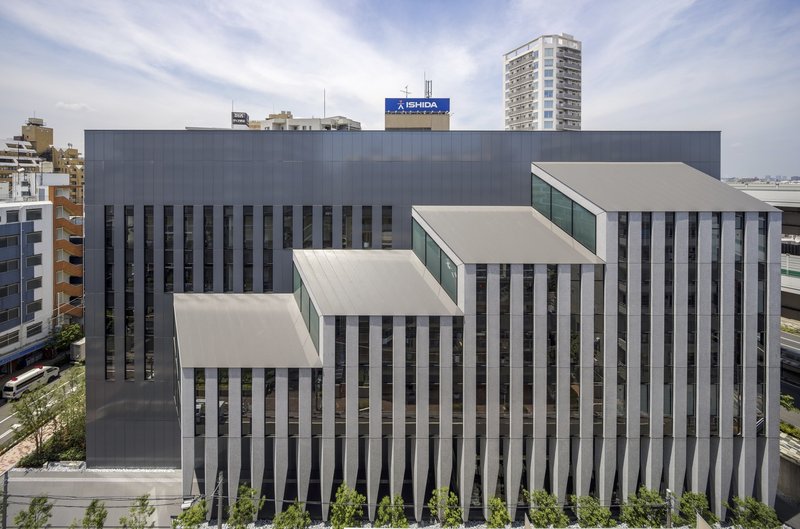
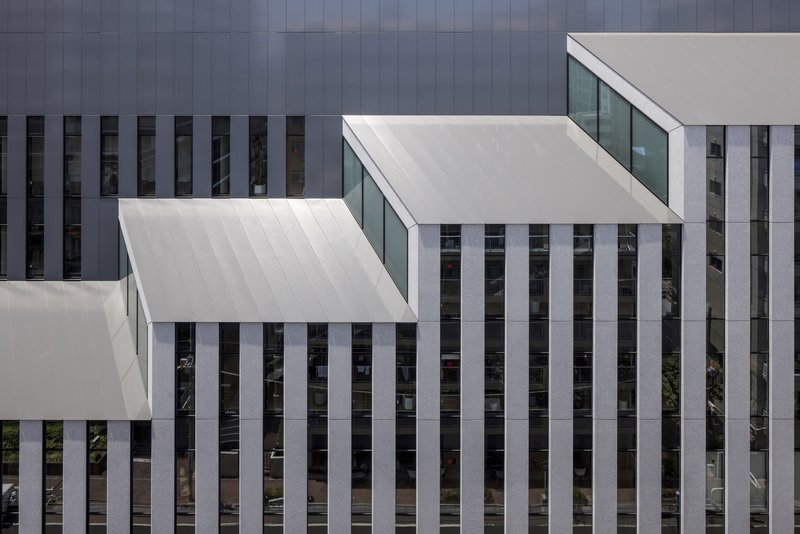
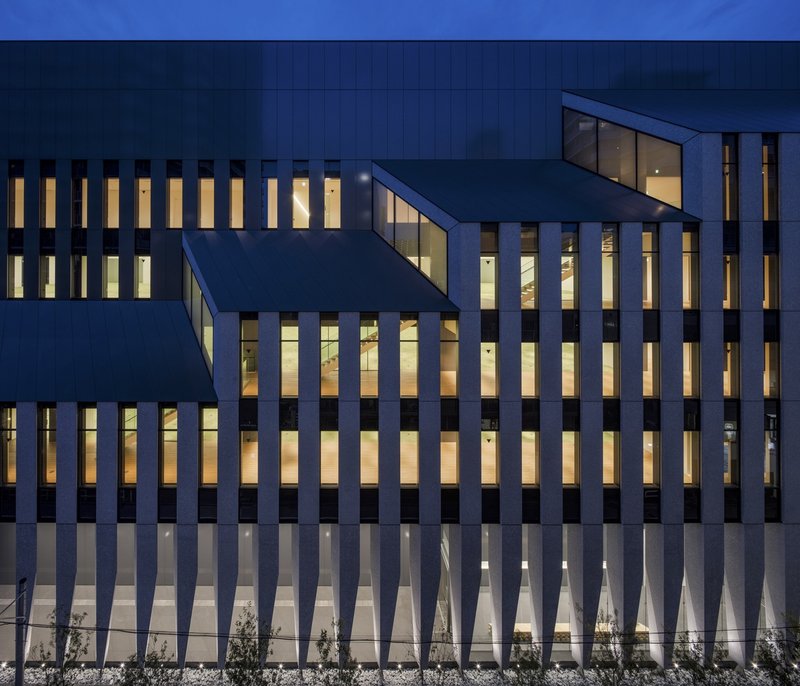
The western and northern facades present a taut, vertically striped skin of polished precast concrete slabs, extruded cement panels, and aluminum cut panels. Material transitions are synchronized with structural joints, so every seam has a reason. Three angular canopies punch outward from the facade, marking the atrium volumes behind without revealing them. At blue hour the vertical fins glow against the dark panels, turning the building into a lantern scaled to the highway corridor.
The restraint is deliberate. Ishida builds instruments of measurement; the architecture mirrors that ethos. No ornament, no gratuitous curve. Every surface is either structure, envelope, or environmental device. The polished finish of the precast panels catches and redirects ambient light, giving the facade a subtle depth that rewards a second look without demanding one.
The Colonnade as Urban Threshold
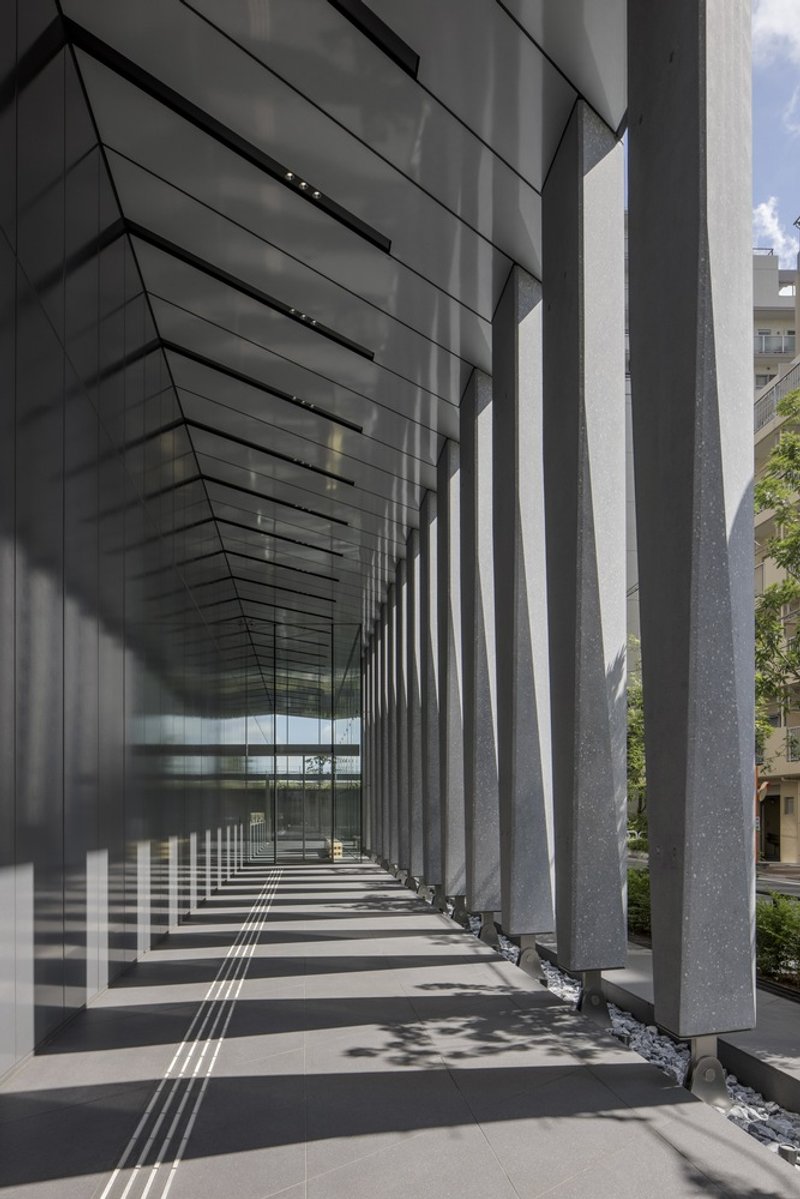
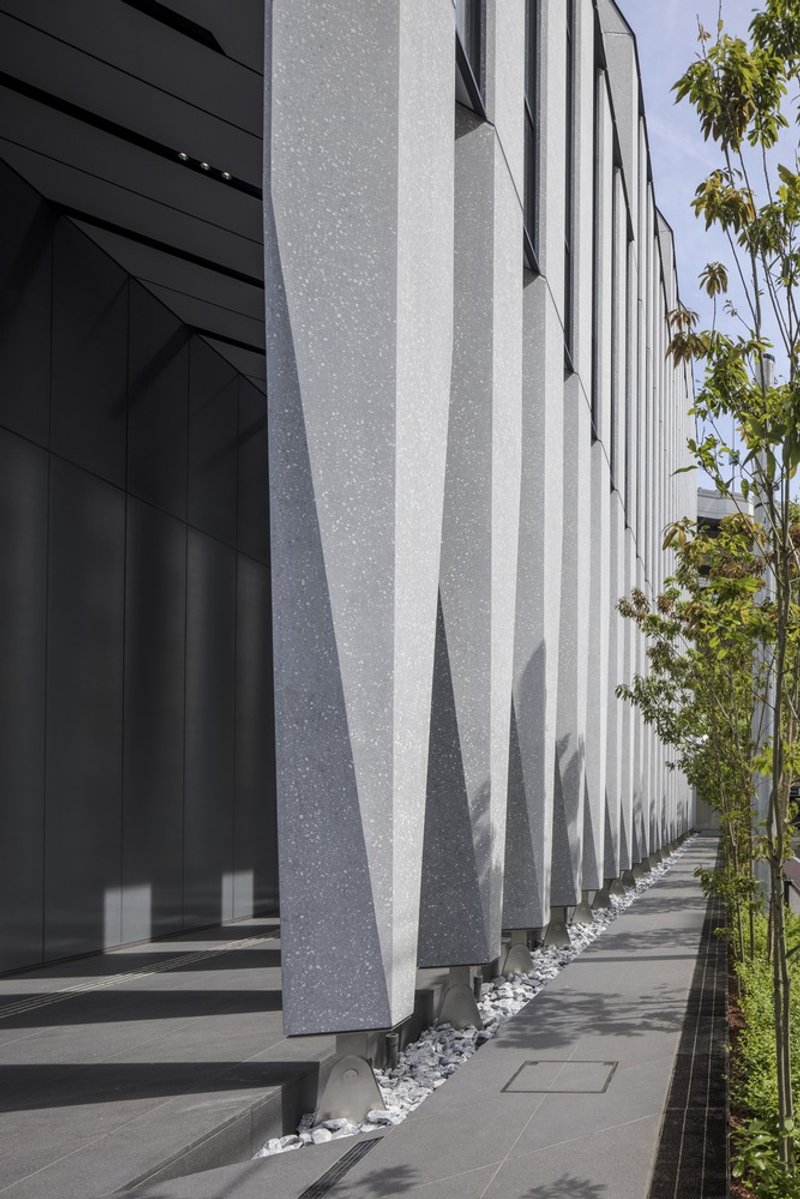
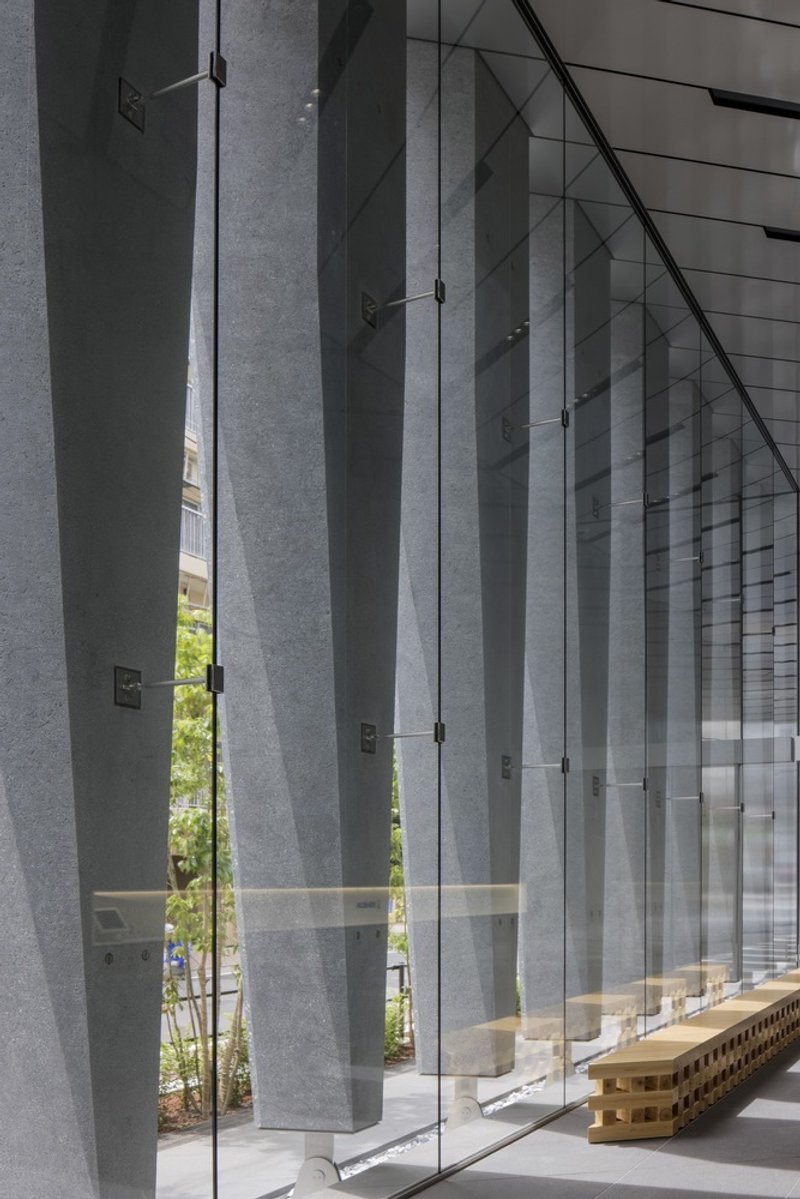
The eastern edge faces the pedestrian street connecting Shin-Itabashi Station to JR Itabashi Station, and Nikken Sekkei designed it as a community promenade rather than a property line. Solid polished prestressed concrete columns form a colonnade that creates a porous, semi-public threshold. Bamboo plantings soften the base, and the covered walkway invites pedestrians to walk alongside, not past, the building.
We appreciate how the columns, tapered and precisely finished, hold the facade above the street without heaviness. The glass curtain wall between them offers glimpses of greenery and lobby activity, blurring the boundary between corporate interior and civic sidewalk. It is a small gesture with an outsized effect on how the neighborhood experiences the building.
The White Zone: Structure as Atmosphere
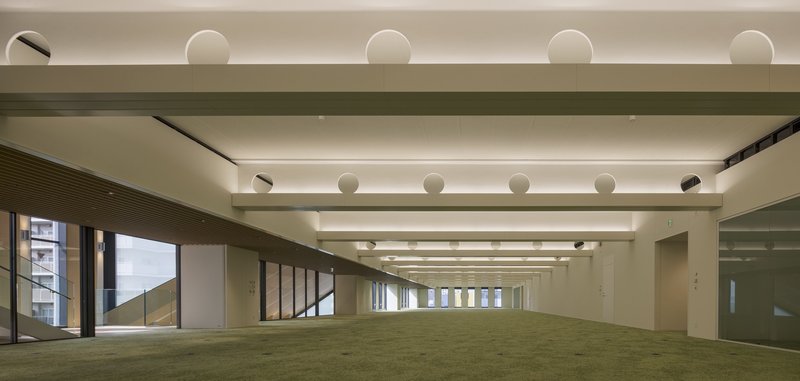
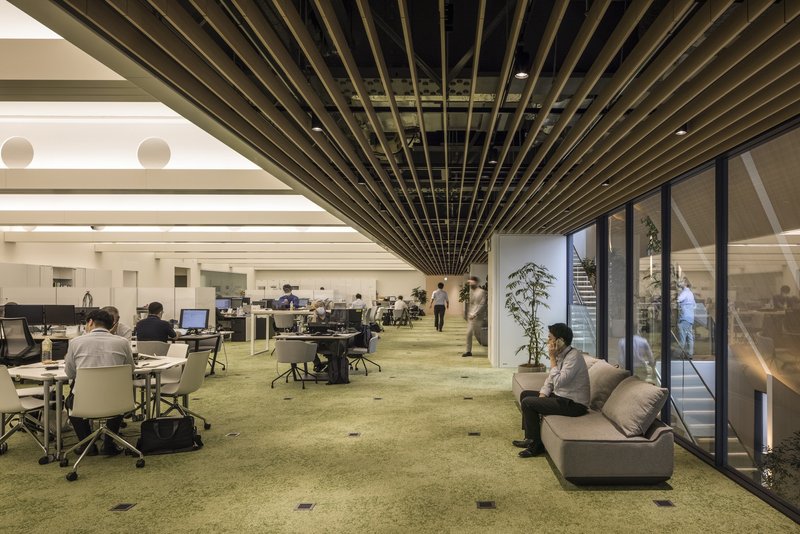
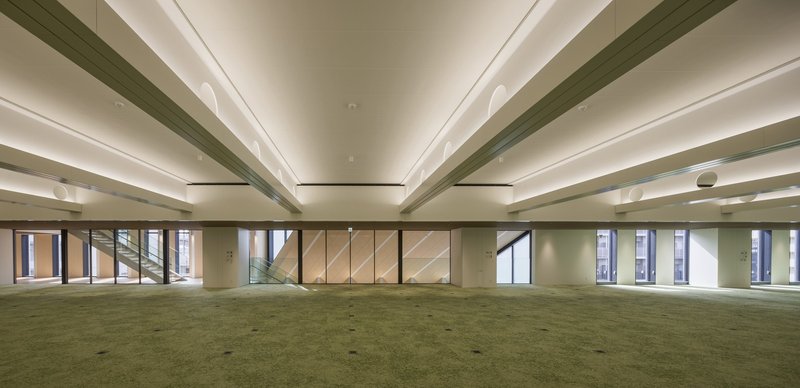
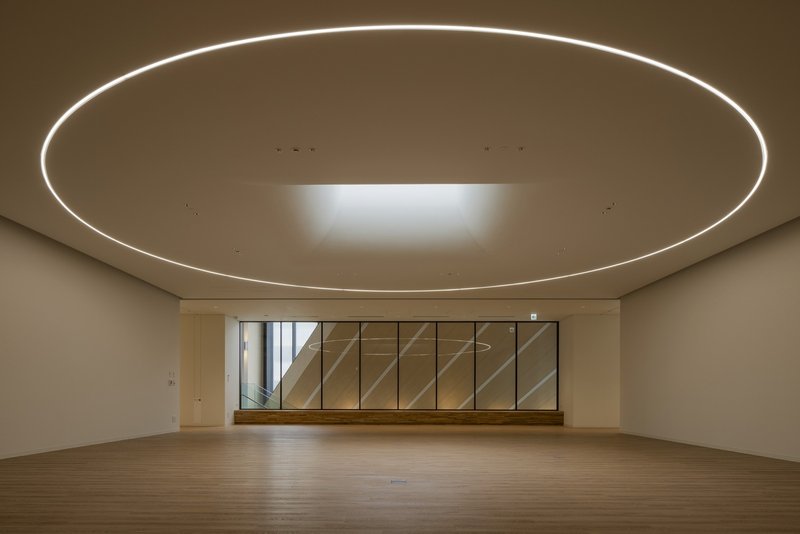
In the white zone, steel beams at a 3,600-millimeter pitch are left fully exposed against a white deck ceiling, painted with fireproof coating and lit exclusively by indirect beam fixtures. The four-meter floor-to-ceiling height gives the workspace a loft-like openness uncommon in Japanese office buildings. Circular skylights punch through the ceiling plane, introducing daylight in controlled doses that supplement the artificial illumination.
The one-way ductless air conditioning system here is worth noting. Conditioned air is delivered along the ceiling surface using the Coanda effect and extracted through floor suction, eliminating the visual and acoustic clutter of ductwork. At every 10.8-meter span, the system can toggle between radiant and convection modes, responding to occupancy density and solar gain without rearranging furniture or controls. Green carpet anchors the palette, a warm counterpoint to all the white overhead.
The Wood Zone: Warmth at a Lower Register
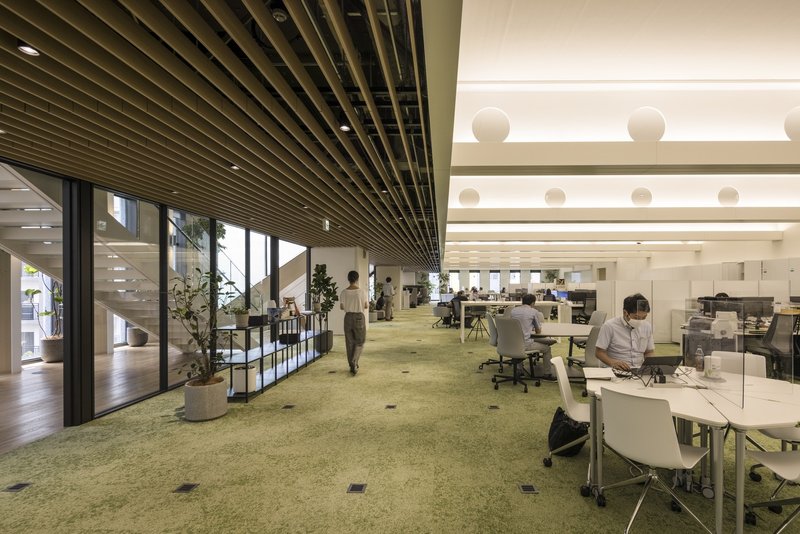
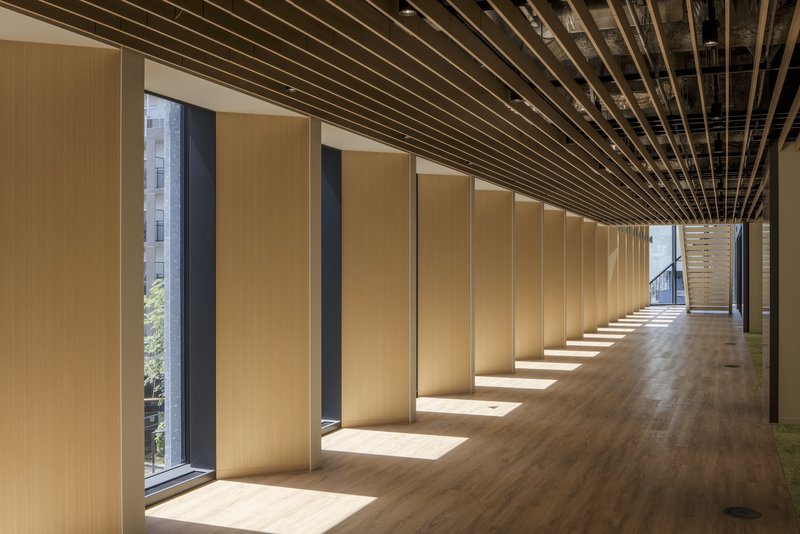
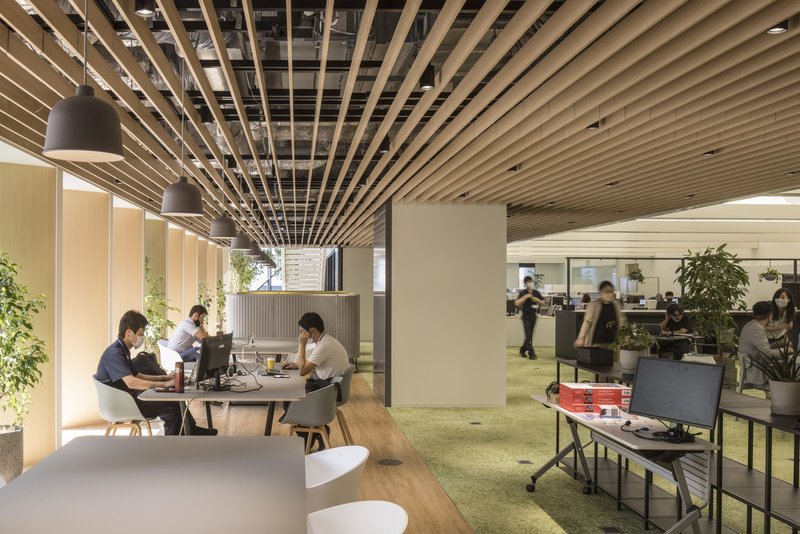
Drop a floor or cross a corridor and the atmosphere shifts entirely. The wood zone brings the ceiling down, lines it with timber slat baffles, and introduces pendant lighting, potted plants, and communal tables. Where the white zone rewards heads-down concentration, this zone is tuned for conversation, casual meetings, and the kind of low-friction socializing that remote work cannot replicate.
Corridors in this zone use vertical timber slats that cast rhythmic shadows across the floor, making even the transition between rooms feel deliberate. Conference rooms with sliding wood panels and recessed rectangular ceiling lights offer acoustic privacy without severing the visual connection to the open workspace. The material palette is warm but not domestic; it reads as professional hospitality.
Vertical Circulation as Ventilation Engine
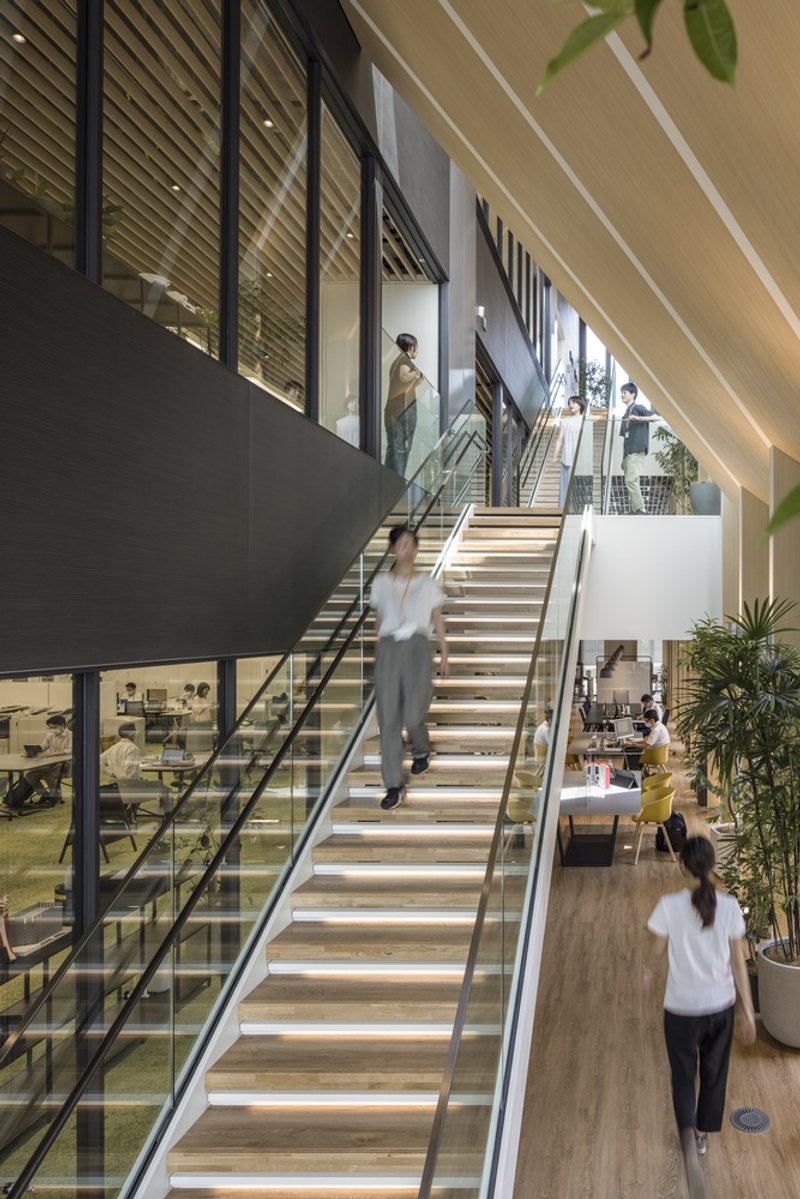
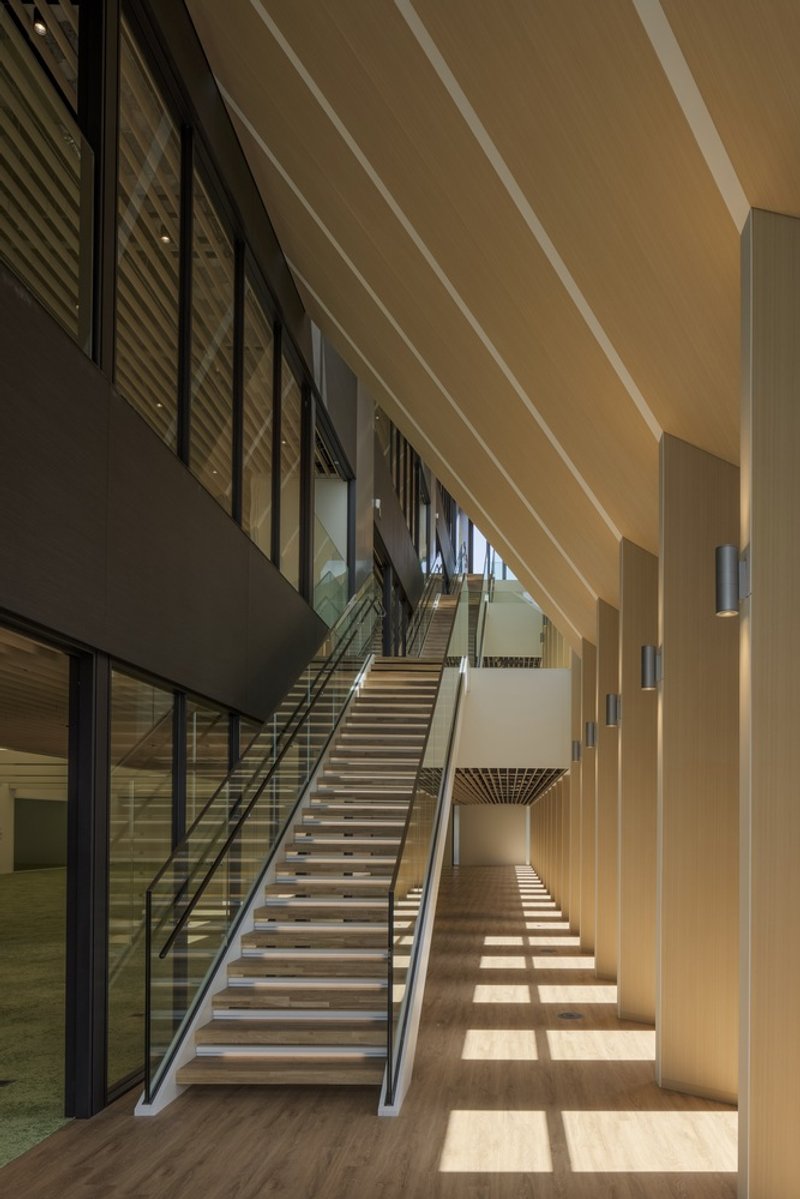
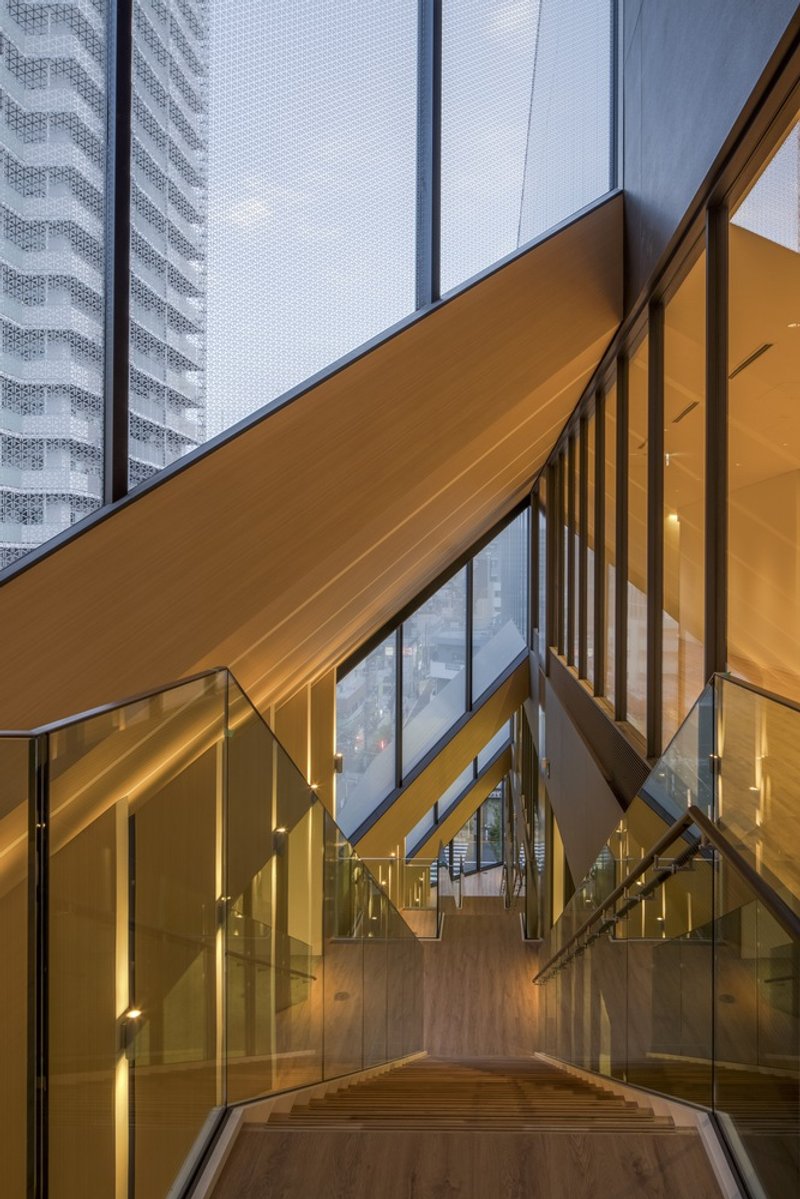
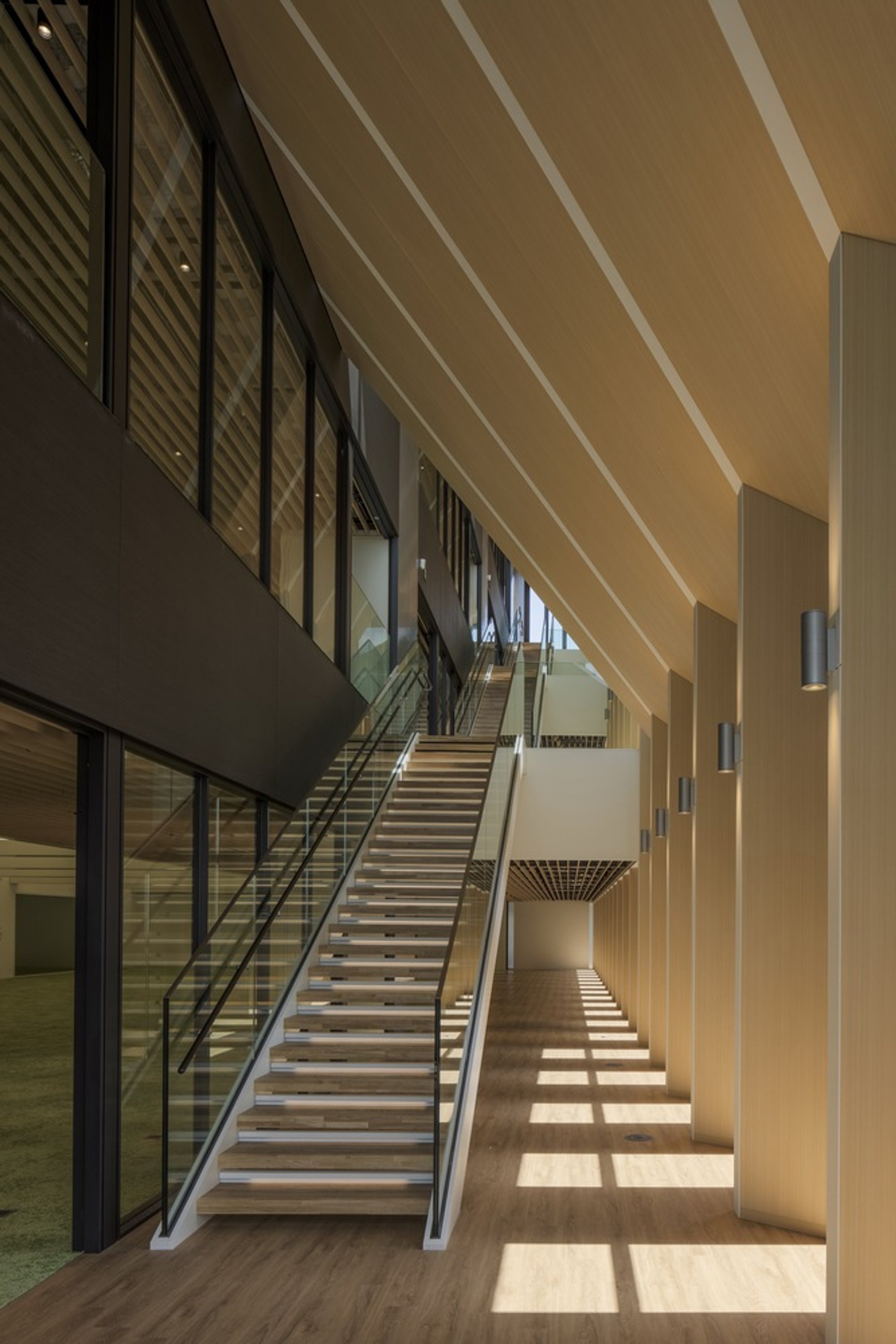
The diagonal atriums are the building's signature move, and the staircases threading through them are its most photogenic element. Open timber treads, glass balustrades, and timber battens filter afternoon sunlight as it descends through the stepped vaults. The experience of climbing between floors is not perfunctory; it is designed to feel like arriving somewhere rather than merely ascending.
But the real work is invisible. Each vaulted atrium space acts as a gravity ventilation chimney. Warm interior air rises through the stairwell volumes and exits at the rooftop, drawing fresh outside air in at lower levels. Natural top lights at the apex of each vault reinforce the stack effect while delivering daylight deep into the plan. The stairs are not merely circulation; they are the building's respiratory system.
Lobby and Transition Spaces
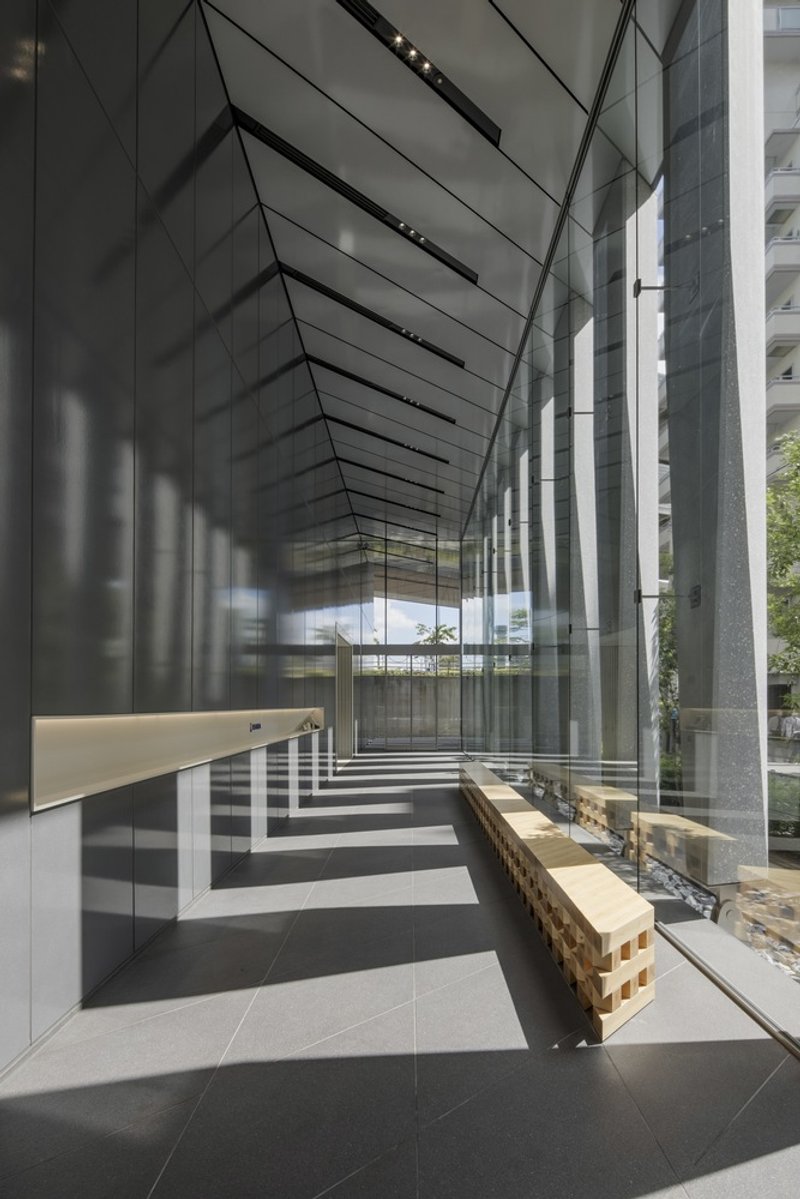
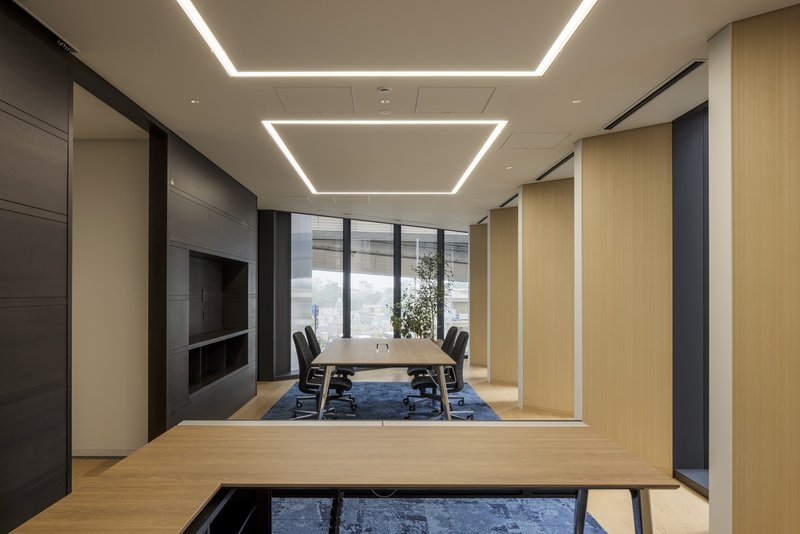
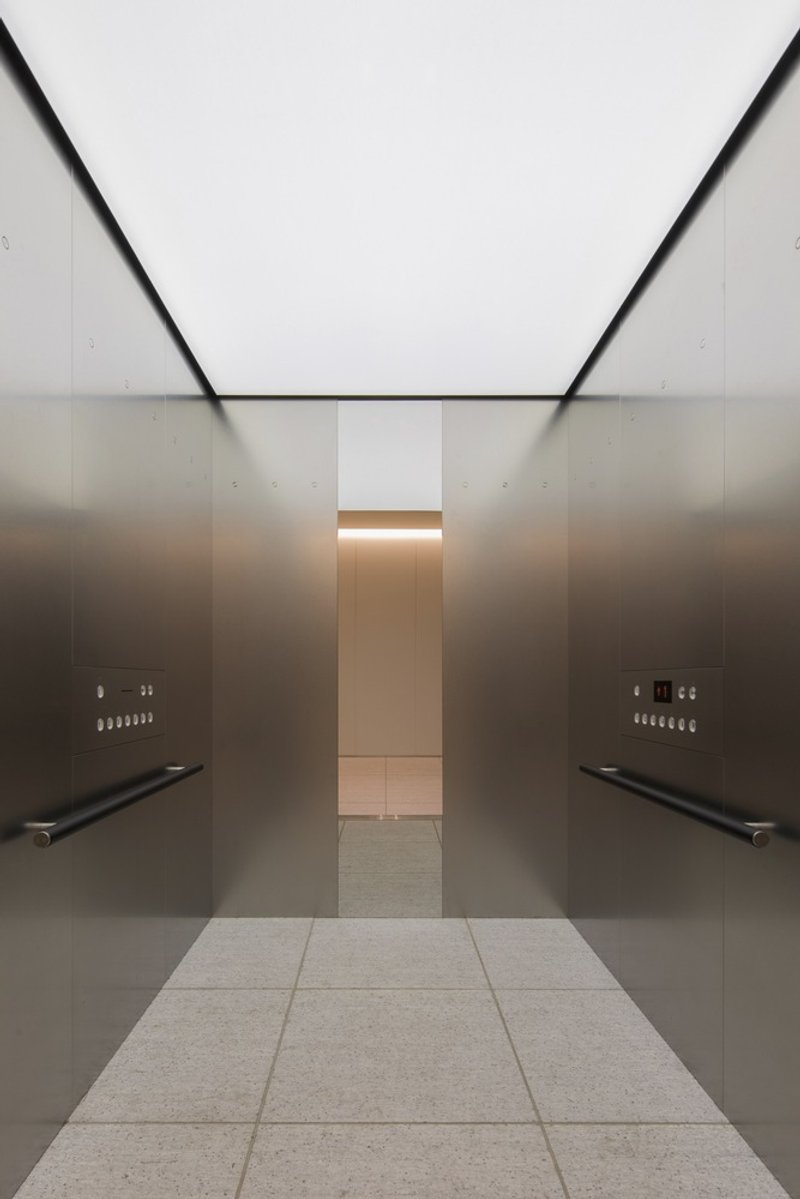
The ground-floor entry lobby bridges the colonnade and the office floors above with glass walls, timber benches, and diagonal ceiling beams that announce the structural rhythm visitors will encounter throughout. It is spare, letting the column grid and the incoming daylight do the decorative work.
Upper-level corridors like the gradient metal-paneled passage and the room overlooking the atrium stair show Nikken Sekkei's attention to moments between primary spaces. A symmetrical corridor with recessed lighting becomes a frame for the view at its end. A room with a circular recessed ceiling light and gridded glass partition becomes a small gallery of the building's own spatial drama. These are spaces you pass through in seconds, but their quality sets the tone for everything else.
Street-Level Presence
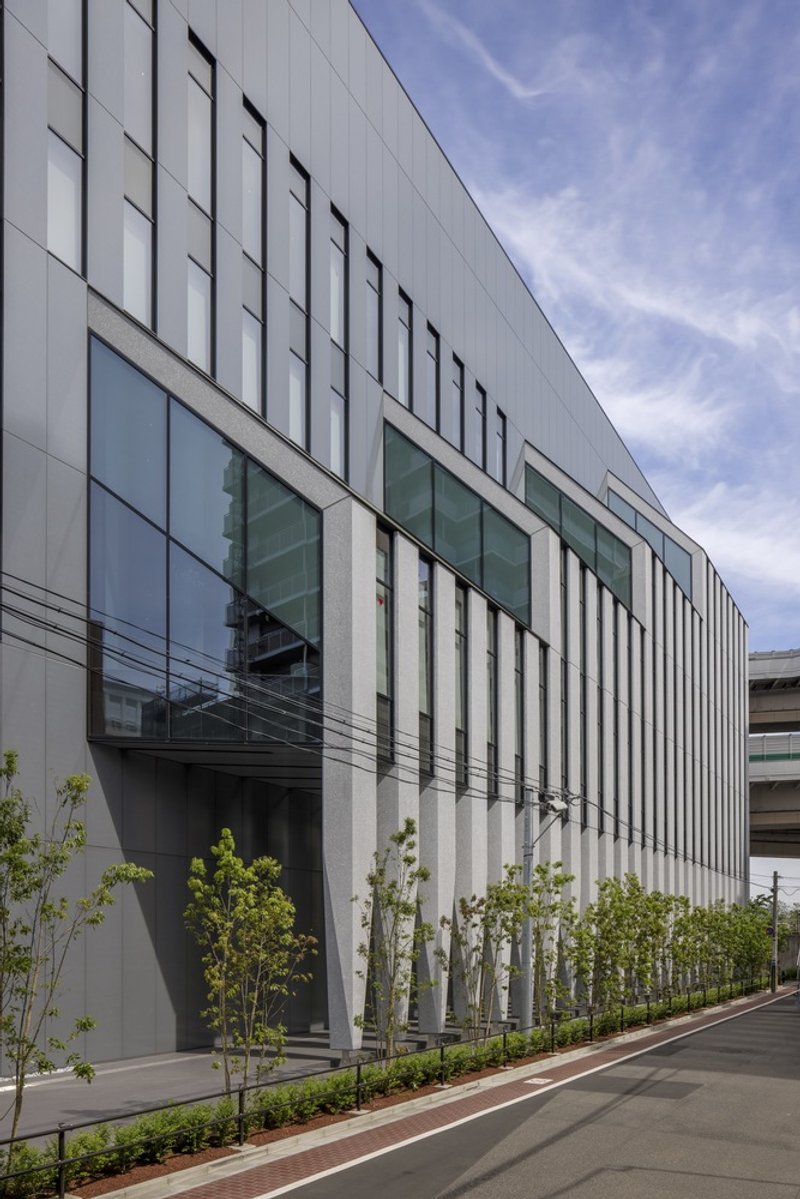
From the public sidewalk, young trees soften the vertically paneled metal facade, and the building recedes enough to feel civic rather than corporate. The eastern promenade, improved at Nikken Sekkei's initiative, turns what could have been a blank service edge into a genuine piece of neighborhood infrastructure. This is the kind of detail that does not win awards but wins neighbors.
Plans and Drawings
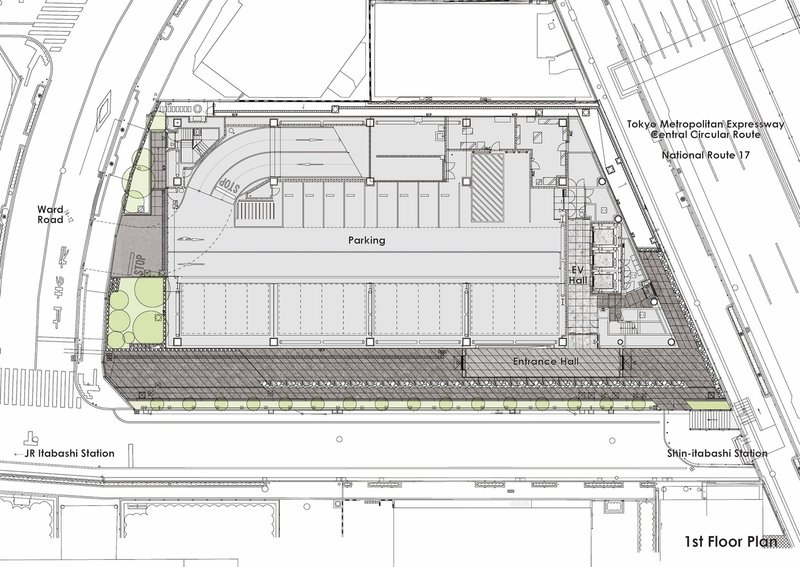
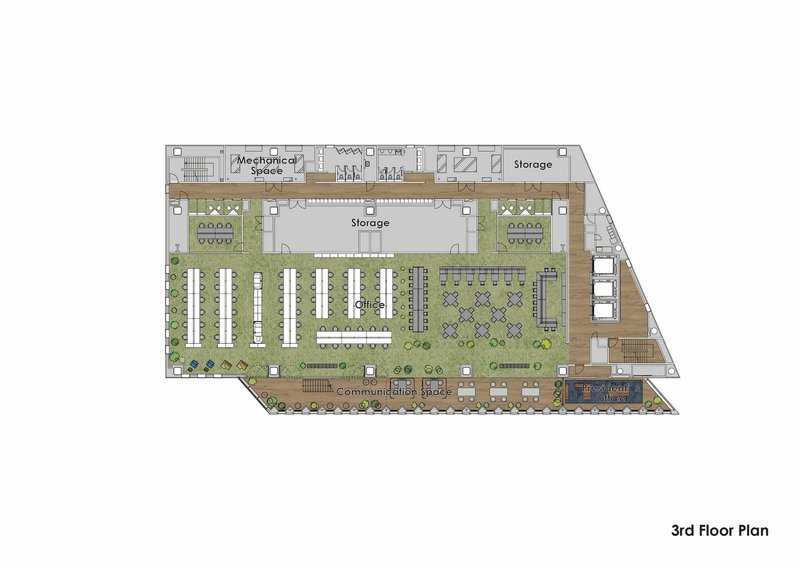
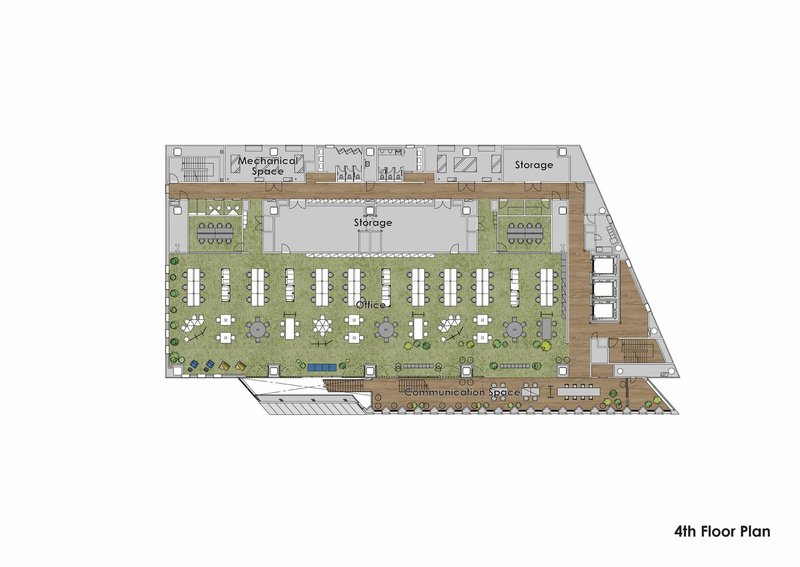
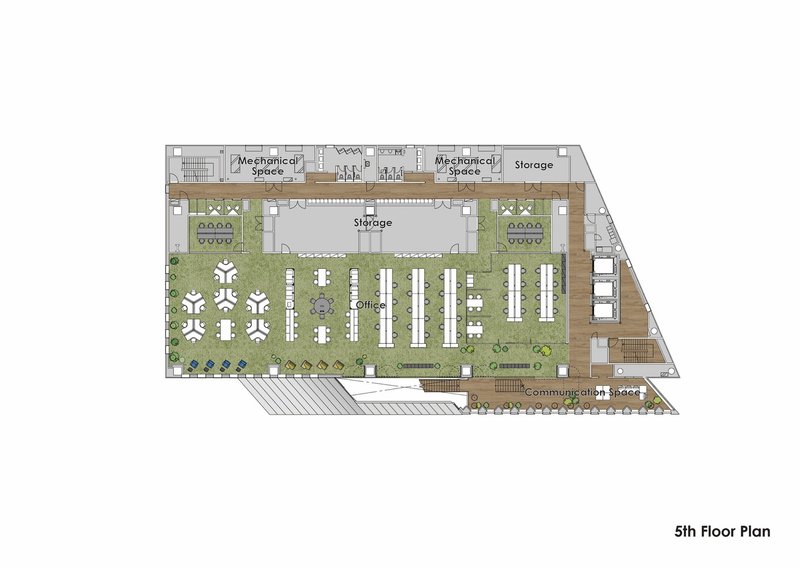
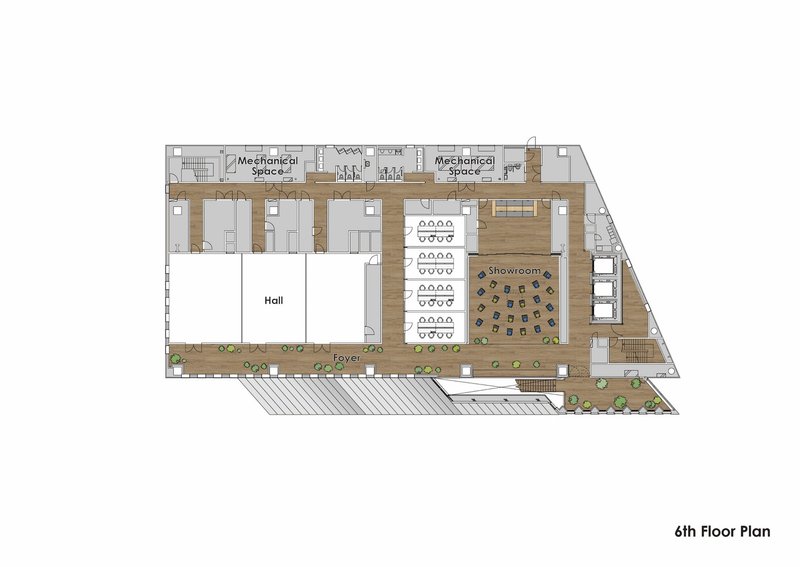
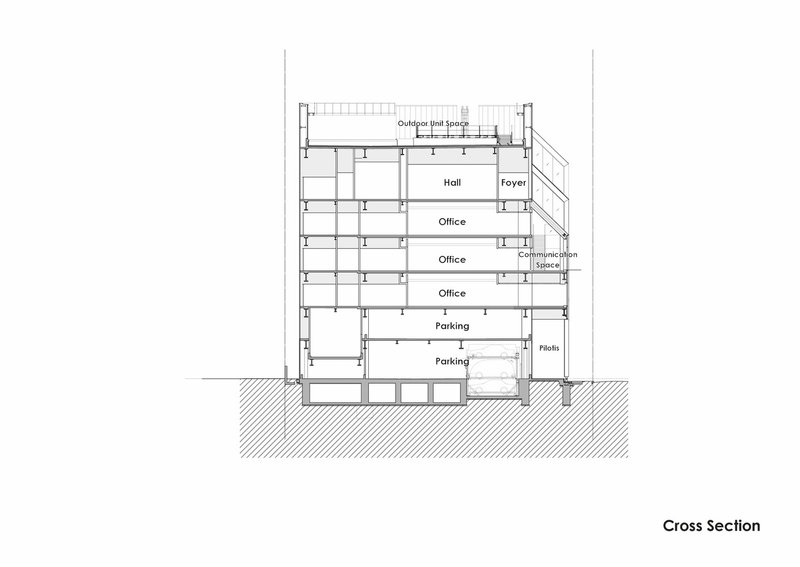
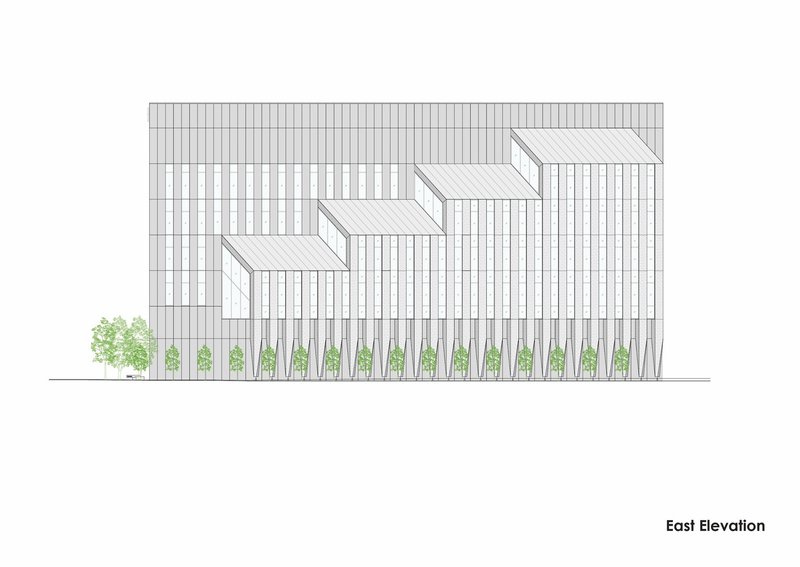
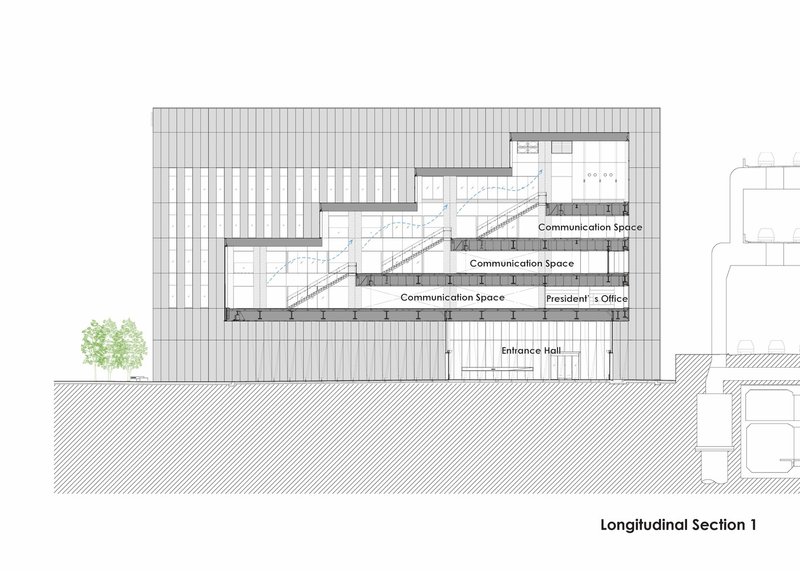
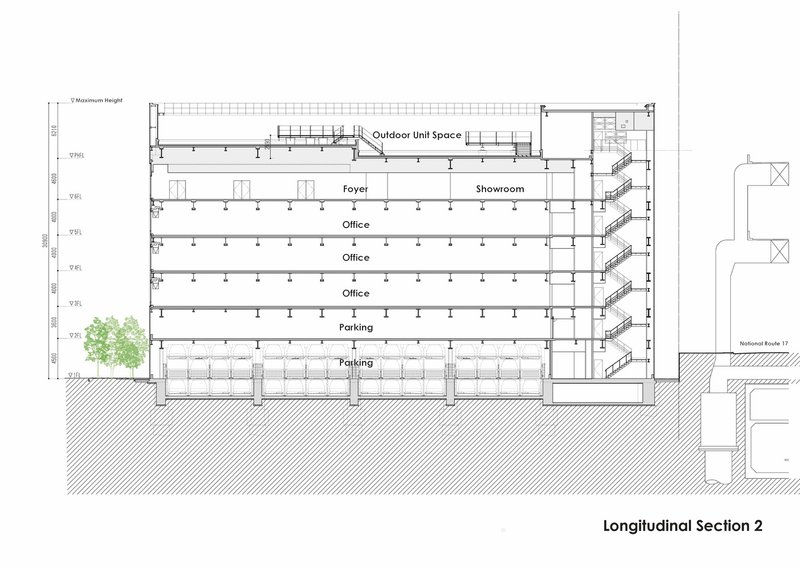
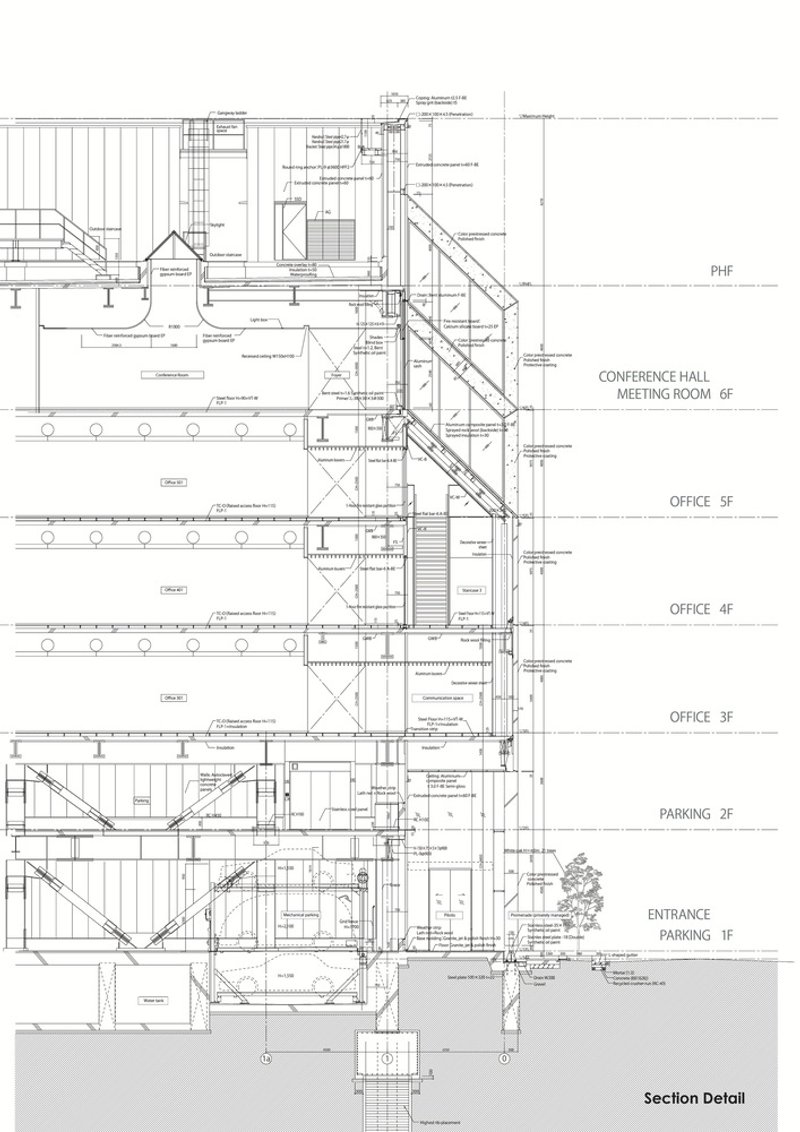
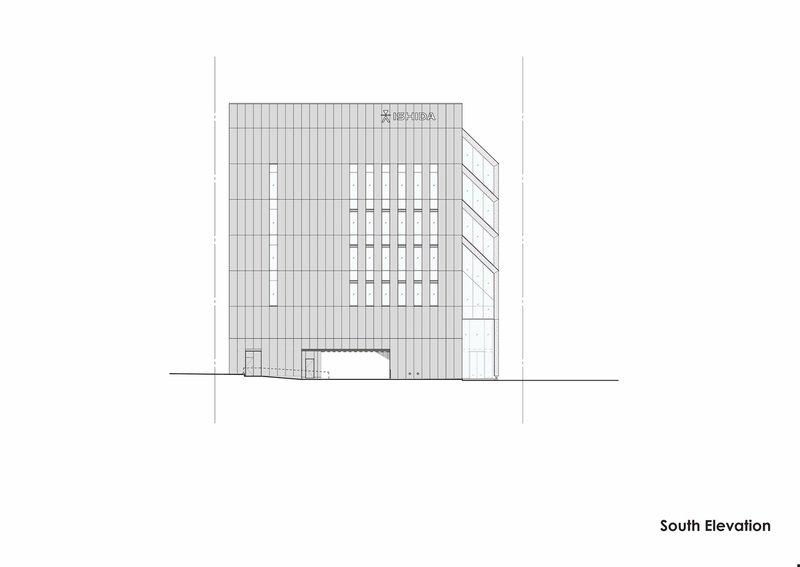
The floor plans reveal a compact footprint densely organized around a central service core. Parking occupies the lower levels, office floors stack above, and planted zones appear consistently on the third through fifth floors, reinforcing biophilic intent. The cross section is the most telling drawing: it shows the diagonal atrium slicing through the building from the third floor to the roof, with the stepped canopy volumes clearly legible as both formal expression and environmental infrastructure.
The longitudinal sections confirm that the stair connecting communication spaces runs at a consistent diagonal through the striped facade, while the detailed technical section annotates the structural framing across every level from parking to conference hall. What reads in photographs as a simple stepped volume is, in section, a tightly choreographed stack of environmental systems, structural logic, and programmatic variety.
Why This Project Matters
Most ZEB-certified office buildings earn their credentials through mechanical upgrades and envelope insulation. The ISHIDA TOKYO Regional Headquarters earns its performance through architectural decisions: the stepped roof that enables gravity ventilation, the atrium vaults that function as chimneys, the ductless Coanda-effect air conditioning that eliminates visible infrastructure. Nikken Sekkei demonstrates that sustainability and spatial quality are not competing priorities but the same design problem, solved once.
The dual-zone workplace concept is equally significant. Rather than imposing a single open-plan ideology, the building offers two atmospheres calibrated to different tasks and temperaments. Employees do not adapt to the building; the building adapts to them. In a post-pandemic office landscape where every company is asking why people should come to work at all, that proposition is a real answer: because the building offers something your apartment cannot.
ISHIDA TOKYO Regional Headquarters by Nikken Sekkei. Itabashi-ku, Tokyo, Japan. 9,282 m². Completed 2021. Photography by Ken'ichi Suzuki.
About the Studio
Share Your Own Work on uni.xyz
If projects like this are the kind of work you want to make, uni.xyz is a place to publish your own, find collaborators, and enter design competitions.




Popular Articles
Popular articles from the community

Kerry Kounnapis Packs 800 Daily Coffees into a 43-Square-Metre Melbourne Laneway Bar
Palace Coffee channels Pellegrini's and European standing bars through oxide-red steel and spotted gum timber in a Ridgway Place sliver.

Milan Crossover: Sustainable Architecture for a New Fashion Culture in Milan
Milan Crossover transforms fashion culture through sustainable architecture, linking material libraries, remake studios, and public runways.
PLATAFORMArq Folds a Concrete Roof Over the Portuguese Mountains in House #474
A 220-square-meter residence in Teixoso, Portugal, wraps board-formed concrete into an angular canopy that frames the Serra da Estrela foothills.
Inside a Timeless Mumbai Residence by Aether Studio
Aether Studio's 2,250 sq ft apartment in Malad, Mumbai uses marble, brass, boucle, and disciplined restraint to build a quiet retreat from the city.

Similar Reads
You might also enjoy these articles


Bamboo Housing Challenge 2026: Design Affordable, Sustainable Homes Using Bamboo
An international design competition by Bamboo U and IBUKU inviting architects and designers to reimagine affordable housing using bamboo — with the winning design built full-scale in Bali.

Computational Design & Education: Beegraphy Design Awards Introduces 7th Category (Featuring Jiyun's Innovative Approach)
Dive into Beegraphy’s 7th Design Awards category, where computational design meets education to create immersive, interactive learning tools, inspired by Jiyun’s work.

From Parametric Lighting to Urban Furniture: Join the 2nd Workshop in Beegraphy’s Computational Design Series
Dive into Cutting-Edge Design Techniques and Practical Applications with Industry Experts

Introducing Sphere by UNI: Pioneering a New Era in AEC Industry
Unlocking Global Potential with BIM and Agile Management


Explore Architecture Competitions
Discover active competitions in this discipline




The International Standard for Design Portfolios


The Global Benchmark for Architecture Dissertation Awards


The Global Benchmark for Graduation Excellence


Challenge to reimagine the Iron Throne
Comments (0)
Please login or sign up to add comments
No comments yet. Be the first to comment!