
It’s My Scene: Modular Interior Architecture for Adaptive Urban Living
A flexible modular interior architecture system redefining how young residents personalize and adapt compact living spaces in aging urban communities.


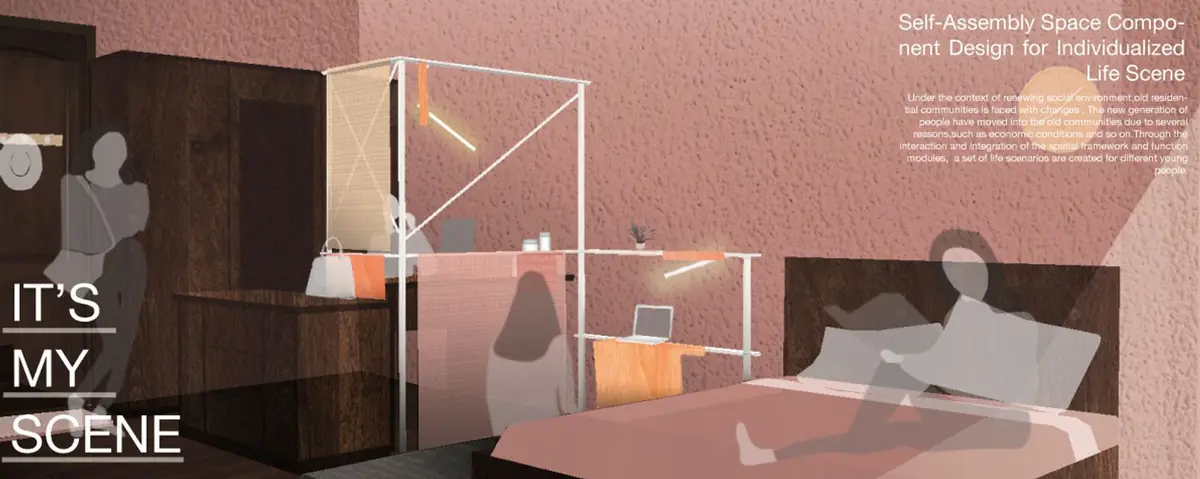
As cities evolve, so do the ways people inhabit them. Across many metropolitan regions, aging residential communities are experiencing a quiet transformation. Young adults: drawn by affordability, location, and cultural familiarity, are moving into older housing stock that was never designed for contemporary lifestyles. It’s My Scene responds to this shift through modular interior architecture, proposing a flexible spatial framework that allows residents to customize their living environments based on personal routines, identities, and daily needs.
Rather than treating small apartments as static containers, the project reimagines the interior as an adaptive system: one that can shift between work, rest, socializing, and leisure without requiring structural renovation. Through the integration of a lightweight spatial frame and interchangeable functional modules, It’s My Scene enables residents to design their own “life scenes” within limited floor areas.
Urban Context: Young Living in Old Communities
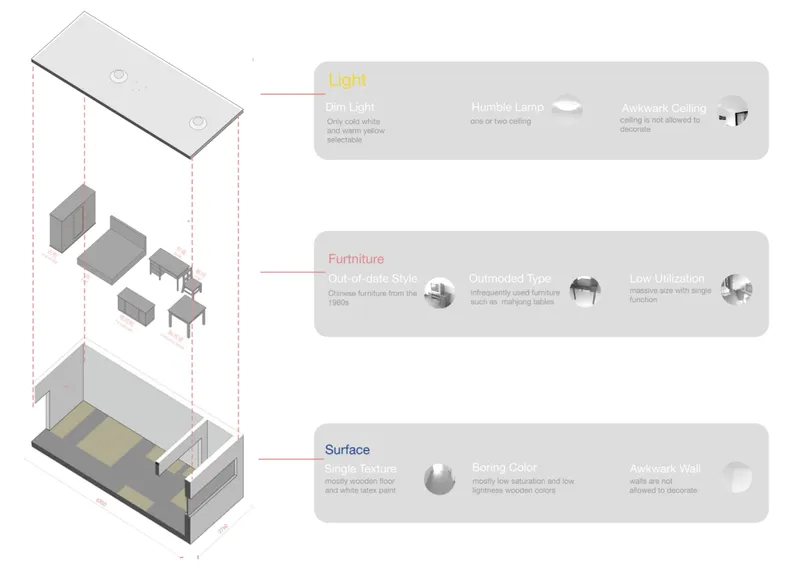
In many older neighborhoods, residential layouts reflect outdated assumptions about domestic life. These spaces often suffer from low utilization, rigid furniture arrangements, and limited opportunities for personalization. For young renters, particularly those aged 22 to 24, this creates a disconnect between lifestyle aspirations and spatial reality.
User research conducted as part of It’s My Scene highlights several recurring challenges:
- A lack of furniture that supports multiple daily activities
- Poor spatial organization in compact one-room apartments
- Outdated furniture typologies with single-use functions
- Minimal ability to personalize space without permanent alterations
The project identifies a clear gap between market offerings and real user needs, setting the stage for a modular interior architecture system that prioritizes adaptability over fixed form.
Framework-Based Interior Architecture
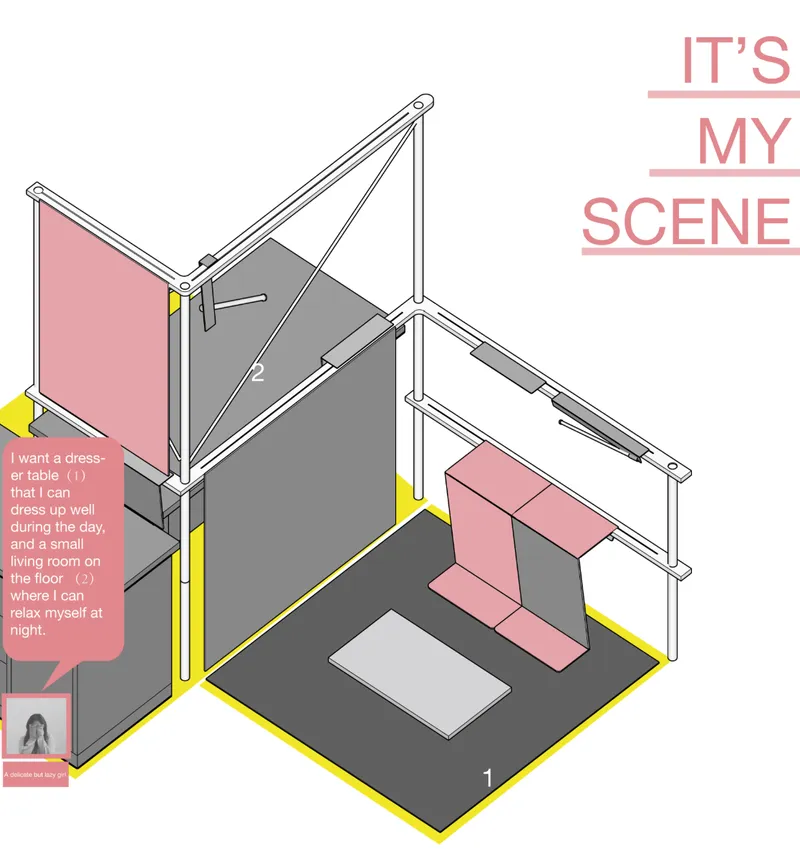
At the core of It’s My Scene is a spatial framework that operates as an architectural scaffold within the interior. This framework is not furniture in the conventional sense, nor is it permanent construction. Instead, it functions as an intermediary architectural layer: capable of supporting surfaces, partitions, lighting elements, and storage modules.
The framework is designed around three usable height zones:
- Floor Height – supporting activities such as seating, lounging, yoga, or sleeping
- Furniture Height – accommodating desks, tables, storage, and working surfaces
- Floating Height – enabling lighting, hanging partitions, and spatial definition without blocking movement
This vertical stratification allows functions to overlap spatially, increasing usability without increasing floor area.
Modular Components and Functional Flexibility
The modular interior architecture system is composed of a series of standardized components that can be rearranged or replaced based on user preference. These include:
- Folding boards that transform between desks, dressing tables, or partitions
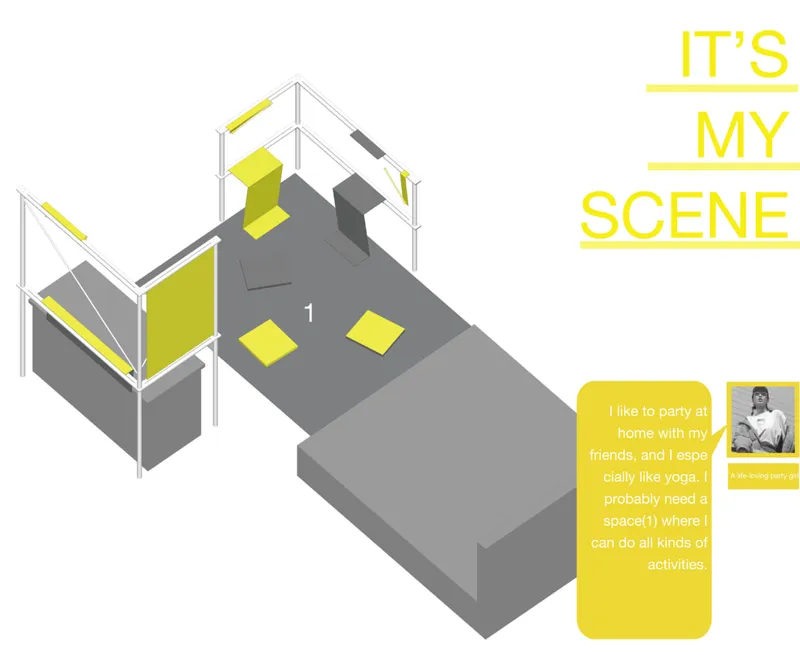
- Floor boards that define activity zones without permanent boundaries
- Integrated lighting components that adapt to different scenes
- Fabric partitions that create privacy while maintaining openness
By combining these elements within the structural framework, users can shift their space from a daytime work environment to an evening entertainment or relaxation scene with minimal effort.
Personalized Life Scenarios
One of the defining features of It’s My Scene is its emphasis on personal scenarios rather than universal layouts. The system supports diverse lifestyles, including:
- The remote worker who needs a large desk and focused environment
- The social resident who prioritizes open floor space for gatherings
- The minimalist user who values flexibility and visual clarity
- The wellness-oriented resident who needs space for movement and exercise
Each configuration is not a final design, but a starting point, encouraging users to continuously adapt their interiors as routines and priorities change.
Material Strategy and Structural Design
The framework and components are primarily constructed from wood-based materials, reinforced with metal fasteners to ensure structural stability. This hybrid approach balances warmth and tactility with durability and precision.
Key structural details include:
- Crosspiece connections that strengthen horizontal and vertical joints
- Slotted connections allowing components to be inserted or removed easily
- Adjustable rods with sleeves that accommodate different height requirements
This construction logic supports both ease of assembly and long-term adaptability, aligning with the project’s emphasis on sustainable interior architecture.
Service Design and User Interaction
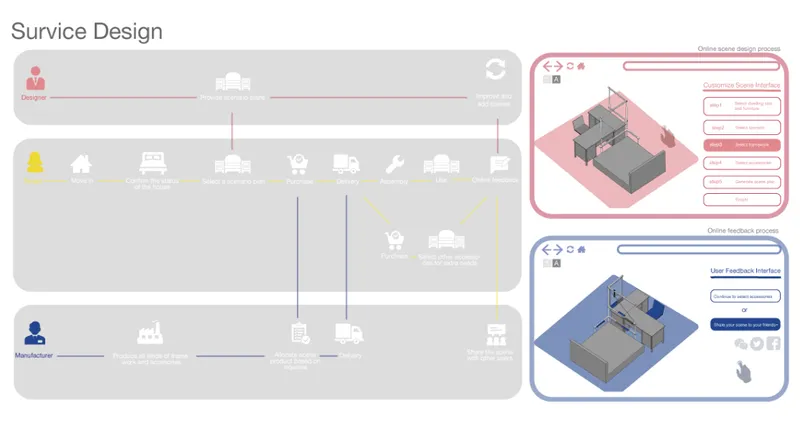
Beyond physical components, It’s My Scene proposes a service-driven model that supports customization. Users engage with the system through a digital interface that allows them to:
- Select spatial frameworks based on room dimensions
- Choose functional modules according to lifestyle needs
- Generate personalized scene layouts
- Provide feedback and share configurations with others
This service layer reinforces the idea that interior architecture is not a one-time decision, but an evolving process shaped by daily life.
Rethinking Small-Space Living
It’s My Scene challenges the notion that small apartments must compromise comfort or identity. By introducing modular interior architecture into existing residential contexts, the project demonstrates how adaptability, personalization, and spatial intelligence can transform underutilized interiors into meaningful living environments.
In an era where urban living is increasingly defined by flexibility, It’s My Scene offers a forward-looking model for how architecture can operate at the scale of everyday life: responsive, human-centered, and deeply personal.
Project by Jiachen Shao


Popular Articles
Popular articles from the community


Lunar Spiral: Space Architecture Shaped by the Mathematics of the Universe
Lunar Spiral reimagines space architecture through Fibonacci geometry, lunar regolith, levitating habitats, and self-sustaining Moon living.

Co-life: Sustainable Architecture for Age-Friendly Community Living
Co-life reimagines sustainable architecture for seniors through courtyards, rammed earth, shared gardens, and spaces designed for belonging.

Little Red Riding Hood: Architectural Design as a Journey Through Fear, Light, and Storytelling
Little Red Riding Hood reimagines the fairy tale through architectural design shaped by fear, light, scale, memory, uncertainty, and choice.

The Musturak Paradise: Senior Living Architecture for a Connected Future in Temara, Morocco
The Musturak Paradise reimagines senior living architecture in Temara via private homes, social spaces, culture, community, and shared care.

Similar Reads
You might also enjoy these articles

Eco Chapel: A Green Architecture Pavilion Designed in Symbiosis with the Forest
Eco Chapel uses green architecture to weave prayer, learning and reuse into a forest pavilion shaped by modular hexagonal canopies for life.
Kaffeebühnen: Coffee Shop Architecture Designed as a Civic Stage Between Vienna’s City and Park
Kaffeebühnen turns coffee shop architecture into a civic stage, linking Vienna’s park edge, urban life, warm timber yards, and coffee craft.
Healing Façade: Sustainable Architecture for Reforestation, Community, and Sacred Ecology in Ethiopia
Healing Façade reimagines sustainable architecture as a living wall that restores soil, catches water and renews Ethiopia's forest churches.


Urban Forest: A Vertical Ecosystem for 5,000 Workers in Singapore's Changi Business Park
Radially stacked pods and layered green decks turn a 7-acre plot into 47 acres of ecological workspace projected for 2040.

Explore Interior Design Competitions
Discover active competitions in this discipline

Challenge to design luxury tourism on rails

Challenge to reimagine the Iron Throne

Photograph architecture without architects

VR headsets Storefront design competition
Comments (0)
Please login or sign up to add comments
No comments yet. Be the first to comment!