

J. Mayer H. Architects Turns a 1900 Berlin Apartment into a Maximalist Color Laboratory
Inside a historic Berlin apartment building, MOM layers fluted timber, neon art, and saturated color into rooms that refuse to be neutral.


There is a certain class of Berlin apartment that carries enormous cultural weight: the Altbau, with its high ceilings, thick walls, and floor plans that feel almost civic in their generosity. These late nineteenth-century buildings were often individually planned, each unit distinct from the next, a fact that sets them apart from the serial housing blocks that came later. When J. Mayer H. Architects took on the renovation of one such apartment for the project they call MOM, the challenge was not just spatial but psychological. How do you intervene in a place whose proportions already command respect?
The answer, led by Jürgen Mayer, is to reject the reverent minimalism that typically governs Altbau renovations and instead treat every surface as a site of invention. MOM is dense with material: fluted timber in shifting tones, saturated cabinetry in canary yellow, neon wall sculptures, suspended coral forms, and upholstery in cobalt and rust. Nothing recedes. The effect is closer to a curated exhibition than a domestic interior, yet the underlying logic of the original rooms, their sequence, their proportions, their relationship to daylight, remains legible throughout.
Timber as Texture and Threshold
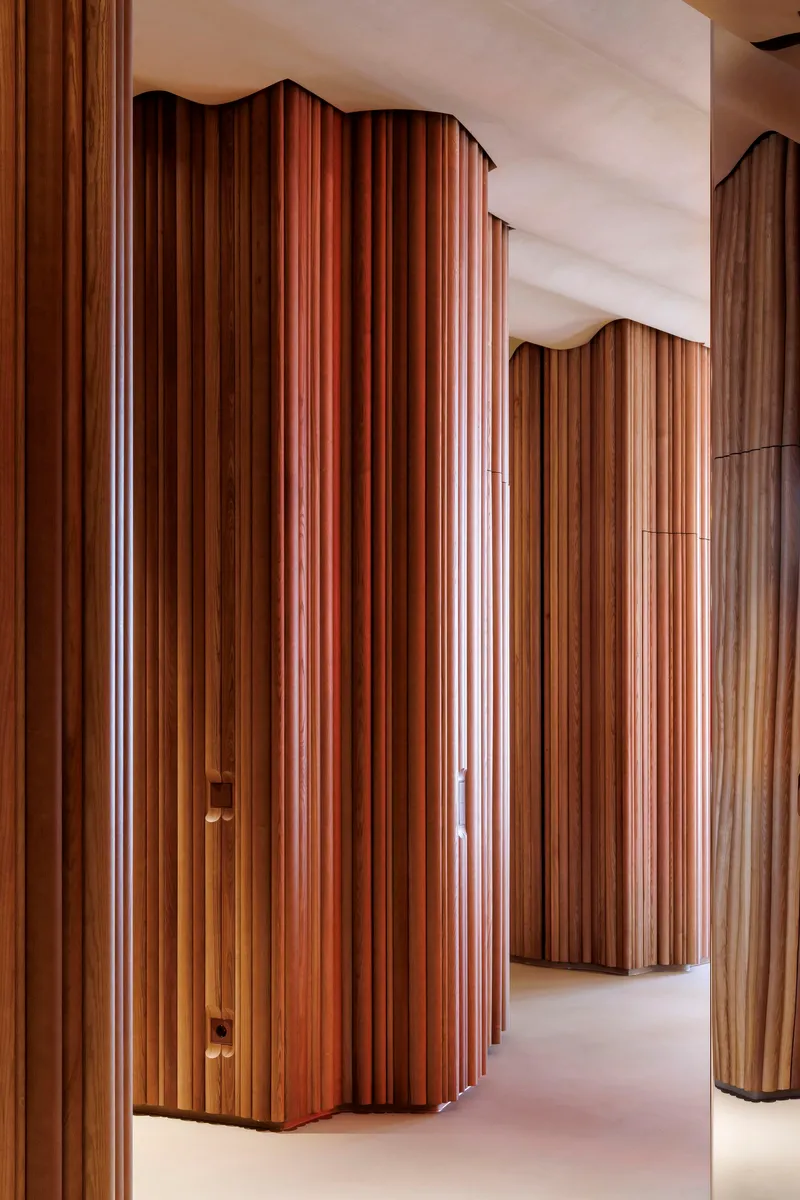

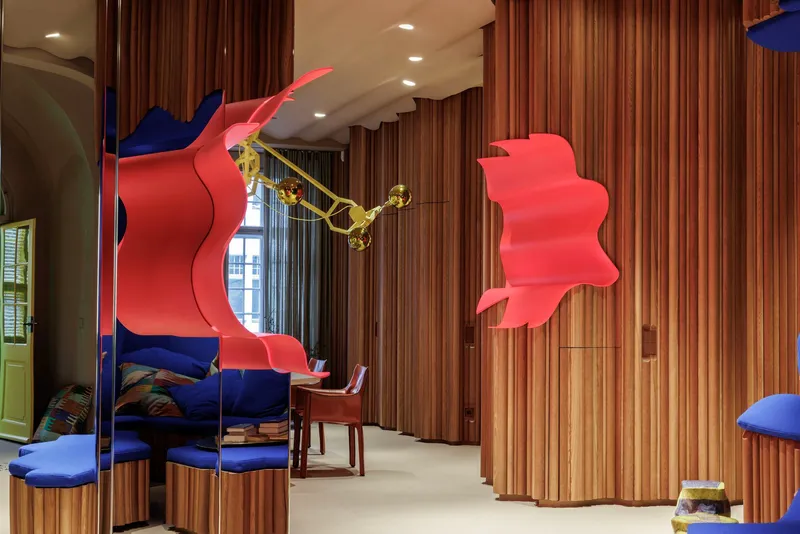
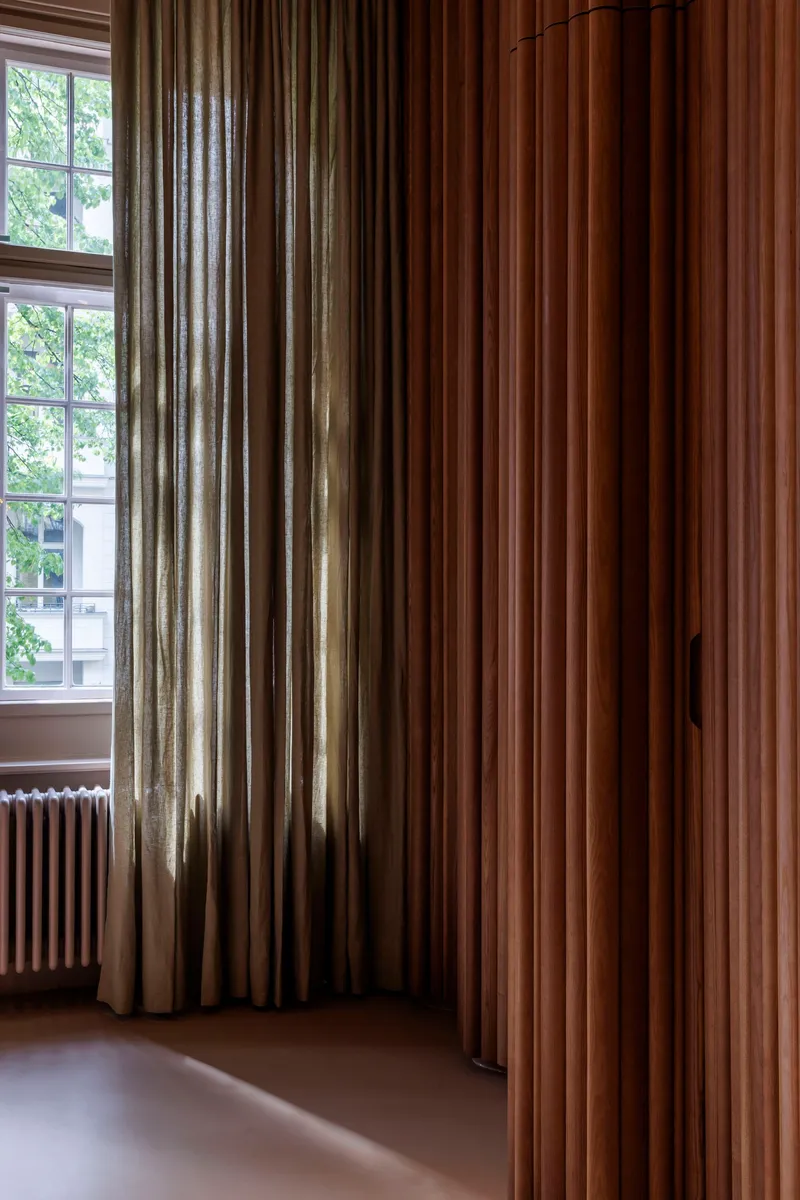
The most consistent material move in MOM is the use of vertically fluted timber paneling, which wraps walls, defines corridors, and creates curved partitions that replace the hard right angles you might expect. These panels shift in tone from pale ash to warm walnut, sometimes within the same wall, generating a rhythmic striation that pulls the eye along the enfilade of rooms. The effect is simultaneously tactile and optical: at a distance the panels read as soft folds; up close they become precise, repetitive ribs.
Critically, these timber surfaces are not decorative wallpaper. They serve as spatial dividers, carving out alcoves and thresholds that modulate the flow between rooms without closing them off. The corridor views show how a paneled door with a fanlight sits alongside a red ribbon sculpture, the old and the new occupying the same sightline without apparent tension.
Color as Architecture

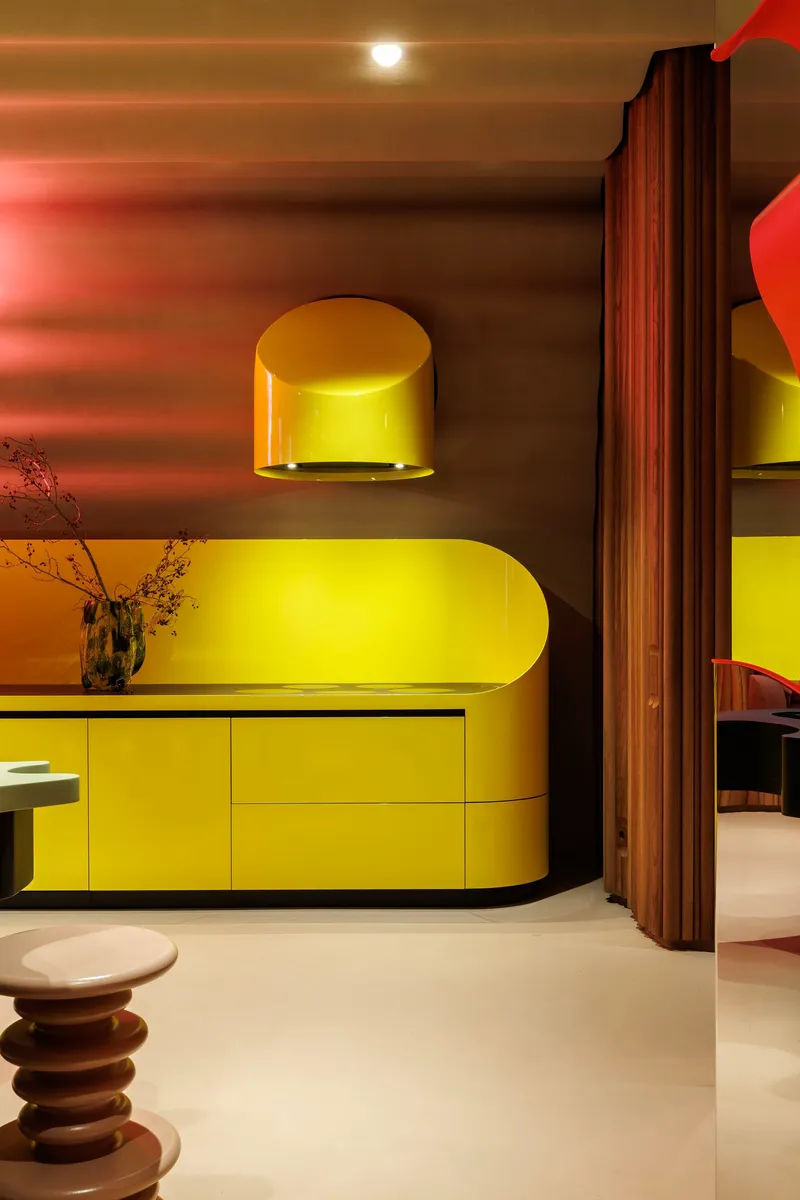

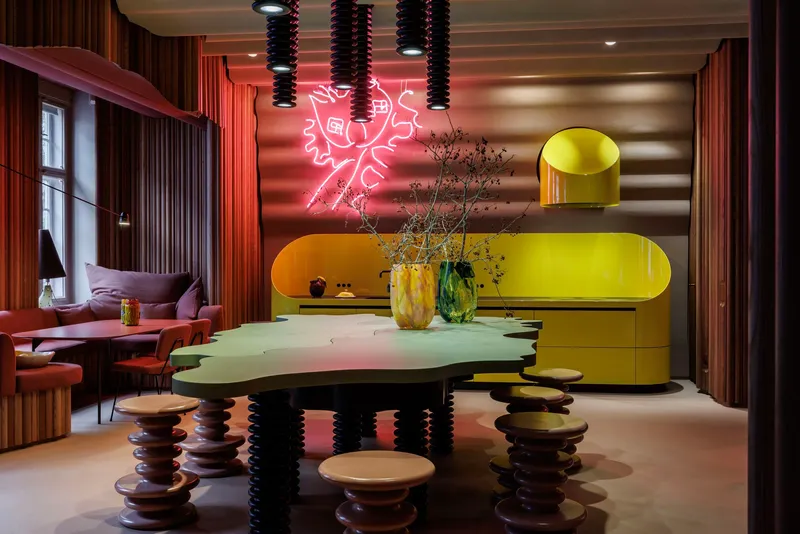
Yellow does a lot of work in this apartment. The kitchen cabinetry wraps in rounded, almost bulbous forms, its glossy finish reflecting the equally polished floor beneath. A golden dome light fixture hovers above like a small planetarium. Against a gradient wall that moves from pink to brown, the yellow reads as both playful and deliberate, a color choice that demands commitment rather than taste. In the sitting room, floor-to-ceiling curtains frame a neon artwork that casts overlapping green and yellow light across the space, turning the room into something closer to a light installation.
What keeps this from tipping into spectacle is the discipline underneath. Each color zone corresponds to a functional area, and the transitions between them, pink to yellow to green, follow the plan's circulation logic. Color here is not applied; it is zoned.
Sculptural Objects and Neon Interventions
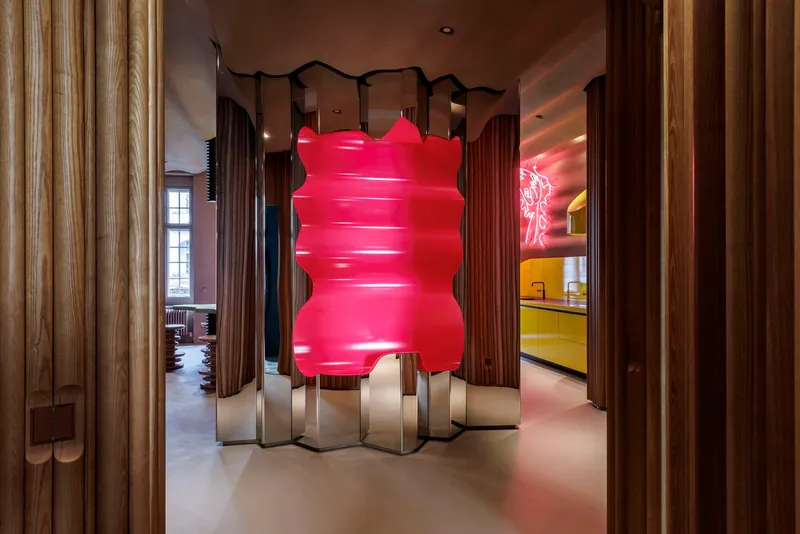

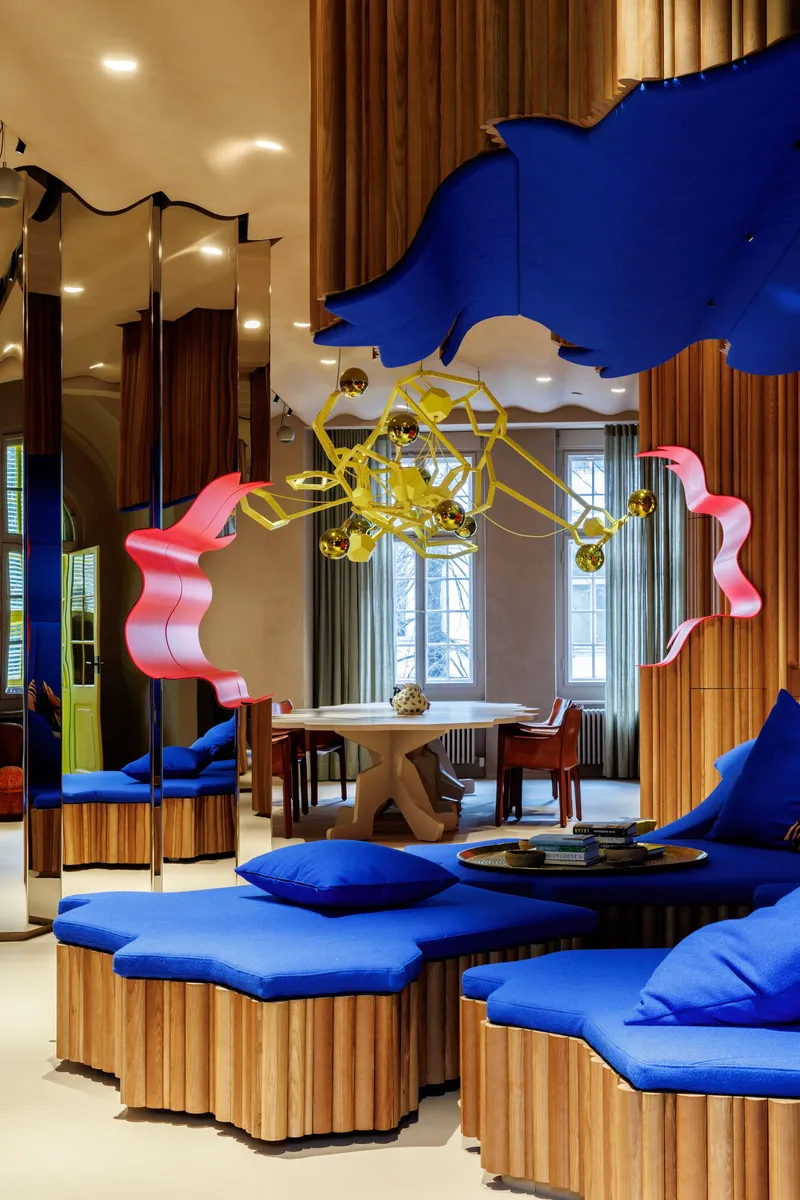
Scattered throughout the apartment are objects that blur the line between furniture, art, and architectural element. A pink inflatable sculpture sits on a zigzag metal base in a timber-clad hallway, visible from multiple rooms. A large coral-colored pendant form, somewhere between a cloud and a sea creature, hangs above the kitchen island. Gold molecular chandeliers appear in dining and lounge areas, their branching geometry a counterpoint to the organic curves of the millwork below.
These pieces are not afterthoughts. They are integrated into the spatial choreography: the inflatable marks a junction, the pendant defines the kitchen's center of gravity, and the chandeliers anchor seating arrangements. The apartment treats art and furniture as co-authors of the space.
The Dining Sequence
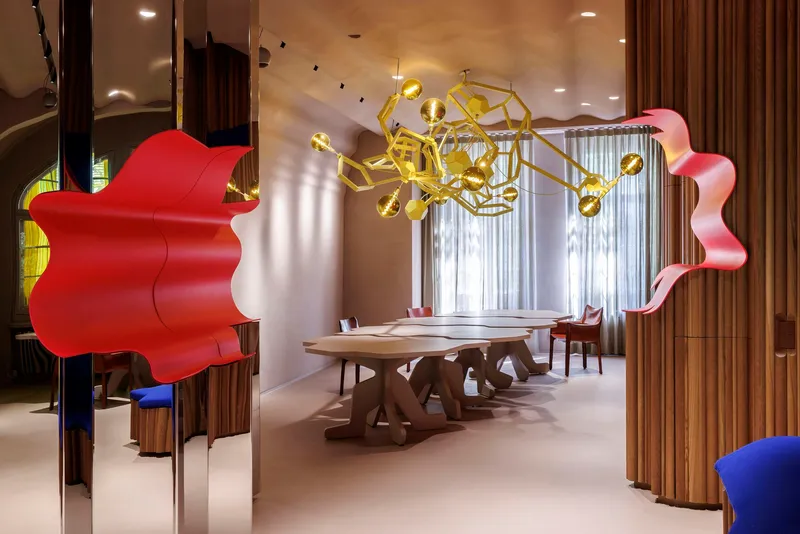
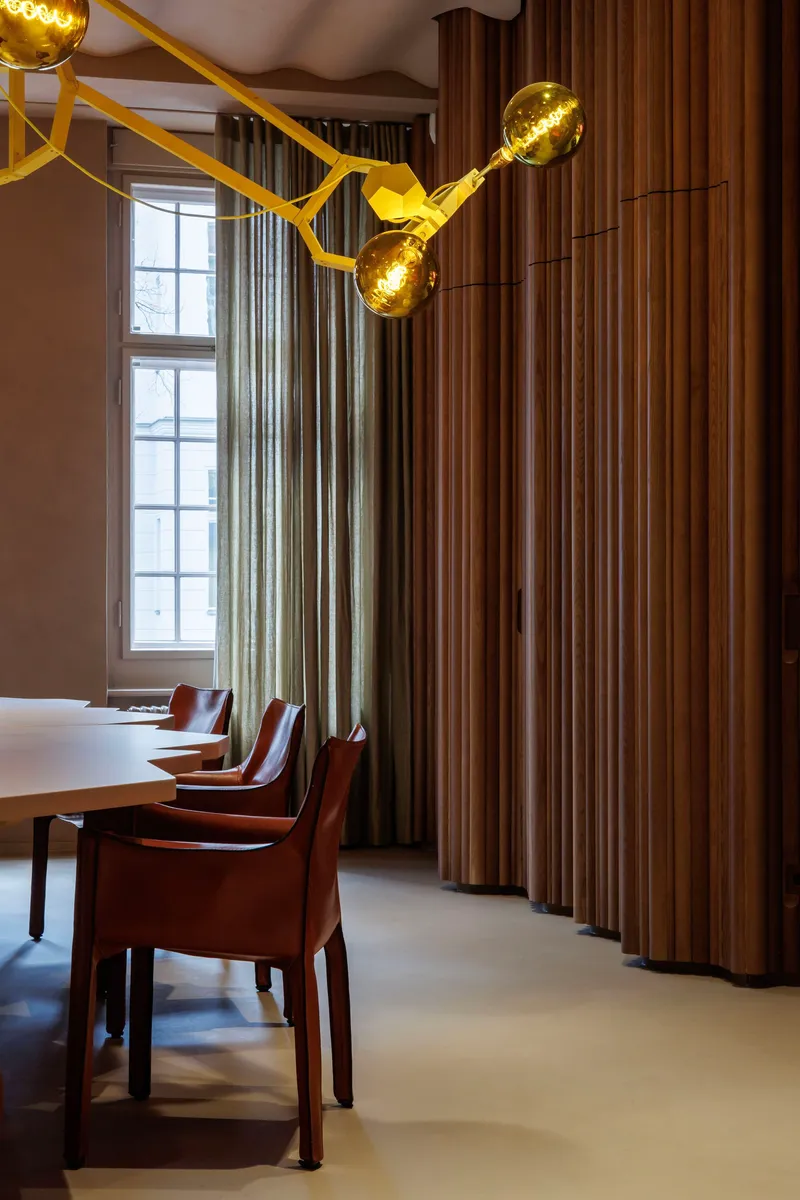
The dining area is accessed through a red sculptural partition, a curving wall that frames the room without enclosing it. Inside, a timber table sits beneath a gold geometric chandelier, flanked by leather chairs and backed by fluted wall panels. The view through the partition toward the yellow millwork beyond creates a layered depth of field that rewards movement through the space. From one angle the room feels intimate; from another it opens into the apartment's broader color field.
The stacked disc base stools that appear at both the dining table and the kitchen counter are a recurring motif. Their cylindrical geometry echoes the rounded cabinetry and the tubular timber side tables elsewhere, establishing a formal language of soft volumes and repeated circles that holds the diverse materials together.
Living and Lounging
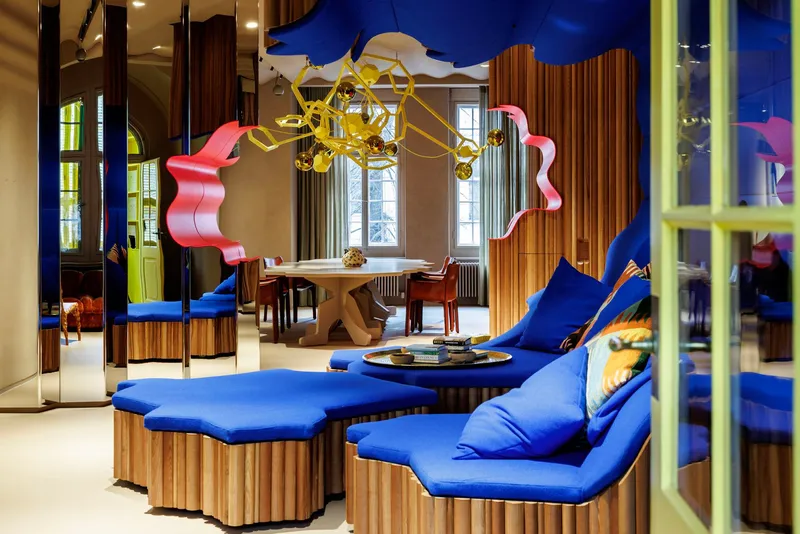


The lounge spaces in MOM lean into deep, enveloping color. Cobalt blue upholstered seating with an undulating headboard sits against vertical wood paneling, its fluted timber base grounding the piece architecturally. Elsewhere, rust-colored velvet chairs cluster around a cylindrical side table, and a brass chandelier hangs beneath the apartment's undulating ceiling, a surface treatment that introduces movement overhead without structural alteration.
The window banquette, with its pink cushions and wall-mounted pendant lamps overlooking winter trees, is perhaps the most traditionally domestic moment in the entire project. It is also one of the few places where the apartment pauses, offering a view outward rather than turning attention back on itself.
Private Rooms and Bathrooms


The private areas maintain the project's material intensity but shift the register. A bathroom pairs a white freestanding tub with a curved arc shower fitting against pale green plaster, its restraint a deliberate counterpoint to the saturated rooms beyond. The second bathroom is less shy: a pink cylindrical sink under purple neon lighting illuminates a vaulted ceiling and an arched doorway, leveraging the original architecture's proportions to amplify the color effect.
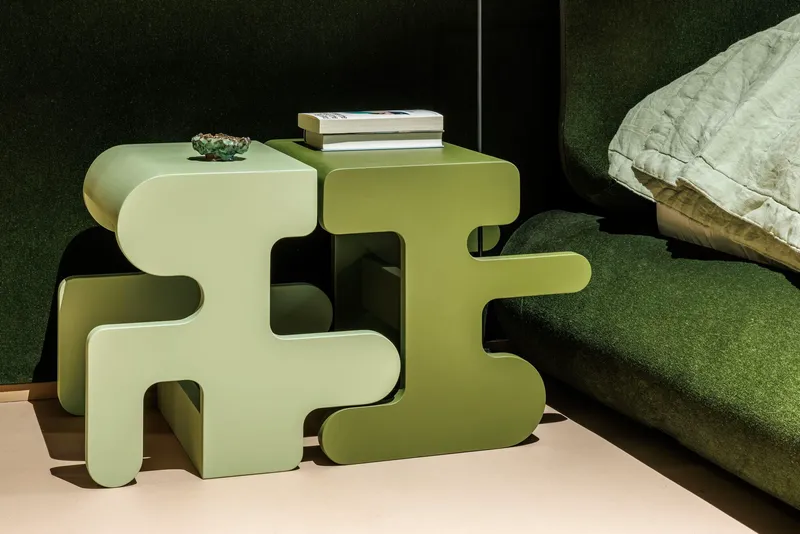
In the bedroom, puzzle-shaped bedside tables in pale green sit beside a dark upholstered headboard, a quiet combination that still insists on formal invention. Even in rest, the apartment refuses the ordinary.
Details and Atmosphere
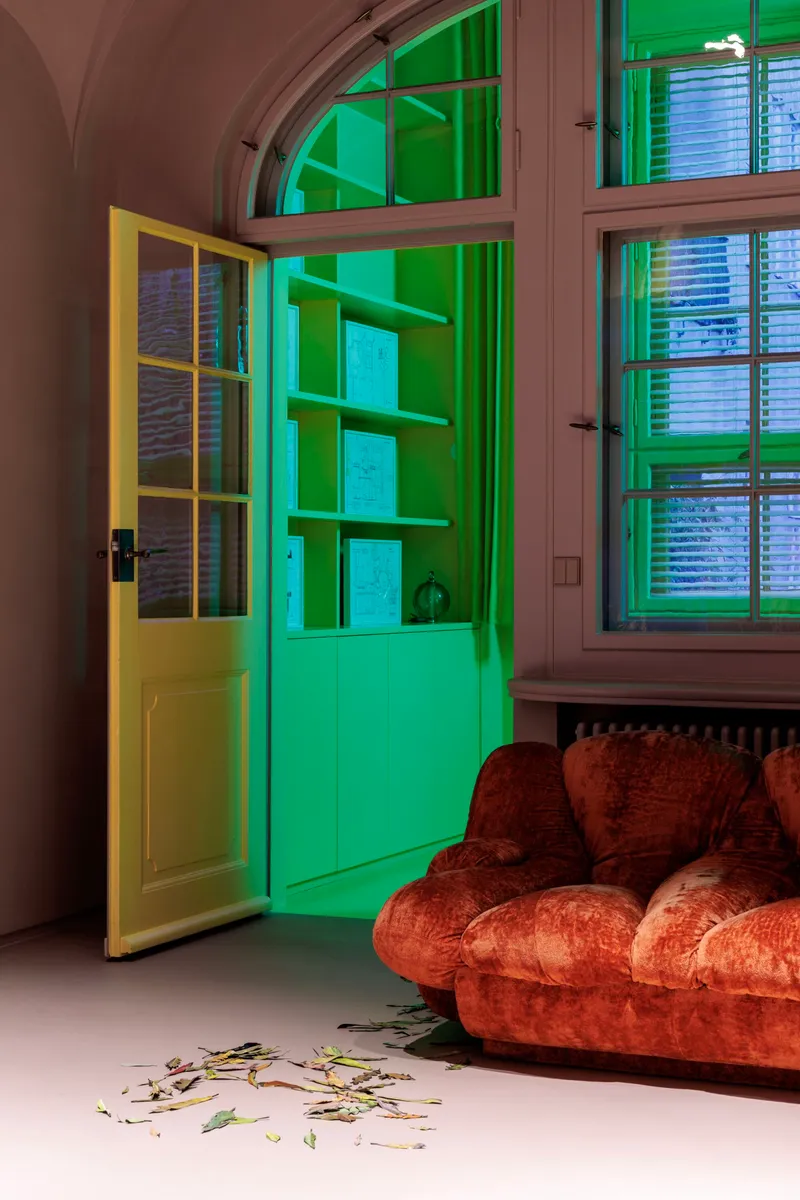

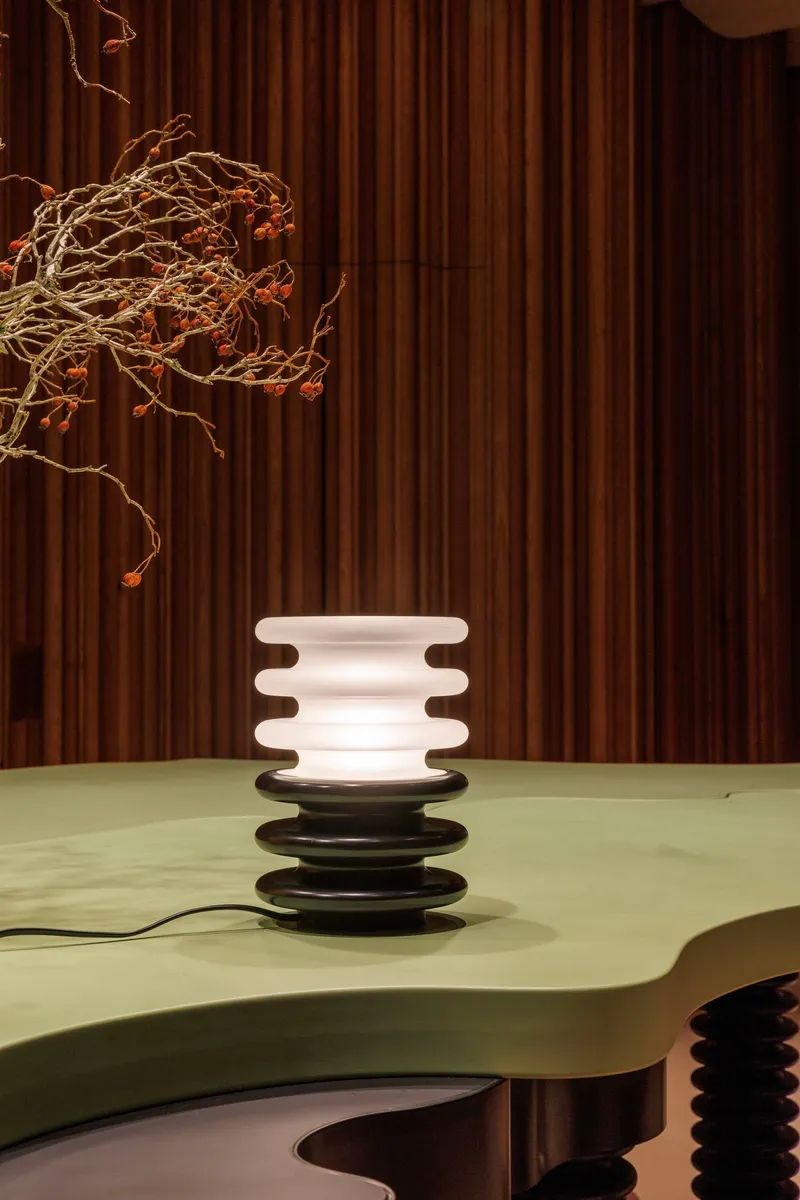
The details here are worth pausing on. A green-lit alcove with open shelving is viewed through a yellow-framed door beside an arched window and a velvet sofa, a composition that manages four distinct color temperatures in a single frame. A stacked disc table lamp on a pale green surface sits against timber paneling with a dried branch overhead, an arrangement that reads as still life. These moments suggest an apartment designed not just for living but for looking.
Plans and Drawings

The floor plan reveals what the photography hints at: an irregular layout of interlocking rectangular rooms with curved corner elements that soften transitions. The plan is distinctly Altbau in its generosity, with rooms strung along an enfilade that allows cross-views and diagonal sightlines. The curved partitions introduced by J. Mayer H. do not contradict this logic; they overlay a second geometry onto it, creating pockets of enclosure within the larger open sequence.
Why This Project Matters
Berlin's Altbau apartments are among the most fetishized domestic spaces in European architecture, and the standard renovation playbook is well known: white walls, herringbone floors, maybe a single statement kitchen. MOM rejects every line of that script. It treats the historic shell not as a sacred container but as an armature for a completely contemporary vision, one that is loud, material-rich, and unapologetically decorative. In doing so, it reopens a question that most residential renovations avoid: what is the limit of intervention in a listed typology?
Jürgen Mayer and his team have long operated at the intersection of architecture and sculptural form, from parametric pavilions to fluid urban furniture. MOM brings that sensibility indoors and, more importantly, makes it livable. The apartment is not a gallery installation or a showroom. It is a home, and the fact that it manages to be this exuberant while still organizing around clear circulation, natural light, and functional zones is the real achievement. The project argues that maximalism, when it is spatially disciplined, is a legitimate domestic strategy.
MOM Apartment by J. Mayer H. Architects, lead architect Jürgen Mayer. Berlin, Germany. Completed 2025. Photography by Frank Sperling.
About the Studio
Share Your Own Work on uni.xyz
If projects like this are the kind of work you want to make, uni.xyz is a place to publish your own, find collaborators, and enter design competitions.


Popular Articles
Popular articles from the community


Singing Woman: Contemporary Architecture Inspired by Estonia’s Voice and the Sea
Singing Woman turns Estonia’s song culture into flowing opera house architecture, blending public life, landscape, sea, and national memory.

Opera by the Sea Estonia: Three Shells Dissolving Architecture into Tallinn's Coastline
A winning opera house proposal replaces monumental form with interconnected shells that blur the boundary between building, park and Baltic Sea.

Opera on the Sea: Driftwood Logic Shapes a Timber Opera House on Estonia's Coast
Trevor Orgill's opera house translates the entangled drift of floating timber into a civic building where wood, water, and music converge.
Extended Shell: Retrofitting Kolkata's Balconies as Living Urban Thresholds
A modular retrofit system recovers the social and environmental intelligence of Kolkata's historic verandas for contemporary Park Street residents.

Similar Reads
You might also enjoy these articles

Bao Huynh Watercolor Atelier: A Serene Art Retreat in Hội An
Bao Huynh Watercolor Atelier in Hội An blends multifunctional art spaces, sustainable design, local materials, and family-friendly living in a serene environment.

Atelier Macri Concept Store Interior Design by CASE-REAL
Atelier Macri store features a "ko" counter, walnut wood details, cork displays, blending retail, gallery, and seamless customer experiences.

Manuel Vargas Izquierdo Stadium and High-Performance Sports Center: Architectural Excellence in Jalpa de Méndez
The Manuel Vargas Izquierdo Stadium blends sustainable design, inclusive sports facilities, and cultural-inspired architecture, revitalizing Jalpa de Méndez’s public spaces.

KAKR Buluh Awar Hall: Revitalizing Community and Ecology Through Bamboo Architecture
Community built bamboo hall revitalizes Buluh Awar village, empowering youth, restoring ecology, celebrating vernacular craftsmanship through sustainable architecture and culture.

Explore Apartment Competitions
Discover active competitions in this discipline

Challenge to reimagine the Iron Throne

Photograph architecture without architects

Illustrate the lost glory of Angkor Wat - Render Challenge

Design challenge to reuse E-waste
Comments (0)
Please login or sign up to add comments
No comments yet. Be the first to comment!