

Innauer-Matt Architekten Builds a Rust-Red Concrete Headquarters That Echoes Bludenz's Old Town
A five-story office building in western Austria turns colored precast concrete into a civic gesture, bridging historic core and suburban edge.


Corporate headquarters rarely earn their place in a town's collective memory. Most slot into the streetscape without ambition, or else they shout so loudly they repel everything around them. The Jägerbau Headquarters in Bludenz, Austria, completed in 2023 by Innauer-Matt Architekten, does something more considered: it picks up the rust-red tones already scattered across the old town's painted facades and casts them into a new material language of colored precast concrete. The result is a 1,520 m² building that feels simultaneously familiar and unmistakably contemporary.
What makes it genuinely interesting is the commitment to a single material idea carried all the way through. The concrete is not a veneer; it is the load-bearing structure, the facade texture, and the interior finish. Innauer-Matt call this an Edelrohbau, a refined raw construction where the building's skeleton is also its skin. That ambition extends to the urban strategy: the building occupies a former livestock market between Herrengasse and Zürcherstrasse, stitching together the taller commercial core and the lower suburban fringe with a stepped profile of three-story cube and five-story tower.
A Facade That Plays With Light


The street elevation along Herrengasse reads as a rhythmic procession of vertical concrete fins, each one a prefabricated element weighing up to 5,900 kg. Gray cement mixed with a brown liquid additive gives the concrete its distinctive rust-red hue, a color that shifts in perceived intensity depending on weather and time of day. In overcast Vorarlberg light the building sits quietly among its neighbors; under direct sun, shadows from the tilted lamellae carve deep lines into the surface, revealing a second layer of depth.
The ground floor pulls back from the facade plane to create a glazed arcade, an urbane gesture that recalls the arcaded commercial buildings of the adjacent old town. Large shop windows punctuate this zone, keeping the street edge activated. Above, the alternating tilt of the concrete columns gives the upper floors a visual rhythm that is orderly without being rigid.
Entry Sequence and the Perforated Ceiling
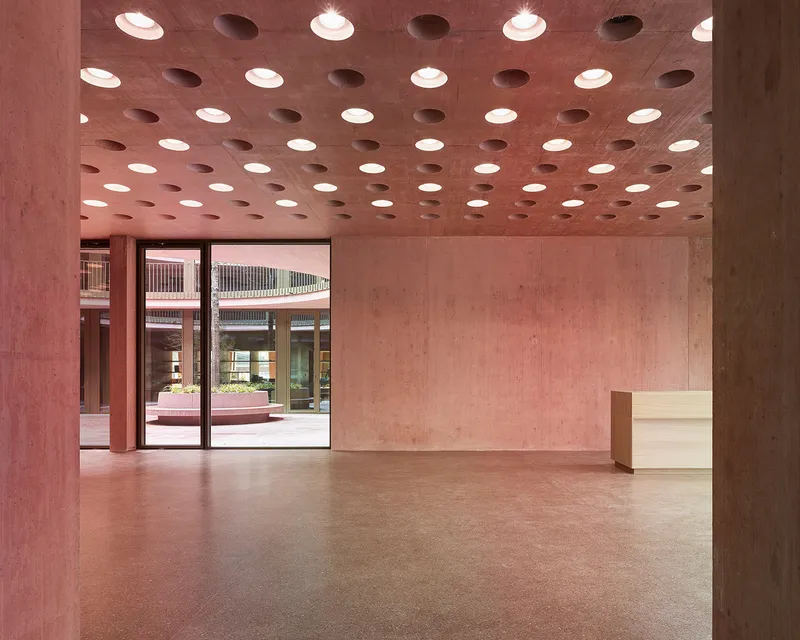
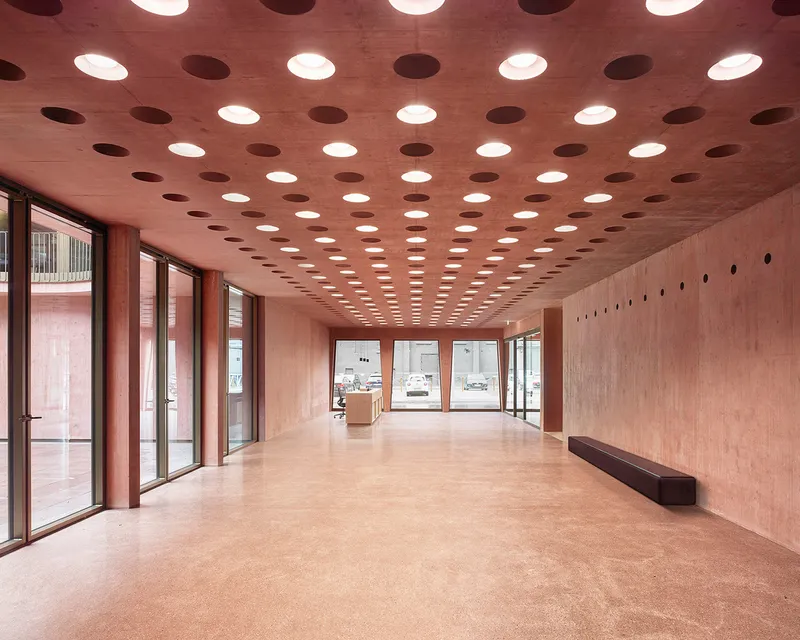
A small plaza at the Herrengasse entrance continues Bludenz's tradition of linked public squares, a scaled-down piazza that announces the building before you step inside. The lobby beyond is generous, doubling as an event space. Its most arresting detail is the ceiling: a grid of circular recesses, roughly 300 of them, punched into the concrete soffit in varying diameters. The effect is at once technical (a nod to the Jäger Group's construction expertise) and atmospheric, scattering light across the polished red terrazzo floor.
Full-height glazing at the far wall dissolves the boundary between lobby and inner courtyard, so that the first impression on entering is one of depth: plaza, foyer, courtyard, sky. It is a sequence that gives the company a public face without surrendering control of the interior.
The Elliptical Courtyard as Social Core
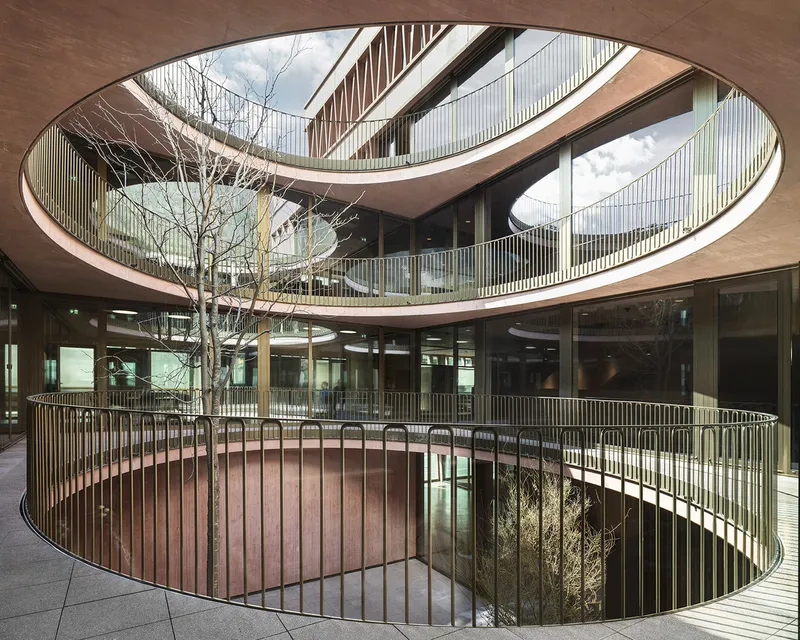
At the center of the plan sits an elliptical courtyard that punches vertically through the floor slabs, pulling daylight and fresh air into the deep plan. A continuous balcony wraps each level, edged with brass-colored lacquered railings, giving employees a reason to step outside without leaving the building. Planted beds and young trees at the base soften the concrete enclosure and will, over time, establish a genuinely green microclimate.
Semi-public program, from tea kitchens to meeting rooms and break areas, faces this courtyard. Individual workstations orient outward toward the street. The split is smart: private focus zones get the city views, while communal spaces share the calmer, sheltered interior. The courtyard's curved geometry also avoids the dead corners that plague rectangular atria, keeping sightlines continuous and the social energy circulating.
Material Warmth in a Concrete Building


The corridor and auditorium shots reveal how the architects prevent the Edelrohbau strategy from becoming austere. Bronze metal cladding lines certain circulation walls, catching warm downlight and creating an almost domestic glow against the pink-red concrete. In the auditorium, pendant fixtures hang at varying heights over stepped seating, and the same red concrete wraps the room like a vessel, giving the space both acoustic presence and visual coherence.
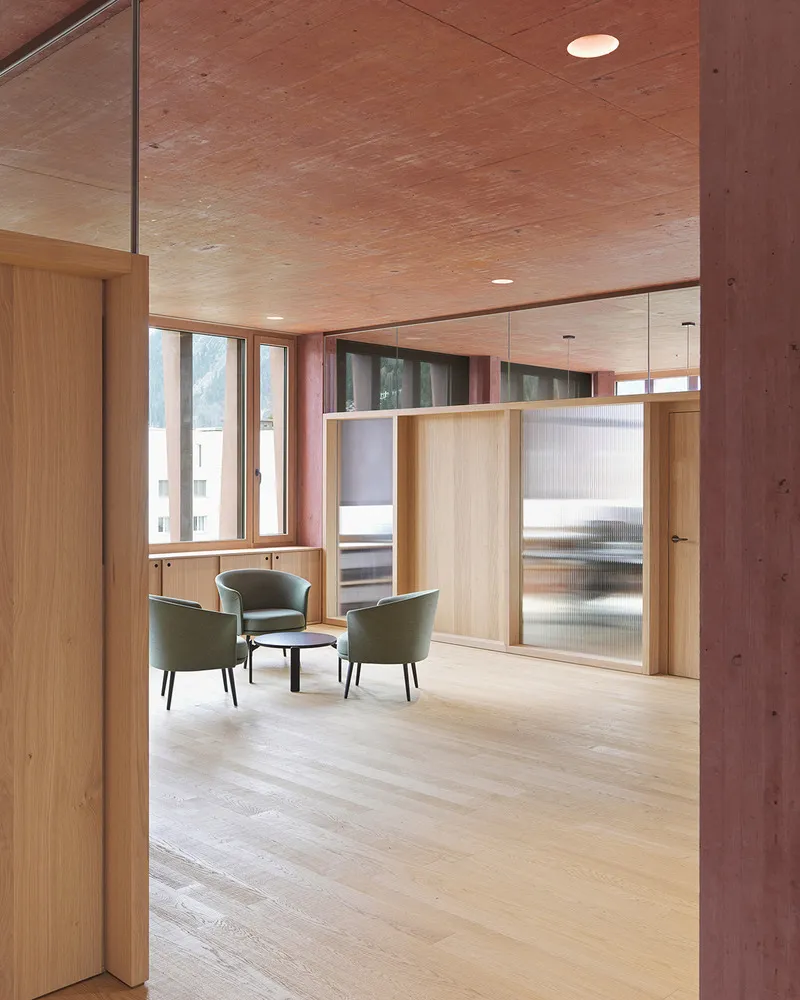
Light oak planks appear where the body touches the building: furniture, storage units, door frames. Natural fiber carpets in brown and polished red terrazzo floors complete a material palette that is deliberately narrow, with each surface earning its place through tactile contrast rather than chromatic competition.
Where Work Meets the Mountain Panorama
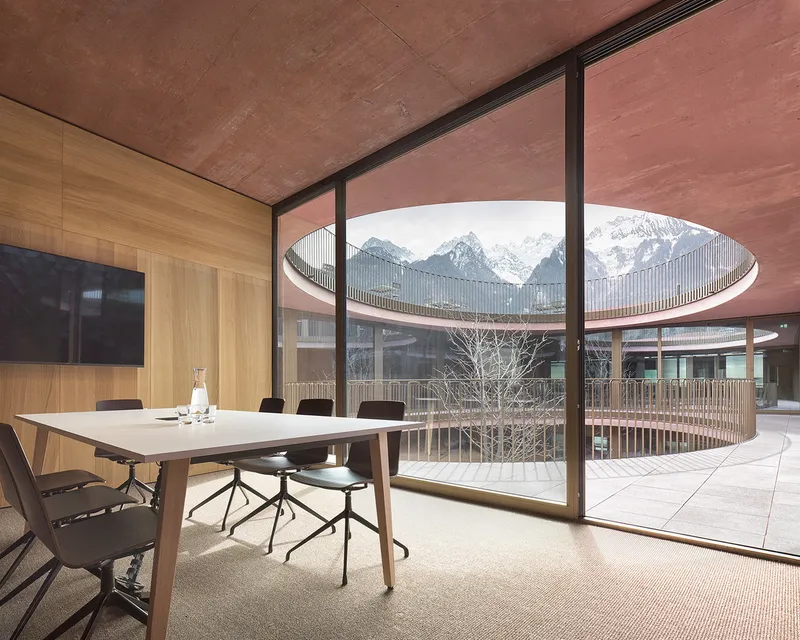

The upper floors tilt the program toward wellbeing. A conference room wrapped in floor-to-ceiling glazing frames the courtyard in the foreground and snow-capped peaks beyond, collapsing interior focus and alpine grandeur into a single frame. On the top level, a dining hall lined in pale timber paneling and fitted with a pink acoustic ceiling opens toward the same mountain views, serving as communal kitchen, bar, and cafeteria for the building's 140 employees.
These are not afterthought amenity floors. They sit at the building's summit by design, rewarding the daily climb (or elevator ride) with the best light, the longest views, and the most relaxed atmosphere. Management occupies the tower top, but the shared social spaces sit just below, keeping hierarchy legible without isolating it.
Energy Strategy Below Grade
Beneath the underground garage, 20 geothermal boreholes reach over 200 meters into the earth, providing both heating and cooling energy. Photovoltaic panels on the roof surfaces feed electricity directly into the building's systems, and the concrete lamellae double as passive solar control, reducing reliance on external shading devices. The entire building was modeled energetically in 3D during planning, aligning the building services with the thermal mass strategy inherent in all that exposed concrete. It is a clean example of performance embedded in structure rather than bolted on.
Why This Project Matters
The Vorarlberg region has long been recognized for its rigorous building culture, where craft and spatial intelligence outweigh spectacle. Innauer-Matt's Jägerbau Headquarters belongs squarely in that tradition, but it pushes the conversation forward by proving that colored precast concrete can carry both structural and cultural weight. The building does not mimic the old town; it translates its chromatic identity into a contemporary tectonic system. That distinction matters. Too many contextual projects end up as costume dramas; this one earns its place through material logic.
For corporate architecture more broadly, the project offers a useful counterargument to the glass-and-steel office box and the coworking aesthetic alike. Here is a headquarters that commits to a single material idea, a generous public ground floor, and genuine amenity spaces for its workforce, all while anchoring itself in a specific town with a specific history. The Jägerbau building proves that commercial ambition and civic generosity can share the same concrete frame.
Jägerbau Headquarters, Bludenz, Austria. Architects: Innauer-Matt Architekten. Area: 1,520 m². Completed: 2023. Photography: Adolf Bereuter.
About the Studio
Share Your Own Work on uni.xyz
If projects like this are the kind of work you want to make, uni.xyz is a place to publish your own, find collaborators, and enter design competitions.


Popular Articles
Popular articles from the community


U.GA Architects Wraps an Oval Rooftop Pool in Curved Board-Formed Concrete on Busan's Jeollidan-gil
In Busan's Jeonpo-dong, a 454 m² mixed-use block stacks a neighborhood facility, guest rooms and an oval rooftop pool inside spiraling concrete walls.

longwave studio Reorganizes a 112 m² Tainan Apartment Around the Daily Routines of a Family and Two Cats
In Tainan, Taiwan, birch plywood, rust-red furniture and a freestanding plaster wall link arrival, storage, work and family life in one apartment.

GROUP A Strips a 1969 Rotterdam Harbor Headquarters to Its Frame and Wraps It in Timber Louvers
In Rotterdam's M4H harbor district, Ferro Offices reuses a 1969 frame, adds one timber storey and reaches BREEAM-NL Outstanding.

LT2A and OPEN Architectes Thread a Brick and Glass High School Through a Wooded Belgian Campus
In Braine-l'Alleud, a 3,000 m² wing for Collège Cardinal Mercier pairs pale brick with a glazed colonnade, deferring to a small chapel and a dense wood.

Similar Reads
You might also enjoy these articles


Hodi-Mandai Geram
Project Function: Preservation and revitalization of the Intangible heritage and socio-spatial identity of the Hodi by Housing, Cultural Memory Center, Sacred Grove, landscape, local tourism economy


Olio Towers: A Mid-Rise for Performers That Fuses Housing, Rehearsal, and Stage
Located blocks from Houston's Theater District, this modular tower stacks living units around a central performance atrium.

Oasis: Modular Green Housing Carved into Dhaka's Urban Fabric
A shortlisted Plugin Housing entry reclaims unauthorized settlements in Dhaka with stepped concrete volumes, green roofs, and ventilation-driven design.

Black Hole: A Floating Megastructure for the Post-Physical Era
Emiliano Mazzarotto envisions a spherical, self-scaling arena where e-sports, digital hotels, and holographic stadiums replace traditional public space.

Explore B19 Architekten Bda – Weimar Competitions
Discover active competitions in this discipline

Challenge to reimagine the Iron Throne

Photograph architecture without architects

Illustrate the lost glory of Angkor Wat - Render Challenge

Design challenge to reuse E-waste
Comments (0)
Please login or sign up to add comments
No comments yet. Be the first to comment!