

Jiyo Dilli: Modulating Urban Entropy at the Heart of Connaught Place
A proposal for Neo Delhi that treats the city as a bio-mechanical system, balancing economy, transport, and social life around a circular core.


Cities are not static compositions. They behave more like bio-mechanical systems, governed by entropy: the constant tug between randomness and structure. Jiyo Dilli ("Live Delhi") starts from this premise and asks what happens when you treat Connaught Place not as a heritage artifact to be preserved in amber, but as a living nucleus whose stability depends on the dynamic equilibrium between economy, transport, social life, and built mass. The result is a framework that refuses the tired binary of conservation versus modernization, proposing instead a system that modulates these forces so the city can evolve organically.
Designed by Akhilesh, this project received an honorable mention in the Neo Delhi competition. The brief called for visions that could rejuvenate Delhi's iconic circular commercial district into a vibrant metropolitan fabric. Akhilesh's response grounds itself in what he calls "architectural sustainability," a philosophy that integrates Delhi's historical landmarks into a future-driven framework while leveraging green technologies and promoting social inclusivity.
Concentric Rings and Radiating Wings


The axonometric drawing reveals the proposal's organizational logic: a circular building composed of concentric rings with radiating wings that extend outward like the spokes of a wheel. The geometry is not arbitrary. It directly echoes the existing radial plan of Connaught Place, amplifying its inherent structure rather than imposing an alien grid. In elevation, a domed structure flanked by pavilions anchors the composition, its profile recalling Mughal and Lutyens-era silhouettes without resorting to pastiche. Birds in flight above the roofline are a small but telling detail, suggesting the design aspires to a porousness between built form and the open sky.
Mapping the Forces: Demographics, Circulation, Economy
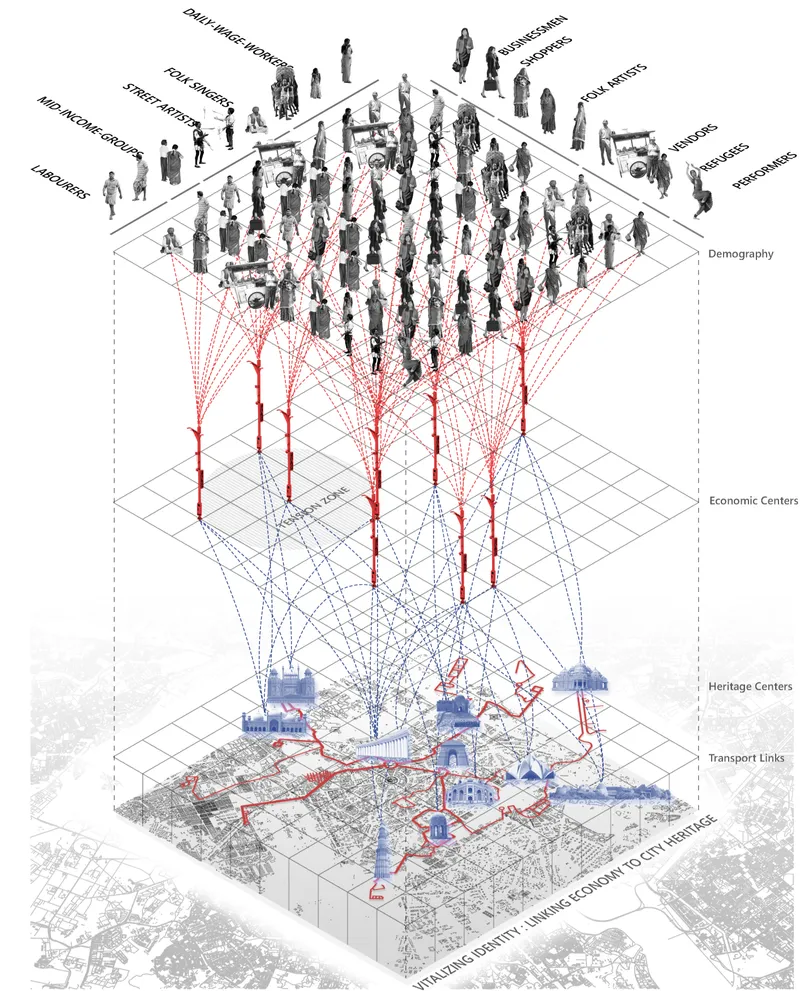

Two analytical diagrams lay bare the project's systems thinking. The first maps demographic connections between street-level figures and urban nodes through a network of red lines, making visible the social threads that typically remain invisible in masterplans. The second tracks circulation patterns and economic flows around the circular district, with labeled icons identifying where goods, people, and capital converge. Together, these drawings argue that urban form should be a consequence of these flows rather than an imposition upon them. Entropy modulation, in Akhilesh's vocabulary, means reading these forces accurately and calibrating built interventions to sustain organic growth.
Multilevel Public Life from Waterfront to Exhibition Hall


The sectional drawing is where the proposal becomes most spatially compelling. It depicts a multilevel public space that stacks exhibition areas, gathering zones, and a waterfront promenade into a single cross-section. The layering creates a gradient of activity: quiet contemplation at the water's edge, cultural programming in the middle, and urban bustle above. A companion diagram traces pedestrian movement from street vendors all the way to office towers through various activity zones, demonstrating how the design stitches together Delhi's informal economies and its formal commercial infrastructure. This is dynamic land use in practice: heritage spaces transformed into multi-purpose hubs where a chai cart and a corporate lobby coexist within the same circulatory system.
The Dome, the Cart, the Crowd
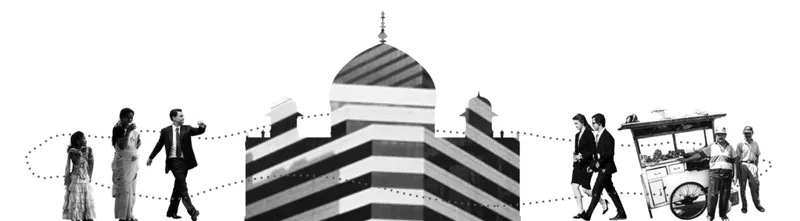
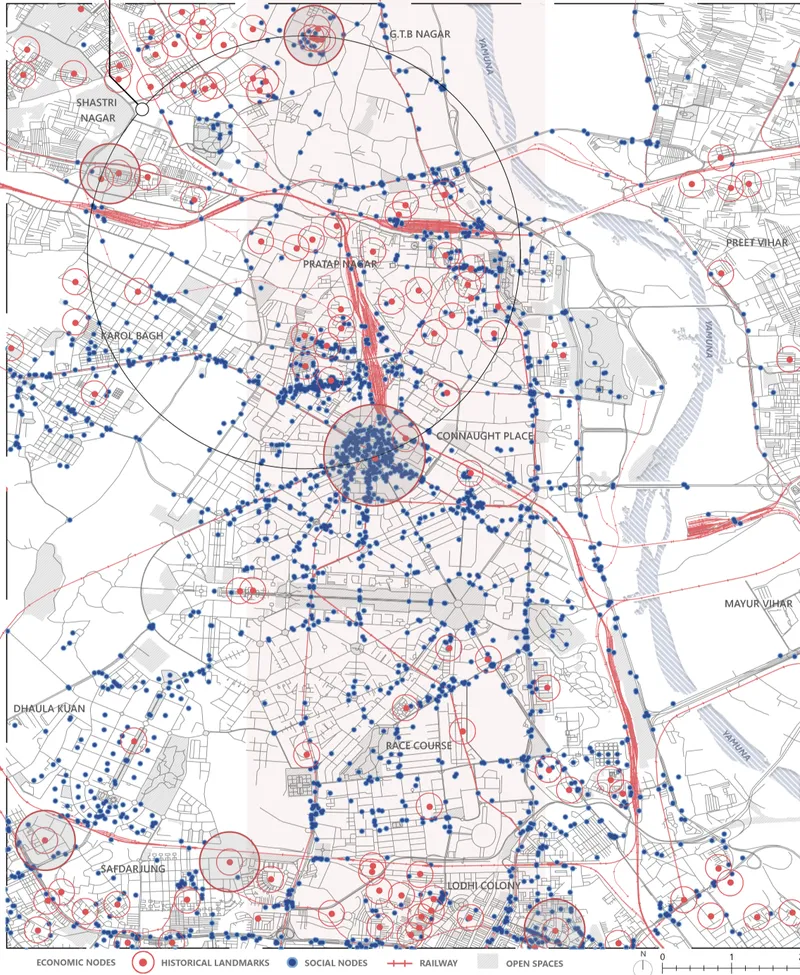
A composite image juxtaposes pedestrians, a striped dome with a finial, and figures near a street cart, collapsing the distance between monumental architecture and everyday commerce. It is a deliberate statement: in this version of Neo Delhi, the grandeur of the dome and the humility of the street vendor occupy the same visual field and the same design priority. An accompanying urban mapping diagram uses blue dots for social nodes and red circles for historical landmarks, revealing how the proposal threads new public life through existing heritage fabric. Social inclusivity, one of the project's stated goals, here takes cartographic form.
Street Scenes as Design Evidence

A vertical collage of street scenes captures the kinetic texture of Delhi: pedestrians, vehicles, trees, and activity zones stacked in a single frame. This is not decoration. It functions as design evidence, documenting the very entropy the project seeks to modulate. The collage insists that any credible urban proposal for Delhi must begin by acknowledging the density, informality, and sheer variety of its street life. The design does not erase this complexity; it builds a framework capable of absorbing it.
Why This Project Matters
Jiyo Dilli matters because it refuses the easy narratives that dominate heritage-city discourse. It does not romanticize the past, nor does it fetishize technological futures. Instead, it proposes a thermodynamic reading of the city: stability through the continuous balancing of forces. Connaught Place becomes not a museum or a mall, but a living system whose concentric geometry amplifies existing social, economic, and circulatory patterns rather than overriding them.
For a competition like Neo Delhi, which asks how one of the world's most historically layered capitals can accommodate contemporary urban demands, Akhilesh's entry offers a genuinely systemic answer. The diagrams, sections, and collages work together to build a case that "living cities" are not designed once and preserved; they are continuously calibrated. That is a position worth paying attention to.
View the Full Project
About the Designers
Designer: Akhilesh
Enter a Design Competition on uni.xyz
uni.xyz runs architecture and design competitions year-round that reward proposals with spatial conviction and real site intelligence.
Project credits: Jiyo Dilli : Live Delhi by Akhilesh Neo Delhi (uni.xyz).


Popular Articles
Popular articles from the community


Extended Shell: Retrofitting Kolkata's Balconies as Living Urban Thresholds
A modular retrofit system recovers the social and environmental intelligence of Kolkata's historic verandas for contemporary Park Street residents.

Singing Woman: Contemporary Architecture Inspired by Estonia’s Voice and the Sea
Singing Woman turns Estonia’s song culture into flowing opera house architecture, blending public life, landscape, sea, and national memory.

Tsunami Convergenics: Turning Catastrophic Ocean Forces into Underwater Housing Infrastructure
A speculative underwater settlement off the coast of Onagawa, Japan, treats tsunamis and typhoons as energy sources rather than threats.

Opera on the Sea: Driftwood Logic Shapes a Timber Opera House on Estonia's Coast
Trevor Orgill's opera house translates the entangled drift of floating timber into a civic building where wood, water, and music converge.

Similar Reads
You might also enjoy these articles

Day and Night Park: A Time-Based Urban Newsstand in Beijing
A temporary urban newsstand in Beijing blending travel, light, and reading through poetic colors, compact form, and community-focused design.

Modernist Patio Renovation in El Masnou, Barcelona by Oliver Segura Arquitectura + Cebrià Arquitectura
Modernist patio renovation blending tradition and innovation with a movable pool, leveled floors, and Catalan materials in El Masnou.

Alto Residencial Coop: Cooperative Housing Development in Santiago de Compostela by Carbajo Barrios Arquitectos
A linear cooperative housing complex blending white volumes and perforated metal façades, enhancing community living, natural light, privacy, and urban integration.

Vil Genis School by BPA ARCHITECTURE – Massy, France
Vil Genis School in Massy, France, features sustainable design, south-facing classrooms, community integration, accessible spaces, and modern educational architecture.

Comments (0)
Please login or sign up to add comments
No comments yet. Be the first to comment!