
Jo Nagasaka Turns a Corner of a Yoyogi Office into a 46 m² Farm Shop and Kitchen
In a quiet residential pocket of Shibuya, Schemata Architects builds a community food hub on a carpenter's budget.


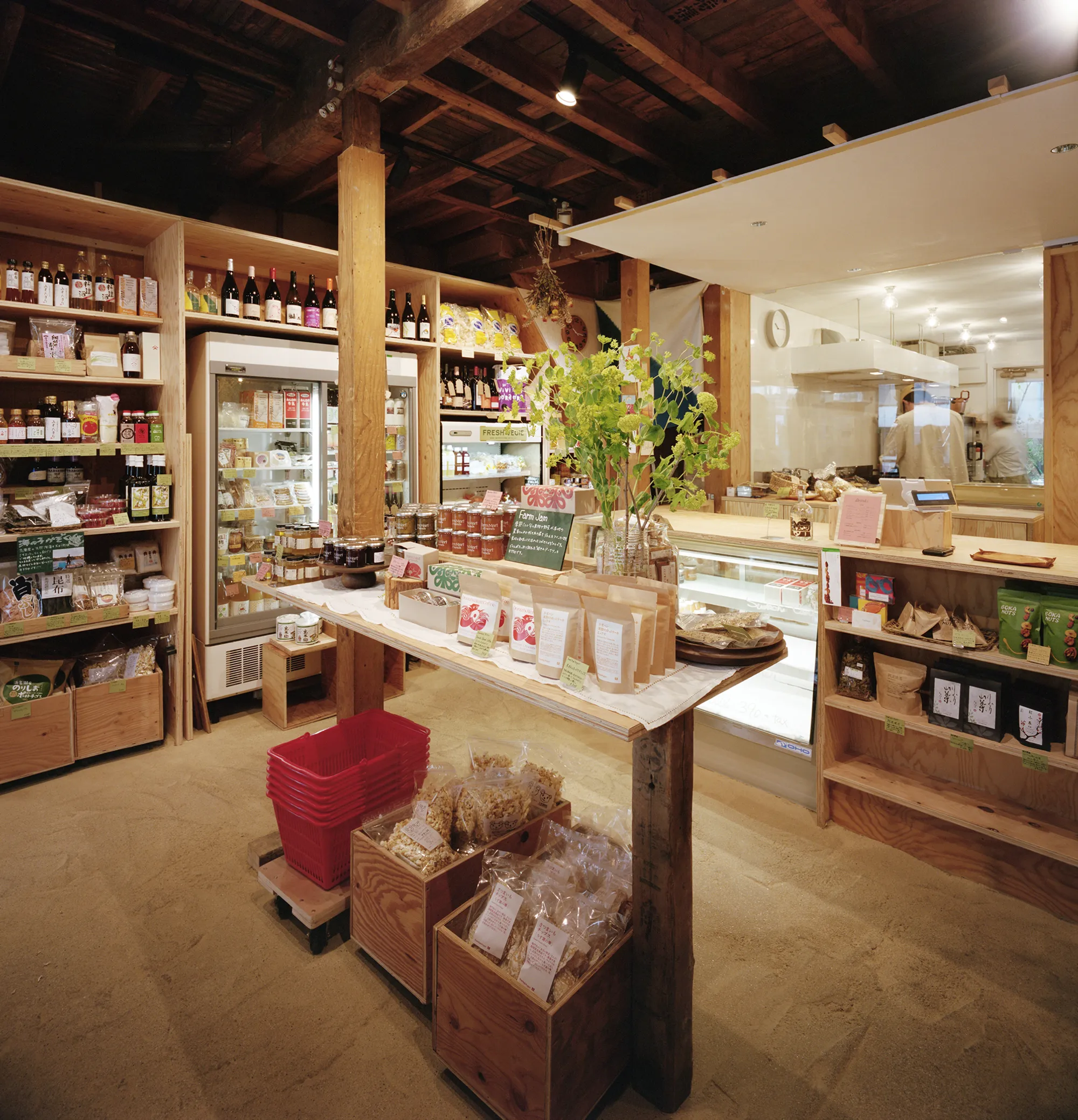
FarmMart & Friends is one of those projects where the constraints say more than the finish materials. Carved out of a sliver of the Monosus company office in Yoyogi, this 46 m² shop and kitchen was designed by Jo Nagasaka of Schemata Architects with a radical concession: the architects stepped back from construction entirely, letting a skilled carpenter named Takamoto, a former staff member, design and build the interior while they supervised. The result is a space that feels handmade because it literally is, and that honesty reads in every plywood joint and exposed rafter.
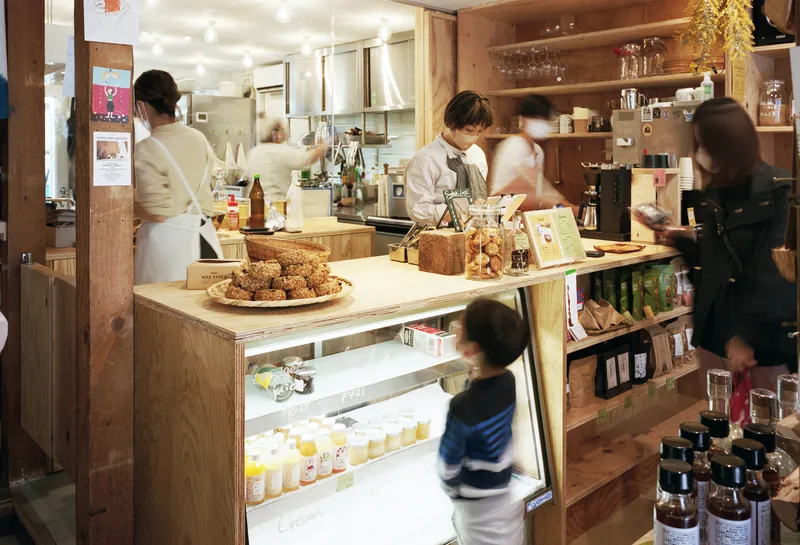
The project sits in a secluded residential stretch of Yoyogi, next door to Bakery Shiomi and its wood-fired oven. Together they form a small constellation of food-focused community spaces, the kind of micro-urbanism that Shibuya rarely gets credit for. FarmMart sells farm-direct produce and makes jams in its tiny kitchen, with an eat-in counter for standing drinks. It is a shop, a kitchen, and a neighborhood living room, all packed into less space than most studio apartments.
The Courtyard as Threshold
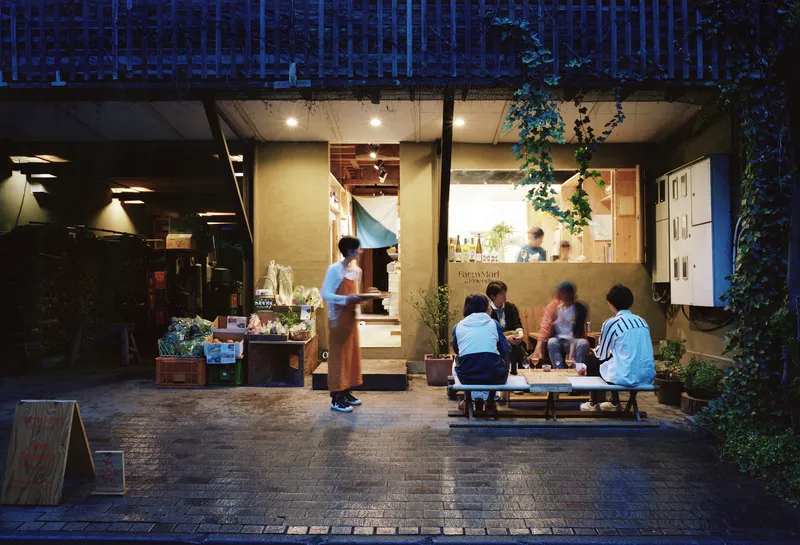
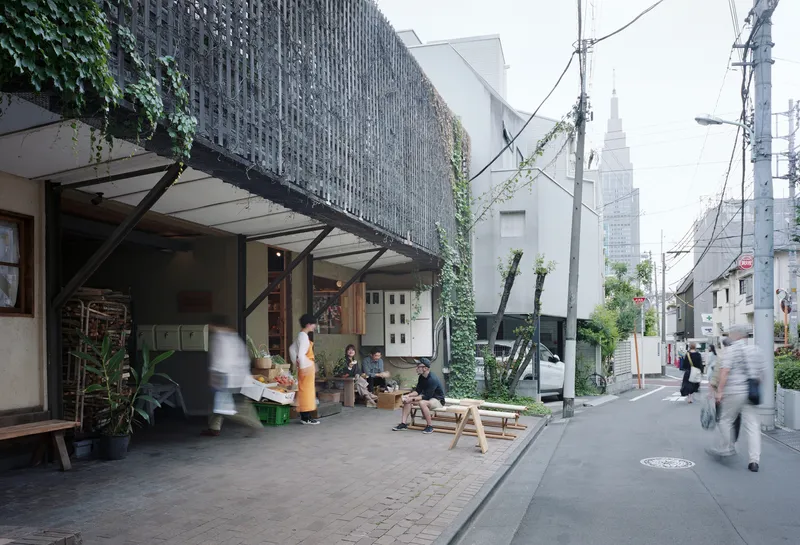
The shopfront opens fully onto a small paved courtyard that acts as an outdoor extension of the interior. At dusk, the glass facade dissolves the boundary between shop and street, pulling neighbors in with warm light and visible activity. A perforated brick screen and exposed steel bracing on the adjacent wall give the exterior a raw, almost industrial texture that contrasts with the plywood warmth inside. It is a deliberate move: the threshold is welcoming precisely because it does not try too hard.
For a space this small, the courtyard is not a luxury but a spatial necessity. It doubles the shop's social footprint without adding a single square meter of conditioned floor area. People gather outside because the architecture tells them they can.
Plywood as System, Not Surface


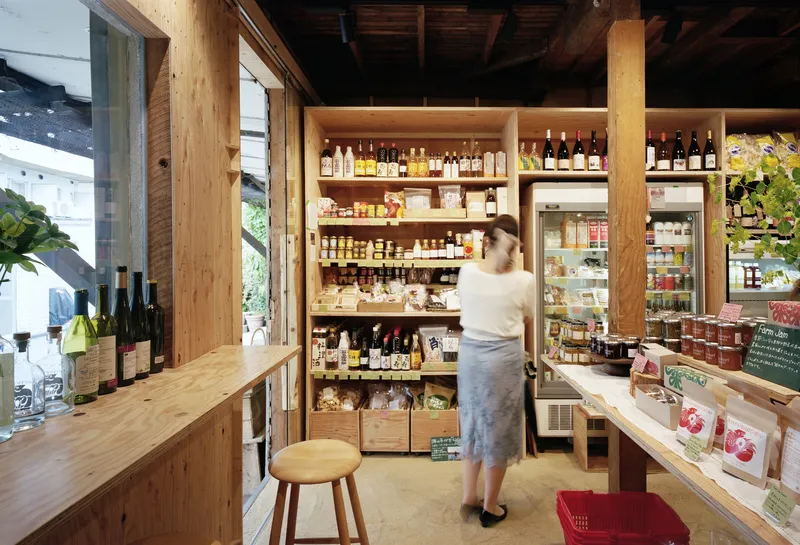
The interior is almost entirely plywood: counters, shelving, wall panels, display cases. But calling it a "plywood interior" undersells what is happening here. Takamoto built an integrated furniture system that is simultaneously structure, storage, and display. Shelves are sized to the products they hold. The counter doubles as a service bar and a work surface. Nothing is decorative; everything performs.
The result has a quality that expensive fit-outs rarely achieve: coherence born from economy. When one material does everything, a tiny room reads as one continuous idea rather than a collage of competing finishes. The exposed timber ceiling beams above reinforce this legibility, connecting the new plywood insertions to the existing wood structure of the office building.
A Kitchen Scaled to Its Purpose
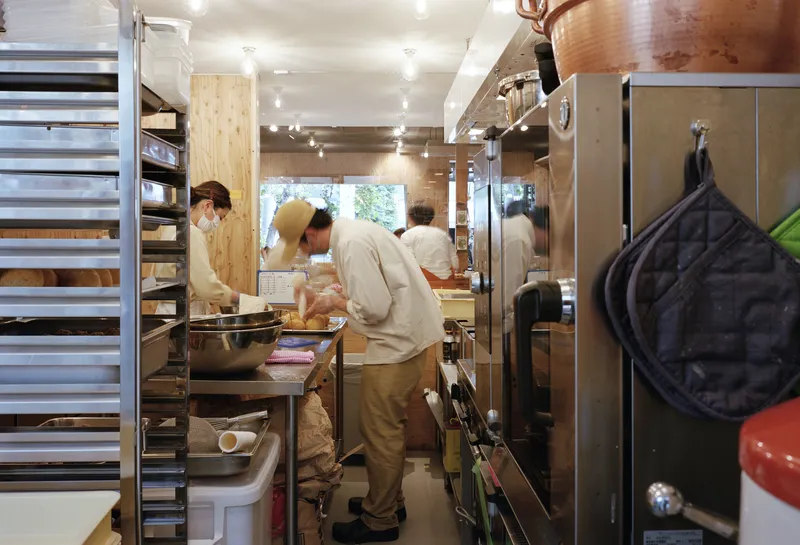
The kitchen occupies the rear of the plan, visible through the service counter but separated enough to function independently. It is tight: a stainless steel prep surface, track lighting, and just enough room for two staff to work side by side. The narrow proportions force an efficient workflow where everything is within arm's reach, a constraint that any professional cook would recognize as an advantage.
Transparency matters here. Customers can see jams being made from the same produce displayed on the shelves in front of them. The architecture does not just house the program; it narrates the supply chain. Farm to shelf to jar, all visible from the standing counter.
The Window Counter and the Street
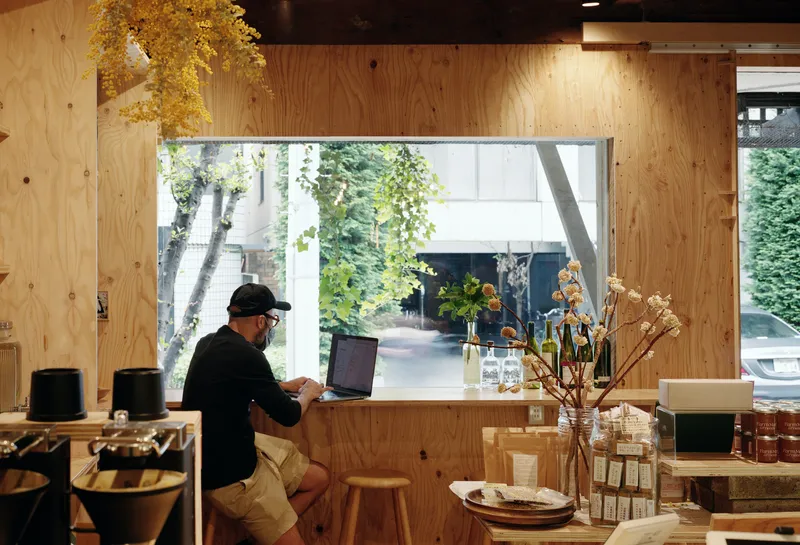

A plywood-lined window counter faces the street, creating a perch where someone can sit with a laptop and remain simultaneously inside the shop and oriented toward the neighborhood. It is a simple gesture, the kind of thing a café might do, but here it signals something specific about the project's ambition. FarmMart is not a destination; it is a place you stop by while walking through your own neighborhood. The window counter makes that casualness architectural.
Behind the counter, a framed floral artwork catches light through the glass, a rare moment of decoration in an otherwise utilitarian interior. It works because it is the only one.
Exposed Structure as Character

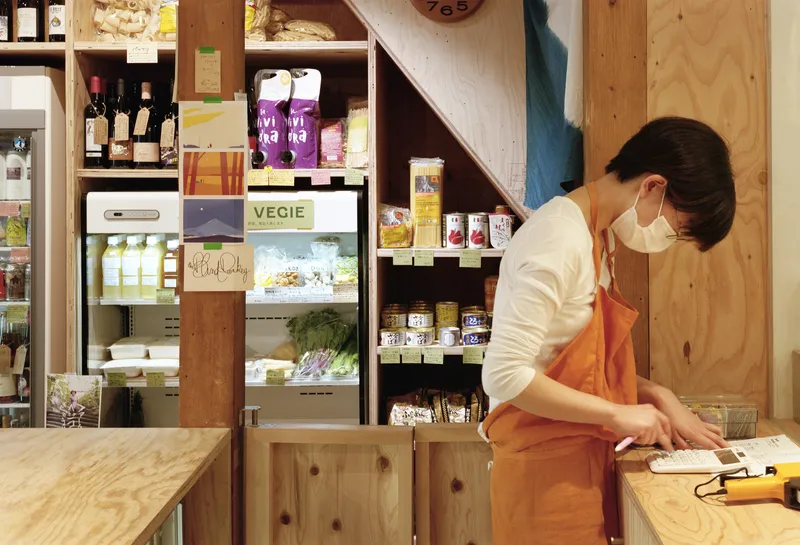
The decision to leave the existing timber beams and rafters exposed does more than save money on a dropped ceiling. It gives the room vertical generosity that the floor plan cannot provide. At 46 m², every centimeter of perceived height matters, and the angled roof structure draws the eye upward, making the shop feel larger than its footprint suggests.
There is also a practical benefit: the open ceiling accommodates track lighting that can be repositioned as the shop's displays evolve. In a space this small, flexibility is not a design philosophy; it is a survival strategy. The architecture anticipates change because the program demands it.
Plans and Drawings
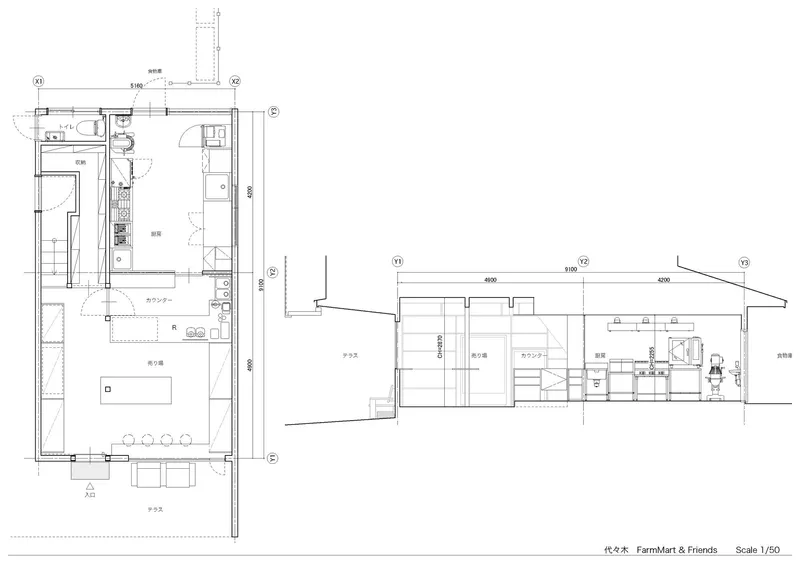
The floor plan and section drawing reveal how precisely the 46 m² is divided between retail, service counter, kitchen, and storage. The plan is essentially linear: enter from the courtyard, move past the display shelves, arrive at the counter, with the kitchen behind. The section shows the roof pitch that gives the interior its unexpected height. What is striking is how little circulation space exists. Nearly every square meter is working space, a layout that only functions because the carpenter who built it understood the daily movements of the people who would use it.
Why This Project Matters
FarmMart & Friends is a case study in what happens when architects relinquish control without abandoning responsibility. Jo Nagasaka's decision to let a carpenter lead construction while his firm supervised is not just a budget strategy; it is a model for how small commercial projects can be realized in dense urban neighborhoods where conventional fees and timelines make renovation prohibitive. The result is a space that feels more alive than most architect-designed retail interiors precisely because it was shaped by the hands of someone who builds, not just draws.
More broadly, the project demonstrates that community food spaces do not need to be large or expensive to be meaningful. At 46 m², FarmMart connects local farmers to urban residents, gives a neighborhood a gathering point, and proves that a plywood counter and an open door are sometimes all the architecture you need. The ambition is not in the materials or the scale. It is in the willingness to make a place worth returning to, and then to get out of the way.
FarmMart & Friends Shop and Kitchen by Jo Nagasaka of Schemata Architects. Yoyogi, Shibuya City, Japan. 46 m². Completed 2022. Photography by Yurika Kono.
About the Studio
Schemata Architects
Share Your Own Work on uni.xyz
If projects like this are the kind of work you want to make, uni.xyz is a place to publish your own, find collaborators, and enter design competitions.




Popular Articles
Popular articles from the community


Lunar Spiral: Space Architecture Shaped by the Mathematics of the Universe
Lunar Spiral reimagines space architecture through Fibonacci geometry, lunar regolith, levitating habitats, and self-sustaining Moon living.

The Ocean Hive: Sustainable Architecture for a Self-Sufficient Civilization at Sea
The Ocean Hive imagines sustainable architecture at sea, where modular habitats, algae, wave power and ocean waste sustain a growing colony.

The Earth Pod: 3D Printed Homes for Resilient Refugee Communities
The Earth Pod reimagines refugee housing through 3D printed homes made from clay, combining resilience, self-sufficiency, and rapid shelter.

Co-life: Sustainable Architecture for Age-Friendly Community Living
Co-life reimagines sustainable architecture for seniors through courtyards, rammed earth, shared gardens, and spaces designed for belonging.


Similar Reads
You might also enjoy these articles

Bao Huynh Watercolor Atelier: A Serene Art Retreat in Hội An
Bao Huynh Watercolor Atelier in Hội An blends multifunctional art spaces, sustainable design, local materials, and family-friendly living in a serene environment.

Atelier Macri Concept Store Interior Design by CASE-REAL
Atelier Macri store features a "ko" counter, walnut wood details, cork displays, blending retail, gallery, and seamless customer experiences.

Manuel Vargas Izquierdo Stadium and High-Performance Sports Center: Architectural Excellence in Jalpa de Méndez
The Manuel Vargas Izquierdo Stadium blends sustainable design, inclusive sports facilities, and cultural-inspired architecture, revitalizing Jalpa de Méndez’s public spaces.

KAKR Buluh Awar Hall: Revitalizing Community and Ecology Through Bamboo Architecture
Community built bamboo hall revitalizes Buluh Awar village, empowering youth, restoring ecology, celebrating vernacular craftsmanship through sustainable architecture and culture.


Comments (0)
Please login or sign up to add comments
No comments yet. Be the first to comment!