
JPG ARQ Strips a 1980s São Paulo Apartment Back to Its Concrete Bones
In Santa Cecília, a 106 m² renovation turns demolition into revelation, letting raw structure organize every room and surface.


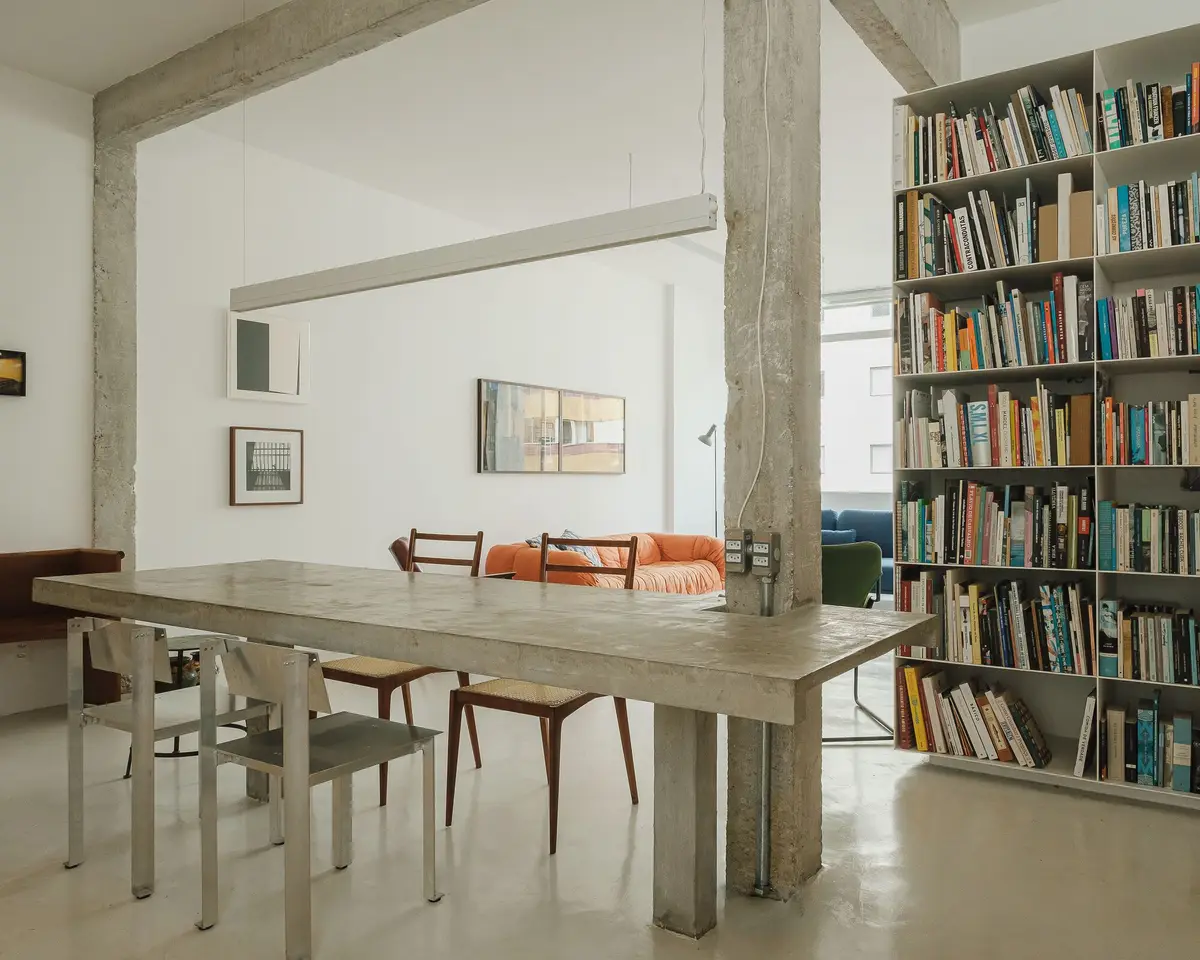
Most apartment renovations add. JPG ARQ chose to subtract. For a young couple on the top floor of a 1980s building in São Paulo's Santa Cecília neighborhood, the studio demolished walls, corridors, bathrooms, and even sections of flooring to expose a spatial generosity that had been buried under decades of compartmentalized planning. What emerged is a 106 m² loft organized not by partitions but by the concrete skeleton that was always there: columns, beams, and rainwater pipes now serve as room dividers, table anchors, and visual landmarks.
The result is an apartment where structure is simultaneously finish and furniture. Fair-faced concrete tables grow directly out of columns. A low plywood cabinet is the only thing separating the kitchen from the office. Natural light, previously blocked by hallways and service rooms, floods from both the exterior facade and the building's interior light wells into every corner of the plan. The project is a convincing argument that the most radical renovation strategy is sometimes the simplest: stop hiding what the building already gave you.
Demolition as Design Move
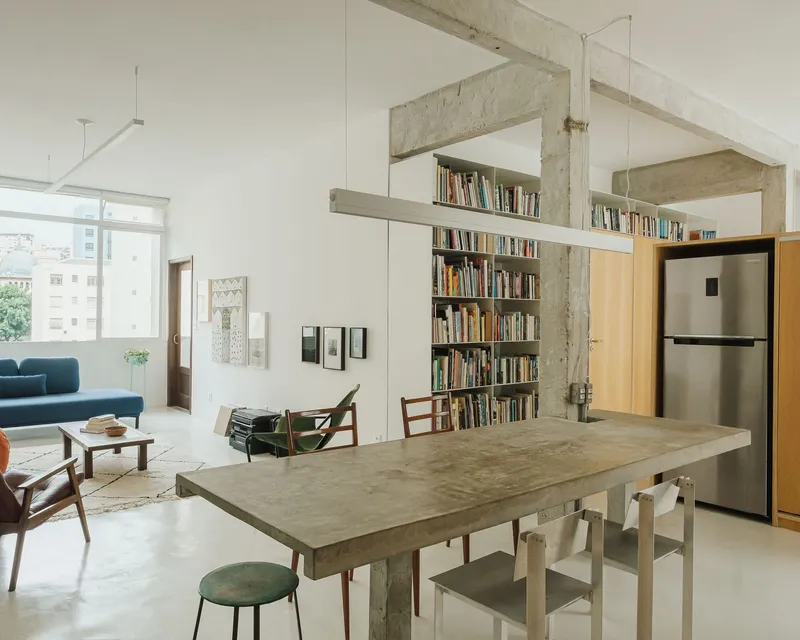
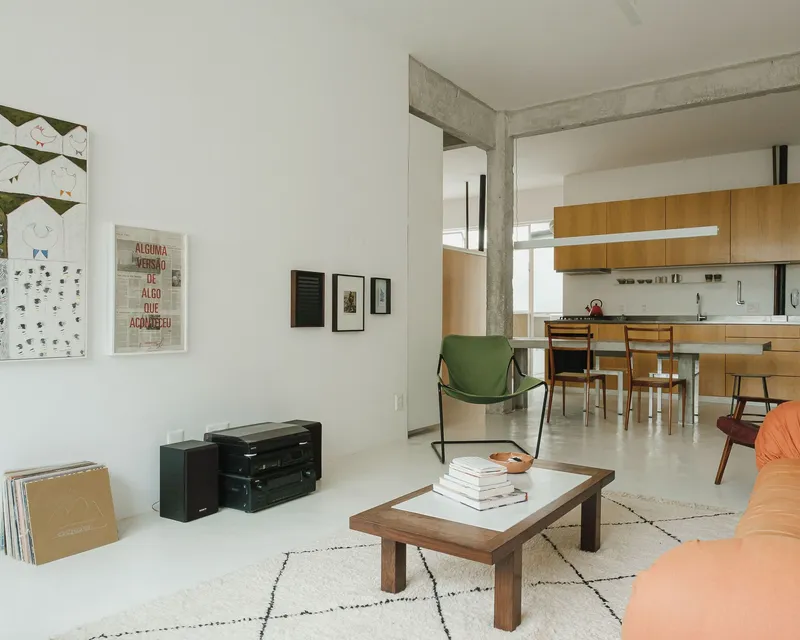
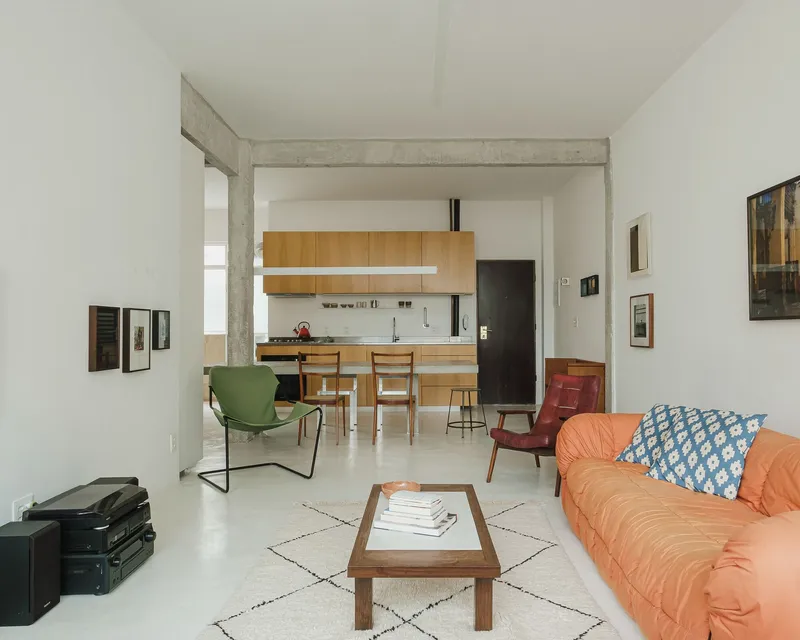
The original apartment was carved into a conventional Brazilian layout: bedrooms along the facade, a central bathroom block, a corridor feeding into separate maid's quarters and a service kitchen. JPG ARQ gutted the entire middle section, pulling bathrooms off-center and collapsing the hallway system to produce a single, continuous living volume. From the entrance, you can see clear through to the balcony glazing, a sightline that the original plan made impossible.
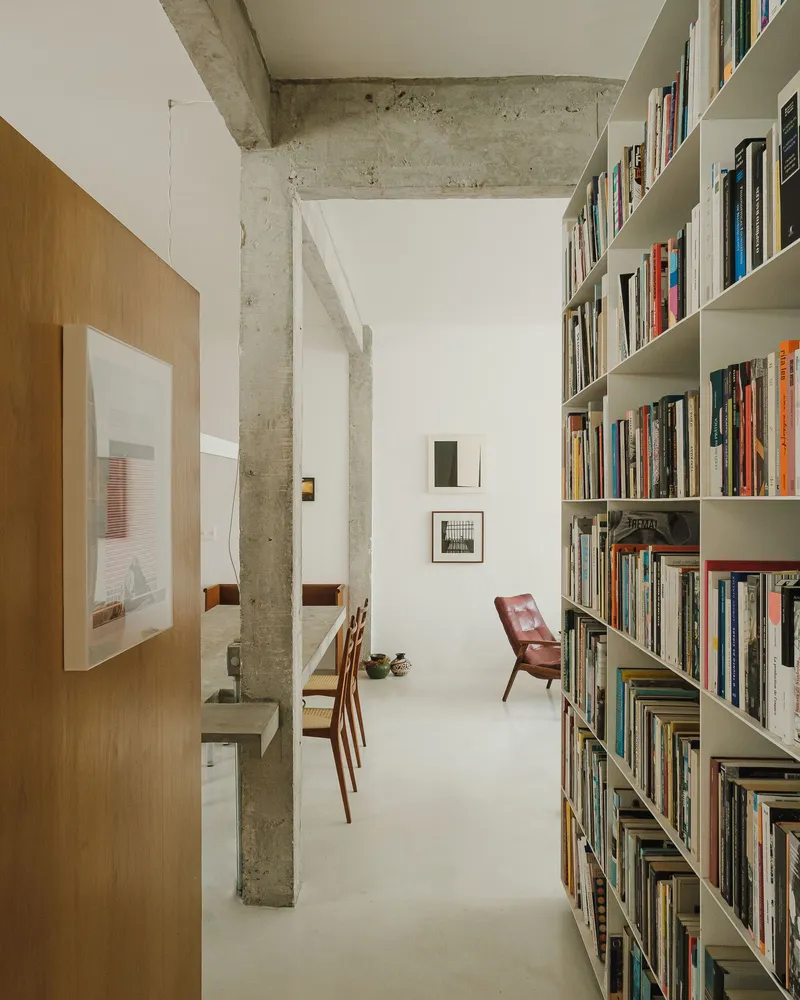
What holds the space together visually is the exposed concrete frame overhead. Beams trace long horizontal lines across the ceiling, connecting column to column, and their rough surfaces are left unfinished against white-painted walls. The contrast reads less as industrial aesthetic and more as honest archaeology: you are looking at the building's real structure, not a decorative quotation of it.
Concrete Tables as Structural Furniture
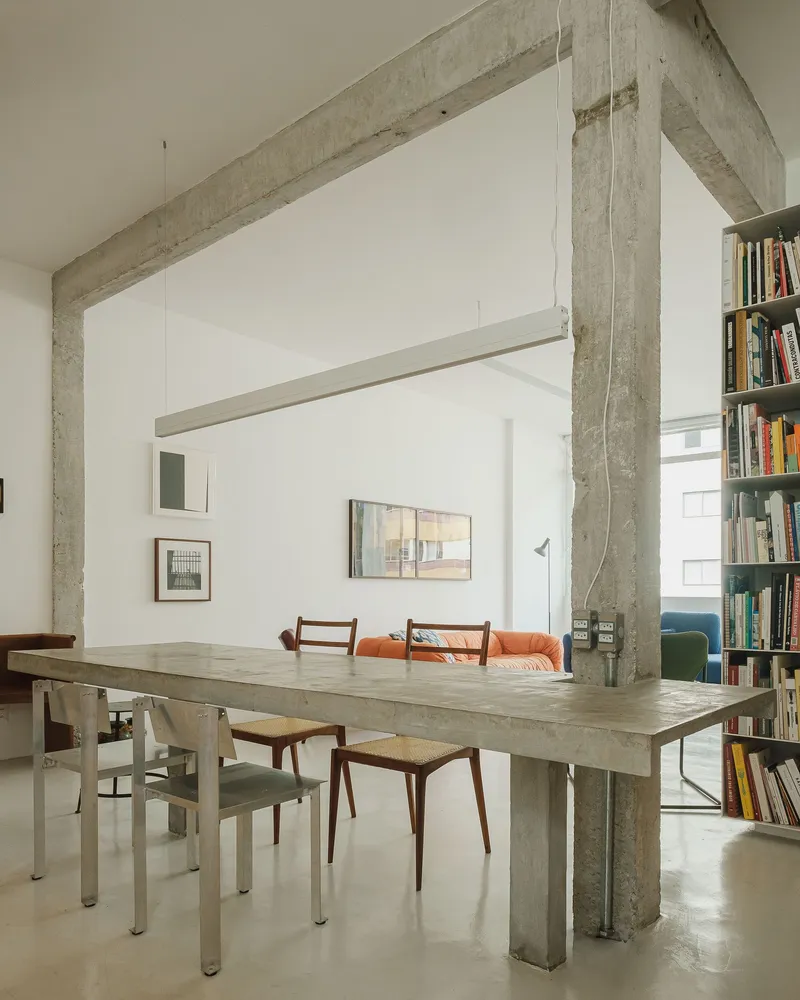
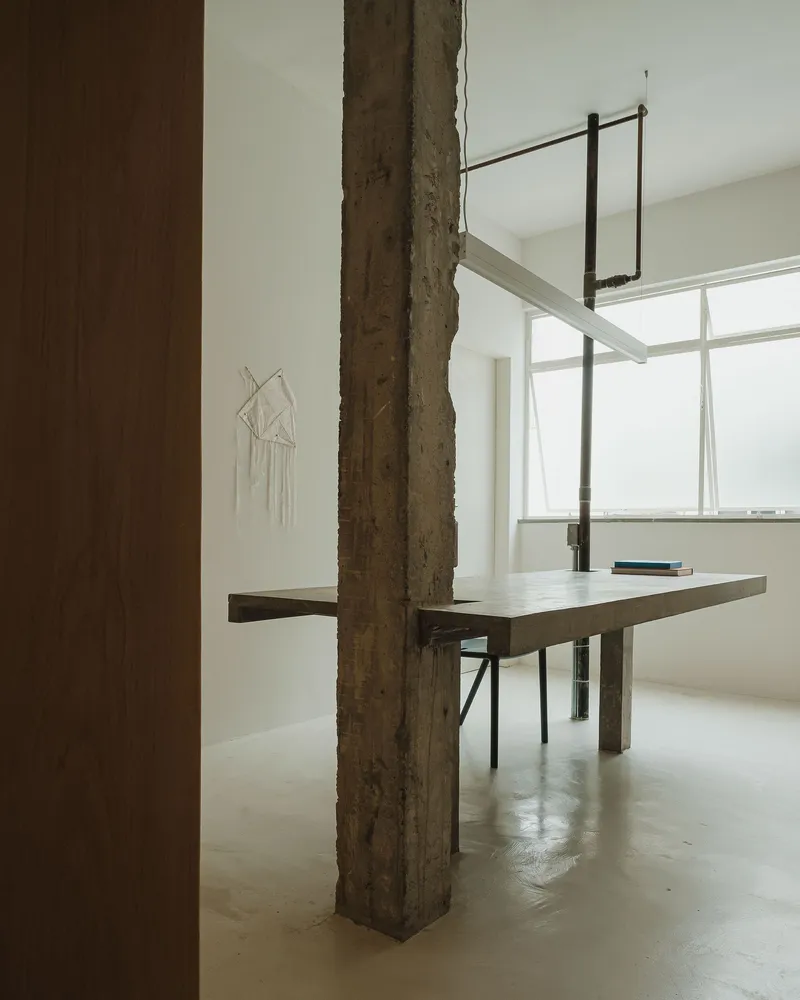
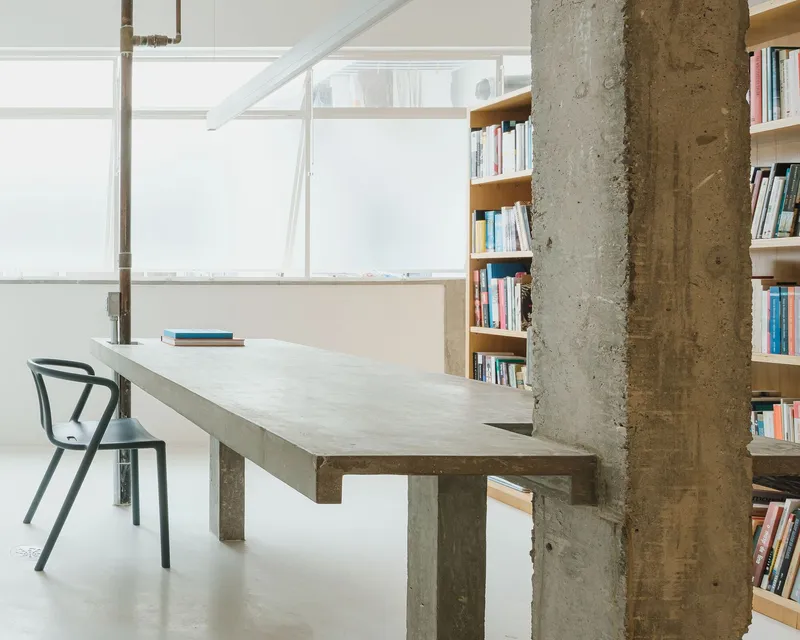
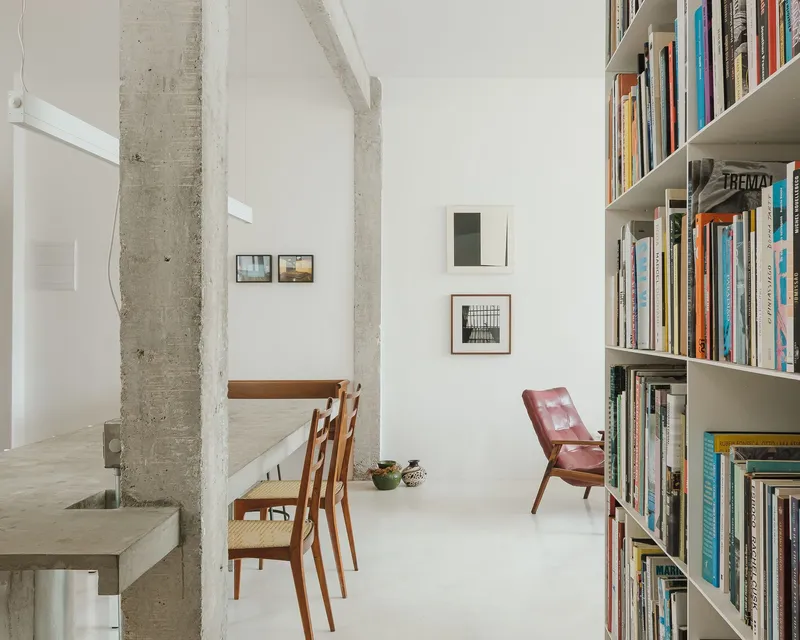
The most inventive gesture in the apartment is the series of fair-faced concrete tables that wrap around existing columns and pipes. Rather than treating the columns as obstacles to be clad or hidden, JPG ARQ used them as literal supports, casting tabletops that grow from the column base and extend into usable dining and work surfaces. A steel rainwater pipe penetrates one of the tables, becoming an almost sculptural element at the center of the workspace.
These fixed tables do double duty as spatial organizers. They mark the threshold between kitchen and dining, between dining and library. Because they are concrete and immovable, they give the otherwise fluid plan a set of stable reference points. The angled legs and rough textures echo the columns above, reinforcing the sense that the furniture and the building share the same material DNA.
The Library Wall and Blonde Wood Palette
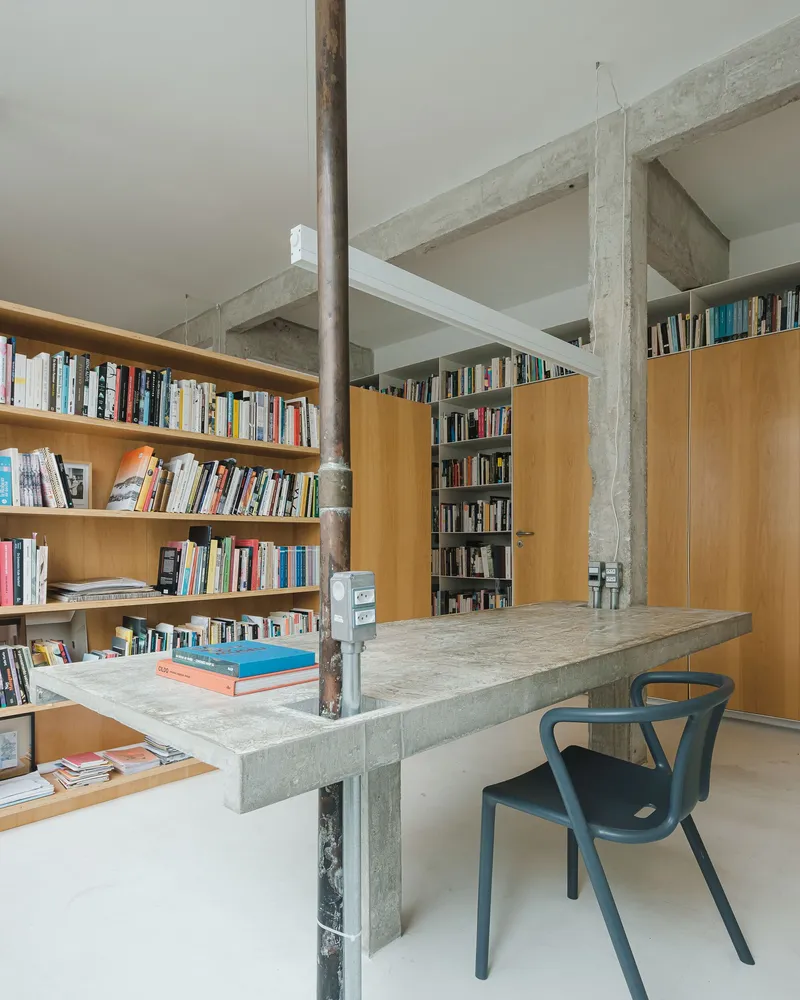
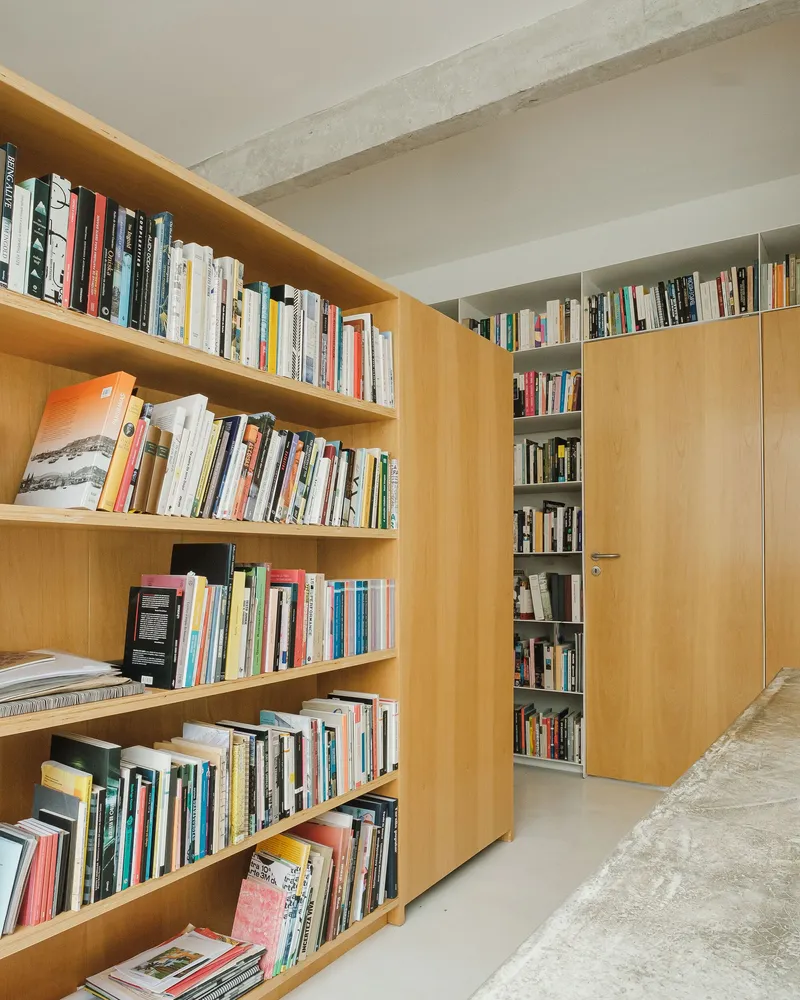
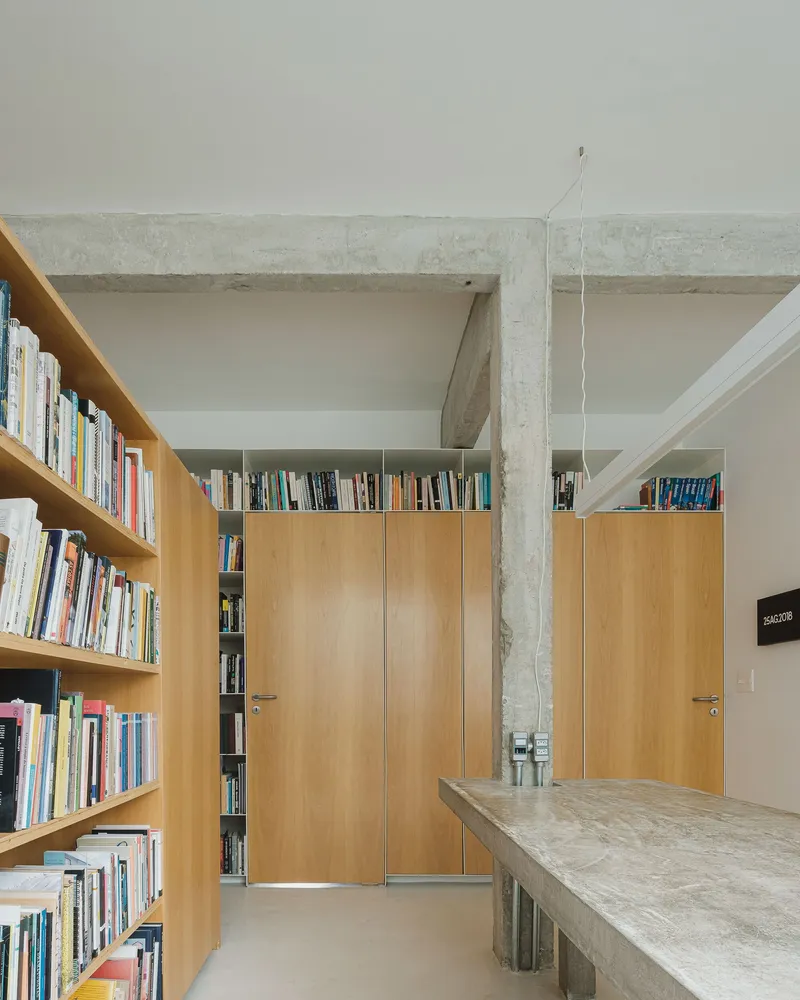
A floor-to-ceiling bookshelf runs along one entire wall of the living zone, built in blonde plywood that recurs across the apartment's cabinetry. The shelving is deep enough to absorb books, records, and objects without feeling cluttered, and its warm tone softens the gray concrete surfaces around it. Where the exposed beam crosses above, the bookcase simply stops, leaving the structural member visible as a horizontal datum line.
Timber doors and plywood panels repeat this material language in the private areas. The palette is deliberately limited: concrete, blond wood, white paint, and polished concrete flooring. There is no tile, no marble, no accent color that breaks the discipline. The restraint lets the spatial drama of the open plan carry the design rather than relying on decorative variety.
Kitchen and Office Brought to Light
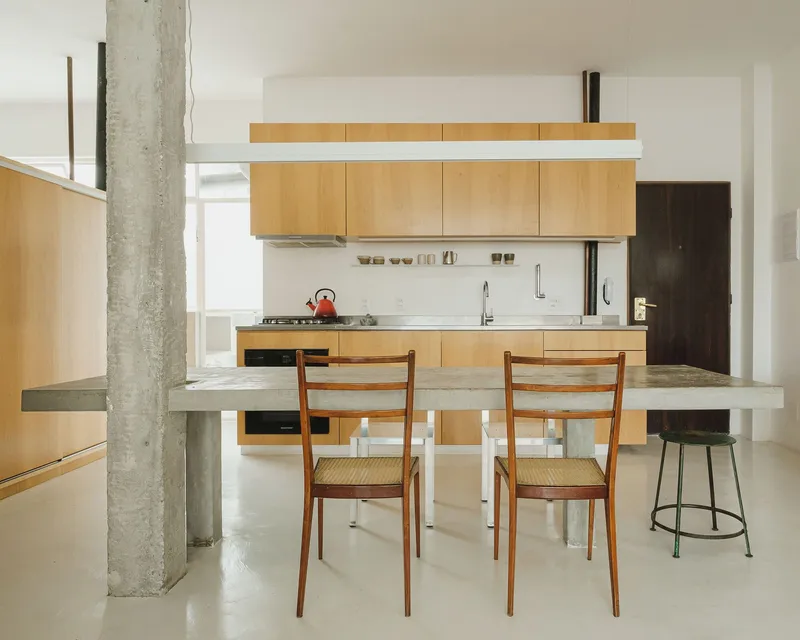
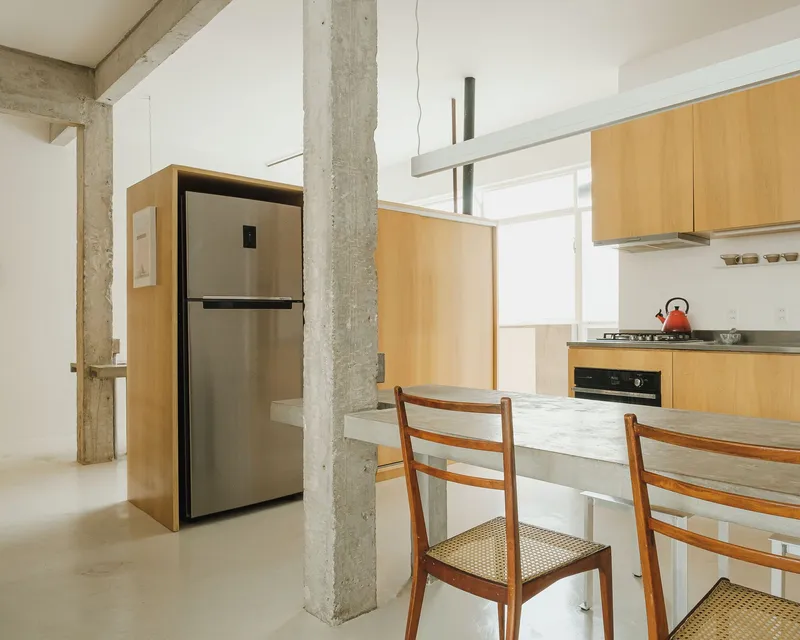
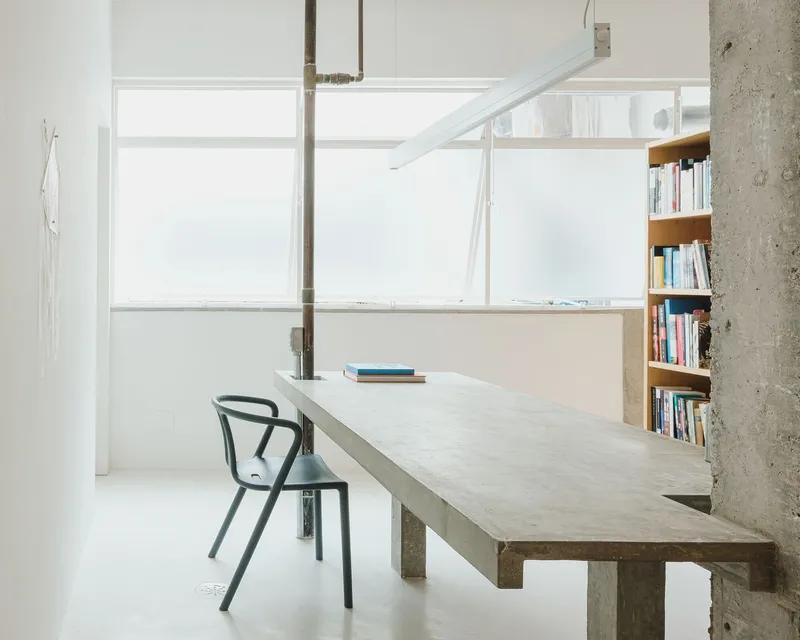
In the original layout, the kitchen was a dark service room and any home office would have been confined to a windowless corner. JPG ARQ relocated both functions toward the building's interior light wells, fitting them with frosted glass panels that let diffused daylight in while maintaining privacy from neighboring units. The kitchen counter wraps around a column in the same way the dining tables do, extending the structural-furniture logic into the cooking zone.
The low plywood cabinet that separates kitchen from office is barely waist height, preserving the visual continuity of the open plan while providing practical storage. It is a remarkably understated move: in a project where columns and beams do the heavy spatial lifting, a simple piece of joinery is all the partition the plan needs.
Thresholds and Filtered Light
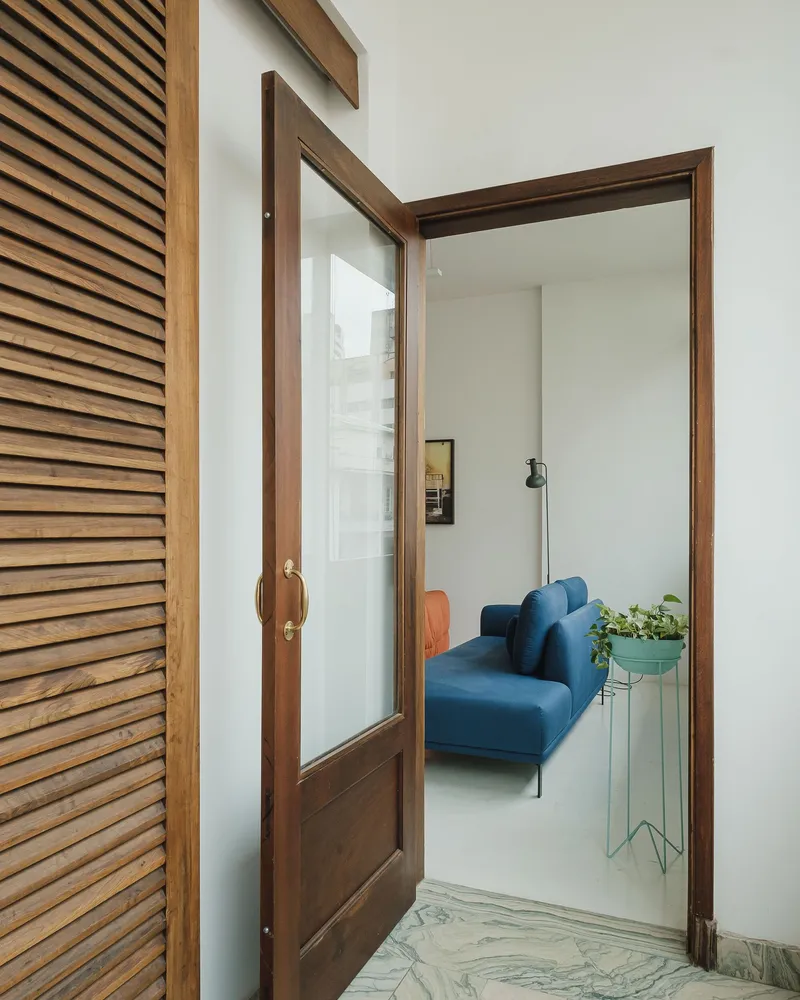
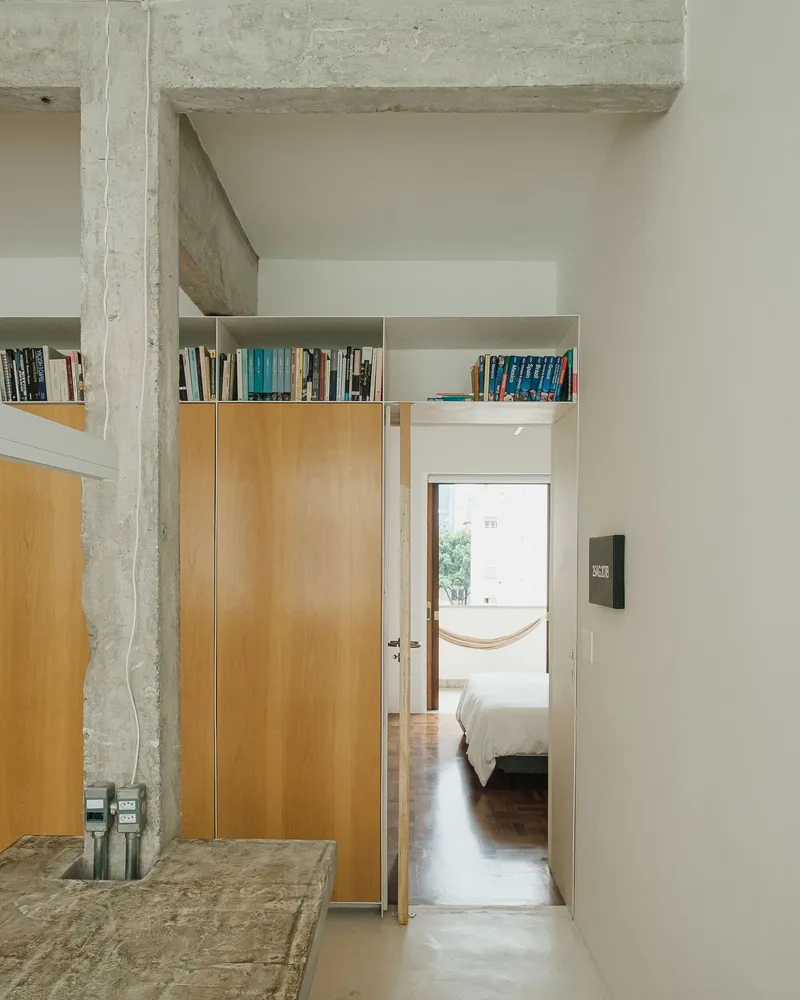
Transitions between public and private are handled with slatted screens and timber-framed glass doors rather than solid walls. A dark wood door with gridded glazing opens from a corridor screened with vertical slats into the living room, creating a layered sequence of transparency. You glimpse the blue sofa through the glass before you enter. Similarly, a doorway frames a bedroom where a hammock hangs beside an exposed column, connecting the relaxed domestic mood to the raw structural language.
These thresholds manage acoustics and visual privacy without severing the spatial flow. Light passes through them, and each frame offers a composed view that makes the compact apartment feel larger than its 106 square meters.
Living with the View
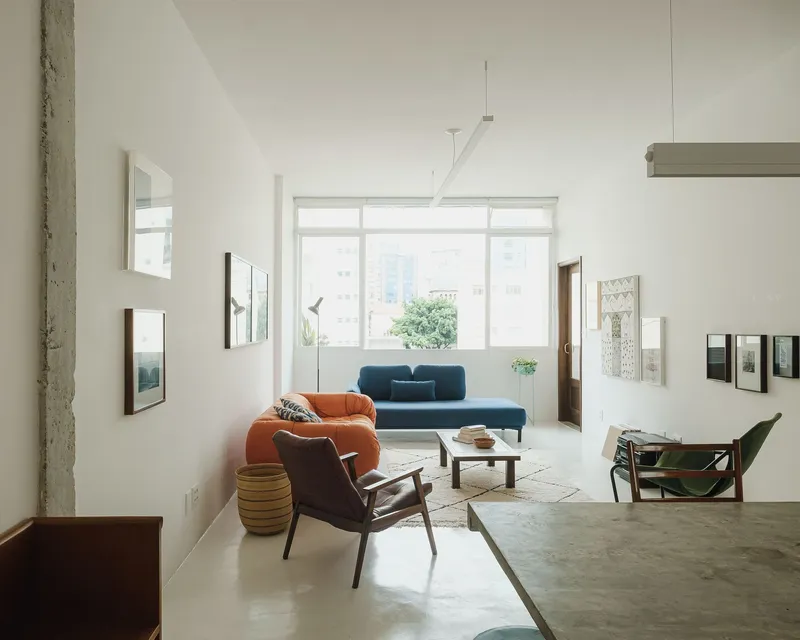
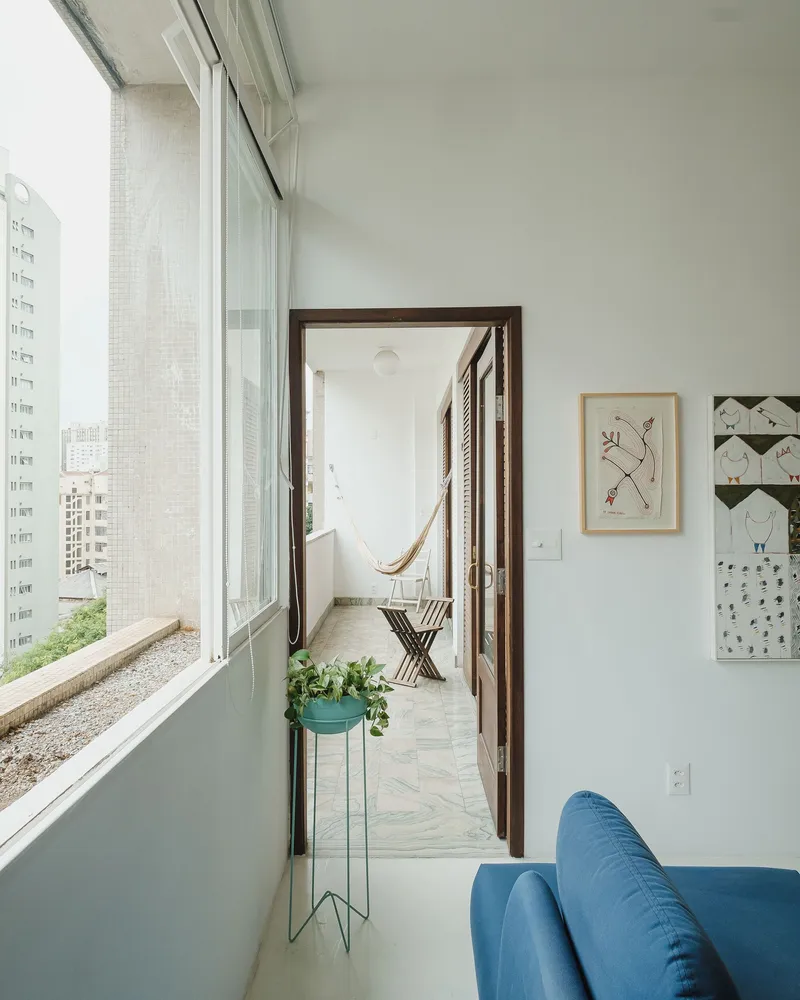
Sitting on the building's top floor, the apartment benefits from a generous relationship with the sky. The living room's large gridded window fills the space with even, diffused daylight, and a glazed balcony opens onto a narrow terrace where a hammock stretches between walls with views to the surrounding Santa Cecília roofscape. The mid-century furniture in the living room feels right at home against the bare concrete: Eames-era proportions complement the structural grid overhead.
The freestanding plywood storage cube visible in the middle of the plan acts as a room within a room, housing storage between two columns without touching the ceiling. It is one of the few volumetric additions in the project, and its modesty underscores the overall strategy: add only what the plan truly requires, and let the building's frame do everything else.
Plans and Drawings
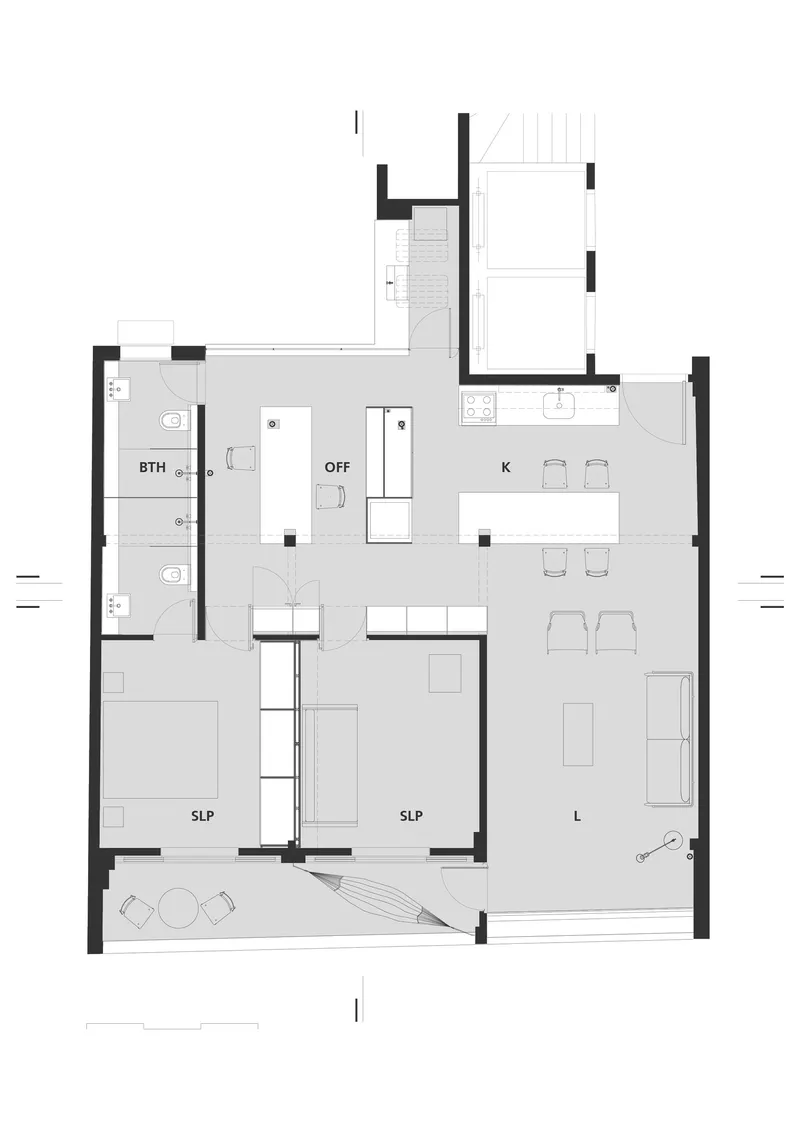
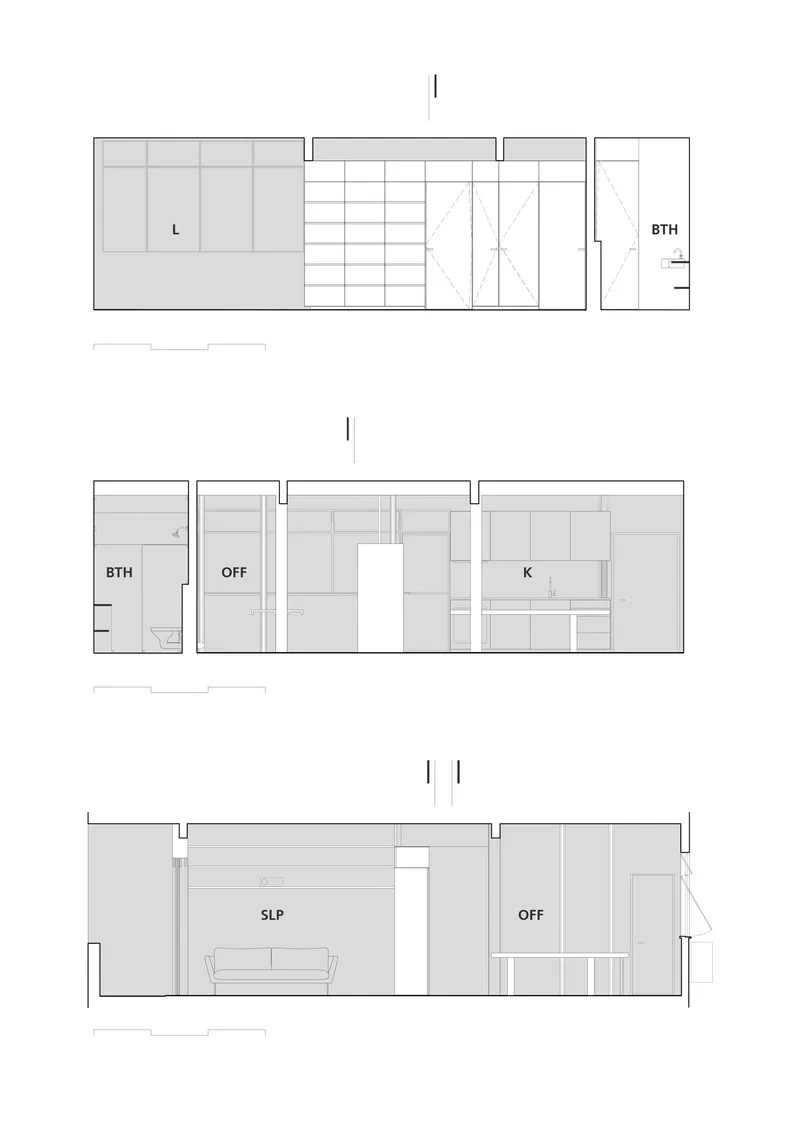
The floor plan confirms what the photographs suggest: the apartment is essentially one room with services pushed to the edges. Bathrooms occupy a compact band along one side, and the two sleeping areas are separated from the open zone by screens rather than load-bearing walls. The section drawings reveal built-in sleeping platforms, tall integrated shelving, and storage configurations that exploit the full floor-to-ceiling height. Every square centimeter of the 106 m² is accounted for.
Why This Project Matters
The Aureliano Coutinho Apartment makes a case that the best renovation material is the one already on site. By stripping the 1980s plan down to its concrete skeleton and using that skeleton as both spatial organizer and furniture, JPG ARQ achieves an atmosphere of rawness and precision that neither a clean minimalist box nor a rough industrial conversion could deliver. The concrete tables growing from columns are not styling choices; they are logical extensions of the structural system, and they give the project a coherence that goes deeper than surface.
For a generation of architects working within the enormous stock of late-twentieth-century Brazilian apartment buildings, this project offers a replicable lesson: the compartmentalized layouts of that era were spatial waste, and the structures hiding behind them are often more generous than anyone expected. The act of demolition here is not destructive. It is a form of discovery.
Aureliano Coutinho Apartment by JPG ARQ. Located in Santa Cecília, São Paulo, Brazil. 106 m². Completed in 2020. Photography by Pedro Kok.
About the Studio
Share Your Own Work on uni.xyz
If projects like this are the kind of work you want to make, uni.xyz is a place to publish your own, find collaborators, and enter design competitions.


Popular Articles
Popular articles from the community


ALGAL REALM: A Bio-Integrated Lunar Habitat Design for Life Beyond Earth
ALGAL REALM reimagines lunar habitat design with algae-powered life support, 3D-printed regolith, and vertical living for a lunar future.

Play: Fragments of Their World
Familiar architecture becomes modular playground design, creating safe spaces where displaced children can learn, connect, imagine and play.

Little Red Riding Hood: Architectural Design as a Journey Through Fear, Light, and Storytelling
Little Red Riding Hood reimagines the fairy tale through architectural design shaped by fear, light, scale, memory, uncertainty, and choice.

Hill & Cross Opera: Sculptural Opera House Architecture Shaped by Tallinn’s Landscape and Identity
Hill & Cross Opera reimagines opera house architecture in Tallinn through its sculptural hill, civic plaza, glass wave and a luminous cross.

Similar Reads
You might also enjoy these articles

Bao Huynh Watercolor Atelier: A Serene Art Retreat in Hội An
Bao Huynh Watercolor Atelier in Hội An blends multifunctional art spaces, sustainable design, local materials, and family-friendly living in a serene environment.

Atelier Macri Concept Store Interior Design by CASE-REAL
Atelier Macri store features a "ko" counter, walnut wood details, cork displays, blending retail, gallery, and seamless customer experiences.

Manuel Vargas Izquierdo Stadium and High-Performance Sports Center: Architectural Excellence in Jalpa de Méndez
The Manuel Vargas Izquierdo Stadium blends sustainable design, inclusive sports facilities, and cultural-inspired architecture, revitalizing Jalpa de Méndez’s public spaces.

KAKR Buluh Awar Hall: Revitalizing Community and Ecology Through Bamboo Architecture
Community built bamboo hall revitalizes Buluh Awar village, empowering youth, restoring ecology, celebrating vernacular craftsmanship through sustainable architecture and culture.

Explore Apartment Competitions
Discover active competitions in this discipline

Challenge to reimagine the Iron Throne

Photograph architecture without architects

Illustrate the lost glory of Angkor Wat - Render Challenge

Design challenge to reuse E-waste
Comments (0)
Please login or sign up to add comments
No comments yet. Be the first to comment!