

Jugnoo (Firefly): A Bamboo Wall Light You Dim by Folding It
A wire-free bamboo sconce by Sashi Malik where three hinged segments open and close as one, turning the act of dimming into a gesture of touch.


Most light fixtures hide their control in a switch on another wall. Jugnoo (Firefly) puts it in the object itself: you change the light by physically opening or closing the lamp. The result is a small wall-mounted unit where brightness is a matter of posture rather than circuitry, and where the fixture keeps its sculptural presence whether it is glowing or dark.
Designed by Sashi Malik and published as a project on uni.xyz, Jugnoo takes its name and its logic from the firefly, an insect that lights up for a moment and then fades. The brief Malik set was precise: a portable, self-contained accent light with no switches, no wiring and no external hardware. It is built mainly from bamboo with aluminium components and energy-efficient LEDs. It weighs about 450 grams and costs roughly Rs. 200 (about $3) in materials, figures that matter as much to the argument as the form does.
A Firefly's Pulse Inside a Bird's Silhouette

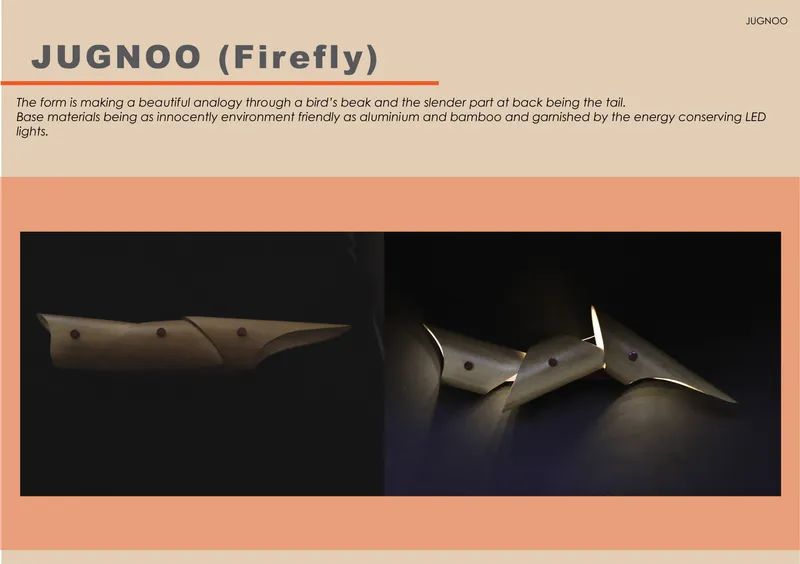
The prototype photographs show the lamp closed and then unfolded, and the difference is the whole point. Closed, the jointed bamboo body reads as a compact, faceted object. Open, it spreads into something closer to a creature mid-movement. Malik draws the analogy directly: the front reads as a beak and the tapered rear as a tail. That gives the fixture a recognisable silhouette in daylight, when most sconces are just hardware waiting for dusk.
The presentation board makes the firefly reference concrete by pairing the unlit lamp with the same object glowing in a dark room. The light is not meant to flood the space. It flickers into presence when the user opens the lamp and retreats when they close it, which is a more modest and more accurate reading of the insect than a literal glowing bug. The biomimicry works at two levels: the form borrows from the bird, and the behaviour borrows from the firefly.
Three Bamboo Segments That Move as One

The cutting template is the most revealing image in the set. It lays out the bamboo segment profiles as flat geometry, and beside it sit dark painted prototypes tied with string on a wooden board. This is a design worked out by hand and through testing. The final mechanism stacks three bamboo segments in a column, linked so that a single open-close action moves all three at once. Adjusting one element dims the light, brightens it or turns it off completely.
Malik's later studies pushed the linkage toward an S-shaped movement, so the segments twist as they open instead of simply hinging outward. That decision matters spatially, not just mechanically. A twisting body changes the angle at which each segment meets the light source, which changes what lands on the wall. The mechanism does two jobs: it replaces the switch, and it shapes the light.
The Wall Becomes Part of the Fixture
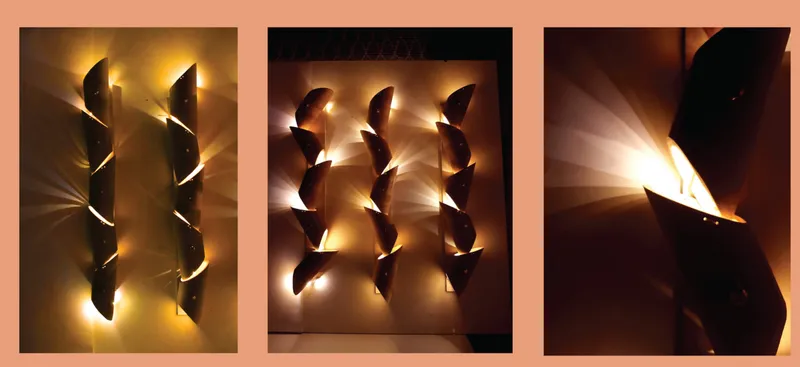
The night photographs show what the twist was for. Mounted on pale walls, the sconces throw fanned, layered light outward from their openings, produced by several internal light sources interacting with the bamboo segments. The close-up of a single glowing opening shows how tightly the aperture controls the beam. The wall stops being a neutral backdrop and becomes the surface on which the lamp draws, with texture, colour and shadow all part of the composition.
This is where Jugnoo makes its case as accent lighting rather than task lighting. The effect is soft and atmospheric, suited to residential, hospitality or cultural interiors, where a wall of repeated units could read as a pattern of light rather than a row of fittings. Because each unit can be opened to a different degree, a cluster would never look quite the same twice.
No Wiring, Just a Base That Opens

The final sequence follows a hand opening the lamp's red base outdoors and swapping out a 9-volt battery. It is a modest image, but it shows a lot about the design. Battery replacement is meant to be easy, and the lack of wiring means the unit can be mounted wherever a wall allows, with no electrician and no chasing of cables. The independence that defines the interaction also defines the installation.
There is a trade-off here that a future iteration could address: battery power keeps the unit portable but brings its own replacement cycle and disposal question. Even so, pairing a renewable primary material with low-draw LEDs and a 450-gram body keeps the overall footprint small, and making the battery easy to reach respects the user's time.
Why This Project Matters
Jugnoo shows that interactivity does not need sensors or apps. Malik gets the experience of a responsive light from a three-segment bamboo linkage and a single gesture, and that mechanism also produces the light pattern on the wall. When the control and the effect are the same physical movement, the object feels resolved in a way that many bolt-on smart fixtures do not.
The numbers also make a quiet argument. A wall light at about 450 grams and roughly $3 in materials, made mostly of bamboo, suggests that sustainable lighting does not have to be a premium category. The cutting templates and string-tied prototypes show a designer finding the form through making, and the outcome is a fixture that reads as sculpture by day and as a soft wash of light at night.
View the Full Project
About the Designers
Designers: Sashi Malik, Sashi Mali
Enter a Design Competition on uni.xyz
uni.xyz runs architecture and design competitions year-round that reward proposals with spatial conviction and real site intelligence.
Project credits: Jugnoo (Firefly) by Sashi Malik, Sashi Mali.


Popular Articles
Popular articles from the community


Temporary Home for Dogs: A Reversed Zoo Rethinks Animal Shelter Architecture
In Bucharest, a sinuous corridor and freed landscape flip the logic of containment, designing a shelter that works to make itself unnecessary.

Singing Woman: An Opera House That Performs Before the Curtain Rises
Ovidiu Cristian Pavel's conceptual opera house translates Estonia's choral identity into a sculpted waterfront landmark facing the Baltic Sea.

Extended Shell: Retrofitting Kolkata's Balconies as Living Urban Thresholds
A modular retrofit system recovers the social and environmental intelligence of Kolkata's historic verandas for contemporary Park Street residents.

Opera on the Sea: Driftwood Logic Shapes a Timber Opera House on Estonia's Coast
Trevor Orgill's opera house translates the entangled drift of floating timber into a civic building where wood, water, and music converge.

Similar Reads
You might also enjoy these articles


Maya Harvest: A Cacao Resort Village Rooted in Mayan Tradition and Local Craft
Situated within a Tabasco cacao plantation, this shortlisted resort proposal merges vernacular materials with hands-on cultural immersion.
Harmonia: A River-Shaped Community That Grows Over Decades in Boa Vista
Curved pathways and modular grid structures along the Branco River create a phased settlement designed to evolve from 2030 to 2050.

The Architecture of Bathing: A Mughal Hammam Reimagined Across the Yamuna
Charlotte May's honorable mention entry for The Black Taj reinterprets Agra's bathing rituals through red sandstone, water, and framed views of the Taj Mah
Om-1: A Wall-Hung System That Moves Your Workspace Off the Desk
Modular plywood boards, magnetic pegs, and utility elements migrate clutter from the horizontal surface to the vertical plane.

Explore Lighting Fixture Competitions
Discover active competitions in this discipline

Design challenge to equip cities with modern furniture

Packaging challenge - Design meets sustainability
Comments (0)
Please login or sign up to add comments
No comments yet. Be the first to comment!