

Narrative Architects Revitalizes a Declining South Korean Port Town One Building at a Time
In Julpo, a series of bold architectural insertions confronts stagnation with sculptural steel, raw OSB, and radical contrast.


Julpo was once a thriving port. Then sediment filled the harbor, the economy shifted to agriculture, young people left for the cities, and the town quietly emptied out. It is the kind of place that rarely appears in architecture magazines, precisely because it has so little of what we typically celebrate: no clients with daring taste, no generous budgets, no cultural infrastructure to build on. What Narrative Architects has done here is treat that vacuum not as a constraint but as raw material, inserting a sequence of small, deliberately provocative structures into Julpo's fabric to restart a conversation between the town and its own future.
The Julpo Regeneration Series is not a master plan. It is a set of tactical strikes: a community hub grafted onto an existing brick building, a sculptural public restroom, and a warehouse turned gallery. Each intervention is modest in footprint but loud in architectural language, deploying green-painted steel, OSB panels, and double-curved metallic cladding against a backdrop of aging concrete, corrugated metal, and overhead power lines. The dissonance is the point. By refusing to blend in, the new elements make visible the latent energy of a place most people had written off.
A Community Hub Where None Existed
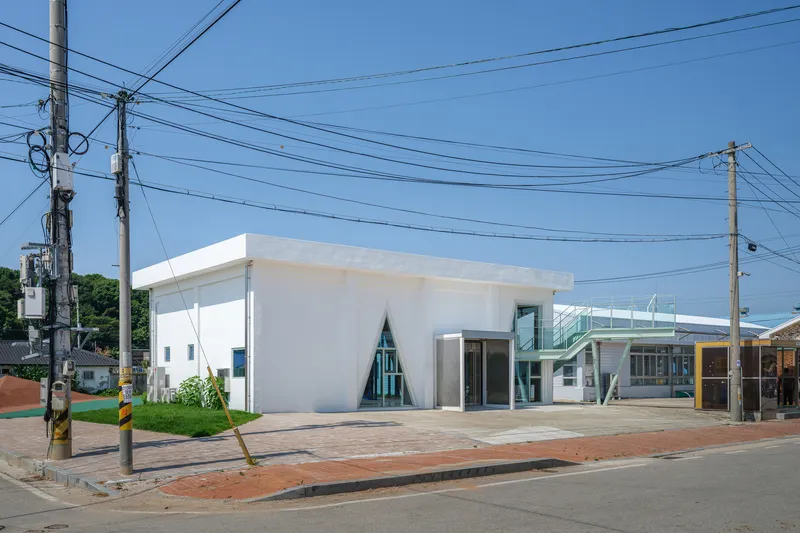
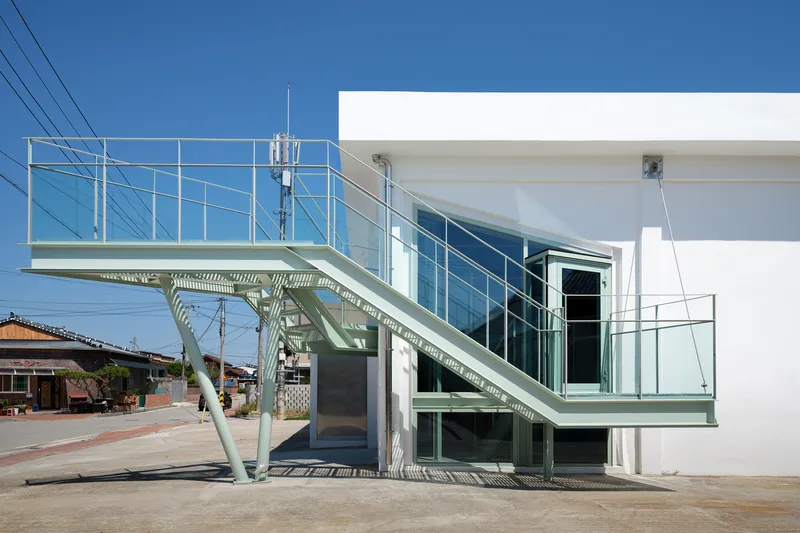
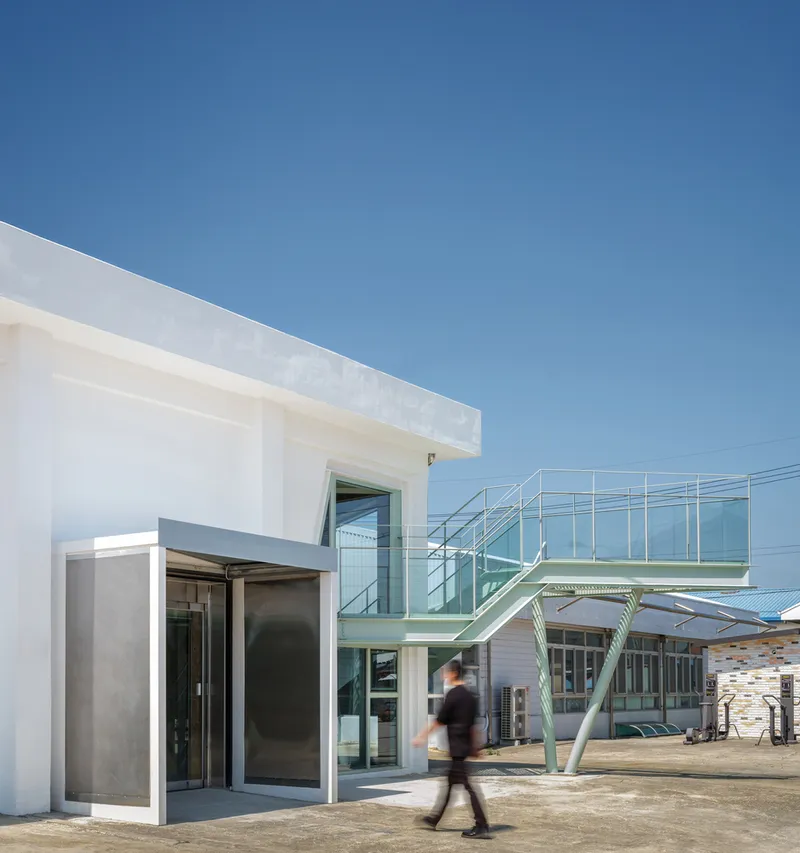
The original building served as a meeting place for market merchants and housed a public restroom. It was the kind of structure that exists in every small Korean town: brick walls, minimal program, zero ambition. Narrative Architects kept the reinforced brick shell but gutted the interior to accommodate an enlarged meeting room, a video studio, and a shared kitchen. The program expansion alone would have been useful. What makes the project interesting is the rooftop observation deck, reached by a splayed green steel staircase that leans against the white concrete volume like a piece of industrial sculpture.
The deck is oriented toward the sunset, a deliberate callback to Julpo's identity as a western coastal town. It is a small gesture with outsized effect: suddenly a forgotten building on a forgotten street becomes a destination. The green steel, the triangular window punched into the white wall, the tubular supports fanning outward at the base of the stair all signal that something has changed here. They mark the building as a public asset, not a leftover.
Sculptural Disruption on a Quiet Street

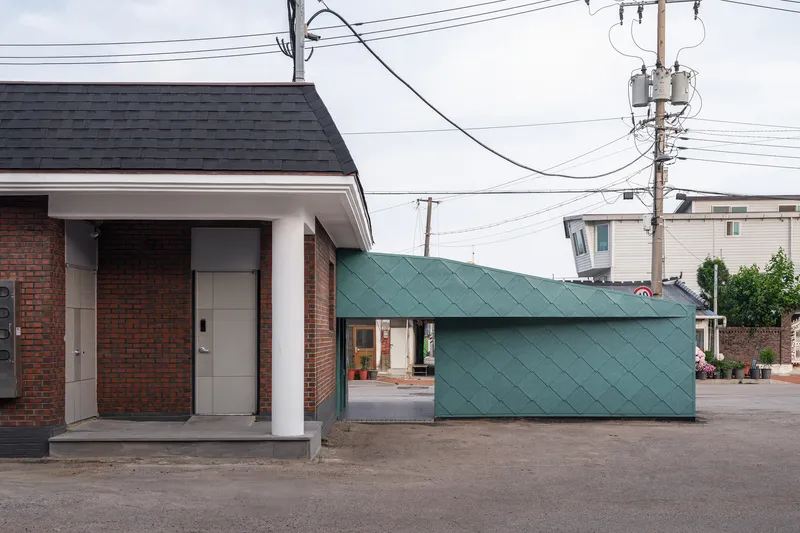
The new public restroom is the most visually aggressive element in the series. Wrapped in metallic cladding with a low-tech double-curved roof, it sits next to the brick entrance pavilion like a visitor from another century. The diamond-patterned green metal skin has nothing in common with the red corrugated warehouse facade across the courtyard. That collision is calculated. Narrative Architects is not interested in contextual politeness. They want the new form to provoke a reaction, to make residents and visitors alike stop and reassess what a small-town public building can look like.
The courtyard formed between the restroom, the hub, and the surrounding structures acts as a connective outdoor room. A green steel stair bridge links rooftop levels, turning what was once a gap between buildings into a navigable public circuit. The power lines overhead and the rough textures of the existing walls remain fully visible. Nothing is concealed or prettified. The project gains its credibility precisely from this honesty about the conditions it operates within.
The Warehouse Gallery: Architecture as Archaeology
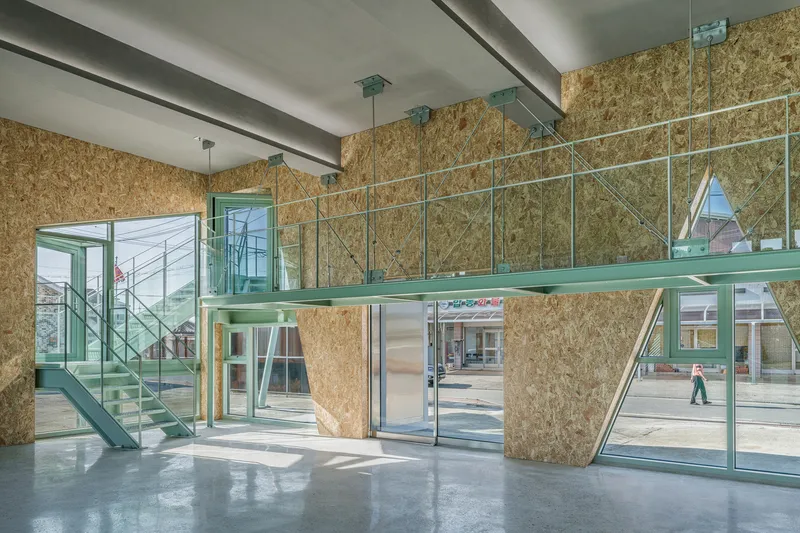
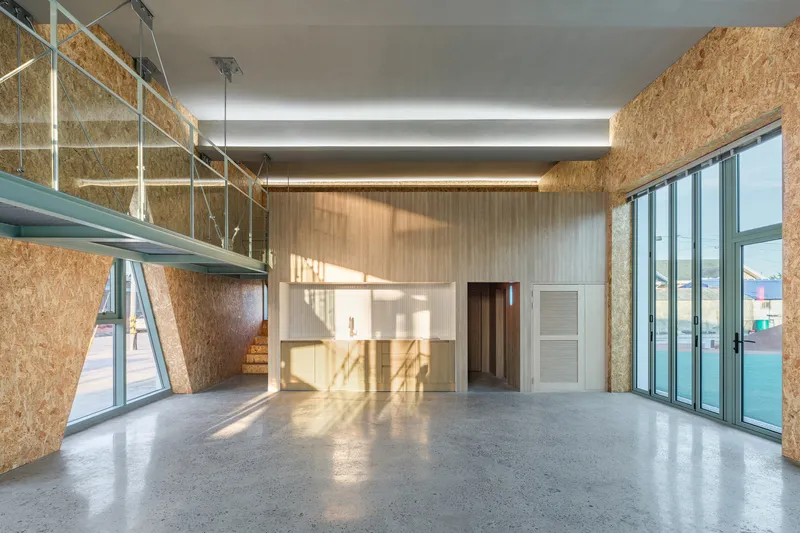
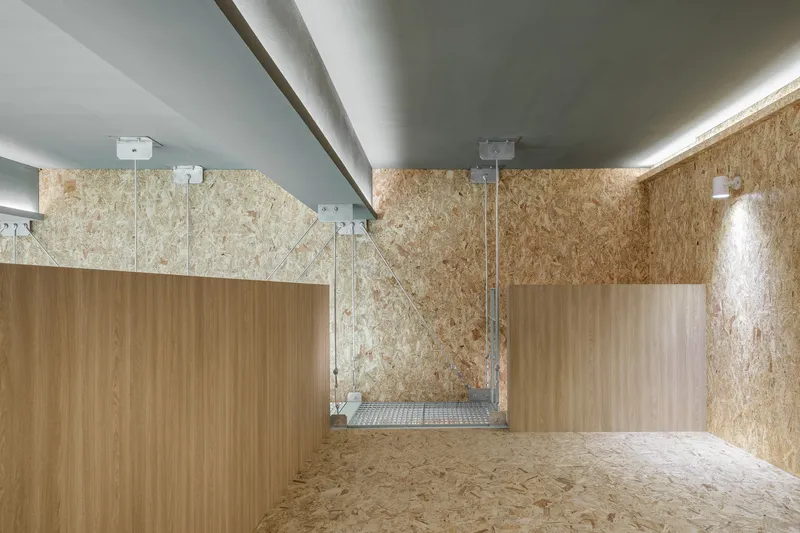
Julpo's reinforced concrete warehouses date from the town's trading era and had been sealed off for years, their cold-storage doors shutting out the community that once depended on them. Narrative Architects pried those doors open, fixed them as canopies, and suspended a lightweight steel gallery within the existing concrete frame. The gallery does not simply occupy the warehouse; it traverses and penetrates the exterior walls, creating an experience where Julpo's past (displayed in exhibitions) overlaps physically with its present (visible through glazed openings to the street).
Inside, OSB panels line the double-height volume, giving the space a warm, provisional quality that reads as workshop rather than white cube. Freestanding timber-clad boxes house smaller program elements. Afternoon sunlight pours through the glass doors and rakes across the rough surfaces, making the interior feel alive even when empty. The spatial layering, where you glimpse the mezzanine walkway from below, or look down through mesh treads to the polished concrete floor, keeps you aware of the building's vertical section at all times. It is a warehouse that has been taught to think in three dimensions.
Steel, Mesh, and the Language of Lightness
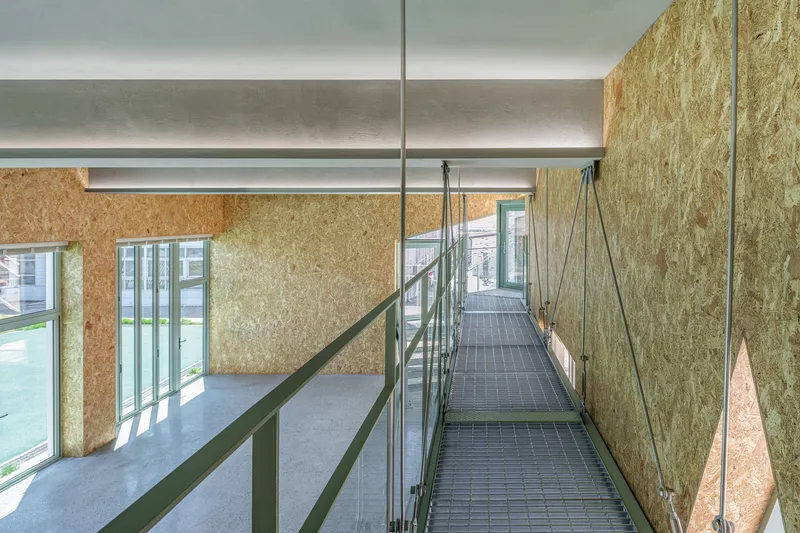
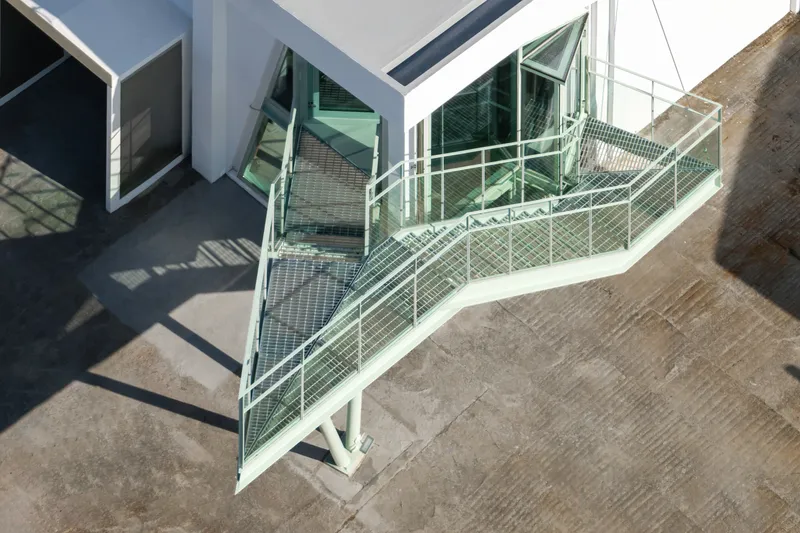
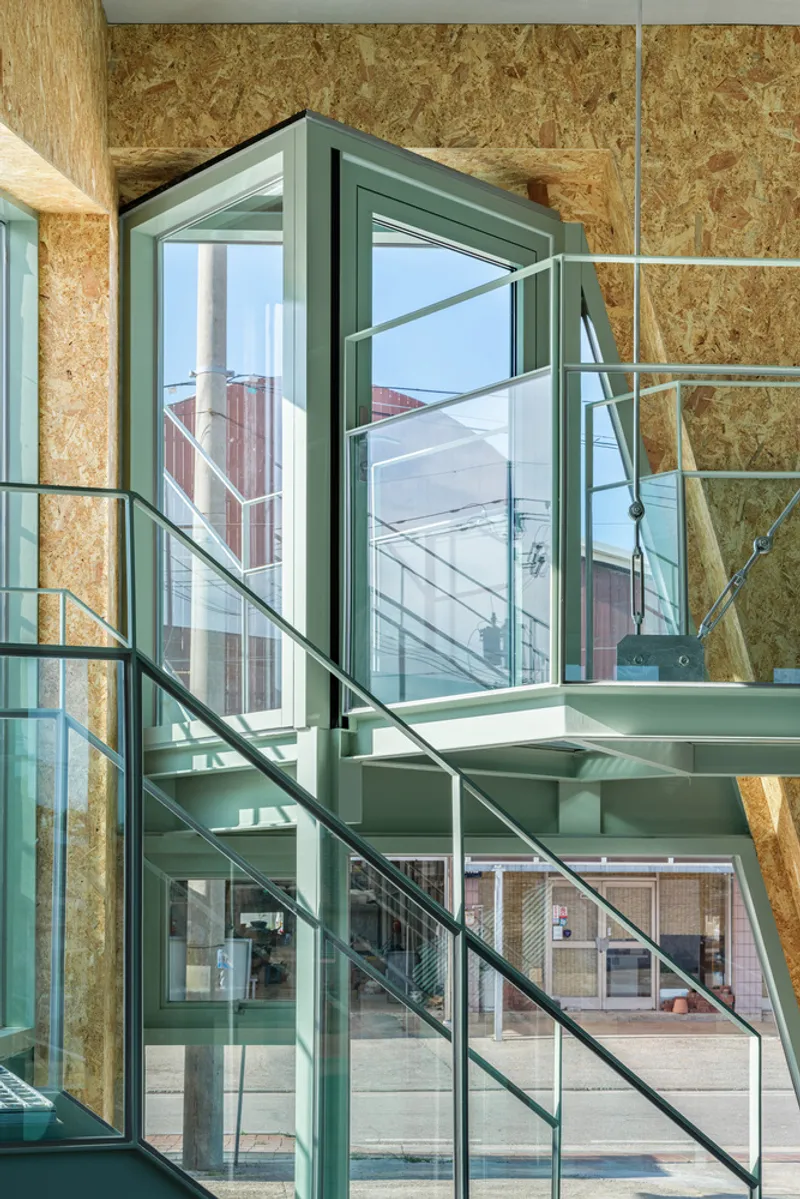
The material palette across all three interventions is remarkably consistent: green-painted steel for structure and stairs, steel mesh and grating for walkways, OSB for wall linings, and wire tension cables for the suspended bridge. It is an inventory of lightweight, off-the-shelf industrial components assembled with precision. The green color, repeated on every steel element from the stair treads to the mezzanine handrails, functions as a unifying brand mark for the entire regeneration series, tying otherwise scattered projects into a single legible campaign.
There is a cleverness to the way the mesh treads and wire cables allow light and shadow to pass through them. The overhead view of the staircase reveals a pattern of shadows on the polished concrete that is almost textile in quality. The glass treads on the interior stair catch light differently at each hour. These are not luxurious materials, but they are used with enough care that they generate genuine spatial richness. The lesson is one that declining towns everywhere need to hear: limited budgets do not require limited ambitions.
Inside the Warehouse Volume
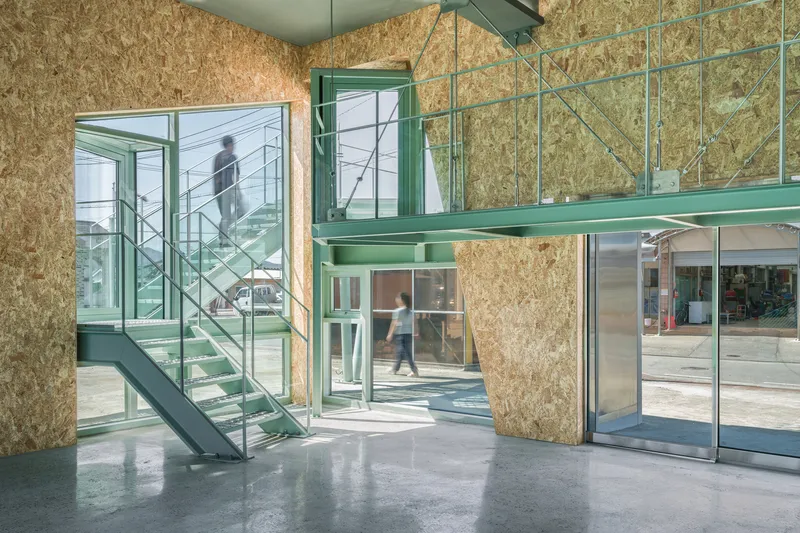
The double-height entrance hall is where the project's public ambition is most legible. Figures move through a space defined by the warm grain of oriented strand board on the walls and the hard linearity of the green steel staircase rising through the section. The proportions are generous for a town of Julpo's scale. The hall does not feel like a community center; it feels like a civic institution, and that shift in register is intentional. Narrative Architects is betting that if you build spaces that take a community seriously, the community will respond in kind.
Plans and Drawings
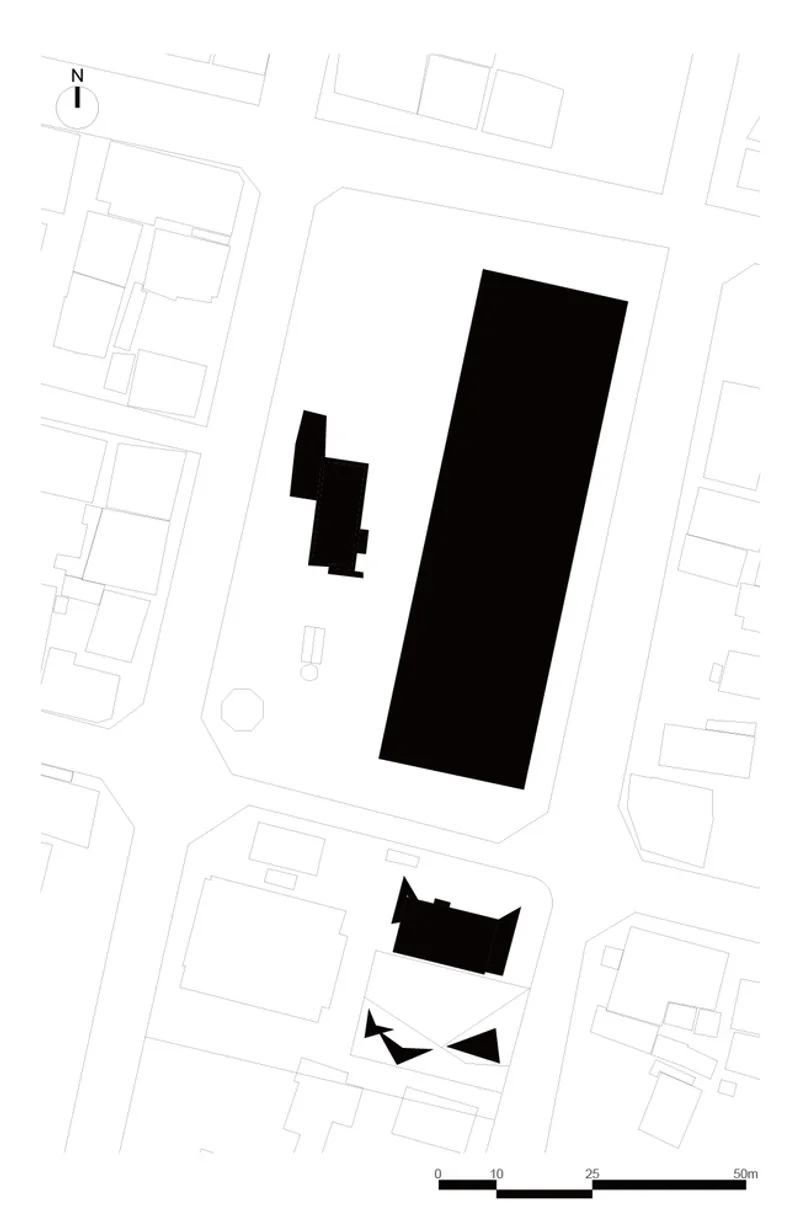
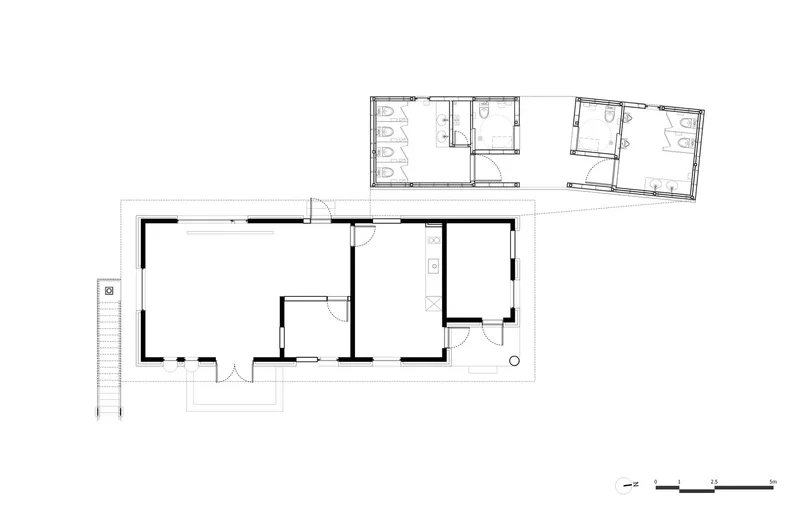
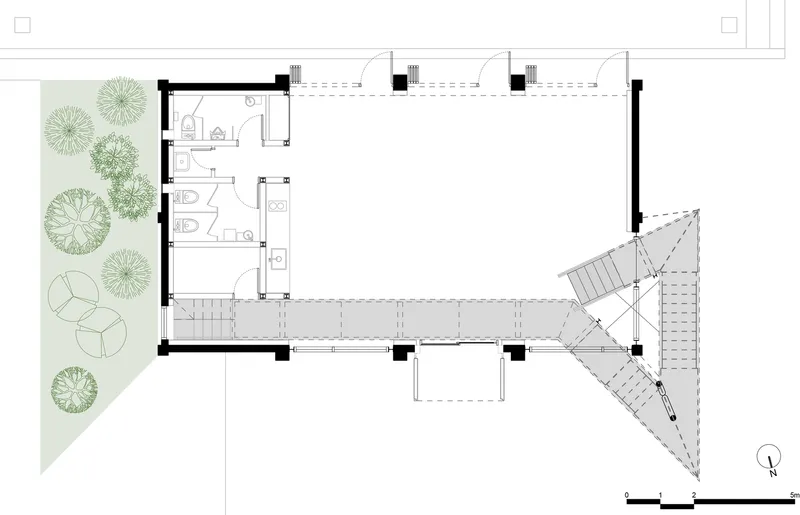
The site plan reveals just how tightly embedded the interventions are within Julpo's existing urban block. The buildings sit among dense, small-scale parcels with narrow streets, not on cleared land or generous setbacks. The floor plans confirm the economy of the approach: compact rectangular footprints with corner gardens, diagonal stair towers, and restroom clusters that negotiate between the orthogonal grid of the town and the sculptural geometries of the new insertions. The attached restroom block reads as an appendage on one plan, an autonomous object on another, reflecting its dual role as functional infrastructure and provocative urban marker.
Why This Project Matters
Most urban regeneration projects in small towns fall into one of two traps. Either they produce polite, forgettable buildings that change nothing, or they import a spectacle that has no relationship to local life. Narrative Architects avoids both by calibrating each intervention to be just dissonant enough to demand attention while remaining useful enough to earn its place. A meeting room, a kitchen, a public toilet, a gallery: the programs are ordinary. The architecture is not. That gap between the everyday function and the unexpected form is where the regeneration actually happens, in the moment a resident looks up and realizes that someone took their town seriously enough to put something strange and beautiful in it.
Julpo is unlikely to become a destination. The power lines will stay, the population will remain small, and the harbor will not reopen. But the Regeneration Series proves that architecture does not need to solve those problems to matter. What it can do is change the terms of a conversation. Where there was decline, there is now a rooftop sunset deck. Where there was a sealed warehouse, there is now a gallery that lets sunlight and history coexist. That is not a miracle. It is something more sustainable: an argument, made in steel and OSB, that even the smallest towns deserve to be designed with intention.
Julpo Regeneration Series by Narrative Architects, Julpo, South Korea.
About the Studio
Share Your Own Work on uni.xyz
If projects like this are the kind of work you want to make, uni.xyz is a place to publish your own, find collaborators, and enter design competitions.


Popular Articles
Popular articles from the community

Extended Shell: Retrofitting Kolkata's Balconies as Living Urban Thresholds
A modular retrofit system recovers the social and environmental intelligence of Kolkata's historic verandas for contemporary Park Street residents.

Opera on the Sea: Driftwood Logic Shapes a Timber Opera House on Estonia's Coast
Trevor Orgill's opera house translates the entangled drift of floating timber into a civic building where wood, water, and music converge.
Opera by the Sea Estonia: Three Shells Dissolving Architecture into Tallinn's Coastline
A winning opera house proposal replaces monumental form with interconnected shells that blur the boundary between building, park and Baltic Sea.

Singing Woman: Contemporary Architecture Inspired by Estonia’s Voice and the Sea
Singing Woman turns Estonia’s song culture into flowing opera house architecture, blending public life, landscape, sea, and national memory.

Similar Reads
You might also enjoy these articles

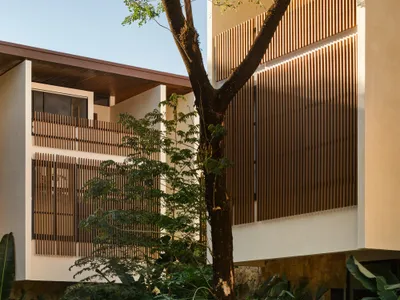
FAMM Arquitectura Organizes Ten Villas Around Courtyards and Jungle in Nosara, Costa Rica
El Molino pairs two elongated volumes with deep overhangs and timber louvers to build a compact coastal community five minutes from the beach.
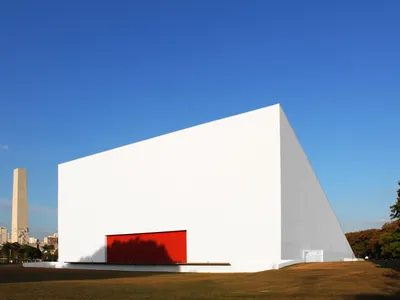
Oscar Niemeyer's Ibirapuera Park Pavilions Define São Paulo's Cultural Identity in Concrete and Curve
A constellation of modernist volumes set within São Paulo's most important urban park, conceived for the city's 400th anniversary in 1954.
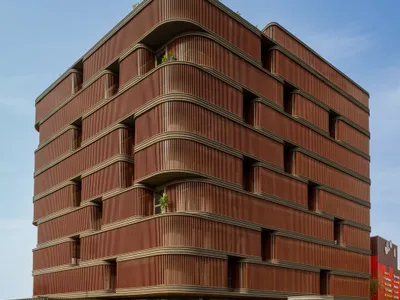
Sanjay Puri Architects Wraps a Jaipur Office Tower in Capsule-Shaped Green Buffers
A nine-level climate-responsive workplace near Jaipur Airport uses stacked planter terraces and aluminium screens to fight 40°C heat.
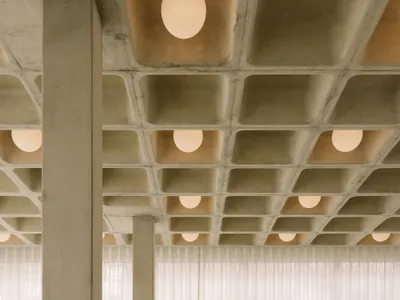
RHO Converts a Berlin Spree-Side Industrial Courtyard into Enkime's 1,000 m² Agency Headquarters
A social media agency's new home in Charlottenburg trades glossy branding for concrete waffle ceilings, glazed tile, and sheer curtains.

Explore Urban Renewal Competitions
Discover active competitions in this discipline

Challenge to reimagine the Iron Throne

Photograph architecture without architects

Illustrate the lost glory of Angkor Wat - Render Challenge

Design challenge to reuse E-waste
Comments (0)
Please login or sign up to add comments
No comments yet. Be the first to comment!