
Jumping House Lab Spirals a Concrete Tower Above the Treetops for Mountaintop Cyclists
A 90-square-meter rest station in Shaoxing climbs past the canopy to unlock panoramic views along a mountain cycle track.


At the highest point of a mountain cycling track in Shaoxing, China, a problem presented itself: the view to the north, the one worth stopping for, was entirely blocked by trees at eye height. Jumping House Lab's response was not to clear the forest but to build through it. Their rest station, completed in 2021, uses a board-formed concrete tower to lift cyclists above the canopy and into a panorama of ridgelines and distant city sprawl. The building is small, just 90 square meters, but its vertical ambition makes it feel like an event on the landscape.
What makes this project worth studying is its refusal to accept the ground plane as the terminus of the journey. The entire sequence, from bike parking at the entrance through a spiraling corridor to an elevated observation room, is organized around ascent. The building doesn't sit on the mountaintop so much as it extends it, adding just enough altitude to transform a rest stop into a destination. Lead architects Tiantian Wang and Yaqin Luo treated infrastructure as architecture, turning a utilitarian pause along a cycling route into something genuinely spatial.
A Tower That Extends the Mountain
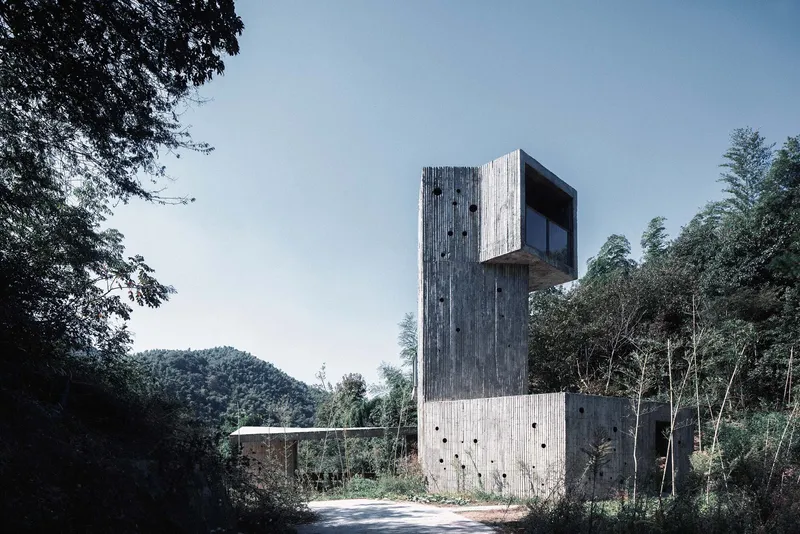
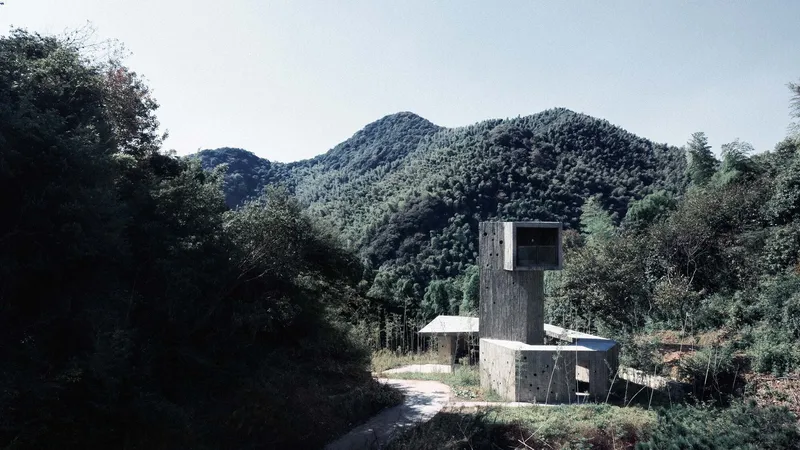

From the road, the tower reads as a vertical slab of rough concrete punching through the forest canopy. Its board-formed surfaces give it a grain that rhymes with the surrounding bark and timber, while its geometry, hard and rectangular, refuses any picturesque camouflage. The single-story base volume hugs the slope, its horizontal roof line providing counterweight to the tower's insistent verticality. Together they create a composition that is both compact and legible from a distance.
The relationship between the tower and its low-lying base is the key formal move. The base handles arrival and rest. The tower handles aspiration and view. One is grounded, sheltered, practical. The other is exposed, aspirational, almost totemic. The fact that both are cast in the same board-formed concrete unifies them materially while their distinct proportions keep the tension alive.
Arrival and the Corridor Sequence


The entrance sequence is deliberately compressed. Cyclists arrive along a gravel path and pass beneath cantilevered concrete volumes that frame the entry with deep shadow. Circular openings puncture the walls overhead, casting shifting discs of light onto the ground. The ribbed concrete surfaces are tactile and immediate, pulling you into the building before you fully understand its layout. Bike parking is integrated at the entrance, treating the bicycle not as an afterthought but as the reason the building exists.
A covered courtyard with vertical timber formwork walls and planted vegetation acts as a decompression chamber between the road and the interior. The gravel floor continues from outside, blurring the threshold. You are still outdoors, technically, but the walls have begun to steer your movement. It is a classic architectural promenade compressed into a very tight footprint.
Board-Formed Concrete as Texture and Identity


The building's material palette is deliberately narrow: steel, concrete, gravel, and not much else. The board-formed concrete does all the heavy lifting, both structurally and atmospherically. Its rough horizontal striations pick up light differently depending on the time of day and the angle of approach. At dawn the surface glows warm; under overcast skies it turns monolithic and somber. There is no applied finish anywhere, which means the building will age with the forest rather than against it.
Inside the stairwell, the same concrete walls frame a narrow ascent punctuated by steel railings. The gravel floor at the base gives way to harder surfaces as you climb. Scattered apertures in the walls admit controlled slices of light and greenery, rewarding the effort of each flight with a new fragment of the landscape. It is a technique borrowed from traditional Chinese garden design, where views are parceled out sequentially rather than offered all at once.
The Payoff: Framed Views at the Summit
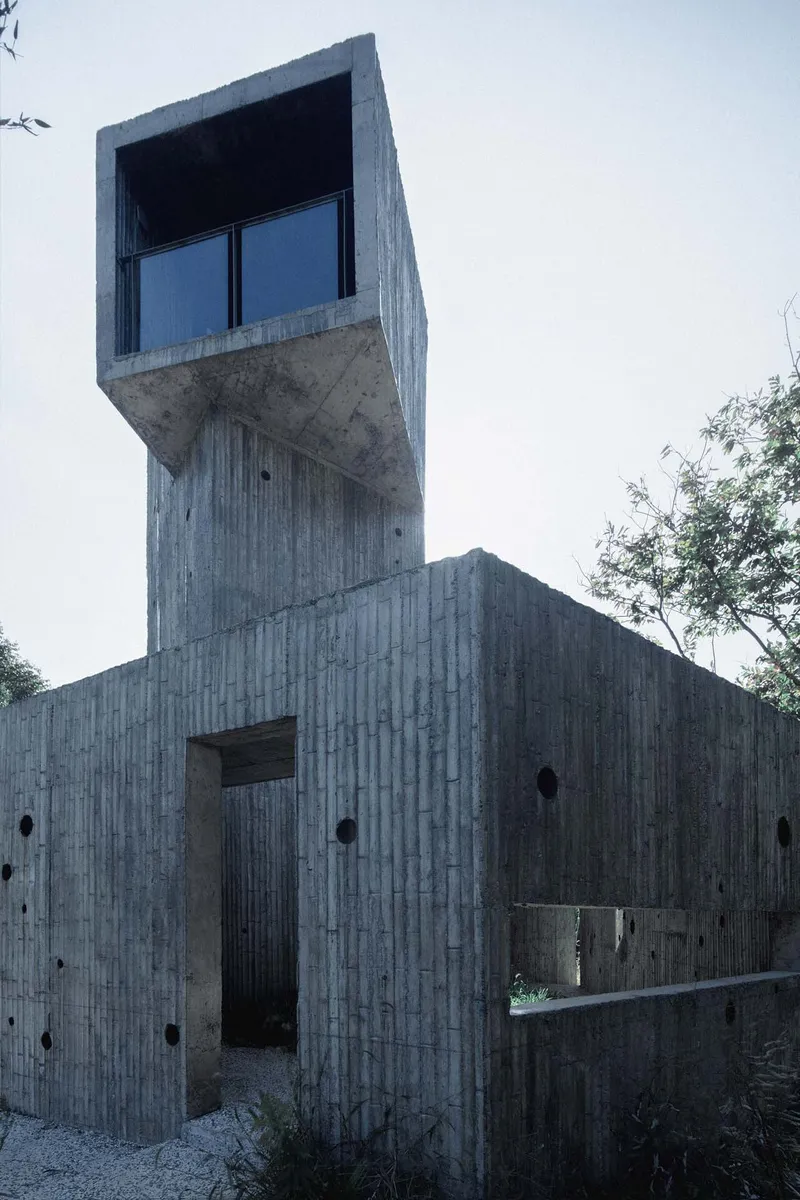


The cantilevered observation room at the top of the tower is where the building delivers on its promise. A concrete balcony with a glass railing opens onto layered mountain ridges receding into haze. The view that was invisible at ground level now stretches to the horizon. The room itself is spare, almost unfurnished, because it doesn't need to compete with what lies beyond it. A sheltered terrace below frames a tighter horizontal slice of the hillside, offering a more intimate alternative to the exposed summit.
At dusk, the observation room glows like a lantern above the canopy. The shift from utilitarian rest stop to something almost ceremonial is complete. You came here to park your bike and catch your breath; you leave having witnessed the valley from a vantage point the mountain itself could not provide.
Landscape Relationship
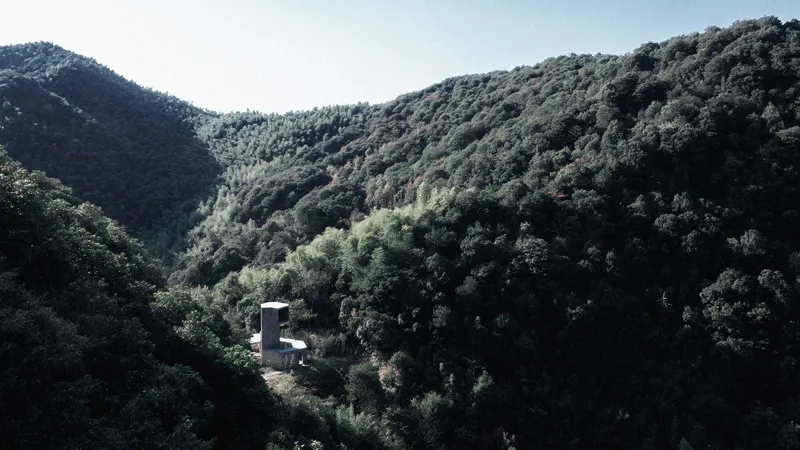


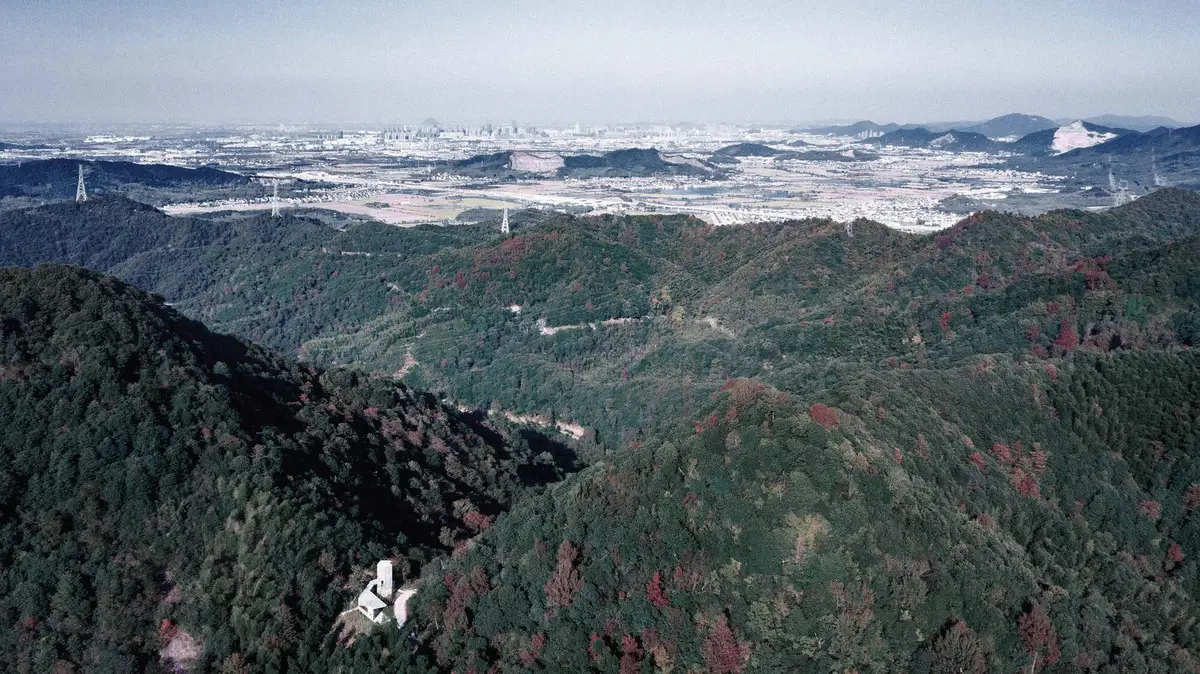
Aerial views reveal how tightly the building is embedded in its valley. The concrete volumes are nearly engulfed by dense forest on all sides, with only the tower breaking free above the tree line. The cycling path threads past the base and continues along the ridge, making the building a waypoint rather than a terminus. The architects resisted the temptation to clear the site for better ground-level views, understanding that the forest is not an obstacle but the very condition that gives the tower its purpose.
From the covered terrace, a ribbed concrete ceiling compresses the space and directs the eye outward through a horizontal slot framing the hillside beyond. It is a controlled moment of release after the tight entry sequence. The building constantly alternates between compression and expansion, darkness and light, enclosure and panorama. For 90 square meters, it packs a remarkable amount of spatial drama.
Plans and Drawings
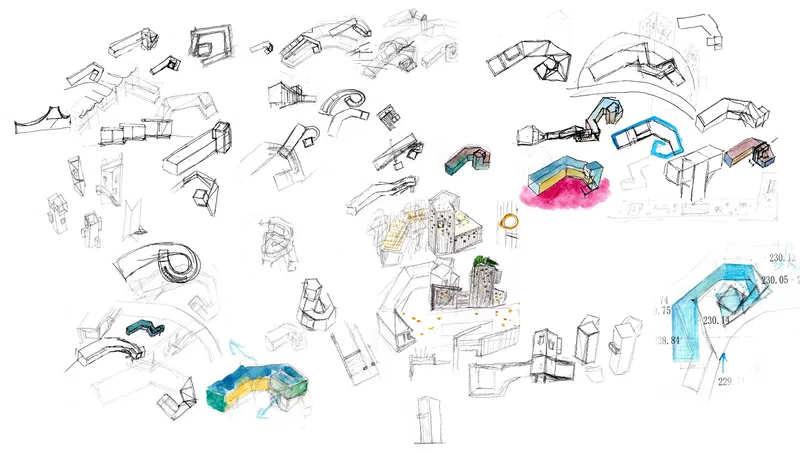
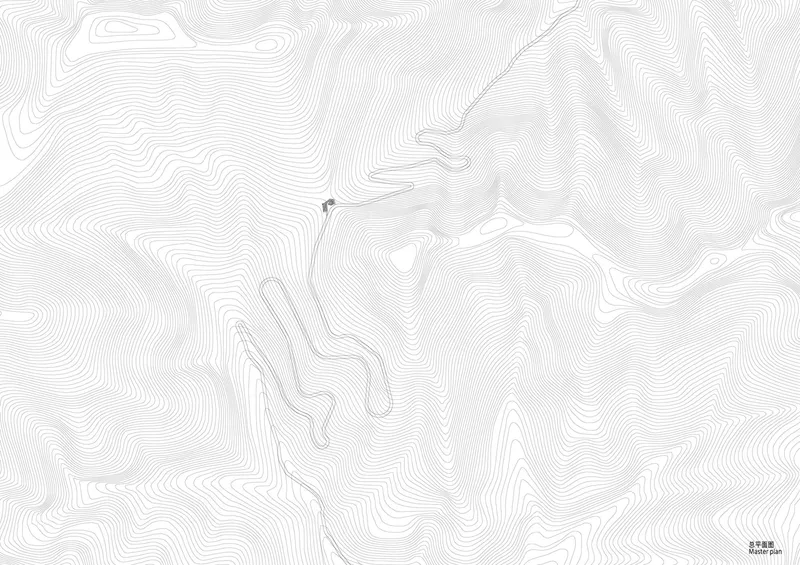


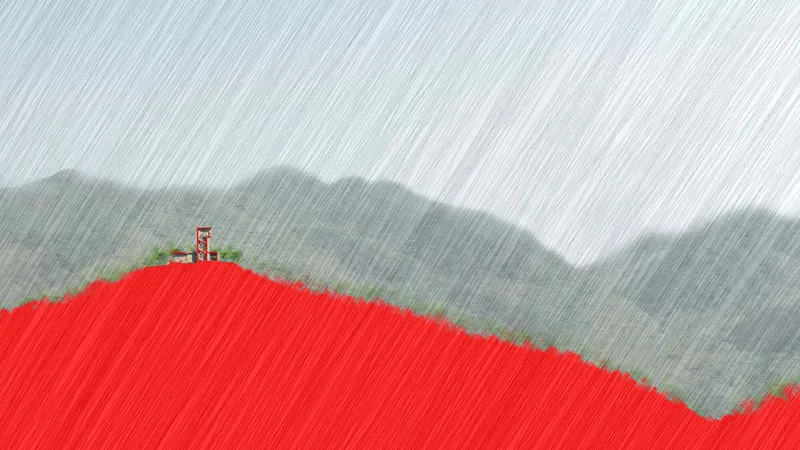
The conceptual sketches reveal a design process rooted in iteration, with watercolor highlights picking out the tower volume as the project's anchor from the earliest stages. The topographic site drawing shows the building perched on a ridgeline, surrounded by tightly spaced contour lines that explain the steepness of the terrain and the logic of placing the program at the track's apex. Floor plans show a rotated square volume nested within angular perimeter walls, a geometry that creates diagonal sight lines and pockets of residual space for planting.
The elevation and section drawings are particularly instructive. Three facades show how the tower's proportions change depending on your vantage point: slender from the approach, broader from the valley floor. The rendered section through the hillside depicts the tower emerging from a vivid red slope, an abstraction that makes the building's ambition clear. It is not resting on the mountain. It is growing out of it.
Why This Project Matters
Rest stops along recreational routes are usually afterthoughts: a bench, a sign, maybe a trash can. Jumping House Lab's mountaintop station argues that these small moments of pause deserve the same spatial intelligence as any cultural building. By organizing the entire program around a single deficiency of the site, the blocked view to the north, the architects produced a building that is simultaneously pragmatic and poetic. It parks your bike, shelters you from rain, and then lifts you above the forest to see something you could not see before.
The project also demonstrates that 90 square meters is not a limitation but a discipline. Every square meter here has a job. The corridor circulates, the courtyard decompresses, the stairwell elevates, the observation room reveals. Nothing is wasted, and nothing is redundant. For young architects looking to make an impact with a modest budget and a remote site, this rest station is a case study in doing exactly enough.
A Rest Station on A Mountaintop, designed by Jumping House Lab with lead architects Tiantian Wang and Yaqin Luo. Located in Shaoxing, China. 90 m². Completed in 2021. Photography by Zhi Xia and Tiantian Wang.
About the Studio
Jumping House Lab
Share Your Own Work on uni.xyz
If projects like this are the kind of work you want to make, uni.xyz is a place to publish your own, find collaborators, and enter design competitions.


Popular Articles
Popular articles from the community


Co-Life: Senior Housing Design That Reconnects Older Adults With the City
Co-Life reimagines senior housing design through healing gardens, shared streets, workshops, and a sustainable community across generations.

Little Red Riding Hood: Architectural Design as a Journey Through Fear, Light, and Storytelling
Little Red Riding Hood reimagines the fairy tale through architectural design shaped by fear, light, scale, memory, uncertainty, and choice.

The Ocean Hive: Sustainable Architecture for a Self-Sufficient Civilization at Sea
The Ocean Hive imagines sustainable architecture at sea, where modular habitats, algae, wave power and ocean waste sustain a growing colony.

Play: Fragments of Their World
Familiar architecture becomes modular playground design, creating safe spaces where displaced children can learn, connect, imagine and play.

Similar Reads
You might also enjoy these articles

Bao Huynh Watercolor Atelier: A Serene Art Retreat in Hội An
Bao Huynh Watercolor Atelier in Hội An blends multifunctional art spaces, sustainable design, local materials, and family-friendly living in a serene environment.

Atelier Macri Concept Store Interior Design by CASE-REAL
Atelier Macri store features a "ko" counter, walnut wood details, cork displays, blending retail, gallery, and seamless customer experiences.

Manuel Vargas Izquierdo Stadium and High-Performance Sports Center: Architectural Excellence in Jalpa de Méndez
The Manuel Vargas Izquierdo Stadium blends sustainable design, inclusive sports facilities, and cultural-inspired architecture, revitalizing Jalpa de Méndez’s public spaces.
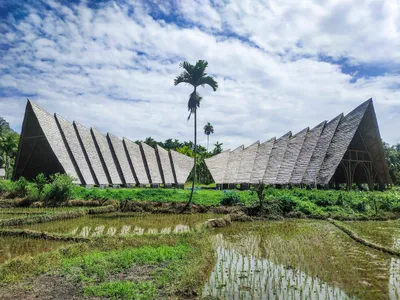
KAKR Buluh Awar Hall: Revitalizing Community and Ecology Through Bamboo Architecture
Community built bamboo hall revitalizes Buluh Awar village, empowering youth, restoring ecology, celebrating vernacular craftsmanship through sustainable architecture and culture.


Comments (0)
Please login or sign up to add comments
No comments yet. Be the first to comment!