
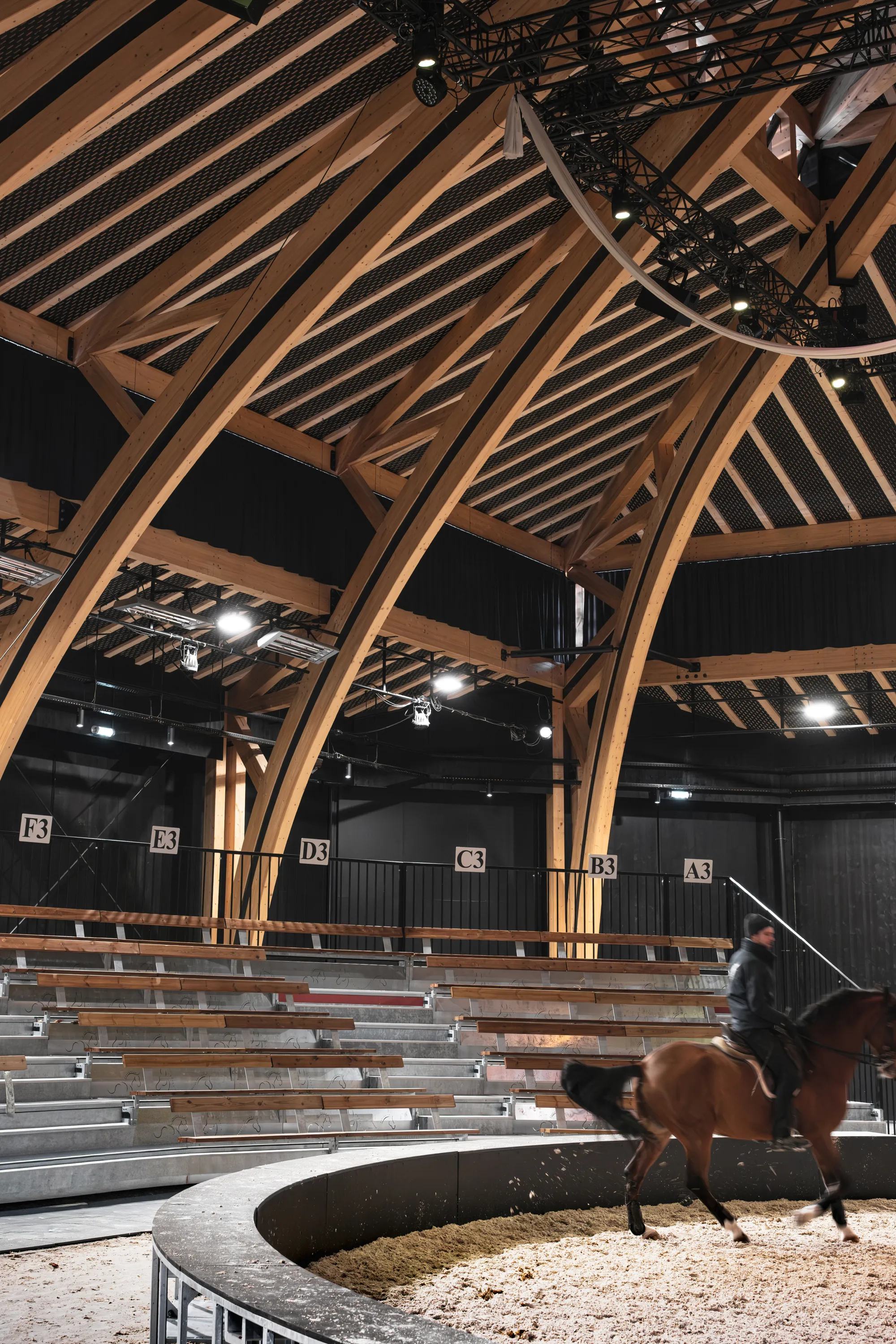
K architectures Builds a Timber Circus Hall Inside a Napoleonic Stud Farm in Brittany
A 700-seat equestrian arena in Saint-Martin-de-Mailloc channels the spirit of vanished wooden circuses and Breton market halls.


France's national stud farms are some of the most peculiar survivors of 19th-century state architecture: part military infrastructure, part agricultural monument, part ceremonial stage. Hennebont's stud, established in 1856 on the grounds of the former Abbey of La Joie in Morbihan, is one of five equestrian centers still operating in Brittany. When K architectures was commissioned to insert a new 700-seat performance hall into the Cour du Puits, one of two historic courtyards framed by Napoleonic stables, the challenge was never simply structural. It was about finding a formal language that could coexist with slate roofs and stone walls while doing something those 19th-century builders never managed: making timber span without compromise.
The result is a 1,464 m² arena that reads, from certain angles, like a building the site has always wanted but never had. The hall's tiered slate roof rises 17 meters above the courtyard, echoing the vast roofscapes of Breton longères and the layered profiles of market halls from Questembert to Plouescat. But the references run deeper than regional vernacular. K architectures explicitly channels the duality of early sedentary circuses: the stable, permanent exterior of 19th-century wooden circus buildings fused with the constructive cleverness of semi-stable, itinerant structures. Victor Baltard's Marché Secrétan in Paris is cited as a touchstone, and you can see it in the vault's ambition and its honest exposure of structure.
A Vault That Borrows from Circus and Market Hall
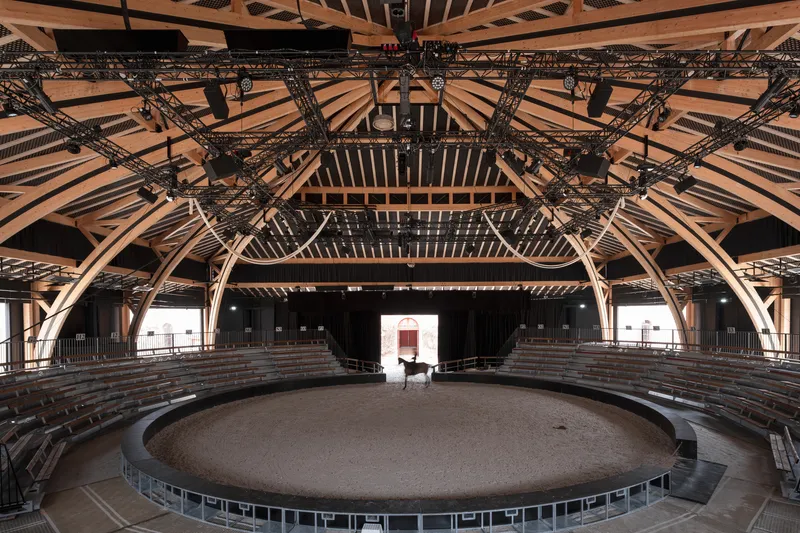
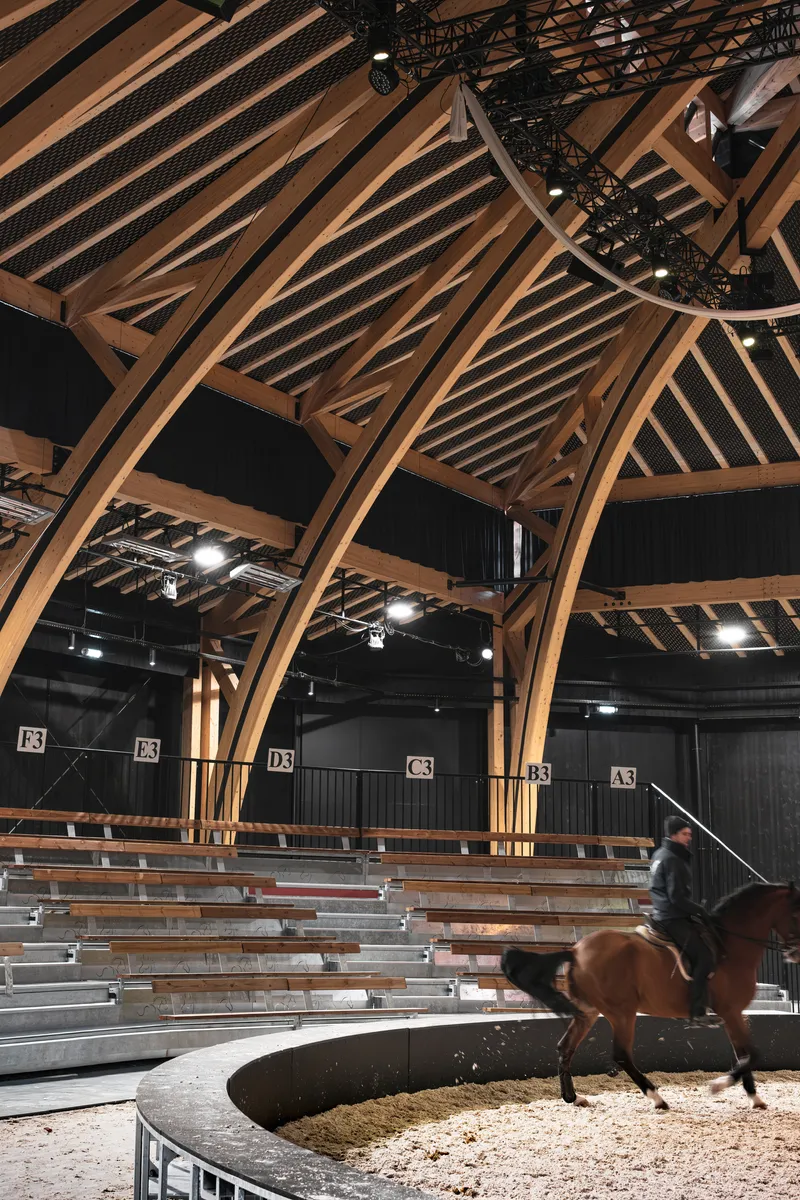
Step inside and the arena's geometry reveals its real trick. The floor plan begins as a 19-meter-diameter circle at the performance area, then widens outward into a 39 x 20 meter rectangle at the perimeter walls. That transition from round to rectangular is managed overhead by a laminated timber vault whose arched ribs splay outward as they descend, distributing load to two entirely liberated facades that carry no structural weight at all. The whole system rests on a modular principle: three template forms, duplicated four times each, precision-machined off-site and assembled rapidly on the ground.
The exposed timber structure, built by GLC with CLT panels from Lignatec and Swedish-sourced wood from Stora Enso and Setra, dominates the interior. Secondary steelwork and technical systems are finished in dark matte tones so they recede, leaving the warm, rhythmic pattern of glulam arches and rafters as the defining visual experience. The effect is closer to being inside a ship's hull or an inverted keel than a conventional arena.
Slatted Timber Walls That Open and Close
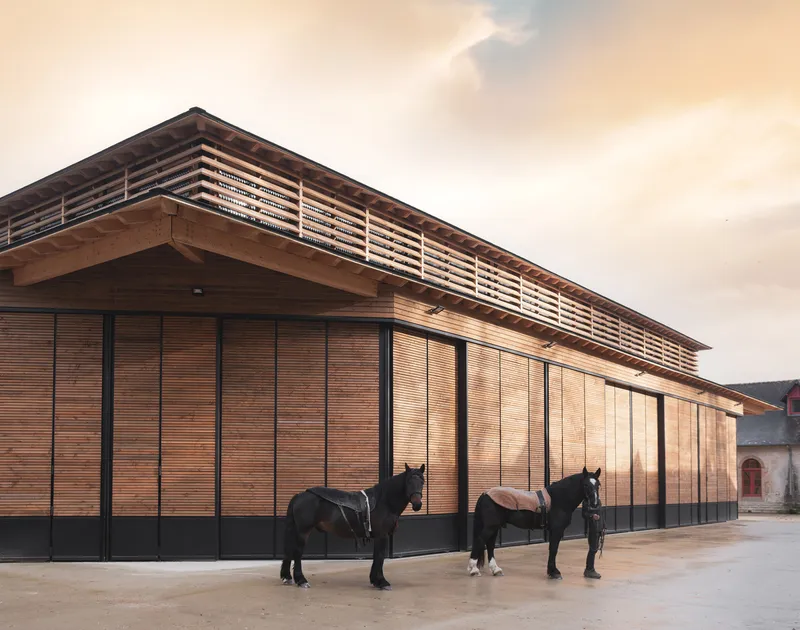
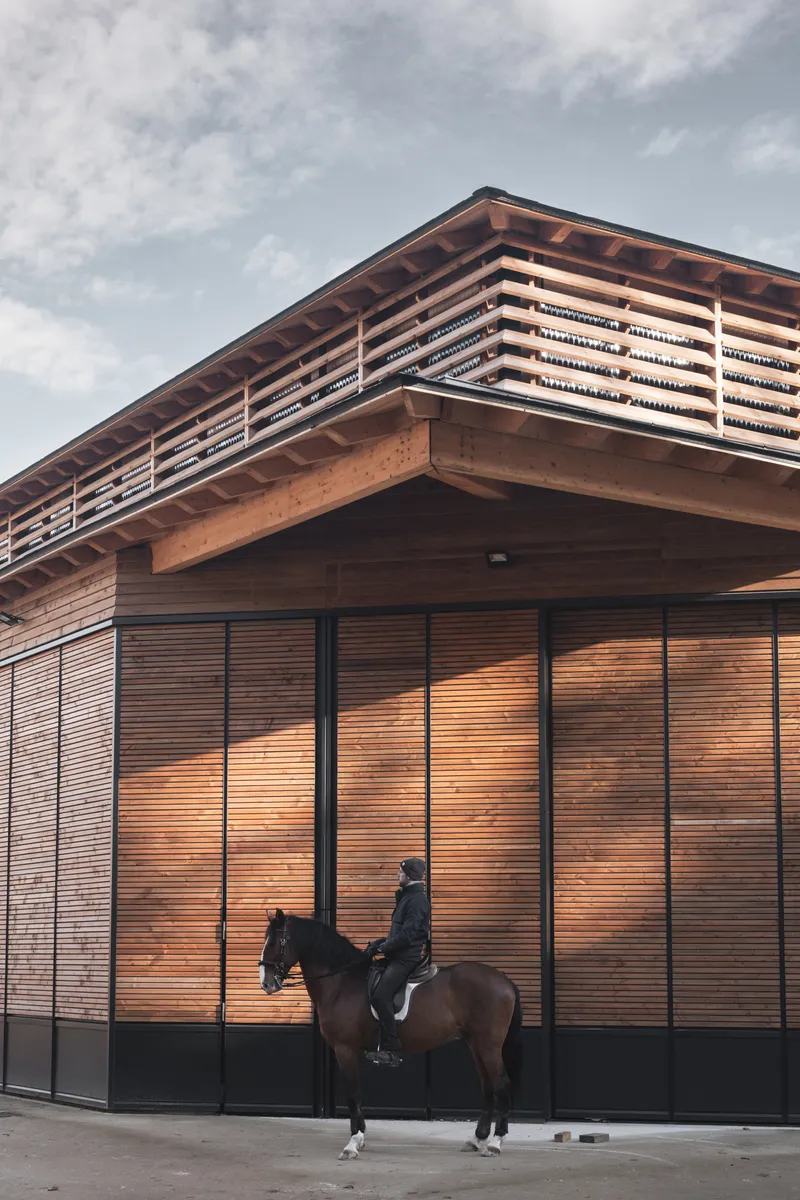
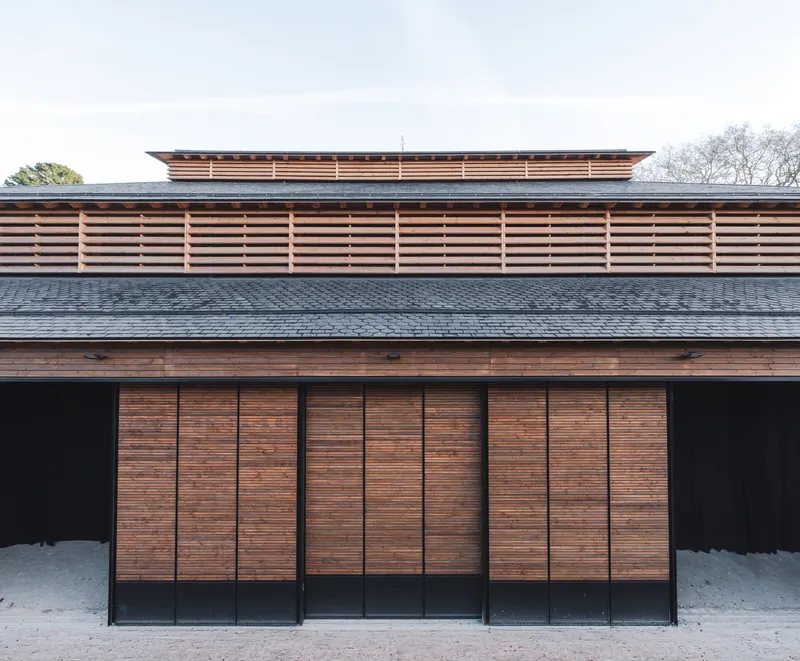
The facades are where the building negotiates its dual identity as architecture and infrastructure. Horizontal timber slats, arranged in crenelated bands with adjustable louvers, wrap the upper tiers of the hall, filtering daylight into the arena through two luminous rings. Below, vertical slatted panels and retractable wall sections can slide behind slender fixed piers, transforming the building from an enclosed performance space into a semi-open pavilion between events. It is a genuinely useful detail: horses and handlers need easy passage, and the courtyard needs to breathe.
The material palette keeps things deliberately restrained. Timber cladding by Piveteau handles the facades, while rectangular slate on the roof references the Napoleonic stables next door. The interleaving of rectangular and rounded slates across the tiered roofline is a subtle move, drawing the eye upward and reinforcing the layered profile that makes the building legible from a distance.
Dialogue with the Napoleonic Courtyard
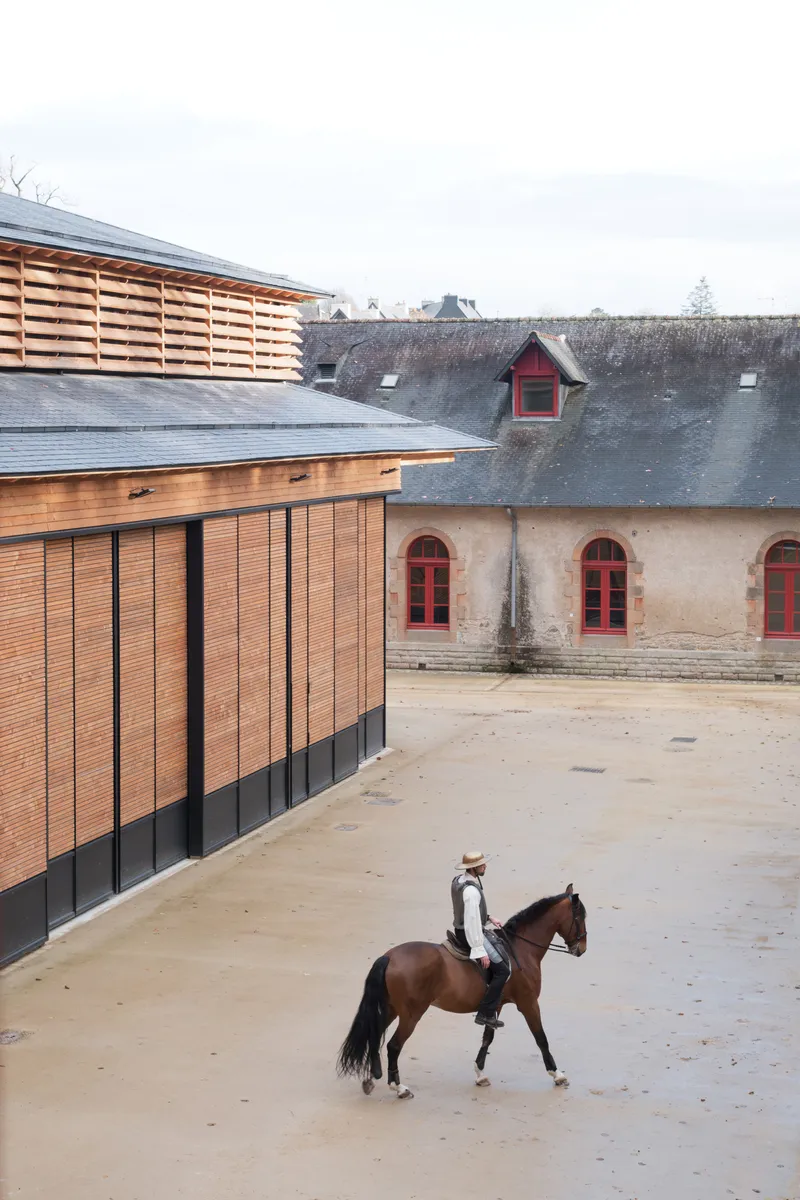
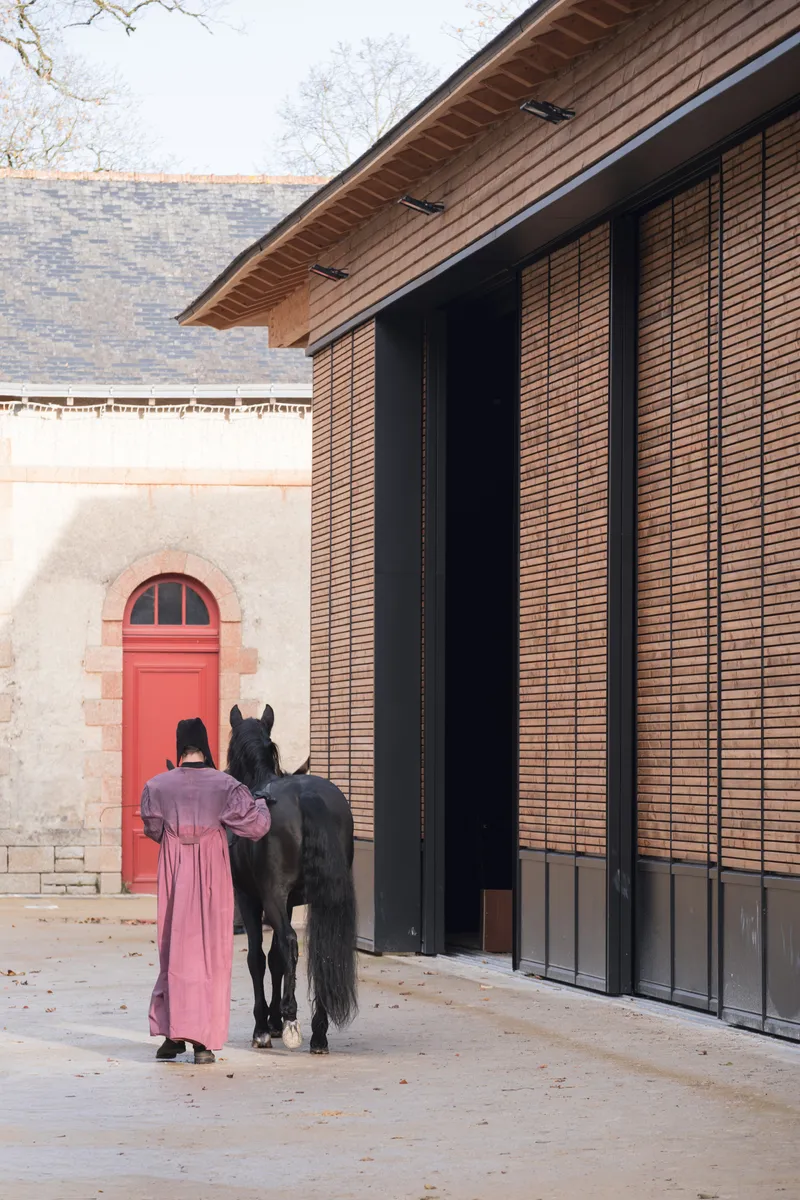
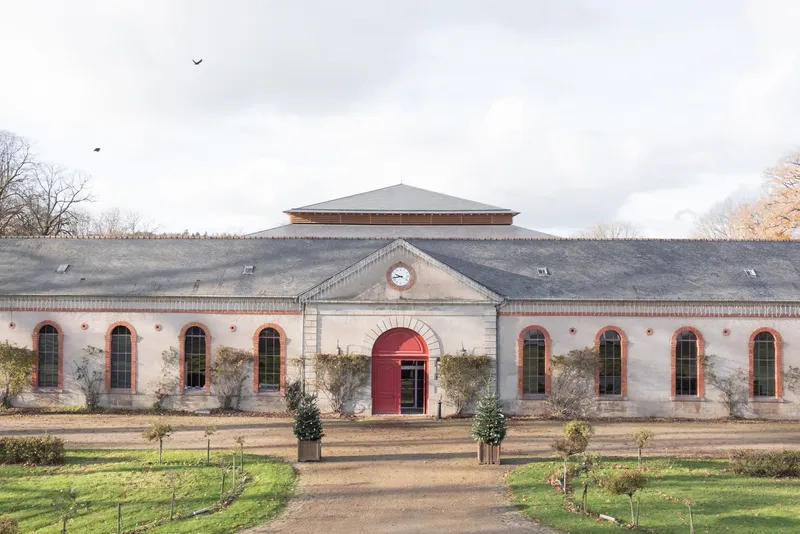
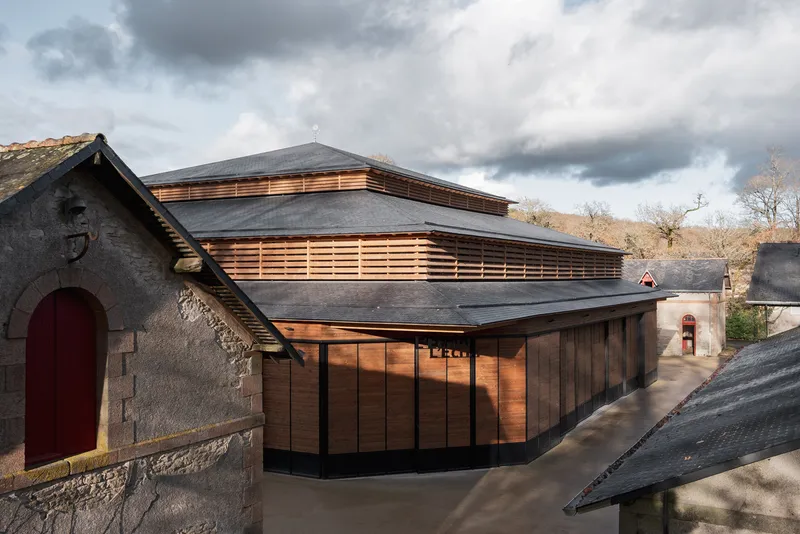
Context shots tell as much as interiors here. The new hall rises above the existing stone stables, its tiered slate roofline engaging in a measured dialogue with the courtyard's original profiles. K architectures chose not to mimic or defer: the timber-and-slate volume is clearly contemporary, but its massing, its material register, and its scale are calibrated to the rhythms of the surrounding buildings. The arched windows and rusticated stone of the older wings provide a foil for the new hall's horizontal slat screens, and the contrast works precisely because neither element tries to be the other.
Approaching through the courtyard with a horse in hand, as several of these images suggest, the building functions first as a backdrop: permeable, tactile, slightly warm in color. It does not announce itself as a monument. It announces itself as a workplace for horses and riders that happens to possess exceptional spatial intelligence.
Light Filtered Through Two Luminous Rings
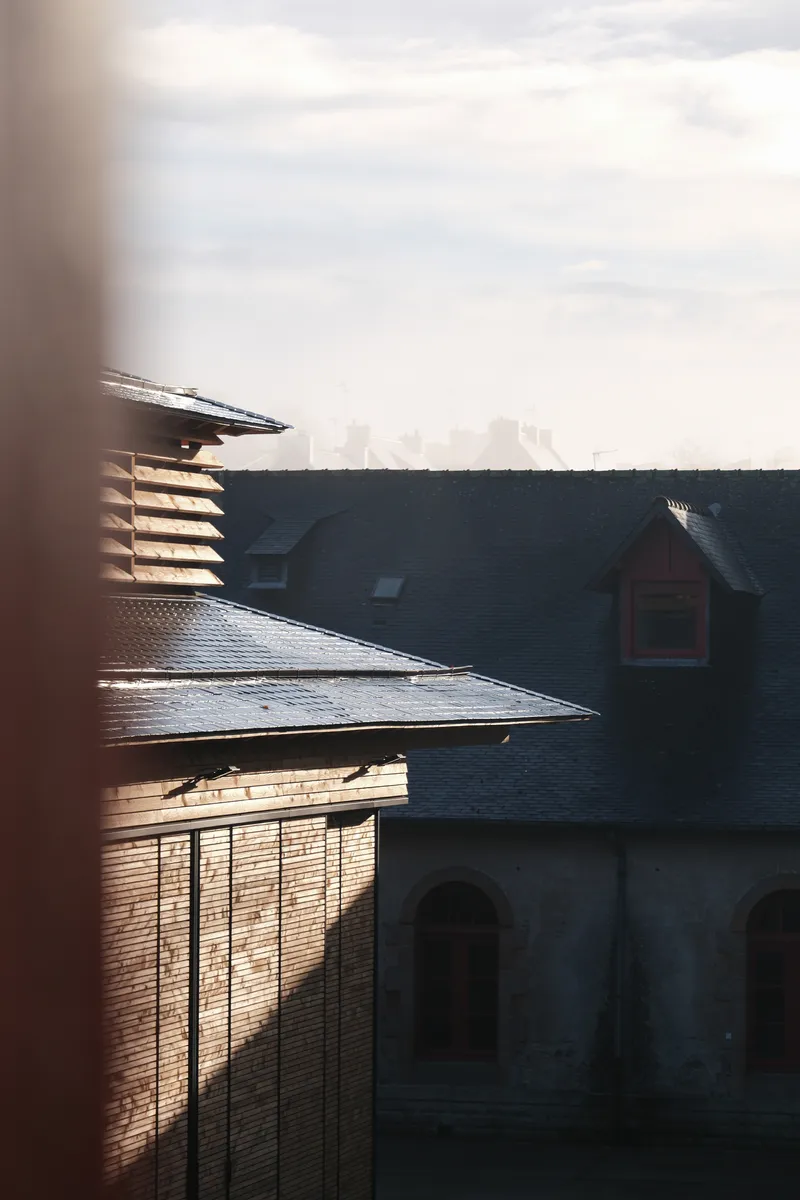
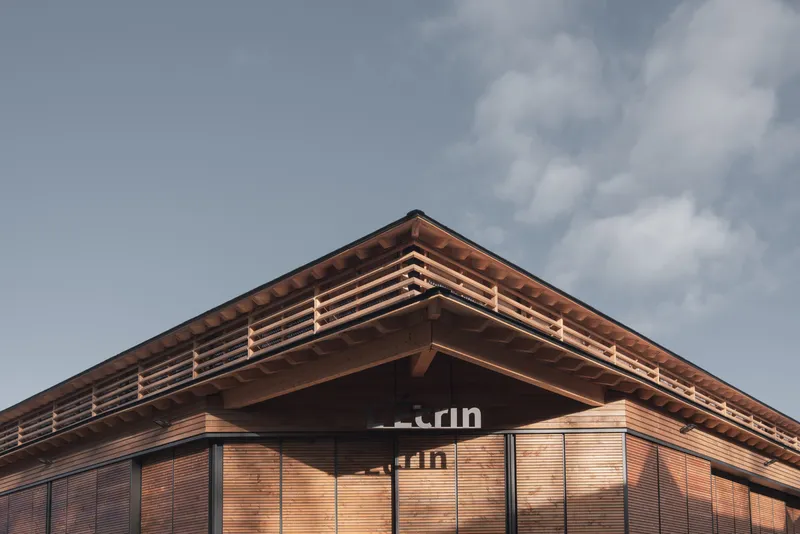
The daylighting strategy is one of the project's most considered details. Two bands of clerestory glazing run along the upper tiers of the roof, coupled with the adjustable wooden slats that soften and diffuse incoming light before it reaches the arena floor. Skylights embedded in the arched vault expand the sense of volume beneath the highest ribs. The effect is even, ambient illumination that avoids glare for both performers and spectators, critical in equestrian contexts where sudden light changes can spook horses.
From outside, the layered roof profiles and louvered screens catch afternoon sunlight at a raking angle, casting deep horizontal shadows across the facade. The building changes character through the day. At dusk, the timber screens glow from within, and the hall reads as a lantern set into the courtyard.
Aerial Reading: A Tiered Roof in Countryside
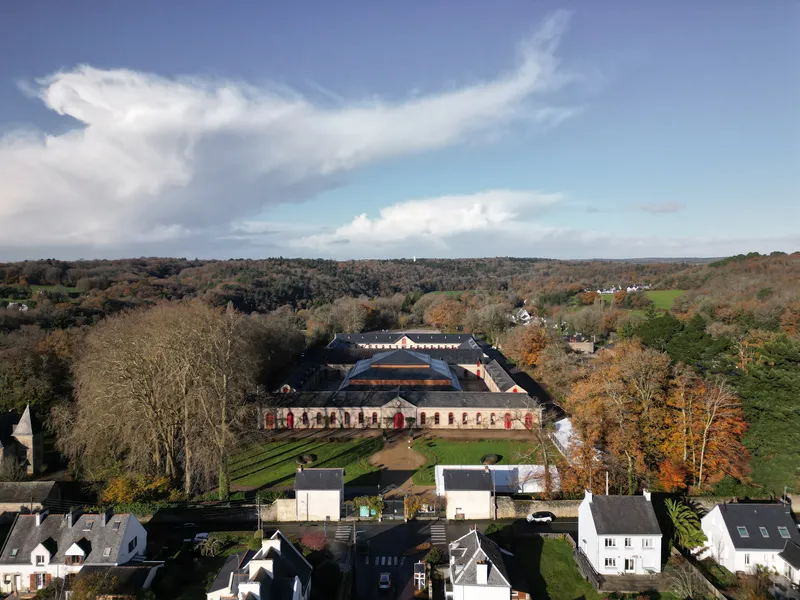
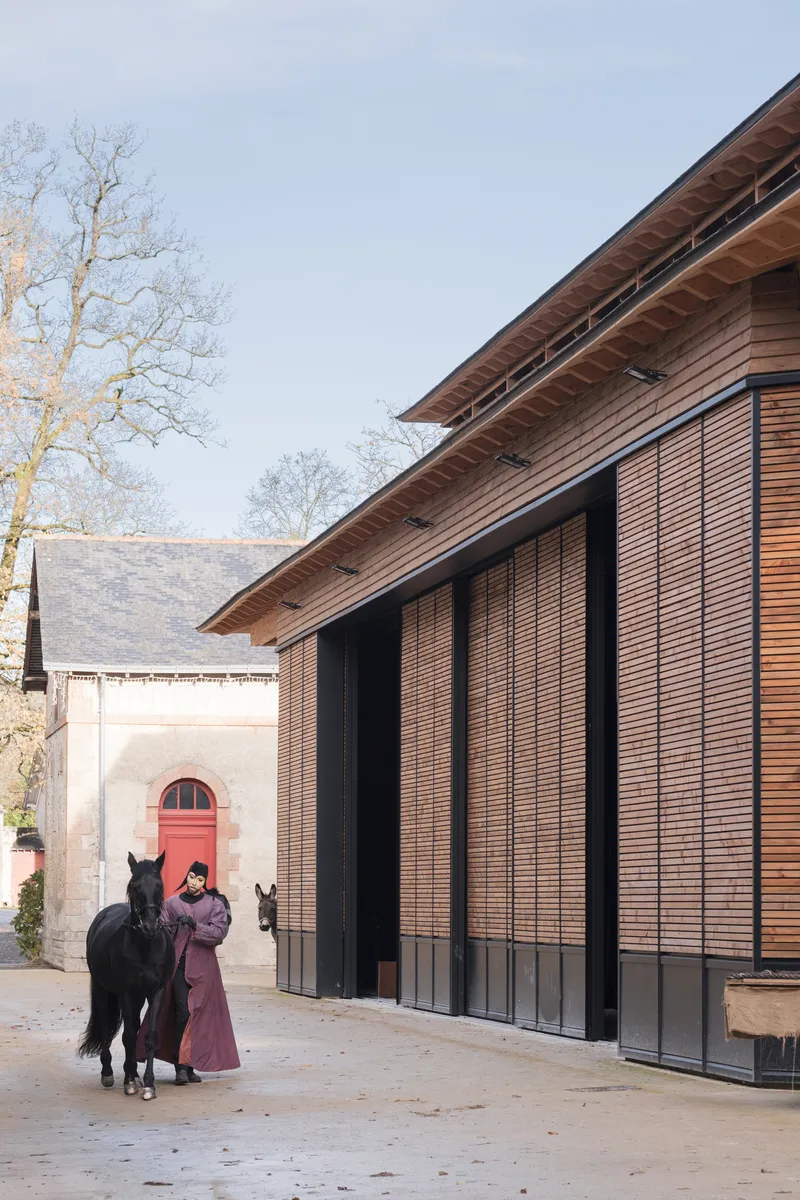
Seen from above, the building's stepped massing is legible as a series of concentric roof tiers descending from the central ridge. The courtyard's symmetry is preserved, with the new volume occupying the Cour du Puits without overwhelming the surrounding wings. Autumn trees and rolling Breton countryside frame the composition and reinforce the sense of a building that belongs to its landscape rather than competing with it.
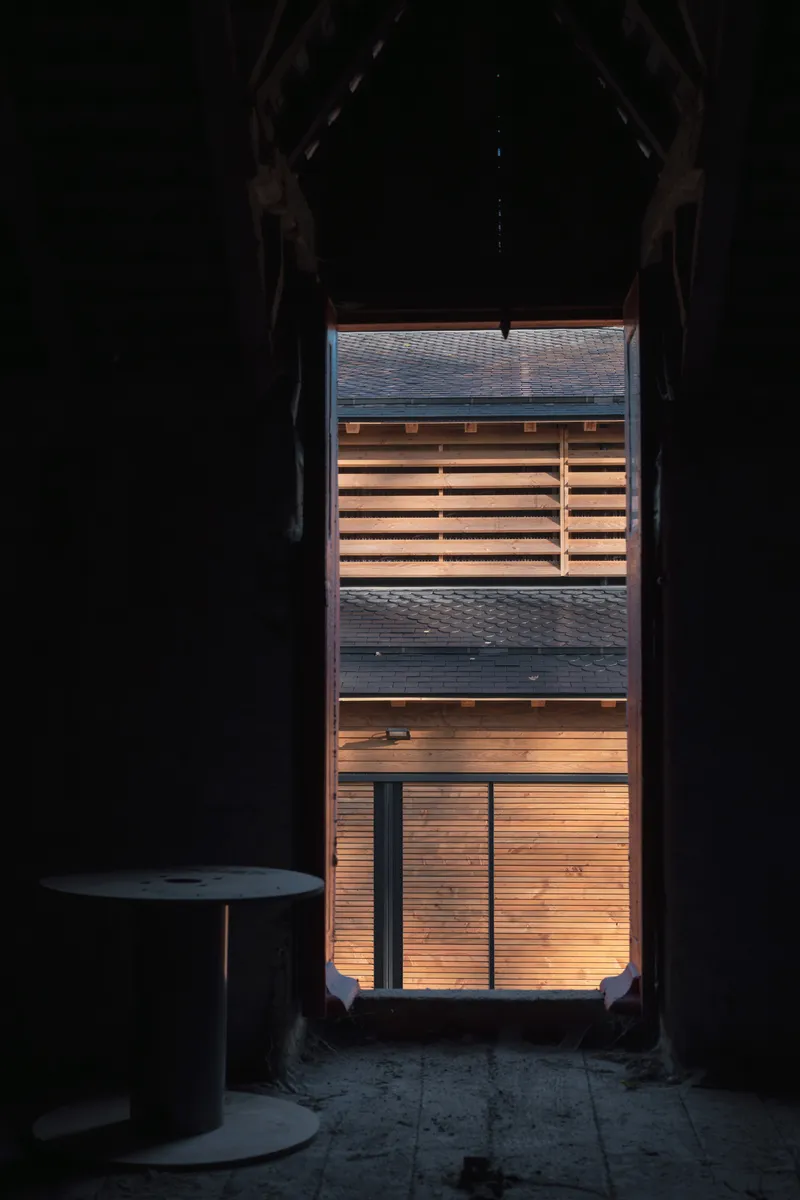
The corner and threshold views are equally telling. A darkened archway in the stone stables frames the backlit timber facade at dusk, compressing the spatial experience into a single cinematic moment. The building rewards approach from every direction, which is not something you can say about many arenas.
Corner Details and the Roof Edge
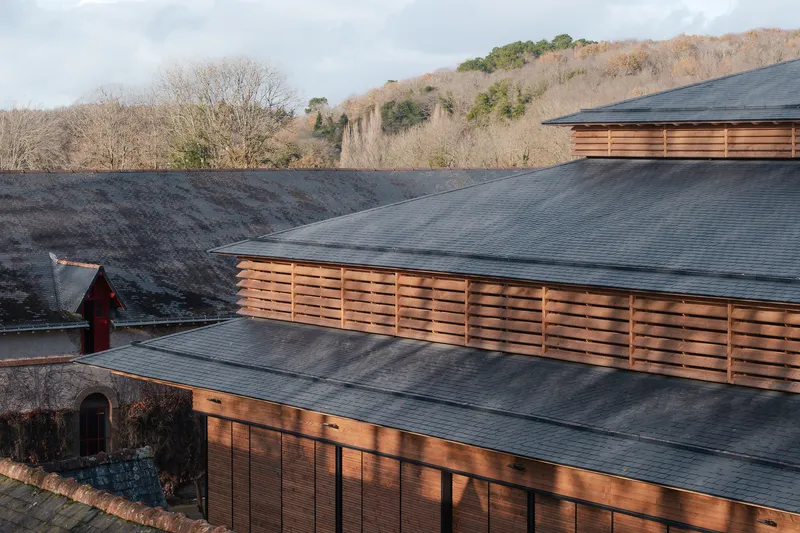
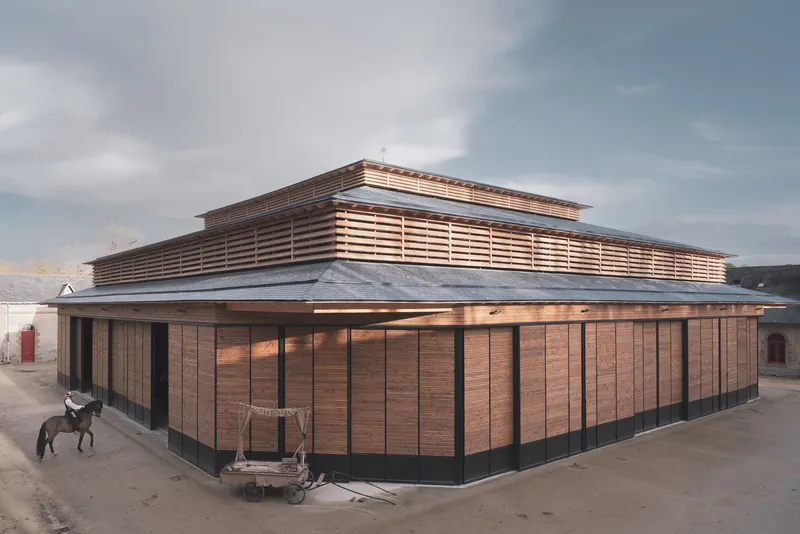
Close-up views of the building's corners reveal how carefully the roof molding and louvered screens are resolved. The dark-tiled lower roof meets the timber-louvered upper tier at a clean horizontal line, and vertical slat panels define the wall plane below. A horse-drawn cart and winter hillside in the background remind you that this is a working equestrian facility in rural Brittany, not a cultural venue in a city center. The budget of 3.6 million euros (2020 value) reflects that pragmatism: this is not extravagant construction, but it is precise, well-detailed, and materially honest.
Plans and Drawings
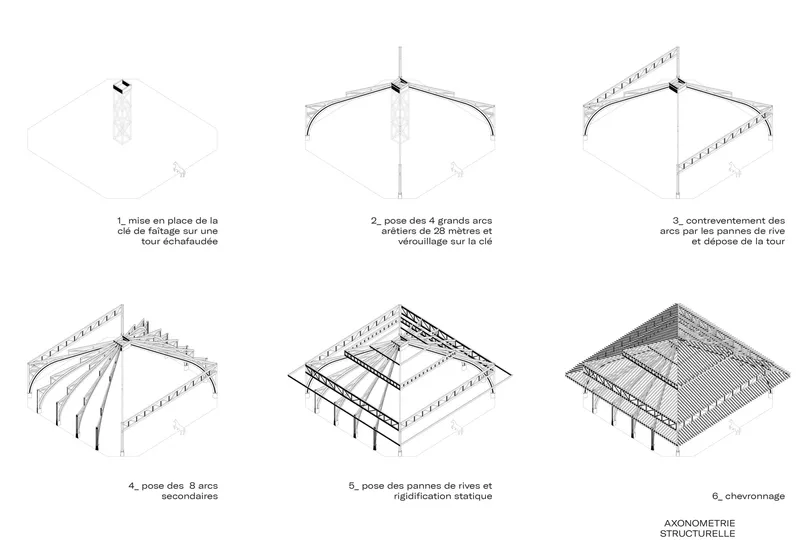
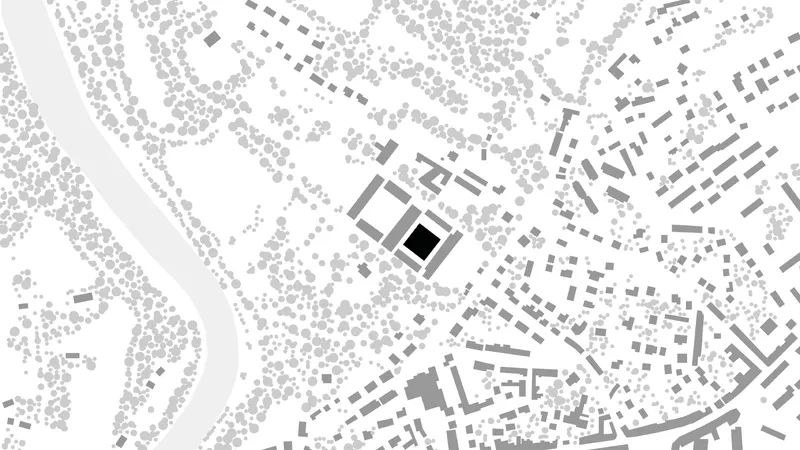
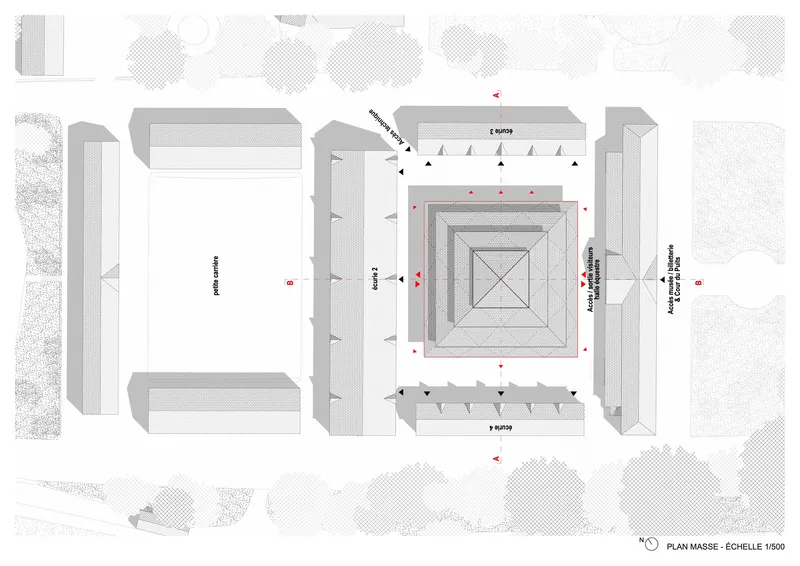
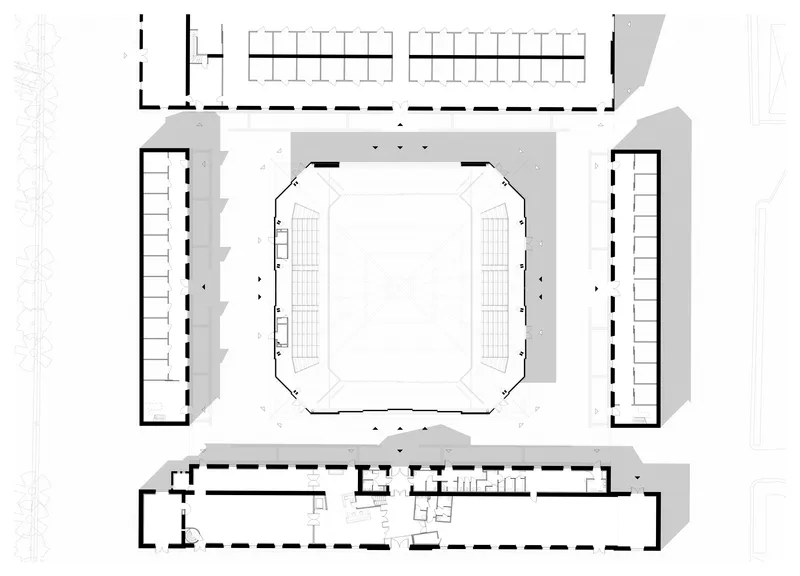
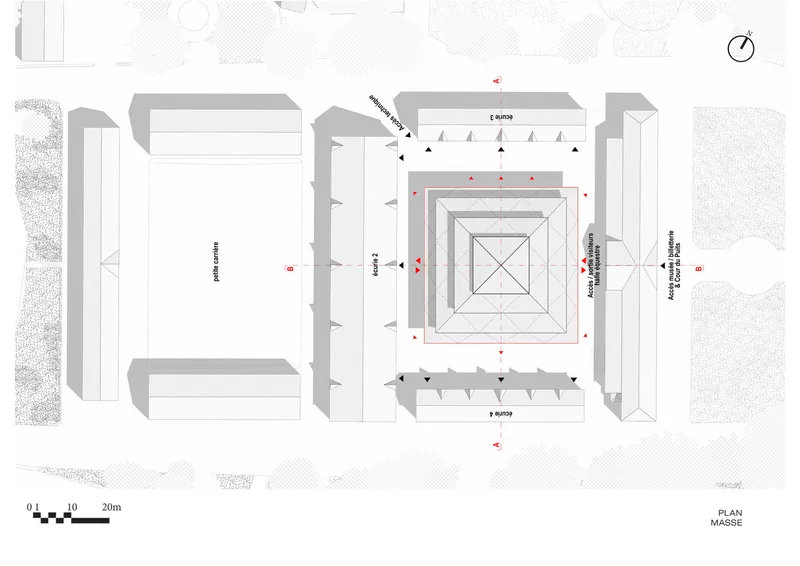
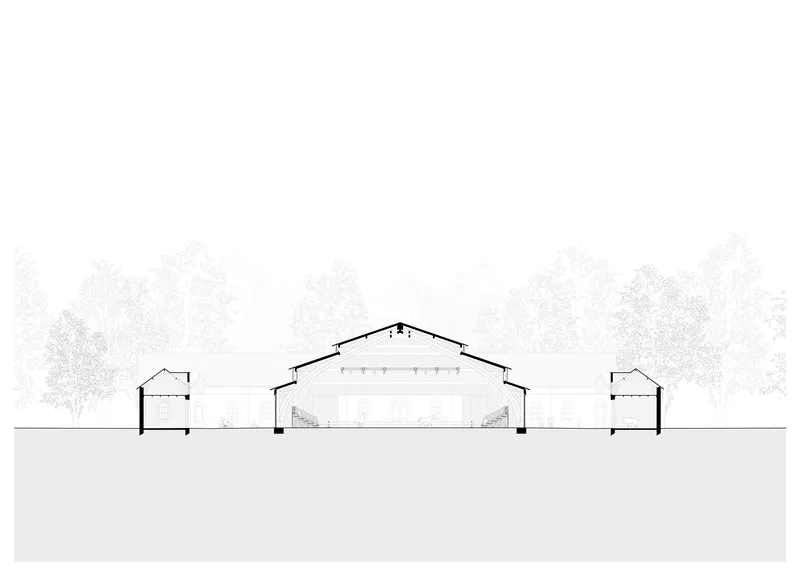
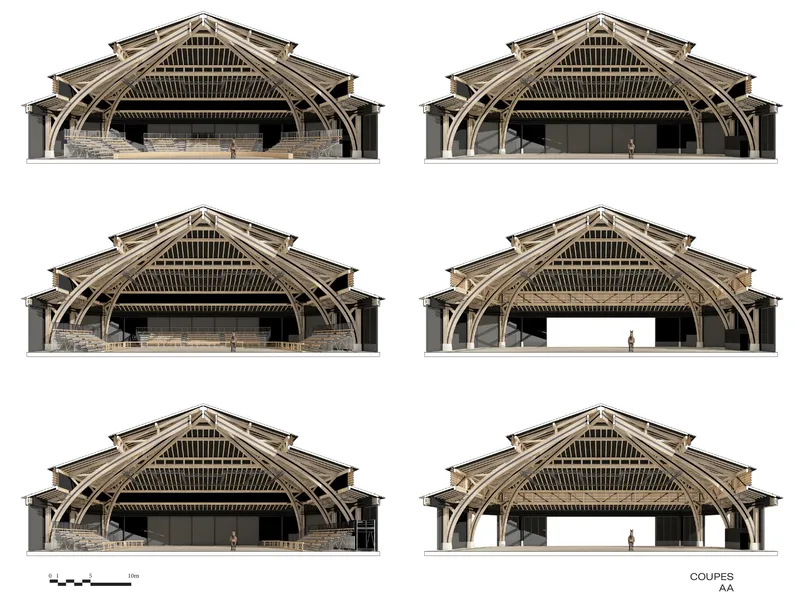
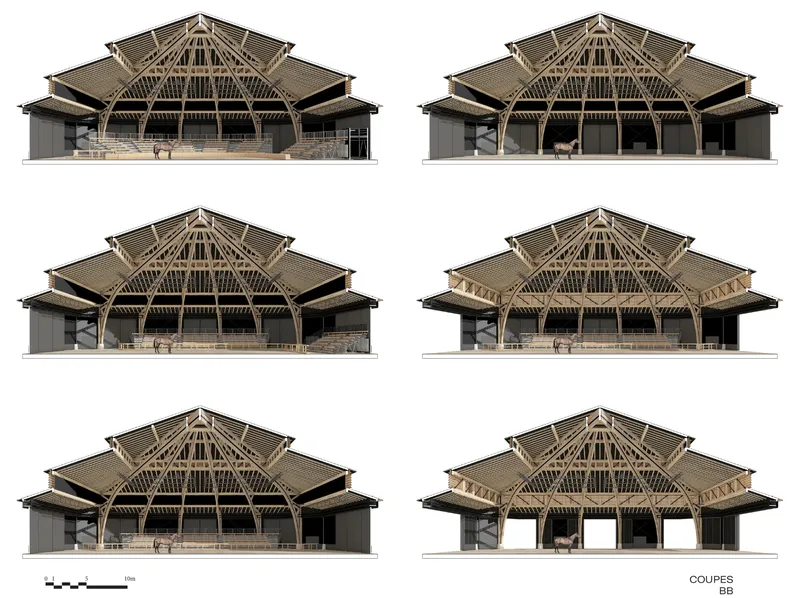
The axonometric assembly sequence is especially revealing. It breaks the vault into its modular components, showing how the three template arches are duplicated and spliced to form the full span. The site plans make clear how the octagonal volume of the new hall sits within the courtyard's orthogonal grid, while the floor plan confirms the circle-to-rectangle transition that defines the arena's geometry. Cross-sections through the building expose the relationship between the tall central hall and its lower flanking tiers, and the six elevation variations document how the timber truss system adapts to different orientations and facade conditions. Together, these drawings reveal a project that was solved in section as much as in plan.
Why This Project Matters
Equestrian architecture rarely receives this level of design intelligence. Most contemporary arenas are pre-engineered metal sheds with token cladding, functional but indifferent to place. K architectures has done something more ambitious: they have produced a building that draws its formal logic from the history of circus architecture, Breton vernacular construction, and 19th-century iron-and-glass market halls, then executes it in bio-sourced timber and regional slate at a restrained budget. The result is a hall that feels both inevitable and surprising, as if the stud farm's courtyard had always anticipated a building of this scale and character.
What makes the project genuinely instructive is its refusal to separate heritage sensitivity from structural ambition. The retractable facades, the modular vault system, the circle-to-rectangle plan: these are not compromises driven by context. They are design ideas that could only have emerged from deep engagement with the site's geometry and history. At a moment when adaptive reuse projects often default to either pastiche or aggressive contrast, Hennebont charts a third path. It is architecture that listens to a place, then speaks with its own voice.
Hennebont National Stud Farm by K architectures. Saint-Martin-de-Mailloc, France. 1,464 m². Completed 2025.
About the Studio
Share Your Own Work on uni.xyz
If projects like this are the kind of work you want to make, uni.xyz is a place to publish your own, find collaborators, and enter design competitions.




Popular Articles
Popular articles from the community


The Earth Pod: 3D Printed Homes for Resilient Refugee Communities
The Earth Pod reimagines refugee housing through 3D printed homes made from clay, combining resilience, self-sufficiency, and rapid shelter.

Conexión: Biophilic Design Reimagines High-Rise Living in Hong Kong
Conexión reimagines high-rise living in Hong Kong through biophilic design, green facades, shared spaces, daylight, water and nature within.

Play: Fragments of Their World
Familiar architecture becomes modular playground design, creating safe spaces where displaced children can learn, connect, imagine and play.

Co-life: Sustainable Architecture for Age-Friendly Community Living
Co-life reimagines sustainable architecture for seniors through courtyards, rammed earth, shared gardens, and spaces designed for belonging.


Similar Reads
You might also enjoy these articles

Bao Huynh Watercolor Atelier: A Serene Art Retreat in Hội An
Bao Huynh Watercolor Atelier in Hội An blends multifunctional art spaces, sustainable design, local materials, and family-friendly living in a serene environment.

Atelier Macri Concept Store Interior Design by CASE-REAL
Atelier Macri store features a "ko" counter, walnut wood details, cork displays, blending retail, gallery, and seamless customer experiences.

Manuel Vargas Izquierdo Stadium and High-Performance Sports Center: Architectural Excellence in Jalpa de Méndez
The Manuel Vargas Izquierdo Stadium blends sustainable design, inclusive sports facilities, and cultural-inspired architecture, revitalizing Jalpa de Méndez’s public spaces.

KAKR Buluh Awar Hall: Revitalizing Community and Ecology Through Bamboo Architecture
Community built bamboo hall revitalizes Buluh Awar village, empowering youth, restoring ecology, celebrating vernacular craftsmanship through sustainable architecture and culture.


Explore Industrial Building Competitions
Discover active competitions in this discipline



Challenge to design a barrier free sports center


Challenge to design an outdoor ice-rink and park
Comments (0)
Please login or sign up to add comments
No comments yet. Be the first to comment!