
Kanisavaran Office Splits a Concrete Villa Along a Central Core in Northern Iran
Villa 1028 grows outward from a shared nucleus, opening its south face to a stream while shielding its north from the street.


Most weekend retreats in Iran's Caspian coastal belt follow a predictable formula: a single volume dropped onto a compact lot, windows punched toward the greenery, privacy solved with a perimeter wall. Villa 1028, designed by Kanisavaran Office and completed in 2024 within the Khaneh Darya residential complex in Mazandaran Province, rejects that shorthand. Instead of building a box and then carving out light wells, architect Mohammad Kanisavaran started from the center, treating a single structural core as a seed from which the house grew outward in two diverging wings.
The result is a 350-square-meter concrete dwelling that operates on a deliberate contradiction: the desire to be seen and the simultaneous need to remain unseen. Its north facade, facing a public street, presents a solid, introverted wall. Its south facade, oriented toward a natural stream, opens generously with floor-to-ceiling glass. That split personality is not a stylistic gesture. It is a direct spatial translation of the site's asymmetric conditions: urban edge on one side, landscape on the other, and a planted courtyard holding the two together.
Growing from the Inside Out
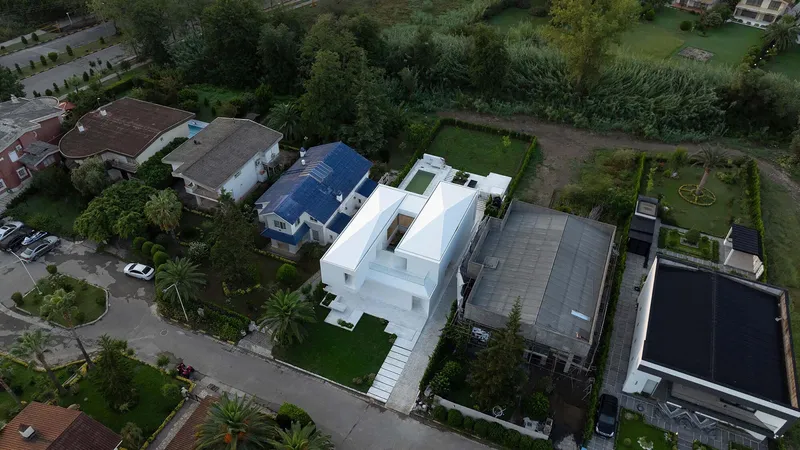
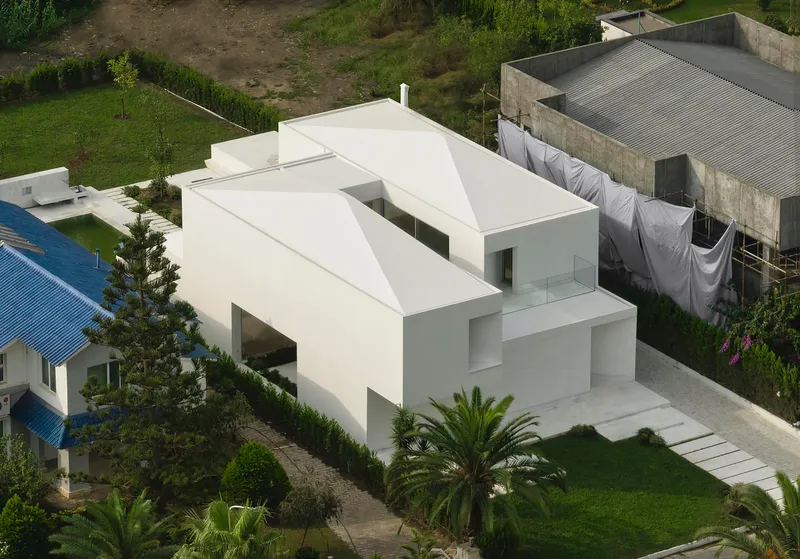
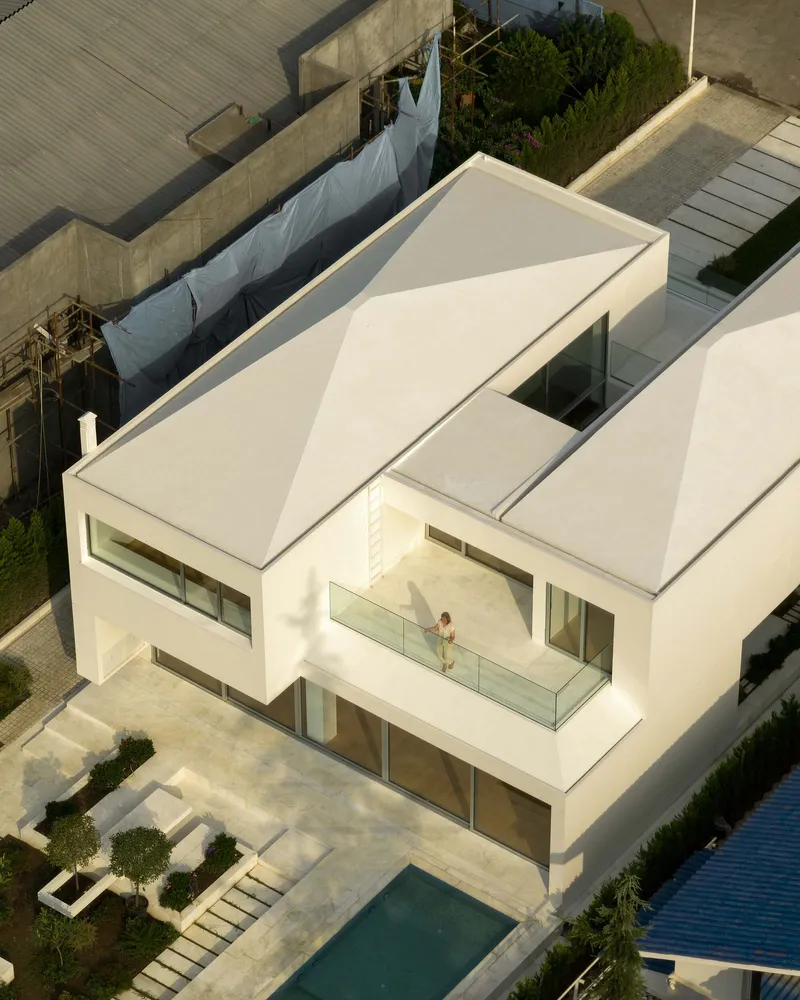
Seen from above, the villa reads as two angular white volumes that interlock around a central courtyard. The roof planes fold at different pitches, breaking the symmetry and creating a silhouette that shifts depending on the viewing angle. It is tempting to read this as sculptural indulgence, but the logic is more grounded than that. The folded roofs are responses to rain and prevailing breezes, the two climatic forces that Kanisavaran identifies as having shaped the building's primary structure.
At ground level, the central core functions as a connector, a shared zone where interior life meets the courtyard and, by extension, the landscape beyond. Step up to the first floor, and the same core reverses its role: it becomes a divider, splitting the plan into two separate zones to the east and west. That inversion, connector below, separator above, is the organizational engine of the house.
The Courtyard as Mediator
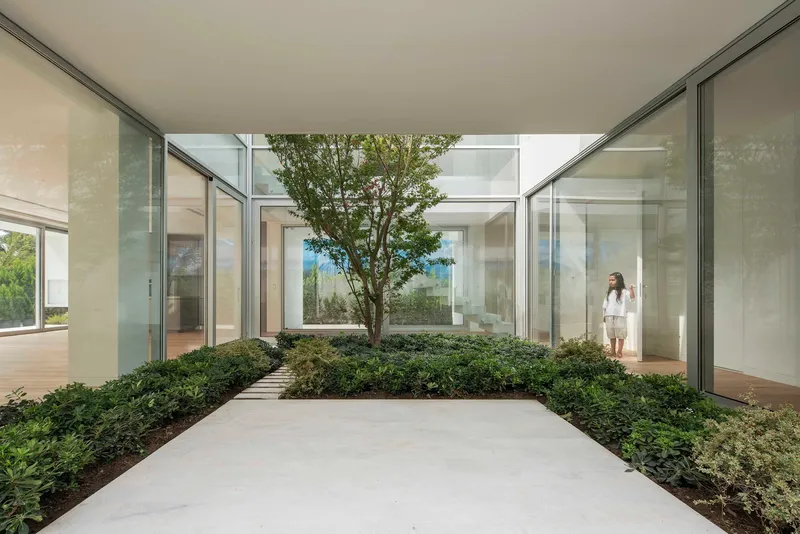
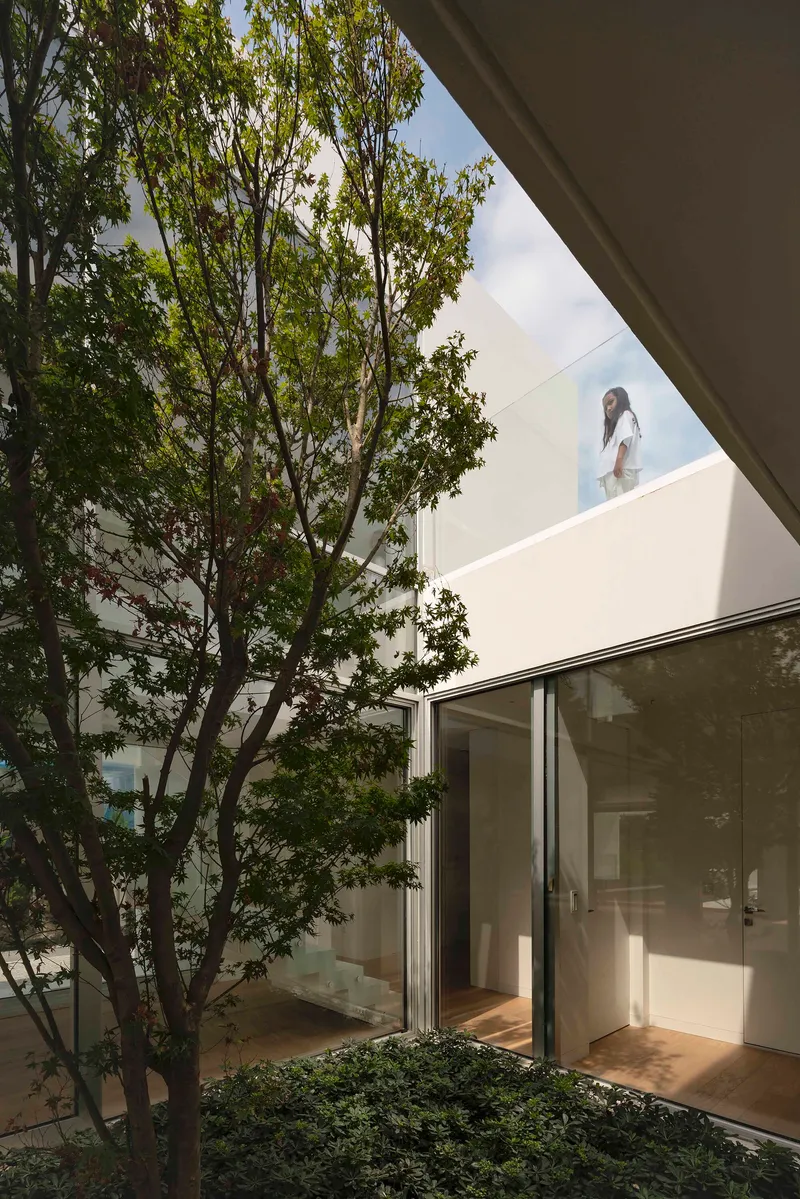
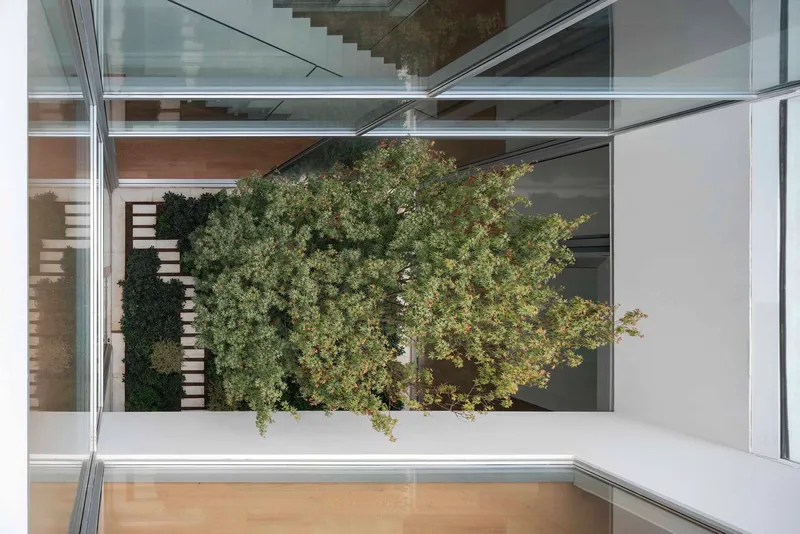
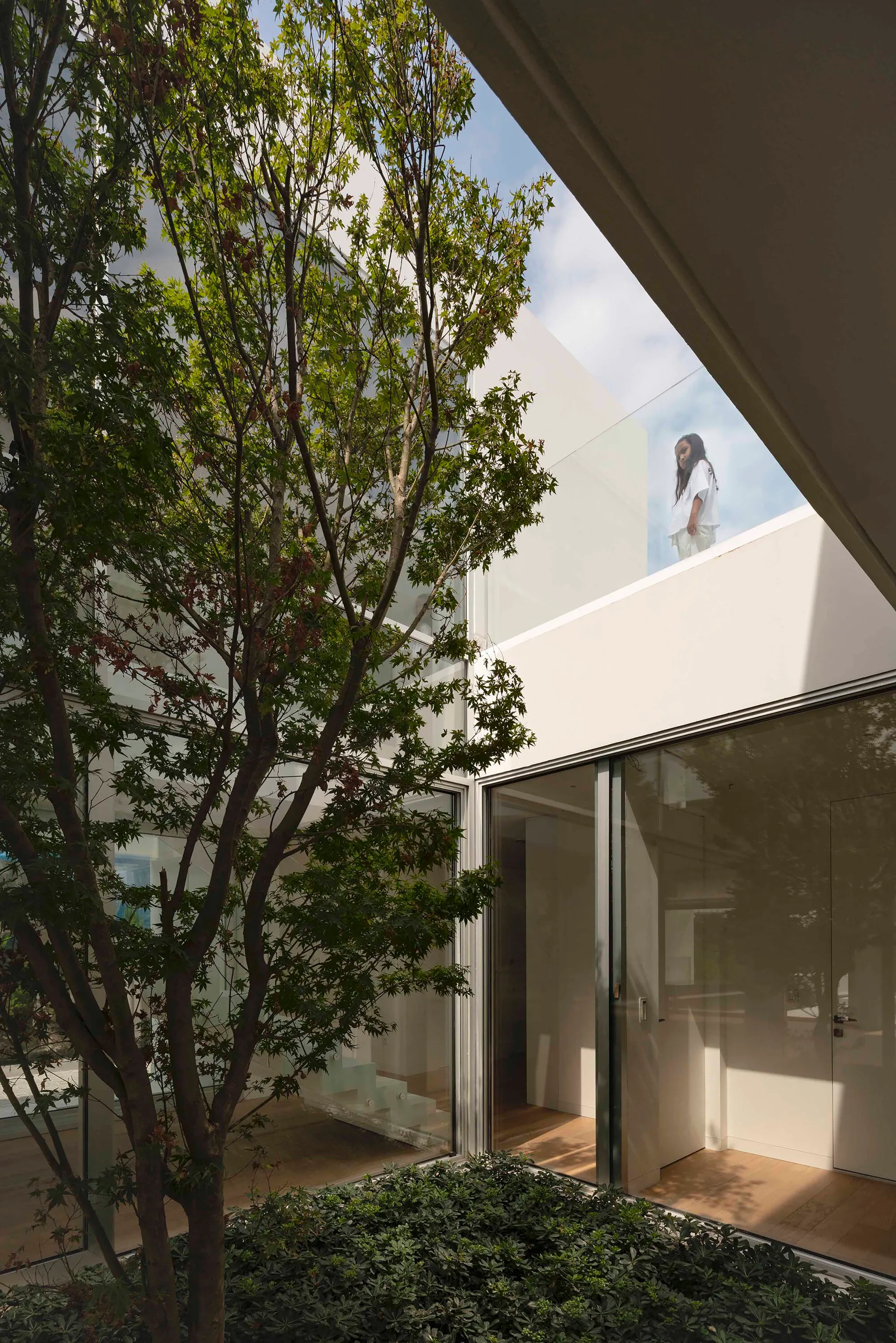
A mature multi-stem tree anchors the sunken courtyard at the heart of the plan. It is not ornamental planting. The tree is a spatial protagonist, visible from nearly every room through walls of glass, and it sets the scale for everything around it. The courtyard floor sits below the main living level, pulling daylight deep into the ground-floor rooms while creating a sense of interiority that a flat garden could never achieve.
Sliding glass panels along the courtyard edges allow the boundary between inside and outside to dissolve entirely in warm weather. When closed, the glazing still preserves visual continuity: you are always looking through the house, never at a dead end. The upper-level terrace wraps around the courtyard's perimeter, adding a second register of engagement with the tree and the sky above it.
Thresholds and Vertical Connections
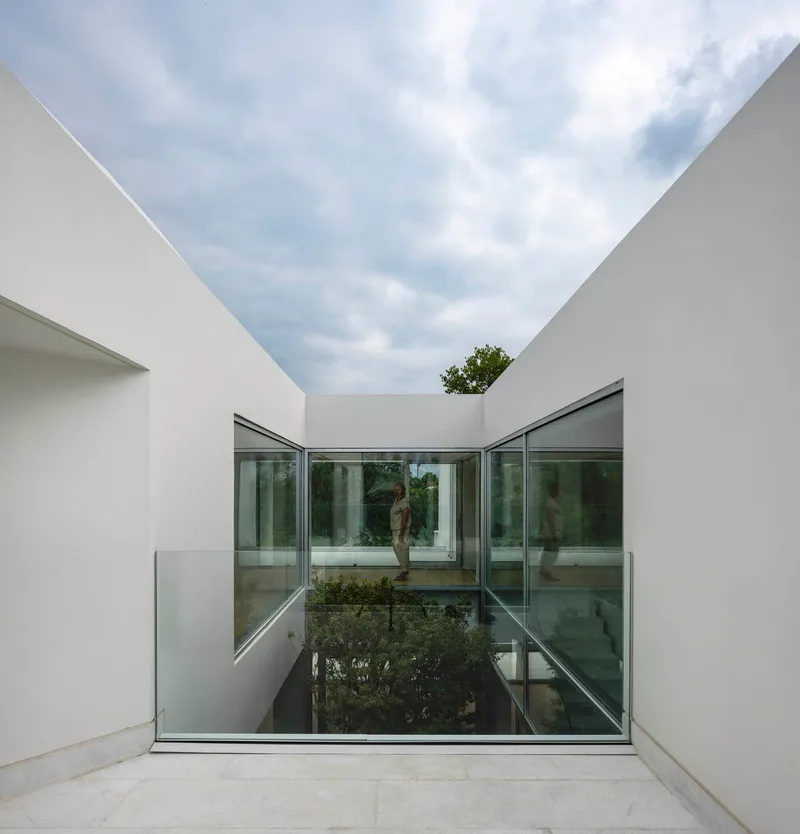
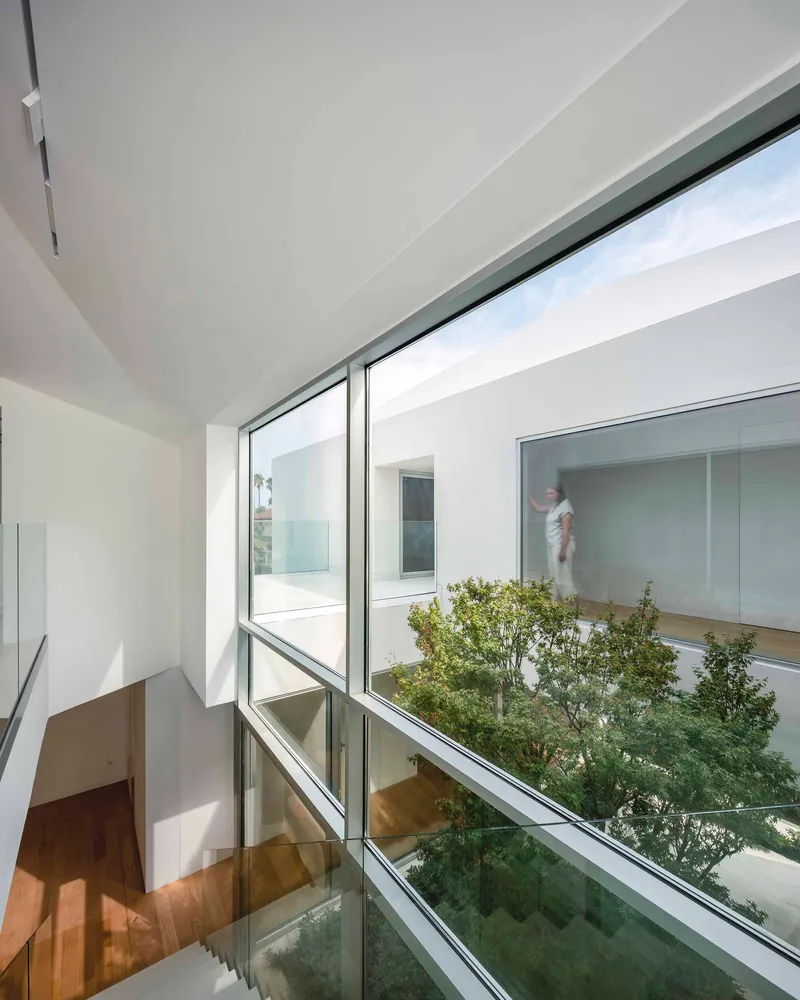
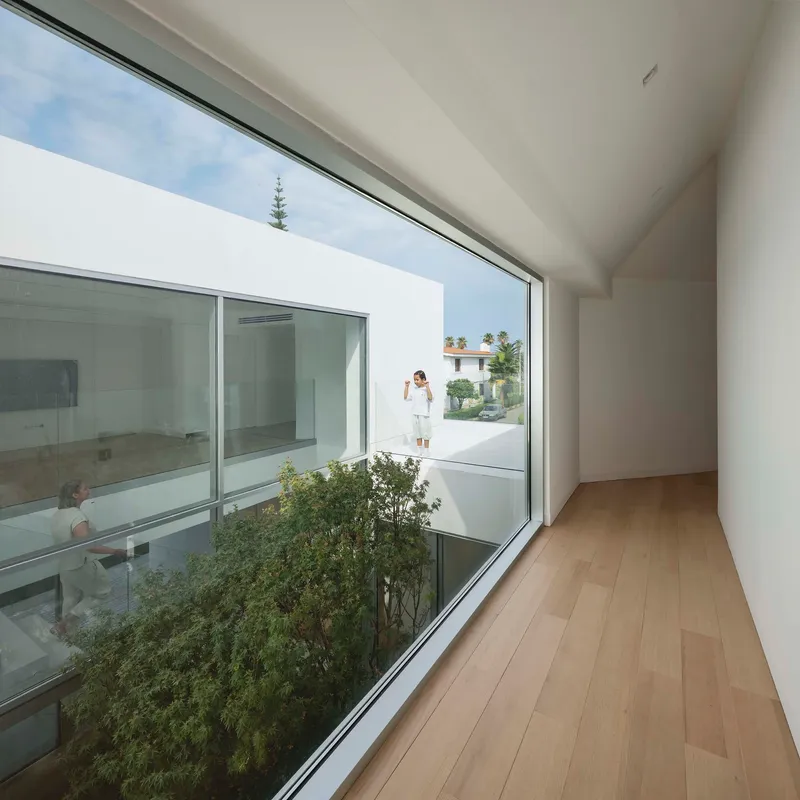
A glass-floored bridge spans the courtyard void at the upper level, connecting the two wings in a way that is simultaneously functional and theatrical. Walking across it, you look straight down through the floor at the planted beds below. It is a moment of mild vertigo that reminds you the house is organized vertically as much as horizontally.
The stairwell reinforces that layering. Timber treads rise alongside a glass balustrade that keeps the courtyard in full view during the ascent. A narrow vertical slit in a curved white wall frames a single tree, turning circulation into a curated sequence of glimpses. These are not grand gestures. They are small calibrations of aperture and material that keep you oriented within the plan.
Two Faces: Street and Stream
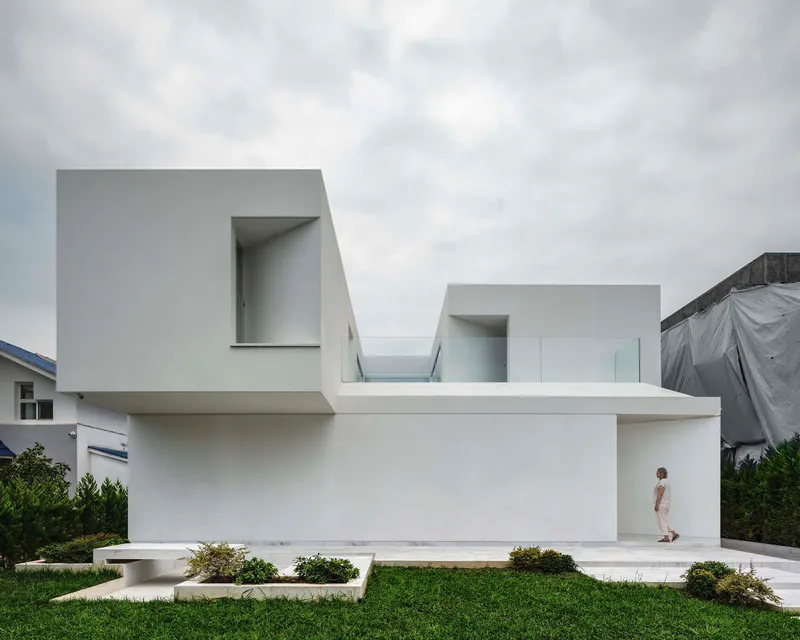
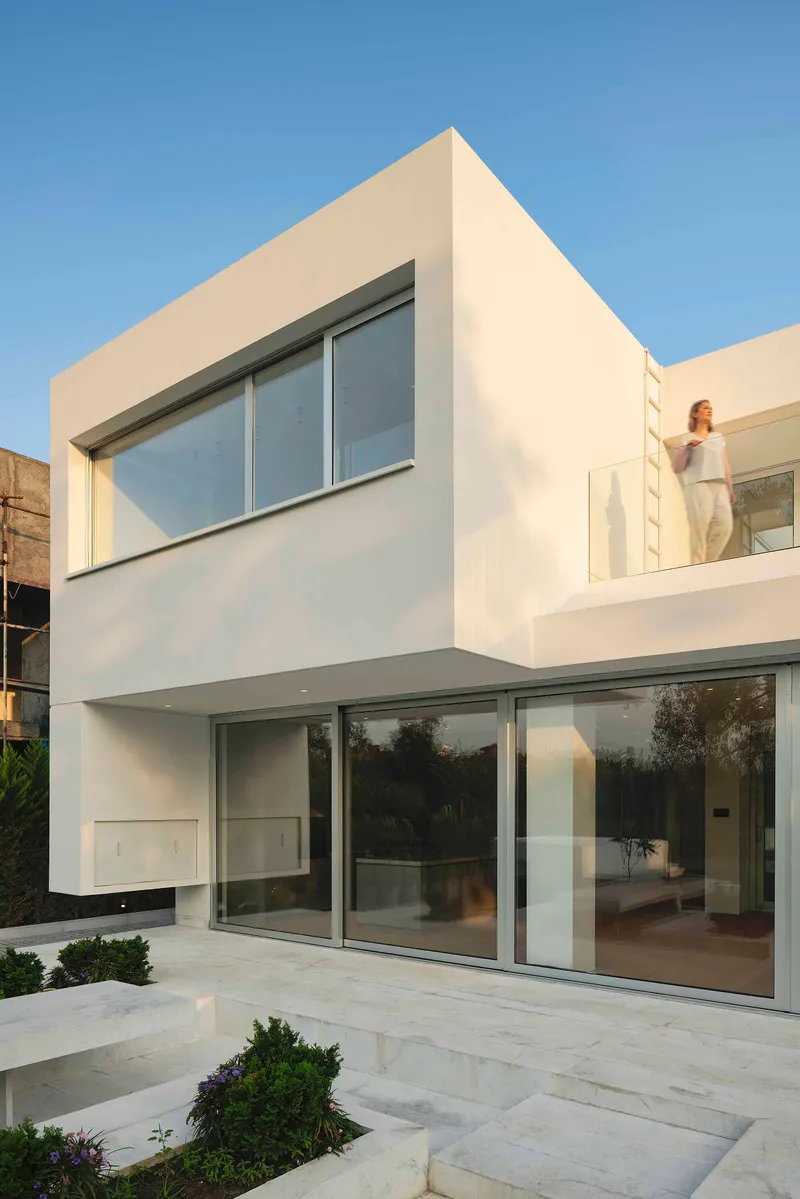
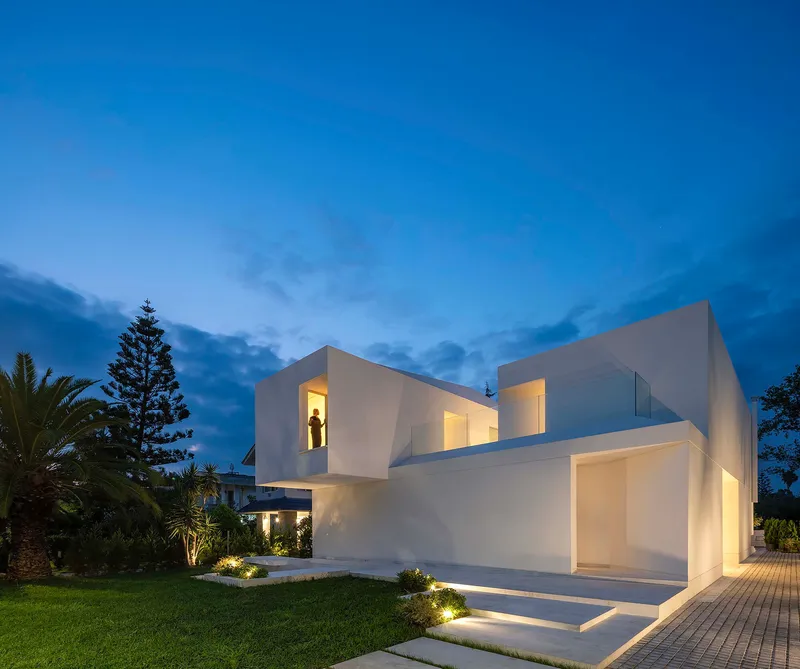
The north facade is a white wall with minimal openings: ribbon windows, a recessed entrance, and a cantilevered volume that signals domestic scale without exposing the interior. It communicates restraint and privacy, appropriate behavior for a street-facing elevation in a residential complex. The south facade flips the script entirely. Full-height glazing opens toward the stream, inviting light, breeze, and views into the living spaces. At dusk, the illuminated openings turn the house into a lantern, its inner life legible from the landscape.
Kanisavaran describes this duality as the tension between wanting to be seen and needing to remain unseen. It is a condition familiar to anyone who has designed a house that sits between a public road and a private landscape. What distinguishes Villa 1028 is the precision with which that tension is resolved: not through a gradient but through a clean split, two entirely different architectural faces joined by a shared concrete skeleton.
Concrete Surface and Seamless Geometry
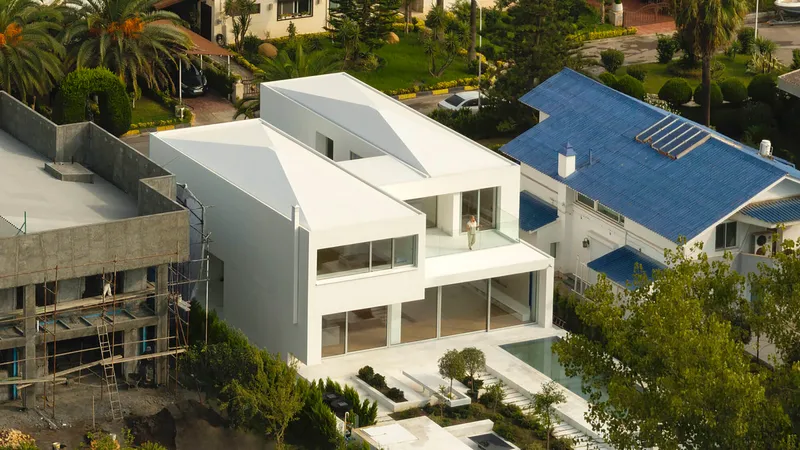
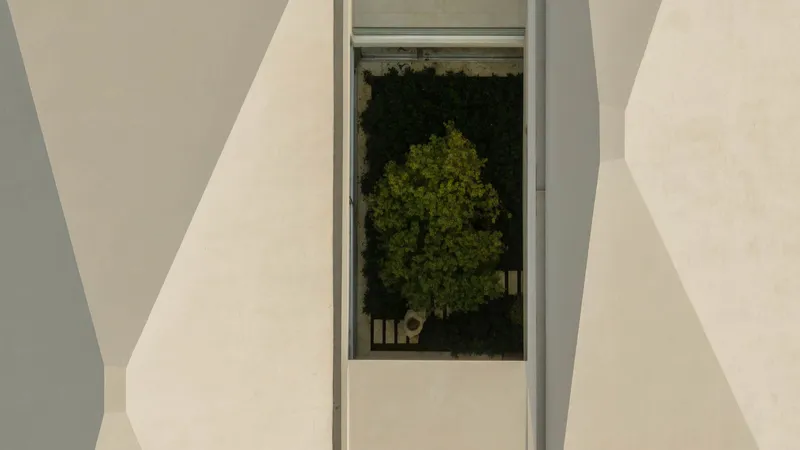
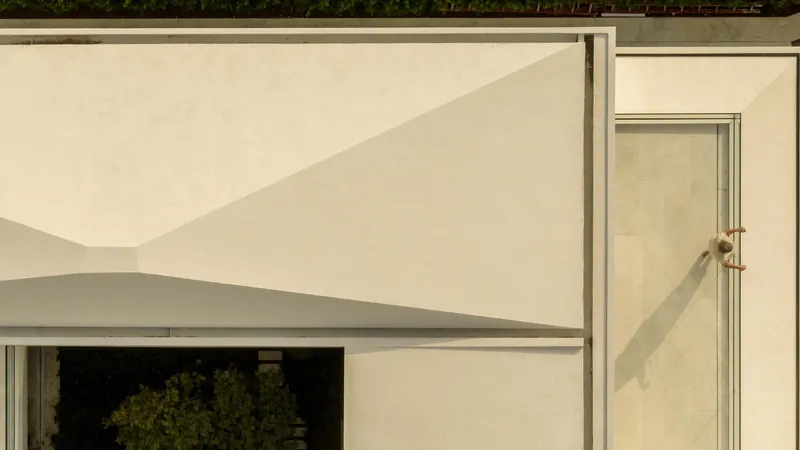
The building is concrete throughout, finished in white stucco that gives the exterior a monolithic appearance. Kanisavaran paid particular attention to the junctions where roof meets wall, ensuring that the geometry reads as visually seamless. There are no visible gutters, no exposed flashings, no moments where the surface language breaks. The curved roof edges flow into the vertical planes as if the entire envelope were formed from a single continuous sheet.
That pursuit of surface continuity is more than cosmetic discipline. It reinforces the reading of each wing as a sculpted volume rather than an assembly of parts, which in turn makes the courtyard cuts and glass insertions feel more dramatic. When the material is this consistent, every opening becomes an event.
Roof Terraces and Upper Life
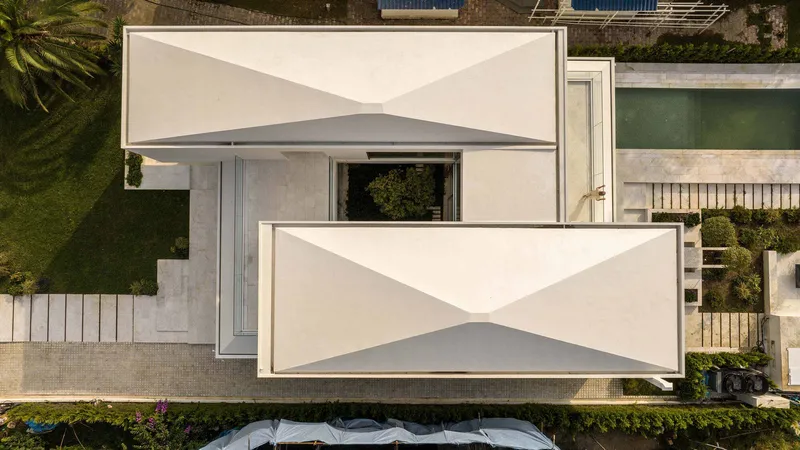
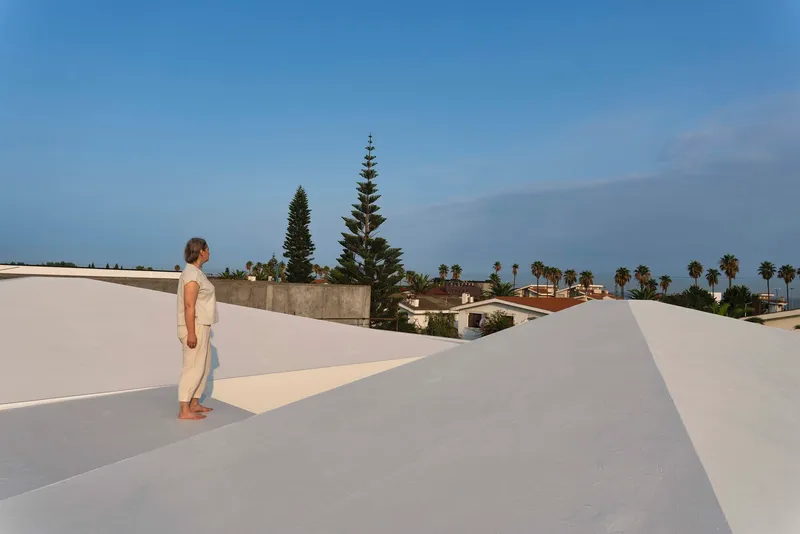
The folded roof planes create usable terraces at the upper level, extending the domestic program outdoors. From these elevated platforms, the palm trees of the surrounding neighborhood become the borrowed landscape. The triangular shadow patterns cast by cantilevered edges shift throughout the day, turning the terrace surfaces into a kind of sundial. It is a quiet amenity, but for a weekend retreat that exists to slow time down, these shifts in light and shade are the point.
Plans and Drawings
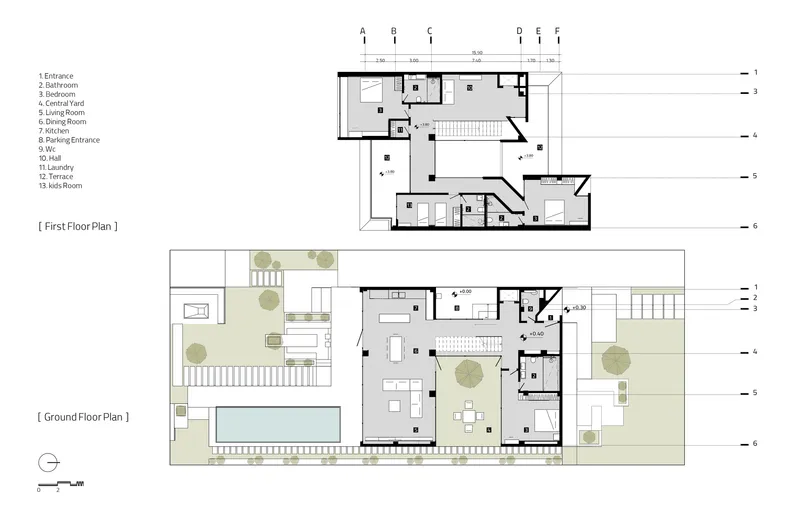
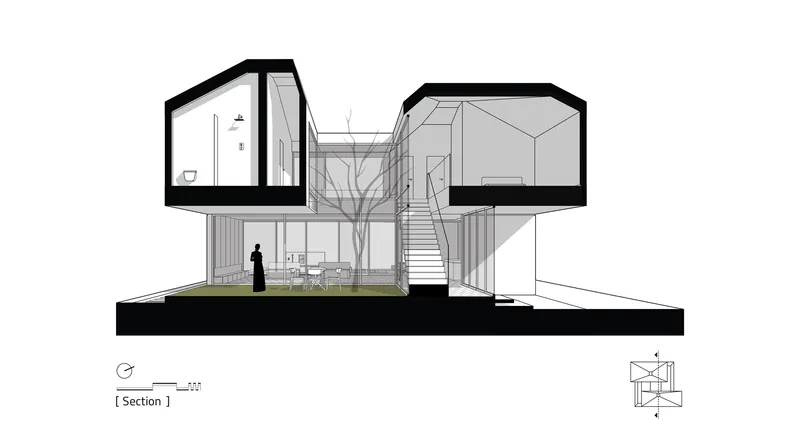
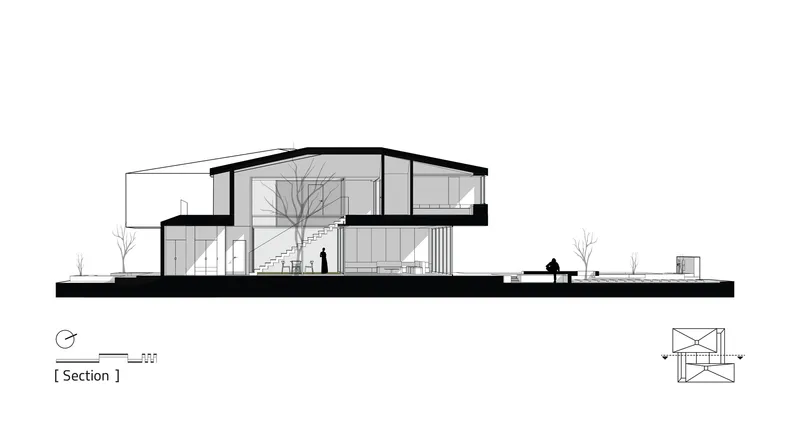
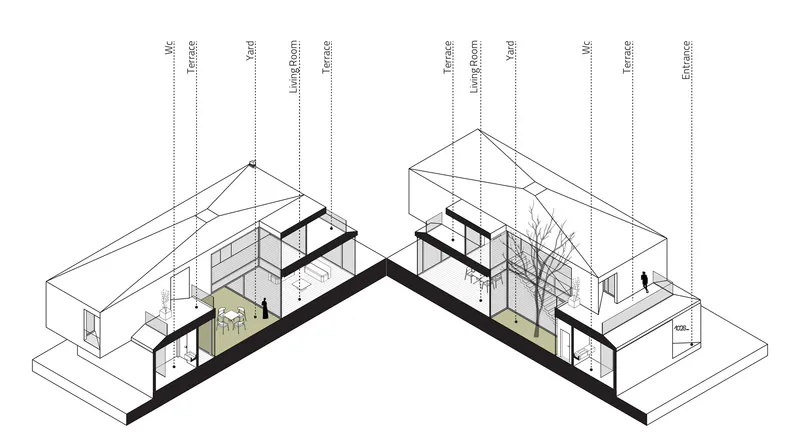
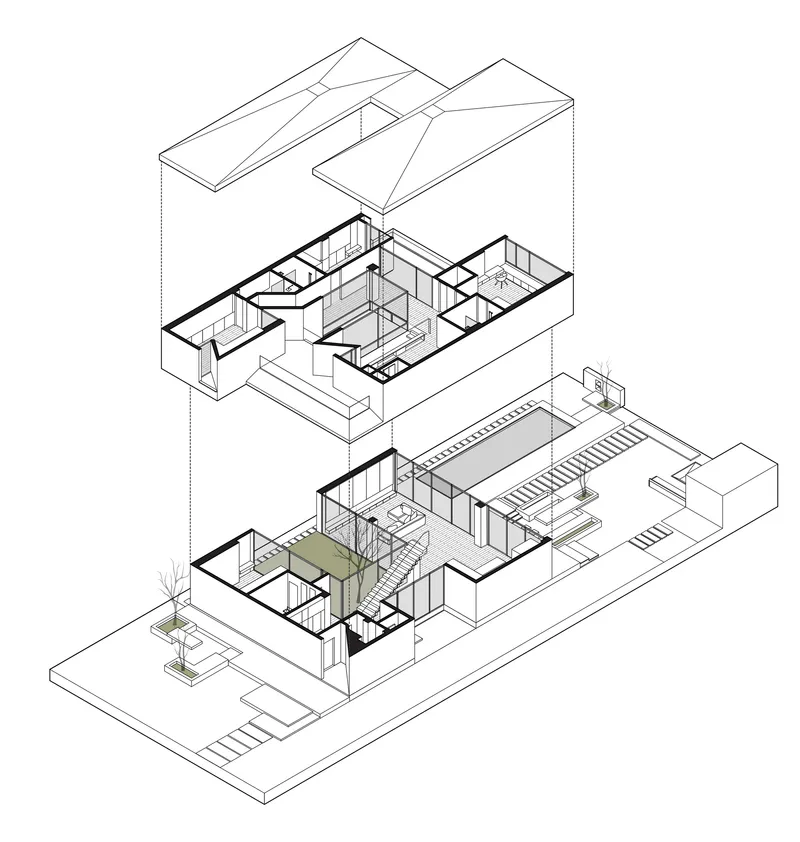
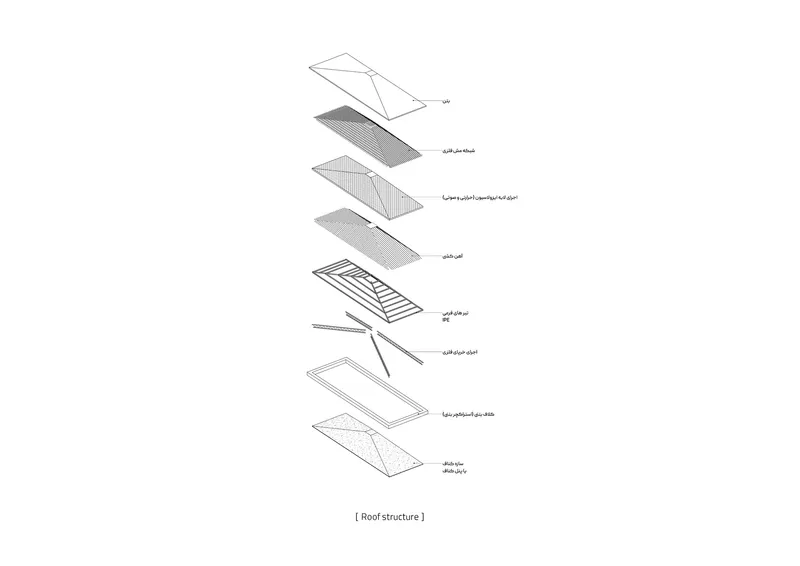
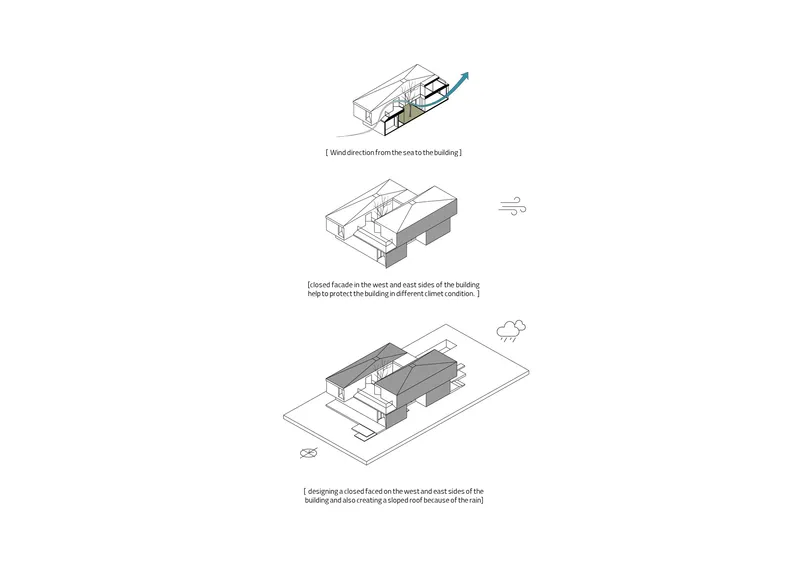
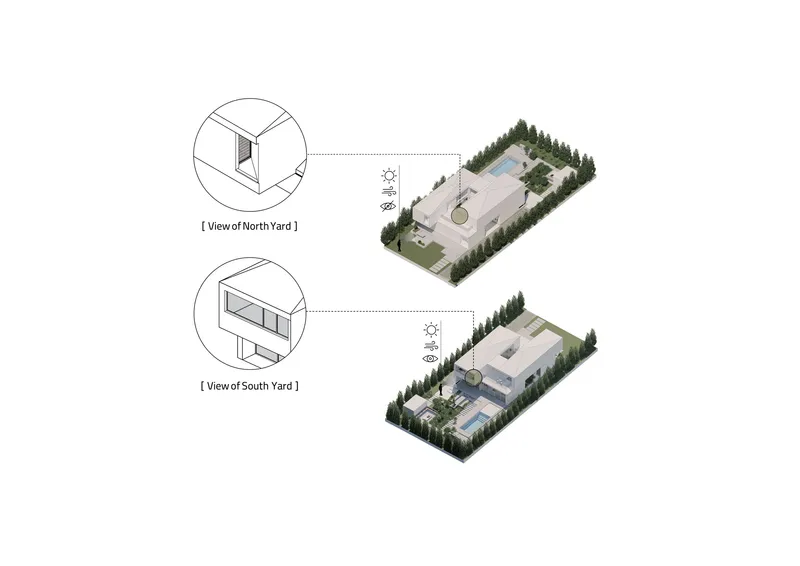
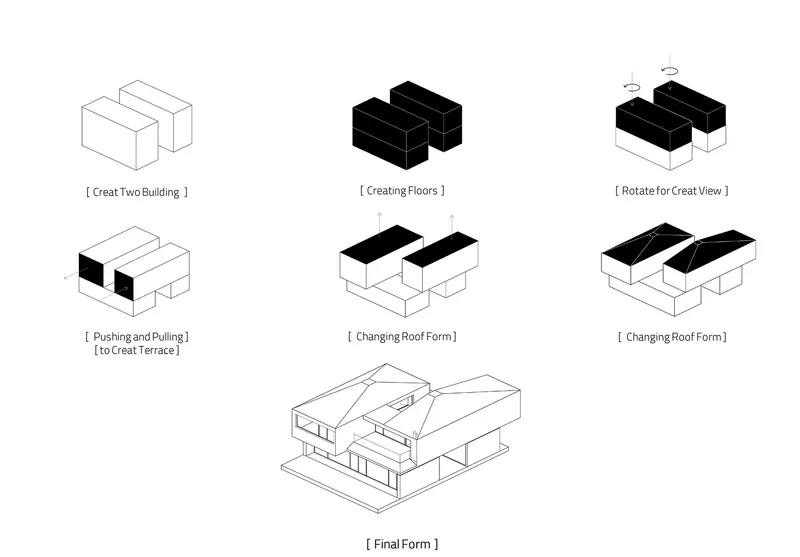
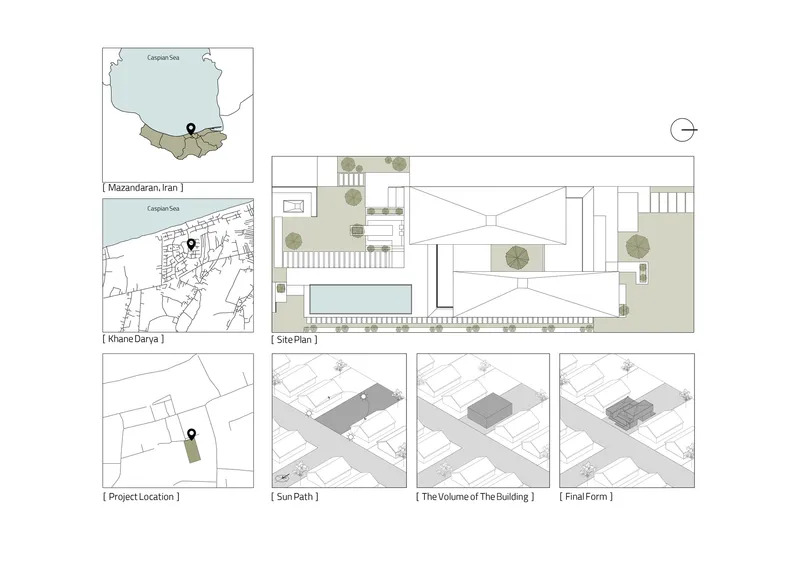
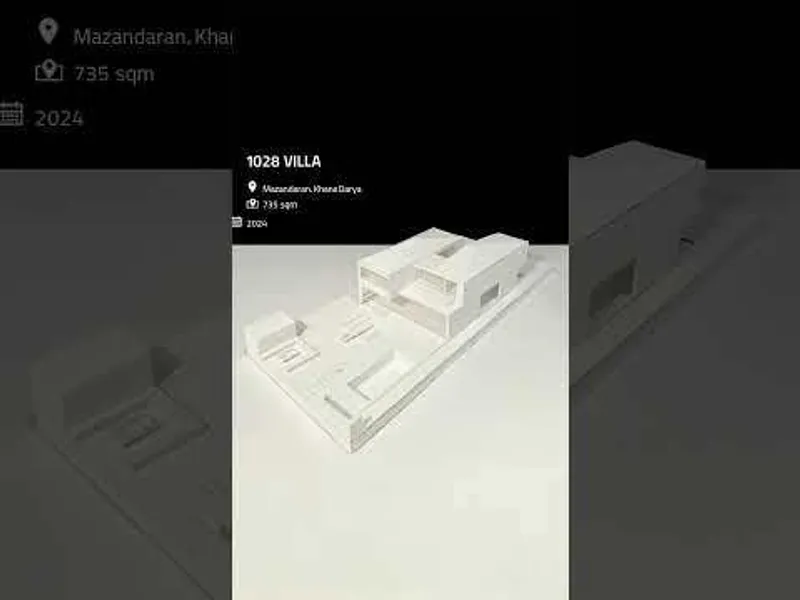
The drawings reveal the full extent of the design logic. Floor plans confirm how the central core shifts from connector to divider between levels. Sections show the courtyard's sunken depth and the stair that wraps around the tree, anchoring the vertical circulation to the building's symbolic center. The exploded axonometrics break the house into its constituent layers: structure, roof assembly, and finish surface, making legible a construction sequence that the seamless exterior conceals.
The climate diagrams are especially instructive. They illustrate how sloped facade placement and roof pitch respond to prevailing wind patterns and solar orientation, confirming that the folded forms are not arbitrary. The formal evolution sequence, from two simple rectangular volumes to interlocking masses with folded roofs, reads like a step-by-step proof: each move justified by program, climate, or site condition.
Why This Project Matters
Villa 1028 is a compelling case study in how a small, clearly stated organizational idea, a central core that reverses its function between floors, can generate a rich spatial experience without relying on complexity for its own sake. Kanisavaran's description of the project as an exercise in minimizing words is apt. The plan is economical, the material palette is singular, and the formal moves are few. What gives the house its depth is not variety but precision: the exact placement of glass, the exact pitch of a roof, the exact moment a wall curves.
In a region where weekend villas often default to either nostalgic regionalism or imported minimalism, Villa 1028 charts a third path. It takes local climate seriously, not as a decorative theme but as a generative force. It respects the social codes of the street without retreating into opacity. And it makes a courtyard tree the center of domestic life, an old idea executed with the kind of tectonic control that makes it feel entirely new.
Villa 1028 by Kanisavaran Office, lead architect Mohammad Kanisavaran. Located in the Khaneh Darya residential complex, Mazandaran Province, Iran. 350 m². Completed 2024. Photography by Deed Studio.
About the Studio
Share Your Own Work on uni.xyz
If projects like this are the kind of work you want to make, uni.xyz is a place to publish your own, find collaborators, and enter design competitions.




Popular Articles
Popular articles from the community


Play: Fragments of Their World
Familiar architecture becomes modular playground design, creating safe spaces where displaced children can learn, connect, imagine and play.

Conexión: Biophilic Design Reimagines High-Rise Living in Hong Kong
Conexión reimagines high-rise living in Hong Kong through biophilic design, green facades, shared spaces, daylight, water and nature within.

The Ocean Hive: Sustainable Architecture for a Self-Sufficient Civilization at Sea
The Ocean Hive imagines sustainable architecture at sea, where modular habitats, algae, wave power and ocean waste sustain a growing colony.

Hill & Cross Opera: Sculptural Opera House Architecture Shaped by Tallinn’s Landscape and Identity
Hill & Cross Opera reimagines opera house architecture in Tallinn through its sculptural hill, civic plaza, glass wave and a luminous cross.

Similar Reads
You might also enjoy these articles

Bao Huynh Watercolor Atelier: A Serene Art Retreat in Hội An
Bao Huynh Watercolor Atelier in Hội An blends multifunctional art spaces, sustainable design, local materials, and family-friendly living in a serene environment.

Atelier Macri Concept Store Interior Design by CASE-REAL
Atelier Macri store features a "ko" counter, walnut wood details, cork displays, blending retail, gallery, and seamless customer experiences.

Manuel Vargas Izquierdo Stadium and High-Performance Sports Center: Architectural Excellence in Jalpa de Méndez
The Manuel Vargas Izquierdo Stadium blends sustainable design, inclusive sports facilities, and cultural-inspired architecture, revitalizing Jalpa de Méndez’s public spaces.

KAKR Buluh Awar Hall: Revitalizing Community and Ecology Through Bamboo Architecture
Community built bamboo hall revitalizes Buluh Awar village, empowering youth, restoring ecology, celebrating vernacular craftsmanship through sustainable architecture and culture.



Comments (0)
Please login or sign up to add comments
No comments yet. Be the first to comment!