
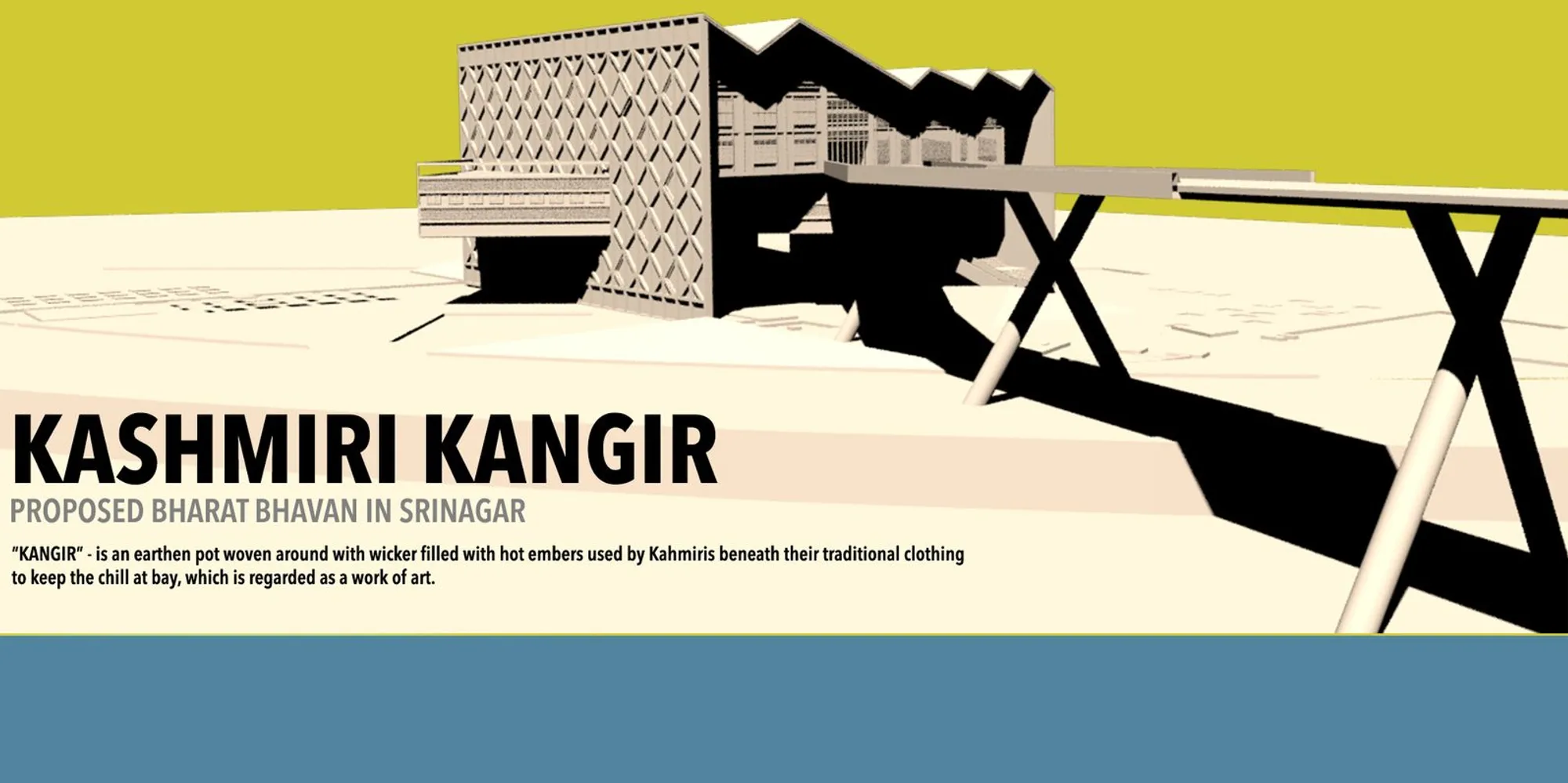
Kashmiri Kangir: A Cultural Centre Woven from Srinagar's Vernacular Memory
An earthen firepot becomes the architectural metaphor for a riverfront cultural complex rooted in craft, timber, and Kashmiri identity.


In Kashmir, the Kangir is not simply a portable heater. It is an earthen pot wrapped in wicker, cradling glowing embers against the body, and its presence in daily life carries the weight of intimacy, craft, and cultural identity. To take this object and scale it into architecture is to argue that a building can hold warmth the same way: not through mechanical systems alone, but through material honesty, communal space, and a deep continuity with place. That is the proposition behind this cultural centre for Srinagar, where over 2,500 years of architectural lineage meet the urgent need for a public building that actually belongs to its city.
Designed by Yashasvi Guleria, this shortlisted entry to the Bharat Bhavan 2020 competition situates itself along the Jhelum River on Srinagar's Tourism Boulevard, linking Dal and Nageen Lakes, the Mughal Gardens, Hazratbal Shrine, and the city's famous houseboats. The proposal reads Srinagar as a living museum, one framed by three Himalayan ranges (Karakoram, Zanskar, and Pir Panjal) and sustained by generations of artisans working in pashmina, paper maché, metalwork, bamboo, and dhochi construction. Aligned with the city's Master Plan 2035 goals for cultural tourism, artisan revival, and sustainable development, the project reframes the Kangir as both metaphor and method: a vessel of resilience and cultural continuity.
Three Layers of a Living City: Heritage, Craft, and Ecology
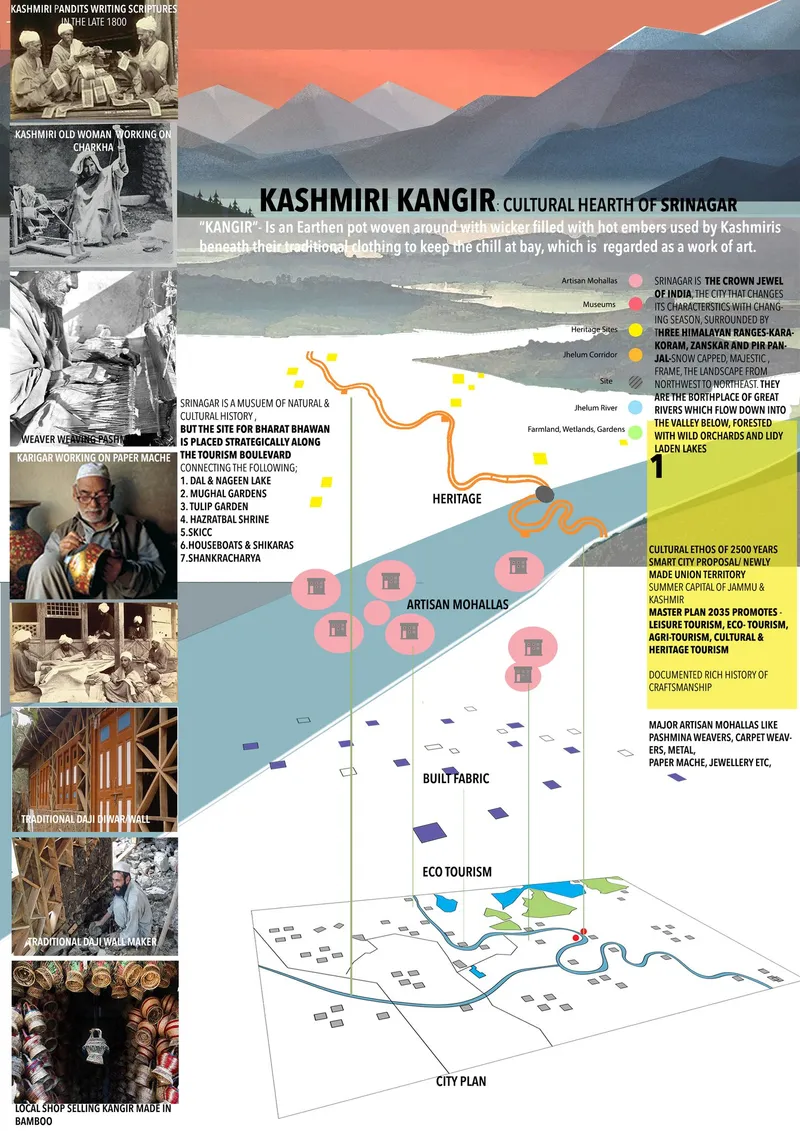
The illustrated site plan reveals the project's organizational logic: three interconnected layers that structure the entire intervention. A Heritage Belt runs along the Jhelum's edge, encompassing historical ghats, old markets, shrines, and bridges. Artisan Mohallas, the craft-based neighborhoods that form Srinagar's social and economic fabric, are strengthened through new movement corridors, public courtyards, and interactive platforms where artisans can work, display, and teach. The third layer integrates green corridors, wetlands, orchards, and walkable networks that characterize the broader ecological framework of the city.
What makes this layering compelling is its refusal to treat the cultural centre as an isolated object. The building is conceived as a node within a network, not a destination severed from its surroundings. Pedestrian movement along the riverfront becomes a defining experience, with new bridge access allowing visitors to arrive from the Jhelum itself and cross seamlessly into the heritage quarter. Parking is pushed outward to maintain pedestrian priority, while shikara routes extend the mobility system onto the water.
A Diamond Lattice Screen Rising from the Riverbank
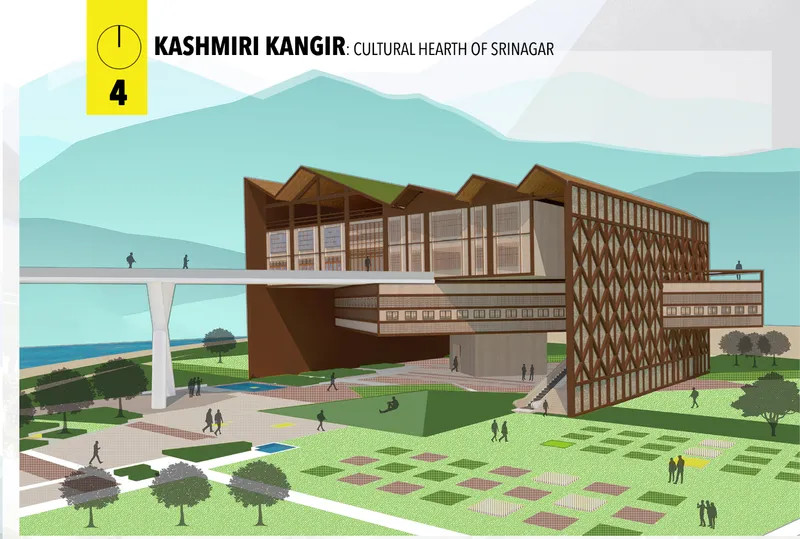
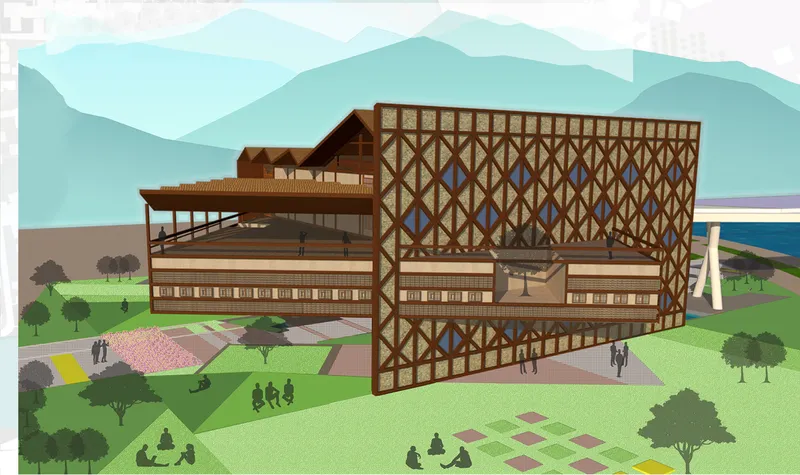
The building's most striking feature is its diamond-patterned timber screen, a facade system that wraps the multistory volume with an unmistakable reference to Kashmiri wicker weaving. Seen from the elevated pedestrian bridge in the first rendering, the lattice facade reads as a single textured surface that mediates between the interior programme and the landscaped grounds. The second view reveals the layered quality of this skin: horizontal timber banding alternates with the diagonal lattice, creating a depth that shifts as visitors move around the building.
The facade is more than decorative. It performs climatically, filtering harsh light and managing ventilation in a region where temperatures swing dramatically between seasons. Its material language, rooted in earth, timber, brick, and stone, draws directly from the construction techniques that Kashmiri artisans have refined over millennia. The screen transforms the building into a scaled-up Kangir: a woven enclosure holding warmth and life within.
Symmetry, Structure, and the Logic of Stacking
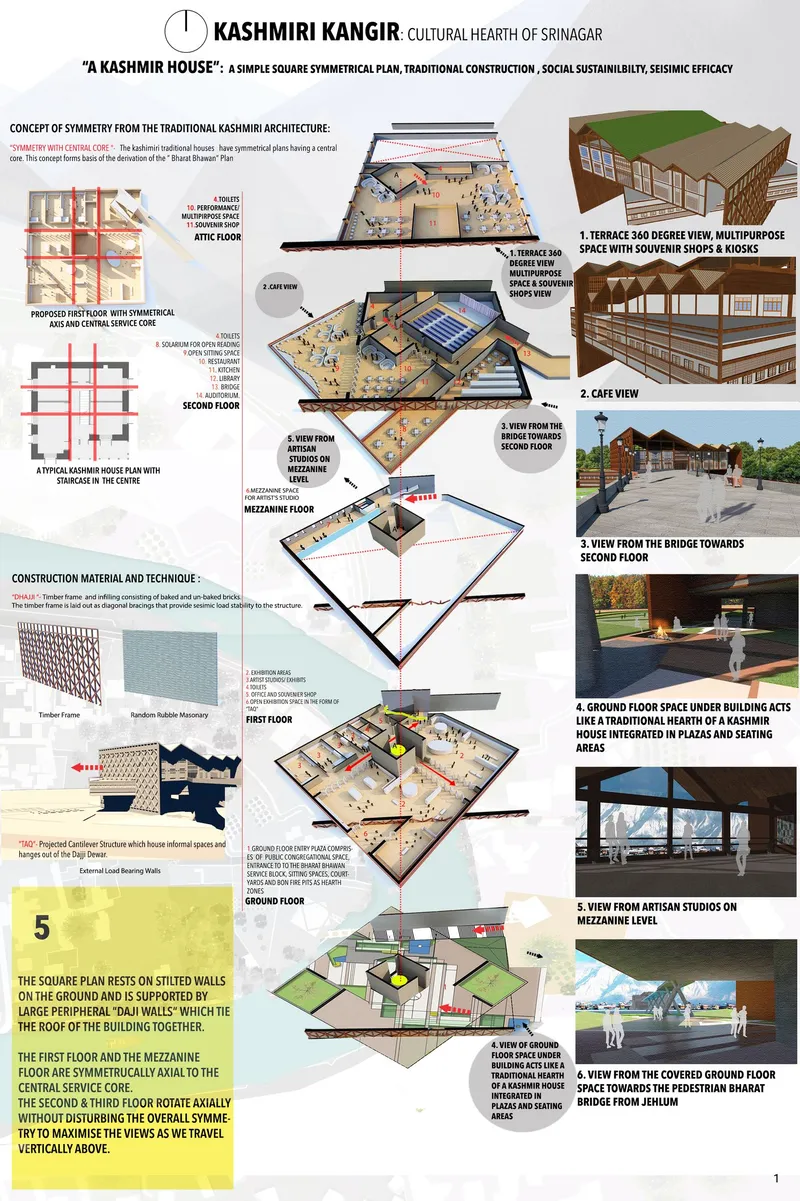
The exploded axonometric drawings lay bare the building's internal organization. Symmetrical floor plans stack vertically, each level accommodating distinct programmatic zones while maintaining a consistent structural grammar. Construction details visible in the drawing show how the timber lattice integrates with the primary structure, and how terrace spaces are carved out at upper levels to offer views toward the river and surrounding mountains. The axonometric format makes it possible to read the building simultaneously as plan, section, and elevation, a clarity of communication that demonstrates the designer's control over the project's spatial logic.
Ground and Screen: The Building Meets Its Landscape
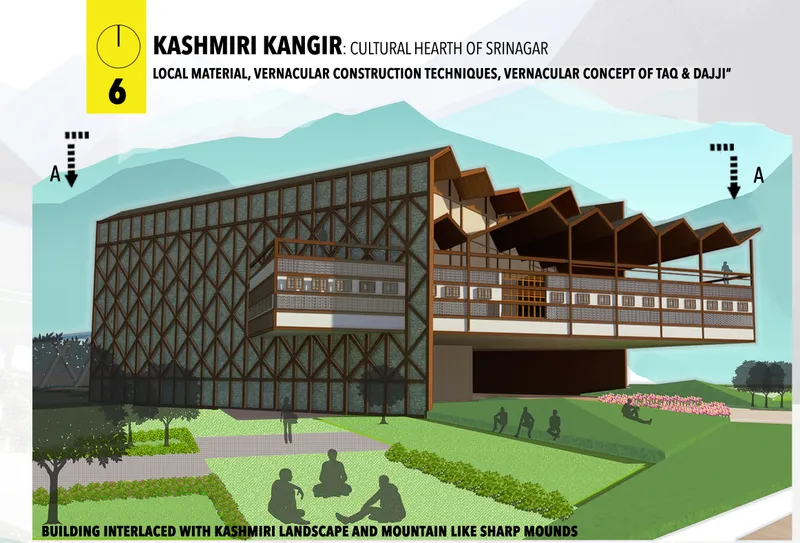
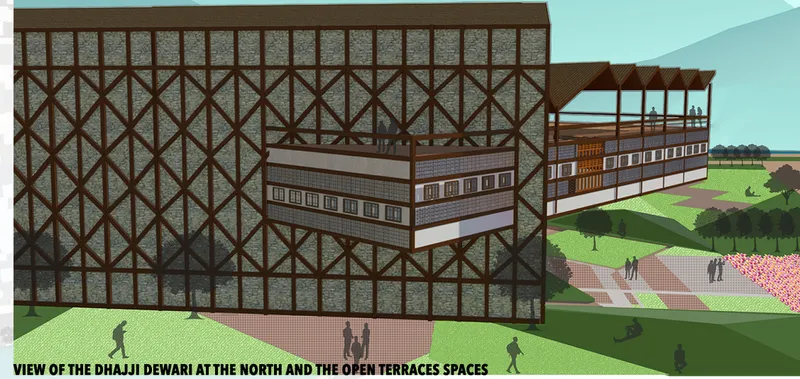
Two final perspectives capture the building's relationship with its sloping site. In the wider view, the lattice screen facade rises above a landscaped incline dotted with visitors, grounding the cultural centre in the topography rather than imposing upon it. The close-up rendering focuses on the texture of the timber lattice wall against the horizontal banding, with open terraces below inviting occupation. There is a generosity to these outdoor spaces: they suggest that the building's programme extends beyond its walls into the courtyards and walkways that connect it to the broader artisan and heritage network.
The careful grading of the landscape, combined with the transparency of the screen facade, means the building never reads as a fortress or a monument sealed off from its context. Instead, it operates as a threshold, a place where the city flows in and craft flows out. The design fulfills its stated intent of reviving the Jhelum's heritage edge while creating interconnected public spaces that feel genuinely inviting.
Why This Project Matters
The temptation with culturally charged projects is to lean on symbolism and leave the architecture behind. The Kashmiri Kangir avoids that trap by grounding its metaphor in material reality. The wicker weave of the Kangir becomes a structural and climatic facade system. The communal warmth of the firepot becomes a network of artisan courtyards and public platforms. The project's three-layer site strategy, linking heritage, craft, and ecology, offers a model for how cultural centres in Indian cities might be embedded within existing urban fabrics rather than dropped onto cleared sites.
What Guleria demonstrates here is that vernacular architecture does not mean nostalgia. It means taking the intelligence embedded in 2,500 years of building practice, from material selection to spatial organization to climate response, and deploying it to serve a contemporary cultural programme. For Srinagar, a city where the intangible heritage of craft is as vital as the tangible heritage of buildings, this kind of architecture feels not just appropriate but necessary.
View the Full Project
About the Designers
Designer: Yashasvi Guleria
Enter a Design Competition on uni.xyz
uni.xyz runs architecture and design competitions year-round that reward proposals with spatial conviction and real site intelligence.
Project credits: Kashmiri Kangir by Yashasvi Guleria Bharat Bhavan 2020 (uni.xyz).



Popular Articles
Popular articles from the community


Co-life: Sustainable Architecture for Age-Friendly Community Living
Co-life reimagines sustainable architecture for seniors through courtyards, rammed earth, shared gardens, and spaces designed for belonging.

Conexión: Biophilic Design Reimagines High-Rise Living in Hong Kong
Conexión reimagines high-rise living in Hong Kong through biophilic design, green facades, shared spaces, daylight, water and nature within.

Hill & Cross Opera: Sculptural Opera House Architecture Shaped by Tallinn’s Landscape and Identity
Hill & Cross Opera reimagines opera house architecture in Tallinn through its sculptural hill, civic plaza, glass wave and a luminous cross.

Co-Life: Senior Housing Design That Reconnects Older Adults With the City
Co-Life reimagines senior housing design through healing gardens, shared streets, workshops, and a sustainable community across generations.


Similar Reads
You might also enjoy these articles

Lunar Spiral: Space Architecture Shaped by the Mathematics of the Universe
Lunar Spiral reimagines space architecture through Fibonacci geometry, lunar regolith, levitating habitats, and self-sustaining Moon living.
The Main Dream: Modular Architecture for Play, Learning, and Community
A modular playground turns recycled plastic into adaptable spaces where refugee children can play, build, learn, and reconnect.

Play: Fragments of Their World
Familiar architecture becomes modular playground design, creating safe spaces where displaced children can learn, connect, imagine and play.

Wadi Rum Observatory: Desert Architecture Designed for the Night Sky
Wadi Rum Observatory turns desert architecture into a quiet instrument for astronomy, hiding research spaces under Jordan's starlit terrain.





Comments (0)
Please login or sign up to add comments
No comments yet. Be the first to comment!