
Kengo Kuma Builds a CLT Staircase to the Sky Overlooking Japan's Largest Sand Dunes
A timber café and observatory in Tottori rises nine meters to frame coastal dunes stretching 14.5 kilometers along the Sea of Japan.


Tottori's sand dunes are one of Japan's geological spectacles: 14.5 kilometers of wind-sculpted coast tucked inside the UNESCO-designated San'in Kaigan Geopark. Sitting at their edge, between a parking lot and the ocean, a small timber pavilion by Kengo Kuma & Associates does the obvious thing, which is to get visitors up high, and the less obvious thing, which is to make the ascent feel like the whole point. The Tottori Takahama Café is only 199 square meters across two levels, yet its inverted pyramidal form and exterior staircase give it the presence of something much larger. Opened in August 2022, the building stacks a ground-floor café beneath a rooftop observatory, linked by a diagonal stair that the architects describe as a "staircase to the sky."
What makes the project worth studying isn't its program, which is straightforward, but its material strategy. The hybrid structure pairs cross-laminated timber panels made from Tottori-grown lumber with reinforced concrete, allowing a cantilevered form that widens as it rises. Every detail, from the washi paper light pendants dusted with local sand to the pottery sinks glazed at a nearby Mingei workshop, ties the building to its region. Kuma has long preached a gospel of material locality, but here the argument is unusually legible: the warm, striated CLT skin reads almost like compressed dune sediment.
An Inverted Pyramid on the Dune's Edge
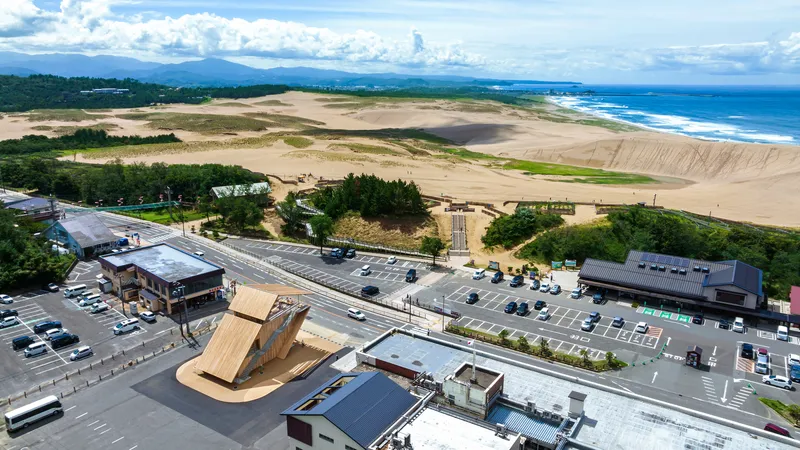
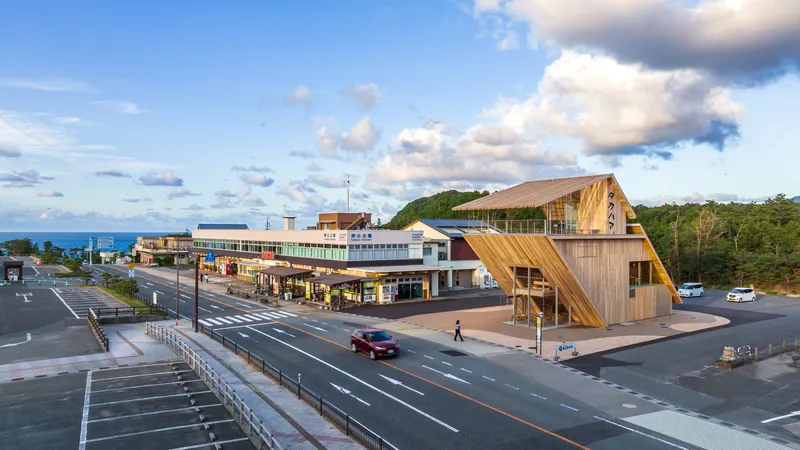
Seen from above, the building's footprint is modest, a compact rectangle nestled between a bus station and an asphalt lot. The aerial perspective reveals how deliberately the café was sited: it acts as a visual anchor for arriving tourists, its angled roofline distinguishing it immediately from the flat-roofed service buildings around it. At dusk, the warm glow of its timber frame turns the structure into a lantern against the darkening coast.
The contrast between the building's intimacy and the vastness of its setting is the core spatial idea. You arrive in a banal infrastructure zone, but the pavilion reorients your gaze upward and outward. The staircase isn't enclosed; it's exposed to the coastal wind, so the transition from ground level to rooftop observatory is genuinely experiential, not just circulatory.
A Timber Skin That Echoes the Dunes

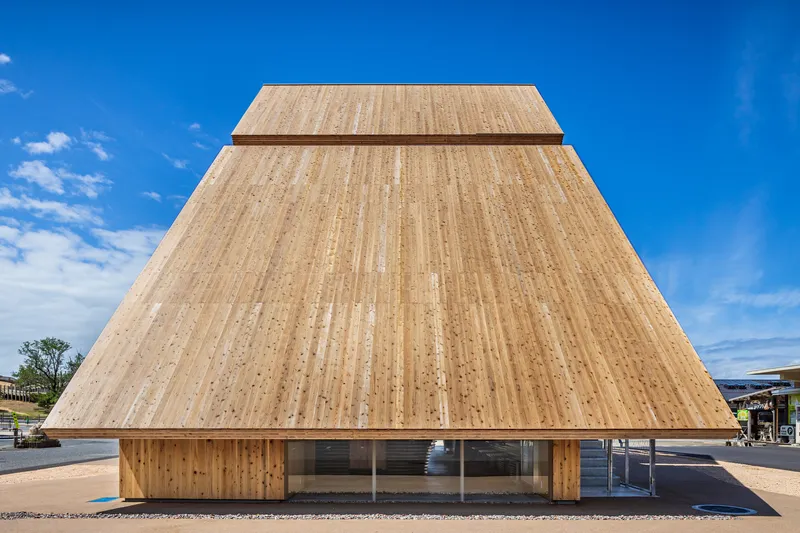

The CLT panels that wrap the exterior do double duty as structure and expression. Horizontal slats layer over the panels like geological strata, giving the facade a directional grain that shifts in character depending on the angle and the light. From the front, the inverted pyramidal form reads as a single sculptural gesture: a broad crown tapering to a narrower base. From the side, the diagonal staircase and vertical cladding break down the mass into a more legible composition of parts.
Wooden shutters surround portions of the building, modulating views and solar gain without resorting to mechanical systems. The palette stays relentlessly natural: untreated timber against sand, sky, and concrete. It's a restrained move for Kuma, who sometimes over-applies his signature lattice vocabulary. Here the material does the talking, and the form stays disciplined.
Ground-Floor Café: Mingei Craft Meets CLT
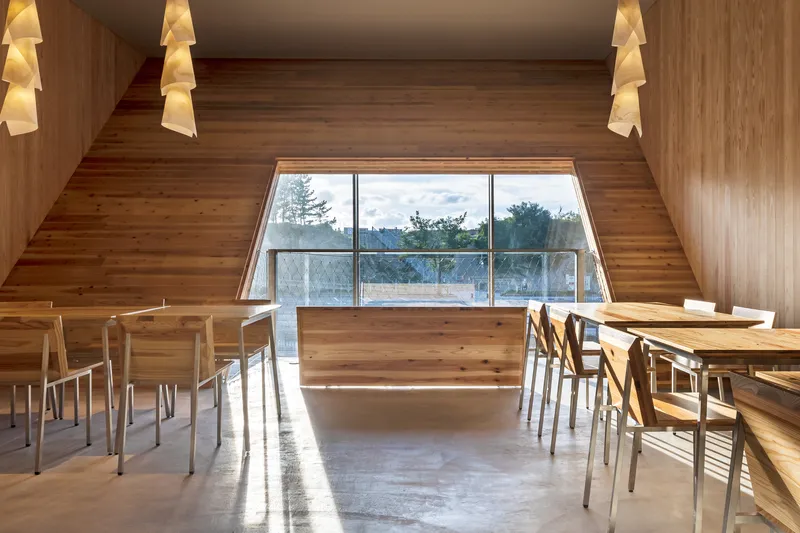
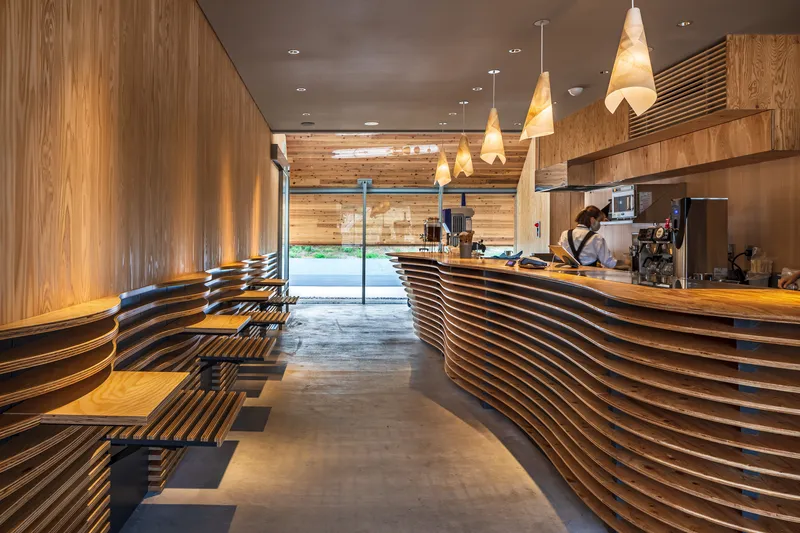
Inside, the café space is wrapped in the same horizontal slatted timber that defines the exterior, collapsing the boundary between inside and out. Angled glazing on one wall floods the dining area with daylight and frames oblique views toward the dunes. The furniture is custom: chairs fabricated from CLT, continuing the structural material into the scale of the hand. It's a coherent decision that avoids the cognitive dissonance of, say, mass-produced plastic seating inside a craft-focused building.
Overhead, conical pendant lights made of washi paper embedded with grains of local sand cast a soft, diffused glow. The pendants are the project's most poetic detail. They literalize Kuma's interest in embedding site specificity into material at a granular level, sand from the dunes suspended in a translucent Japanese paper craft. In the bathrooms, glazed pottery sinks from the Nakai-gama workshop, a Tottori Mingei atelier producing ceramics with distinctive green and black finishes, extend the homage to regional craft traditions that predate modern architecture.
The Rooftop Observatory and Its Timber Pergola
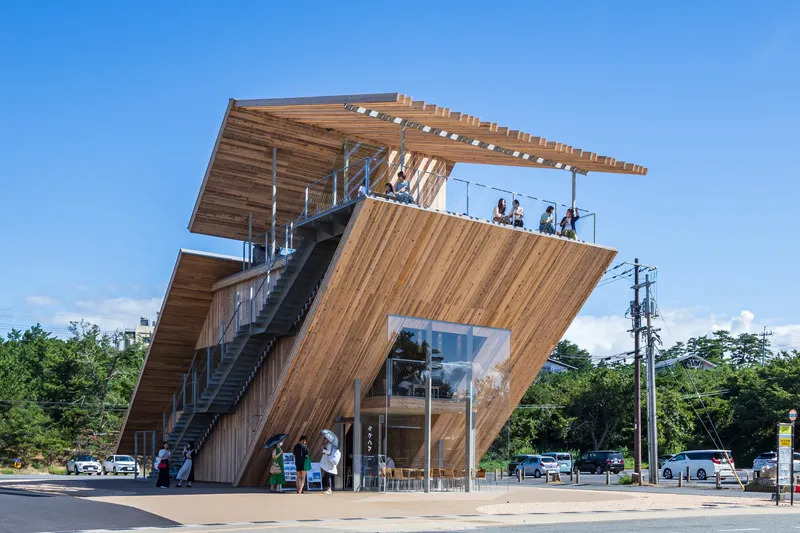
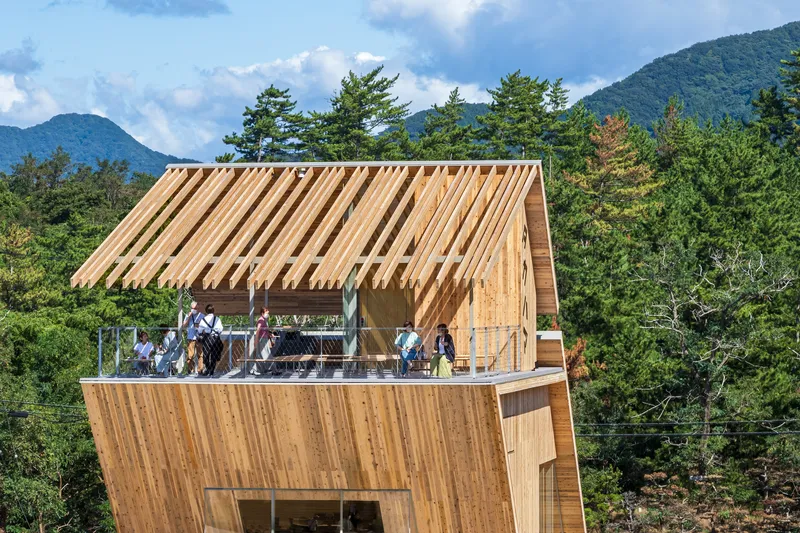
The upper level is the building's payoff. An exterior staircase deposits visitors onto a decked terrace roughly nine meters above grade, where a sculptural timber pergola provides shade without blocking sightlines. Slatted rafters fan out overhead, filtering coastal sunlight into rhythmic bands. Glass railings keep the perimeter transparent, letting the panorama of dunes, ocean, and distant mountains feel unmediated.
The pergola structure is worth examining closely. Its members are not uniform; they taper and angle in ways that recall the radiating patterns of traditional Japanese roof carpentry, reinterpreted through the precision of CNC-cut CLT. The effect is simultaneously archaic and technological, which is Kuma's sweet spot. As a viewing platform, it competes with the dunes themselves for your attention, which is either a problem or the point, depending on your tolerance for architectural protagonism.
Blue Hour: The Building as Lantern

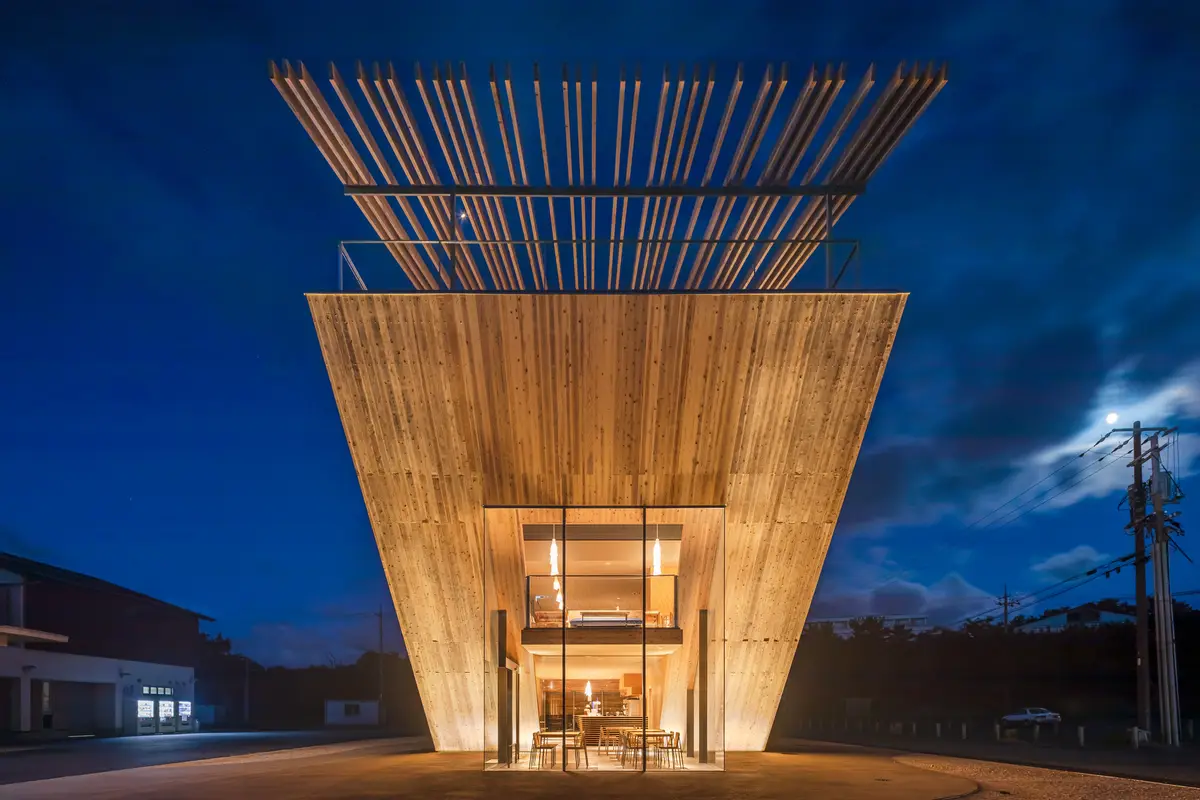
At twilight, the café transforms. Warm interior lighting radiates through the slatted timber screens, turning the entire structure into a glowing volume. The inverted pyramidal silhouette, topped by the exposed rafter crown of the pergola, reads like a beacon against the deep blue of the coastal sky. It's the image that will circulate most, and justifiably so: it captures the building's dual identity as both a sheltering interior and a signal in the landscape.
Plans and Drawings
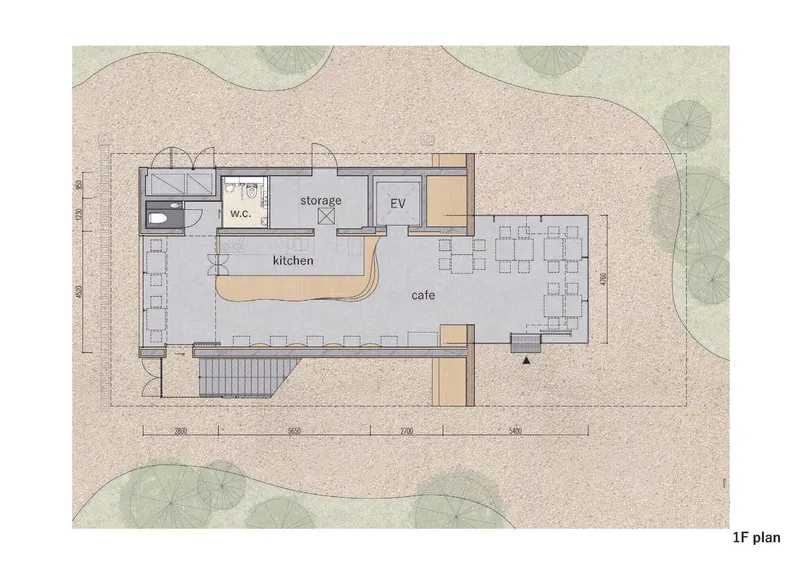

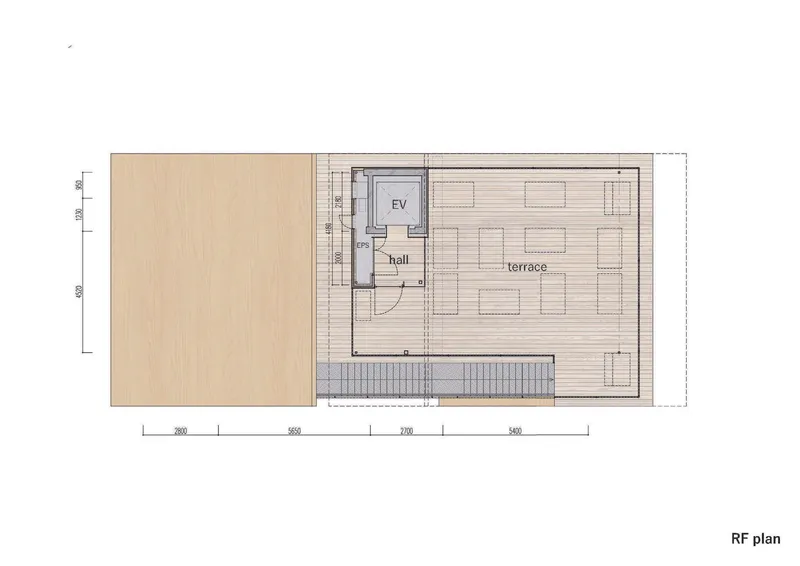

The watercolor-rendered floor plans reveal a compact and efficient organization. The ground floor concentrates the kitchen, service areas, and primary café seating into a tight rectangle. The second floor shifts the program toward a smaller seating zone flanked by restrooms and an elevator, with the stair continuing upward to the roof terrace. The roof plan shows a generous decked area, confirming that the observatory function commands nearly the full footprint of the building.
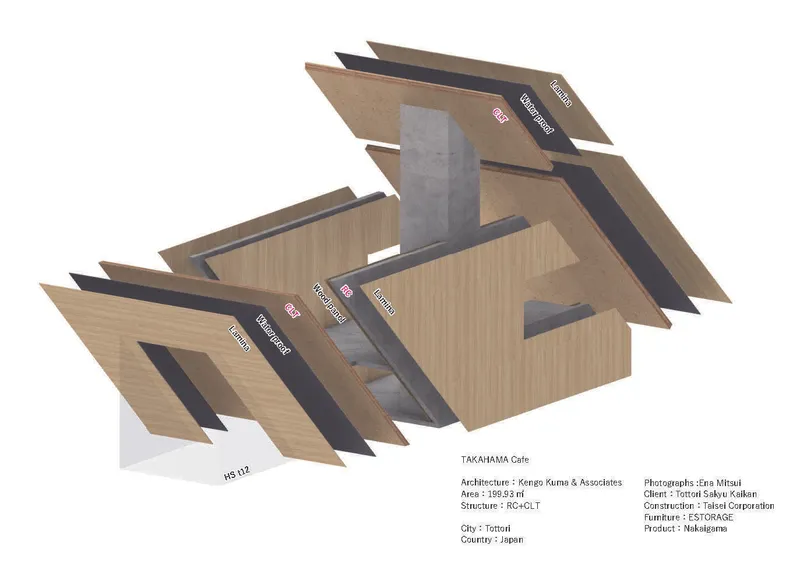
The section drawing is the most instructive. It exposes the split-level interior, the angular roof slope, and the way the building's mass widens as it rises, cantilevering outward from a narrower base. A concealed machine room sits at the apex, tucked beneath the pergola. The exploded axonometric clarifies the layered roof planes and vertical circulation core, making legible a structural logic that reads from the outside as a single sculptural form. These drawings collectively argue for CLT as a medium capable of formal ambition, not just sustainable virtue.
Why This Project Matters
Tourist infrastructure at natural landmarks is often disposable architecture: generic cafés and gift shops designed to process visitors rather than engage them. The Tottori Takahama Café resists that pattern by treating every material choice as an argument for place. Tottori lumber becomes CLT structure; local sand becomes lighting; Mingei pottery becomes bathroom fixtures. The cumulative effect is a building that doesn't just sit near the dunes but participates in the cultural and material ecology of the region.
For Kengo Kuma, the project also represents a useful case study in restraint. At 199 square meters, there is nowhere to hide behind complexity. The hybrid CLT-and-concrete structure is straightforward, the program is minimal, and the formal move, an inverted pyramid with a staircase, is singular. That clarity lets the material craft carry the design, which is where Kuma's work is most persuasive. Whether or not you buy the "staircase to the sky" poetry, the building delivers on a practical level: it gets you up to see the dunes, gives you a good cup of coffee on the way, and does both inside a structure that will age alongside the landscape it frames.
Tottori Takahama Café by Kengo Kuma & Associates. Tottori, Japan. 199 m². Completed 2022. Photography by Kawasumi-Kobayashi Kenji Photograph Office.
About the Studio
Share Your Own Work on uni.xyz
If projects like this are the kind of work you want to make, uni.xyz is a place to publish your own, find collaborators, and enter design competitions.


Popular Articles
Popular articles from the community


The Ocean Hive: Sustainable Architecture for a Self-Sufficient Civilization at Sea
The Ocean Hive imagines sustainable architecture at sea, where modular habitats, algae, wave power and ocean waste sustain a growing colony.

Conexión: Biophilic Design Reimagines High-Rise Living in Hong Kong
Conexión reimagines high-rise living in Hong Kong through biophilic design, green facades, shared spaces, daylight, water and nature within.

Lunar Spiral: Space Architecture Shaped by the Mathematics of the Universe
Lunar Spiral reimagines space architecture through Fibonacci geometry, lunar regolith, levitating habitats, and self-sustaining Moon living.

The Musturak Paradise: Senior Living Architecture for a Connected Future in Temara, Morocco
The Musturak Paradise reimagines senior living architecture in Temara via private homes, social spaces, culture, community, and shared care.

Similar Reads
You might also enjoy these articles

Bao Huynh Watercolor Atelier: A Serene Art Retreat in Hội An
Bao Huynh Watercolor Atelier in Hội An blends multifunctional art spaces, sustainable design, local materials, and family-friendly living in a serene environment.

Atelier Macri Concept Store Interior Design by CASE-REAL
Atelier Macri store features a "ko" counter, walnut wood details, cork displays, blending retail, gallery, and seamless customer experiences.

Manuel Vargas Izquierdo Stadium and High-Performance Sports Center: Architectural Excellence in Jalpa de Méndez
The Manuel Vargas Izquierdo Stadium blends sustainable design, inclusive sports facilities, and cultural-inspired architecture, revitalizing Jalpa de Méndez’s public spaces.

KAKR Buluh Awar Hall: Revitalizing Community and Ecology Through Bamboo Architecture
Community built bamboo hall revitalizes Buluh Awar village, empowering youth, restoring ecology, celebrating vernacular craftsmanship through sustainable architecture and culture.

Explore Cafe Competitions
Discover active competitions in this discipline

Challenge to design luxury tourism on rails

VR headsets Storefront design competition

Designing a staircase for a client
Comments (0)
Please login or sign up to add comments
No comments yet. Be the first to comment!