
Khan Bonshek Retrofits a 1981 Postmodern Pyramid House in Milton Keynes Around a Sculptural Spiral Stair
A red clay shingle pyramid, originally built for Milton Keynes' Homeworld Expo, gets a CNC birch plywood core and ground-source heat pumps.


Milton Keynes was incorporated in 1967 as a new town, absorbing eighteen medieval villages into a grid of roundabouts and rationalist housing. In 1981, the Milton Keynes Development Corporation staged the Homeworld Expo in the Bradwell Common district, commissioning 36 landmark homes to demonstrate the future of British domestic architecture. One of those homes was the Pyramid House, designed by Cardiff-based Wigley Fox Architects: a three-story pyramidal volume with an upside-down layout, a glass-roofed upstairs lounge, steps descending directly to the garden, and, somewhat remarkably, a basement that could double as a nuclear fallout shelter.
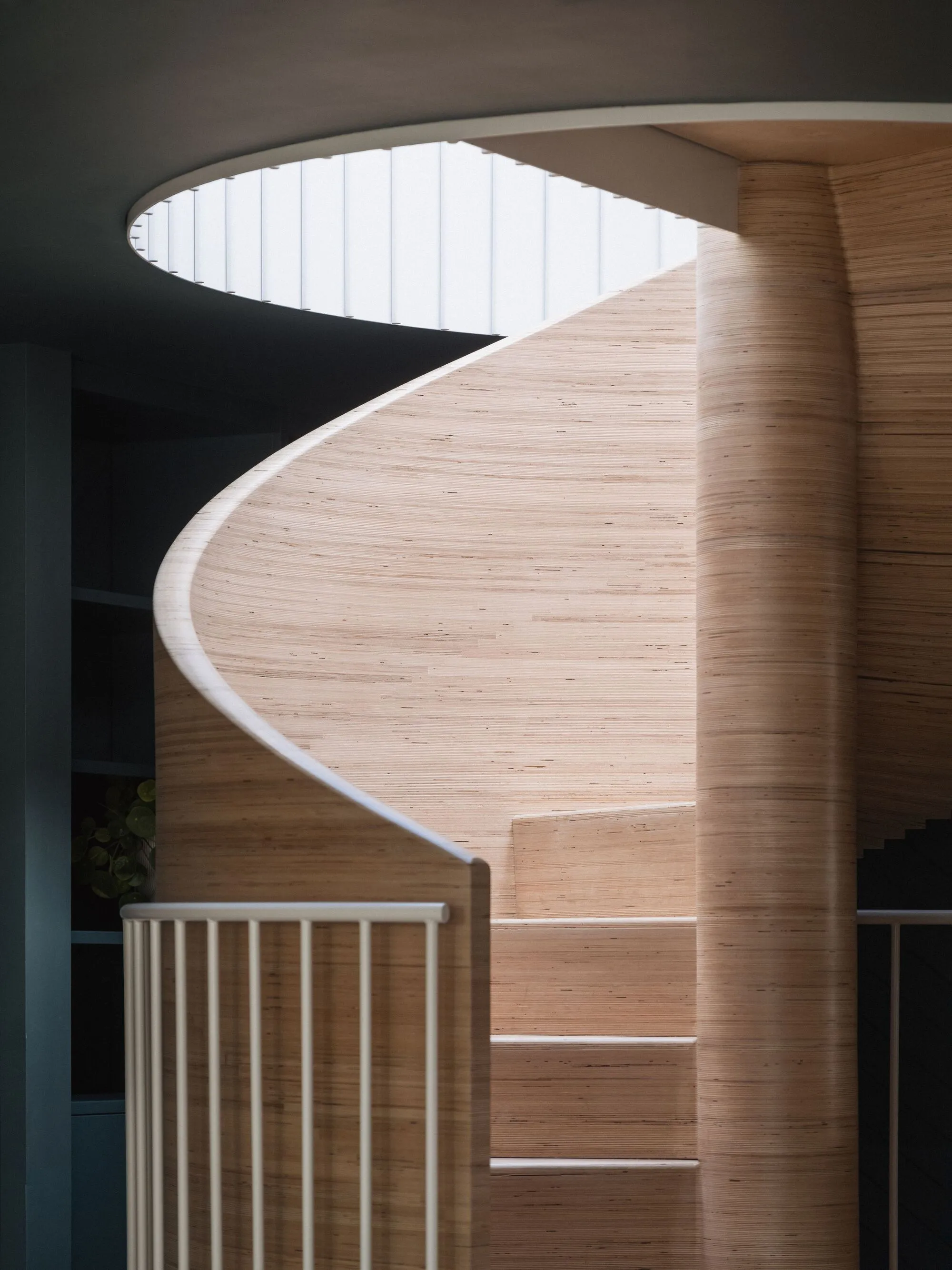
Forty-three years later, Khan Bonshek has completed a full retrofit and refurbishment that confronts the usual problem of postmodern houses: they photograph well and age badly. The practice's intervention is disciplined and precise. Rather than neutralizing the pyramid's eccentricity, Khan Bonshek intensified it, threading a CNC-milled birch plywood spiral staircase through the center of the structure as a new circulatory spine and opening up the ground floor by removing partitions while simultaneously carving out deliberately cosy zones elsewhere. The result is a five-bedroom home organized as a triptych of working, living, and resting spaces, wrapped in red clay shingles and powered by two ground-source heat pumps. The original expo showpiece now functions as an actual home, and a very efficient one.
A Pyramid on a Shadow Gap
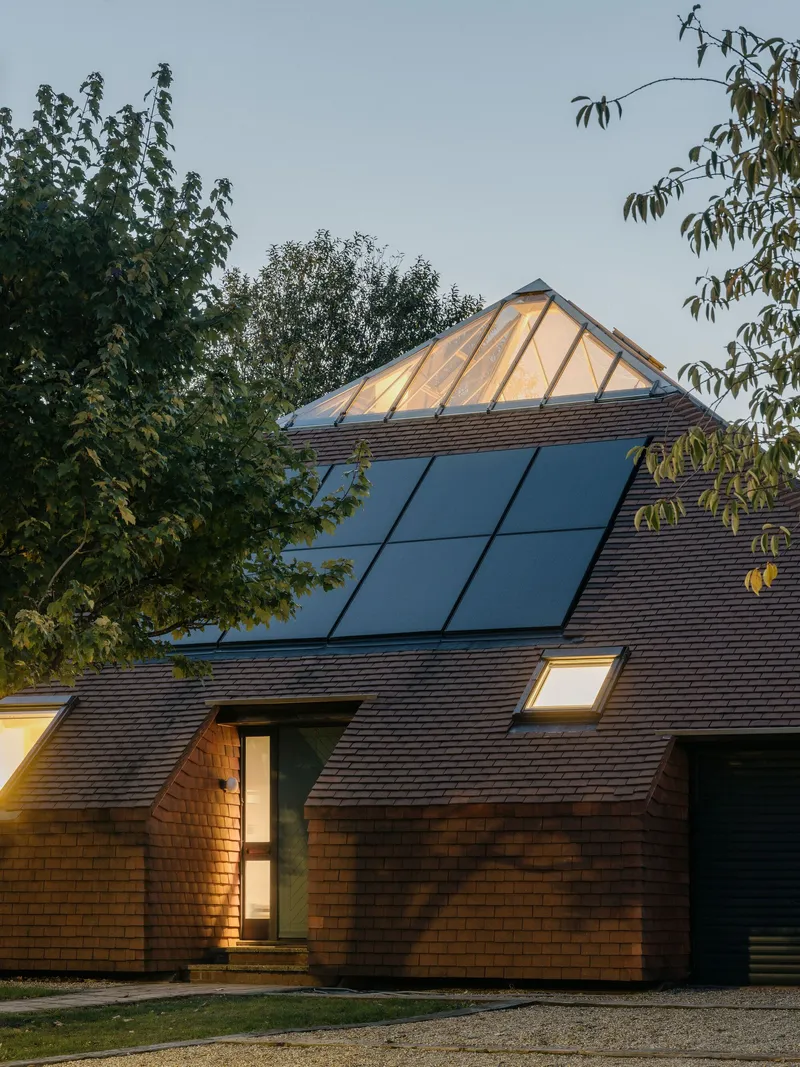

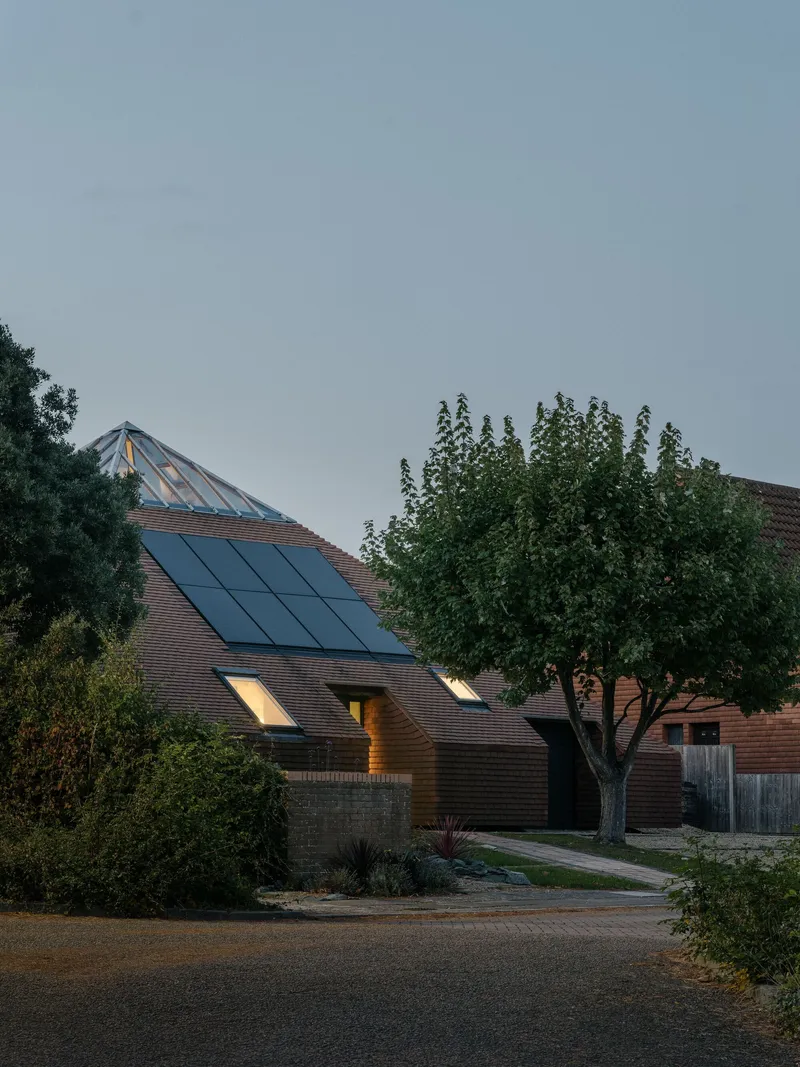
From the street, the Pyramid House reads as a taut, symmetrical wedge clad in red clay shingles, an oddly ecclesiastical presence on a suburban cul-de-sac. The structure cantilevers out from its foundations, raised just enough to create a shadow gap at the base that lifts the entire mass off the ground. It is a subtle but critical detail: the pyramid appears to hover, which keeps the form from feeling earthbound or tomb-like. The original hard landscaping has been replaced with a large, light-colored gravel driveway and a walkway that leads to a recessed entrance, stripping away visual clutter so the geometry of the roof can do its work.
Solar panels and a lantern skylight are integrated into the roof slope on the street side. At dusk, the skylight glows like a beacon, turning the apex of the pyramid into a lantern. A new dormer extension at the rear opens the upper level toward the garden. Khan Bonshek has left the postmodern silhouette untouched while quietly upgrading the envelope with high levels of insulation and renewable energy systems.
The Staircase as Sculptural Engine
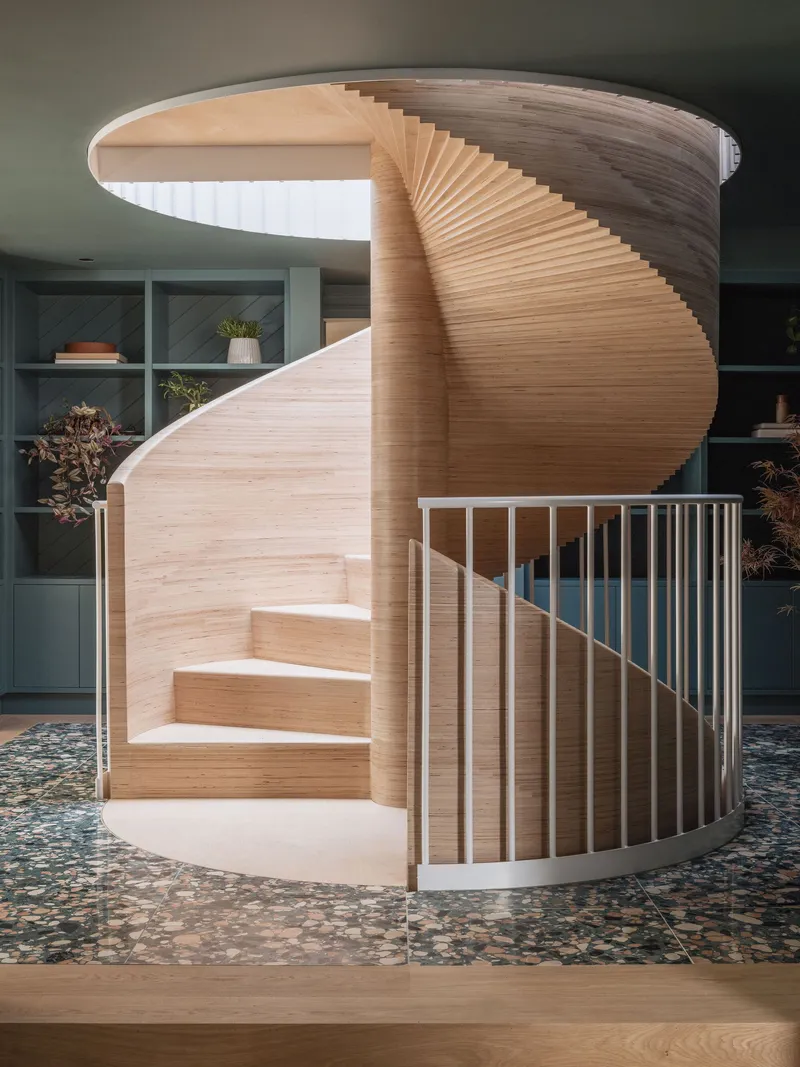
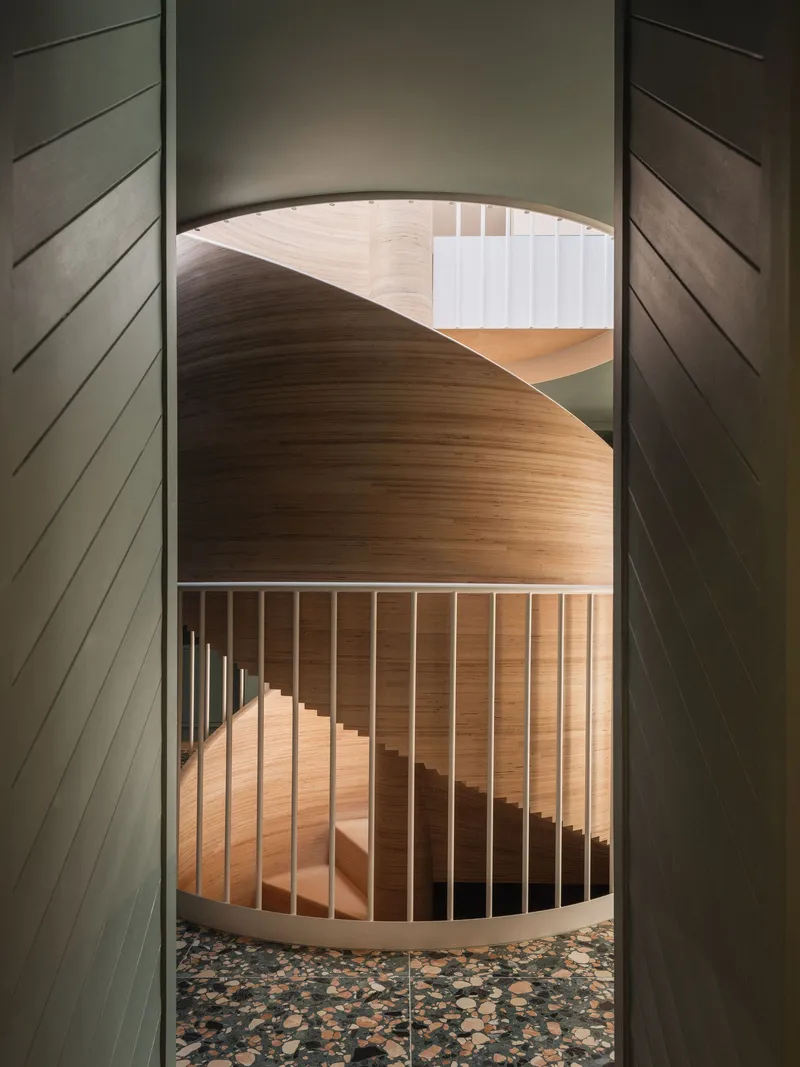

The centrepiece of the refurbishment is the helical timber staircase, and it deserves the word centrepiece literally. Floor joists radiate from the center of the plan, and the stair occupies that center, wrapping around a cylindrical void and rising toward a glazed roof lantern that floods the core with daylight. The staircase comprises hundreds of individually CNC-cut birch plywood pieces, milled and hand-layered by Landmark Joinery in Liverpool to form a smooth, sinuous parabolic curve. The treads are stacked horizontally like geological strata, giving the surface a warmth and tactility that no painted steel or cast concrete could achieve.
Looking up from the terrazzo floor of the sunken lower ground level, the stair reads as a timber whirlpool receding toward light. Looking down from the upper gallery, you see the layers of birch ply compressing into a golden spiral above the small library that Khan Bonshek has tucked at the staircase's base. The white vertical balusters and metal handrail keep things from becoming too precious: this is robust joinery, not a sculpture you cannot touch.
Height-and-a-Half Drama in the Living Spaces

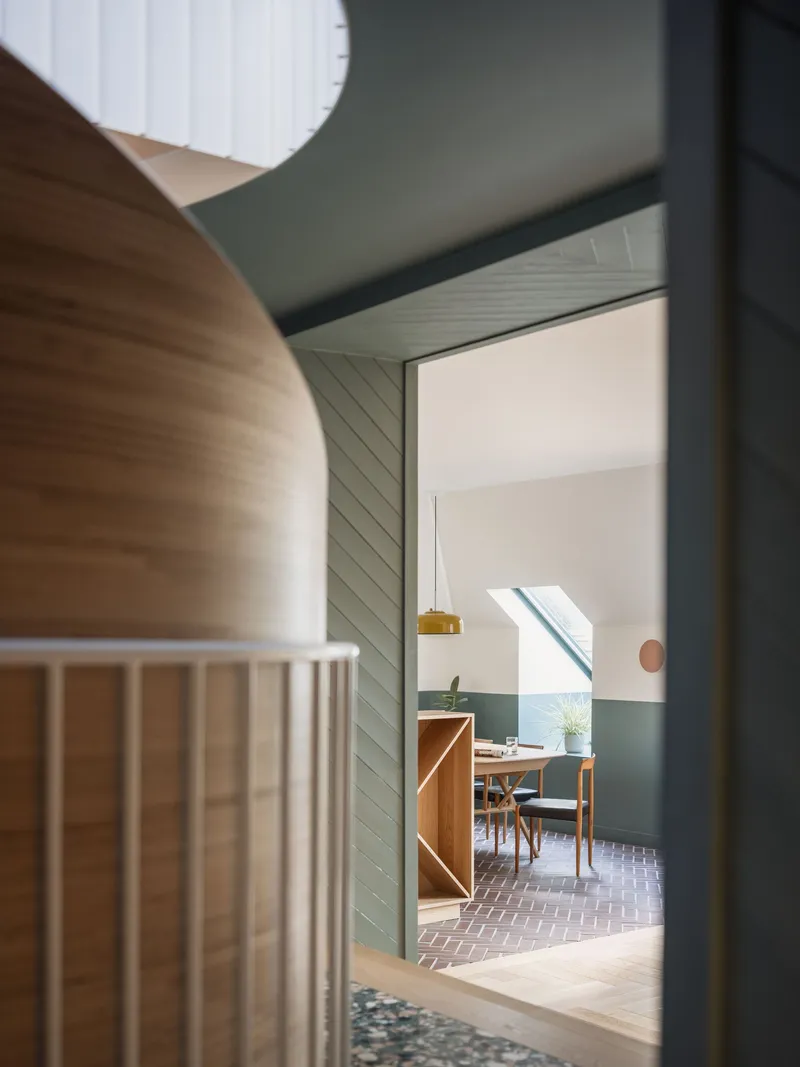
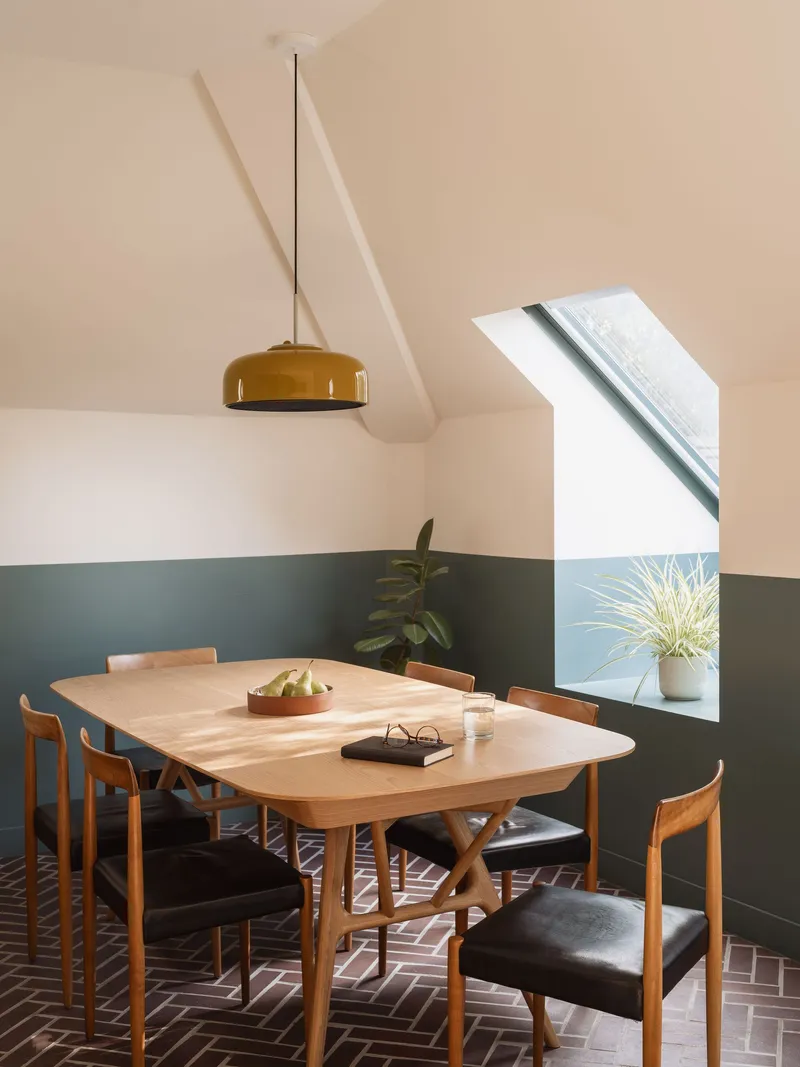
Khan Bonshek created what they describe as height-and-a-half spaces on the ground floor, using the pyramid's sloped ceilings as an asset rather than a constraint. In the dining area, the vaulted ceiling rises to an angled skylight that pours afternoon light across a two-tone wall treatment: light oak timber panelling on the lower register, white above. A brass pendant drops into the double-height volume, scaling the room down to something domestic despite the generous proportions.
Original doorways were closed off and other openings widened to create long sight lines through the structure. The hallway view into the dining room, framed by vertical timber panelling, pulls the eye through a compressed threshold into that expanded volume. It is a sequence borrowed from classical enfilade planning, deployed here inside a postmodern pyramid. The three types of natural terrazzo flooring tie these rooms together into a continuous ground plane.
Kitchen and Terrazzo
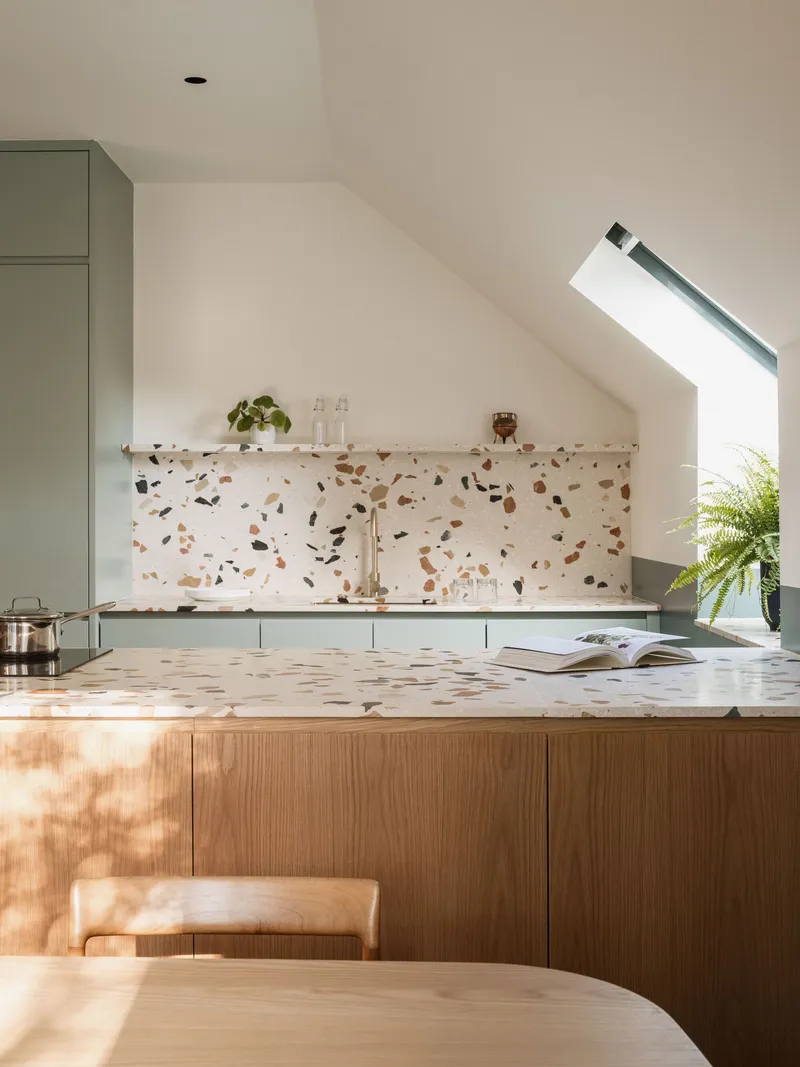
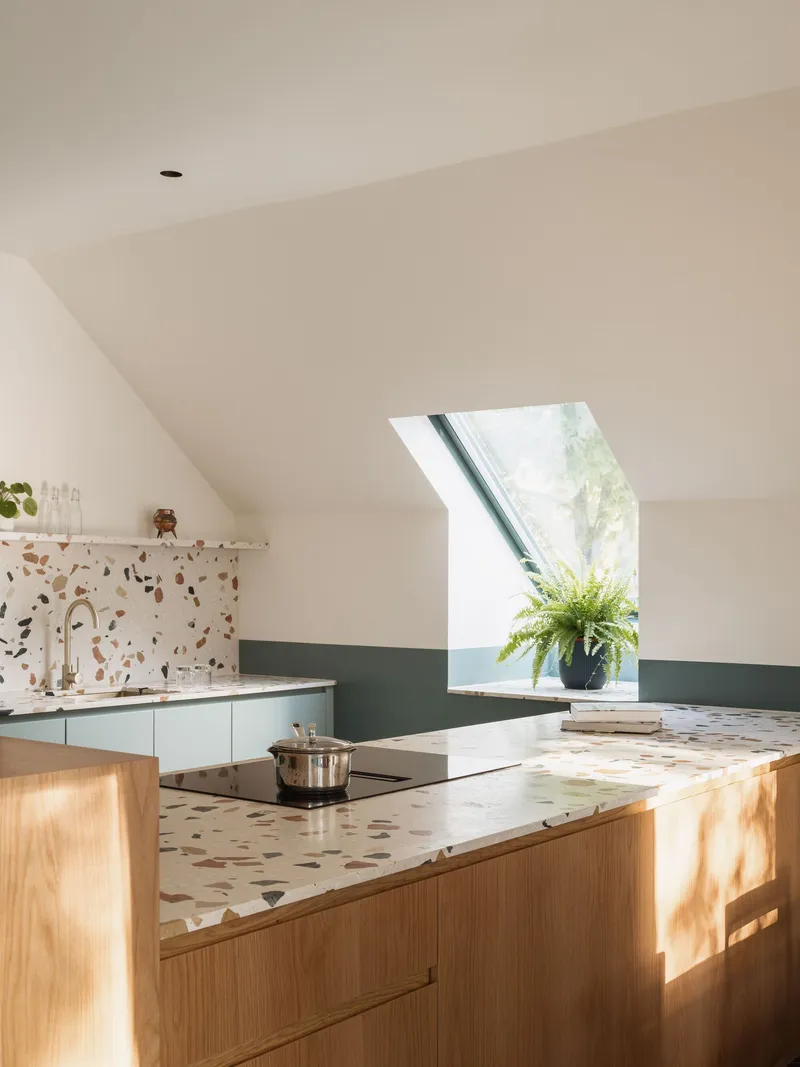
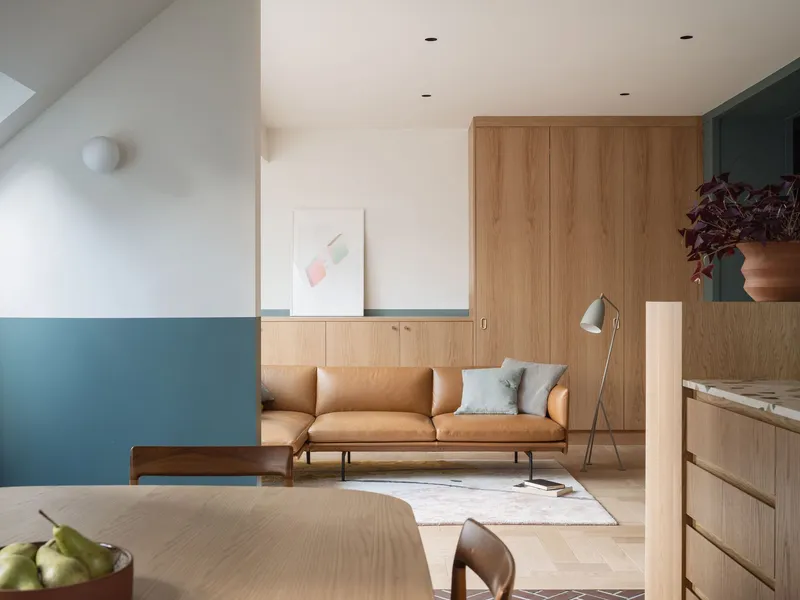
The kitchen sits beneath one of the angled skylights, which transforms morning light into a raking wash across the terrazzo countertop and backsplash. Timber cabinetry in light oak matches the panelling elsewhere in the house, maintaining a restrained material palette that avoids the common renovation trap of treating every room as a separate mood board. The island is generous without being monumental, scaled for a family kitchen rather than a cooking showroom.
In the adjacent living area, a horizontal paint band wraps the room below white walls and the sloped ceiling, grounding the proportions of a space that might otherwise feel vertiginous. Timber cabinetry lines the lower walls, providing storage that doubles as a plinth. The strategy is consistent throughout: warm material at hand height, light and air above.
The Upper Level: Sleeping Pods, Sauna, and Garden Stair
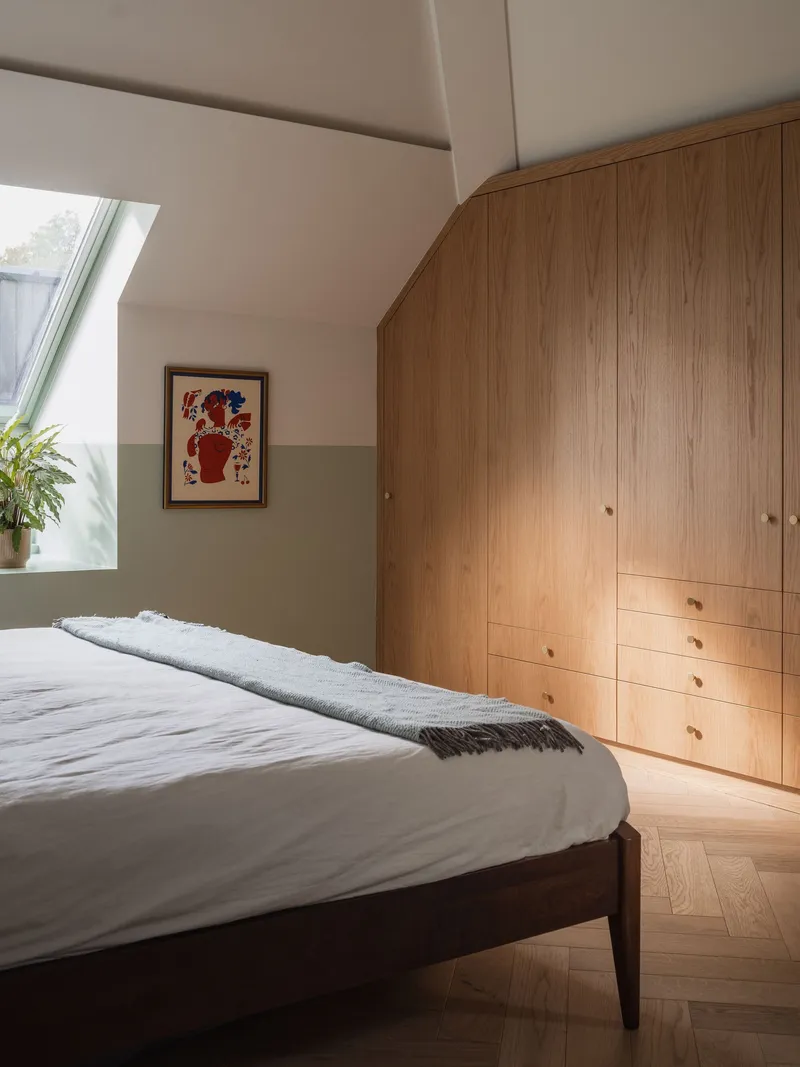
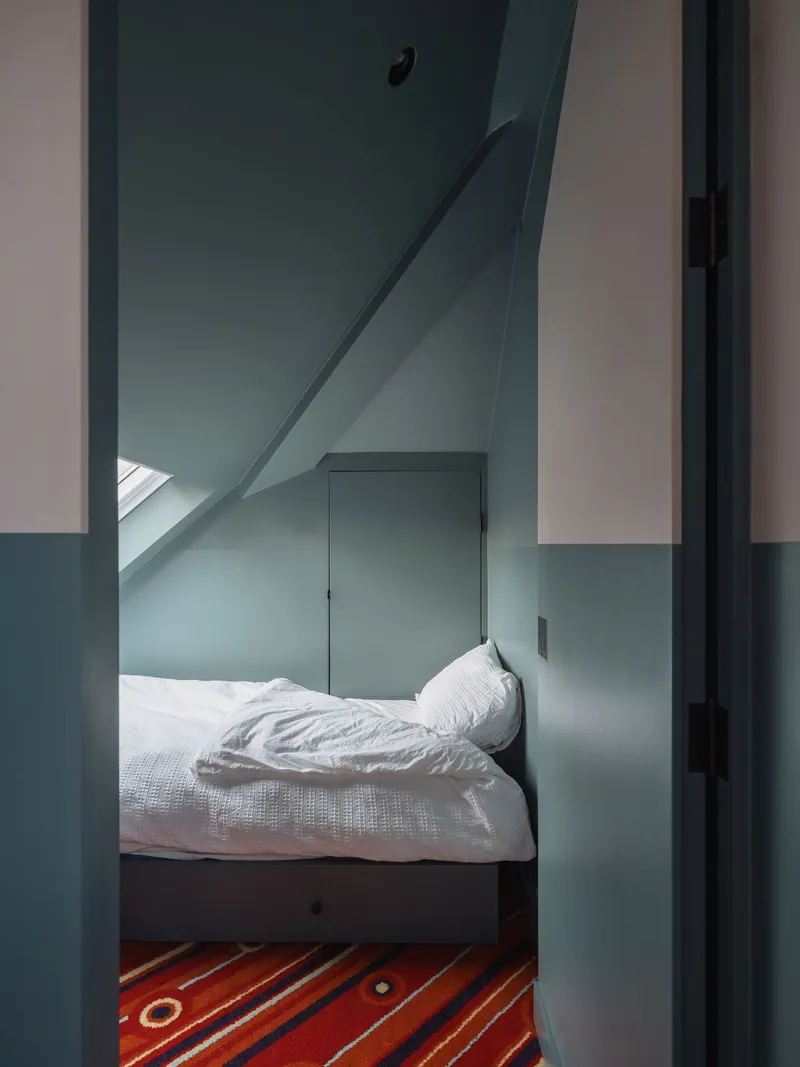
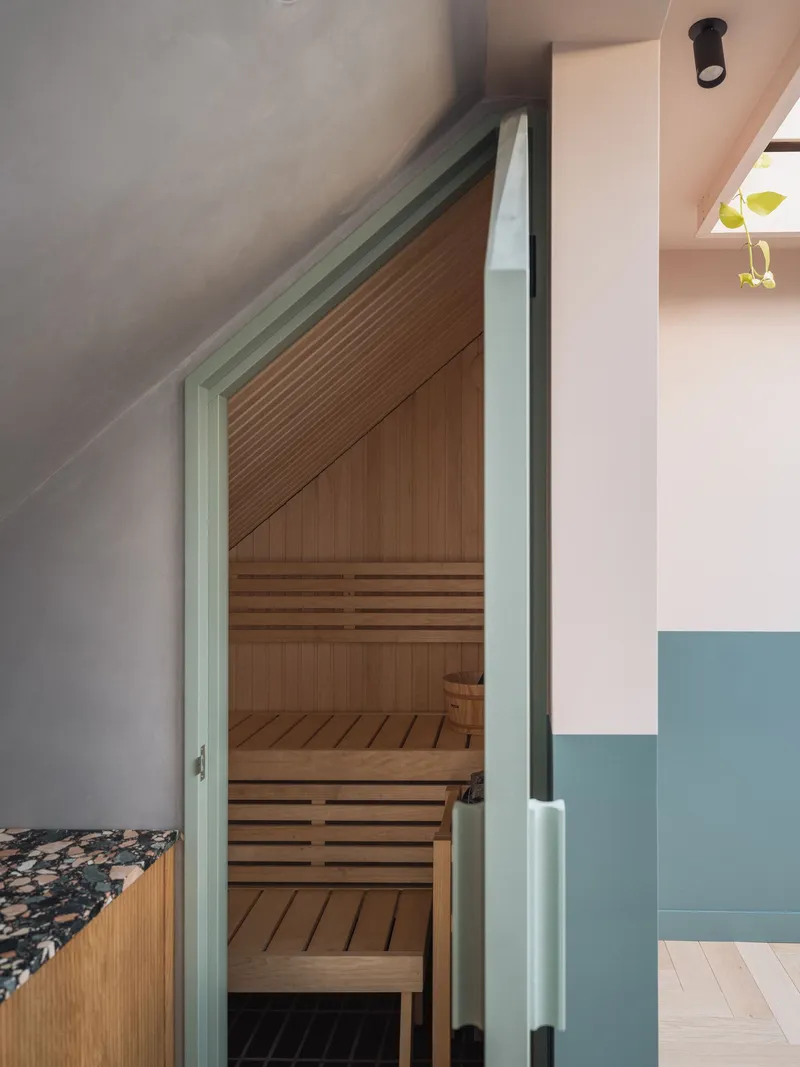
The upper level takes full advantage of the pyramid's converging planes. Two sleeping pods tuck under the sloped ceilings, each receiving natural light from skylights punched through the roof. Built-in oak wardrobes line the walls, compressing storage into the lowest part of the section where headroom is minimal. A compact sauna with slatted timber benches slots under another slope, its warm colour and tight proportions making it feel like a cabin within the pyramid.
The dormer extension at the rear houses an office workspace and sitting room. A straight flight of stairs descends from this upper level down the pyramid slope to the rear garden, preserving the original upside-down logic of the Wigley Fox design: the social and contemplative spaces are elevated, and the connection to the landscape is direct, almost theatrical.
Bathrooms and Intentional Coziness
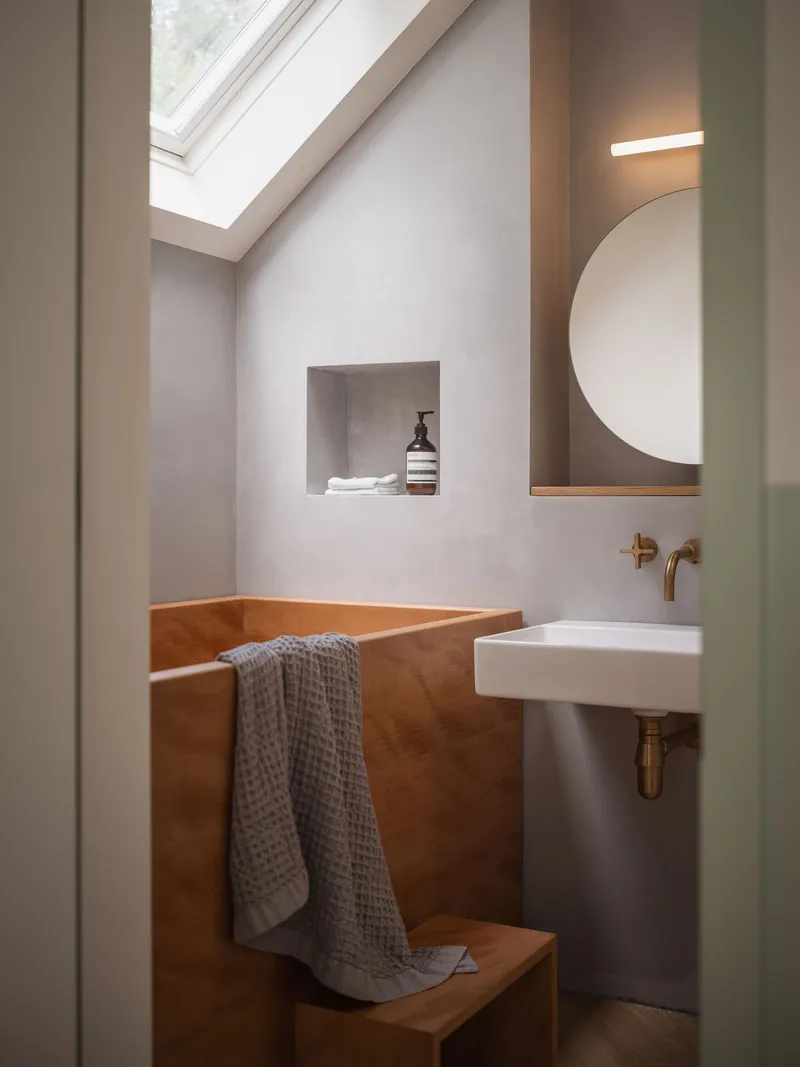
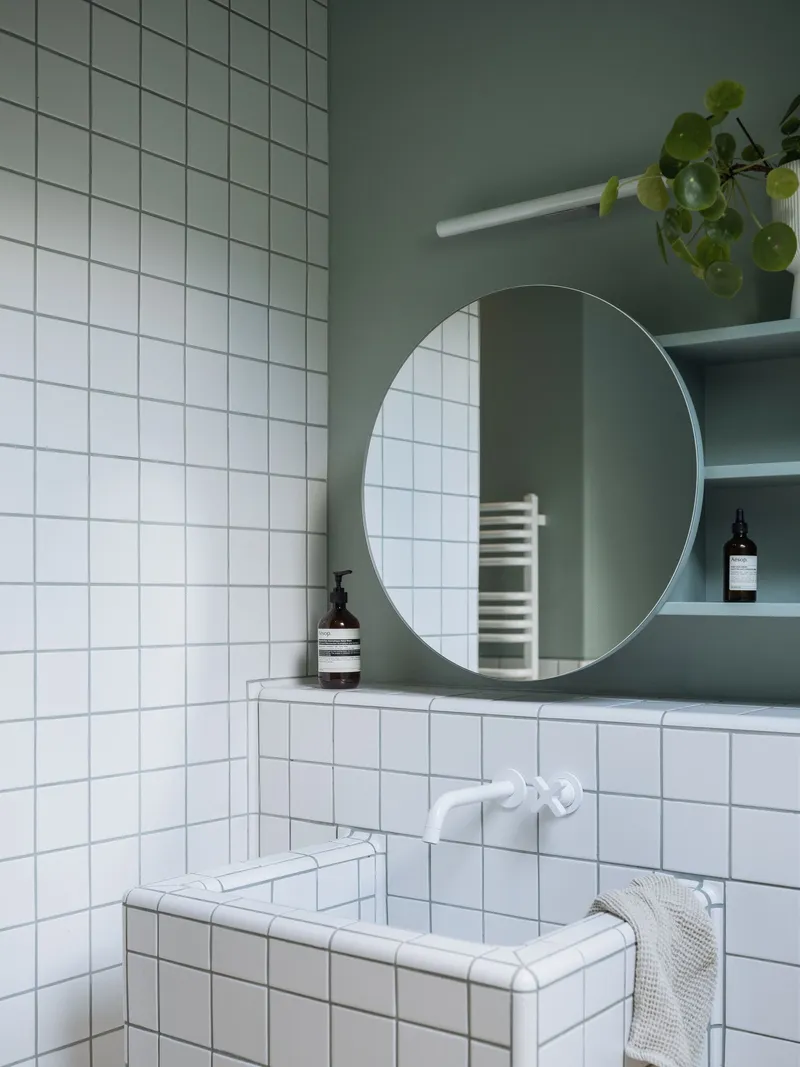
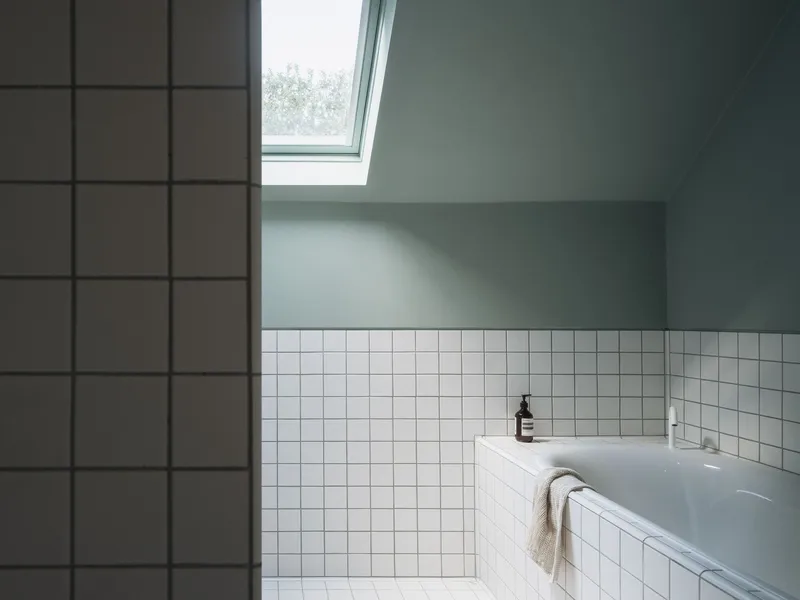
Khan Bonshek describes the smaller spaces of the house as intentionally cosy, and the bathrooms are where that strategy pays off most clearly. White square tiles, sage green painted alcoves, round mirrors, and brass fixtures create a series of small rooms that feel considered rather than leftover. The bathtub corner catches soft daylight from the angled skylight, a detail that elevates a functional space into something meditative.

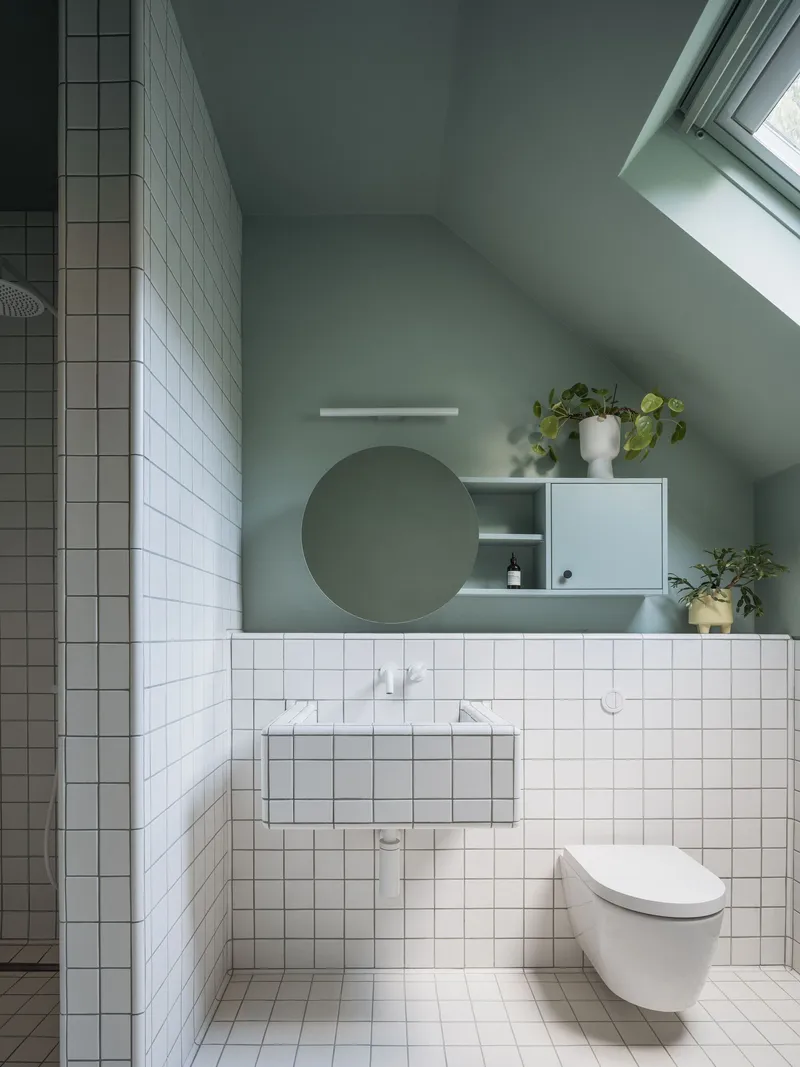
The wet room and shower enclosure are lined in small white mosaic tiles with brass hardware, keeping the material language minimal. These rooms would be easy to overlook, but they demonstrate the discipline of the project: the same care that went into the CNC staircase went into selecting the tile format for a powder room. Nothing defaults to generic.
The Reading Nook and Gallery


At the base of the spiral staircase, in the sunken lower ground floor, a reading nook with built-in oak shelving occupies the leftover geometry beneath the stair. It is a small, deliberate space that rewards the decision to descend rather than ascend. The terrazzo floor tiles anchor it to the rest of the house while the timber shelving connects it to the staircase above. At the top of the house, an upper gallery with a fully glazed skylight roof and hanging plants turns the circulation space into something closer to a conservatory. The vertical distance between these two moments, nook and gallery, is the experiential range of the whole project.
Plans and Drawings
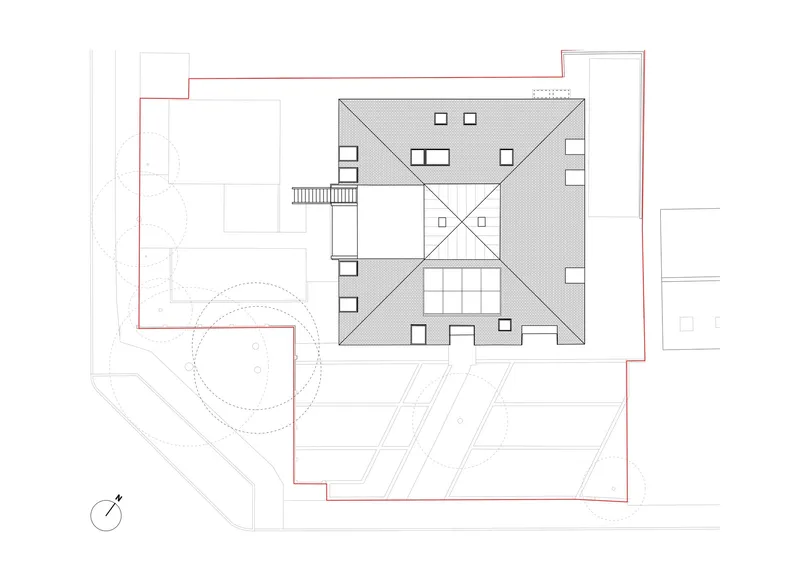

The roof plan reveals the central skylight as the organizing element of the composition: it sits at the apex of the square pyramid, with the volumes of the dormer and garden studio attached as subsidiary forms. The elevation drawing shows the gabled profile flanked by lower flat-roofed extensions, confirming that the pyramid is not a pure geometric solid but a hybrid form with practical appendages. The drawings clarify what the photographs make atmospheric: that the building's structure radiates from a single point, and the staircase occupies that point.
Why This Project Matters
The British postmodern house occupies an awkward position in architectural history: too recent to be heritage, too idiosyncratic to be easily retrofitted, and often too poorly insulated to meet contemporary performance standards. The Pyramid House demonstrates that these buildings can be upgraded without being gutted of their character. Khan Bonshek's material palette of birch plywood, natural terrazzo, light oak, and red clay shingles is warm and restrained, never competing with the pyramidal geometry but always reinforcing it. The ground-source heat pumps and high insulation levels bring the building into the present tense without apology.
More broadly, the project is an argument for taking the 1981 Homeworld homes seriously. These were speculative, sometimes eccentric propositions about how British families might live. Most have been incrementally altered beyond recognition. By treating the Pyramid House as a building worth understanding before modifying, Khan Bonshek has produced a refurbishment that is more rigorous, and ultimately more inventive, than a demolition and new build would have been. The spiral staircase alone justifies the effort: it is a piece of digital fabrication that could only exist inside this particular pyramidal section, shaped by the building's constraints into something no blank-site brief would have produced.
Pyramid House, retrofit and refurbishment by Khan Bonshek. Milton Keynes, United Kingdom. 3,335 sq ft (original house) plus 310 sq ft garden studio. Completed July 2024. Structural engineer: Banfield Wood. Main contractor: Manchester Interior Contracts. Photography by James Retief.
About the Studio
Khan Bonshek
Official website of Khan Bonshek, one of the studios behind this project.
khanbonshek.comShare Your Own Work on uni.xyz
If projects like this are the kind of work you want to make, uni.xyz is a place to publish your own, find collaborators, and enter design competitions.



Popular Articles
Popular articles from the community


AL-JANNAH: Sustainable Architecture and Permaculture for Afghan Widows
AL-JANNAH uses sustainable architecture and permaculture to create resilient oasis of housing, learning, work and renewal for Afghan widows.

The Earth Pod: 3D Printed Homes for Resilient Refugee Communities
The Earth Pod reimagines refugee housing through 3D printed homes made from clay, combining resilience, self-sufficiency, and rapid shelter.

The Musturak Paradise: Senior Living Architecture for a Connected Future in Temara, Morocco
The Musturak Paradise reimagines senior living architecture in Temara via private homes, social spaces, culture, community, and shared care.

Conexión: Biophilic Design Reimagines High-Rise Living in Hong Kong
Conexión reimagines high-rise living in Hong Kong through biophilic design, green facades, shared spaces, daylight, water and nature within.


Similar Reads
You might also enjoy these articles

Bao Huynh Watercolor Atelier: A Serene Art Retreat in Hội An
Bao Huynh Watercolor Atelier in Hội An blends multifunctional art spaces, sustainable design, local materials, and family-friendly living in a serene environment.

Atelier Macri Concept Store Interior Design by CASE-REAL
Atelier Macri store features a "ko" counter, walnut wood details, cork displays, blending retail, gallery, and seamless customer experiences.

Manuel Vargas Izquierdo Stadium and High-Performance Sports Center: Architectural Excellence in Jalpa de Méndez
The Manuel Vargas Izquierdo Stadium blends sustainable design, inclusive sports facilities, and cultural-inspired architecture, revitalizing Jalpa de Méndez’s public spaces.

KAKR Buluh Awar Hall: Revitalizing Community and Ecology Through Bamboo Architecture
Community built bamboo hall revitalizes Buluh Awar village, empowering youth, restoring ecology, celebrating vernacular craftsmanship through sustainable architecture and culture.




Comments (0)
Please login or sign up to add comments
No comments yet. Be the first to comment!