
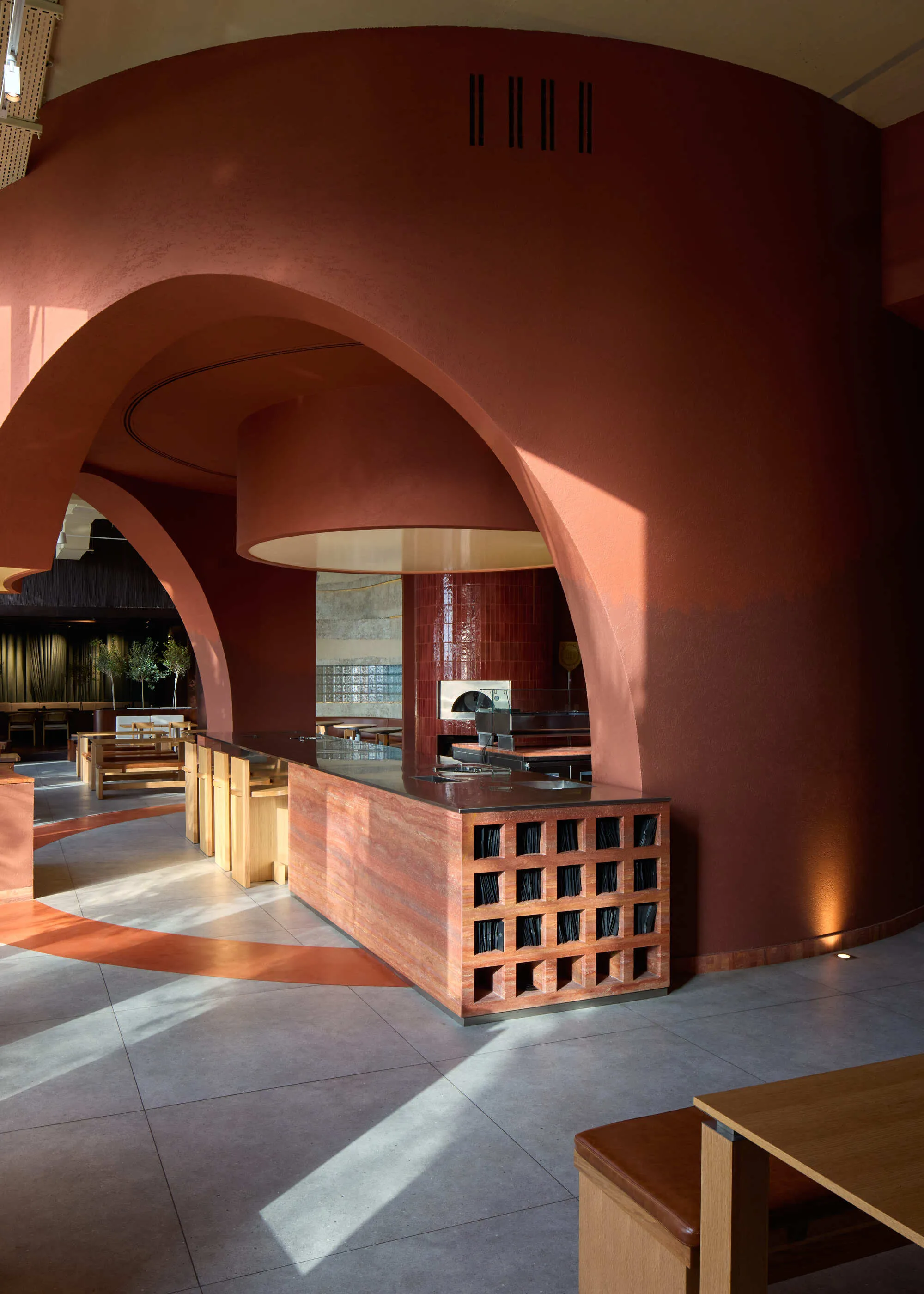
Kidz Studio Grounds a Chain Pizzeria in Abu Dhabi with Sandstone, Copper, and Botanical Geometry
Blu Pizzeria channels plant architecture through warm material contrasts and sculptural timber columns in the UAE capital.


Chain restaurants face a persistent design problem: how to feel specific to a place without abandoning the brand thread that ties locations together. Blu Pizzeria, the latest outpost of a growing Italian restaurant group with venues in Dubai and Riyadh, resolves this tension with an interior that commits fully to material craft. Designed by Moscow and Dubai-based Kidz Studio under lead architect Egor Bogomolov, the 338-square-meter Abu Dhabi space draws from the chain's overarching nature-inspired framework, where each location references a different element: Terra for earth, Mare for sea, Monti for mountains. Here, the theme is Blu Fiori, and the botanical reference runs deeper than decoration.
Rather than filling the restaurant with literal greenery, Kidz Studio interprets the plant concept through what lies beneath: soil as a nourishing base. That translates into a palette of sandstone, copper, and terracotta-toned surfaces, punctuated by restrained green accents. The result is a space that feels warm, geological, and grounded, where the geometry of arches, circular ceiling recesses, and timber-clad columns suggests organic growth without resorting to the predictable leaf motifs that clutter so many hospitality interiors in the Gulf.
Arrival and the Layered Threshold
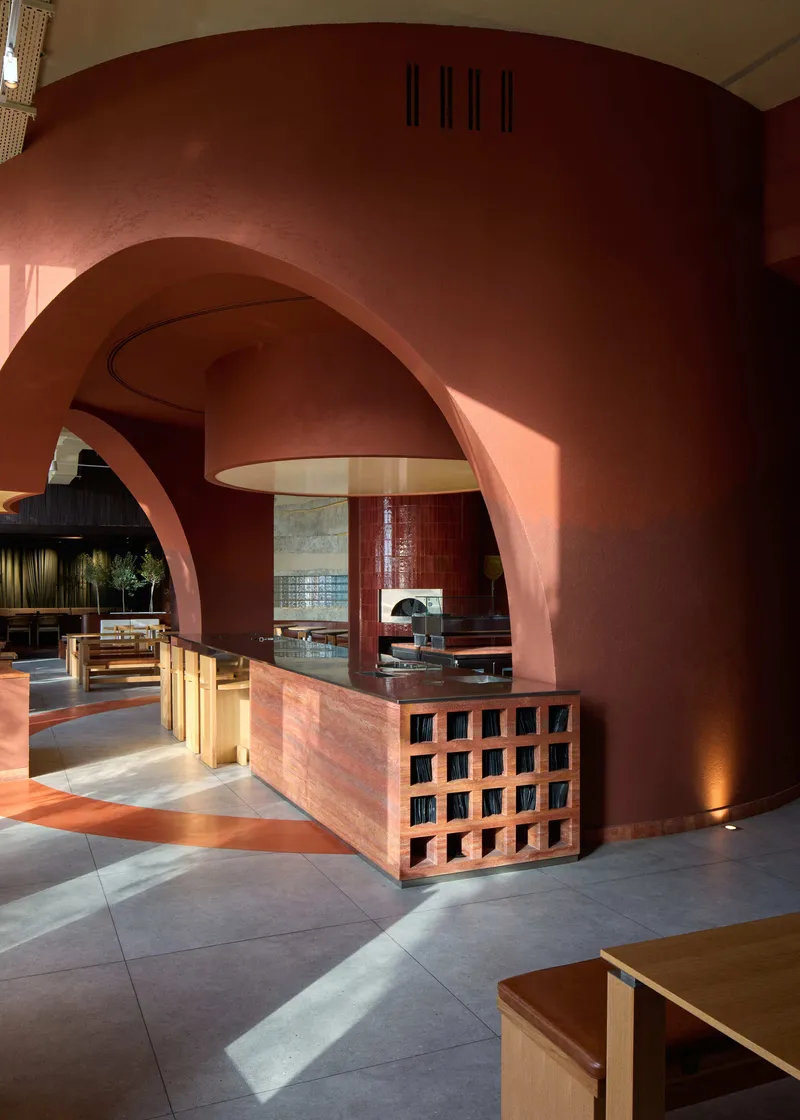
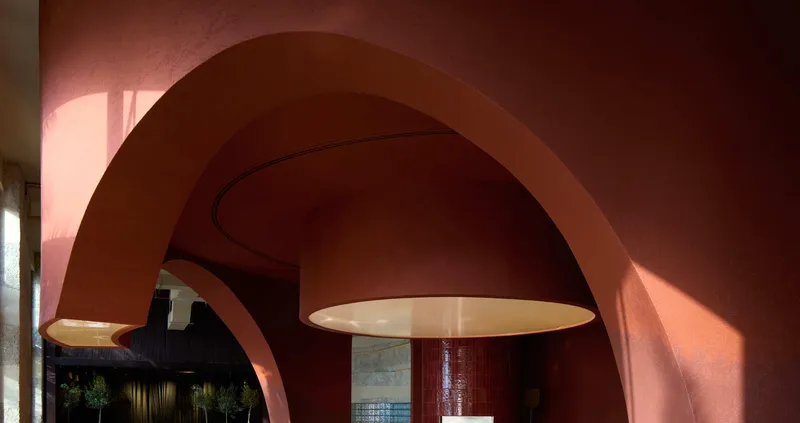
The entrance sequence sets up the material logic of the entire project. A reception counter with a latticed base sits beneath layered terracotta arches, each one slightly offset, producing a telescoping depth that draws the eye inward. A suspended pendant fixture drops into the composition like a punctuation mark. The effect is processional: you pass through thickness, not just a doorway.
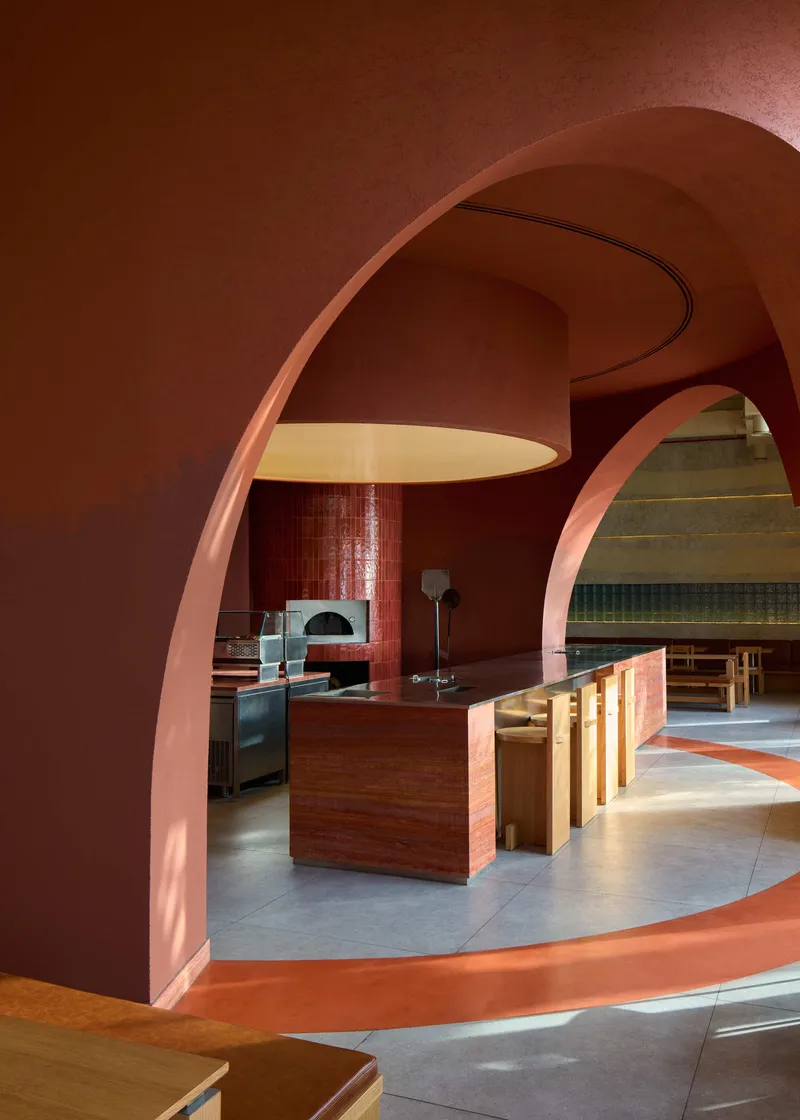
This layering recurs in the rounded archways deeper inside the space, where afternoon sunlight catches the warm-toned surfaces and gives the interior a quality closer to masonry construction than restaurant fit-out. The arched openings frame views between zones, controlling sightlines and establishing a rhythm of reveal and enclosure that prevents the 338 square meters from reading as a single undifferentiated room.
The Counter as Anchor
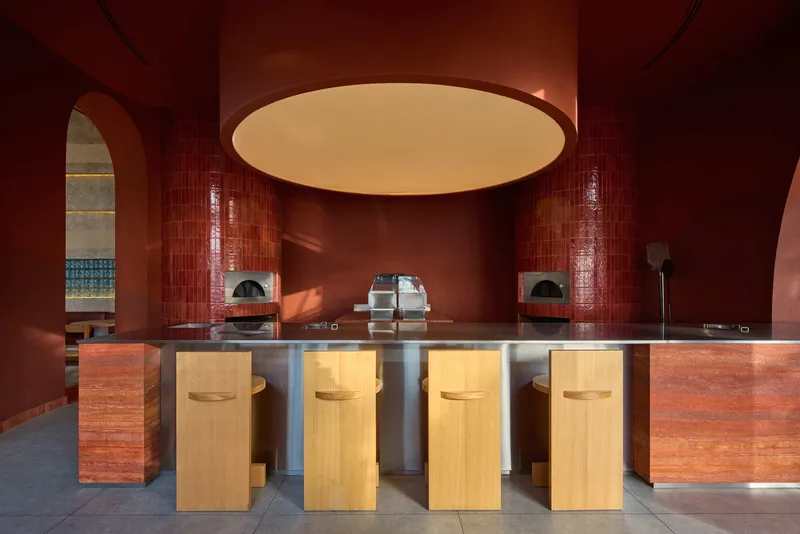
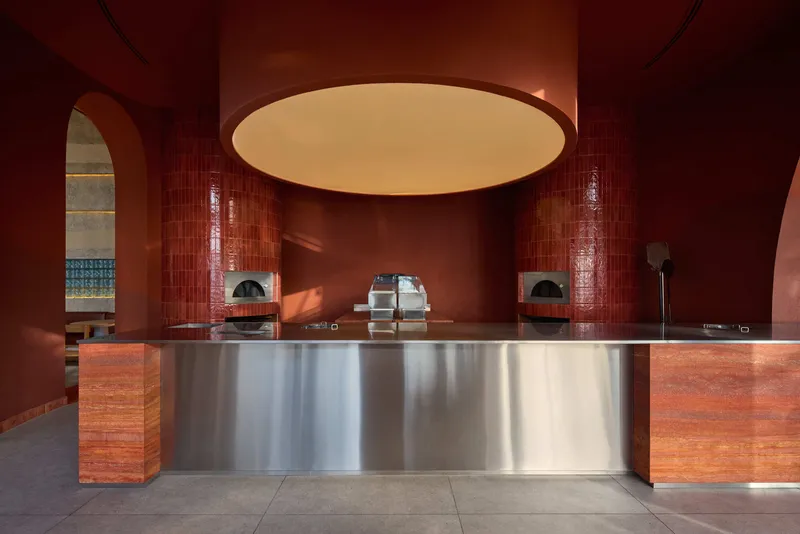
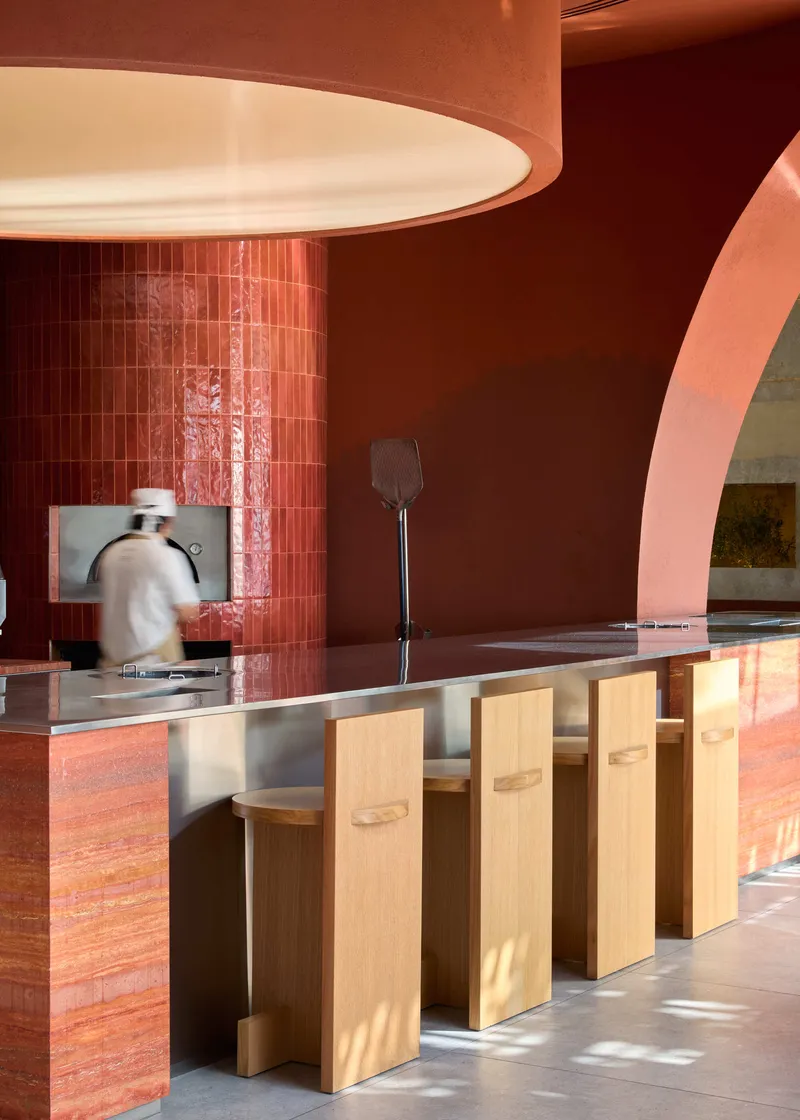
A central open kitchen with two ovens forms the spatial and social focal point. The long counter, finished in brushed stainless steel with timber ends, wraps the cooking area and doubles as casual seating. Above it, a circular ceiling cutout emits a soft ambient glow, reinforcing the idea that the kitchen is the hearth around which everything else organizes.
Timber stools line the counter, their warm grain contrasting sharply with the industrial precision of the stainless steel front. The circular ceiling recess appears in multiple views, always slightly different depending on the angle, a detail that reads as both ceiling sculpture and functional lighting strategy. Ventilation and air-conditioning systems are fully integrated into ceiling boxes elsewhere in the plan, keeping the mechanical reality invisible and allowing the overhead plane to participate in the design rather than simply contain it.
Glass Block Ribbons and Banquette Zones
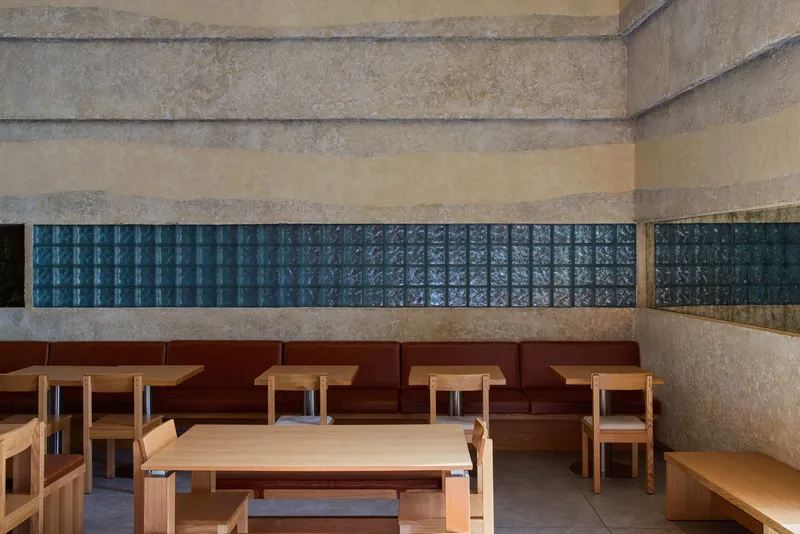
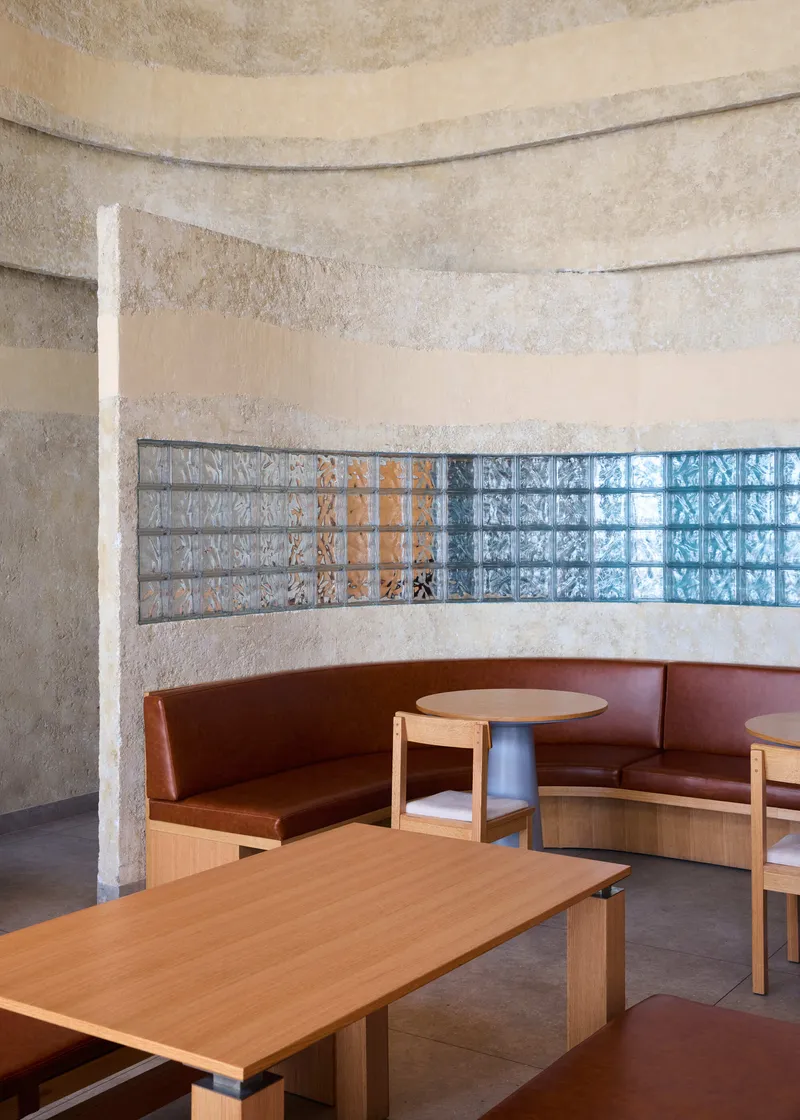
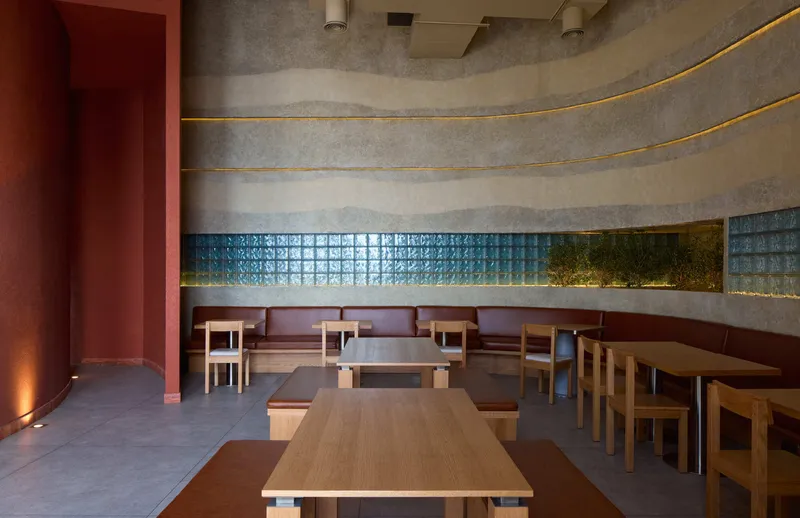
Along the perimeter, built-in banquettes sit against layered concrete walls, interrupted by horizontal bands of blue glass block. These ribbon windows introduce a cool-toned light that offsets the warm sandstone and terracotta palette, pulling in the "blu" of the brand name in a way that feels structural rather than applied. The glass block is trapezoidal in places, aligned with the facade geometry and calibrated to admit light without exposing diners to direct sun or street-level views.
The flooring beneath these banquette zones uses the same material applied in a different technique than the main dining floor, a subtle but effective way to signal zone transitions without resorting to level changes or partition walls. Four-person tables line up along the facade where the trapezoidal windows land, producing a cadence of table, light, table, light that gives the perimeter seating a comfortable regularity.
Timber Columns as Trees
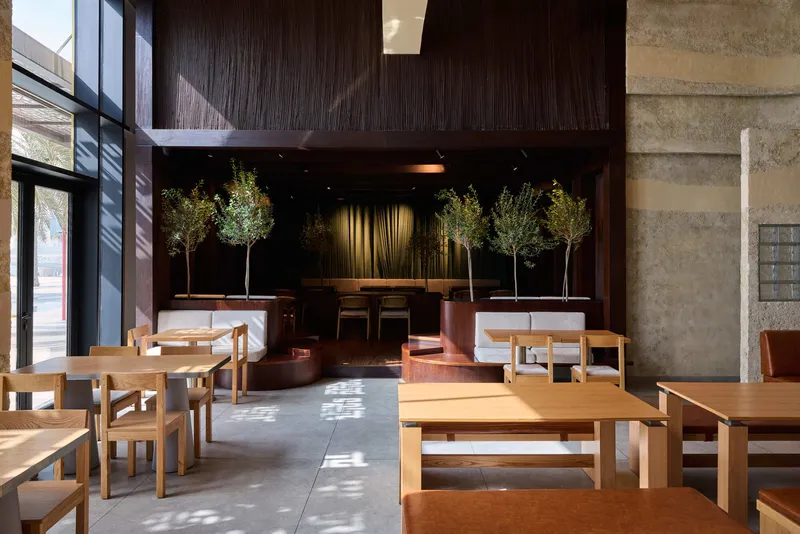
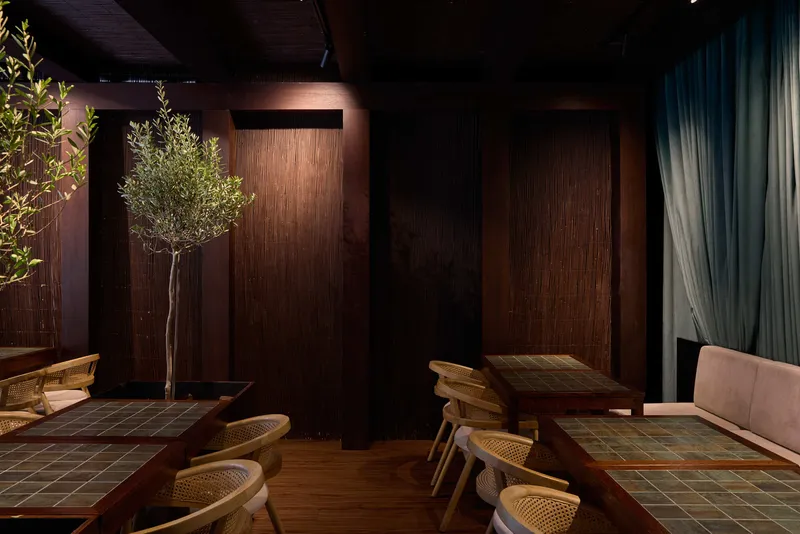
The existing space came loaded with structural columns, a constraint that most designers would minimize. Kidz Studio turned them into the project's strongest formal gesture: each column is wrapped in sculptural timber cladding designed to evoke trees. Vertical slats fan outward near the ceiling, and planted olive trees sit between them, reinforcing the botanical theme without overplaying it. The dining hall photograph, with its stage-like alcove flooded in afternoon sunlight, shows these timber elements working as spatial dividers, canopy simulators, and wayfinding markers all at once.
Wood-paneled walls with vertical slats extend the logic of the column cladding to the room's edges, creating continuity between freestanding and wall-bound surfaces. Tiled dining tables and cane-backed chairs keep the furniture honest and tactile, avoiding the polished-marble trap that haunts high-end Gulf hospitality.
The Secluded Room and Circulation
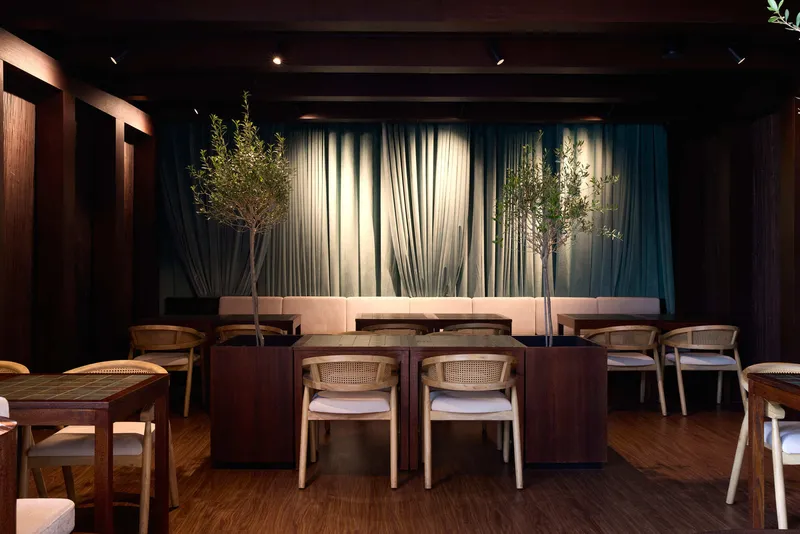
Toward the rear, a secluded room with dark timber paneling and exposed ceiling beams provides a tonal shift. Illuminated fabric drapes soften the acoustics and light, turning this zone into a quieter counterpoint to the open kitchen energy of the main hall. The palette here is noticeably darker, the grain of the timber more prominent, a clear signal that this space is meant for longer stays and lower volumes.
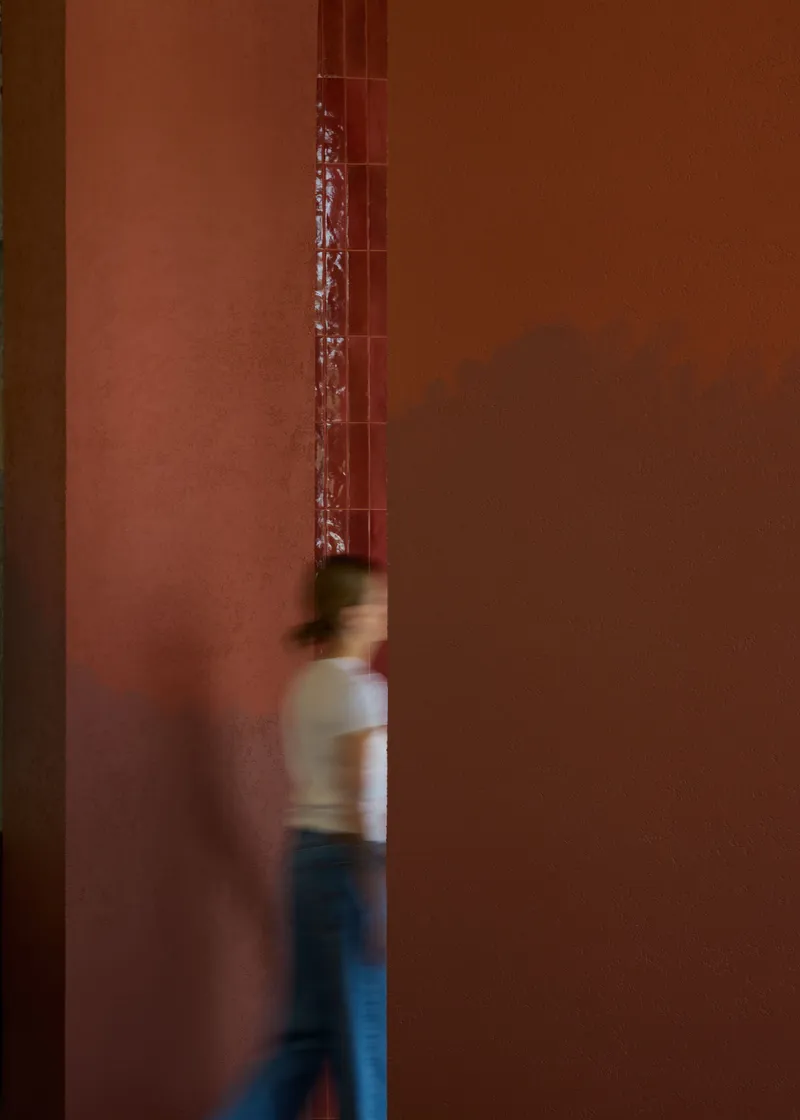
Connecting these zones is a narrow passageway lined in terracotta. A blurred figure in motion captures the corridor's purpose: it is transitional, compressed, and deliberately quick. The shift from open dining to tight corridor to secluded room creates a spatial narrative that rewards walking through the restaurant, not just sitting in it. Views through arched openings, like the one framing a pendant light and curved soffit, layer these experiences into a sequence that feels curated without feeling forced.
Material Craft in a Challenging Market
Several details in the project are quietly remarkable for the regional context. Slim sink traps, rarely available in the UAE market, were sourced and integrated. Custom copper wall panels were developed as part of the warm-toned material strategy. Mounting methods for functional elements were specially engineered, and the design team maintained on-site supervision to refine details adaptively during construction, a process that acknowledges the gap between drawing-board precision and the realities of local construction practice.
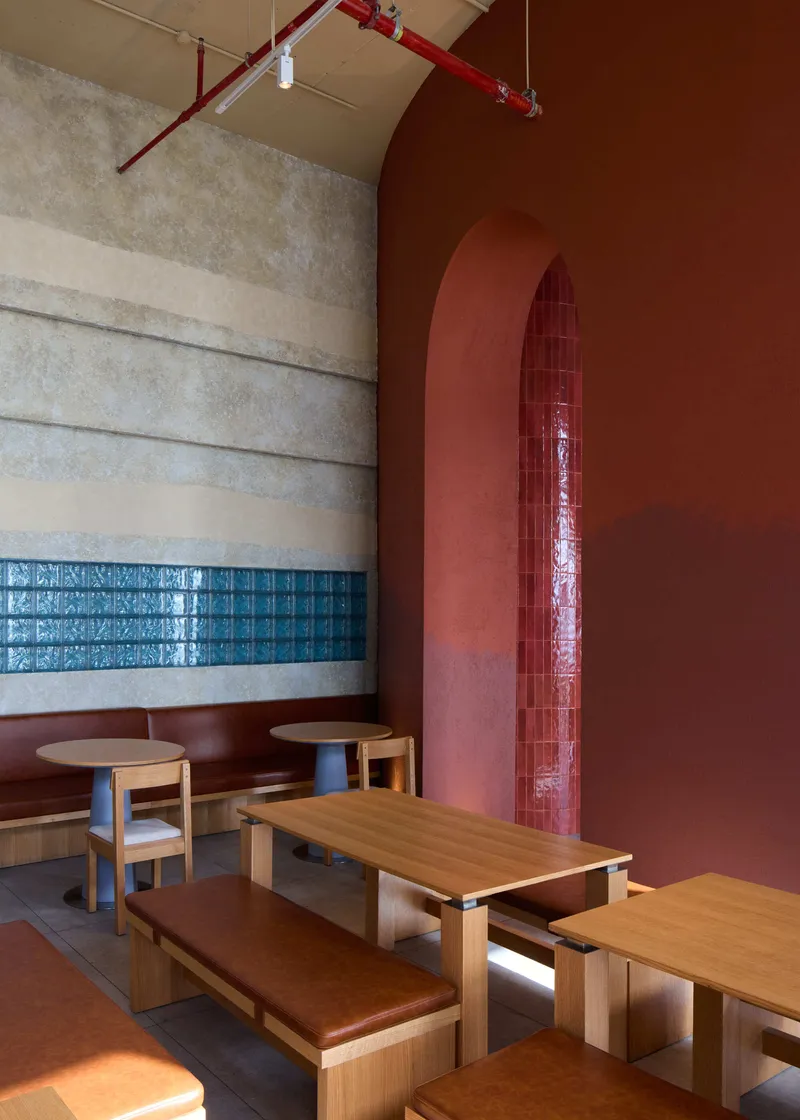
The corner detail of an arched alcove with red glazed tile, paired with exposed red conduit, is telling. Rather than hiding every service run, the design selectively reveals infrastructure when it aligns with the color story. It is a confident move: the conduit reads as deliberate, not accidental, because the surrounding tile commits to the same hue.
Plans and Drawings
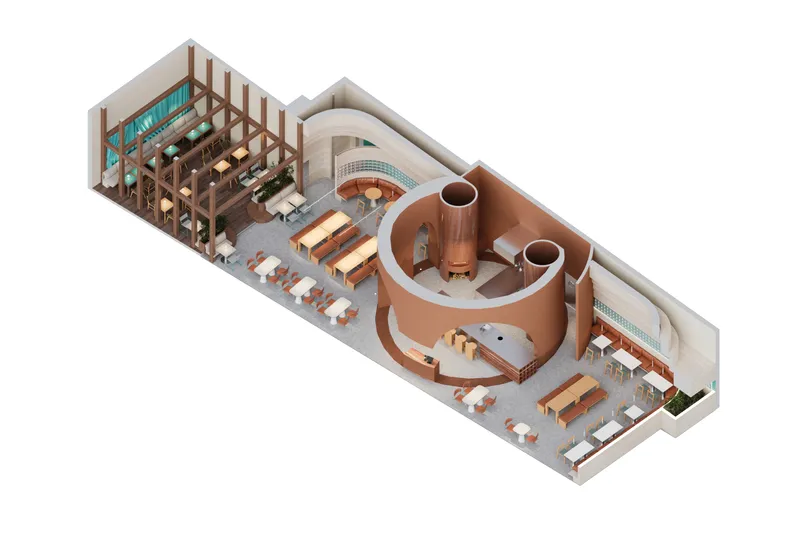
The axonometric drawing reveals the plan strategy clearly: curved copper volumes carve out distinct zones within the rectangular shell, producing the arched thresholds and circular geometries that define the visitor's experience. Dining tables cluster in identifiable groupings around the central kitchen, and the secluded rear room reads as a discrete volume within the larger envelope. The drawing also makes visible how the timber-clad columns distribute across the floor plate, transforming a grid of structural necessities into a spatial asset.
Why This Project Matters
Chain restaurant design in the Gulf too often defaults to one of two modes: polished international minimalism that could be anywhere, or heavily themed interiors that exhaust their novelty in one visit. Blu Pizzeria avoids both by committing to a material concept, soil and botanical geometry, that is abstract enough to hold up over time and specific enough to distinguish this location from its sibling venues. The decision to interpret "plant" as subterranean nourishment rather than surface decoration gives the design an intellectual backbone that prevents it from aging into cliché.
Kidz Studio's achievement here is also logistical. Sourcing uncommon components, adapting details on site, and integrating mechanical systems into the ceiling architecture all require a level of persistence that does not show up in photographs. What does show up is the coherence: sandstone, copper, timber, glass block, and terracotta all belong to the same argument. Nothing is borrowed from another aesthetic vocabulary. For a 338-square-meter pizzeria in Abu Dhabi, that consistency of vision is the most valuable thing on the menu.
Blu Pizzeria by Kidz Studio, lead architect Egor Bogomolov. Abu Dhabi, United Arab Emirates. 338 m², completed 2025. Photography by Oculis Project.
About the Studio
Share Your Own Work on uni.xyz
If projects like this are the kind of work you want to make, uni.xyz is a place to publish your own, find collaborators, and enter design competitions.




Popular Articles
Popular articles from the community


The Musturak Paradise: Senior Living Architecture for a Connected Future in Temara, Morocco
The Musturak Paradise reimagines senior living architecture in Temara via private homes, social spaces, culture, community, and shared care.

Conexión: Biophilic Design Reimagines High-Rise Living in Hong Kong
Conexión reimagines high-rise living in Hong Kong through biophilic design, green facades, shared spaces, daylight, water and nature within.

Riyadh For All: Intergenerational Urban Design for Active Aging in Rabat
Riyadh For All reimagines urban design in Rabat with intergenerational co-living, adaptive courtyards, and Moroccan cultural exchange today.

Co-life: Sustainable Architecture for Age-Friendly Community Living
Co-life reimagines sustainable architecture for seniors through courtyards, rammed earth, shared gardens, and spaces designed for belonging.


Similar Reads
You might also enjoy these articles

Bao Huynh Watercolor Atelier: A Serene Art Retreat in Hội An
Bao Huynh Watercolor Atelier in Hội An blends multifunctional art spaces, sustainable design, local materials, and family-friendly living in a serene environment.

Atelier Macri Concept Store Interior Design by CASE-REAL
Atelier Macri store features a "ko" counter, walnut wood details, cork displays, blending retail, gallery, and seamless customer experiences.

Manuel Vargas Izquierdo Stadium and High-Performance Sports Center: Architectural Excellence in Jalpa de Méndez
The Manuel Vargas Izquierdo Stadium blends sustainable design, inclusive sports facilities, and cultural-inspired architecture, revitalizing Jalpa de Méndez’s public spaces.

KAKR Buluh Awar Hall: Revitalizing Community and Ecology Through Bamboo Architecture
Community built bamboo hall revitalizes Buluh Awar village, empowering youth, restoring ecology, celebrating vernacular craftsmanship through sustainable architecture and culture.

Explore Commercial Buildings Competitions
Discover active competitions in this discipline


Challenge to design luxury tourism on rails


VR headsets Storefront design competition

Designing a staircase for a client
Comments (0)
Please login or sign up to add comments
No comments yet. Be the first to comment!