

Kiko Castello Branco and Lucas Cunha Split a Brazilian Home into Two Timber Pavilions on a Sloping Corner Lot
In Bragança Paulista, a 926-square-meter residence uses a metal spine to join two angled bar volumes that open wide to the landscape.


Most houses that claim to "connect with the landscape" do so by planting a big glass box on a hill. The JL Residence in Bragança Paulista, about 90 kilometers north of São Paulo, takes a sharper line of attack. Kiko Castello Branco Arquitetura and Lucas Cunha broke the 926-square-meter program into two independent bar-shaped volumes, angled to follow the contours of a gently sloping corner lot and stitched together by a single metal structure. The result is a house that does not sit on the terrain so much as settle into it, leaving room for planted courtyards, framed views, and generous cross-ventilation between its parts.
What makes the project genuinely interesting is the tension between heft and transparency. The structural timber beams, slat screens, and overhanging roofs give the house visual weight, yet every room opens through full-height glazing or folding panels to either an interior courtyard or the rolling hills beyond. The two volumes create a kind of dialogue: one bar holds the social program, the other the private rooms, and the space between them becomes the real heart of the house. It is landscape architecture and domestic architecture negotiating as equals.
Two Bars, One Landscape
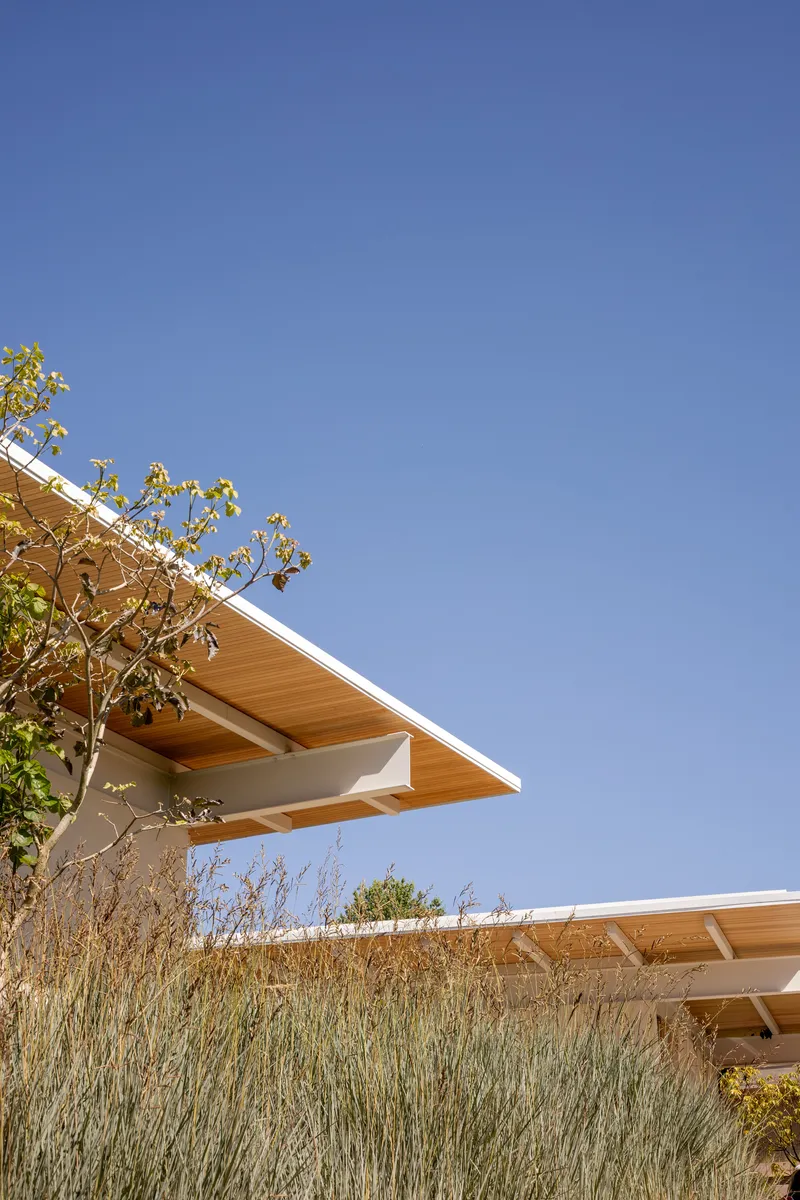
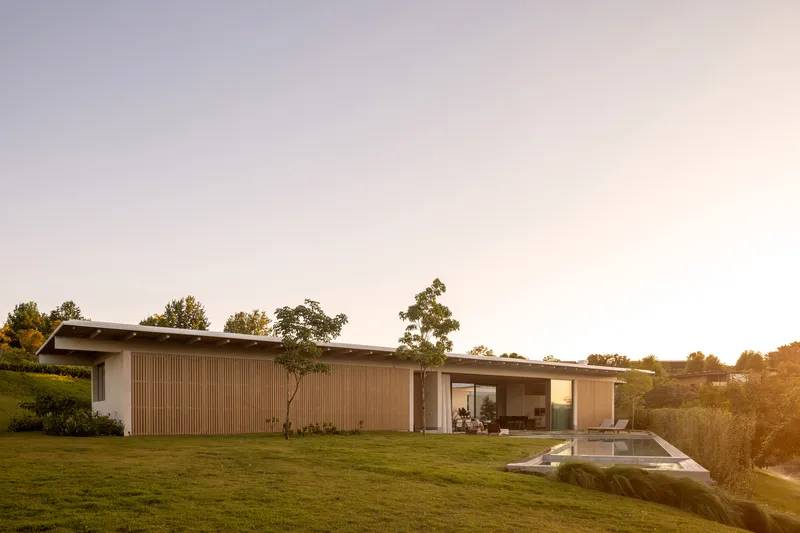
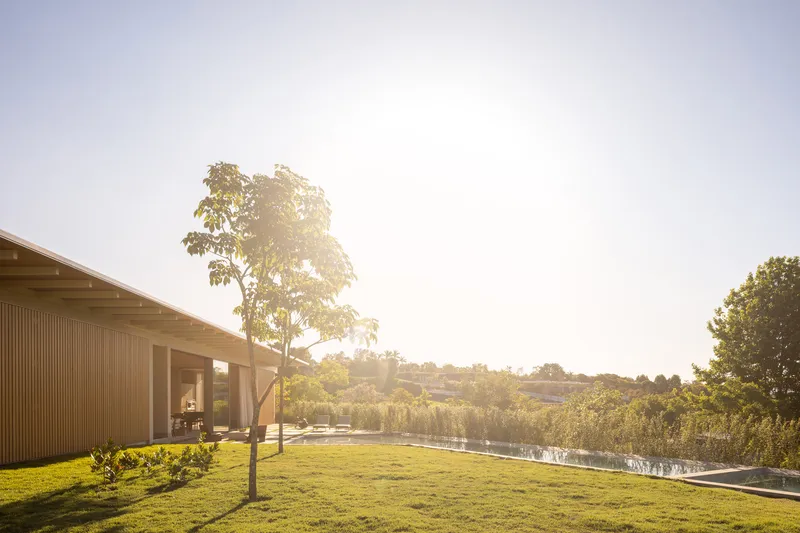
Seen from a distance, the house registers as two low-slung horizontal bands rising from the lawn, their timber soffits and angled rooflines catching the late afternoon sun. The decision to split the program is not arbitrary. The corner lot slopes gently, and by rotating the two bars slightly against each other, Castello Branco and Cunha ensure each volume responds to its own grade line while opening distinct sightlines across the property. Neither volume dominates; instead, the house reads as a pair of landscape elements rather than a single monolithic object.
The overhanging roofs project well beyond the enclosure below, casting deep shade over the facades and sheltering outdoor circulation paths. Structural engineer Mauricio Caberlon's metal framework handles the span between volumes cleanly, while the exposed timber beam ceilings give a warm, almost agricultural character to the covered walkways. André Paoliello's landscape design threads ornamental grasses and planted beds right up to the building edge, blurring the line between garden and architecture.
The Courtyard as Connective Tissue
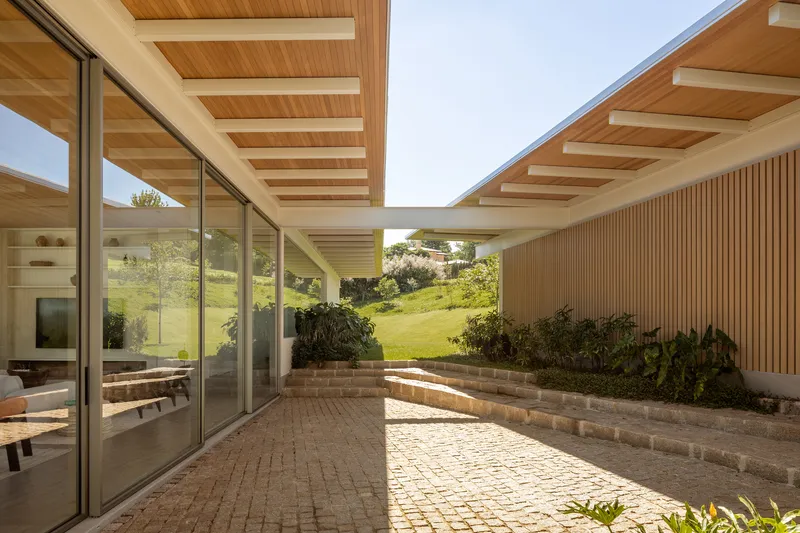
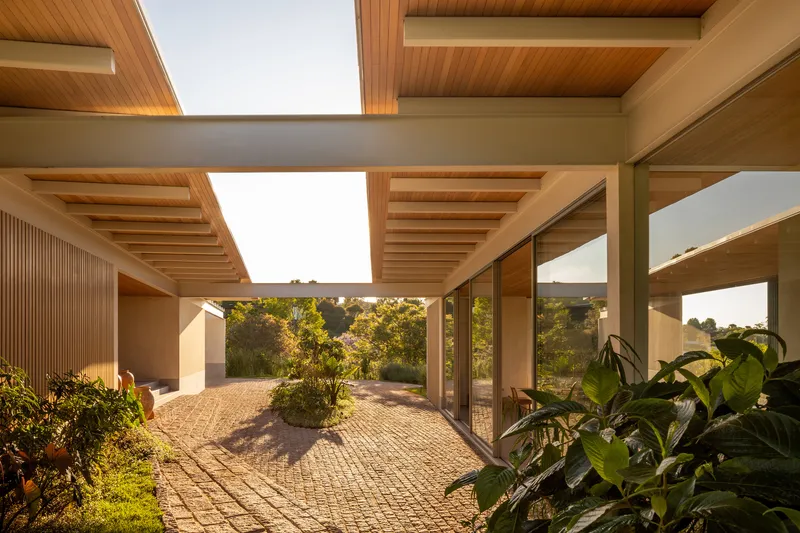
Between and within the two volumes, a series of courtyards and planted beds do the real organizational work. The brick-paved courtyard framed by timber slatted walls and floor-to-ceiling glass is not a leftover space; it is the primary address of the house, the place where interior and exterior share the same ceiling structure. Rectangular skylights punched into the timber beam roof above covered walkways wash the circulation paths with natural light, turning hallways into garden rooms.
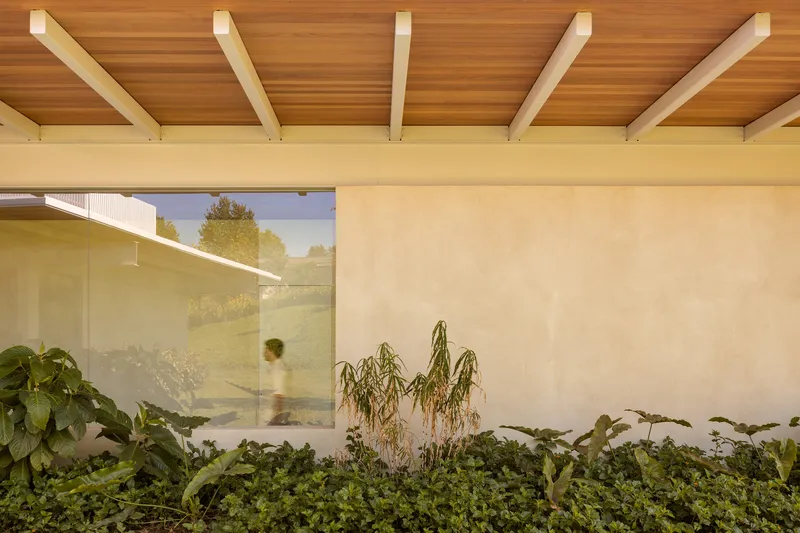
Interior planted beds push greenery right up against the glass walls, and the reflections in afternoon light double the effect. The strategy keeps every room aware of its position relative to the garden. There is no blind corridor here, no room that forgets it sits on a sloping plot full of mature trees. The courtyard is the hinge around which domestic life rotates.
Living Under Timber
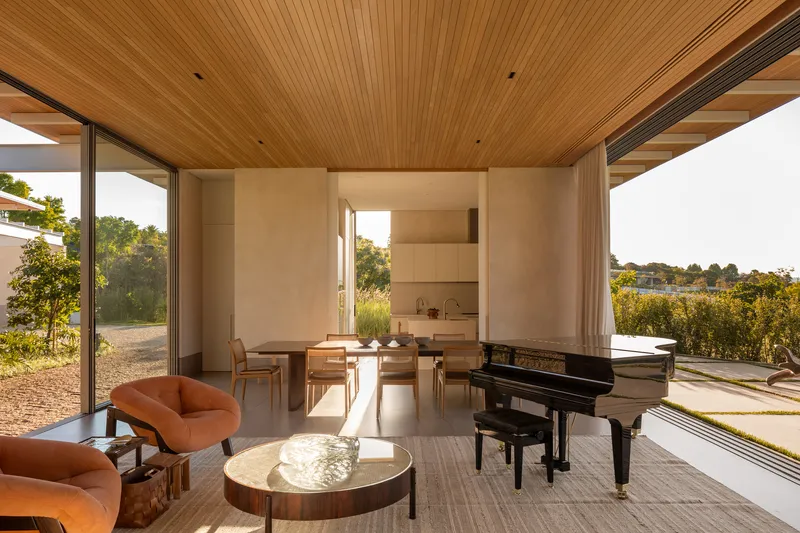
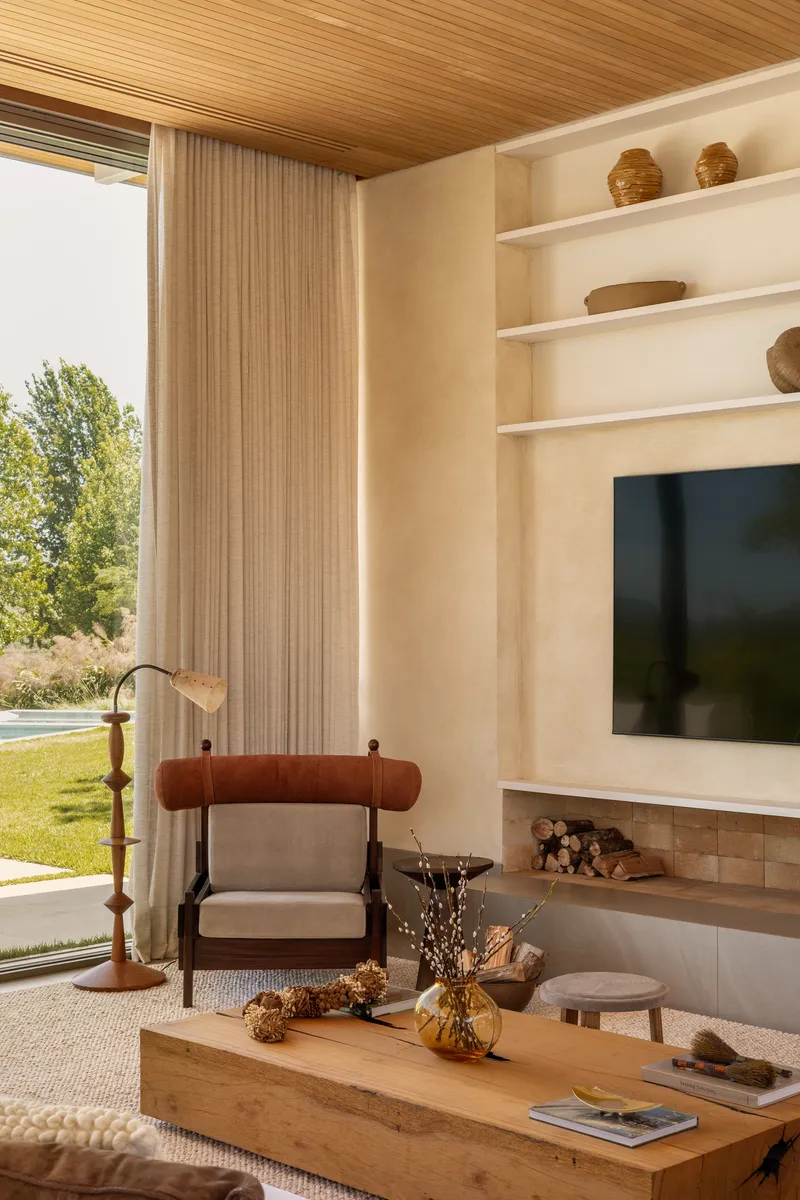
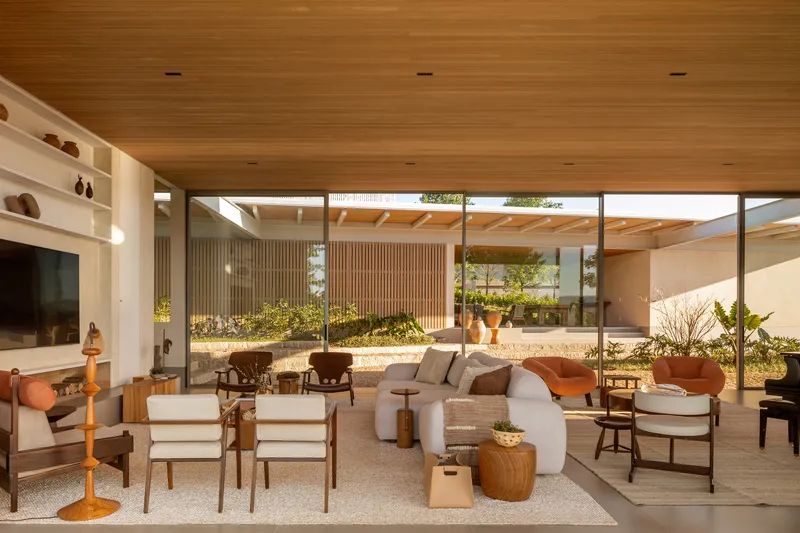
The social volume gathers living, dining, and kitchen into a continuous open plan defined overhead by an unbroken wood slat ceiling. The material continuity is critical: rather than dividing rooms with walls, the architects let the ceiling plane run from the living room's built-in shelving all the way through to the kitchen island, with furniture groupings and changes in floor finish doing the zoning work below. A grand piano near the glass wall catches a wedge of afternoon sunlight, marking the living room as the most generous space in section.
Full-height glazing on both sides of the social bar means the room is always reading two landscapes at once: the interior courtyard on one side, the open lawn and distant hills on the other. It is a simple move, but it prevents the long, narrow plan from ever feeling like a tube. Light enters from multiple angles and changes character throughout the day.
Kitchen and Dining as Threshold
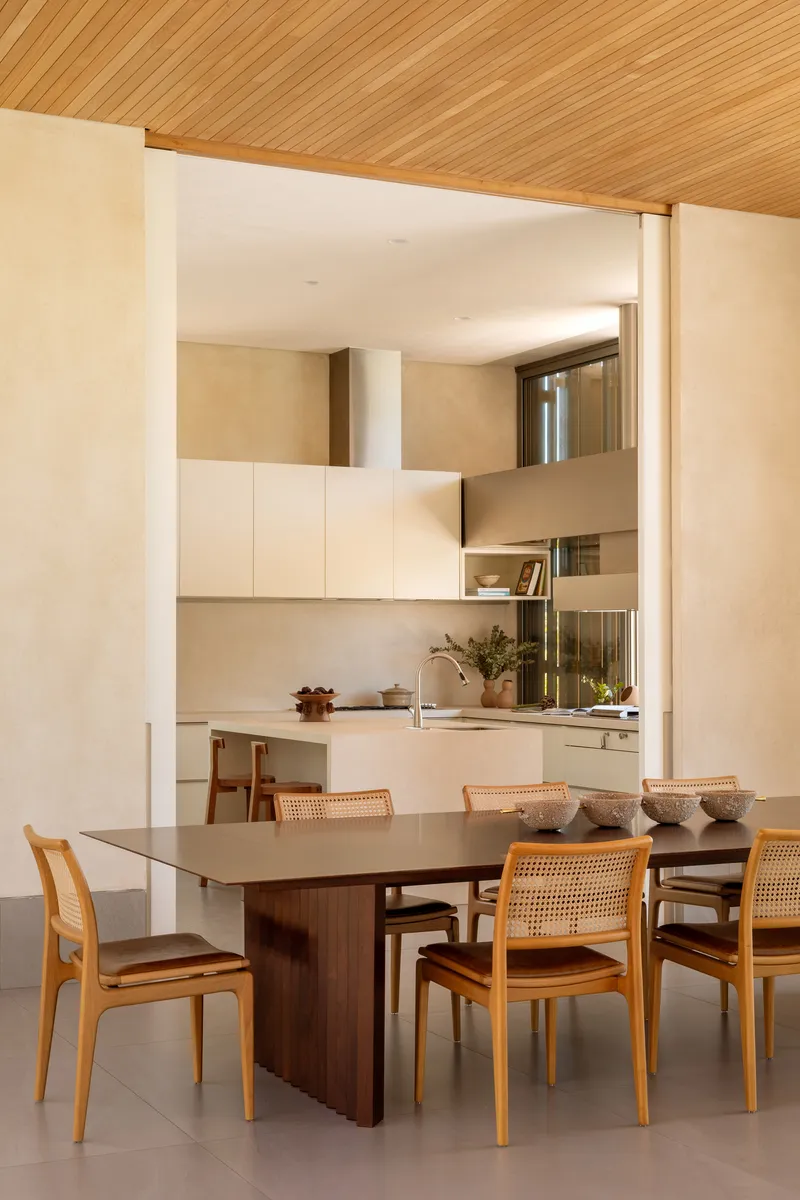
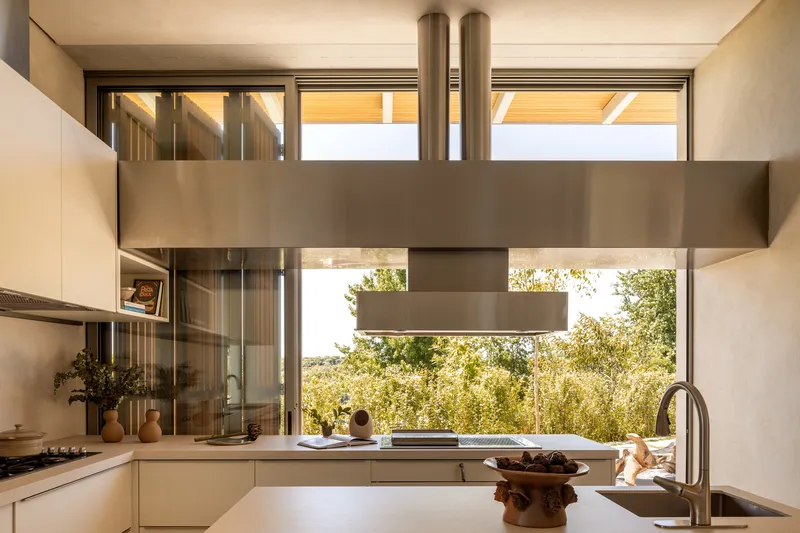
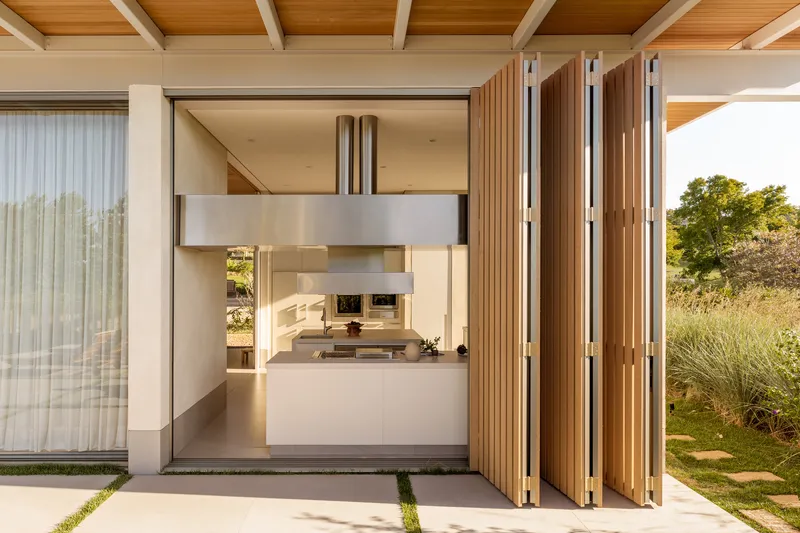
The dining area, furnished with cane chairs beneath the same continuous timber ceiling, operates as a transition point. Look one way and you see the kitchen beyond, its stainless steel range hood tucked beneath clerestory windows that frame tree canopies. Look the other way and a sheer curtain can be drawn back to reveal the courtyard. The kitchen's folding timber screen panels open the room entirely to a terrace with grass joints, effectively doubling the cooking space at dusk when the boundary between indoors and out dissolves.
Manufacturers like Ornare and Eliane supply the finishes, but the material language stays restrained: wood, stone, glass, and metal. Nothing competes with the structural rhythm of the exposed beam ceiling overhead.
Screens, Slats, and the Control of Light
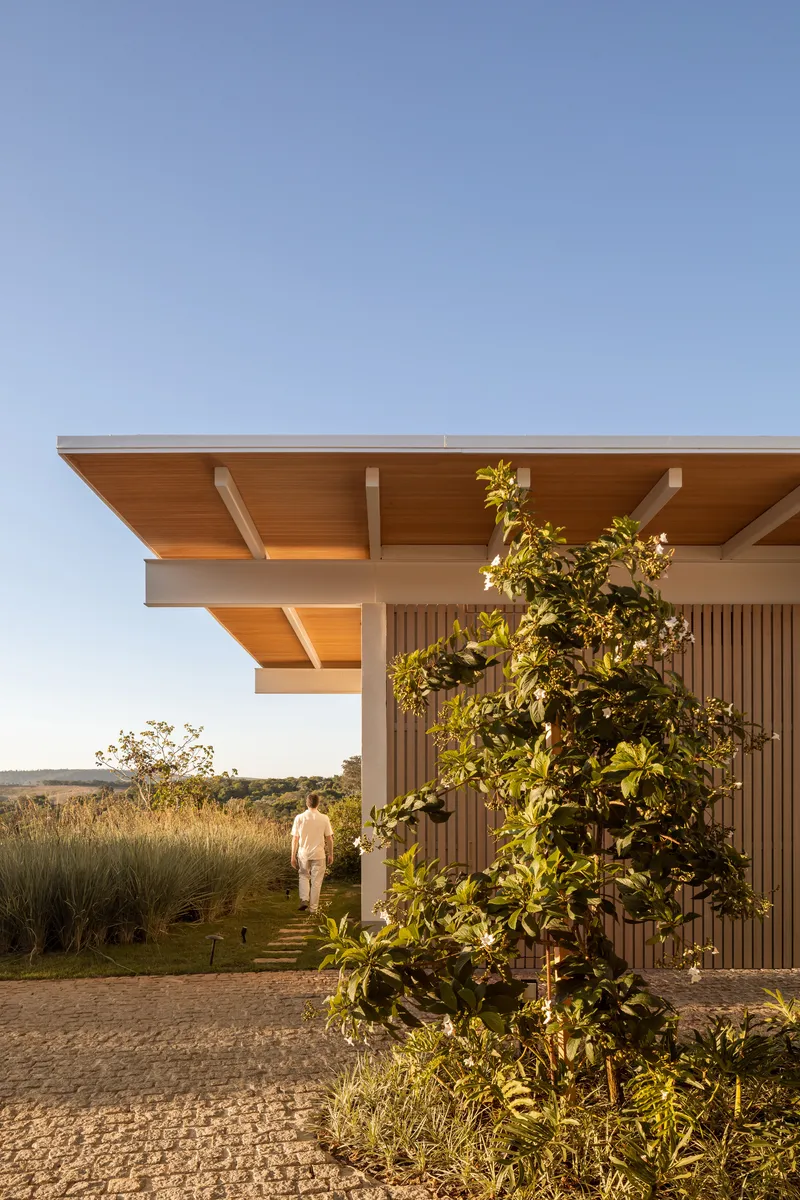
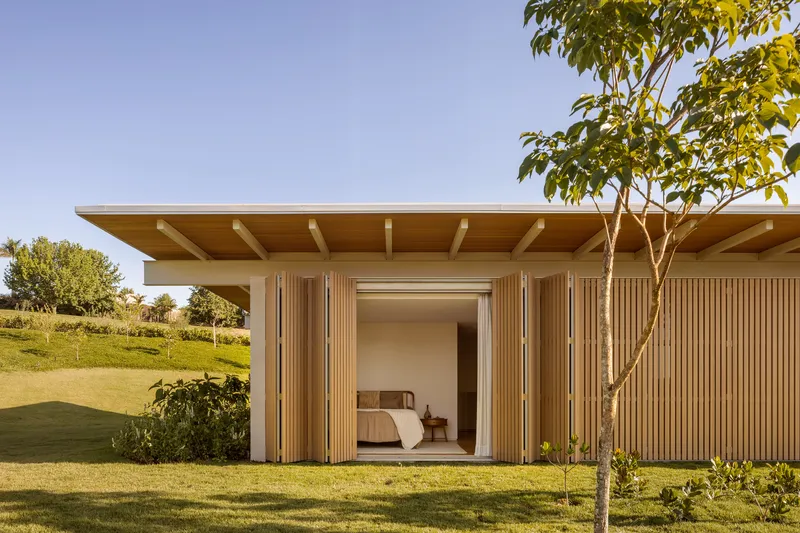
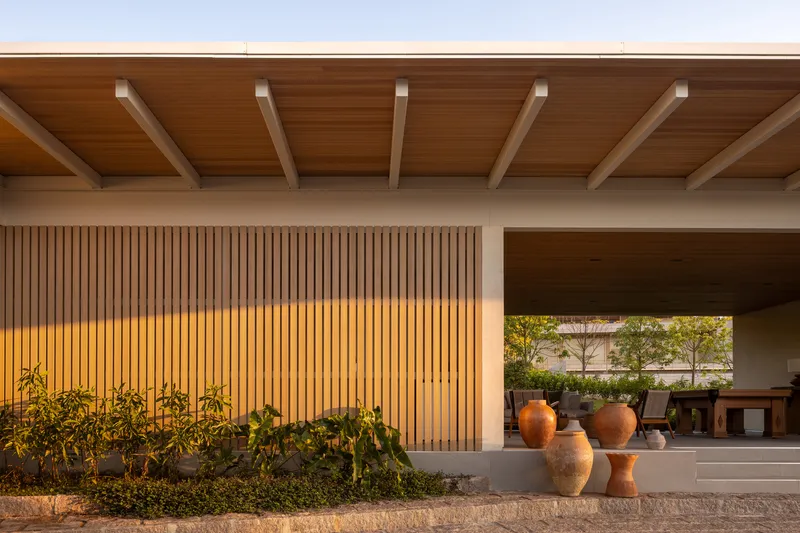
Vertical timber slat screens appear repeatedly across both volumes, performing as privacy filters, sun shading, and visual texture all at once. On the private bar, folding slat doors allow a bedroom to open fully to the lawn and a young tree, or close down to a warm amber glow. On the covered porches, the screens create a layered depth between the interior and the garden, catching light at oblique angles and casting striped shadows across the floor.
The detail is elegant without being precious. Ceramic vessels beside the planted beds on a covered porch, exposed timber rafters, a figure walking through a pool of dusk light: these moments rely on the slat screens to modulate the transition. The architects understand that opacity is as important as transparency. A house that is all glass is a house with nowhere to retreat.
Pool, Lawn, and the Extended Ground Plane
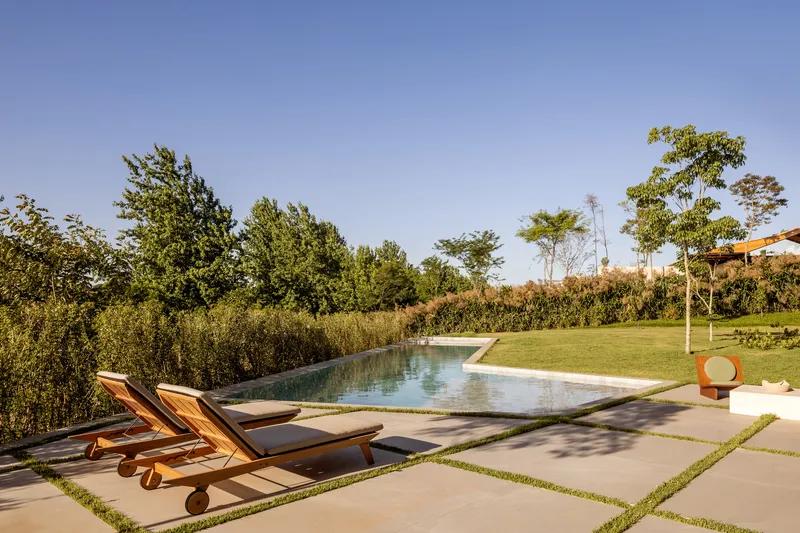
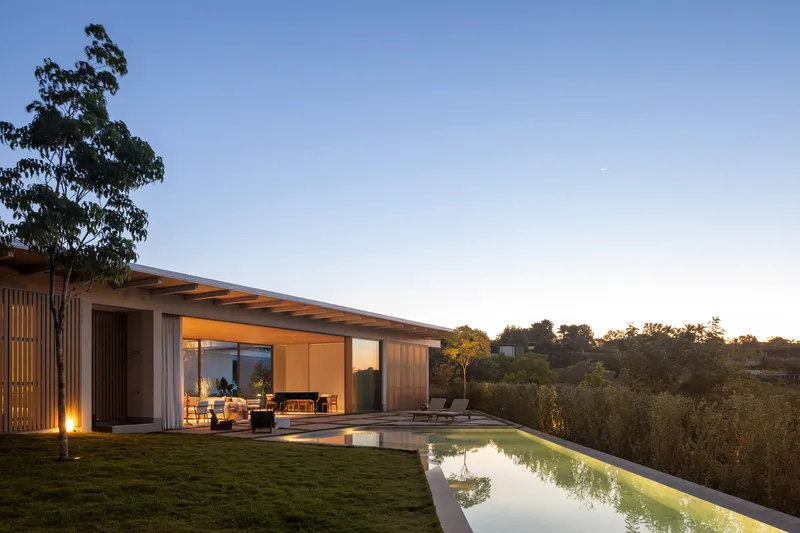
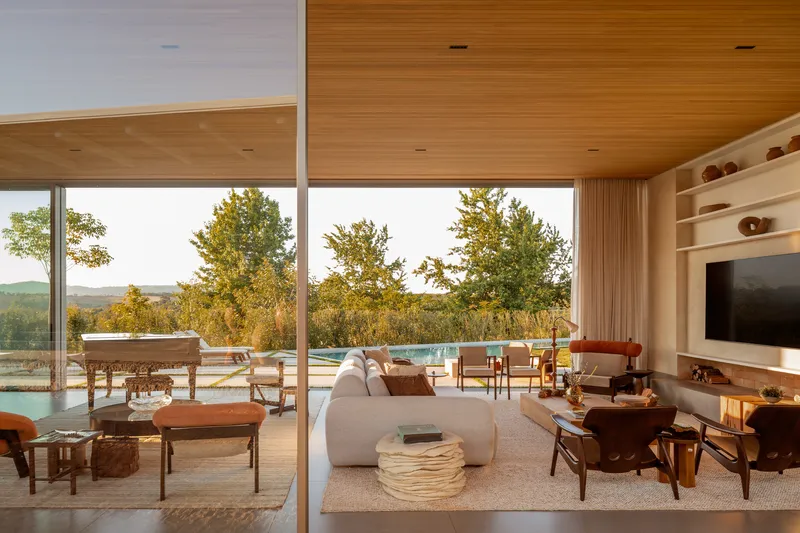
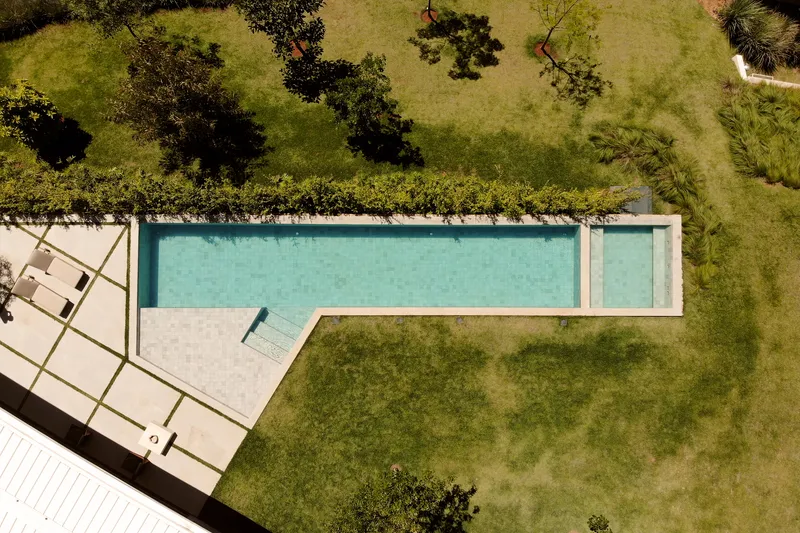
The rectangular lap pool stretches along the south edge of the site, its stone coping and timber loungers forming a clean line against the lawn. From the covered terrace, views run past the pool to rolling hills beyond, and at sunset the entire composition collapses into a single warm gradient. The pool is not an afterthought bolted to the house; it is positioned as a landscape element that extends the ground plane of the lower bar, reinforcing the horizontal datum that governs the whole project.
The relationship between the pool terrace and the glazed living spaces is carefully calibrated. From inside, the water surface acts as a mirror, bouncing light up into the timber ceiling. From outside, the house reads as a backdrop, its overhanging roof and vertical slat cladding framing the swimmer's view of the sky.
Arriving Through the Garden
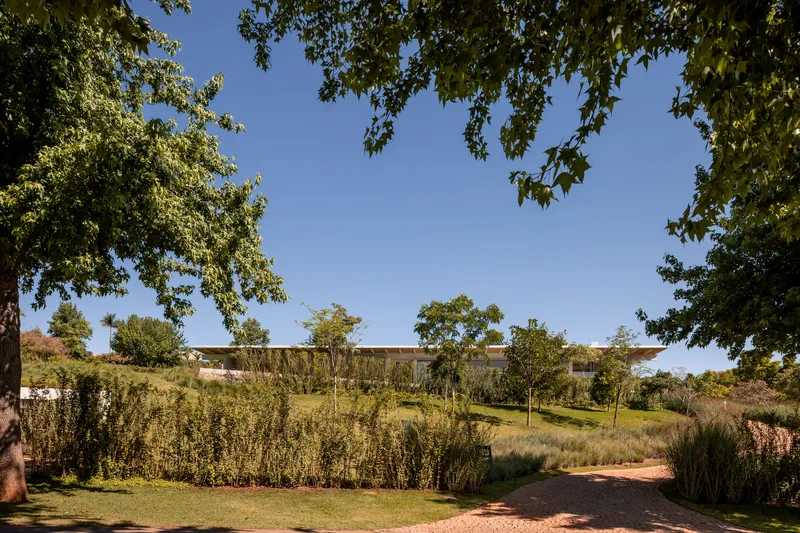
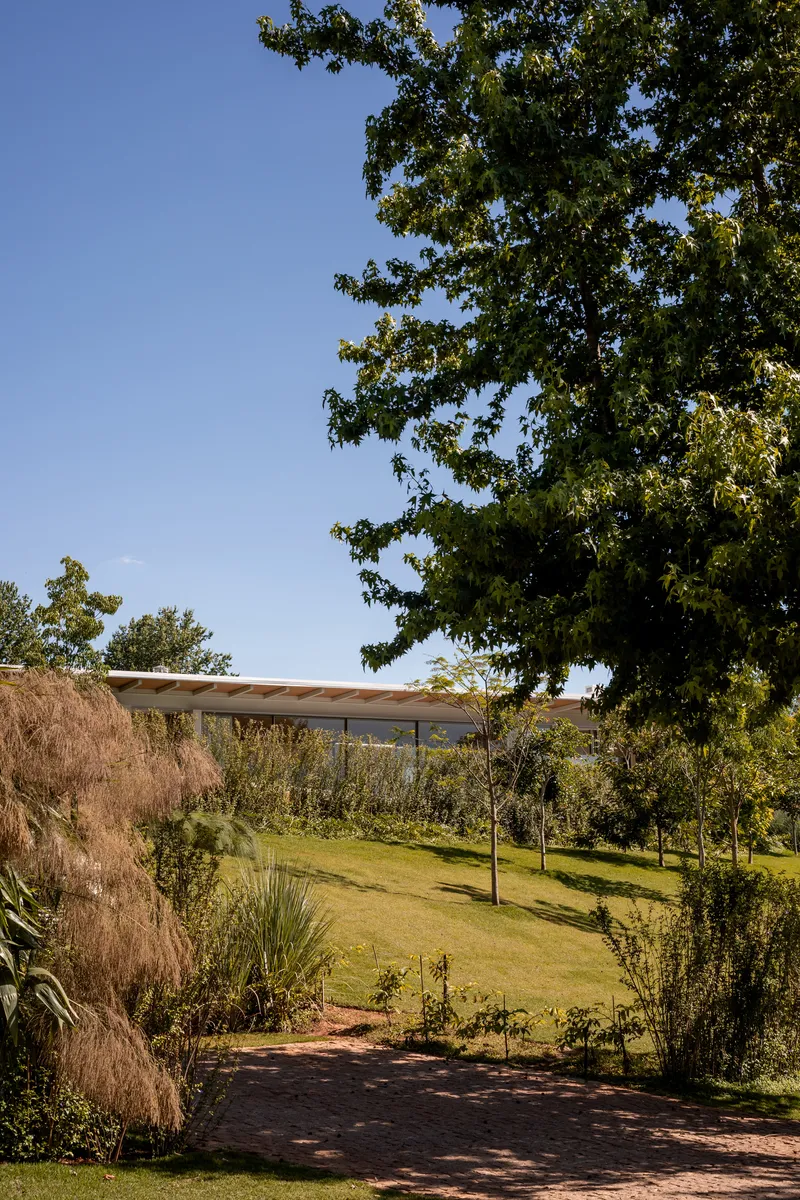
Approach is everything. The gravel path winds through planted gardens and mature trees before the house even comes into view, its low-slung roofline barely breaking the tree canopy. André Paoliello's landscape design deserves real credit here: the planting is not decorative screening but a spatial sequence that slows you down and reorients your attention from the street to the terrain. By the time you reach the entrance, you have already accepted the house's terms. You are in the landscape, and the architecture is simply the part of the landscape that has a roof.
Plans and Drawings
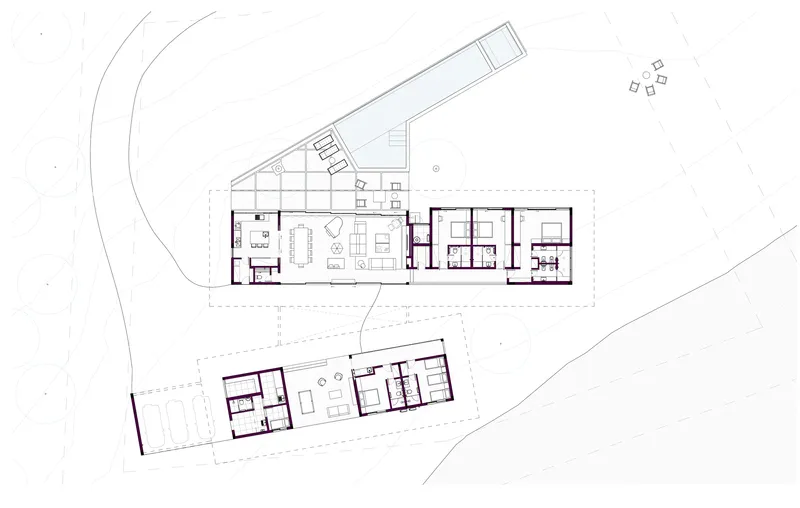
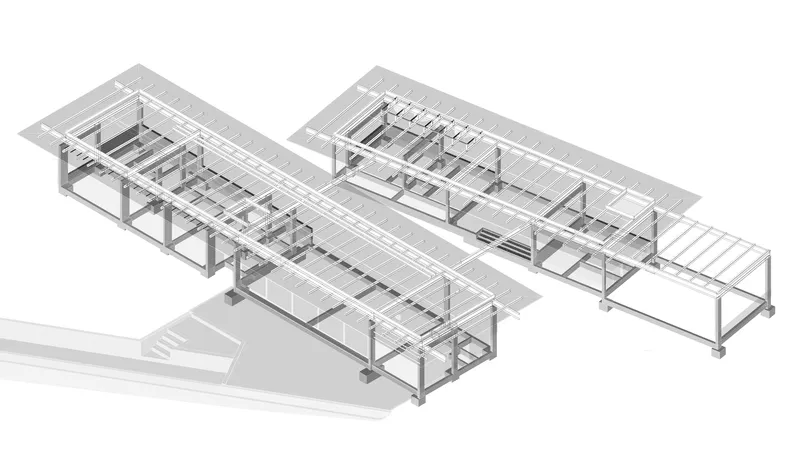
The floor plan makes the dual-bar strategy legible in a single glance: two elongated rectangles, rotated slightly relative to each other, connected by circulation and outdoor space. The social program occupies one bar, private rooms the other, and the gap between them hosts the courtyards that give the house its spatial richness. The axonometric drawing reveals the exposed timber beam and joist roof structure in its full extent, showing how the continuous ceiling plane unifies rooms of different widths beneath a single structural logic.
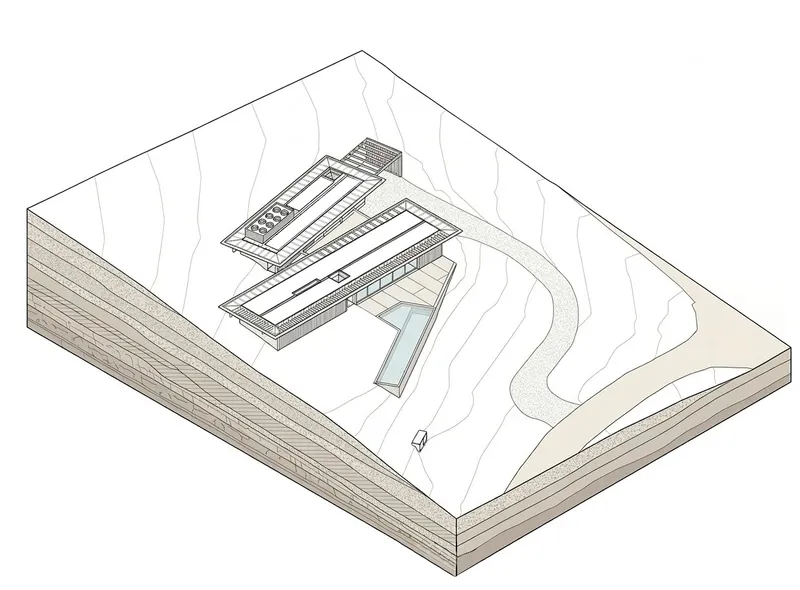
The isometric site drawing is perhaps the most revealing. It shows how the two bars nestle into the sloping contoured terrain, stepping with the grade rather than flattening it. The corner lot condition, which could have produced an awkward geometry, instead becomes the generative constraint. The angle between the volumes opens views outward while enclosing the courtyard inward, a simple geometric trick that pays off in every room of the house.
Why This Project Matters
The JL Residence is not reinventing the Brazilian pavilion house, a lineage that runs from Lina Bo Bardi through Isay Weinfeld and into the present. But it is executing the type with precision and a genuine sensitivity to site. The decision to split the program into two volumes is not a formal gesture; it is a response to slope, orientation, and the desire to give every room a relationship with planted ground. The metal structure that links the bars is an honest connector, not a theatrical bridge, and the timber detailing throughout is warm without being rustic.
What Kiko Castello Branco and Lucas Cunha demonstrate here is that the quality of a domestic project lies in the calibration of thresholds. Folding screens, planted courtyards, covered walkways, clerestory windows: each element controls how much of the landscape enters the house, and when. In a period when residential architecture often swings between hermetic boxes and exhibitionist glass pavilions, the JL Residence occupies a productive middle ground. It is open where it needs to be, closed where privacy demands, and always aware of the hill it sits on.
JL Residence by Kiko Castello Branco Arquitetura and Lucas Cunha. Bragança Paulista, Brazil. 926 m². Completed 2025. Photography by Carolina Lacaz.
About the Studio
Share Your Own Work on uni.xyz
If projects like this are the kind of work you want to make, uni.xyz is a place to publish your own, find collaborators, and enter design competitions.


Popular Articles
Popular articles from the community

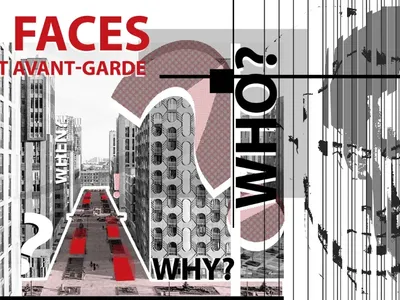
Faces of the Soviet Avant-Garde: Turning Moscow's Street Names into an Open-Air Museum
A network of sculptural installations across a Moscow residential district transforms forgotten architect names into spatial encounters with cultural memor

Singing Woman: An Opera House That Performs Before the Curtain Rises
Ovidiu Cristian Pavel's conceptual opera house translates Estonia's choral identity into a sculpted waterfront landmark facing the Baltic Sea.

The Amber Palace Opera: A Geological Fiction Surfaces on Tallinn's Baltic Waterfront
Pierre Brillard reimagines a Baltic legend as a public landscape, opera house, and waterfront promenade rooted in Tallinn's coastal identity.

Cloaked Colonization: A Mobile Underwater Habitat That Moves Like a Fish
Micah Abaya's shortlisted EHC Pacific entry reimagines ocean settlement as a dispersed network of self-sustaining architectural organisms.

Similar Reads
You might also enjoy these articles

Pixel Gardens: One Repeated Module Stacked Into a Terraced Social Housing Tower for Famagusta
Salem Bader's shortlisted housing tower builds a vertical neighbourhood from one repeated module, offsetting units to carve terraces, light and air.

Bao Huynh Watercolor Atelier: A Serene Art Retreat in Hội An
Bao Huynh Watercolor Atelier in Hội An blends multifunctional art spaces, sustainable design, local materials, and family-friendly living in a serene environment.

Atelier Macri Concept Store Interior Design by CASE-REAL
Atelier Macri store features a "ko" counter, walnut wood details, cork displays, blending retail, gallery, and seamless customer experiences.

Manuel Vargas Izquierdo Stadium and High-Performance Sports Center: Architectural Excellence in Jalpa de Méndez
The Manuel Vargas Izquierdo Stadium blends sustainable design, inclusive sports facilities, and cultural-inspired architecture, revitalizing Jalpa de Méndez’s public spaces.


Comments (0)
Please login or sign up to add comments
No comments yet. Be the first to comment!