

Kinesis: Dance-Driven Eco-Village Where Choreography Shapes Architecture
In Boa Vista, Brazil, circular courtyards and rammed-earth walls transform movement and rhythm into a climate-responsive community.


What if the footwork of a dance could generate a floor plan? Kinesis takes that question literally, translating the rhythmic patterns of Brazilian dance and social gathering into a series of interconnected semicircular forms that define an entire eco-village. The result is an architecture that refuses to stand still: courtyards expand and contract along the site like breathing lungs, circulation paths mimic the steps of choreography, and spatial thickness varies like tempo shifts in music.
Designed by İrem Oba, this shortlisted entry for the Live Green competition situates itself in Boa Vista, Roraima, Brazil. The site context matters: Boa Vista sits in the northern Amazon basin, where equatorial heat, seasonal rains, and a rich cultural relationship with rhythm and communal life all press directly on architectural decisions. Oba responds not with a generic sustainability checklist but with a design process rooted in movement analysis, local materials, and the conviction that ecological performance and cultural expression can be the same thing.
Semicircles That Breathe: Reading the Aerial Plan
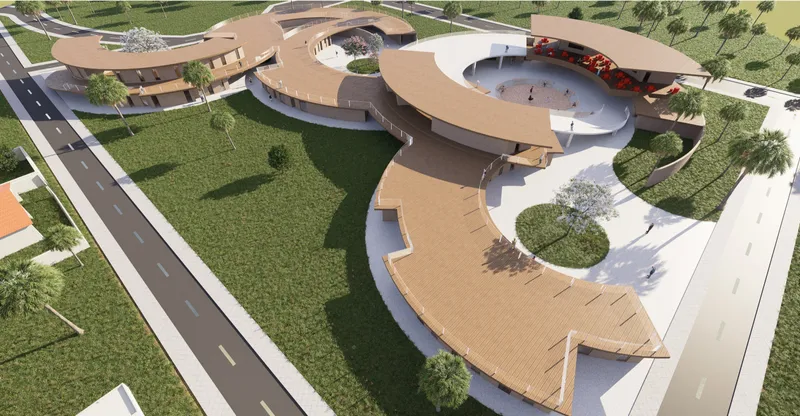
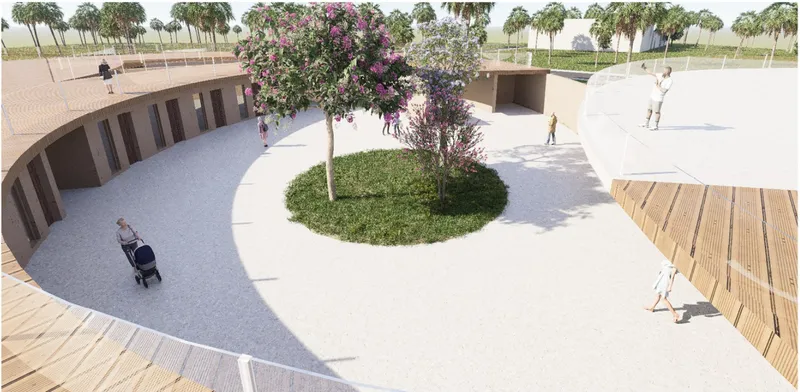
From above, the complex reads as a chain of curving timber roofs linked by open-air courtyards, nestled among palm trees. The geometry is not arbitrary. Oba began her design process by studying urban grids and pedestrian movement in Boa Vista, then introduced fluid curves that evolved into interconnected semicircular forms. Each loop defines a zone for a different activity: dance studios, art spaces, residential units, dining, and exhibition areas, all interlocked through courtyards that serve as social thresholds. The sunken courtyard at ground level, with its circular planted bed and a single tree anchoring the composition, reveals how landscape and architecture merge. White pavement meets timber decking at the seams, signaling transitions between program types without the need for walls.
Rammed Earth and Horizontal Canopies: Climate Response as Spatial Identity
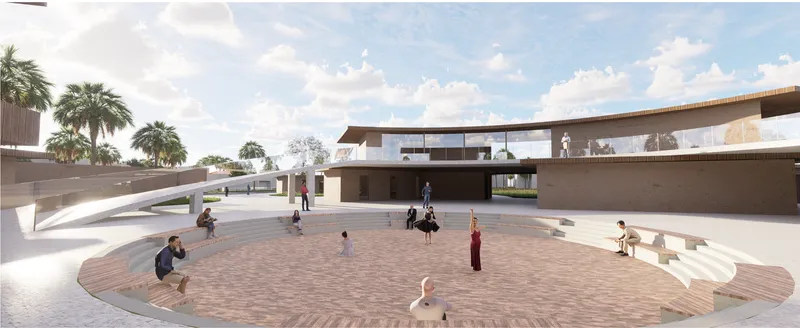
The circular brick plaza captured in afternoon light shows one of the project's clearest climate strategies: horizontal canopy bands suspended above the gathering space. These layered shade elements filter equatorial sun while allowing hot air to escape upward through the gaps between them. Rammed-earth walls flanking the courtyards do double duty, absorbing heat during the day and releasing it slowly at night to regulate interior temperatures. Together with open courtyards that enable cross-ventilation, these passive systems form what Oba describes as a holistic climate-responsive architecture that minimizes energy use while amplifying sensory experience.
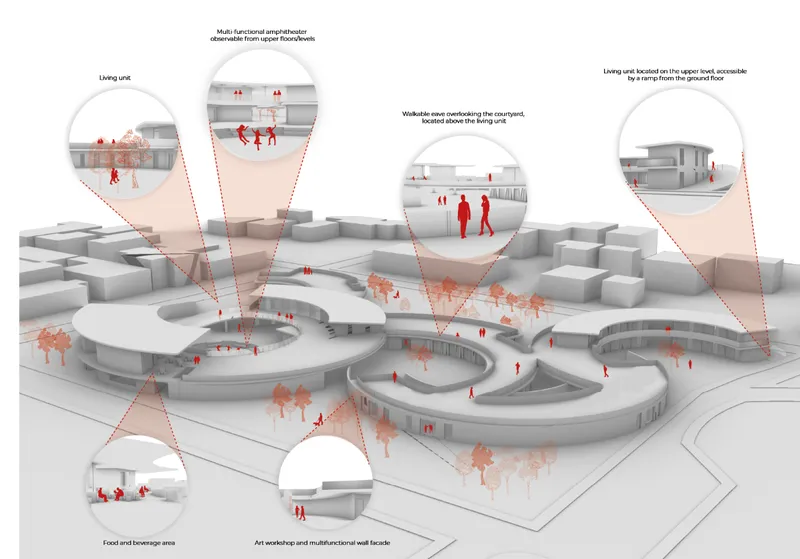
The axonometric diagram lays this logic bare, annotating circulation paths, program zones, and interior vignettes that clarify how movement flows through the plan. Dance studios sit adjacent to the central amphitheater, which functions simultaneously as a gathering space and a performance stage. Residential clusters pull back toward quieter edges. The diagram makes visible what the renderings only imply: every spatial decision traces back to the rhythm of human motion through the site.
Curved Timber Eaves and the Vernacular Made Contemporary
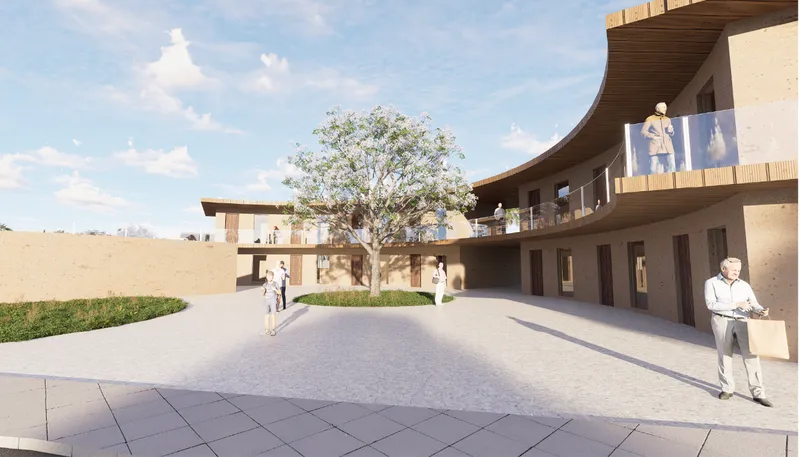
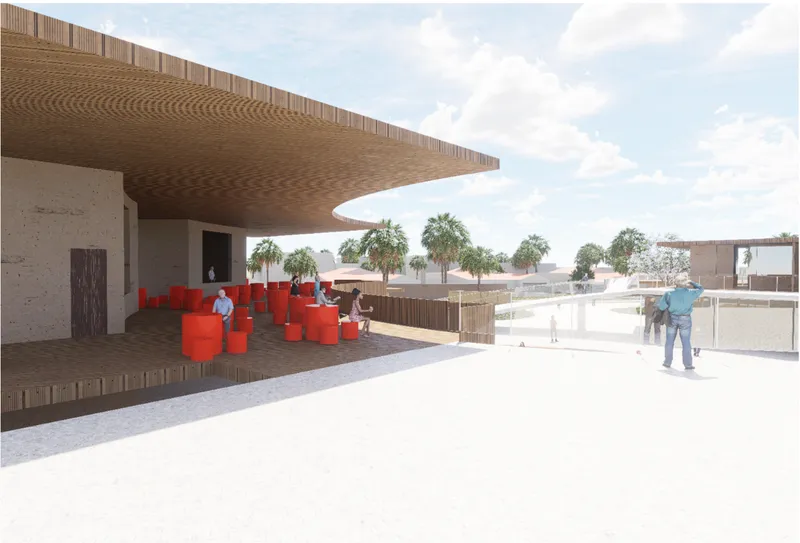
At eye level, the architecture feels grounded and tactile. The courtyard view under a curved timber eave demonstrates how the building wraps around its inhabitants rather than confronting them with flat facades. Enclosed walkways connect interior spaces to the landscape through framed views of sky and trees, making circulation itself a sensory event. The covered terrace pushes this further: a patterned timber soffit overhead, concrete walls providing thermal mass, and red seating elements punctuating the space with warmth. Palm trees beyond the colonnade keep the equatorial landscape constantly in the peripheral vision of anyone moving through the complex.
Material choices reinforce local identity. Rammed-earth façades, wooden decks, and shaded verandas all draw from vernacular building wisdom in the Brazilian north while meeting contemporary performance standards. Oba frames this material honesty as more than a technical strategy: it transforms sustainability from a goal into a lived experience, one where the texture of the wall under your hand connects you to the ground it came from.
Colonnaded Circles: Architecture as Stage and Ecosystem
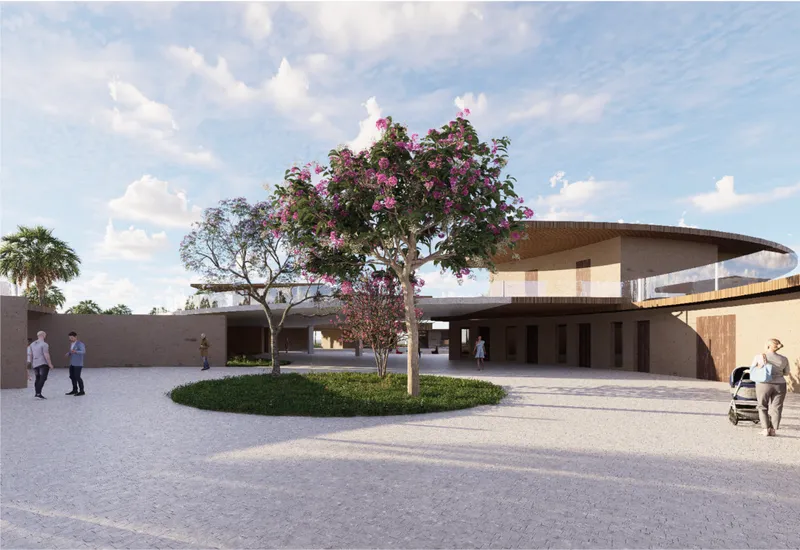
The final exterior view brings the project's ambitions together in a single frame. A circular colonnaded building opens onto a courtyard where flowering trees and visitors coexist. The columns establish rhythm, the canopy provides shade, and the open ground plane invites occupation. At the broader urban scale, Kinesis integrates green corridors, pedestrian-friendly pathways, and rainwater management systems designed to foster biodiversity alongside human well-being. The eco-village is not a retreat from Boa Vista; it is an insertion into the city's social and ecological fabric, offering shared programs like workshops, exhibitions, and performances that strengthen community networks.
Why This Project Matters
Sustainability competitions are filled with entries that treat ecology as a performance metric and culture as a mood board. Kinesis pushes past that split by making movement, specifically the culturally rooted practice of dance and social gathering, the literal generator of form. The semicircular loops, the varying spatial thicknesses, the choreographic circulation routes are not metaphors applied after the fact; they emerge from a design process that treated rhythm as a structural principle from the start.
The lesson here is methodological. By anchoring climate-responsive strategies like rammed-earth construction, passive ventilation, and shading canopies within a cultural narrative specific to Boa Vista, İrem Oba demonstrates that ecological architecture does not have to erase local identity to be effective. When the way people move through space becomes the starting point for how that space manages heat, light, and rain, sustainability stops being a layer added on top and becomes inseparable from the experience of being there.
View the Full Project
About the Designers
Designer: İrem Oba
Enter a Design Competition on uni.xyz
uni.xyz runs architecture and design competitions year-round that reward proposals with spatial conviction and real site intelligence.
Project credits: Uni XYZ Eco Village Kinesis İrem Oba by İrem Oba Live Green (uni.xyz).


Popular Articles
Popular articles from the community


Opera on the Sea: Driftwood Logic Shapes a Timber Opera House on Estonia's Coast
Trevor Orgill's opera house translates the entangled drift of floating timber into a civic building where wood, water, and music converge.

Manzana Morphosis: Stretching Barcelona's Grid into a Living Landscape for 2050
A radical reworking of the Eixample manzana turns density into a tool for generous public space, vertical ecology, and environmental performance.

Temporary Home for Dogs: A Reversed Zoo Rethinks Animal Shelter Architecture
In Bucharest, a sinuous corridor and freed landscape flip the logic of containment, designing a shelter that works to make itself unnecessary.

Tsunami Convergenics: Turning Catastrophic Ocean Forces into Underwater Housing Infrastructure
A speculative underwater settlement off the coast of Onagawa, Japan, treats tsunamis and typhoons as energy sources rather than threats.

Similar Reads
You might also enjoy these articles

Play: Fragments of Their World: Remembered Architecture Rebuilt as a Modular Playground for Refugee Camps
Tom Gardner abstracts domes, arches and towers from the homelands of displaced families into a kit of child-scaled play parts for camp settlements.
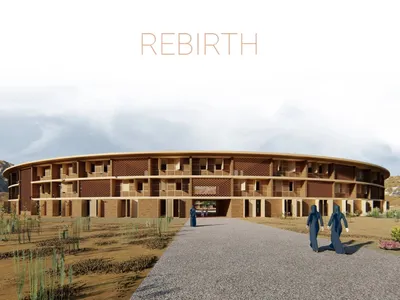
REBIRTH: A Circular Settlement Where Afghan Widows and Their Children Rebuild Life Together
A shortlisted Resile entry turns the circle into a protective ring of timber and brick, gathering homes, classrooms and gardens around a shared landscape.
The Main Dream: A Recycled Plastic Kit That Lets Refugee Children Build Their Own Playground
Thirty-centimetre interlocking cubes that connect on three axes turn play into construction, letting children author the spaces they occupy.

Lunar Spiral: A Fibonacci-Driven Moon Settlement Rising from Shackleton Crater
Golden-spiral geometry organises buried infrastructure and orbiting habitable spheres into a lunar base designed to grow as life on the Moon expands.


Comments (0)
Please login or sign up to add comments
No comments yet. Be the first to comment!