
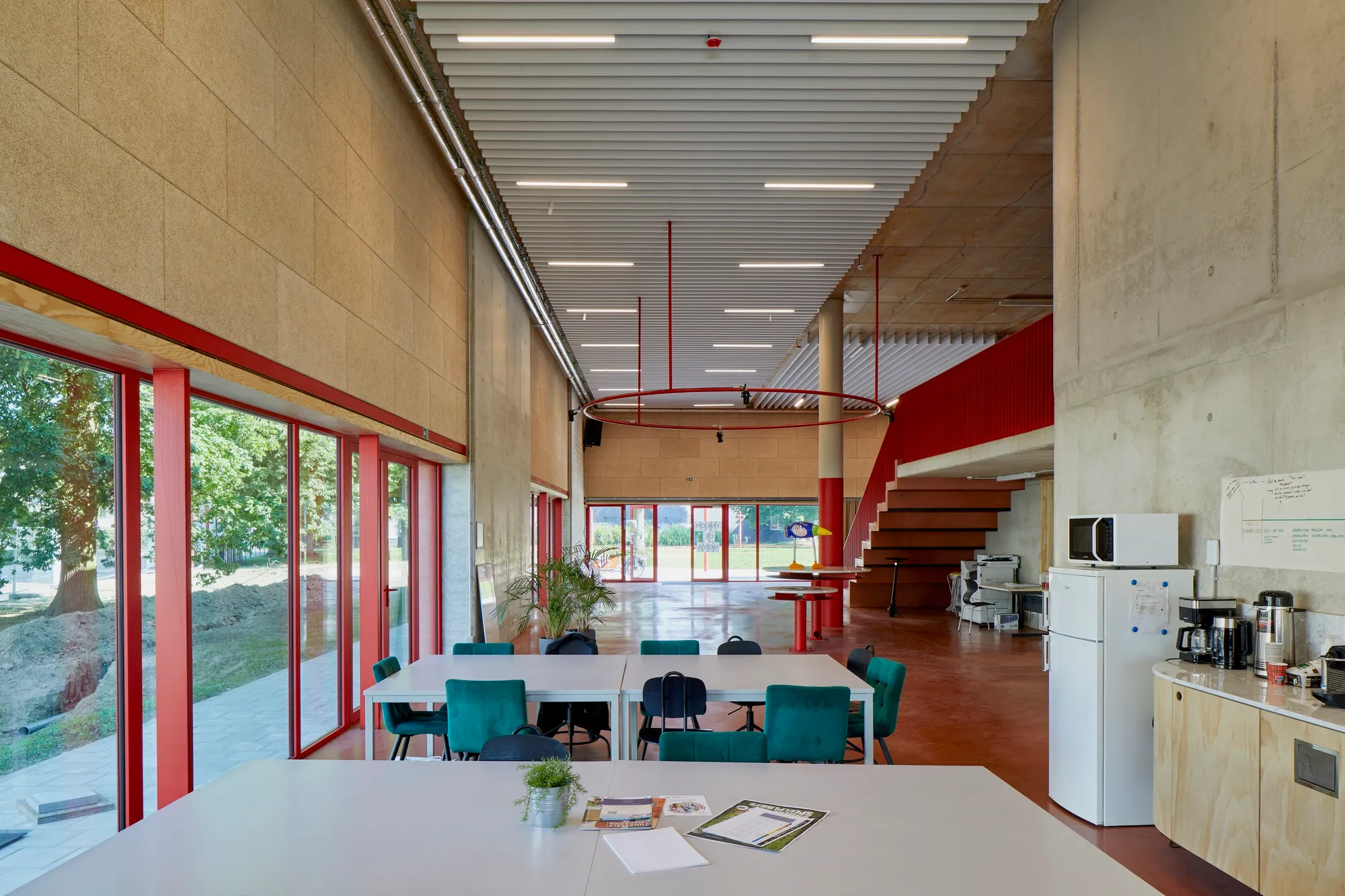
KPW architecten Builds a Column-Free Learning Machine for a Leuven Secondary School
De Nova Secondary School reimagines education through 20-meter open spans, salvaged materials, and a demountable aluminum skin in Kessel-Lo, Belgium.


Schools rarely get to be this structurally frank. De Nova Secondary School, a 1,450 square meter extension to an existing campus in Kessel-Lo, Leuven, is less a conventional school building than a concrete skeleton waiting to be occupied in whatever way its students and teachers see fit. Designed by KPW architecten and completed in 2025, the project takes a campus that grew organically from a cluster of 1950s and 1960s pavilions and adds a single assertive volume whose open floor plates span a full 20 meters without intermediate columns.
What makes the project genuinely worth studying is the degree to which it treats permanence and impermanence as complementary design tools. The concrete structure is the building, full stop. Everything else, from the aluminum cladding to the ventilation ducts to the raised floors that carry power and data, is designed to be removed, replaced, or reconfigured. The school's pedagogy of "learning through experience" demanded flexible space, and KPW responded not with sliding walls and modular furniture but with a structural logic that makes flexibility a consequence of how the building stands up.
A Skin Meant to Be Shed


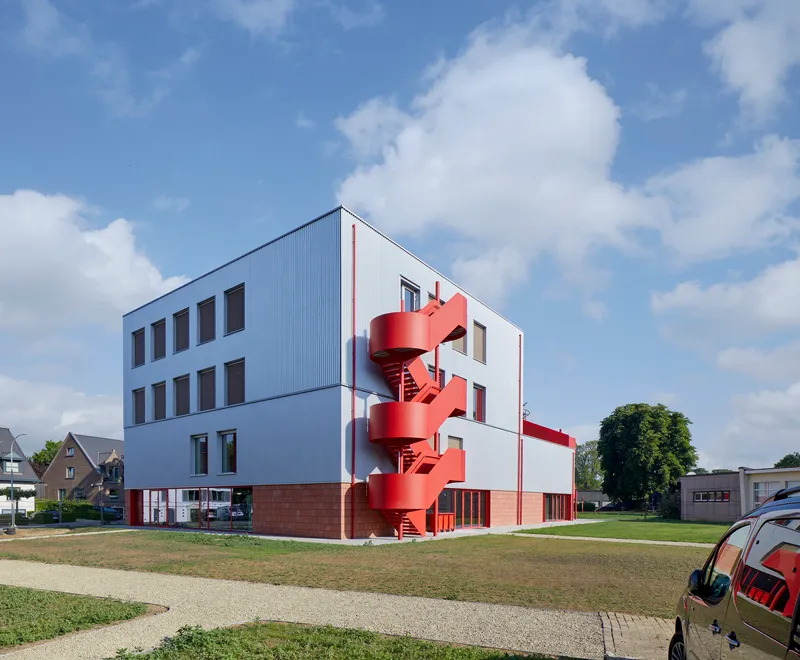
The corrugated aluminum facade is deliberately non-precious. It wraps the volume in a matte, industrial envelope that reads as cladding rather than architecture, which is exactly the point. KPW designed the skin to be demountable so that future upgrades (better thermal insulation, different window proportions, even a complete re-cladding) can happen without touching the primary structure. Conventional school buildings lock their environmental performance into the original construction; De Nova treats the envelope as a replaceable layer with its own, shorter lifespan.
Against this restrained backdrop, the red steel staircase and cylindrical fire escape become something close to ornament. The salmon-pink spiral wrapping around red columns at one corner gives the building a playful vertical accent that students will almost certainly adopt as its logo. It also solves a fire safety requirement that could have been handled with a grim external stair but instead becomes a sculptural event.
The Market Hall at the Heart

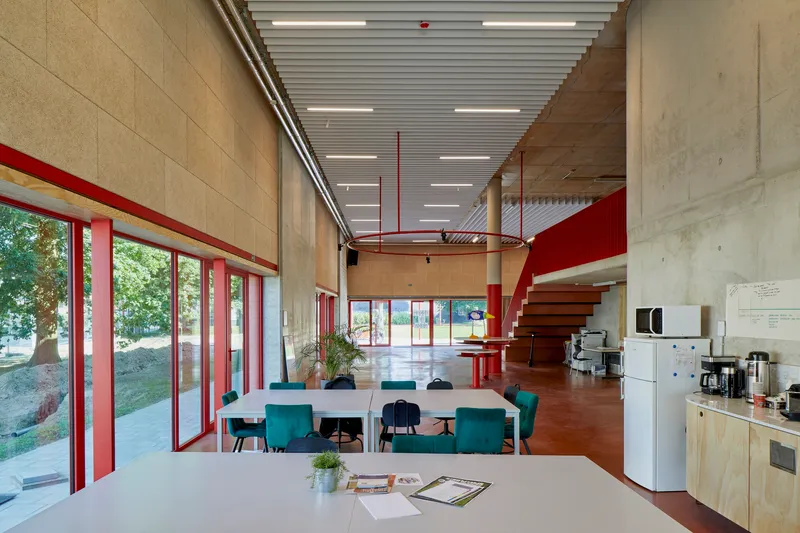
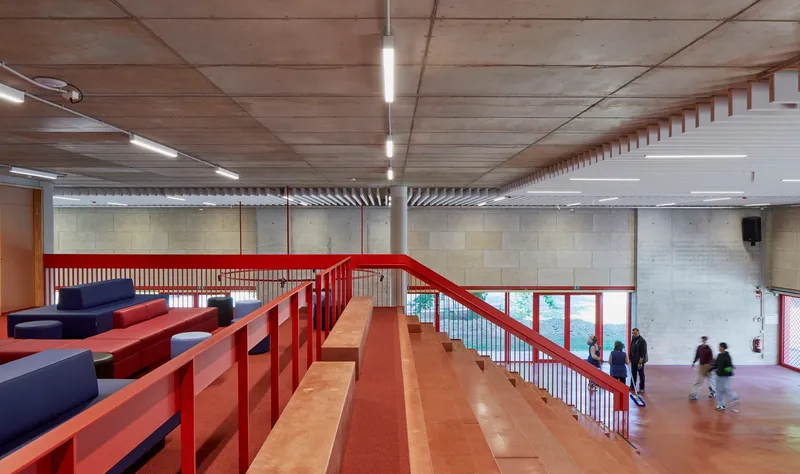
The ground floor is organized around a double-height "market hall," a generous gathering space anchored by a built-in tribune, a library counter, a coffee corner, and lockers. It is not a lobby in any traditional sense. It is the social engine of the school, a place where informal encounters between students, staff, and visiting collaborators from businesses and organizations are encouraged by sheer proximity. The red steel staircase rises through this volume, connecting the tribune to a mezzanine at its top that serves as a quieter library and study retreat.
From the upper mezzanine, you look down into the market hall and grasp the building's organizational logic immediately: a structural core containing circulation and sanitary facilities, ringed by column-free learning platforms. The concrete ceiling is left exposed, services run visibly, and the floor materials shift from terracotta to red rubber to cork to signal changes in program without walls. This is an architecture of texture rather than partition.
Open Platforms, Not Classrooms
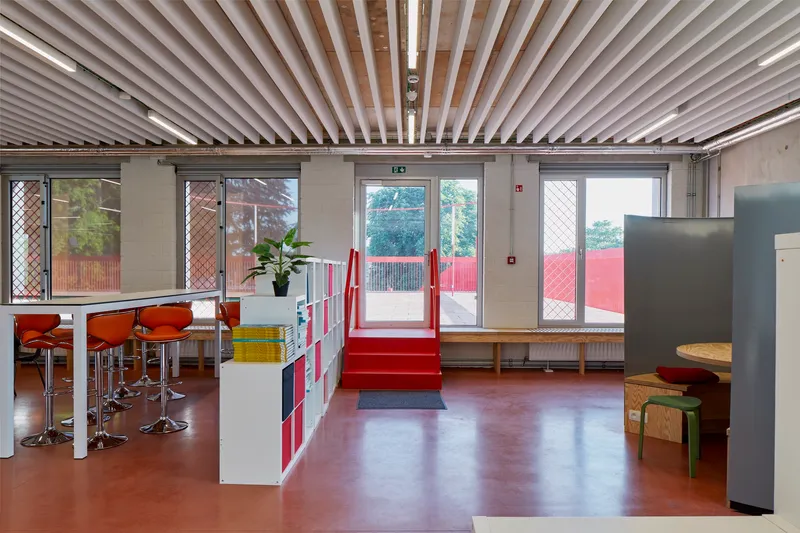
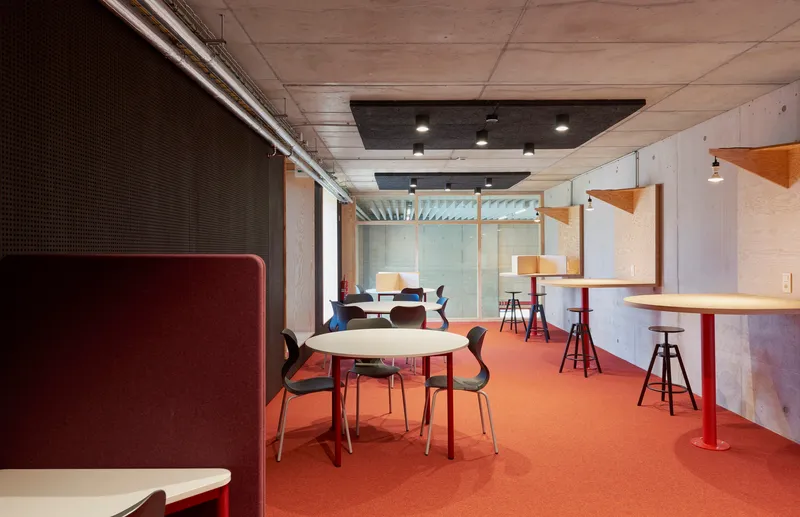

The two upper learning platforms are where the building's structural ambition pays off most directly. Twenty-meter clear spans, achieved by concrete column walls supporting floor plates, create open landscapes that can be subdivided with curtains, timber-framed glass partitions, and moveable furniture rather than fixed walls. Technical equipment is embedded in raised floors, so a new classroom can be configured at any location simply by plugging in. Electrical wiring runs through circular cable ducts that are accessible and modifiable; ventilation systems are removable.
The interstitial zones between program areas are differentiated carefully. Perforated acoustic panels line casual seating nooks. Timber and white acoustic ceiling panels define meeting rooms. Linear baffle ceilings mark transition zones near exterior terraces. These are not leftover spaces but deliberate atmospheric shifts that give students and teachers a range of settings within a single open floor plate. The building trusts its occupants to choose the right environment for the task at hand.
Working Rooms and Quiet Corners


Not everything is open. Enclosed workspaces with plywood casework and exposed conduit offer more concentrated settings for small groups. A meeting room with timber and white acoustic ceiling panels provides a genuinely quiet volume within the larger platform, lit by generous daylight from one side. These pockets of enclosure exist as counterpoints to the open floor, not contradictions. The structural grid and raised floor system make it possible to add or remove them as the school's needs evolve.
Circularity as Common Sense


KPW's circularity strategy avoids the usual sustainability theater. A kindergarten block on the existing campus was demolished to make way for the extension, and its interior objects were salvaged for reuse in the new building. Sick trees felled on site became seating elements, play equipment, and art objects. Existing brick paving was lifted and relaid in the new landscape design. These are not symbolic gestures; they are practical decisions that reduced procurement costs and kept material out of landfill.
The rooftop terrace, ringed by red steel railings and accessible via the external staircase, doubles as an outdoor learning area and play space. It extends the usable area of a compact footprint without consuming additional ground. The view from the terrace takes in the campus's mature trees and the surrounding residential streets of Kessel-Lo, placing students firmly in the neighborhood rather than behind it.
Plans and Drawings


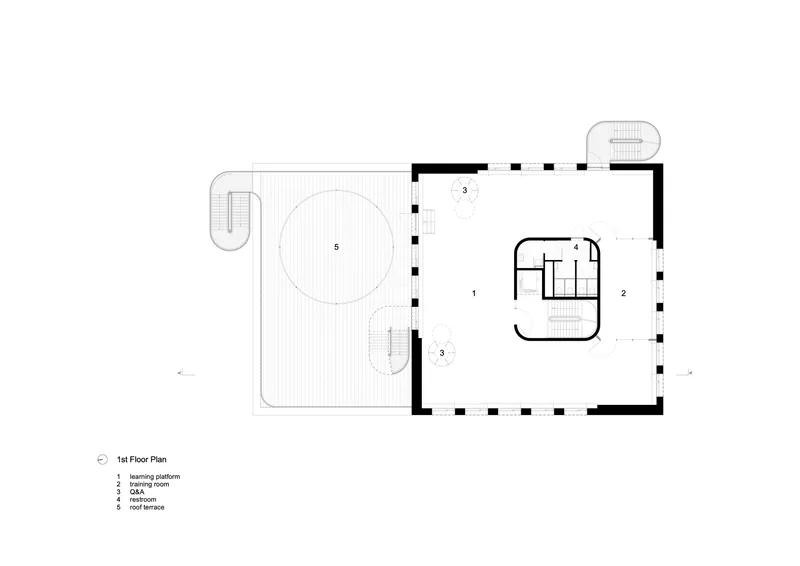


The site plan reveals how the new volume slots into the existing campus geometry, anchored by a circular plaza (recalling the Expo '58-style entrance pavilion nearby) that makes all building entrances visible from the street. The ground floor plan shows the market hall and tribune occupying the center, with the structural core to one side. On the first and second floors, the column-free platforms open out around the core, and the circular rooftop terrace hovers above the spiral stair. The section drawing is the most revealing: it shows the split-level relationship between the tribune, mezzanine, and upper platforms, making clear how the building's three levels contain far more spatial variety than the exterior suggests.
Why This Project Matters
De Nova Secondary School belongs to a growing body of work that refuses to treat educational buildings as fixed containers for a prescribed pedagogy. By separating long-life structure from short-life infill and envelope, KPW architecten have created a building that can absorb decades of curricular change without demolition or major renovation. The 20-meter spans are not showing off; they are a bet that the best school architecture is the kind that gets out of the way.
More quietly, the project demonstrates that circularity in architecture does not require exotic materials or certification checklists. Reusing brick, wood, and furniture from the very site you are building on is a low-tech, high-impact strategy that more school districts should demand. De Nova proves that a modest budget and a clear structural idea can produce a building that is simultaneously generous, adaptable, and honest about how long each of its parts is meant to last.
De Nova Secondary School, designed by KPW architecten. Located in Leuven (Kessel-Lo), Belgium. 1,450 m². Completed in 2025. Photography by Andre Nullens.
About the Studio
Share Your Own Work on uni.xyz
If projects like this are the kind of work you want to make, uni.xyz is a place to publish your own, find collaborators, and enter design competitions.



Popular Articles
Popular articles from the community

EW PARK: Sustainable Architecture Reimagines the Future of Urban Parking
EW PARK reimagines city parking as a modular wooden tower combining automation, solar energy, electric mobility, and adaptable urban design.

Co-Life: Senior Housing Design That Reconnects Older Adults With the City
Co-Life reimagines senior housing design through healing gardens, shared streets, workshops, and a sustainable community across generations.

AL-JANNAH: Sustainable Architecture and Permaculture for Afghan Widows
AL-JANNAH uses sustainable architecture and permaculture to create resilient oasis of housing, learning, work and renewal for Afghan widows.

The Ocean Hive: Sustainable Architecture for a Self-Sufficient Civilization at Sea
The Ocean Hive imagines sustainable architecture at sea, where modular habitats, algae, wave power and ocean waste sustain a growing colony.


Similar Reads
You might also enjoy these articles

Bao Huynh Watercolor Atelier: A Serene Art Retreat in Hội An
Bao Huynh Watercolor Atelier in Hội An blends multifunctional art spaces, sustainable design, local materials, and family-friendly living in a serene environment.

Atelier Macri Concept Store Interior Design by CASE-REAL
Atelier Macri store features a "ko" counter, walnut wood details, cork displays, blending retail, gallery, and seamless customer experiences.

Manuel Vargas Izquierdo Stadium and High-Performance Sports Center: Architectural Excellence in Jalpa de Méndez
The Manuel Vargas Izquierdo Stadium blends sustainable design, inclusive sports facilities, and cultural-inspired architecture, revitalizing Jalpa de Méndez’s public spaces.

KAKR Buluh Awar Hall: Revitalizing Community and Ecology Through Bamboo Architecture
Community built bamboo hall revitalizes Buluh Awar village, empowering youth, restoring ecology, celebrating vernacular craftsmanship through sustainable architecture and culture.


Explore Children School Competitions
Discover active competitions in this discipline



Challenge to design public laboratory


Challenge to reimagine the Iron Throne


Photograph architecture without architects


Illustrate the lost glory of Angkor Wat - Render Challenge
Comments (0)
Please login or sign up to add comments
No comments yet. Be the first to comment!