

Kraft Architects Build a Carpenter's Own Home on a Landlocked Suburban Parcel in Japan
A long timber-framed house in Isesaki City turns a leftover plot between farmland and suburbia into a home of quiet intensity.


Not every site is chosen. Some are inherited, discovered, or simply the only option. In the case of An Unfinished House by Kraft Architects, the plot is a remnant: a parcel on the suburban fringe of Isesaki City in Gunma Prefecture that was bypassed during decades of subdivision and left landlocked, excluded from the formal real estate market. Architects Atsushi Nakamura and Hirari Sato took this overlooked sliver of land and produced a house that stretches horizontally between residential neighborhoods, open farmland, and distant mountains, reading the constraints of the site as its primary architectural resource.
What makes the project genuinely compelling is the collaboration at its core: the client is a local carpenter, and his family worked closely with the architects to design and build the timber-framed structure. The result is a 151 square meter house that feels simultaneously provisional and precise, its corrugated galvalume cladding reflecting the soft light of the surrounding rice paddies while its exposed timber columns organize an interior without fixed hierarchy. The name, An Unfinished House, is not a concession but a thesis. The building resists completion in the conventional sense, preferring instead to remain open to the life that fills it.
A Landscape of Overlapping Scales
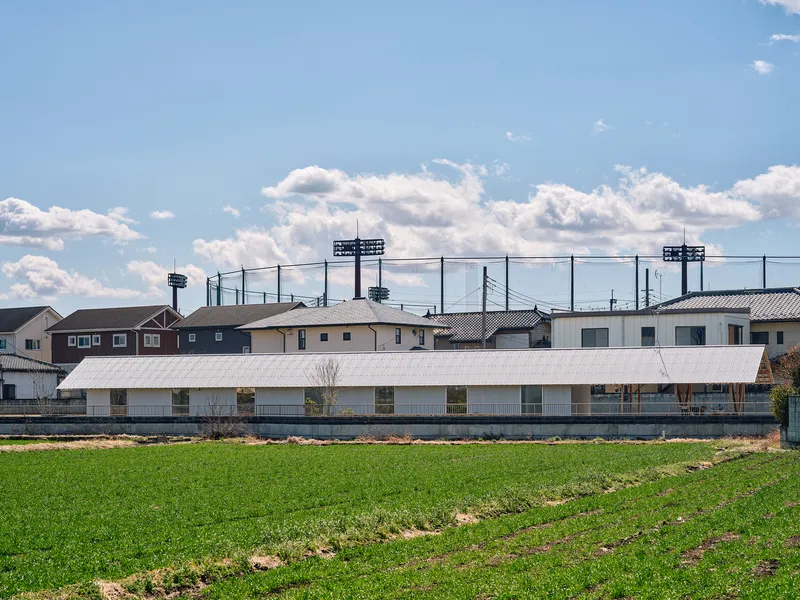
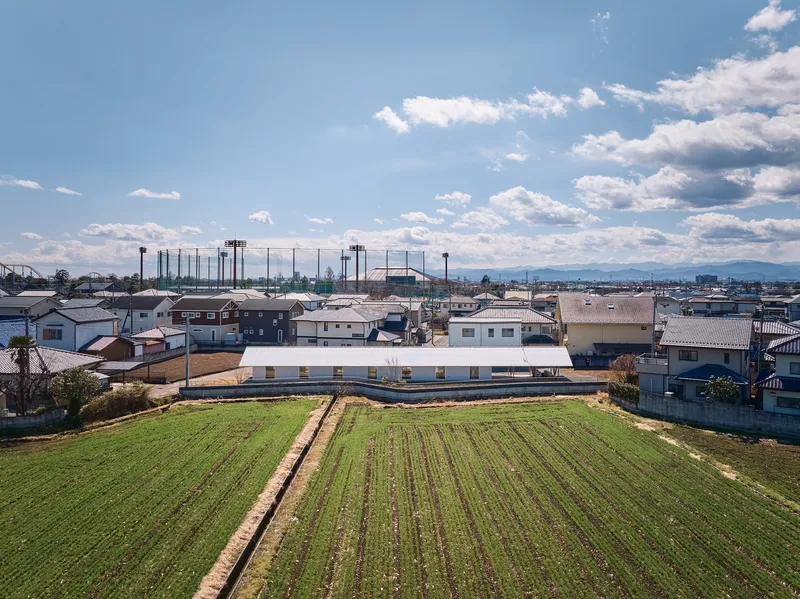
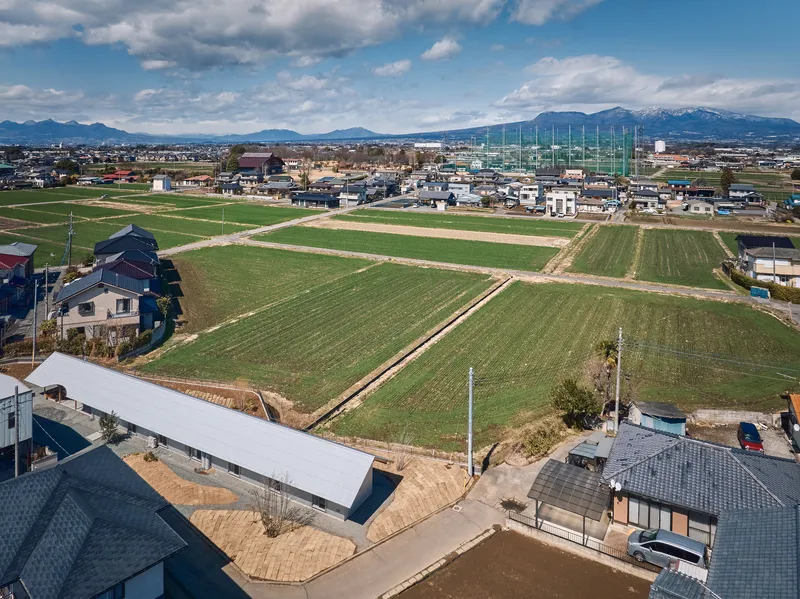
From the air, the strategy is legible immediately. The house is a single elongated bar, its white gabled roof running parallel to the field edge, mediating between the tight residential fabric on one side and the open agricultural grid on the other. The building does not try to dominate or retreat. It sits at a threshold where the suburban and the rural overlap, and its horizontal emphasis acknowledges both scales without deferring to either.
Isesaki's outskirts are characterized by this kind of layering: houses, then paddies, then mountains receding toward the horizon. The architects placed the volume to engage these views sequentially, so that from within the house, the landscape unfolds as a series of framed depths rather than a single panorama. The corrugated galvalume panels catch and diffuse the changing light of the surrounding fields, giving the exterior a chameleon-like quality that shifts through the day.
Corrugated Metal and Timber Eaves
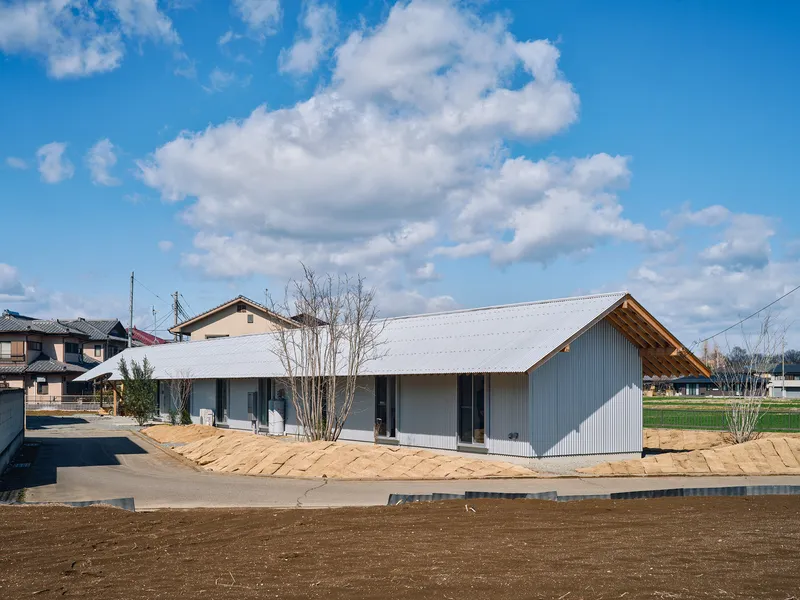
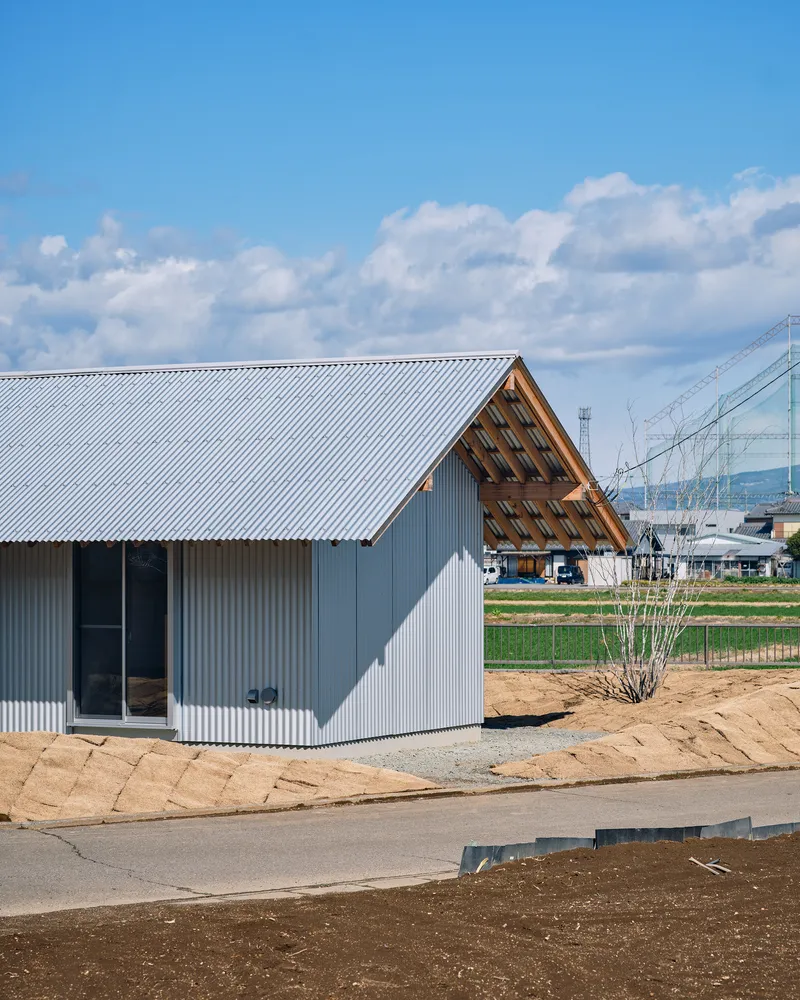
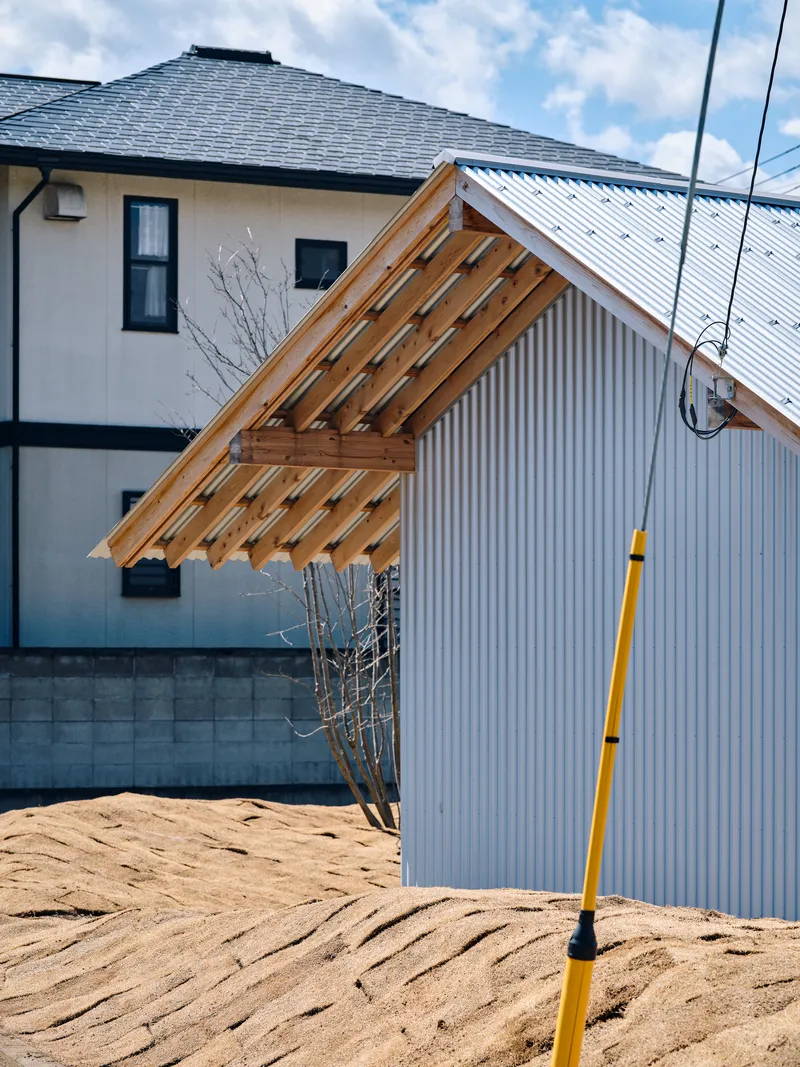
The exterior envelope is deliberately economical. Corrugated galvalume steel panels wrap the walls and roof in a continuous, matte-grey skin that reads as almost agricultural in its plainness. But look closer and the detailing reveals care. Timber slat eaves project from beneath the gabled ends, filtering light and providing shade while softening the transition between metal surface and sky. These eaves are generous, extending well beyond the wall plane to shelter rows of large windows on each side and the gravel pathway that rings the perimeter.
The choice of galvalume over more conventional residential cladding places the house in conversation with the farm buildings and utilitarian structures that dot the Gunma countryside. It is a material that ages honestly, that does not pretend to be something it is not. For a carpenter's house, this directness feels appropriate: the building wears its construction logic on its surface.
The Open Pavilion as Threshold
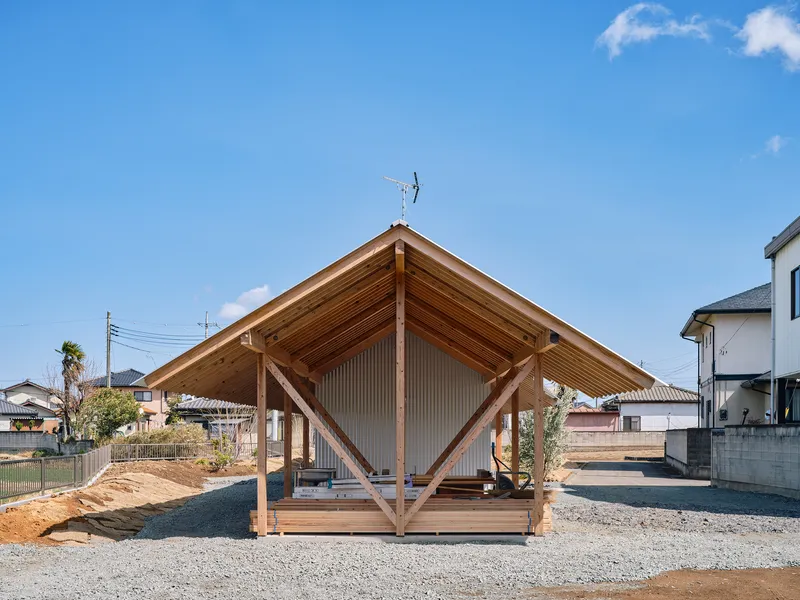
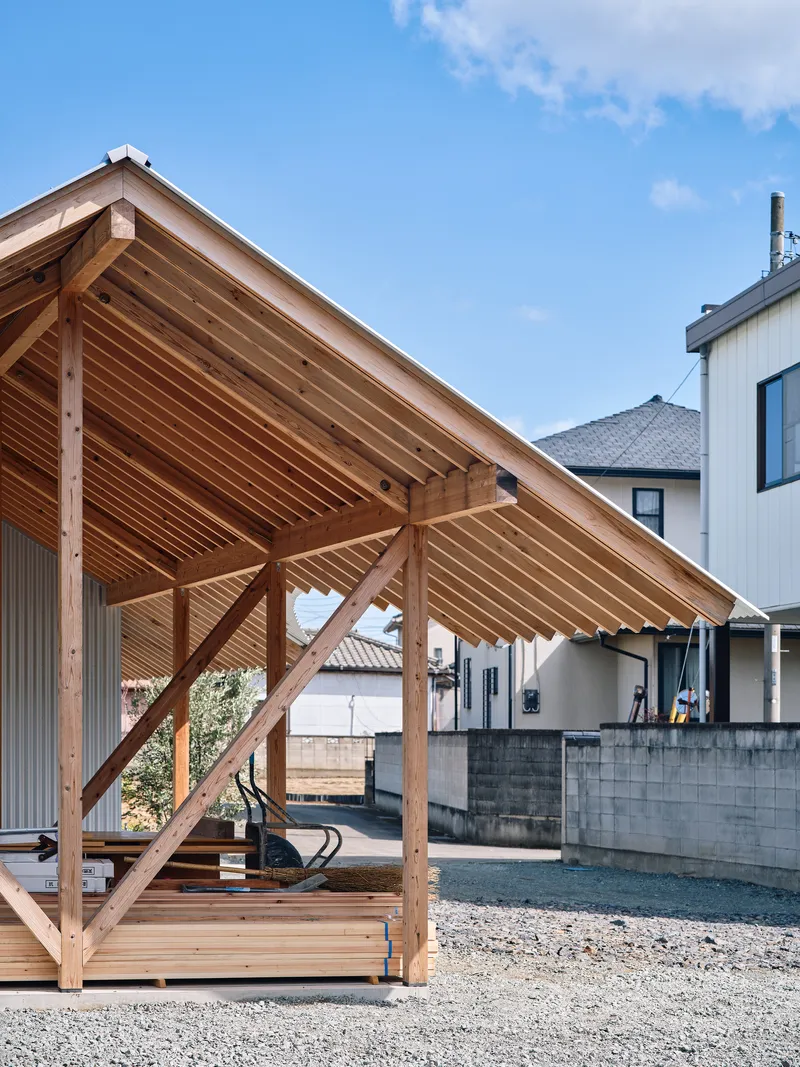
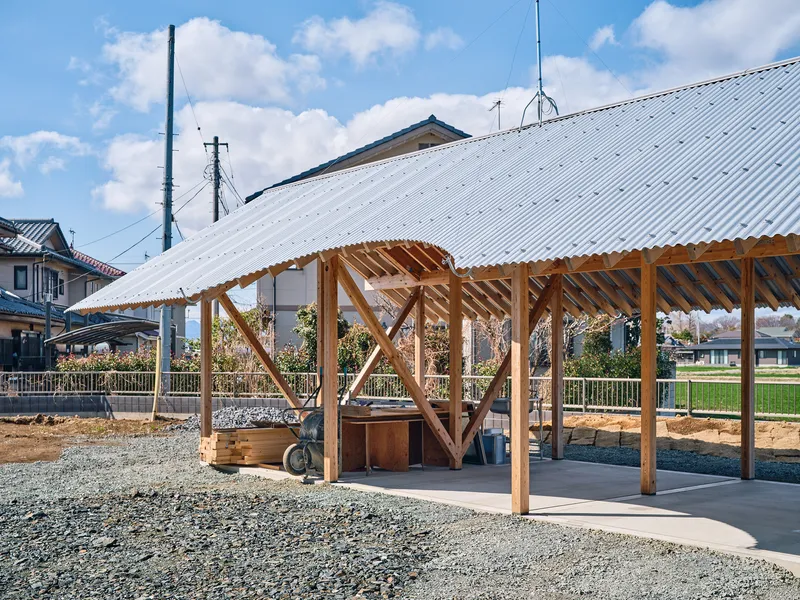
One of the most distinctive moves is the open timber pavilion that occupies one end of the composition. Here, the structure sheds its cladding entirely, revealing the timber frame with its diagonal bracing, exposed rafters, and slatted ceiling. Gravel covers the ground beneath. The space is neither fully interior nor exterior: it is a covered courtyard, a workshop porch, a place where the craft of building remains visible.
The pavilion's diagonal bracing gives it a structural frankness that contrasts with the smooth metal envelope of the enclosed rooms. You can read the forces at work, trace the load paths through the timber members. For a house built by its own client, this legibility is more than aesthetic. It is a kind of autobiography, the carpenter's knowledge of wood construction made spatial.
Rooms Without Hierarchy
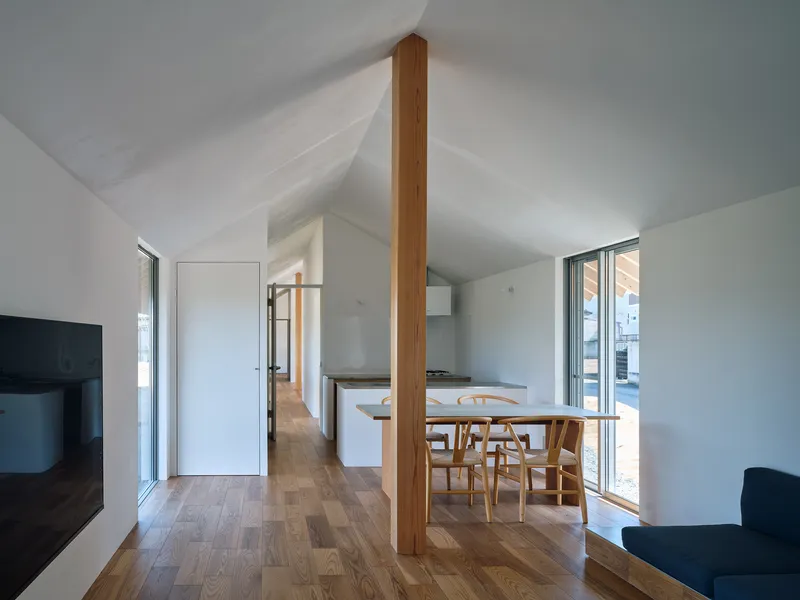
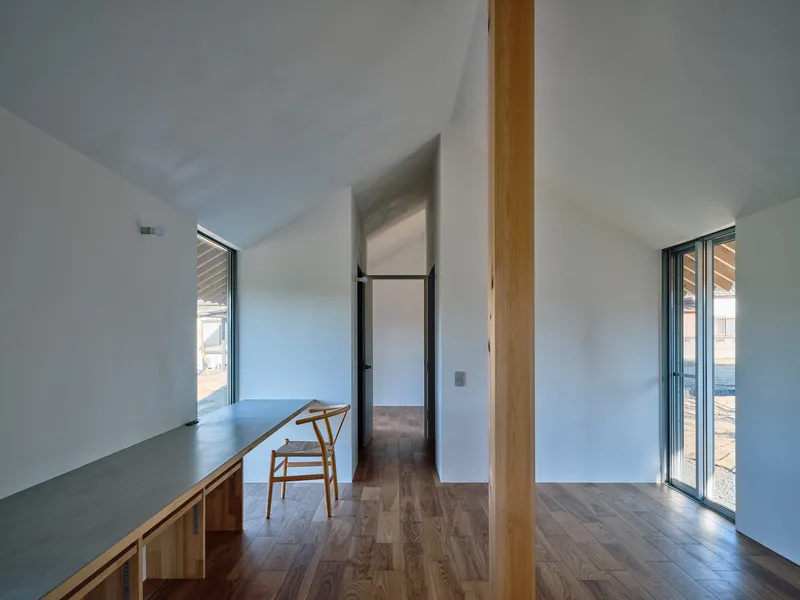
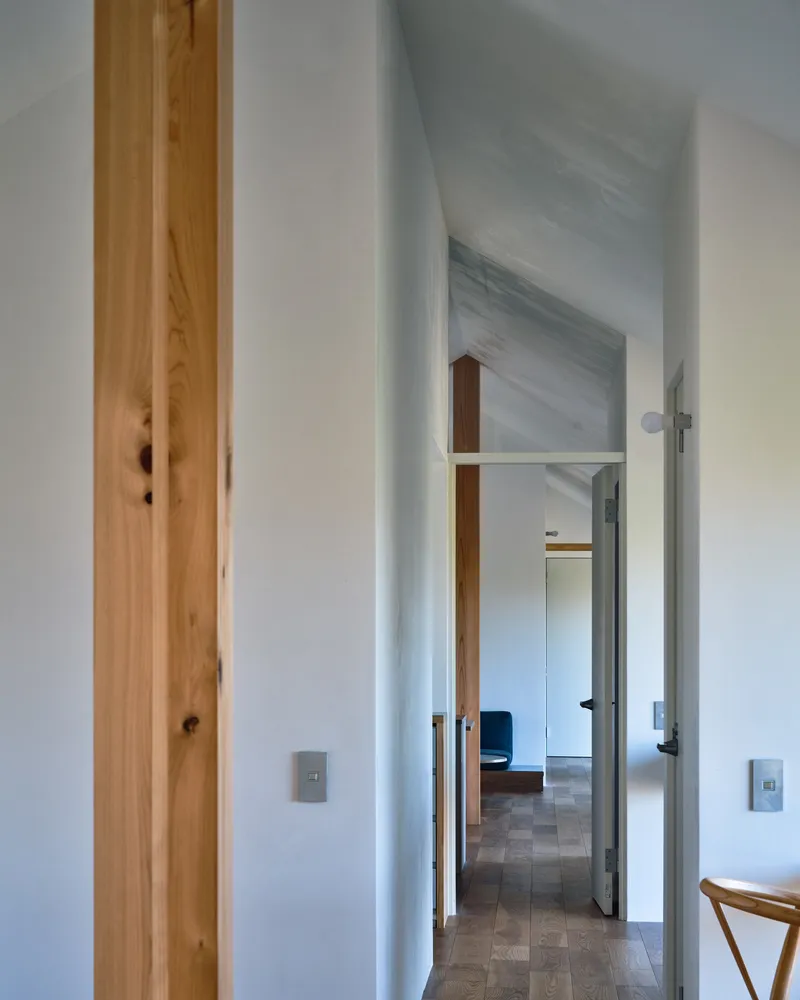
Inside, the plan unfolds as a sequence of rooms that lead into one another along the narrow axis. There are no corridors in the traditional sense. Instead, exposed timber columns mark transitions between spaces, acting as soft boundaries rather than hard walls. The architects describe this as allowing multiple centers of gravity to coexist within the house, and the experience confirms it: the dining area flows into the living room, which flows into the bedroom zone, each space defined by its relationship to the column and the ceiling above rather than by enclosure.
In the center of the plan, a pantry and bathrooms are organized as compact pods on either side of the main axis, creating a narrower, corridor-like threshold that separates the more public living areas from the private bedroom spaces. The compression is deliberate. It makes the rooms on either side feel more expansive by contrast, and it introduces a moment of passage that gives the house a rhythm: open, narrow, open again.
Light, Views, and the Vaulted Ceiling
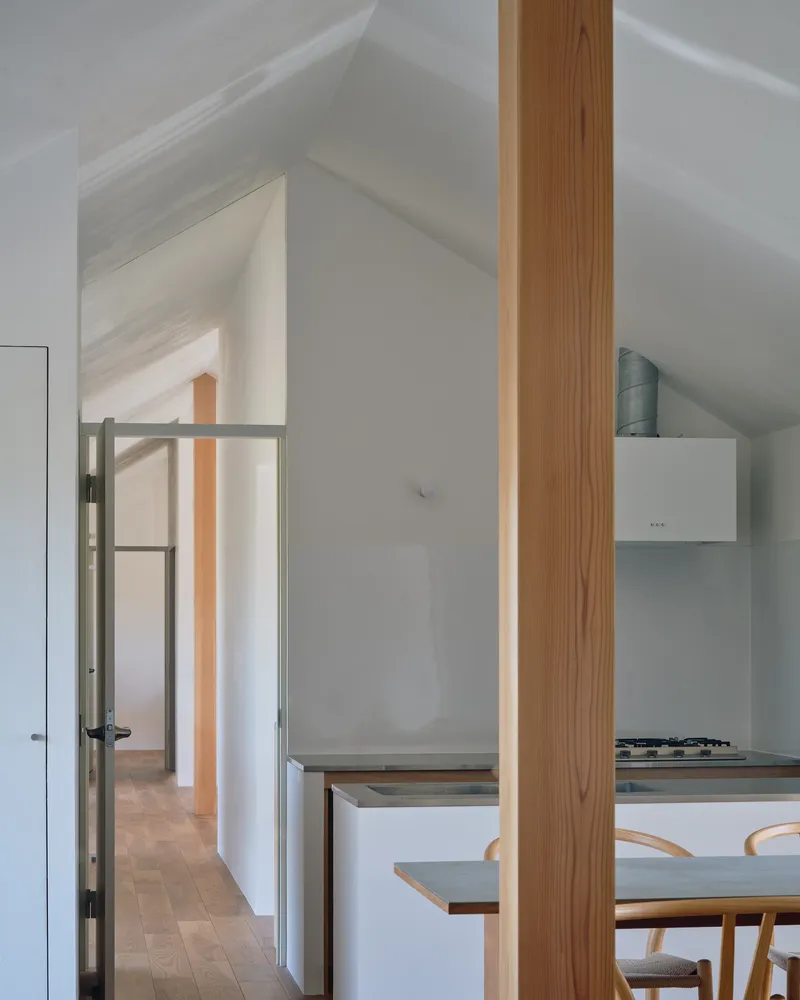
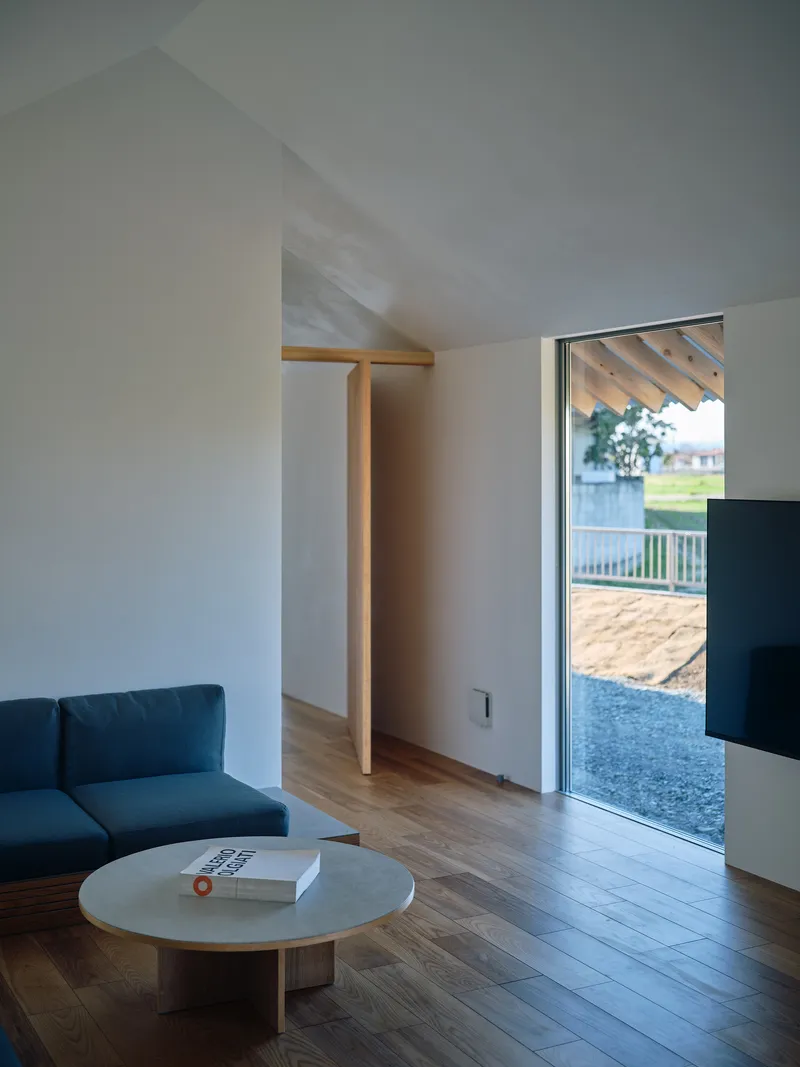
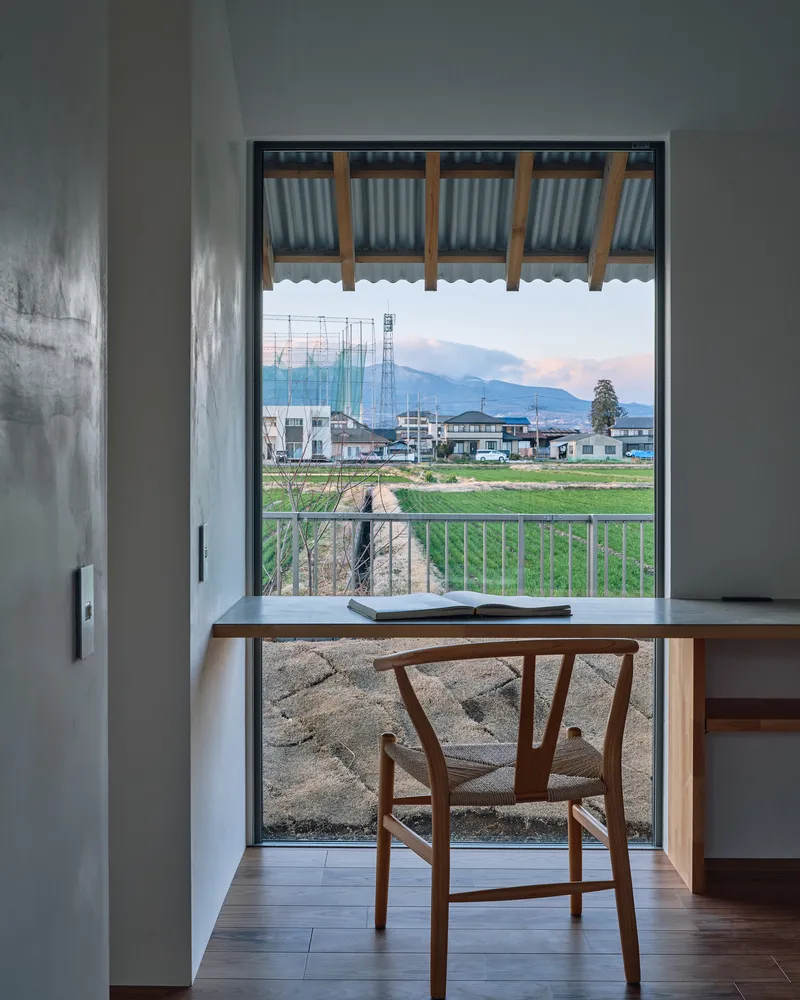
The interior atmosphere owes much to the vaulted white ceiling, which follows the pitch of the roof and amplifies the sense of volume in rooms that are, by floor area, quite modest. Full-height windows line both long sides of the house, pulling in views of fields, neighboring gardens, and distant mountains. The effect is cinematic: each window frames a specific slice of the landscape, and as you move through the sequence of rooms, the views shift and layer.
One image captures this perfectly: a tall, narrow window at dusk, framing rice paddies and the silhouette of mountains beyond. The glass is flush with the wall plane, so the view appears almost painted on. Deep eaves outside shade these openings during the day, preventing glare while maintaining visual connection to the land. It is a passive climate strategy that doubles as a compositional device, keeping the interior cool and calm without sacrificing the panoramic quality that the site makes possible.
Domestic Details and Built-In Furniture
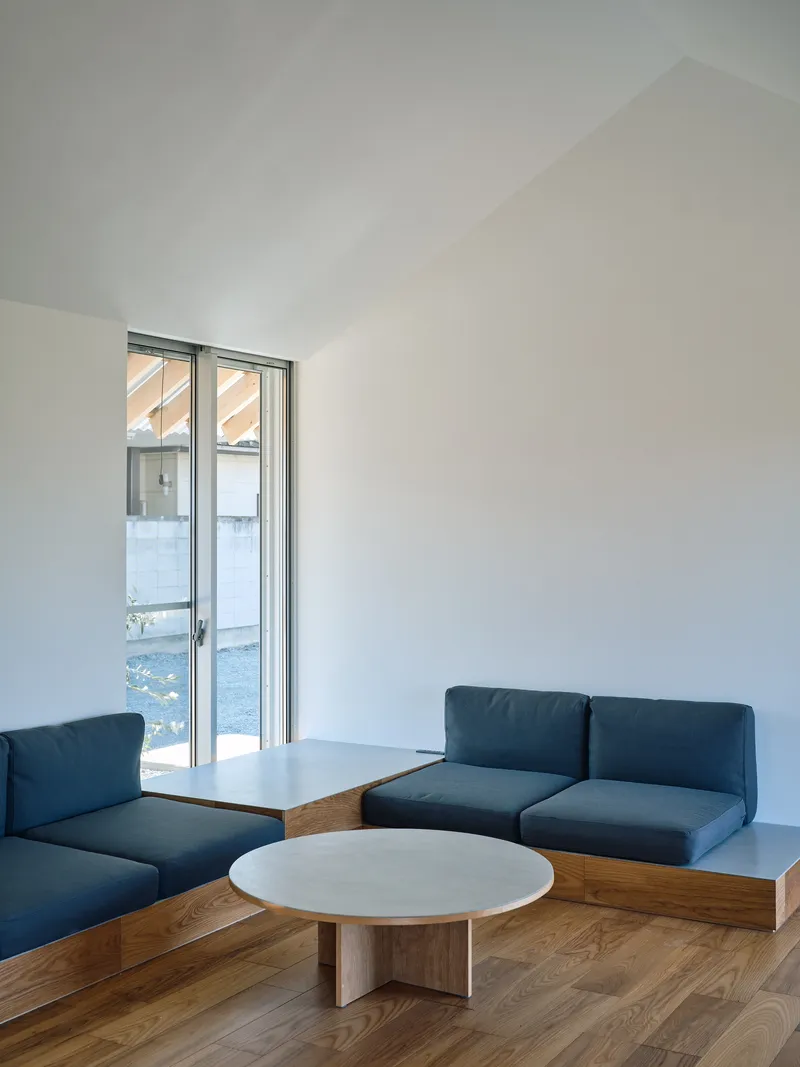
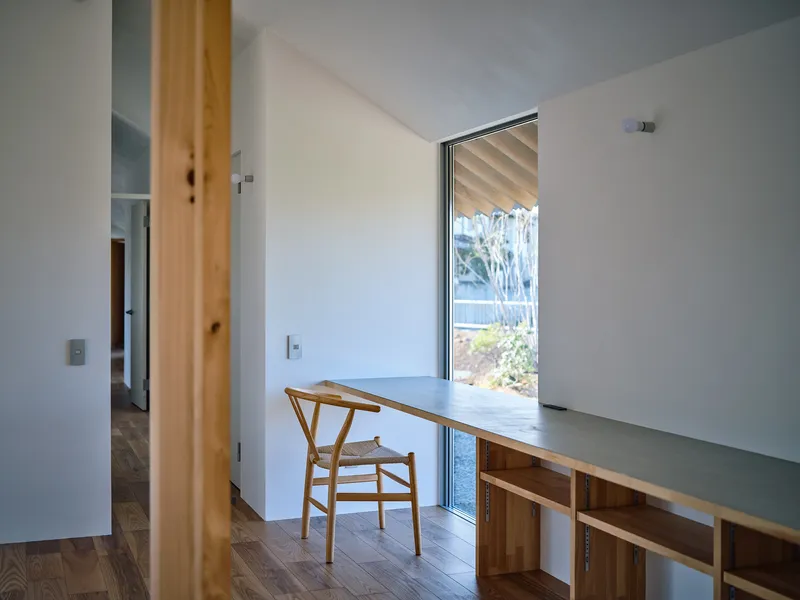
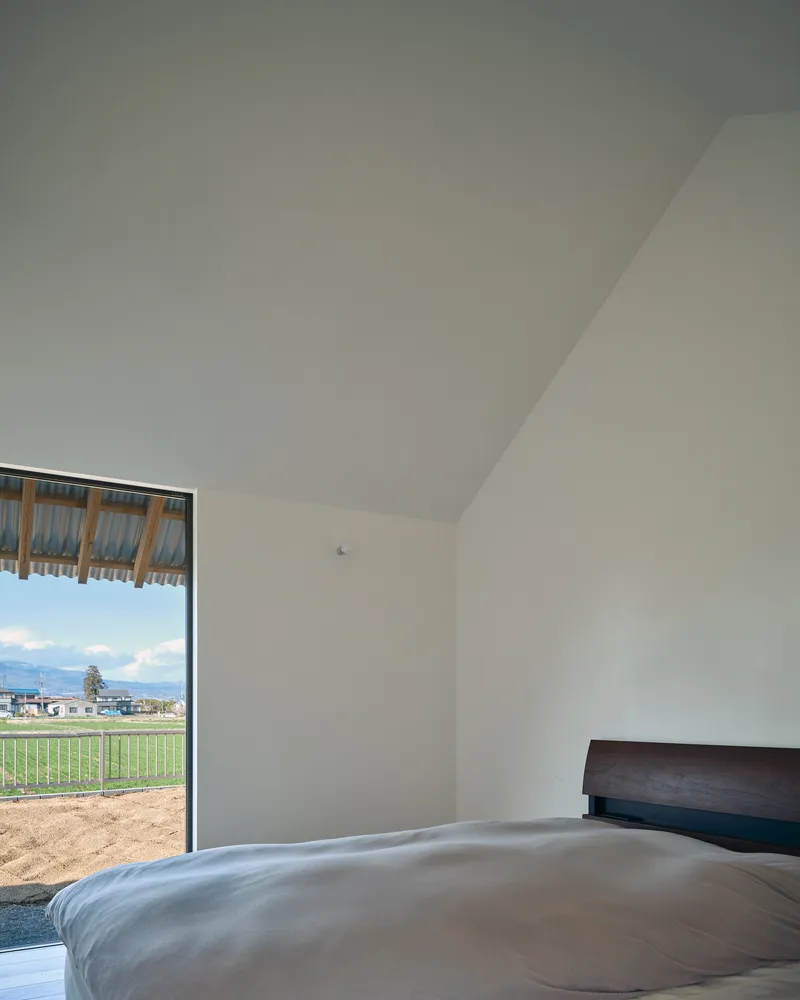
The interiors are spare but not austere. Built-in blue cushioned benches and a low round table create an intimate seating nook that feels almost Japanese in its groundedness. A timber desk with shelving below a tall window becomes a study alcove, the kind of space that invites concentration precisely because it is contained. The bedroom opens through a glazed door directly onto the green fields, collapsing the distance between sleep and landscape.
These are the details that reveal a house designed for living rather than publication. The carpenter-client's hand is visible in the precision of the timber joinery, the alignment of shelves with window mullions, the way a mirror frame in the hallway echoes the slope of the ceiling above it. The house is modest in materials but rich in these small calibrations.
Dusk and the Field
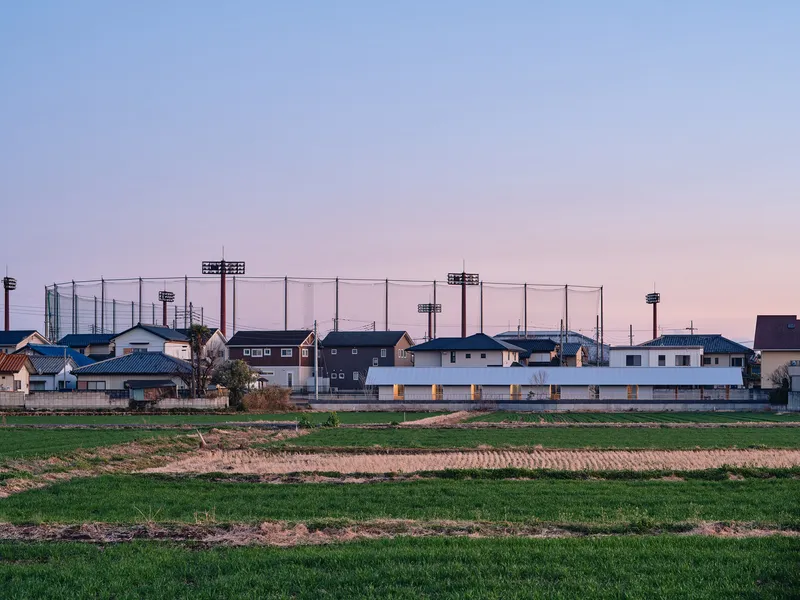
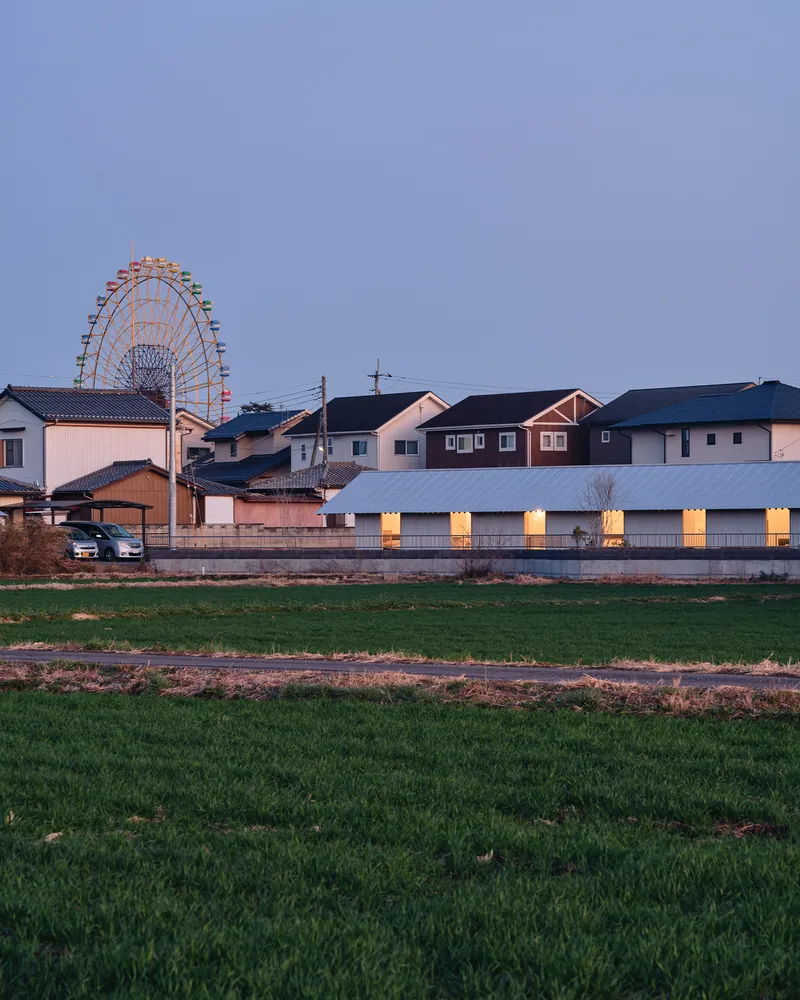
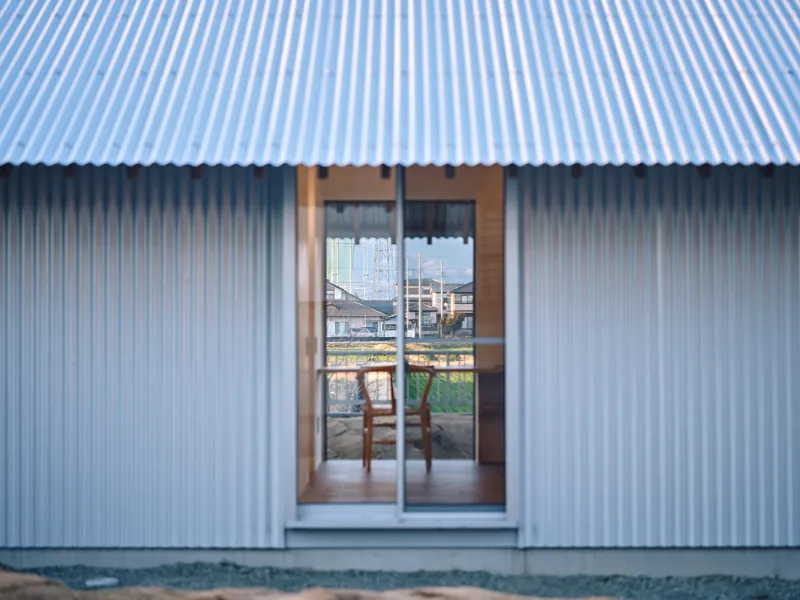
At twilight, the house reveals a second identity. Its evenly spaced openings glow against the darkening field, transforming the long volume into a lantern. From a distance, the building reads as a single luminous bar floating above the crops, its corrugated skin dissolving into silhouette. In one striking photograph, a ferris wheel rises behind the house on the far horizon, placing the domestic scale of the building in surreal juxtaposition with the commercial leisure zone beyond.
These dusk images are the most revealing. They show the house not as an object but as a presence in the landscape, one that participates in the rhythms of the field and the sky rather than asserting itself against them. The galvalume cladding, which reads as grey or silver during the day, turns almost invisible at night, leaving only the warm rectangles of light to mark where the house stands.
Plans and Drawings
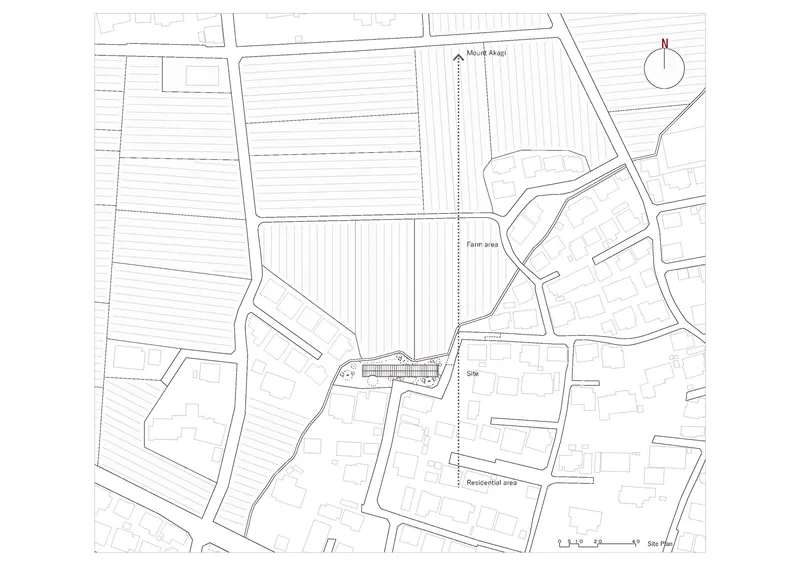
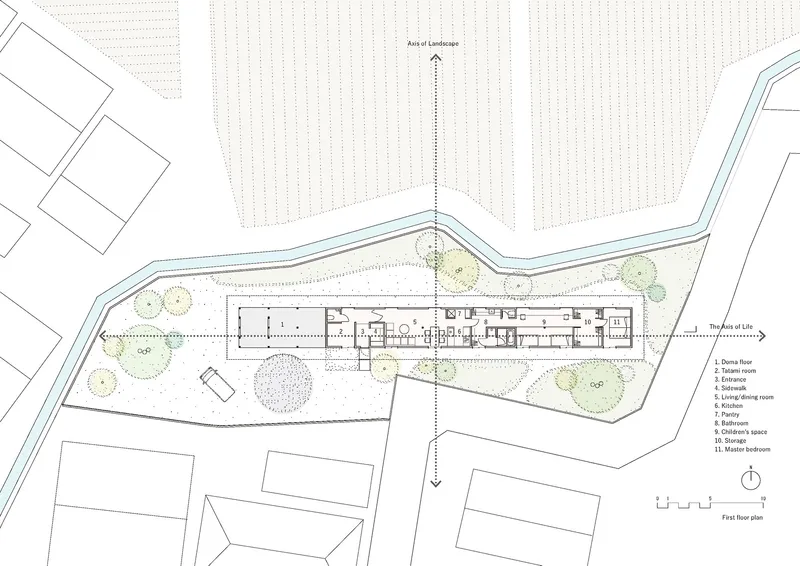
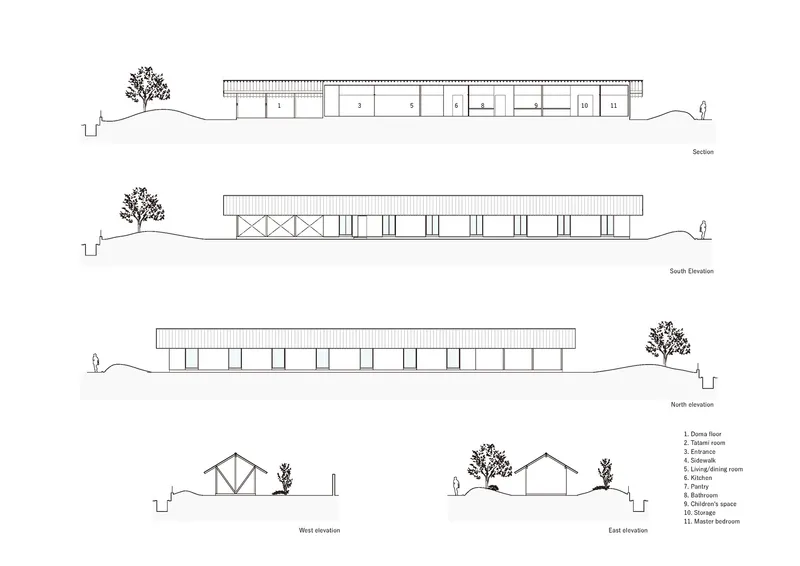
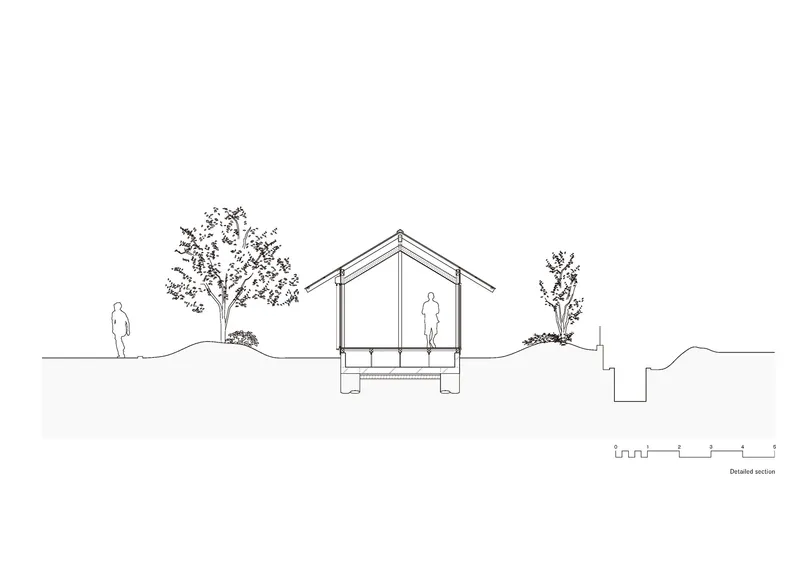
The site plan confirms what the aerial photographs suggest: the house occupies a narrow band between the residential grid and the open field, its elongated footprint running east-west to maximize exposure to the agricultural landscape on both sides. The floor plan reveals the linear sequence of rooms and the central pod of service spaces that pinches the plan at its midpoint. Sections show the gentle pitch of the roof, the concrete plinth on which the timber structure sits, and the generous depth of the eaves. Together, these drawings make clear that the simplicity of the house is a product of discipline, not default.
Why This Project Matters
An Unfinished House is a quiet rebuke to the idea that architecture requires exceptional sites to produce exceptional results. The parcel is a leftover, a gap in the suburban grid that the market forgot. Kraft Architects and their carpenter-client treated this limitation as an invitation, producing a house that draws its character from the specific conditions of its location: the layered landscape, the overlapping scales, the agricultural light. The collaboration between architect and builder is not incidental here. It is the engine of the project, ensuring that every timber joint and every window alignment carries the intelligence of both design and craft.
The project also offers a useful corrective to the tendency in residential architecture to seek closure, to deliver a finished product. By naming the house "unfinished," the architects signal that the building is a framework for inhabitation rather than a sealed container. The exposed columns, the open pavilion, the rooms that flow without doors: all of these moves resist the impulse to over-determine how the house is used. In a discipline that often confuses control with quality, this willingness to leave space for life is both generous and rare.
An Unfinished House by Kraft Architects (Atsushi Nakamura, Hirari Sato). Isesaki, Gunma Prefecture, Japan. 151 m². Completed 2025. Photography by Takuya Seki.
About the Studio
Share Your Own Work on uni.xyz
If projects like this are the kind of work you want to make, uni.xyz is a place to publish your own, find collaborators, and enter design competitions.


Popular Articles
Popular articles from the community

Extended Shell: Retrofitting Kolkata's Balconies as Living Urban Thresholds
A modular retrofit system recovers the social and environmental intelligence of Kolkata's historic verandas for contemporary Park Street residents.

Opera by the Sea Estonia: Three Shells Dissolving Architecture into Tallinn's Coastline
A winning opera house proposal replaces monumental form with interconnected shells that blur the boundary between building, park and Baltic Sea.

Singing Woman: Contemporary Architecture Inspired by Estonia’s Voice and the Sea
Singing Woman turns Estonia’s song culture into flowing opera house architecture, blending public life, landscape, sea, and national memory.

Cloaked Colonization: A Mobile Underwater Habitat That Moves Like a Fish
Micah Abaya's shortlisted EHC Pacific entry reimagines ocean settlement as a dispersed network of self-sustaining architectural organisms.

Similar Reads
You might also enjoy these articles

Bao Huynh Watercolor Atelier: A Serene Art Retreat in Hội An
Bao Huynh Watercolor Atelier in Hội An blends multifunctional art spaces, sustainable design, local materials, and family-friendly living in a serene environment.

Atelier Macri Concept Store Interior Design by CASE-REAL
Atelier Macri store features a "ko" counter, walnut wood details, cork displays, blending retail, gallery, and seamless customer experiences.

Manuel Vargas Izquierdo Stadium and High-Performance Sports Center: Architectural Excellence in Jalpa de Méndez
The Manuel Vargas Izquierdo Stadium blends sustainable design, inclusive sports facilities, and cultural-inspired architecture, revitalizing Jalpa de Méndez’s public spaces.

KAKR Buluh Awar Hall: Revitalizing Community and Ecology Through Bamboo Architecture
Community built bamboo hall revitalizes Buluh Awar village, empowering youth, restoring ecology, celebrating vernacular craftsmanship through sustainable architecture and culture.


Comments (0)
Please login or sign up to add comments
No comments yet. Be the first to comment!