

Kraft Architects Converts a Former Mining Town Building into a Split-Level Office in Rural Japan
In Hida City's depopulating Kamioka district, a corrugated metal renovation fuses timber craft with industrial frankness for a forestry company.


Kamioka is a town that knows something about extraction. Once home to one of the largest mines in eastern Japan, the district in Hida City, Gifu Prefecture, has spent decades watching its population thin and its economy contract. Against that backdrop, Kraft Architects, led by Atsushi Nakamura and Hirari Sato, completed a 111 square meter office renovation in 2025 for a company whose daily work involves maintaining the forests and infrastructure the region still depends on: hazardous tree removal, specialized logging, snow clearing, civil engineering. The project is modest in size but precise in its ambitions, converting an existing structure into a workspace that borrows its material language from both the surrounding mountain landscape and the industrial legacy of the town.
What makes the Kamioka Office compelling is how clearly it resolves a tension that most small renovations dodge entirely. The building has to function as a professional workplace while acknowledging that it sits in a rural village where corrugated metal sheds and timber-framed houses set the visual terms. Kraft Architects answered with a split-level section that buries the utilitarian office below grade in board-formed concrete and lifts the communal spaces into a pitched timber frame above. The result reads as both a house and a workshop, never committing fully to either, and that ambiguity is the project's strength.
A Quiet Presence on a Mountain Street
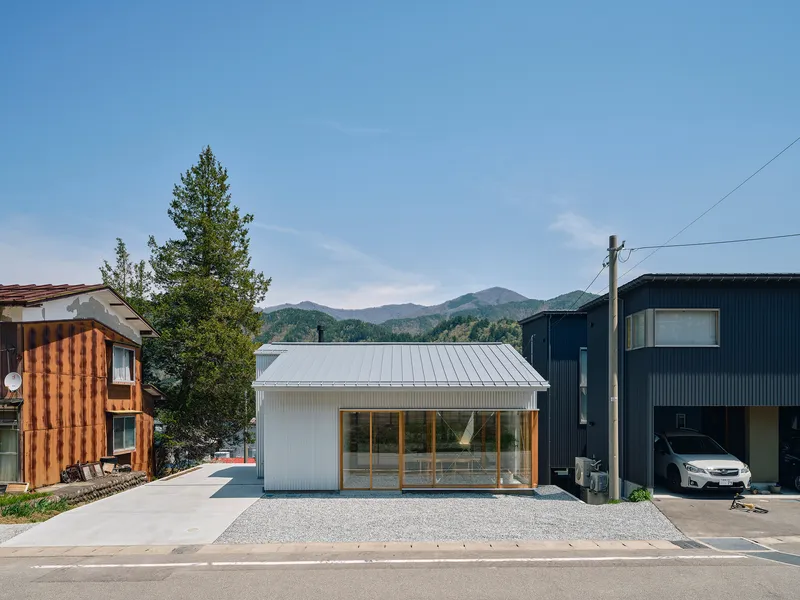


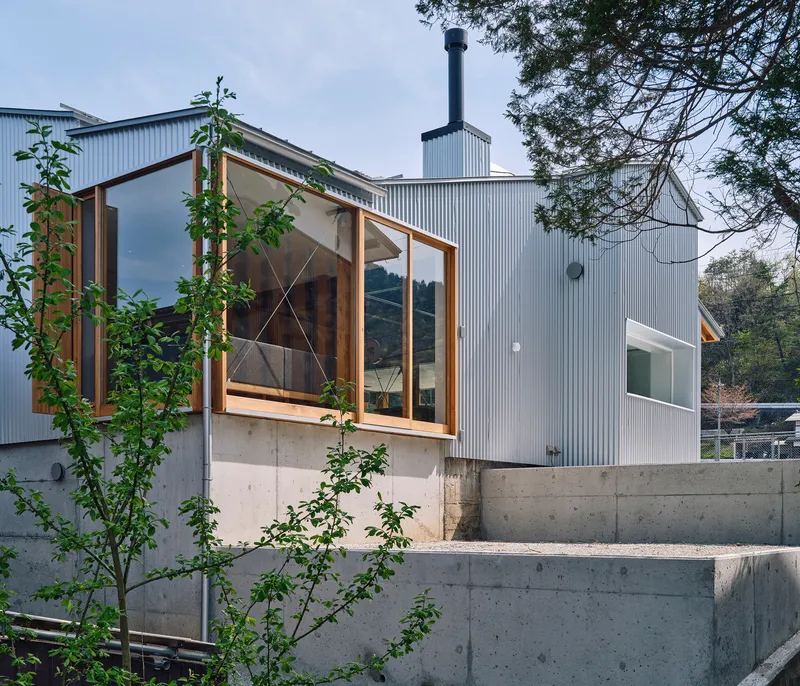
From the street, the building registers as a low-slung volume clad in corrugated white metal, barely taller than its neighbors and deferential to the mountain slopes behind it. There is nothing aggressive about the profile. The gabled roof follows the pitch common to the area's vernacular, and punched openings are kept small enough to maintain the barn-like solidity of the facade. Young trees planted along the concrete base soften the hard edge without concealing it.
The restraint is deliberate. In a village experiencing depopulation, a conspicuous building would be a kind of arrogance. Instead, the corrugated cladding ties the office to the utilitarian structures that already populate the streetscape. Only the timber-framed glazing at certain corners hints that something more considered is happening inside.
The Section Does the Heavy Lifting
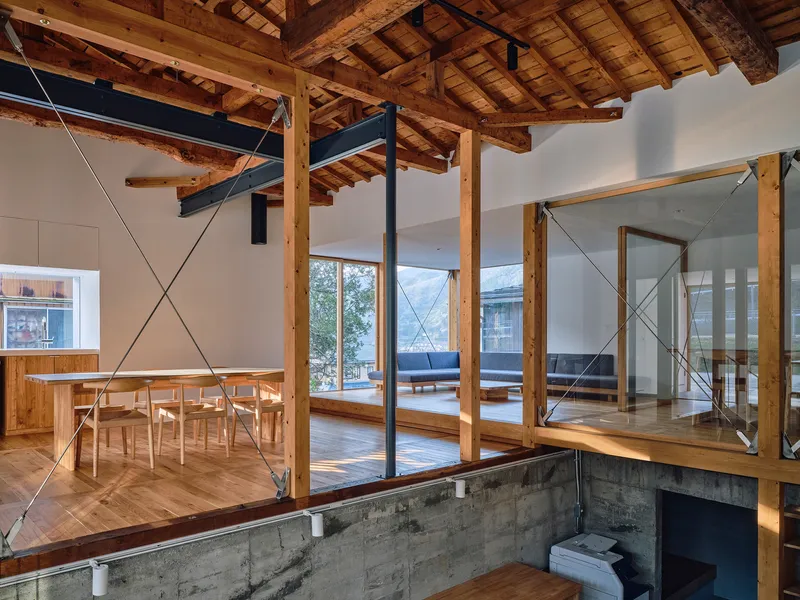

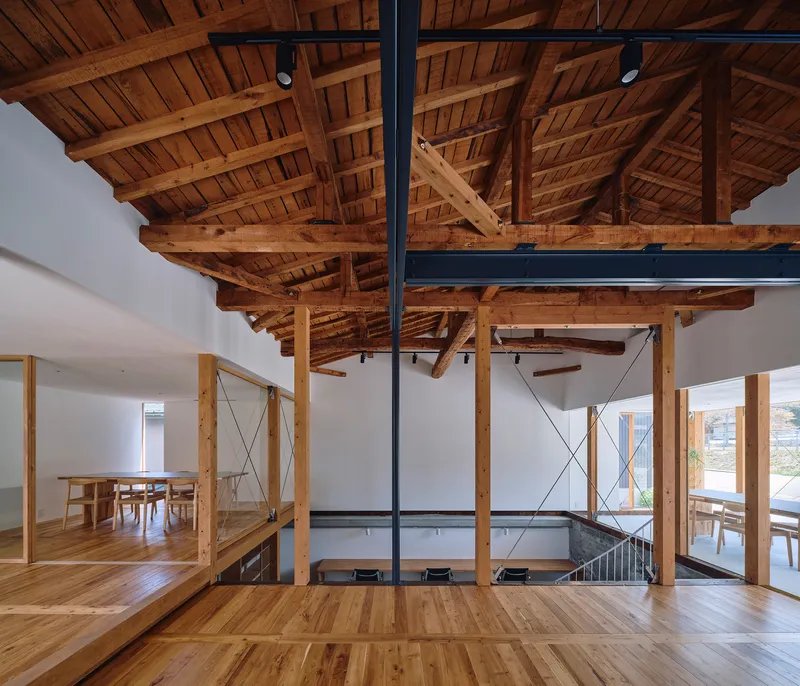
The key move here is sectional. The office and storage areas occupy a partially sunken basement level, wrapped in poured concrete walls that give those rooms a cave-like gravity. Above, a dining and lounge area sits at the upper level beneath a pitched timber ceiling, open to the roof structure. A triangular void, visible in the plan drawings, connects the two levels and lets light drop through the building.
The steel plate staircase that bridges the two zones is honest about its construction: folded metal treads, exposed welds, a handrail that doubles as a guardrail at the upper level. It rises from the concrete half-wall into a forest of timber columns and rafters. The transition from dense, grounded workspace to airy communal room happens within a few steps, and the material shift from concrete to timber makes it legible without signage or graphic wayfinding.
Timber Frame and Steel Tension


The exposed structural system at the upper level is the project's most characterful element. Timber posts and beams form the primary frame, with steel reinforcement plates bolted at the connections and diagonal cable tension rods bracing the assembly against lateral loads. It is a hybrid system that refuses to pretend the timber alone is doing all the work, and the honesty suits a building made for people who fell trees and clear snow for a living.
The cables, stretched taut across the glazed stairwell opening and along the upper walls, give the interior a slight industrial sharpness. They catch light. They vibrate faintly if you touch them. Against the warm grain of the ceiling planking and the roughness of the board-formed concrete below, the cables read as tendons holding the whole assembly in tension. It is a structural strategy that doubles as an interior atmosphere.
Communal Spaces Under the Roof
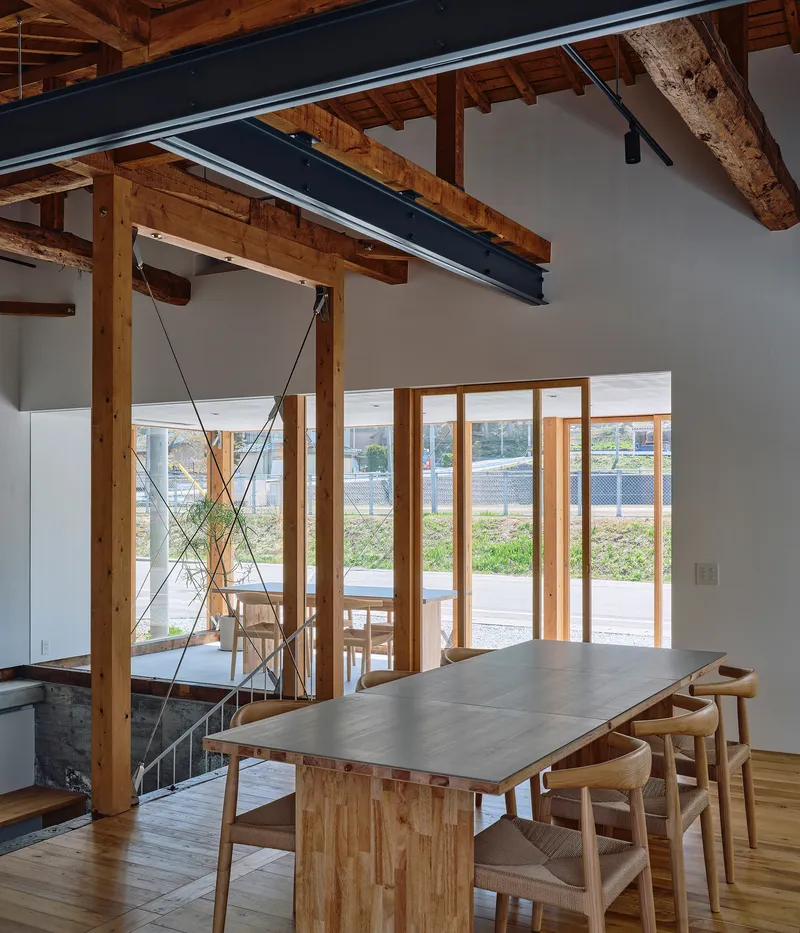


The dining area occupies the heart of the upper level, positioned beneath the peak of the pitched ceiling where headroom is greatest. A long table sits between timber posts, with a steel beam running overhead and cable bracing visible at the periphery. The room functions as both a break space and a meeting room, and the informality of the arrangement, chairs pulled up to a shared table rather than cubicles, reflects the nature of the client's work: crews that start and end each day together.
Narrow door openings frame views inward, channeling sunlight across timber floors toward the table. The effect is domestic in the best sense. You can imagine muddy boots parked at the entry and hot tea on the table in January, when Hida's snowfall buries everything up to the windowsills.
Concrete Below, Mountain Views Above
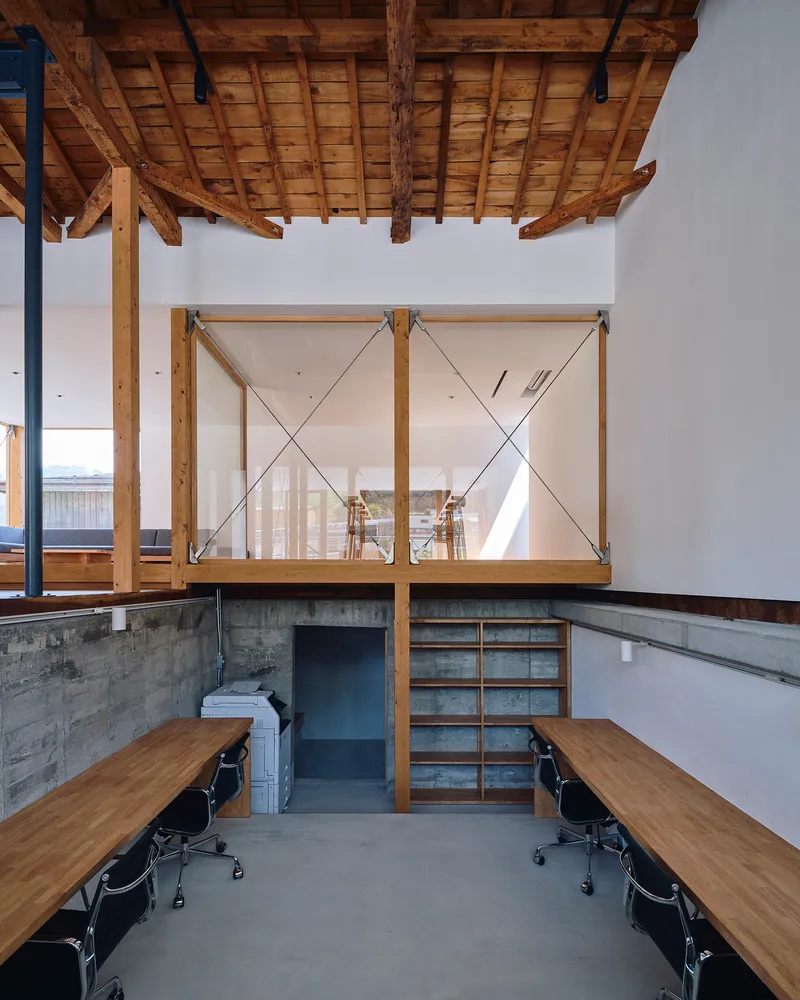


The lower-level workspace is intentionally muted. Board-formed concrete walls retain the grain of their formwork, and polished concrete floors keep the palette monochromatic. Timber frame partitions allow light from the upper level to filter down, preventing the basement from feeling sealed off. The austerity is functional: this is where the administrative work happens, and the lack of ornament keeps distractions to a minimum.
By contrast, the upper level rewards you with views. Corner glazing at the timber-framed walls opens toward distant mountain ridges, pulling the landscape into the room without competing with the structural expression. The framing of these views is careful: cable bracing and timber columns subdivide the glass into smaller panes that keep the scale intimate rather than panoramic.
Dusk and the Lantern Effect
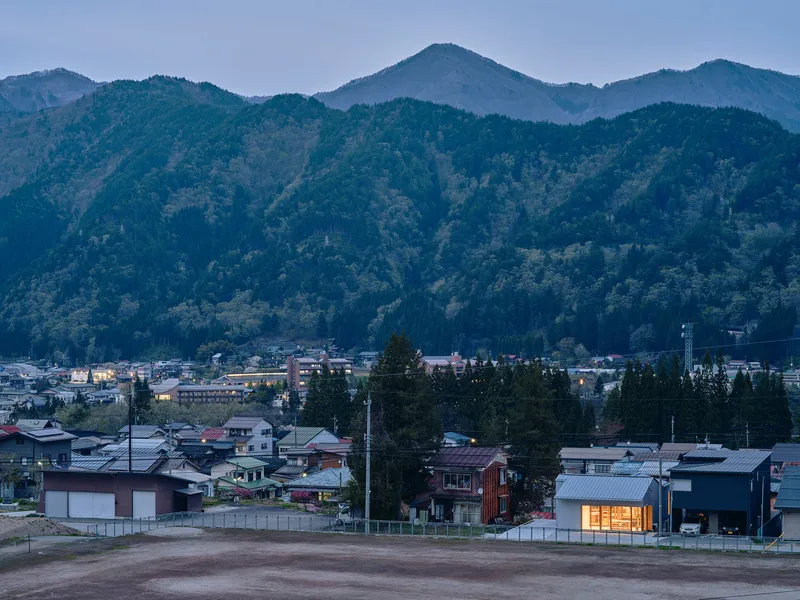

At twilight, the building reverses its daytime reticence. Full-height glazing at the dining area transforms the corrugated metal shell into a lantern, projecting warm light across the village street. The timber slatted facade and the table visible through the glass give the scene a quality somewhere between a farmhouse kitchen and a workshop after hours. For a town losing residents, this kind of visible human activity is itself a form of civic contribution.
The dusk photographs are, frankly, the most persuasive images in the set. They reveal what the daytime shots only suggest: that the building is designed not just to shelter work but to announce that work is still happening here, in a place where the easy assumption would be that nothing is.
Plans and Drawings
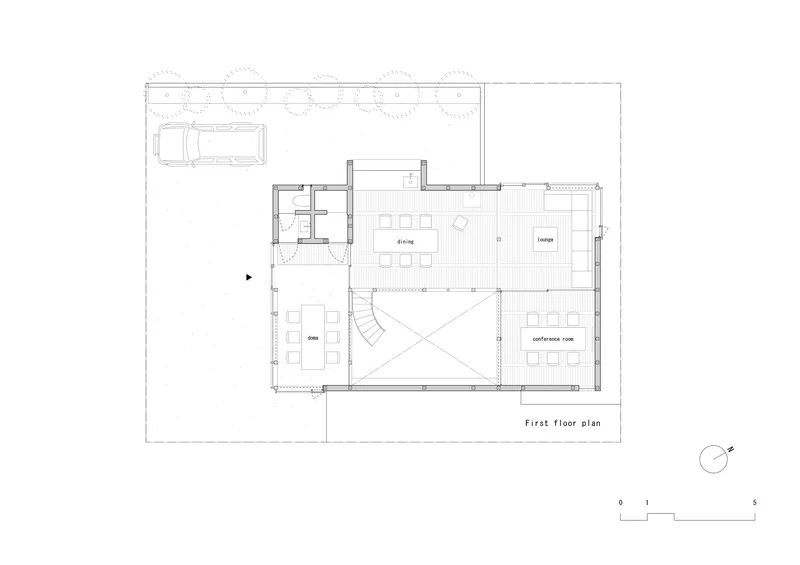
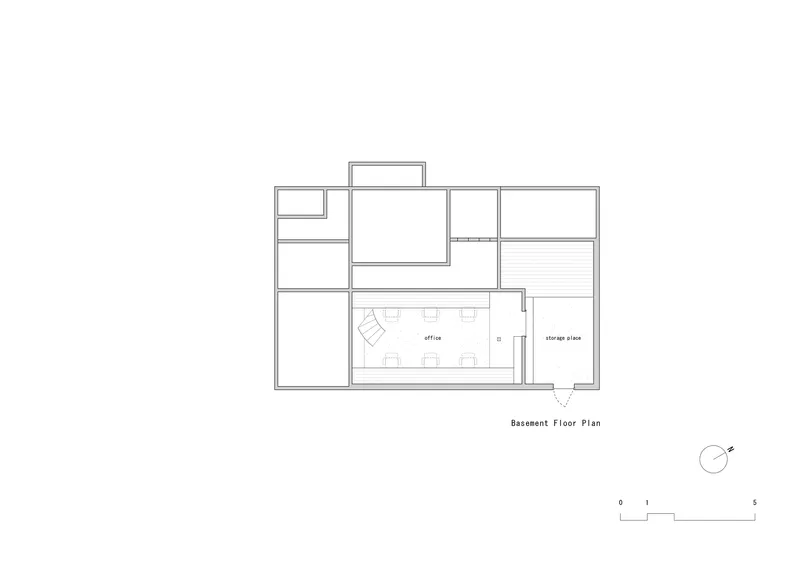
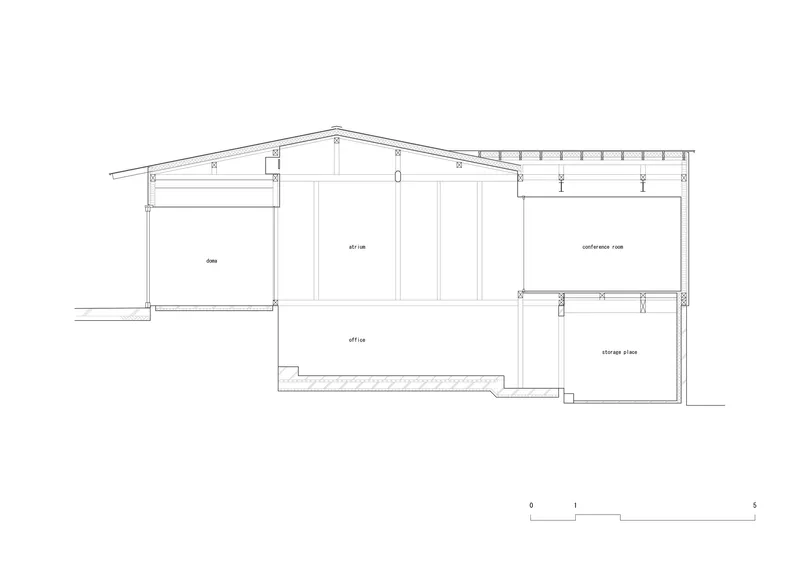
The first floor plan confirms what the photographs imply: a dining area and lounge organized around a central triangular void that serves as the sectional connector between levels, with a carport extending to the left. The basement plan shows the office and storage spaces fitted into the partially sunken footprint with subtle level changes accommodating the slope. The section drawing is the most revealing of the three, making visible the pitched roof structure floating over the atrium and the compressed office level below. The proportional relationship between the two is tighter than you might expect from the interior photographs, which suggests the architects have been skillful at making a compact building feel spatially generous.
Why This Project Matters
The Kamioka Office is not a landmark, and it would be wrong to frame it as one. Its value lies in its ordinariness: the willingness to work within the material language and spatial scale of a shrinking mountain town rather than importing gestures from somewhere else. Kraft Architects understood that the most respectful thing they could do for Kamioka was to build something that looked like it belonged there while quietly performing at a higher level of craft than anything around it. The hybrid timber and steel structure, the sectional play between concrete basement and timber-framed upper level, the considered framing of mountain views: none of these moves announce themselves from the street.
For architecture practices working in depopulating rural areas, the lesson is straightforward. You do not need to build spectacles to justify intervention. A 111 square meter office that keeps a forestry crew warm, organized, and connected to their landscape is architecture doing exactly what it should be doing. We need more projects willing to accept that modest brief and execute it with this level of attention.
Kamioka Office by Kraft Architects (Atsushi Nakamura, Hirari Sato), Hida, Japan. 111 m², completed 2025. Photography by Takuya Seki.
About the Studio
Share Your Own Work on uni.xyz
If projects like this are the kind of work you want to make, uni.xyz is a place to publish your own, find collaborators, and enter design competitions.


Popular Articles
Popular articles from the community


Cloaked Colonization: A Mobile Underwater Habitat That Moves Like a Fish
Micah Abaya's shortlisted EHC Pacific entry reimagines ocean settlement as a dispersed network of self-sustaining architectural organisms.

Manzana Morphosis: Stretching Barcelona's Grid into a Living Landscape for 2050
A radical reworking of the Eixample manzana turns density into a tool for generous public space, vertical ecology, and environmental performance.
Faces of the Soviet Avant-Garde: Turning Moscow's Street Names into an Open-Air Museum
A network of sculptural installations across a Moscow residential district transforms forgotten architect names into spatial encounters with cultural memor
Temporary Home for Dogs: A Reversed Zoo Rethinks Animal Shelter Architecture
In Bucharest, a sinuous corridor and freed landscape flip the logic of containment, designing a shelter that works to make itself unnecessary.

Similar Reads
You might also enjoy these articles

Bao Huynh Watercolor Atelier: A Serene Art Retreat in Hội An
Bao Huynh Watercolor Atelier in Hội An blends multifunctional art spaces, sustainable design, local materials, and family-friendly living in a serene environment.

Atelier Macri Concept Store Interior Design by CASE-REAL
Atelier Macri store features a "ko" counter, walnut wood details, cork displays, blending retail, gallery, and seamless customer experiences.

Manuel Vargas Izquierdo Stadium and High-Performance Sports Center: Architectural Excellence in Jalpa de Méndez
The Manuel Vargas Izquierdo Stadium blends sustainable design, inclusive sports facilities, and cultural-inspired architecture, revitalizing Jalpa de Méndez’s public spaces.

KAKR Buluh Awar Hall: Revitalizing Community and Ecology Through Bamboo Architecture
Community built bamboo hall revitalizes Buluh Awar village, empowering youth, restoring ecology, celebrating vernacular craftsmanship through sustainable architecture and culture.

Comments (0)
Please login or sign up to add comments
No comments yet. Be the first to comment!