
KRFT Architecture Builds a Timber Village for Children on a Dutch Canal in Hoorn
De Zevensprong clusters three timber-clad volumes around courtyards to house a 7,000 square meter child and expertise center in Hoorn, the Netherlands.


Schools for young children tend to fall into two camps: oversized institutions dressed up with primary colors, or saccharine cottages that patronize their users. De Zevensprong, a new integrated child and expertise center in Hoorn designed by KRFT Architecture, sidesteps both traps. The 6,980 square meter complex breaks its program into three distinct timber-clad volumes linked by a white central block, reading less like a single building and more like a small neighborhood assembled along the canal.
What makes De Zevensprong genuinely compelling is how its architecture negotiates scale. A building this large could easily overwhelm the residential fabric of Hoorn, a compact Dutch town whose waterways and low rooflines set a clear grain. By splitting the mass into recognizable pieces and wrapping them in vertical timber boards, KRFT gives the complex an almost domestic rhythm. Irregular window placements animate the facades without resorting to gimmick, and the courtyards between volumes create sheltered outdoor rooms where play and learning spill out of classrooms.
Three Volumes, One Village
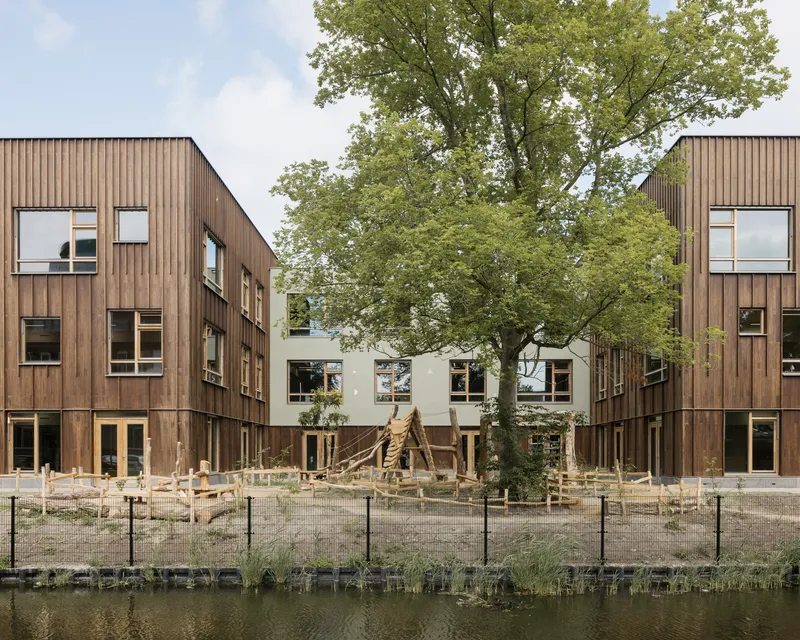
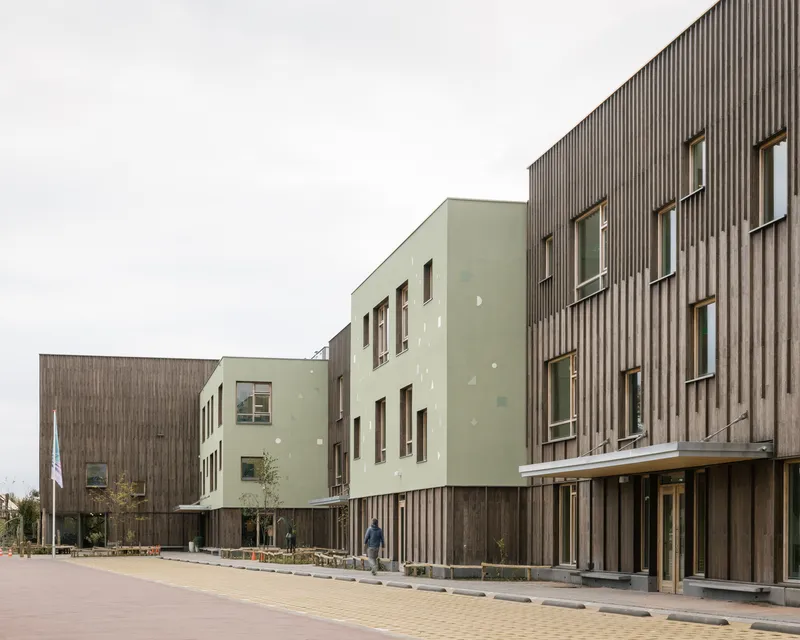
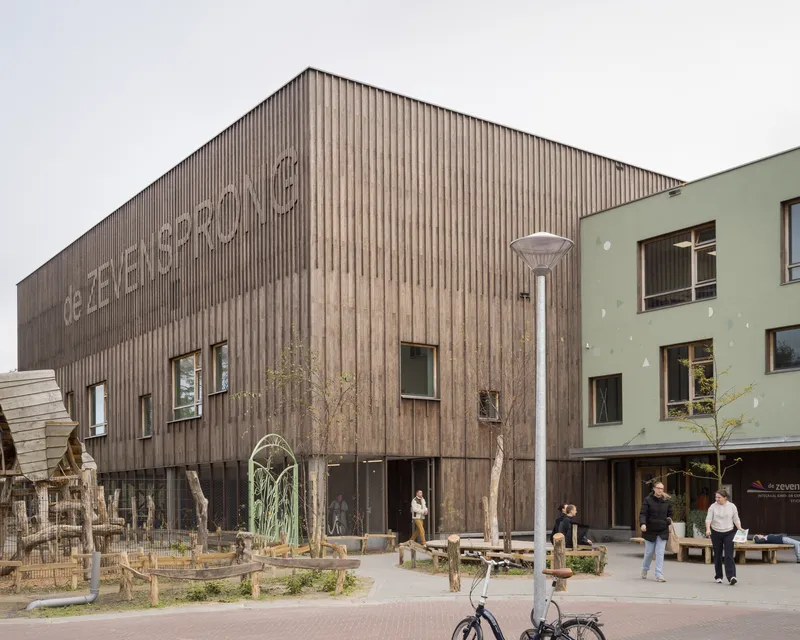
The composition is legible from every angle: pale green rendered surfaces mark the connecting tissue while warm timber cladding distinguishes each of the three main volumes. A mature tree anchored in the courtyard gives the complex an immediate sense of rootedness, as though the buildings arrived around it rather than the other way around. Wooden play structures in the yard reinforce the material palette and blur the boundary between architecture and landscape.
Raised lettering on the timber facades identifies the building without signage brackets or illuminated boxes. It is a small detail, but it signals the care KRFT has taken with craft. Nothing here is applied as decoration; every surface element serves a communicative or spatial purpose.
A Facade That Talks to the Canal
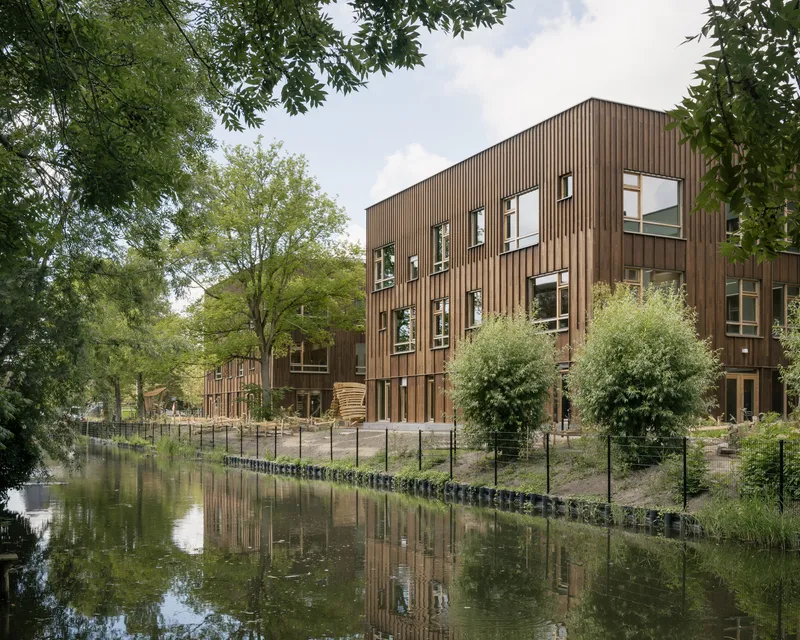
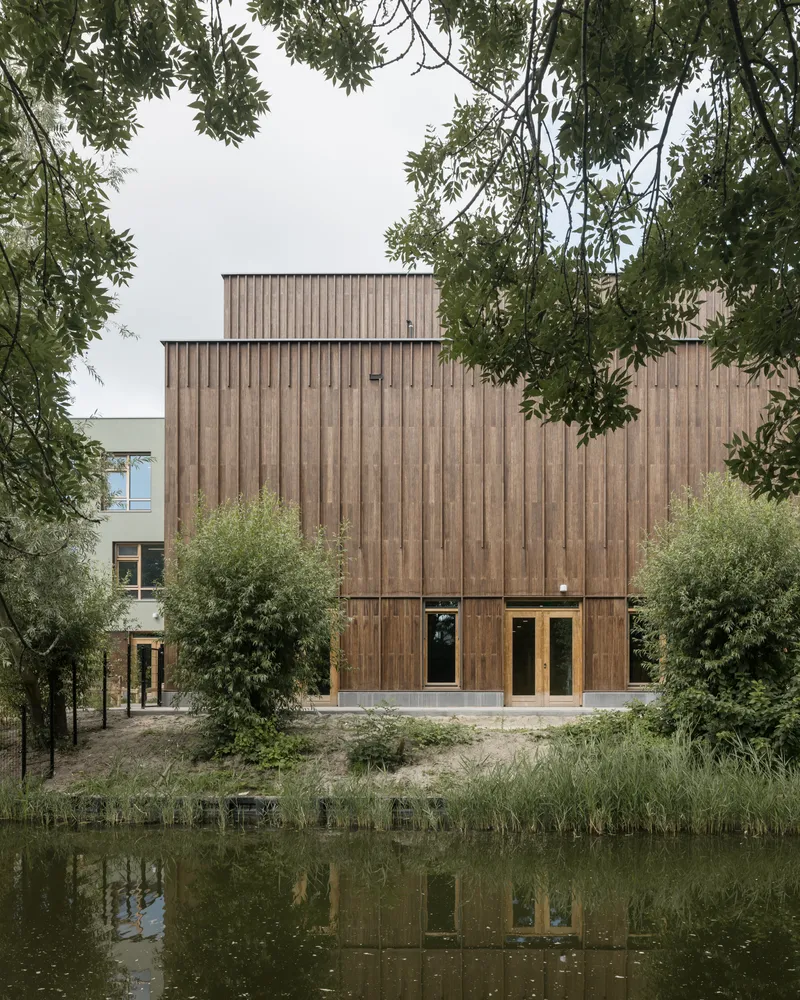
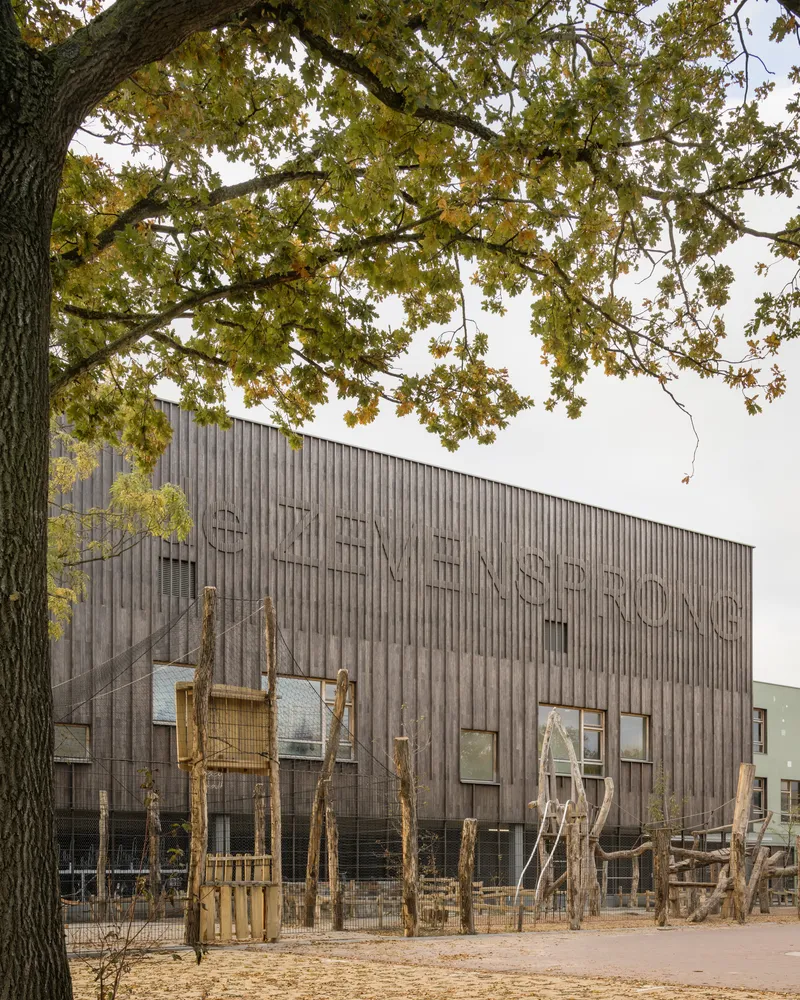
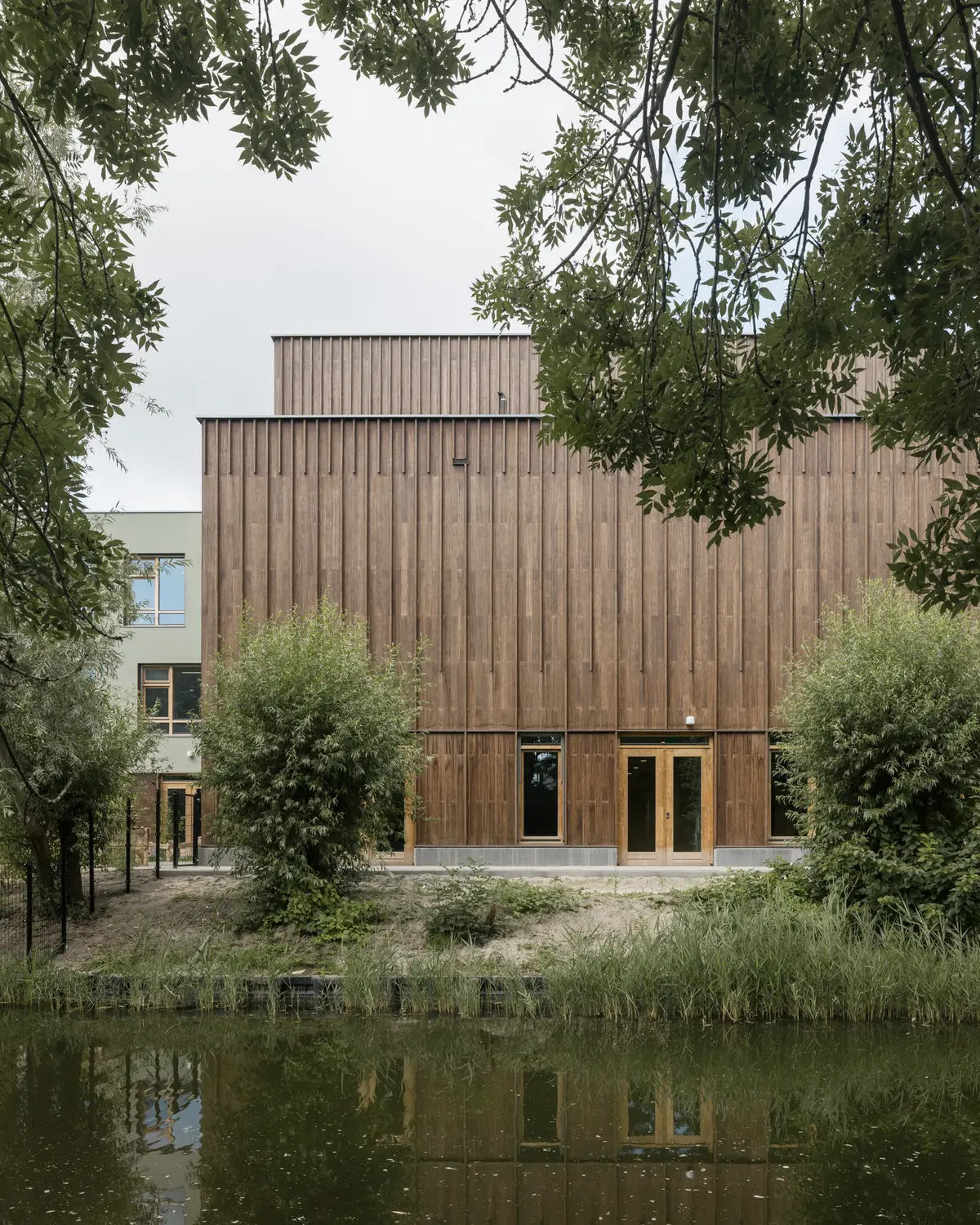
Hoorn's canals give the town its identity, and KRFT clearly understood the obligation that comes with a waterside site. The rear elevation of the timber volume reflects crisply in the canal, its vertical boards echoing the rhythm of rippled water. Overhanging branches frame the view in a way that feels almost composed, though it is really just good siting. The scattered windows, each sized and placed independently, catch light and shadow differently through the day, giving the facade a constantly shifting expression.
From across the water, the three-story mass reads as proportionate to the surrounding context. The timber will gray over time, drawing the building even closer to the muted tones of Dutch skies and older canal-side warehouses. It is a sustainability decision as much as an aesthetic one: untreated wood cladding ages gracefully and requires no repainting.
Scatter Windows and Natural Play
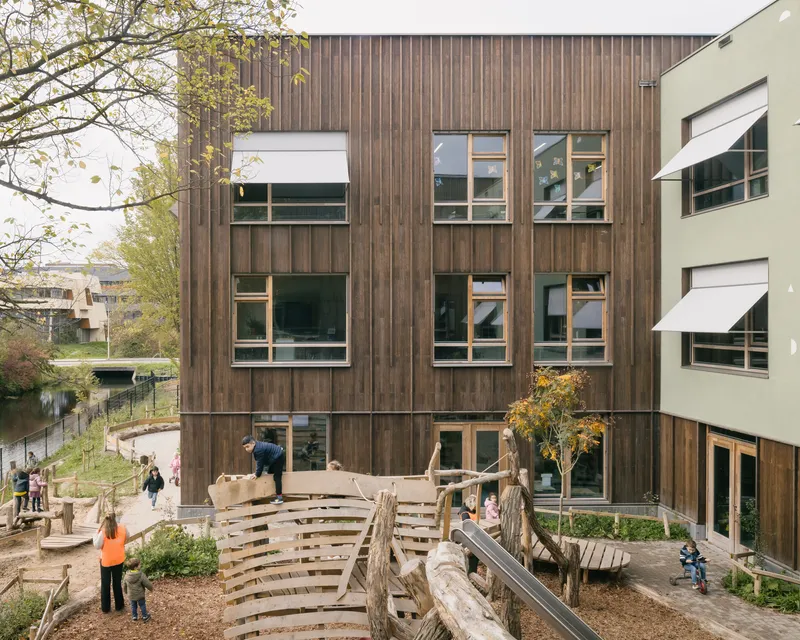

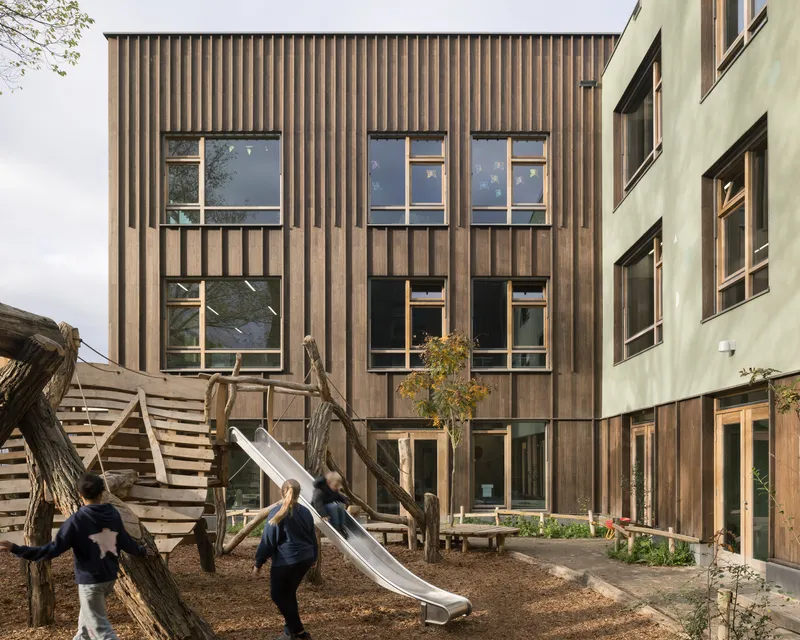
The irregular fenestration deserves a closer look. Rather than aligning windows on a strict grid, KRFT distributes them across the timber facades in a pattern that feels random but is clearly calibrated: each opening corresponds to a specific interior need, whether a desk-height view, a high clerestory, or a full-height frame onto the courtyard. The result on the exterior is a playful composition that invites counting and comparison, a subtle cognitive gift for the children who walk past it every morning.
At ground level, natural play areas with timber equipment, slides, and loose surfaces encourage unstructured activity. The terraces and play zones wrap around the building, so outdoor time is never far from any classroom. Children are visible on terraces and courtyards in nearly every exterior image, which suggests the design succeeds at something many schools fail: making the outside as inviting as the inside.
Timber Ceilings and Skylights Shape Interior Life
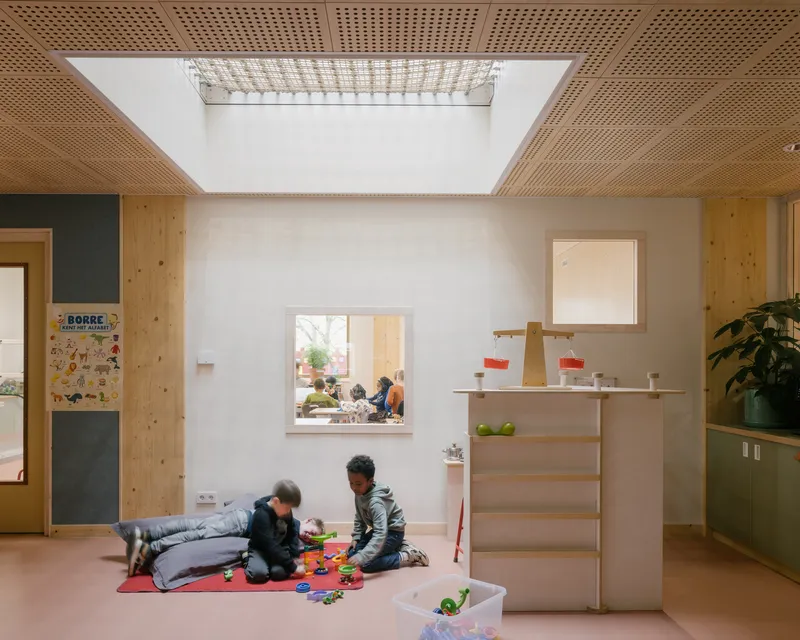
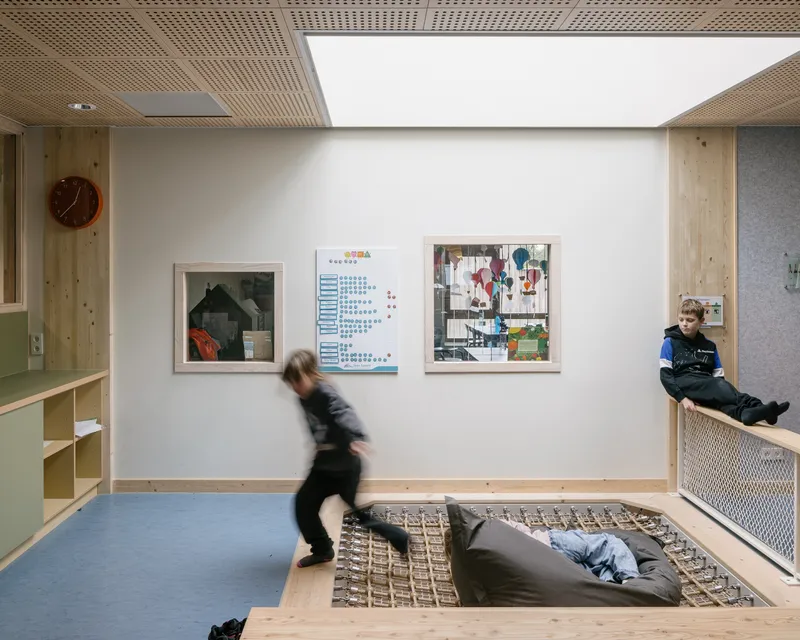
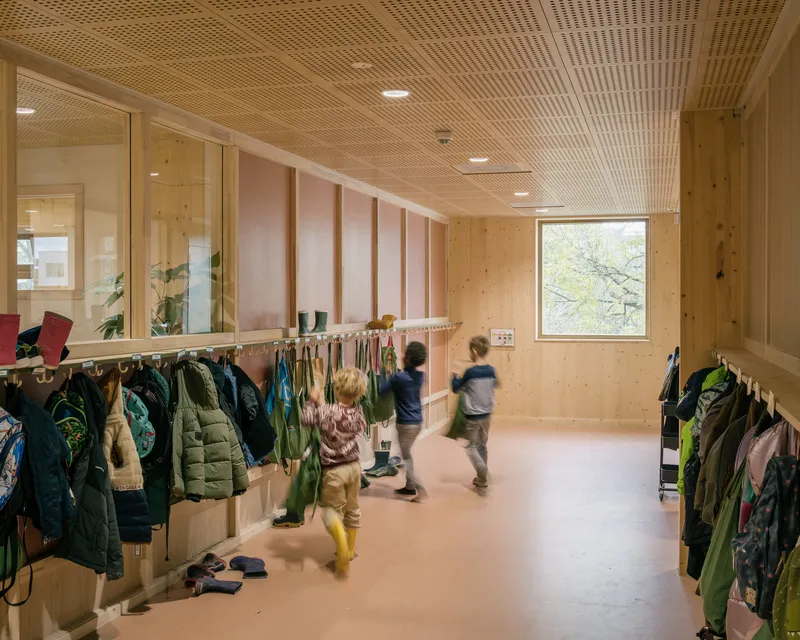
Inside, perforated timber ceilings recur throughout, filtering daylight from skylights into warm, diffused pools. In one room, a sunken reading pit sits below a generous skylight, creating a gravity well for children in motion through the circulation space. The interiors avoid the antiseptic fluorescent-lit corridors typical of institutional buildings; here, plywood surfaces and natural light do most of the atmospheric work.
Corridors double as activity zones. Coat hooks line plywood walls, and the perforated ceilings continue overhead, maintaining acoustic comfort while keeping the material language consistent. The blurring of corridor and classroom reinforces the idea that learning happens everywhere, not only at desks.
Rooms That Do More Than One Thing
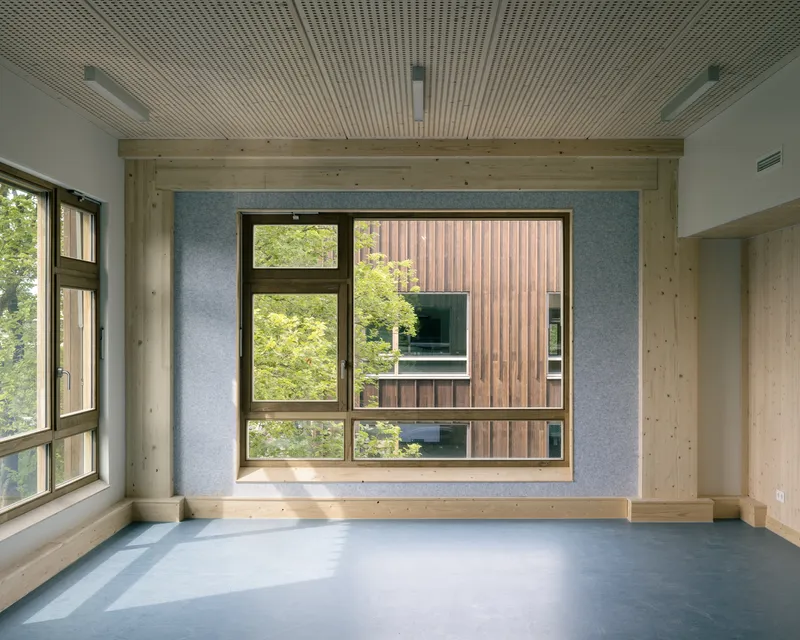
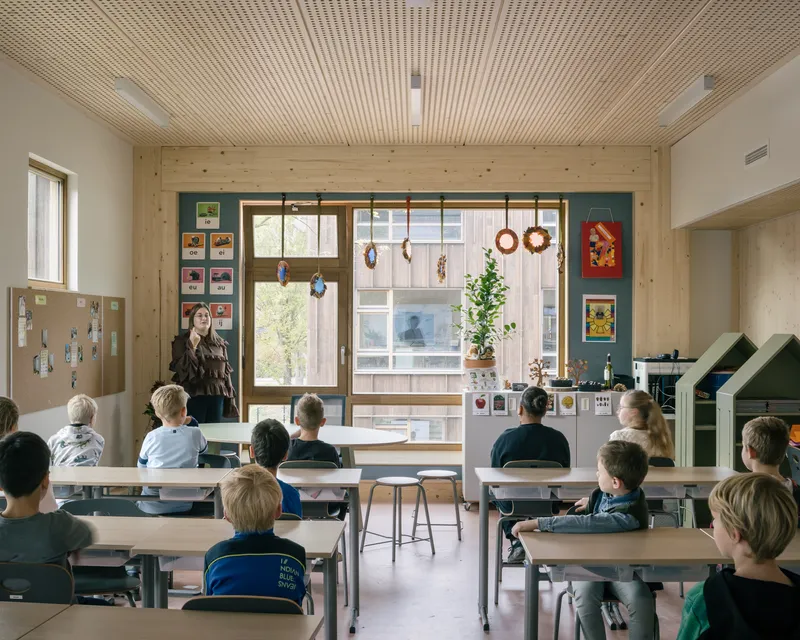
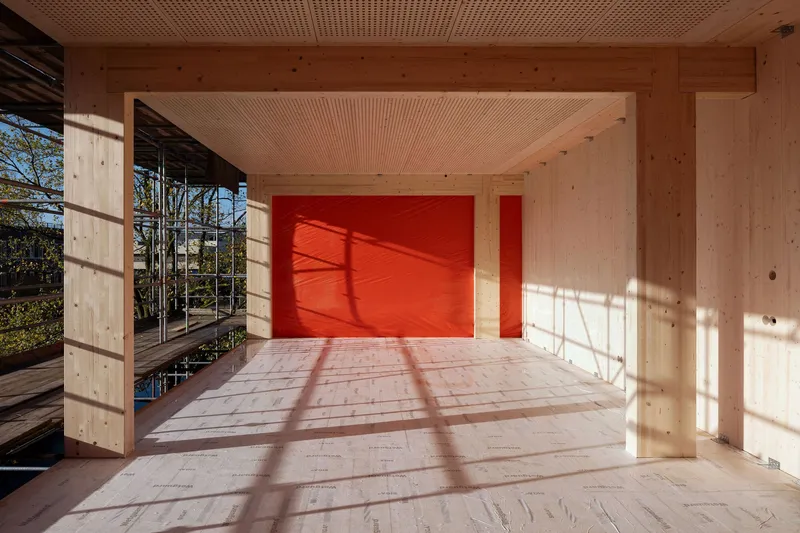
A blue felt wall and stepped timber platform in one room create a small amphitheater overlooking the courtyard, suited for presentations, group reading, or simply sitting. Classrooms feature timber slatted ceilings and generous windows that frame the teacher against natural light rather than a whiteboard. Another room uses red wall panels and perforated ceilings to cast geometric shadows across a plywood floor, turning the space itself into a kind of teaching tool about light and pattern.
These rooms are not precious. They are robust, adaptable, and designed to take a beating from their occupants. That durability is itself a form of respect for children: rather than wrapping everything in plastic laminate, KRFT trusts the materials to age with use.
Kitchen, Gym, and the Social Spine


The kitchen workspace, complete with countertops, a cooktop, and sink positioned beside a tall window, is clearly designed for children to use, not just observe. Food preparation as pedagogy is built into the plan. Nearby, a dining area with built-in bench seating and cork notice tiles on a blue wall serves as both canteen and social hub.
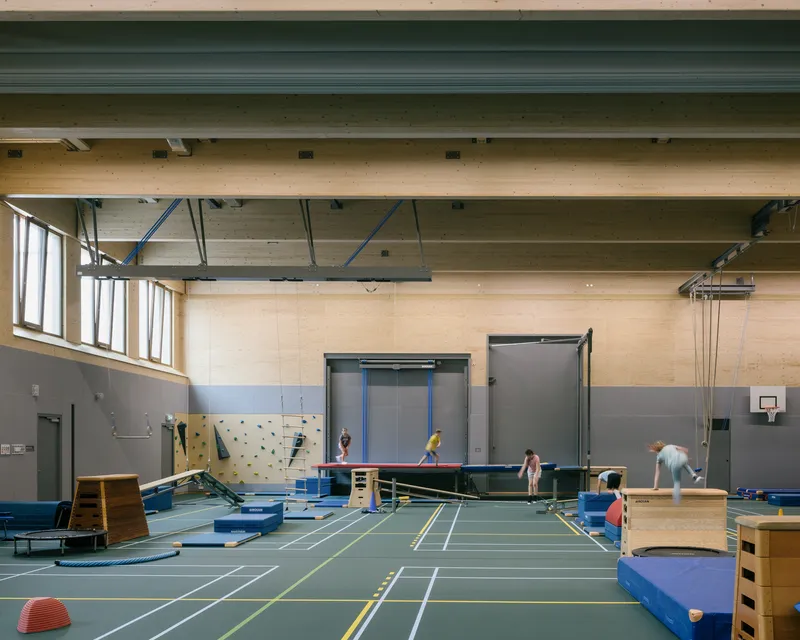
The gymnasium, with its exposed timber ceiling beams and plywood walls, is the largest single volume in the complex. It reads as a barn: honest structure, no dropped ceiling, no synthetic veneer. The choice to leave the beams exposed teaches a spatial lesson about how buildings stand up, which feels entirely intentional in a center dedicated to children's development.
Stairwells, Color, and Construction
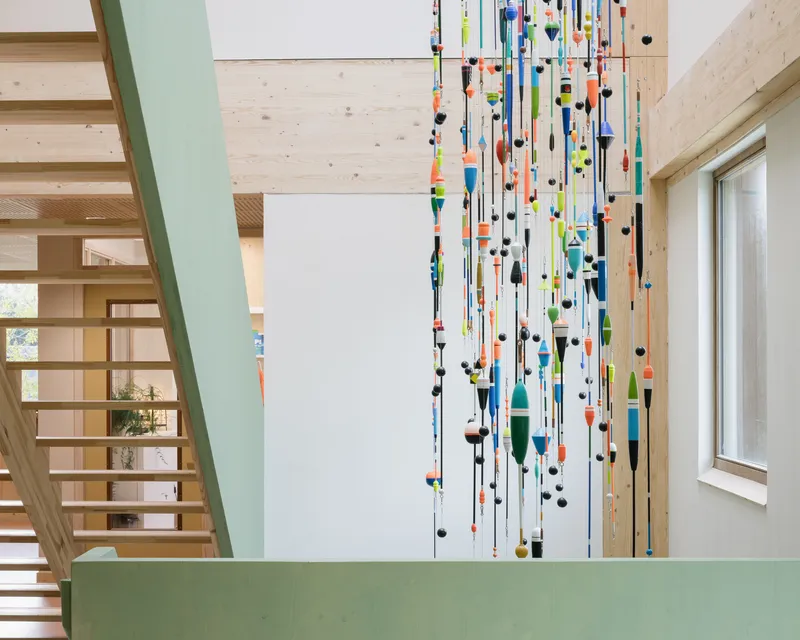
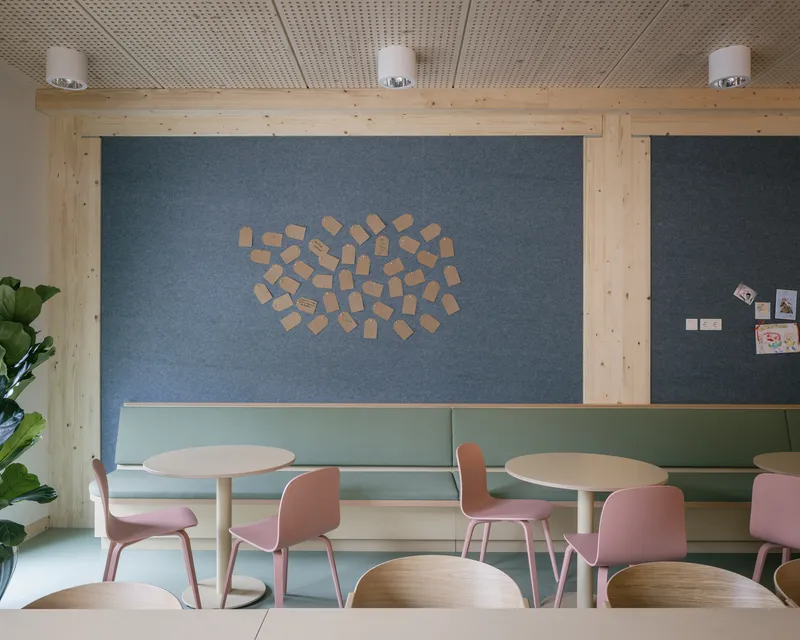

A double-height stairwell with a painted green guardrail and a hanging installation of colorful fishing floats introduces a moment of pure delight. The floats reference Hoorn's maritime heritage, grounding the building in local identity without resorting to kitsch. Elsewhere, the dining area's cork tiles and blue walls provide warmth without overwhelming the material palette. A construction photo reveals the timber structural frame beneath its red weatherproofing membrane, confirming that the timber is not only skin deep: it runs through the bones of the building.
These details matter because they show a project where sustainability is structural rather than cosmetic. The timber frame, the natural cladding, and the daylight strategy all point to a building conceived as a long-term investment in both its community and its environment.
Plans and Drawings
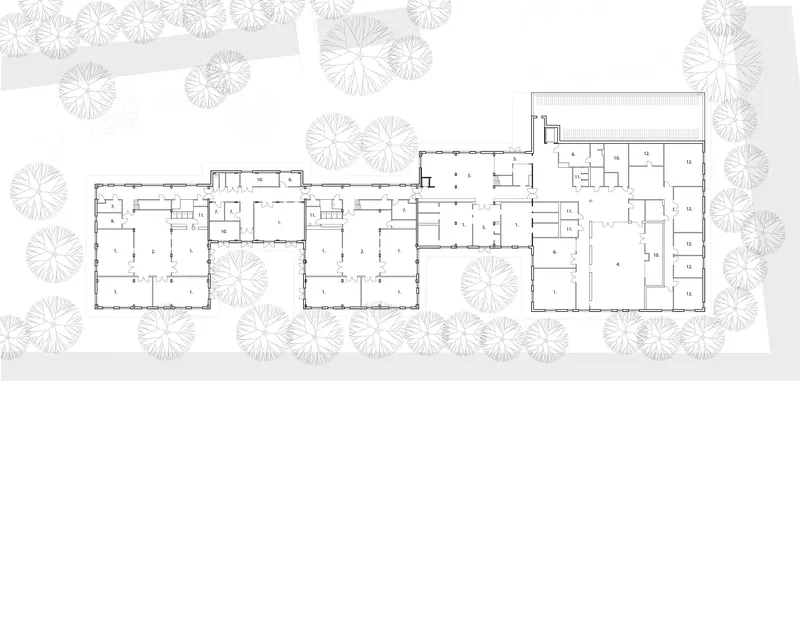
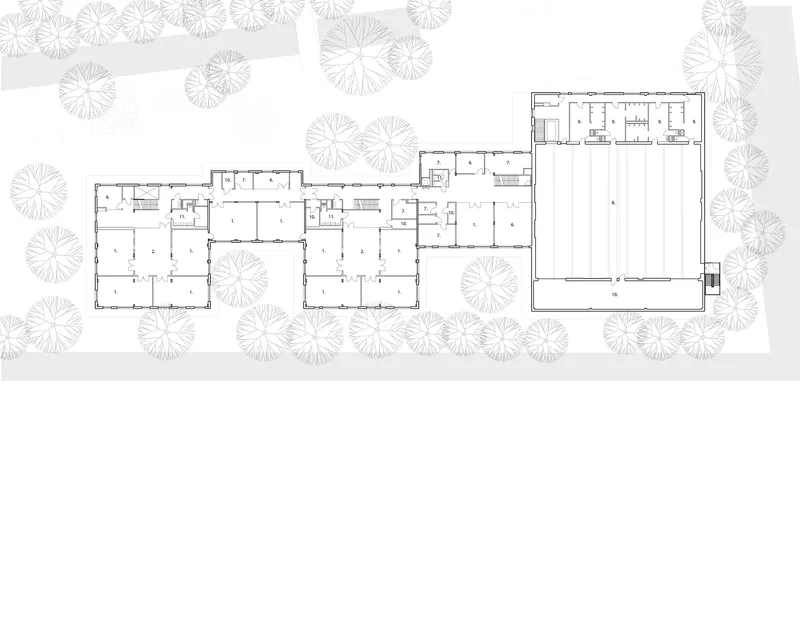
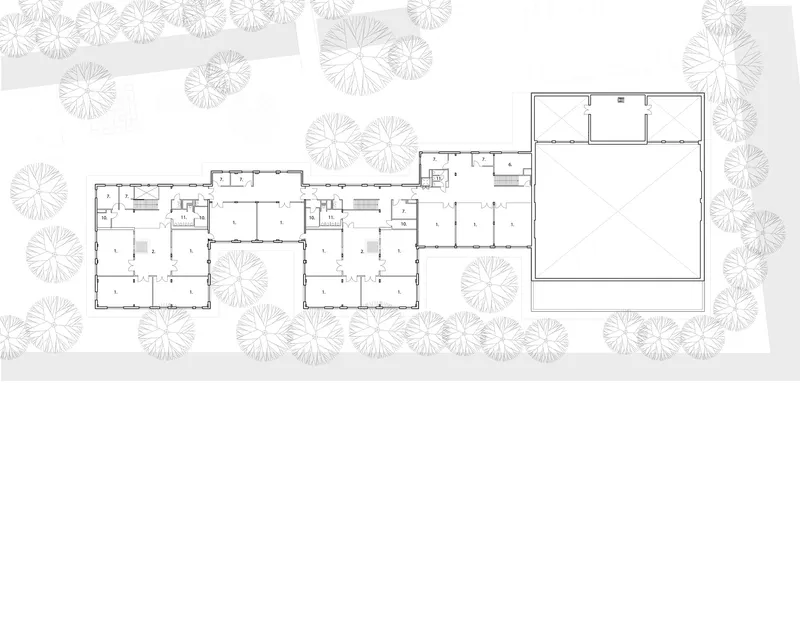
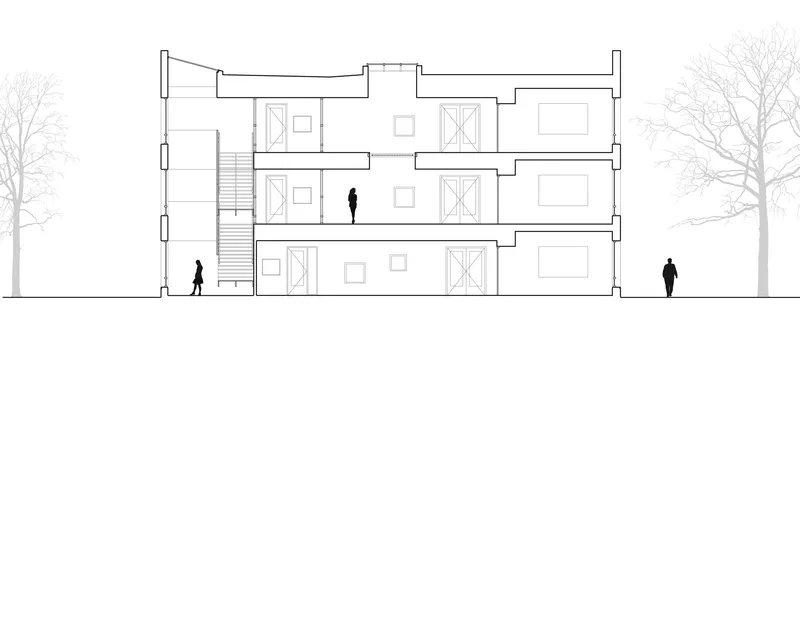
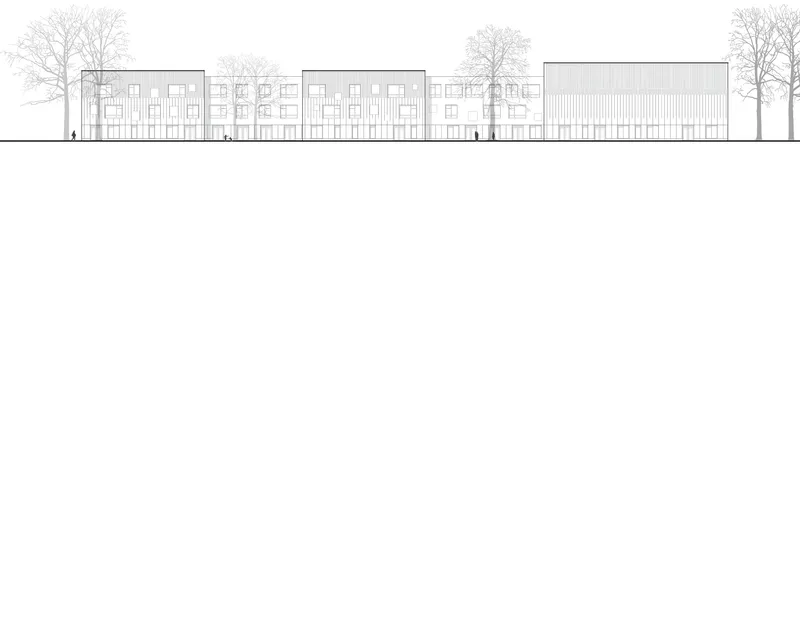
The floor plans confirm the three-volume strategy: classroom wings branch from a shared spine, with the gymnasium and courtyard spaces acting as anchors at opposite ends. Circular tree symbols crowd the site plan, suggesting that landscape is not an afterthought but a co-equal design element. The section drawing reveals a three-story structure with an exterior staircase, while the elevation shows the low-rise complex's varied facade treatments, timber alongside plaster, set against bare winter trees that underscore the building's seasonal dialogue with its surroundings.
Why This Project Matters
De Zevensprong is a reminder that buildings for children do not need to shout. KRFT's approach is quiet but rigorous: break the mass, use honest materials, let daylight do the heavy lifting, and trust kids to engage with architecture that takes them seriously. The result is a building that fits its canal-side context, serves a complex educational program, and demonstrates that timber construction can deliver institutional scale without institutional heaviness.
In a moment when sustainability in schools often means a rooftop solar array bolted onto an otherwise conventional box, De Zevensprong integrates its environmental ambitions into every decision, from structure to skin to the courtyard tree that predates the building itself. It is a project that understands that the best way to teach children about the built environment is to give them a good one to grow up in.
De Zevensprong, Integrated Child and Expertise Center, designed by KRFT Architecture. Located in Hoorn, the Netherlands. Completed in 2025. Total area: 6,980 m².
About the Studio
Share Your Own Work on uni.xyz
If projects like this are the kind of work you want to make, uni.xyz is a place to publish your own, find collaborators, and enter design competitions.


Popular Articles
Popular articles from the community


Opera on the Sea: Driftwood Logic Shapes a Timber Opera House on Estonia's Coast
Trevor Orgill's opera house translates the entangled drift of floating timber into a civic building where wood, water, and music converge.


FCC Arquitectura Expands a Portuguese Granite House with a Board-Marked Concrete Wing
In Portugal, JV House pairs a cleaned-up whitewashed and granite dwelling with a timber-shuttered concrete extension, courtyards and a garden pool.

Singing Woman: An Opera House That Performs Before the Curtain Rises
Ovidiu Cristian Pavel's conceptual opera house translates Estonia's choral identity into a sculpted waterfront landmark facing the Baltic Sea.

The Amber Palace Opera: A Geological Fiction Surfaces on Tallinn's Baltic Waterfront
Pierre Brillard reimagines a Baltic legend as a public landscape, opera house, and waterfront promenade rooted in Tallinn's coastal identity.

Similar Reads
You might also enjoy these articles

LAVA Architecten Gives Vocational Education a Sawtooth-Roofed Face on a Mechelen School Campus
In Mechelen, Belgium, a 2,053 m² STEM school on a 6×6 m grid turns workshops and classrooms into rooms that can be rearranged as teaching changes.

KEMA Studio Turns a Derelict Marvila Attic into a 60 m² Lighthouse Apartment Above Lisbon
In Lisbon's Marvila district, a rebuilt roof, four skylights and two plywood volumes turn an unlivable attic into a bright home facing the Tagus.

Pixel Gardens: One Repeated Module Stacked Into a Terraced Social Housing Tower for Famagusta
Salem Bader's shortlisted housing tower builds a vertical neighbourhood from one repeated module, offsetting units to carve terraces, light and air.

Bao Huynh Watercolor Atelier: A Serene Art Retreat in Hội An
Bao Huynh Watercolor Atelier in Hội An blends multifunctional art spaces, sustainable design, local materials, and family-friendly living in a serene environment.

Explore Interactive Education Zone Competitions
Discover active competitions in this discipline

Challenge to reimagine the Iron Throne

Photograph architecture without architects

Illustrate the lost glory of Angkor Wat - Render Challenge

Design challenge to reuse E-waste
Comments (0)
Please login or sign up to add comments
No comments yet. Be the first to comment!