
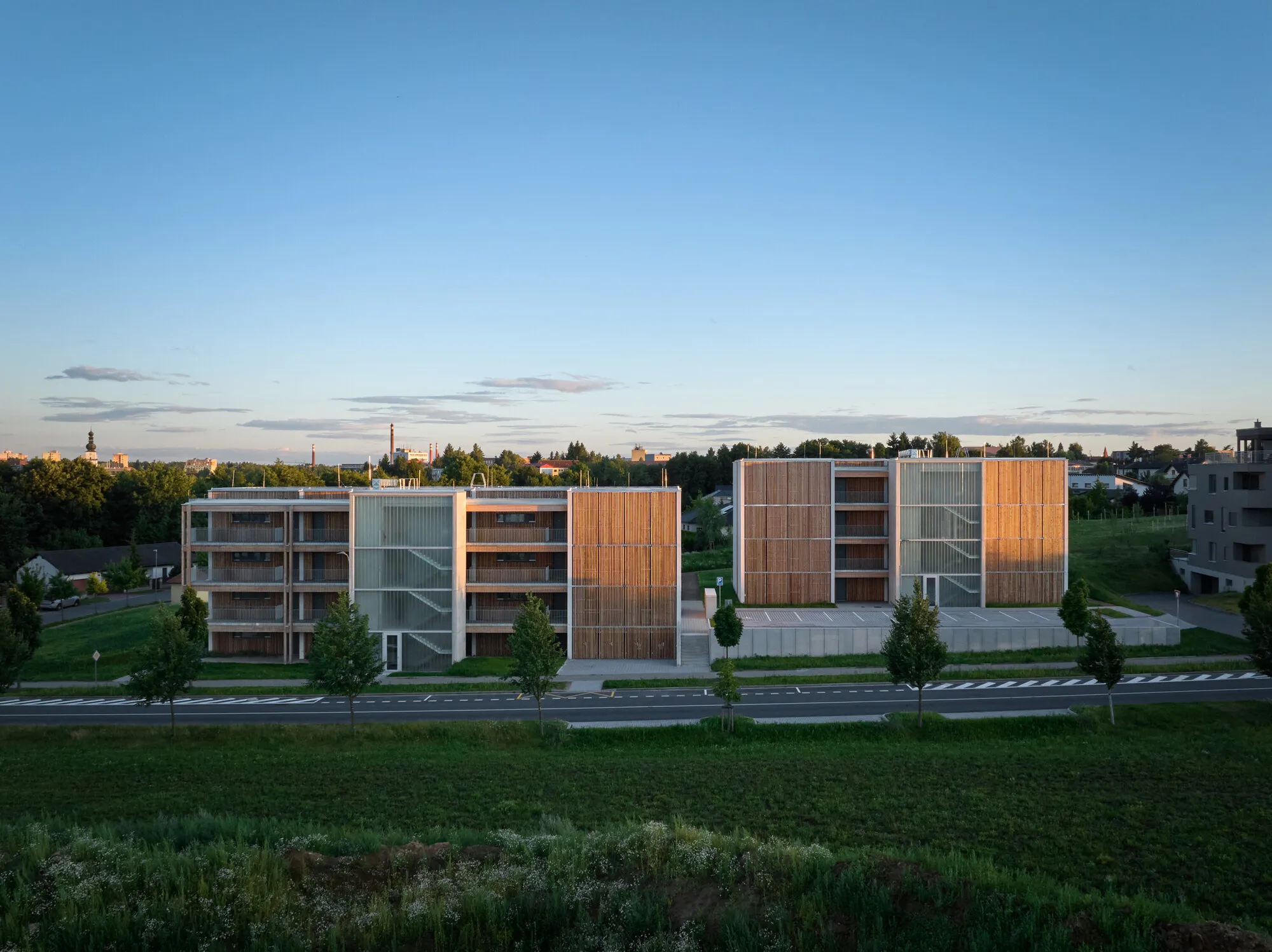
Kuba and Pilar Architekti Build One of Czechia's First Timber Apartment Blocks in Žďár nad Sázavou
Cross-laminated timber panels and prefabricated concrete cores form affordable housing that tests the limits of wood construction in Czechia.


The Czech Republic has not been an early adopter of multi-storey timber housing. Regulations, habit, and a concrete-dominant construction culture have kept wood at the periphery of residential building. That context makes the Zdar Wooden Housing project, completed in 2025 on a corner site in the Klafar district of Žďár nad Sázavou, something more than another CLT apartment block. Designed by Brno-based Kuba and Pilar Architekti, the two four-storey buildings use cross-laminated timber panels for walls and floor slabs, with prefabricated reinforced concrete limited to elevator cores, staircases, and retaining walls. It is among the first of its kind in the country, and it arrives as affordable housing backed by the Czech Ministry of Regional Development.
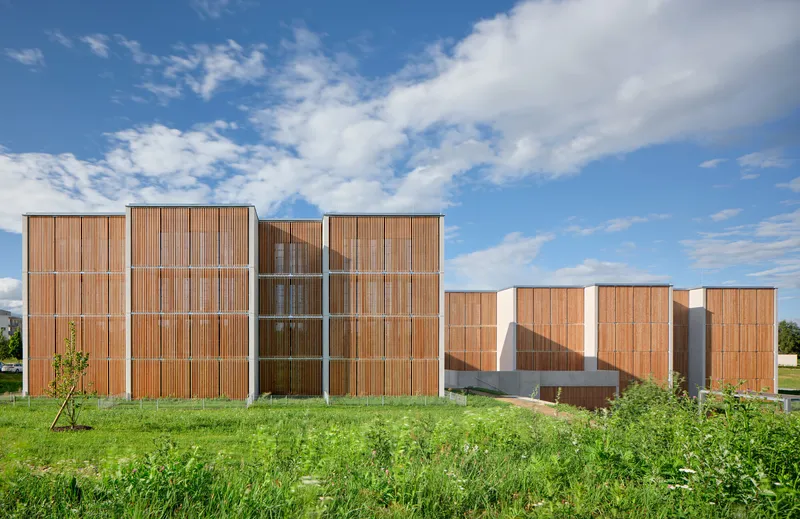
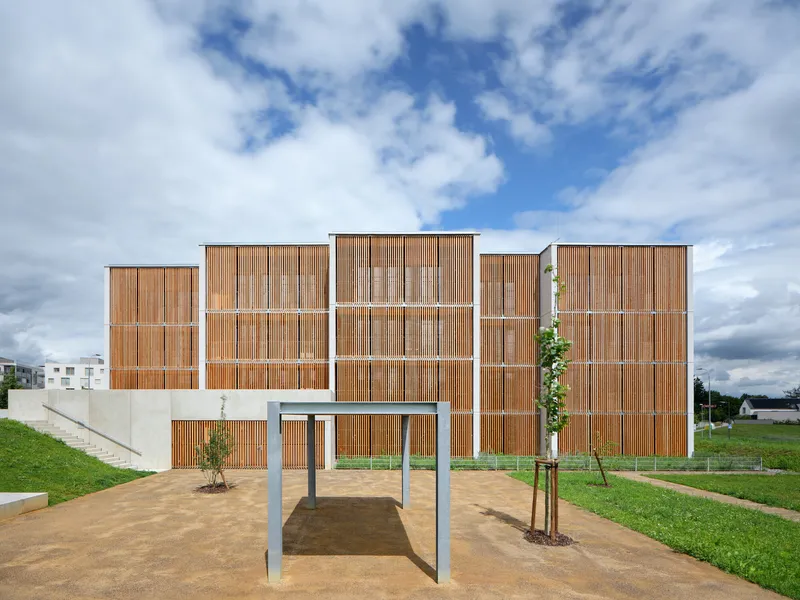
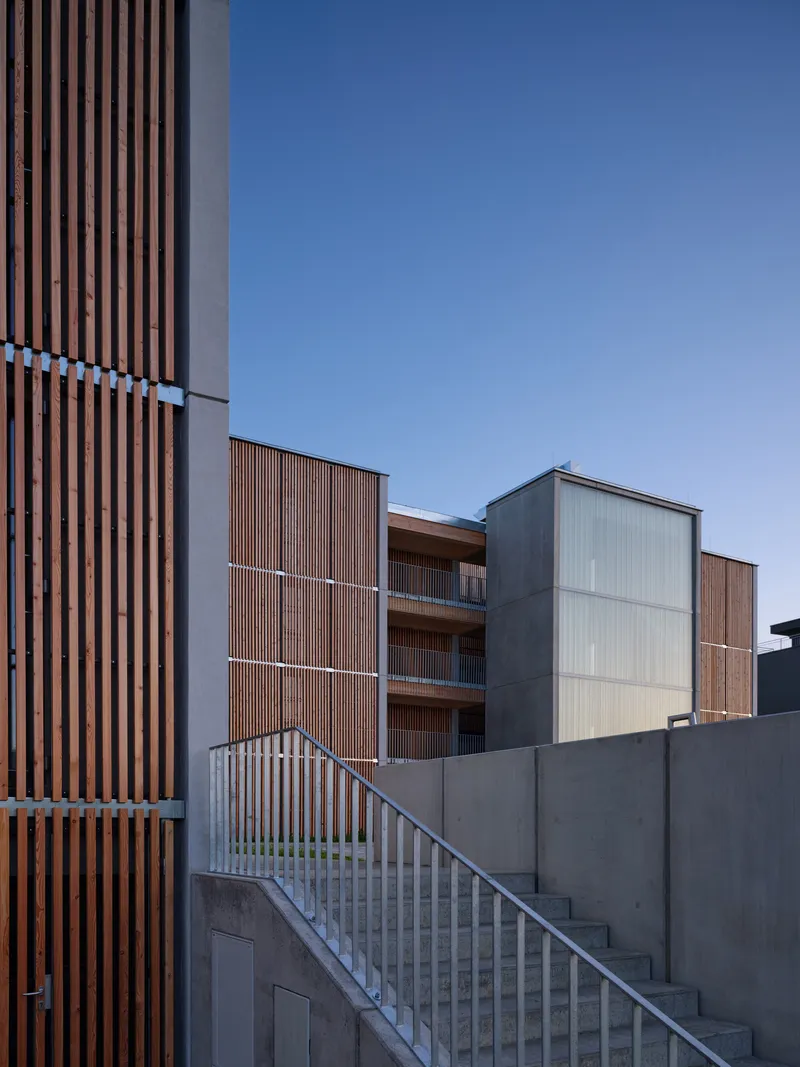
What makes the project worth studying is not the novelty of wood alone but how the architects handle the tension between prefabricated modularity and urban character. The buildings sit at the intersection of Sázavská and K Milířům streets, organized around a traditional city-block logic that creates a gradient from public street frontage to semi-private south-facing courtyards. Recessed loggias punched between transverse load-bearing walls give the facades a layered depth that most prefab housing never achieves. Folding timber shutters animate the surface, and the whole assembly reads less like a demonstration project and more like a convincing proposition for how Czech cities might actually build.
A Timber Facade with Real Depth
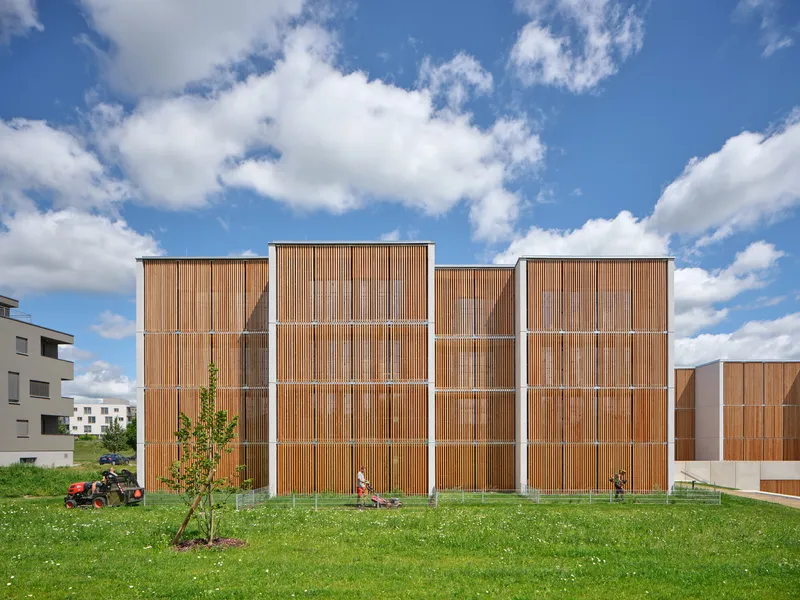
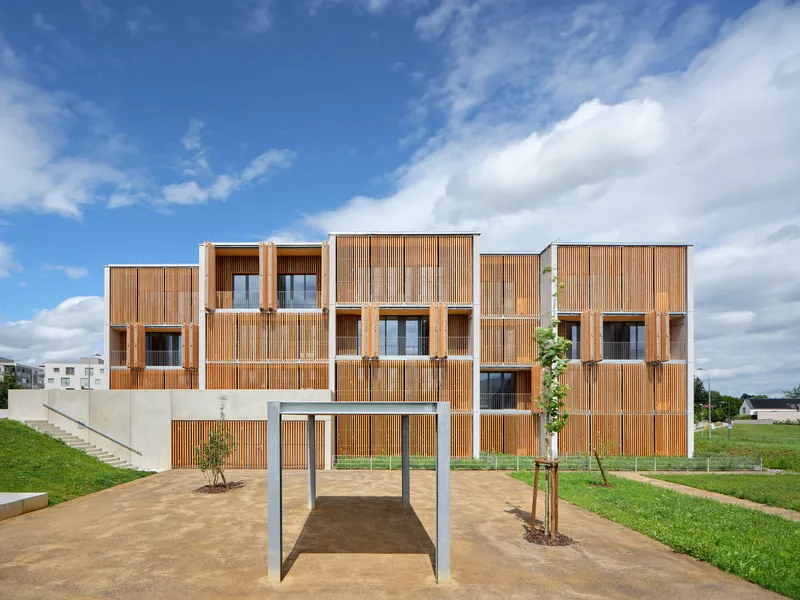
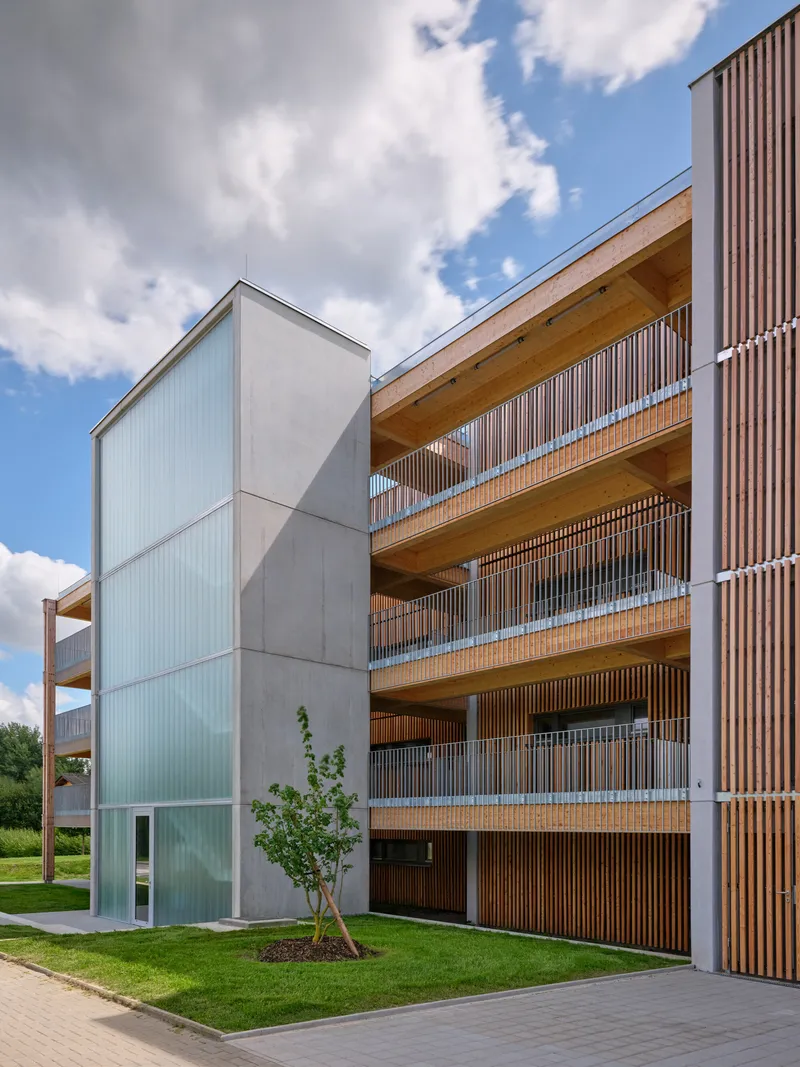
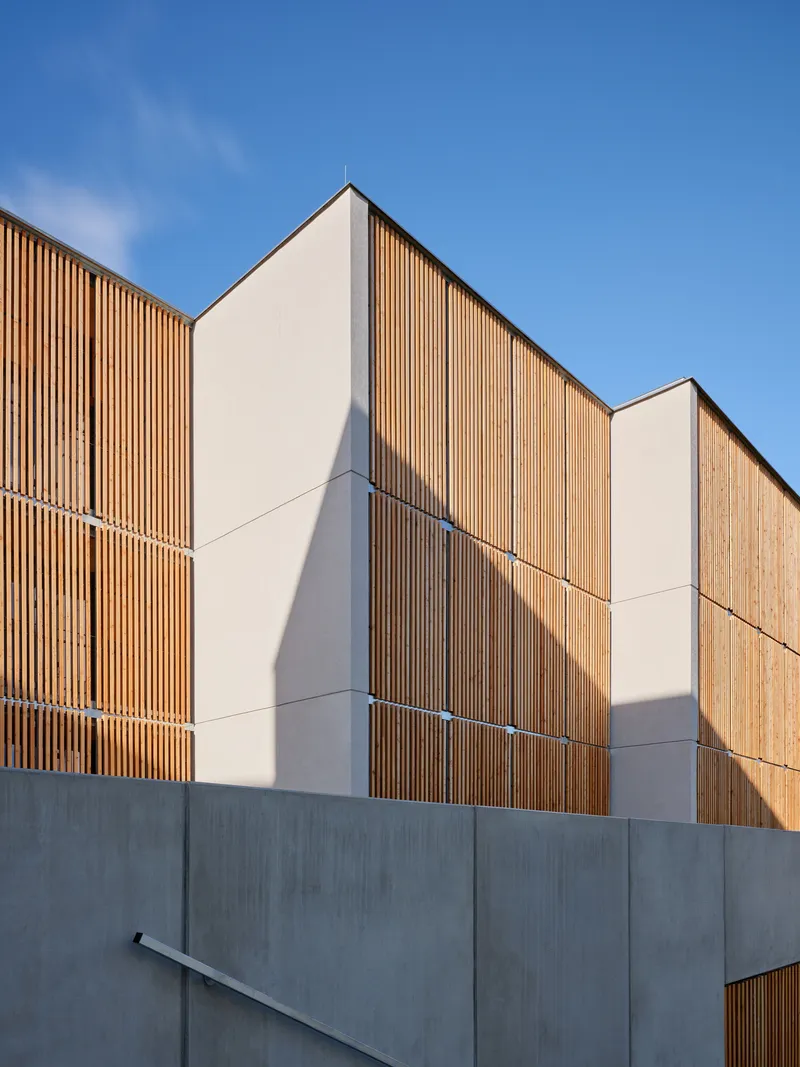
The dominant visual move is the vertical timber slat screen that wraps the loggias. These are not decorative appliqués. They sit within the structural bays created by the transverse CLT walls, producing a rhythm of solid and void that changes character as shutters open and close. When fully deployed, the facade presents a taut, almost textile quality. When residents fold them back, you get glimpses of recessed balconies with exposed timber ceilings and steel railings.
The key insight is that the architects use the shutter system to do three things at once: provide solar shading, give residents control over their privacy, and generate architectural variety without requiring bespoke design for every unit. It is a genuinely efficient strategy. The white horizontal bands and concrete podium ground the composition, preventing the wood from reading as rustic or cabin-like.
Street Presence at Dusk
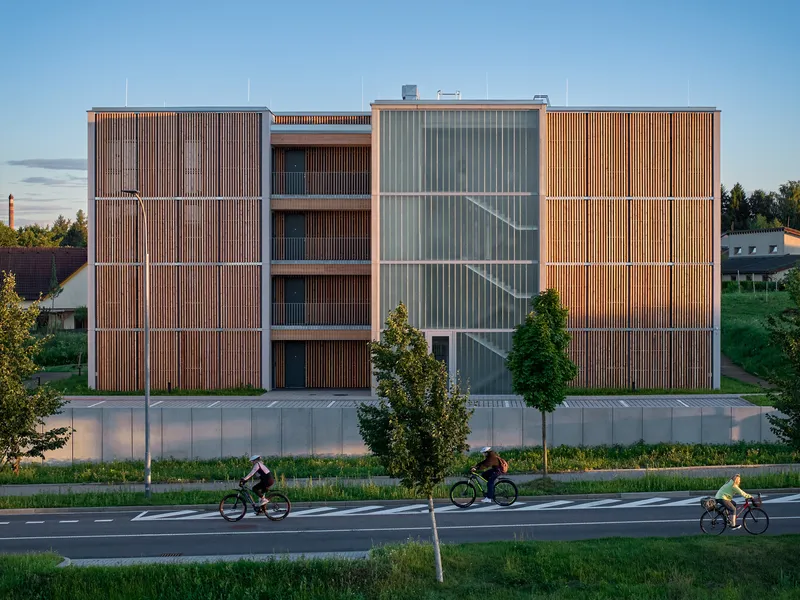
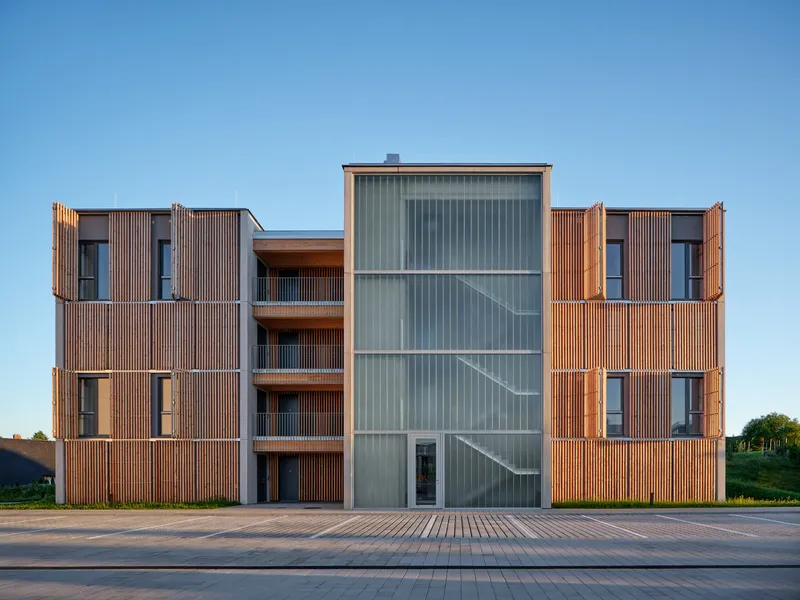
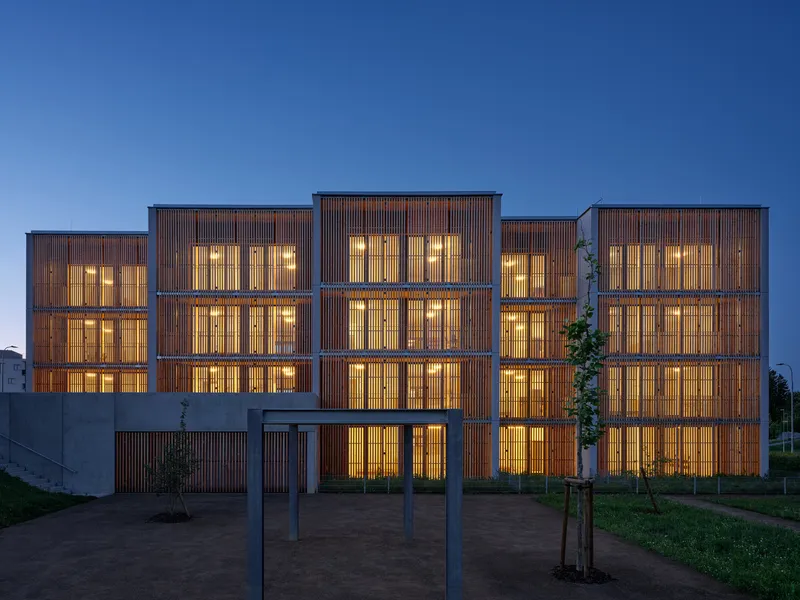
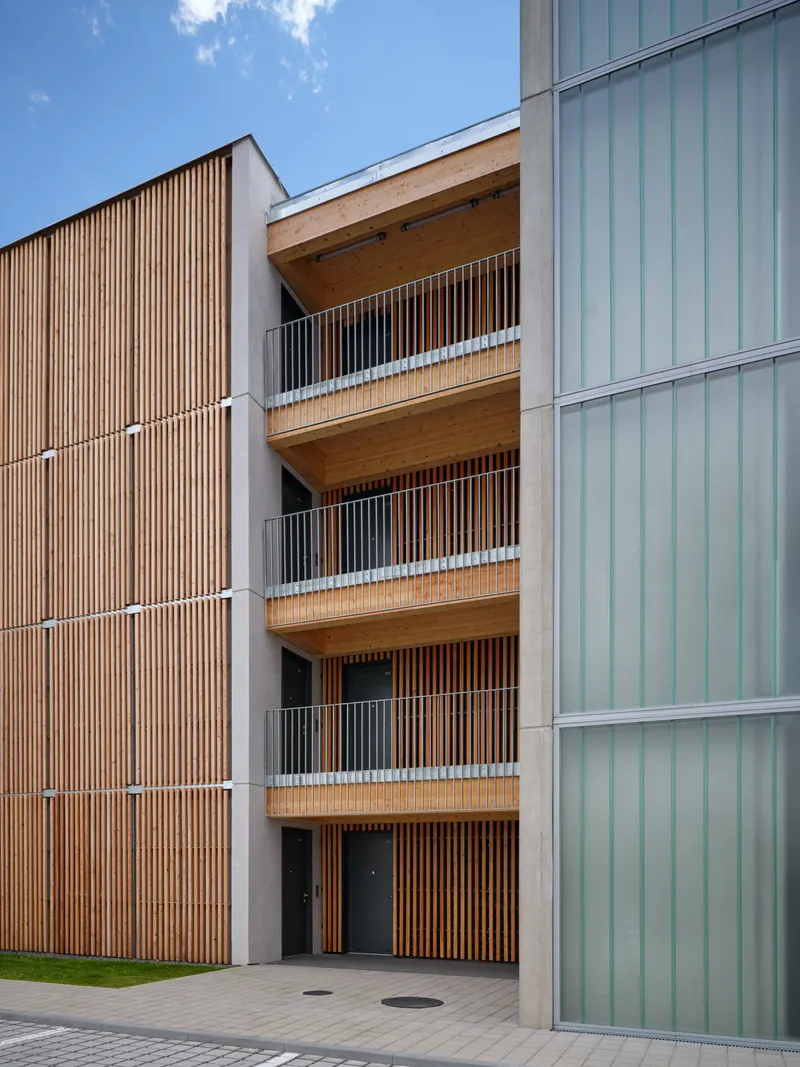
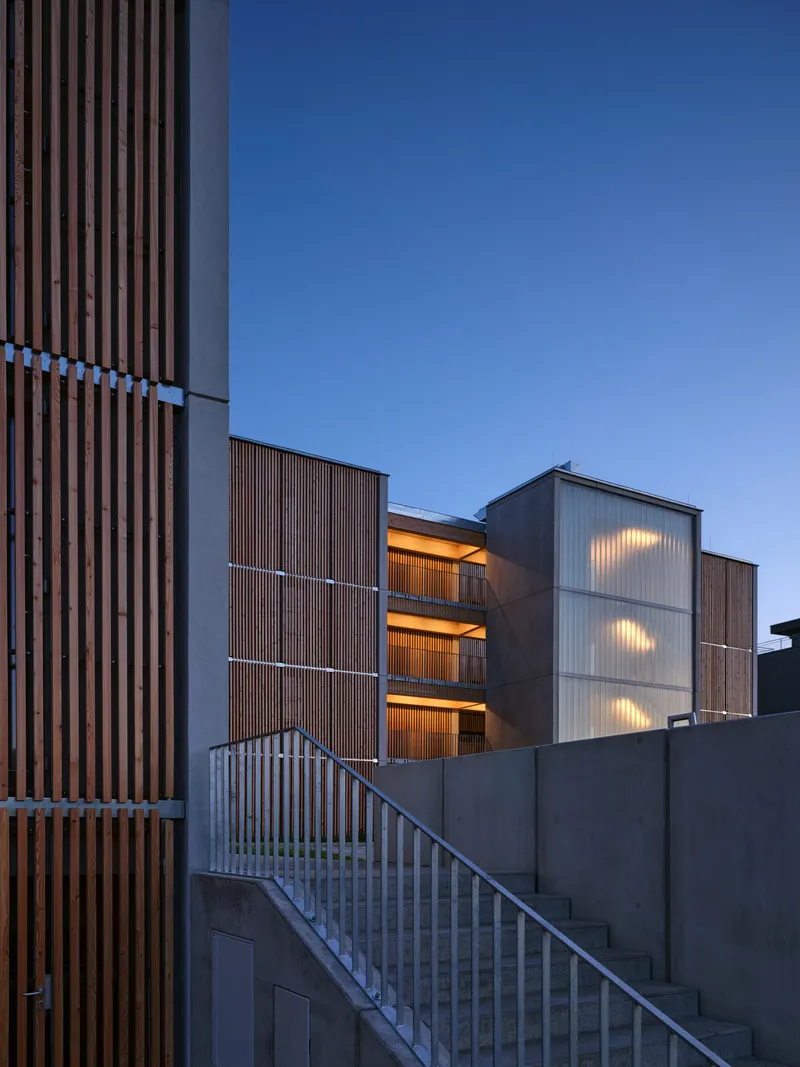
The buildings look best at twilight. When interior lights switch on behind the louvered screens, the facades glow in a warm amber that contrasts with the translucent corrugated panels of the central stair towers. That interplay between opaque timber and diffuse polycarbonate is one of the project's smartest material decisions. The stair cores, built in prefabricated concrete, are wrapped in translucent cladding that turns circulation into a lantern element, signaling entry points along the street.
Cyclists and pedestrians appear in several of these images, and that is telling. The ground-level treatment with young trees, grass lawns, and a clear street edge suggests that the landscape strategy was coordinated with the architecture rather than applied after the fact. The buildings hold the street line without being imposing, which is harder to pull off at four storeys than it sounds.
The Courtyard and Circulation Gallery
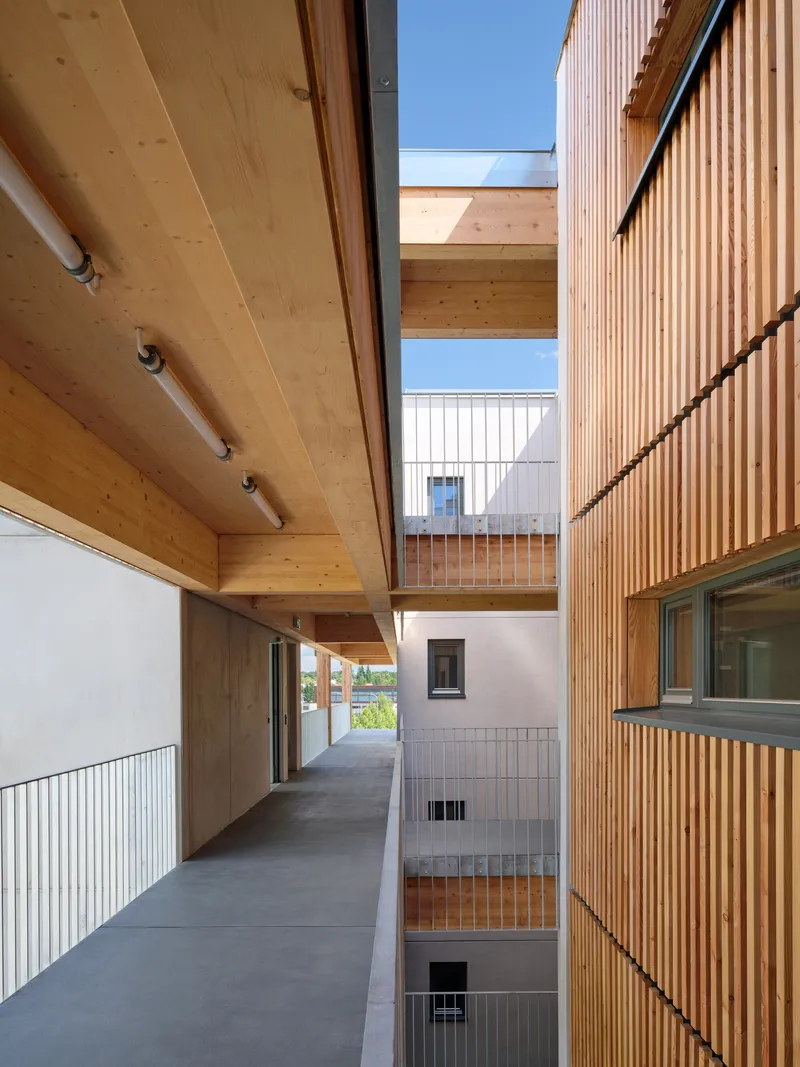
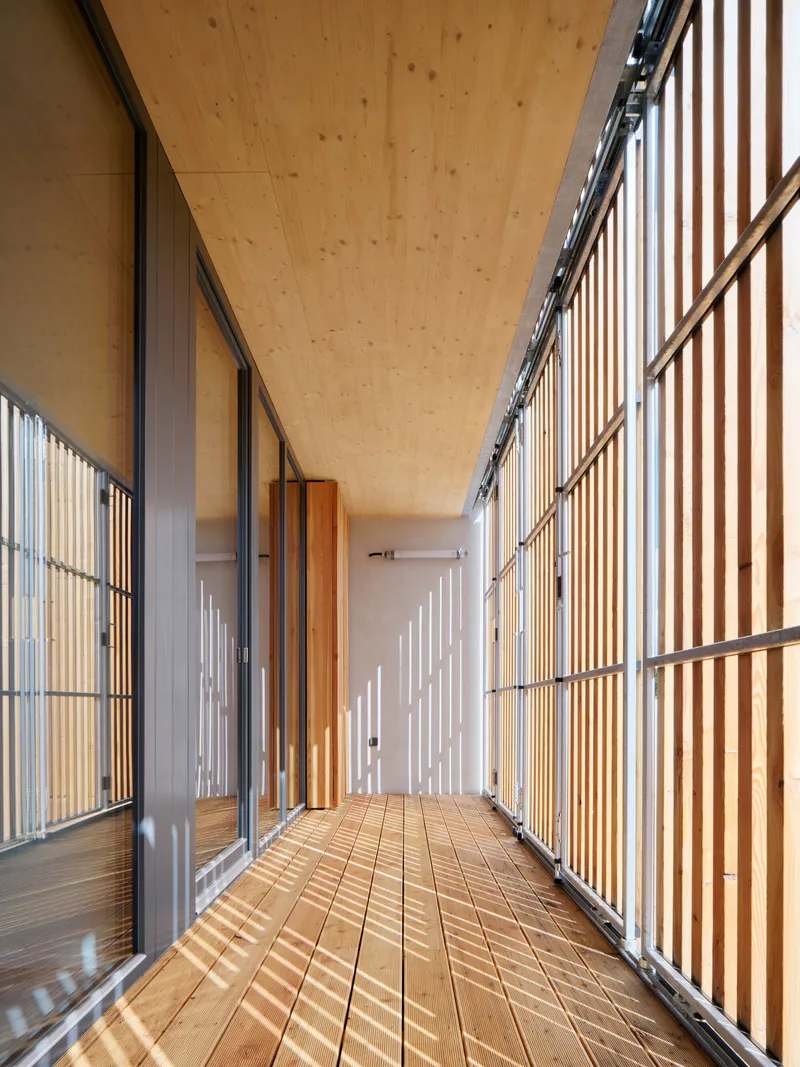
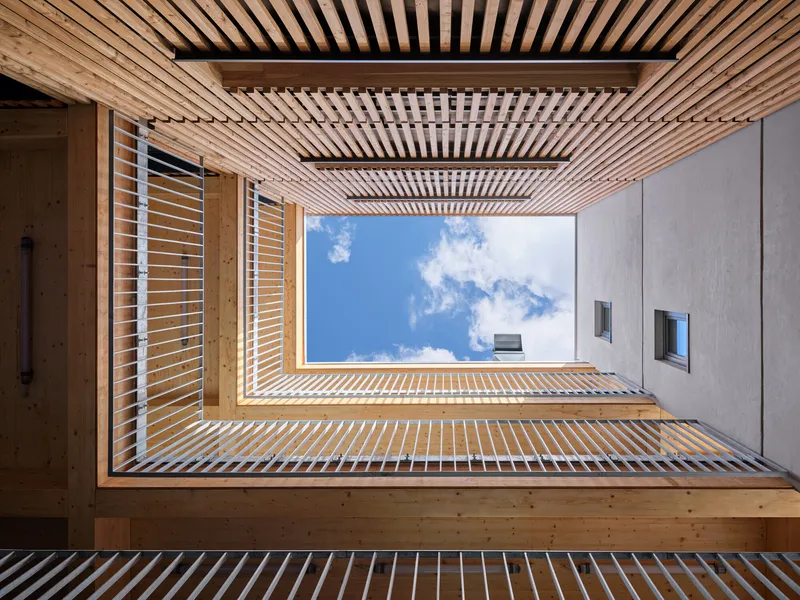
The semi-private courtyard, oriented to the south, is the social heart of the scheme. Upper-level walkways with timber ceilings and steel railings connect units and overlook the shared space below. These galleries are not afterthoughts; they are legible pieces of architecture with their own materiality and light quality. Striped shadows from the louvered screens fall across wood decking, and views upward through the courtyard frame sky in a way that feels deliberate.
The decision to orient every apartment for natural cross-ventilation, with openings to both the south courtyard and the north street, means the gallery circulation also functions as a wind channel. This is passive design embedded in plan logic rather than bolted on through mechanical systems. For an affordable housing project, that level of environmental thinking is notable.
Concrete Cores and Translucent Stairwells
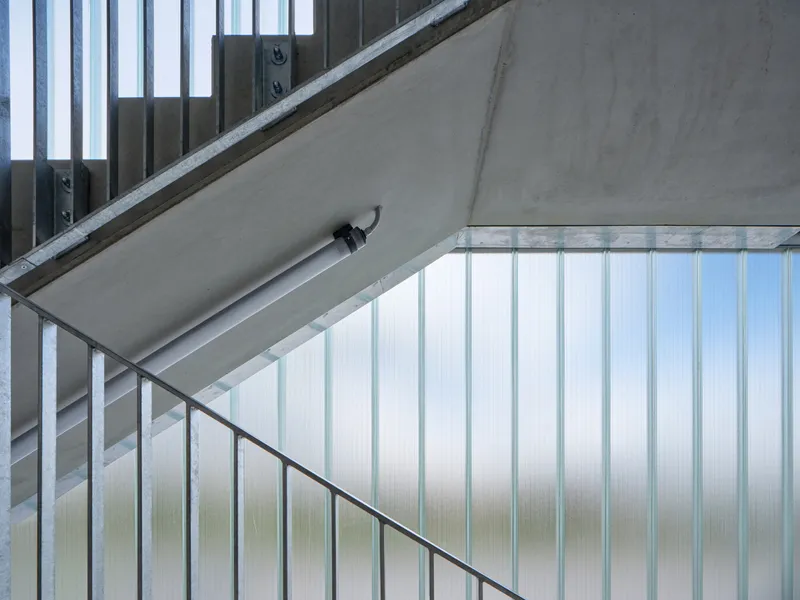
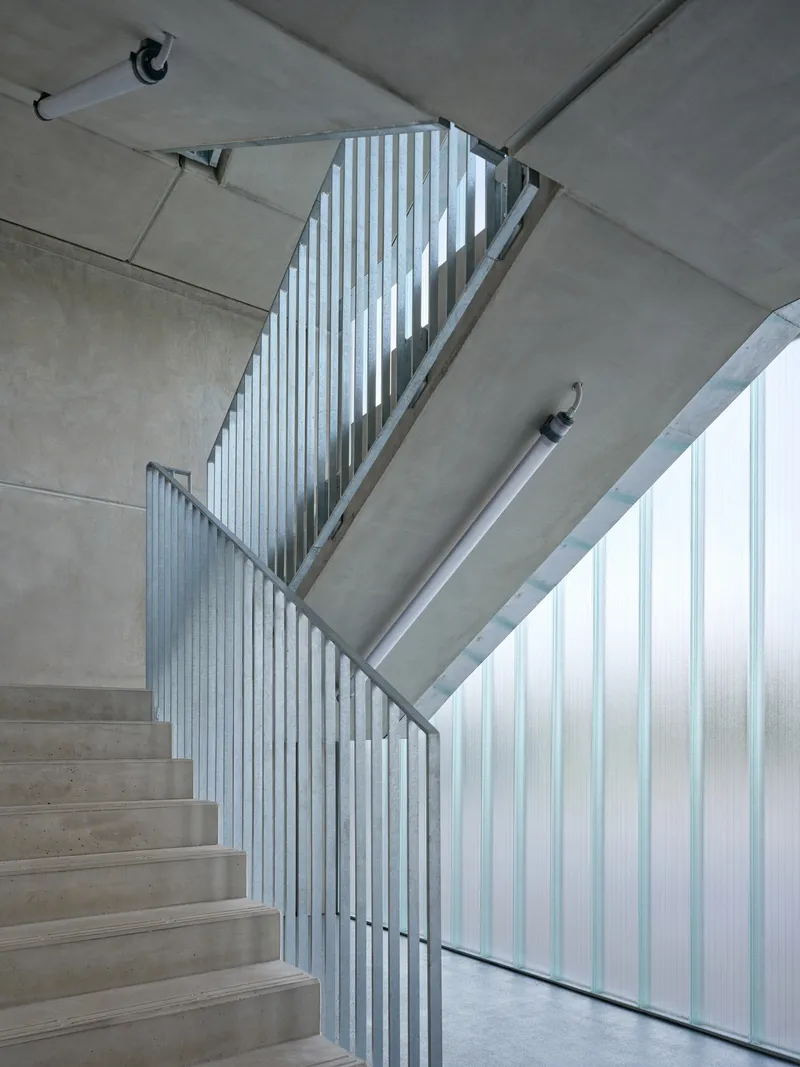
The hybrid structure is most visible in the stairwells, where prefabricated concrete stairs and soffits meet translucent corrugated wall panels. Daylight filters through these panels in a soft, even wash that eliminates the need for artificial lighting during the day. The concrete is left exposed, with a precision that reflects the prefabrication process. Vertical metal railings keep the detailing lean.
This concrete-and-polycarbonate combination serves a structural and fire-safety purpose. By concentrating non-combustible materials in the vertical circulation cores, the architects satisfy code requirements while keeping the majority of the building in timber. It is a pragmatic split that other designers working with CLT in regulated markets will recognize as essential.
Interior Atrium and Material Expression
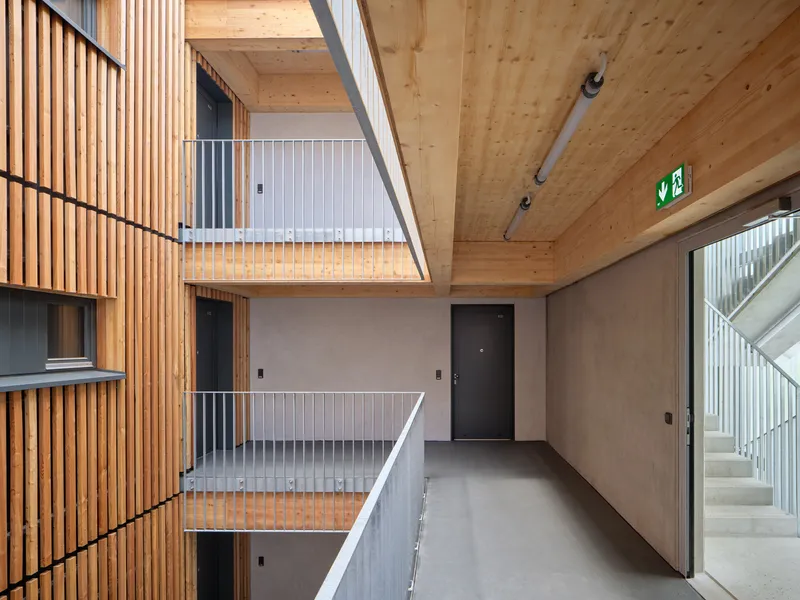
The interior atrium, visible across three levels with a skylight above, exposes the timber structure as the primary finish. CLT ceilings are left unclad, and the warm tone of the wood is consistent from the gallery railings down to the soffit of the ground-floor overhang. There is no attempt to disguise the material or dress it up. The structural logic is the aesthetic logic, which is refreshing in a sector where timber construction is often concealed behind plasterboard for acoustic or fire reasons.
Recessed balconies between corrugated metal walls and vertical slat screens create sheltered outdoor rooms. The timber ceiling of these spaces, continuous with the interior, blurs the threshold between inside and outside in a way that makes compact apartments feel larger than their floor area suggests.
Roofscape and Site
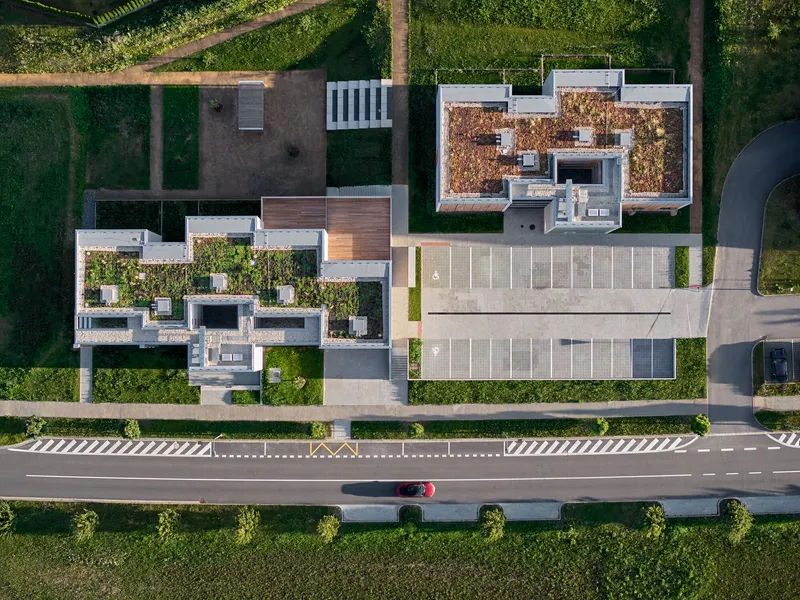
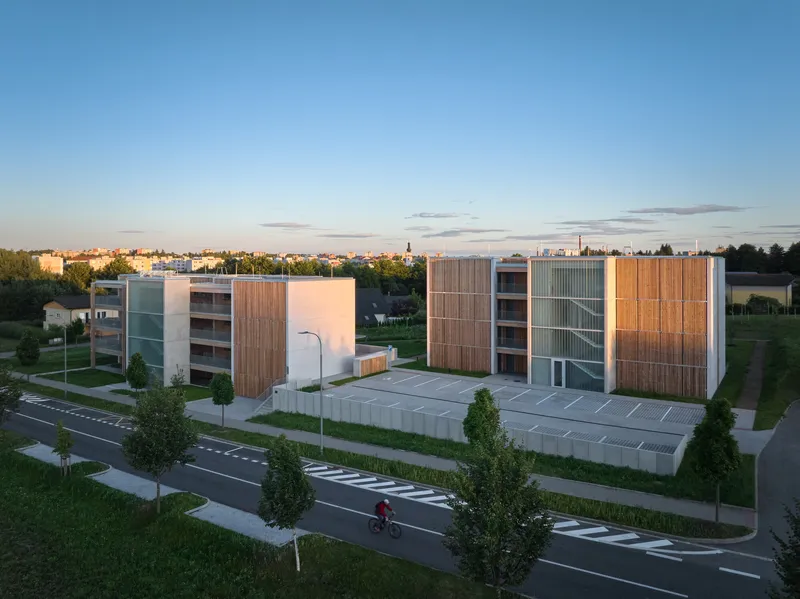
From above, the vegetated rooftops are clearly visible, confirming that the green-roof strategy is not merely aspirational. The two blocks sit in a suburban fabric of curving streets and detached houses, and the aerial views reveal how the parking lot and access road have been organized to keep cars at the perimeter. The site slopes gently, and the architects use this topography to step the building volumes, reducing their apparent mass from the north elevation.
The western portion of the site is reserved for leisure areas and planting, creating a buffer between the residential blocks and the surrounding neighborhood. Permeable surfaces in the landscaping align with the nature-based design principles the project espouses. For a development of this density in a small Czech city, the site strategy is unusually thoughtful.
Plans and Drawings
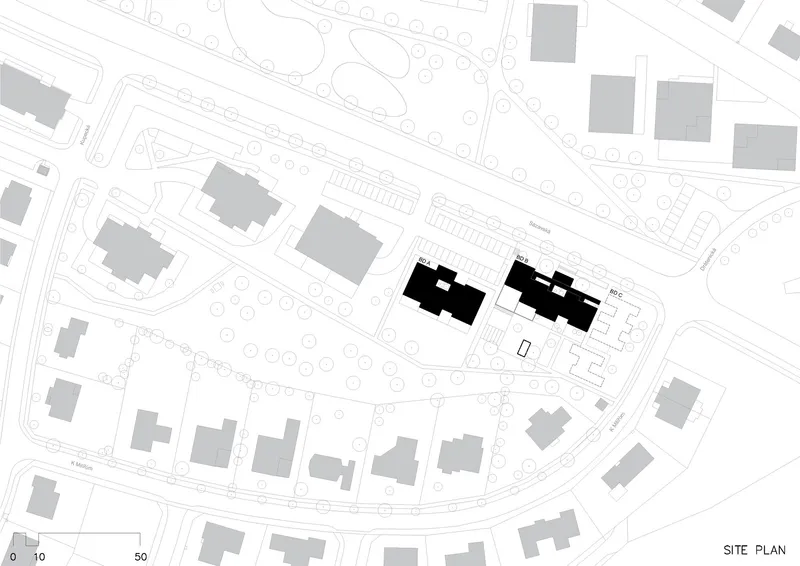
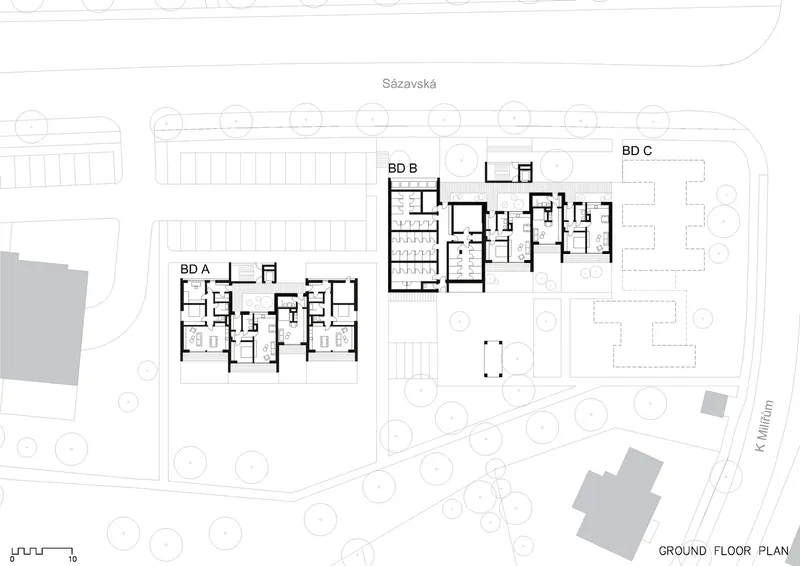
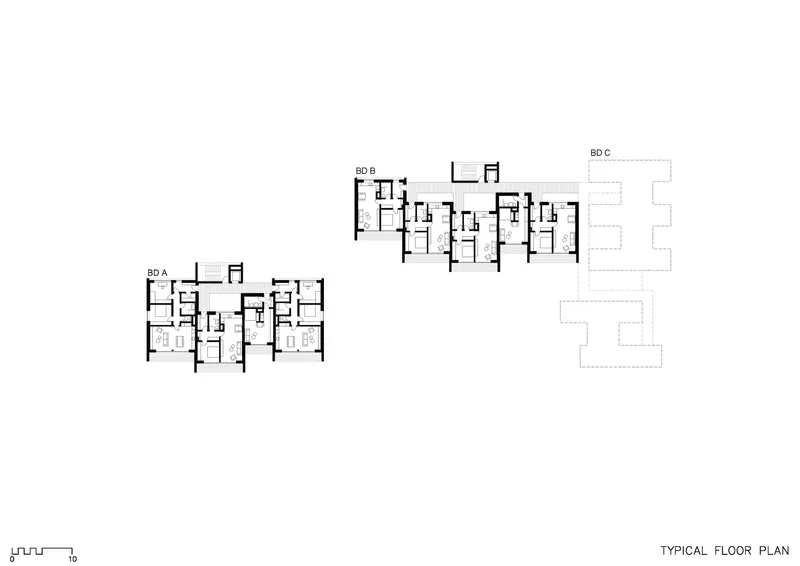
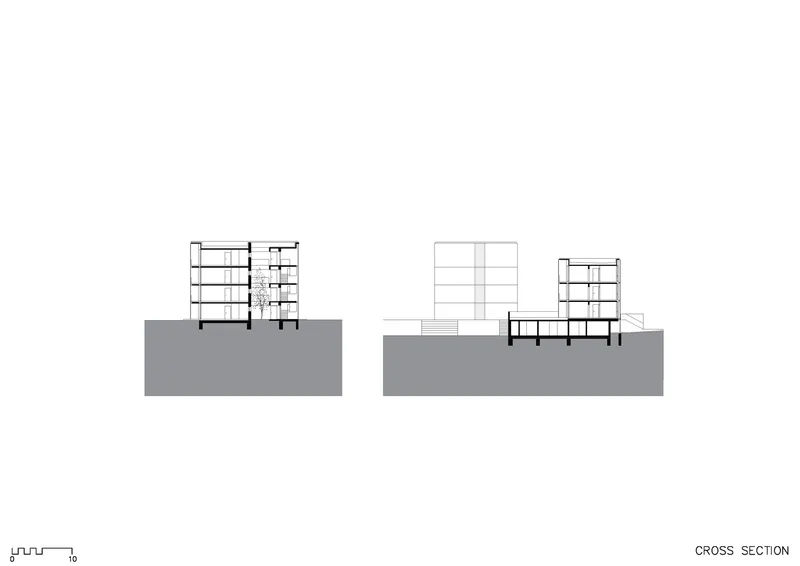
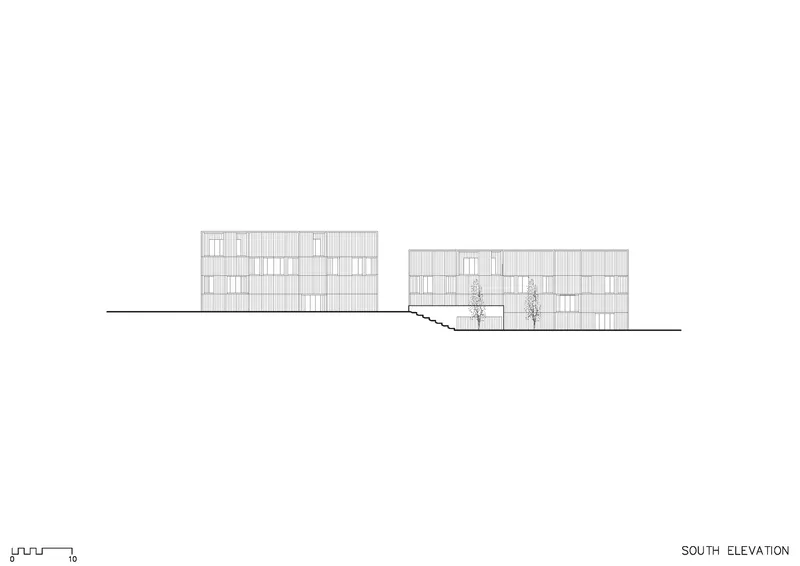
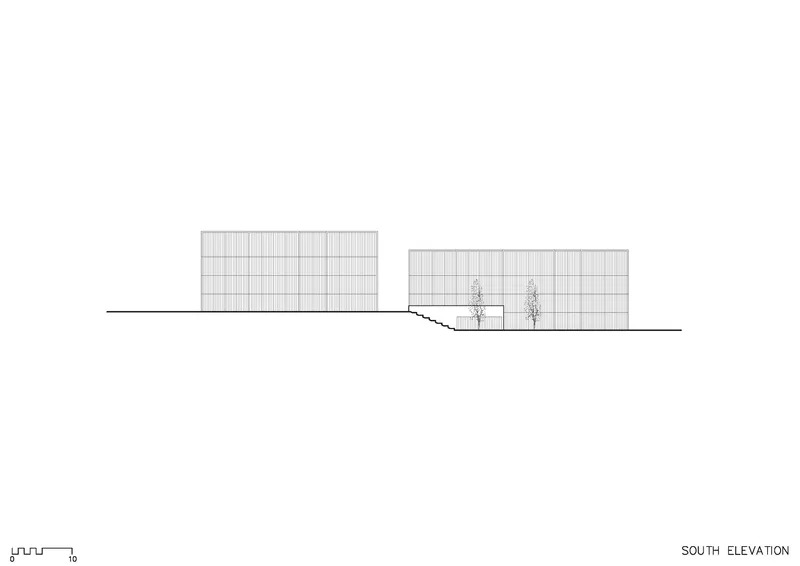
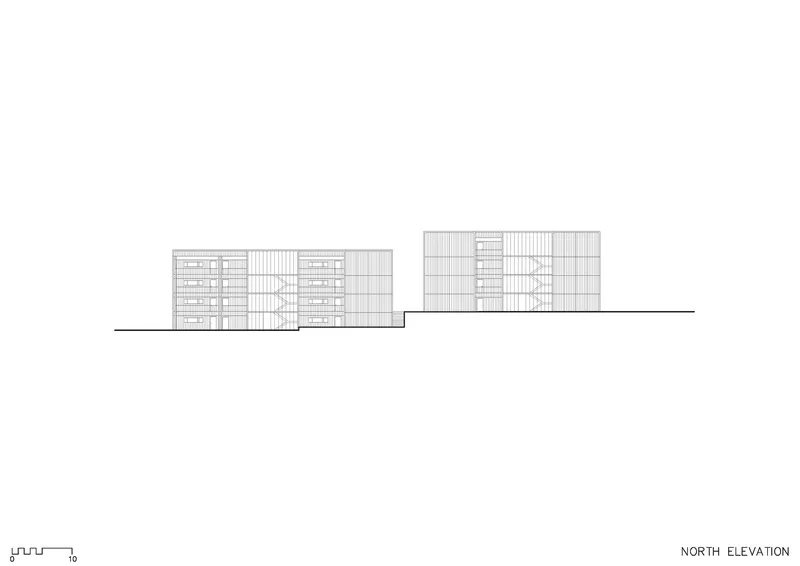
The site plan shows two principal blocks positioned at the bend of a suburban street layout, with landscaped buffers on all sides. The ground floor plan reveals how the individual residential volumes are organized as discrete bars, each served by its own core, while the typical floor plan confirms the modular repetition of unit layouts. Cross sections illustrate the stepping strategy across the sloped terrain, with the taller volume anchoring the corner and shorter elements descending to the west.
The elevation drawings are particularly instructive. The south elevations show the gridded facade of timber screens and planted courtyard entries, while the north elevation reveals how three connected volumes step down the slope. The regularity of the structural grid is evident in every drawing, reinforcing the point that this is architecture built from systematic repetition rather than gestural form-making.
Why This Project Matters
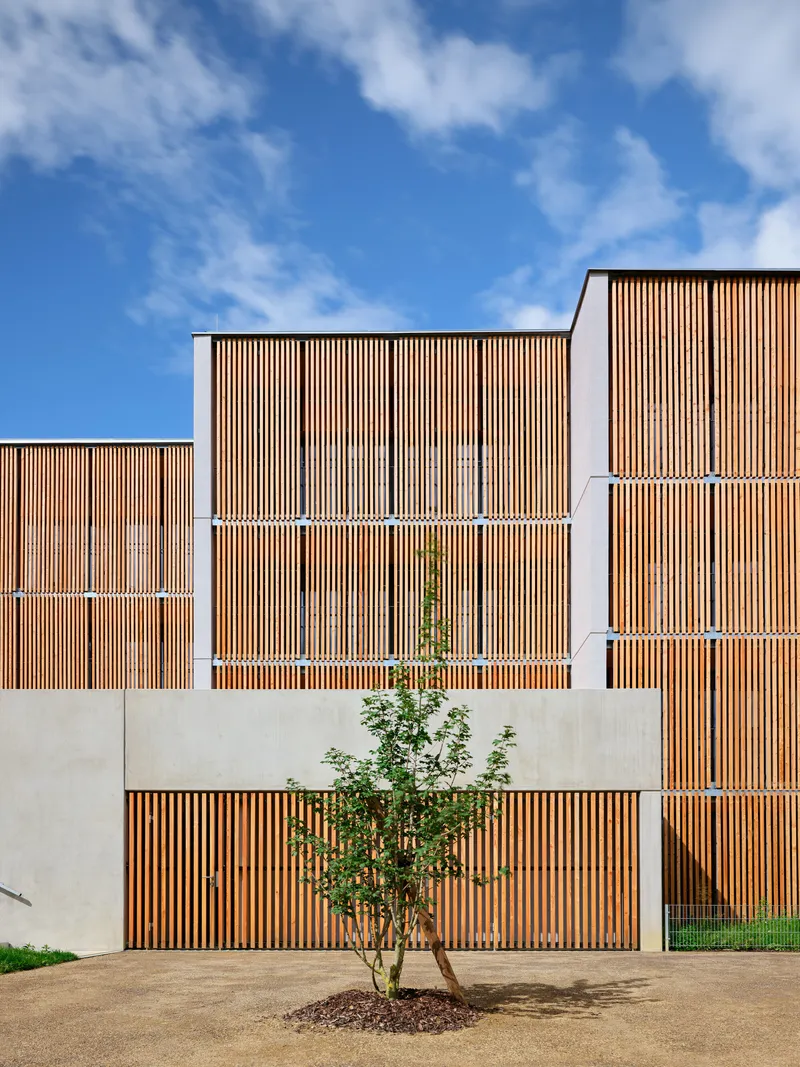
The significance of Zdar Wooden Housing is not symbolic. It is not a pavilion or a research prototype. It is affordable rental housing, funded through a government program, built on a real corner site in a real Czech city. That it happens to be one of the first multi-storey timber residential buildings in the country is important, but what matters more is that it demonstrates timber construction can meet the cost, code, and density requirements of mainstream housing production. The hybrid CLT-and-concrete system, fully prefabricated and assembled on site, is a replicable model.
Kuba and Pilar Architekti have also shown that prefabricated modularity does not have to produce monotonous facades or lifeless streets. The folding shutters, the layered loggias, the translucent stair towers, and the courtyard typology all contribute to a building that engages its neighborhood with specificity and care. If Czech cities are serious about decarbonizing their housing stock, they could do worse than look at what happened in Žďár nad Sázavou.
Zdar Wooden Housing, designed by Kuba and Pilar Architekti. Žďár nad Sázavou, Czechia. 2064 m². Completed 2025. Photography by BoysPlayNice.
About the Studio
Share Your Own Work on uni.xyz
If projects like this are the kind of work you want to make, uni.xyz is a place to publish your own, find collaborators, and enter design competitions.




Popular Articles
Popular articles from the community


The Ocean Hive: Sustainable Architecture for a Self-Sufficient Civilization at Sea
The Ocean Hive imagines sustainable architecture at sea, where modular habitats, algae, wave power and ocean waste sustain a growing colony.

The Earth Pod: 3D Printed Homes for Resilient Refugee Communities
The Earth Pod reimagines refugee housing through 3D printed homes made from clay, combining resilience, self-sufficiency, and rapid shelter.

Co-Life: Senior Housing Design That Reconnects Older Adults With the City
Co-Life reimagines senior housing design through healing gardens, shared streets, workshops, and a sustainable community across generations.

Lunar Spiral: Space Architecture Shaped by the Mathematics of the Universe
Lunar Spiral reimagines space architecture through Fibonacci geometry, lunar regolith, levitating habitats, and self-sustaining Moon living.


Similar Reads
You might also enjoy these articles

Bao Huynh Watercolor Atelier: A Serene Art Retreat in Hội An
Bao Huynh Watercolor Atelier in Hội An blends multifunctional art spaces, sustainable design, local materials, and family-friendly living in a serene environment.

Atelier Macri Concept Store Interior Design by CASE-REAL
Atelier Macri store features a "ko" counter, walnut wood details, cork displays, blending retail, gallery, and seamless customer experiences.

Manuel Vargas Izquierdo Stadium and High-Performance Sports Center: Architectural Excellence in Jalpa de Méndez
The Manuel Vargas Izquierdo Stadium blends sustainable design, inclusive sports facilities, and cultural-inspired architecture, revitalizing Jalpa de Méndez’s public spaces.

KAKR Buluh Awar Hall: Revitalizing Community and Ecology Through Bamboo Architecture
Community built bamboo hall revitalizes Buluh Awar village, empowering youth, restoring ecology, celebrating vernacular craftsmanship through sustainable architecture and culture.
Comments (0)
Please login or sign up to add comments
No comments yet. Be the first to comment!