
Kunze Seeholzer Architekten Slip Six Luminous Confessionals into a Renaissance Church in Munich
Eighteen square meters of vertically ribbed timber volumes bring a quiet, contemporary layer to the Jesuit Church of St. Michael.


The Jesuit Church of St. Michael in Munich's old town, built between 1583 and 1597, sits stylistically at the hinge between Renaissance and Baroque. Its barrel-vaulted nave, coffered ceilings, and gilded plasterwork form one of the most theatrically rich ecclesiastical interiors in southern Germany. When kunze seeholzer architekten, led by Stefanie Seeholzer, was asked to design six new confessionals for this space, the brief was deceptively small: just 18 square meters of built area. But the real challenge was tonal. Anything too assertive would fight the church; anything too deferential would vanish.
The result is a family of pale, vertically ribbed timber volumes that glow softly from within. They read as distinct objects, almost like sacred furniture scaled up to architecture, yet they sit beneath the church's ornamental angels and wrought iron gates without competing for attention. What makes the project genuinely interesting is how the architects used repetition, material restraint, and light to create intimacy inside a space designed for grandeur. These are rooms within a room, and they achieve something surprisingly difficult: privacy and warmth inside a monumental stone interior.
Insertions, Not Additions
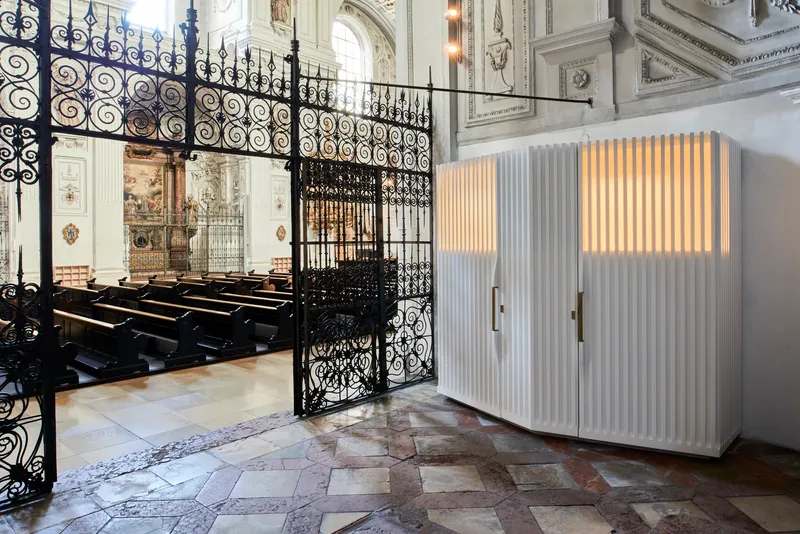
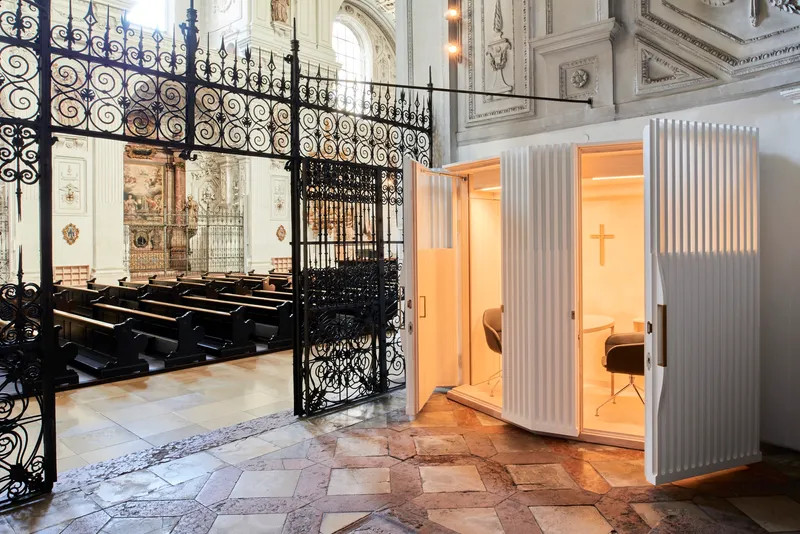
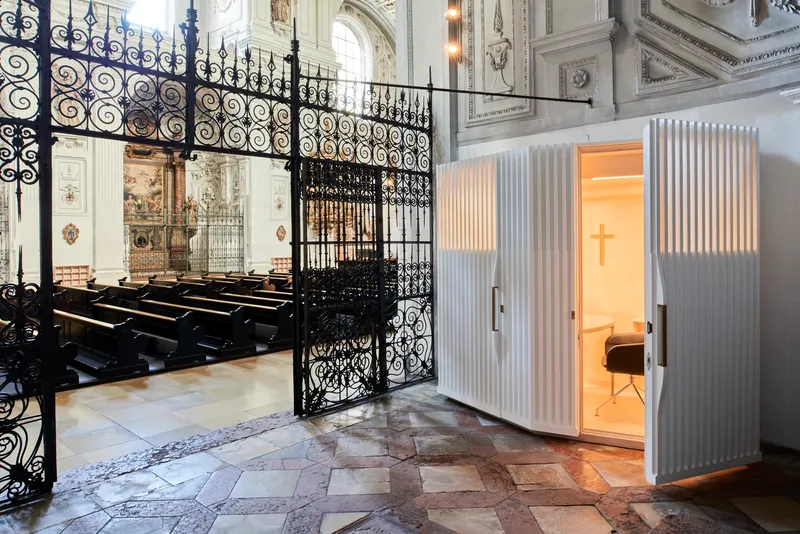
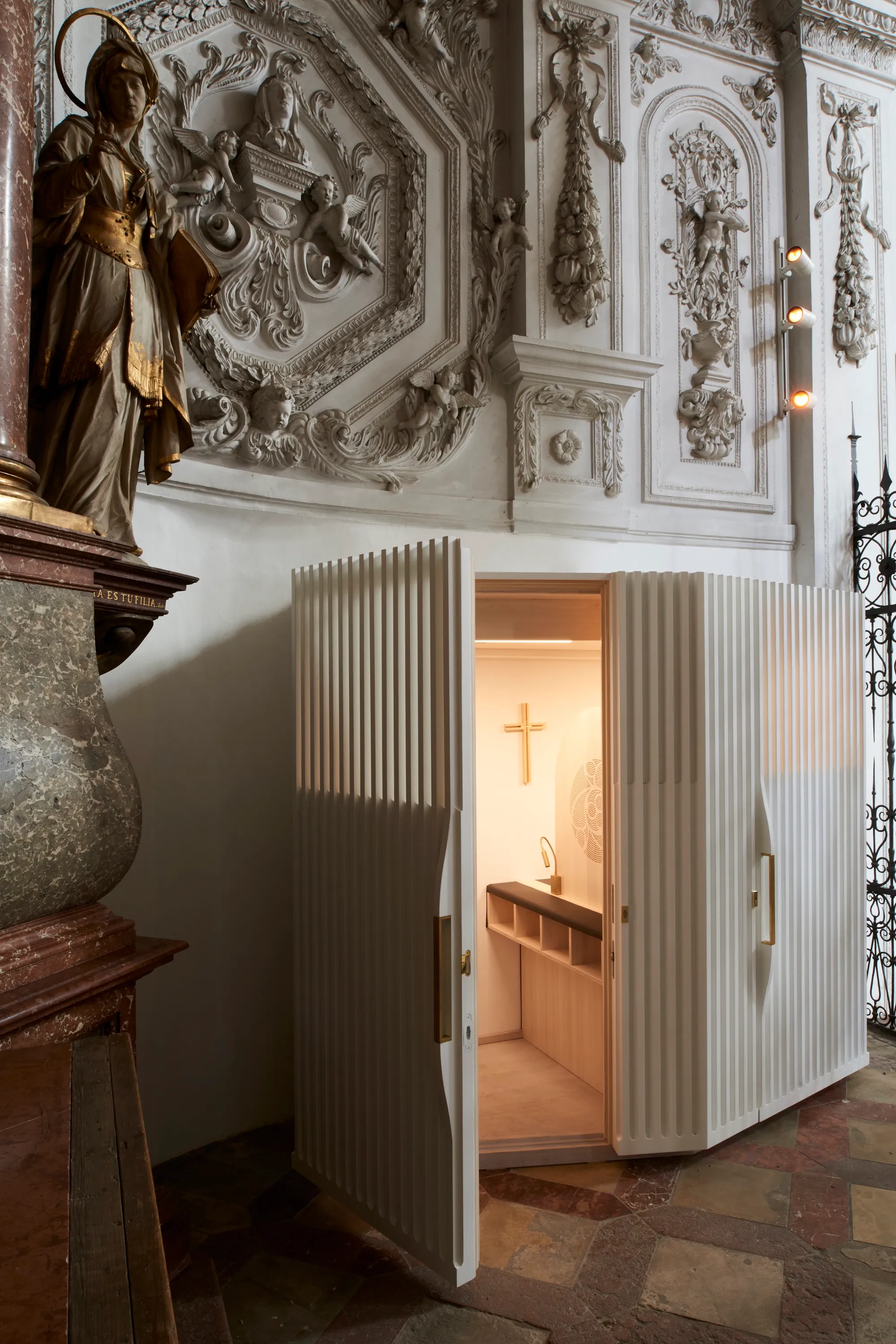
The confessionals are positioned beneath the church's side arches, originally the sites of older confessional furniture placed below sculpted angels carrying instruments of suffering. Rather than mimicking the church's ornamental vocabulary, the new volumes announce themselves clearly as contemporary insertions. Their white, vertically fluted surfaces stand in deliberate contrast to the dark wrought iron enclosures and patterned stone floors that surround them. The formal language is calm and systematic: identical ribs, consistent proportions, no applied ornament.
The strategy works because it refuses to fake continuity. A pastiche approach would have been swallowed by the church's overwhelming decorative density. Instead, these quiet white volumes hold their ground through material consistency and geometric clarity. They borrow nothing from the Baroque but earn their place through composure.
Light as Threshold
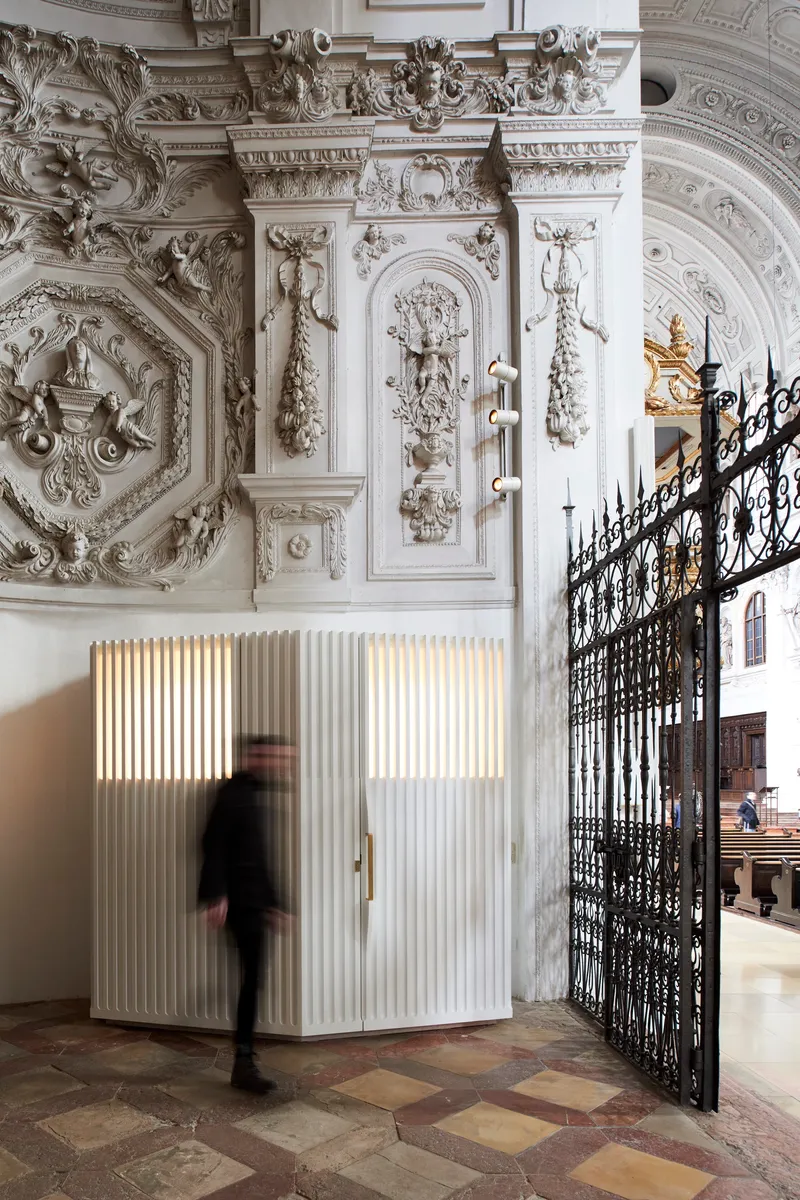
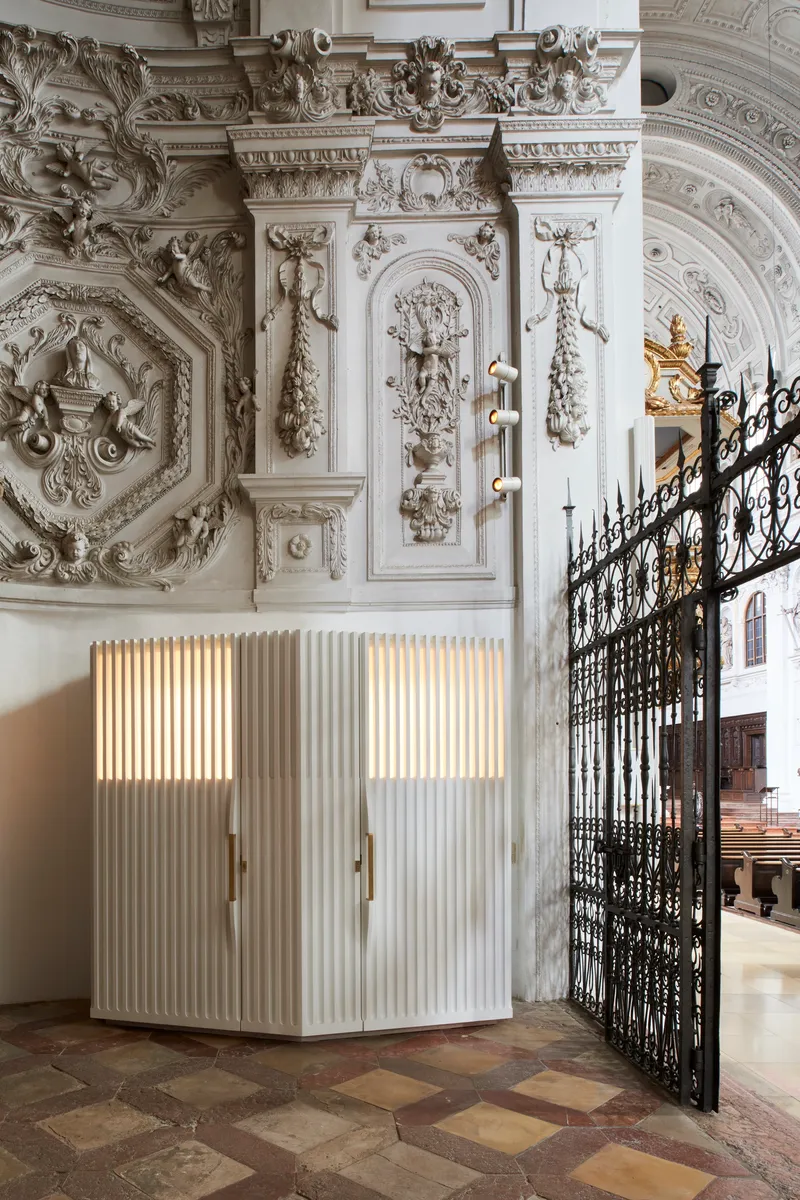
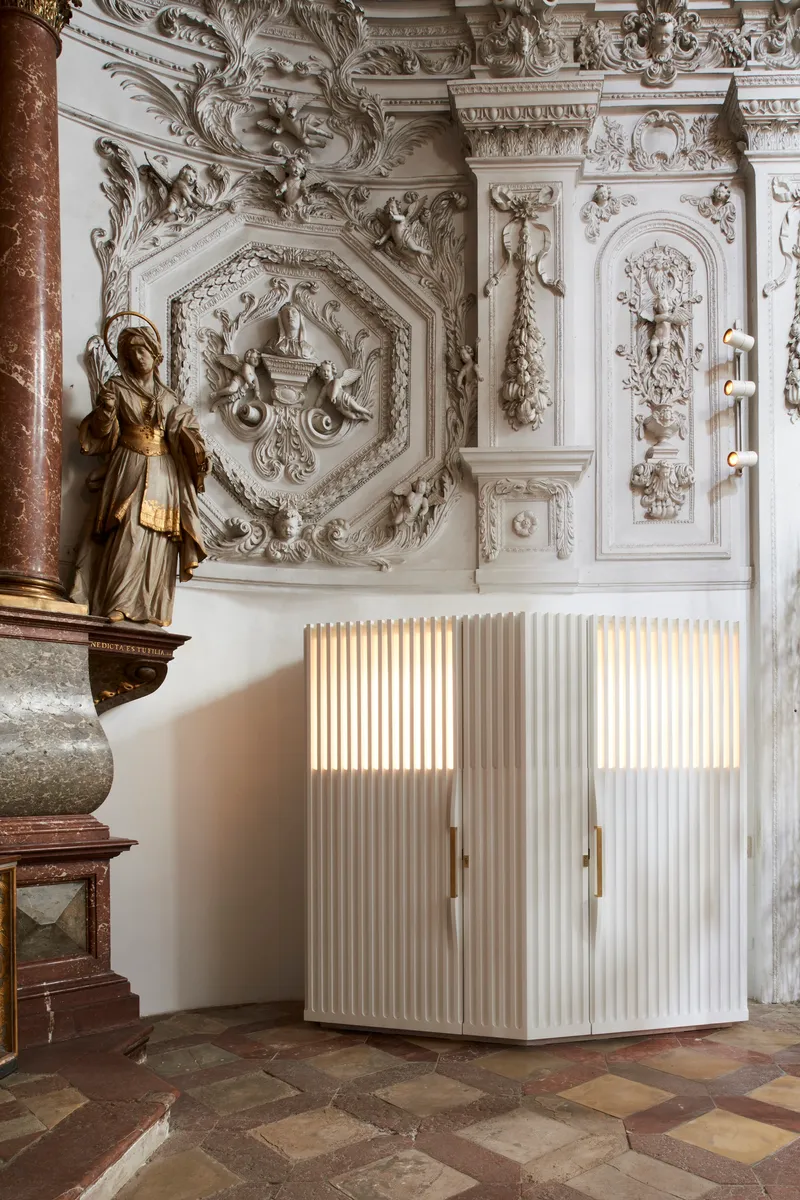
Backlit panels set between the vertical fins transform the confessionals into lanterns within the church's comparatively dim nave. The glow is warm but restrained, enough to signal occupancy and openness without creating a spectacle. It serves a practical wayfinding purpose, marking the confessionals as accessible, but it also establishes a psychological threshold. Walking toward that light, the penitent transitions from the public grandeur of the nave into something intimate and contained.
The interplay between the softly luminous confessional surfaces and the gilded plasterwork overhead is particularly effective. The church's existing ornamentation catches and reflects candlelight in complex, dramatic ways. By contrast, the confessionals emit an even, diffused glow. Two registers of light, centuries apart, coexist without friction.
Inside the Chamber
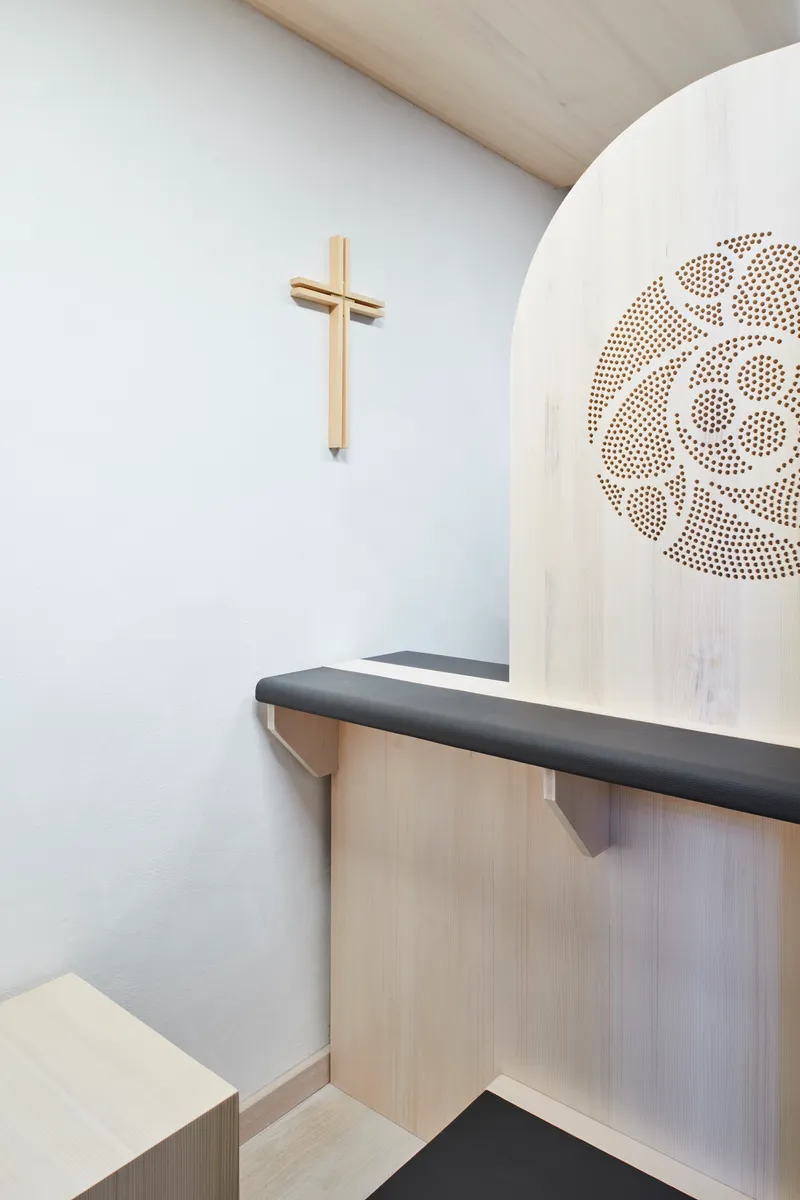
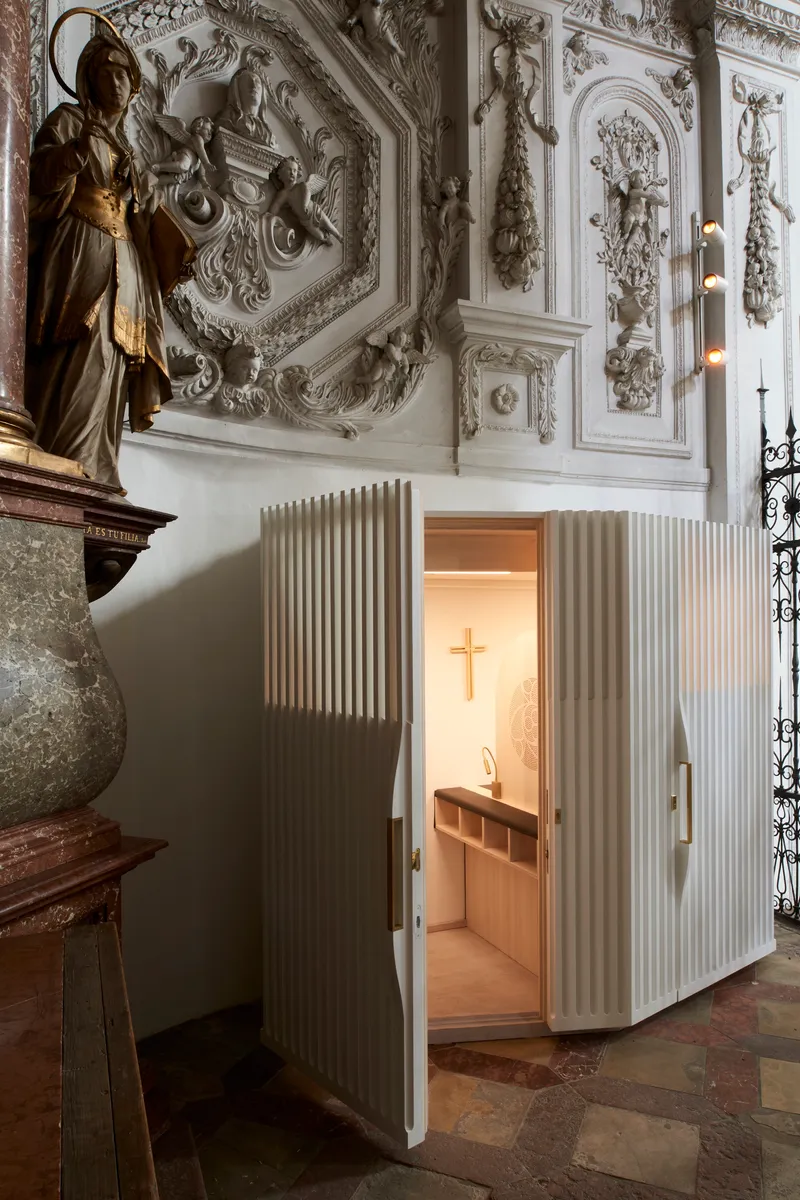
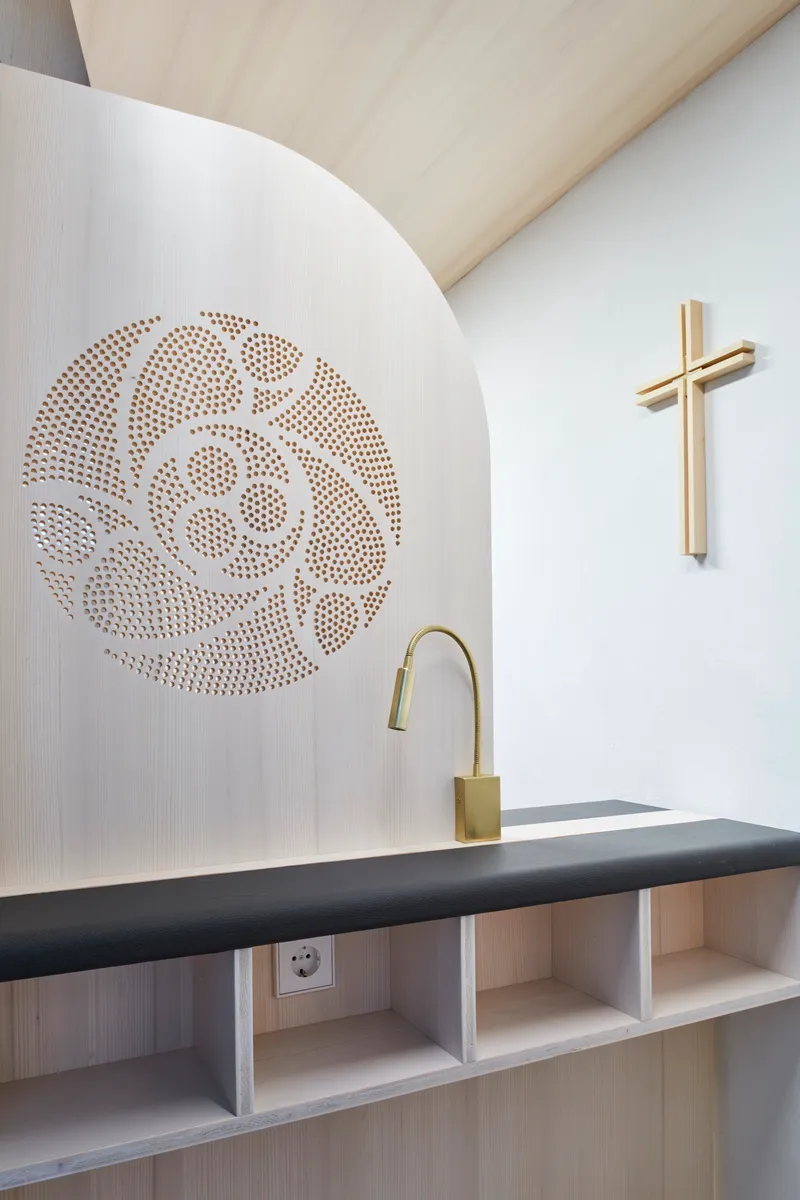
Step through the door and the church effectively disappears. The interiors are pared to essentials: pale timber surfaces, a simple cross mounted on the wall, a bench, and a perforated panel whose circular pattern is the closest the design comes to decorative gesture. Two of the six confessionals are configured as consulting rooms, where the user sits directly opposite the confessor. The remaining four allow the confessor to choose whether to kneel before a traditional grille or sit face to face. This flexibility is a considered response to evolving liturgical practice within the Jesuit tradition.
The perforated panel detail deserves attention. Its pattern recalls the church's own ornamental motifs, abstracted and regularized into something that reads as contemporary craft. It also serves an acoustic and visual purpose, mediating between the two sides of the confessional without fully separating them. A brass fixture and dark upholstered bench add tactile warmth to what could otherwise be an austere box.
Meeting the Church Floor
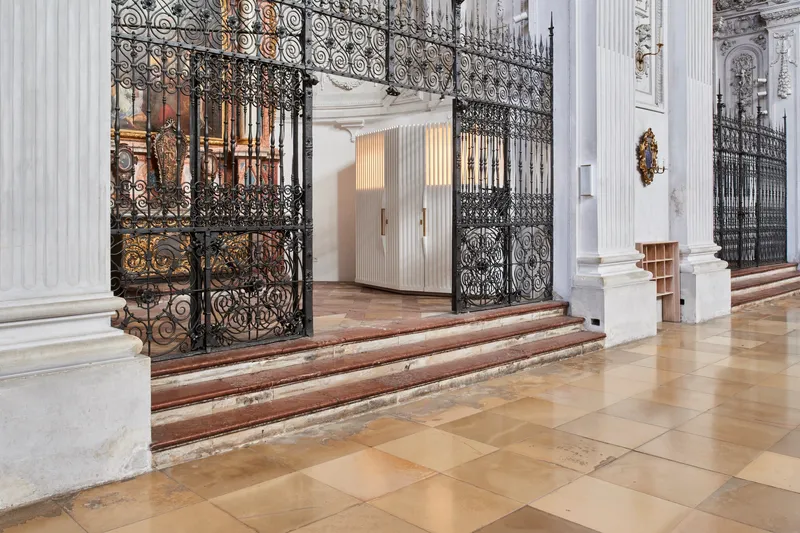
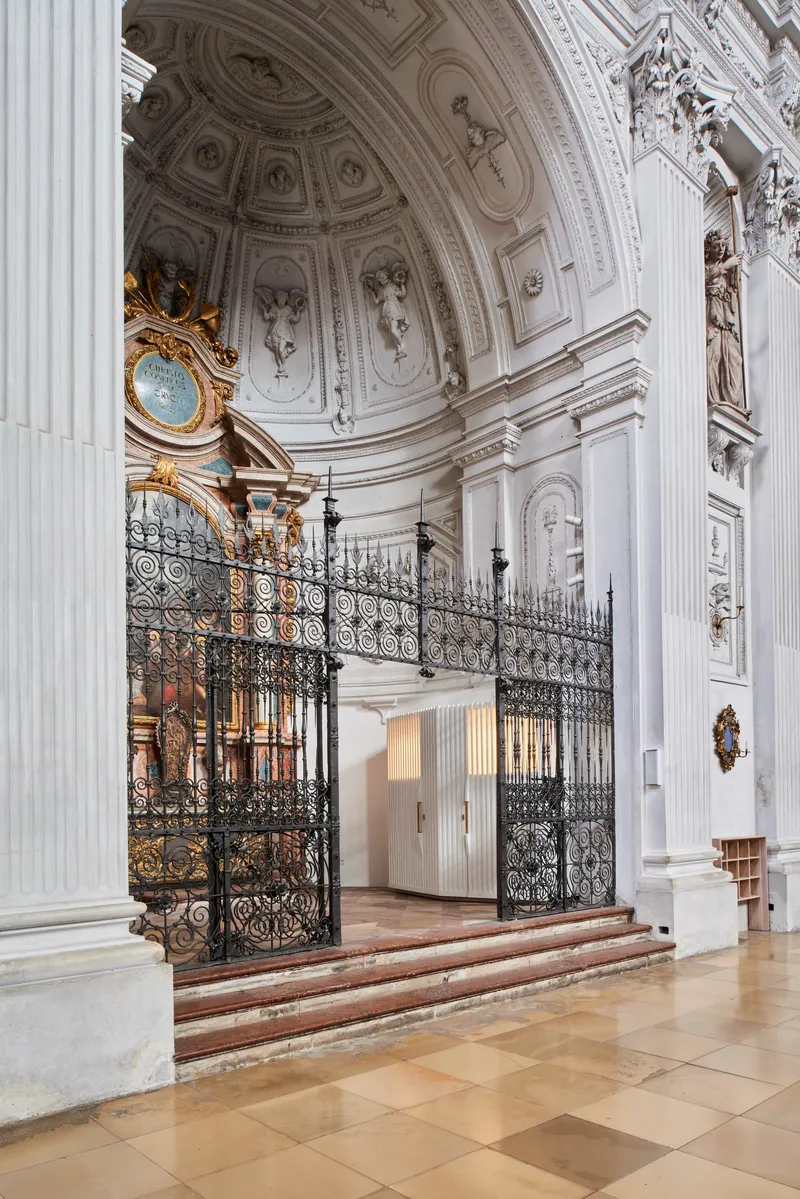
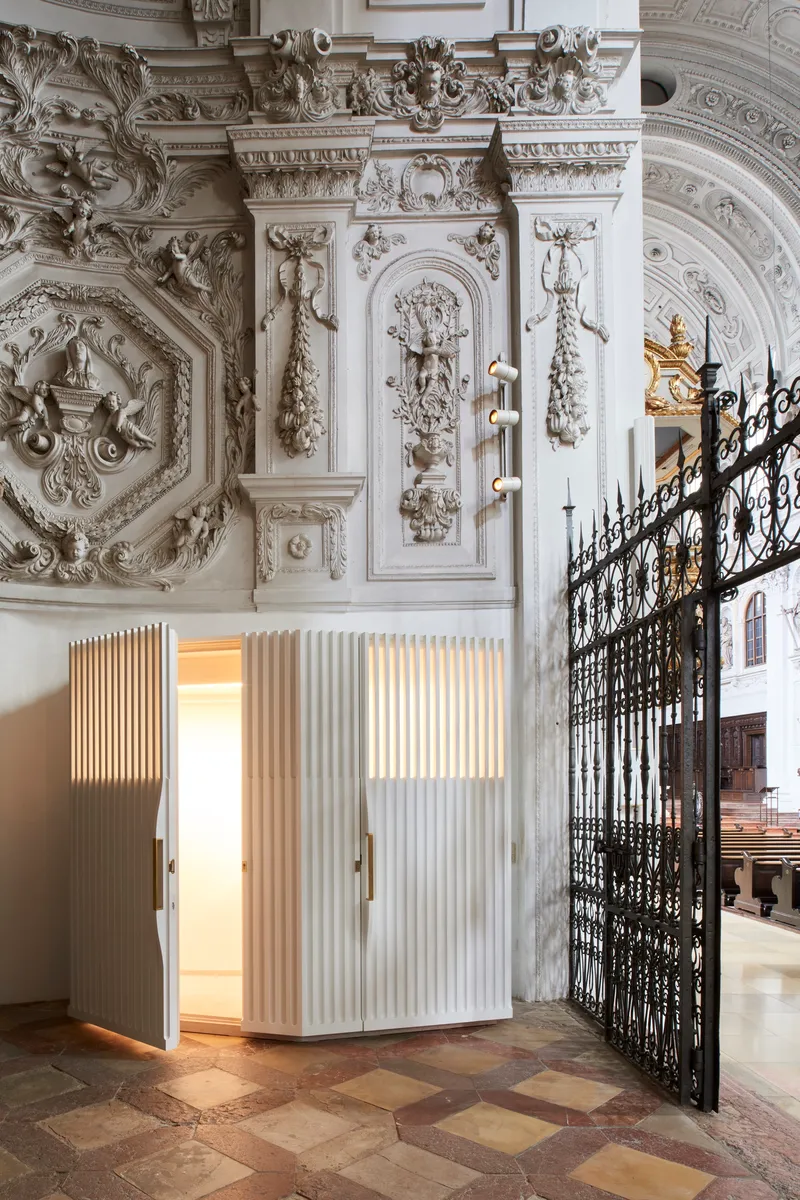
Low marble steps at the base of the wrought iron enclosures create a subtle datum change as one approaches. The confessionals sit slightly elevated from the nave's main floor, reinforcing the sense of crossing into a separate spatial zone. The curvature of the enclosure walls, visible beneath the coffered dome and ornamental plasterwork, suggests that the architects studied the specific geometry of each bay carefully. These are not standardized boxes dropped into available floor space; they are calibrated to the arches above and the ironwork in front.
The open doorway in each unit, with its brass handles and warm interior light, functions almost like a small-scale portico. It invites without demanding. Against the heavy material palette of the church, stone, iron, gilded stucco, the timber confessionals feel almost weightless.
Texture and Repetition
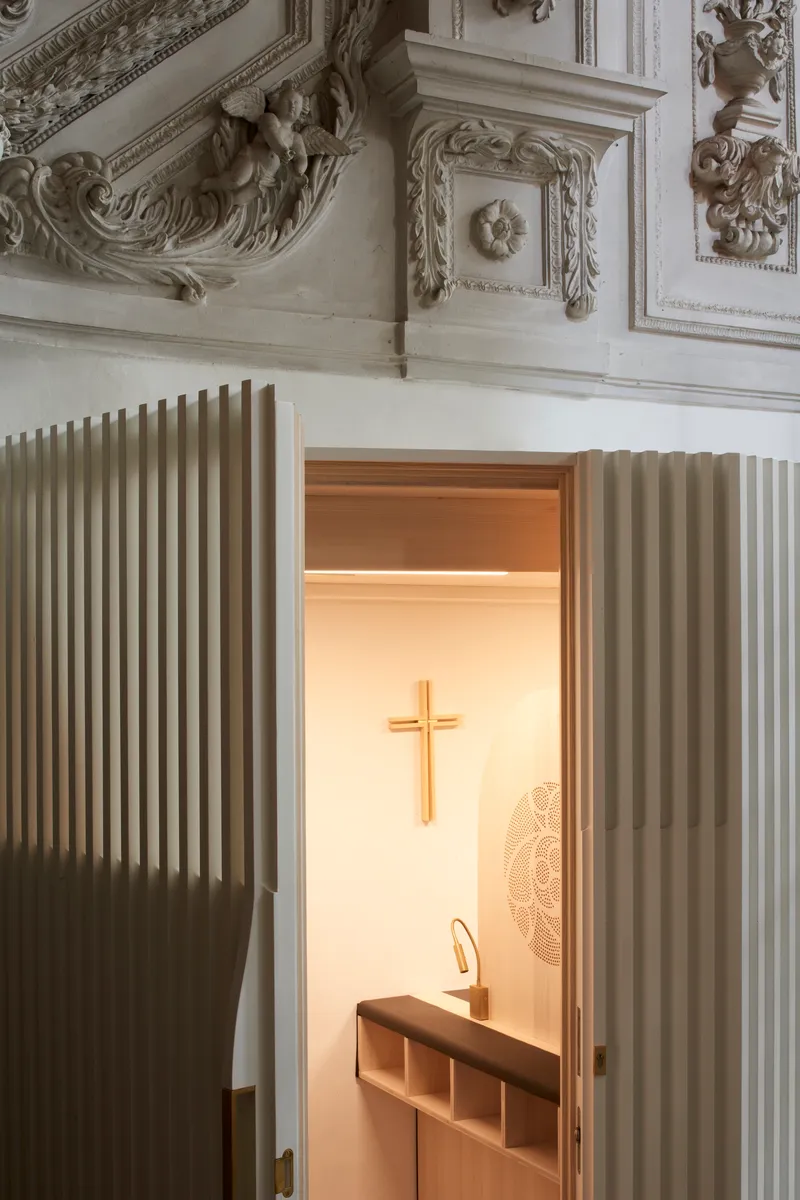
The vertical ribbing that defines the exterior surfaces is the project's most recognizable move. It does several things at once. Structurally, the fins add rigidity to what are thin-walled enclosures. Optically, they break down the scale of each volume into a finer grain that resonates with the church's own fluted pilasters and column shafts. And materially, they create a play of shadow across the white surface that shifts throughout the day as natural light moves through the nave.
Repetition across all six units gives the project cohesion. Whether you encounter a confessional in the north aisle or the south, the language is identical, establishing a legible system. The church already operates on principles of serial repetition, side chapels, bays, arches, and the confessionals tap into that rhythm without imitating it.
Plans and Drawings
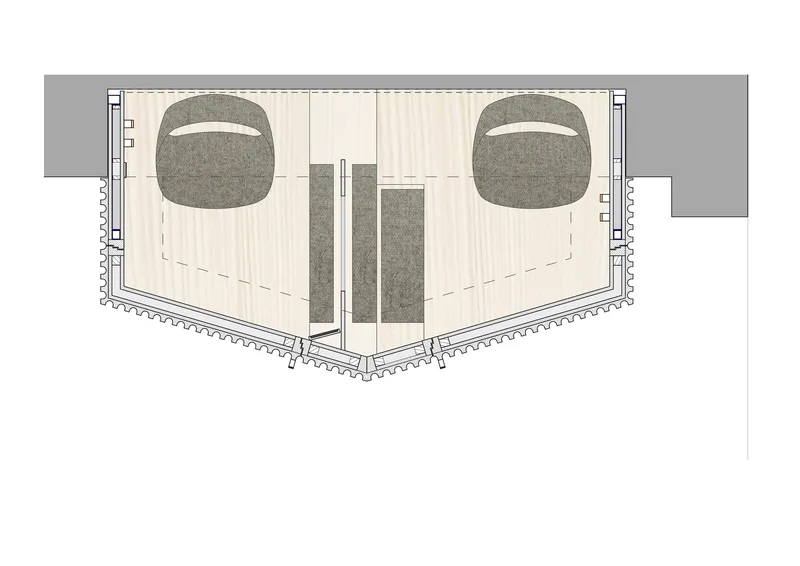
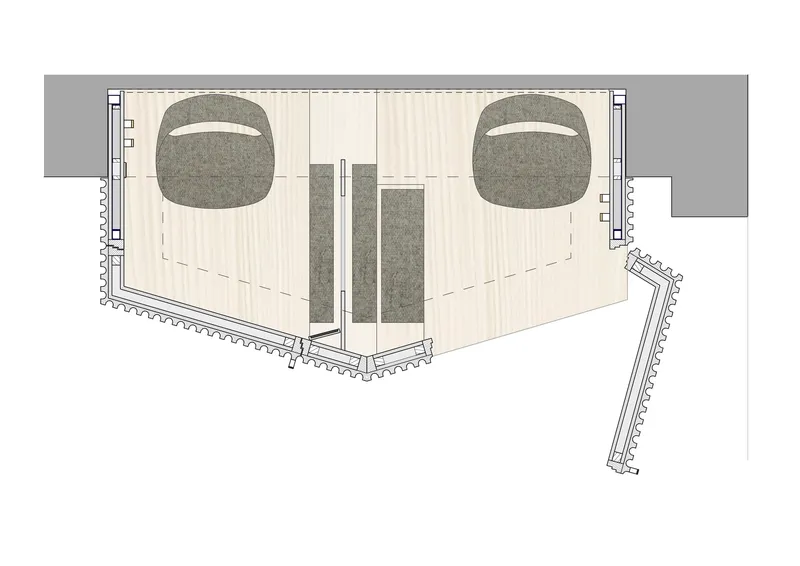
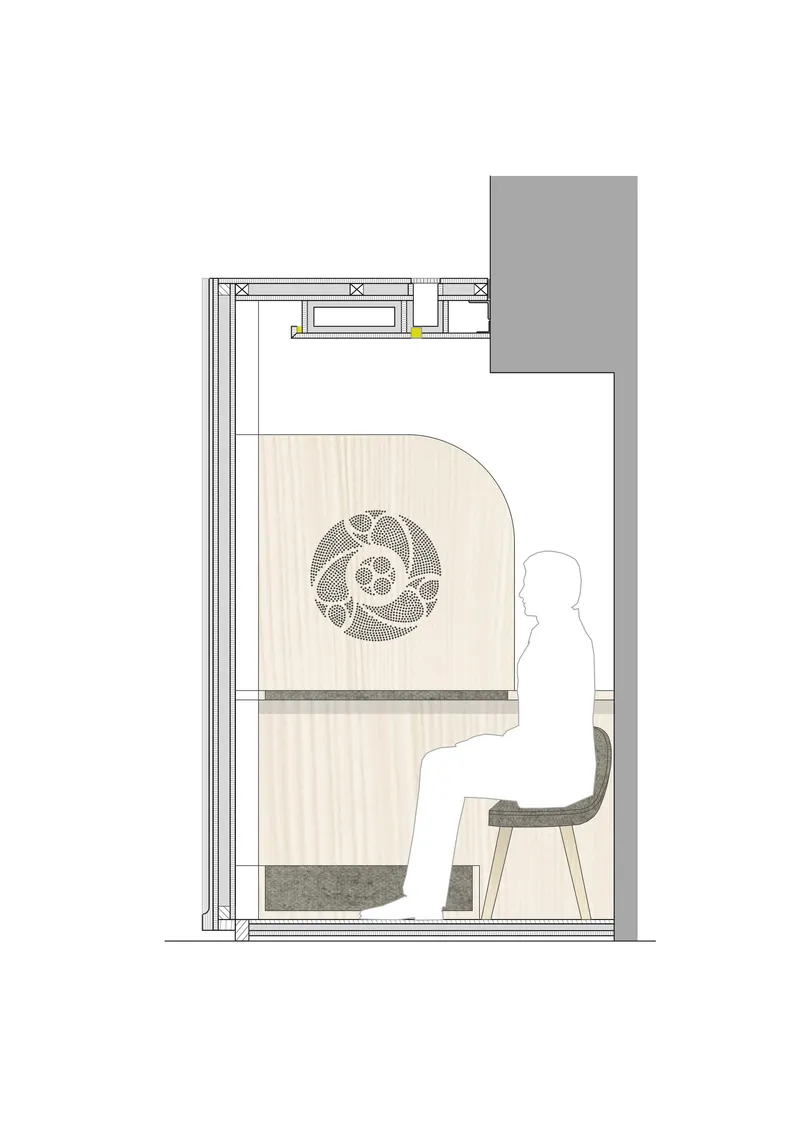
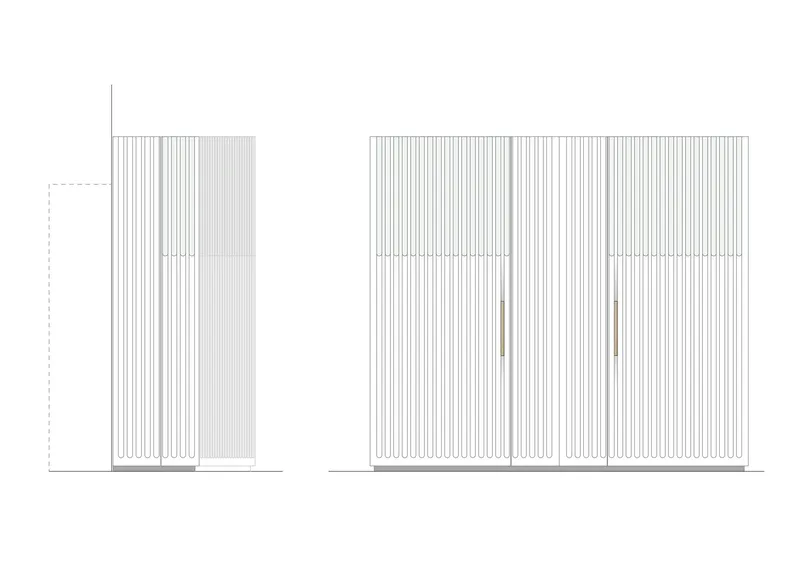
The floor plans reveal twin confessional volumes arranged around a central entry, with curved seating areas that soften the rectilinear geometry of the enclosure. An axonometric detail shows how the ribbed panels and stepped threshold are assembled, suggesting a kit-of-parts logic that would allow the units to be fabricated off-site and installed with minimal disruption to the historic interior. Sections confirm the overhead lighting strategy and illustrate the seated figure's relationship to the decorative motif panel. The elevation drawings compare closed and open configurations, demonstrating that even in its shut state, the confessional remains visually permeable thanks to the gaps between vertical fins.
Why This Project Matters
Interventions inside listed historic churches are among the most scrutinized commissions in European architecture, and they tend to produce two predictable outcomes: invisible deference or aggressive contrast. The confessionals for St. Michael manage to occupy a third position. They are clearly contemporary, unmistakable as 21st-century objects, yet they participate in the church's spatial logic of serial bays, filtered light, and carefully modulated thresholds. That balance is harder to achieve than it looks, especially at a scale this small.
At just 18 square meters, the project is a reminder that architectural intelligence is not proportional to floor area. Every decision here, from the ribbed surface to the perforated panel to the choice of warm interior light against pale timber, was made in direct conversation with a 400-year-old building. The result is furniture that behaves like architecture, and architecture that knows when to be quiet.
Confessionals for St. Michael by kunze seeholzer architekten (lead architect: Stefanie Seeholzer), München, Germany. 18 m², completed 2020. Photography by Jann Averwerser.
About the Studio
Share Your Own Work on uni.xyz
If projects like this are the kind of work you want to make, uni.xyz is a place to publish your own, find collaborators, and enter design competitions.




Popular Articles
Popular articles from the community


Lunar Spiral: Space Architecture Shaped by the Mathematics of the Universe
Lunar Spiral reimagines space architecture through Fibonacci geometry, lunar regolith, levitating habitats, and self-sustaining Moon living.

Hill & Cross Opera: Sculptural Opera House Architecture Shaped by Tallinn’s Landscape and Identity
Hill & Cross Opera reimagines opera house architecture in Tallinn through its sculptural hill, civic plaza, glass wave and a luminous cross.

Play: Fragments of Their World
Familiar architecture becomes modular playground design, creating safe spaces where displaced children can learn, connect, imagine and play.

Conexión: Biophilic Design Reimagines High-Rise Living in Hong Kong
Conexión reimagines high-rise living in Hong Kong through biophilic design, green facades, shared spaces, daylight, water and nature within.
Similar Reads
You might also enjoy these articles

Bao Huynh Watercolor Atelier: A Serene Art Retreat in Hội An
Bao Huynh Watercolor Atelier in Hội An blends multifunctional art spaces, sustainable design, local materials, and family-friendly living in a serene environment.

Atelier Macri Concept Store Interior Design by CASE-REAL
Atelier Macri store features a "ko" counter, walnut wood details, cork displays, blending retail, gallery, and seamless customer experiences.

Manuel Vargas Izquierdo Stadium and High-Performance Sports Center: Architectural Excellence in Jalpa de Méndez
The Manuel Vargas Izquierdo Stadium blends sustainable design, inclusive sports facilities, and cultural-inspired architecture, revitalizing Jalpa de Méndez’s public spaces.

KAKR Buluh Awar Hall: Revitalizing Community and Ecology Through Bamboo Architecture
Community built bamboo hall revitalizes Buluh Awar village, empowering youth, restoring ecology, celebrating vernacular craftsmanship through sustainable architecture and culture.


Explore Architecture Competitions
Discover active competitions in this discipline



Challenge to reimagine the Iron Throne


Photograph architecture without architects


Illustrate the lost glory of Angkor Wat - Render Challenge


Design challenge to reuse E-waste
Comments (0)
Please login or sign up to add comments
No comments yet. Be the first to comment!