

L. McComber Converts a Contaminated Lachine Tavern into 18 Units of Permanent Housing
Place Tenaquip rebuilds a long-abandoned corner tavern in Montreal as dignified brick housing for residents leaving homelessness.


A derelict tavern sat at the corner of William-Macdonald Street and 6th Avenue in Lachine for years, boarded up and poisoned by contaminated soil underneath. Most developers would have scraped the lot clean and started fresh. L. McComber chose a harder path: carefully reconstructing the old building's presence while flanking it with two contemporary brick wings, producing 18 permanent housing units for people transitioning out of homelessness. The result, inaugurated in June 2025, is a project that treats social housing not as a lesser category of architecture but as a site where design rigor matters most.
What makes Place Tenaquip genuinely interesting is the way it refuses to announce itself as "social housing" in any visual register. The red clay brick, the rhythmic balconies, the textured bond patterns all read as considered residential architecture, full stop. The contamination that forced reconstruction rather than renovation became a design opportunity: the team could honor the memory of the corner building while engineering a structure suited to its new program. Developed with Groupe CDH and built by Fortis Construction, the project was delivered on time and on budget, a fact worth noting given how rare that is in affordable housing delivery.
A Corner Rebuilt from Memory
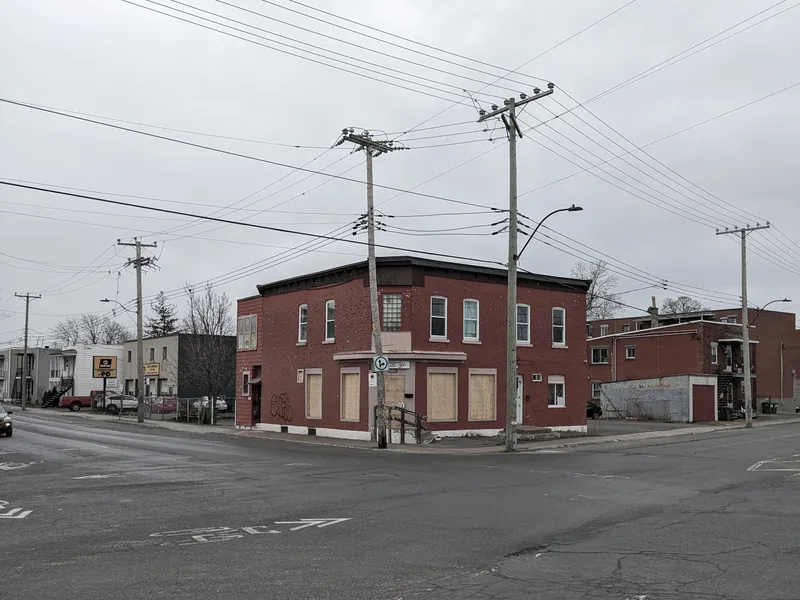
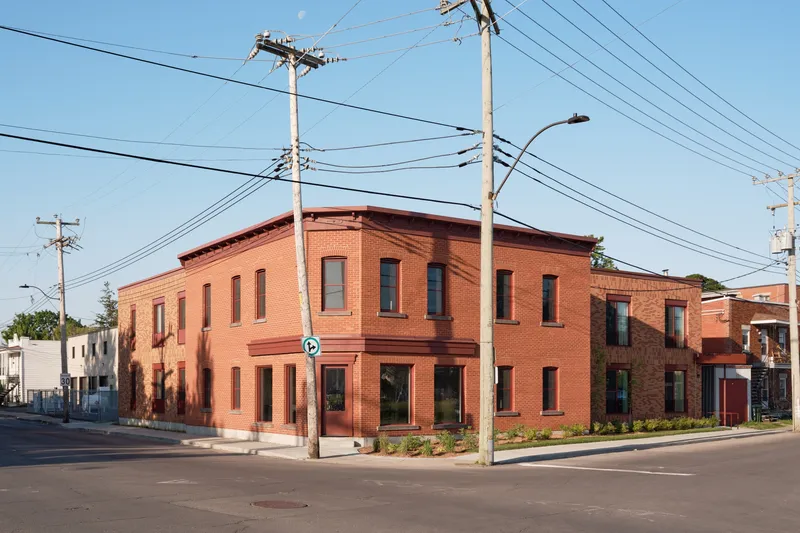

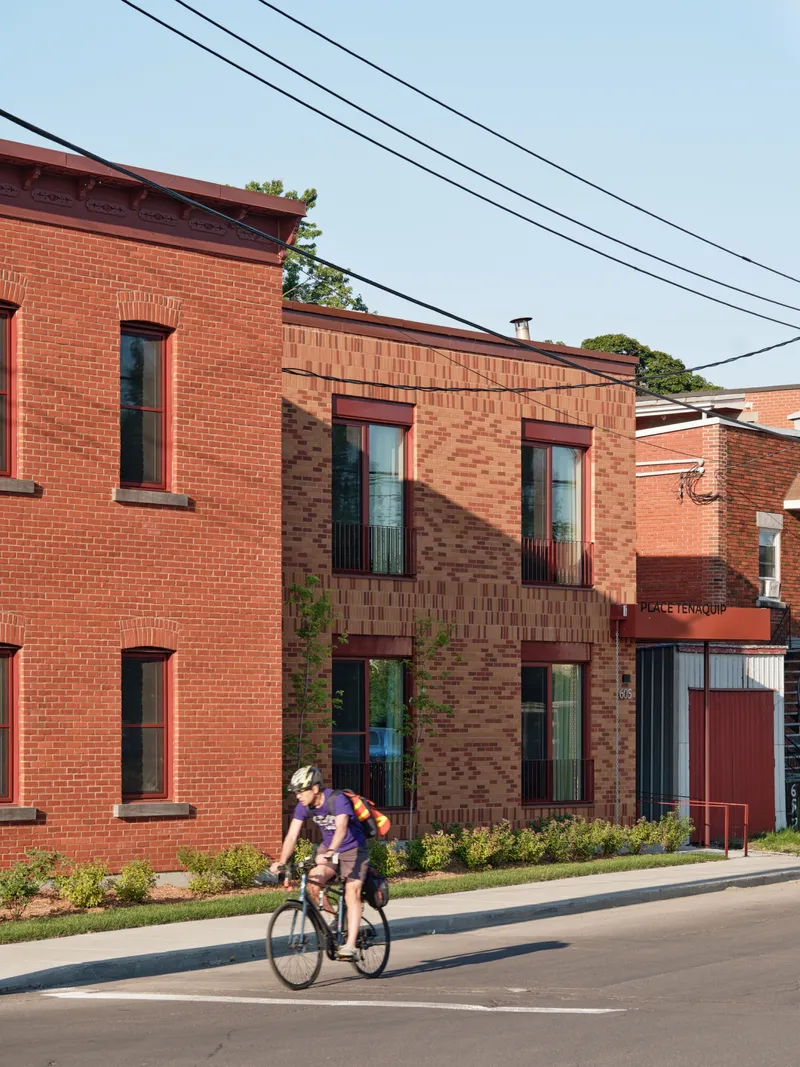
The before and after tells an unusually clear story. The original tavern, boarded and lifeless, occupied a prominent corner lot in a neighborhood that was changing around it. Soil contamination made a straightforward renovation impossible, so L. McComber reconstructed the building's corner presence and extended the complex along the street with new volumes. The completed project holds the corner with the same civic weight the old tavern once did, but now with inhabited balconies, planted edges, and a material warmth that signals care rather than neglect.
Walking along the sidewalk, a passerby encounters varied brick textures across the different volumes. The distinction between the reconstructed portion and the new wings is legible but not aggressive. There is no architectural heroism here, no gesture meant to shock. The building simply fills its lot with the quiet confidence of something that belongs.
Brick as Social Material
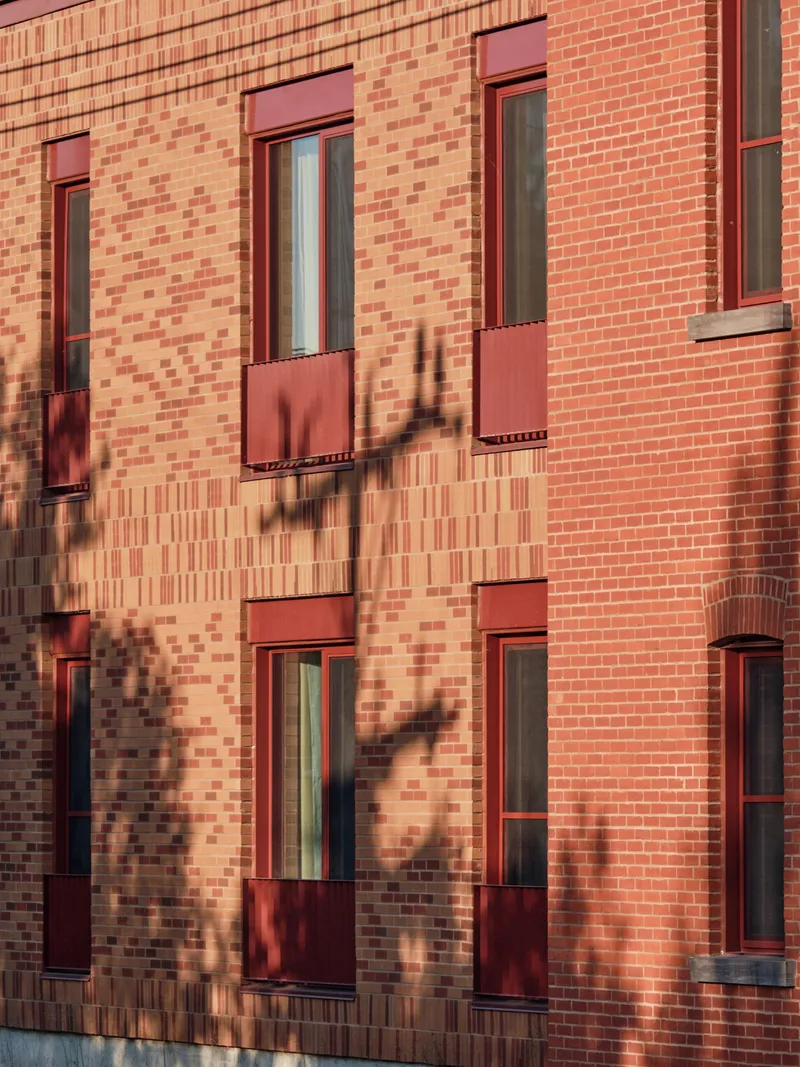
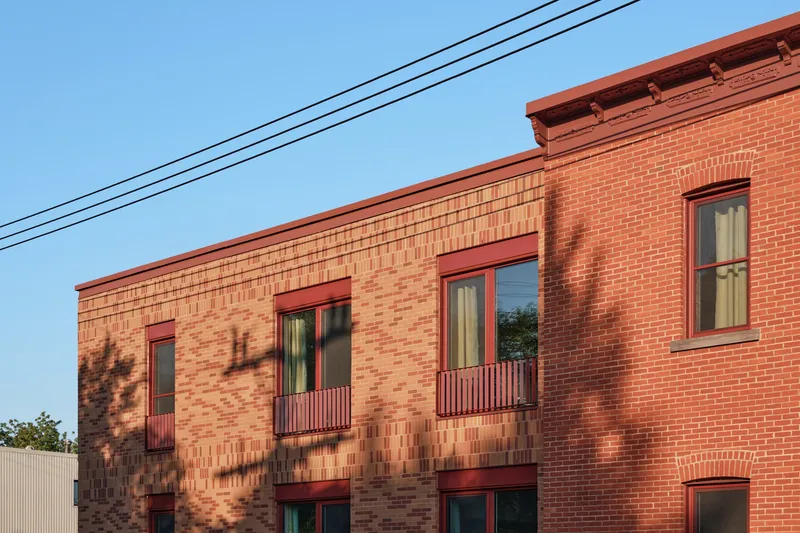

The facades reward close looking. Supplied by Montréal Brique & Pierre, the red clay brick is laid in multiple bond patterns across the building's volumes, creating a textured surface that plays with light throughout the day. Tree shadows dapple across the patterned sections, and at dusk the upper volumes glow with a warmth that owes as much to the masonry's relief as to the color of the clay itself.
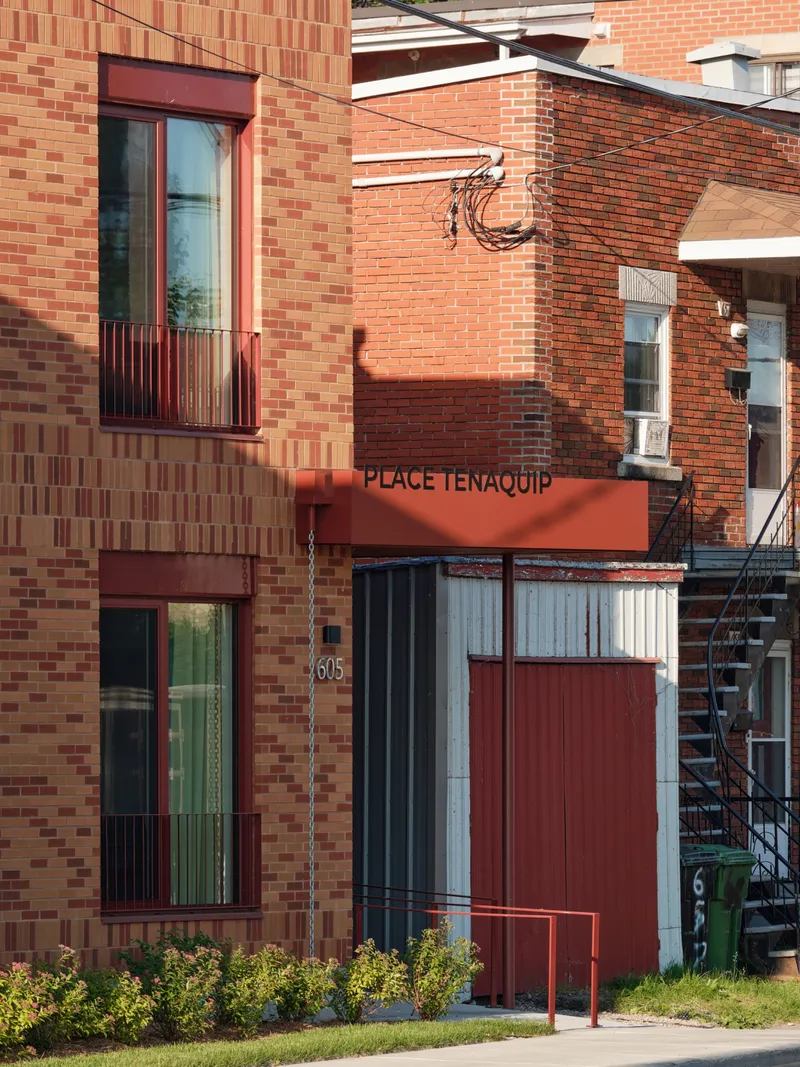
The recessed entrance courtyard is particularly well handled. Red metal screens sit within walls of varied brick bonds, creating an arrival sequence that feels sheltered without feeling institutional. In affordable housing, entrance thresholds carry enormous psychological weight: they are the boundary between public exposure and private safety. L. McComber treats this threshold with the same material seriousness given to the street-facing facades, which is exactly right.
Facade Rhythm and the Red Canopy
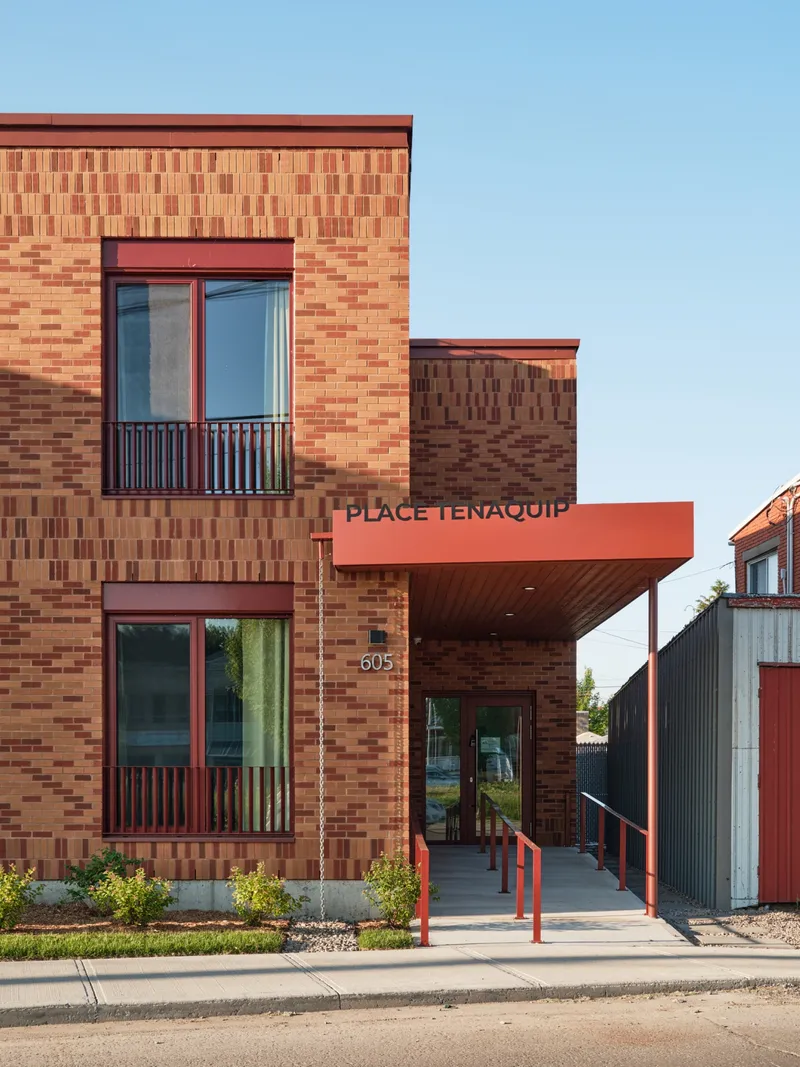
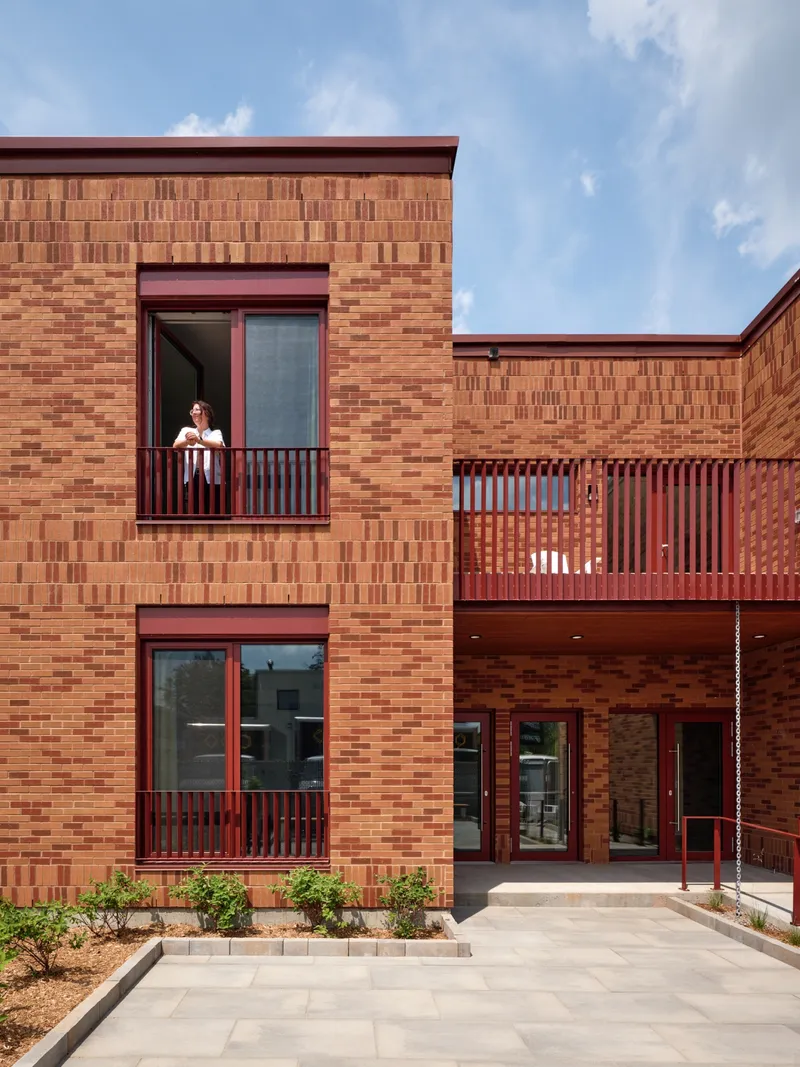
The cantilevered red canopy at the main entrance is the building's most overt formal gesture, and it works precisely because the rest of the architecture is so disciplined. Red metal railings on the stacked balconies echo the canopy's color, stitching a vertical line of life up the facade. A resident standing on an upper balcony in afternoon sun becomes part of the building's composition, a detail that matters in housing designed for people who have spent years being invisible.
At street level, the planted edge softens the base and draws cyclists and pedestrians close. The building participates in its sidewalk, which is essential for a project located near LaSalle Park and the Promenade du Rail. Lachine's public realm is an asset, and Place Tenaquip opens toward it rather than turning away.
Interior Spaces Built for Dignity

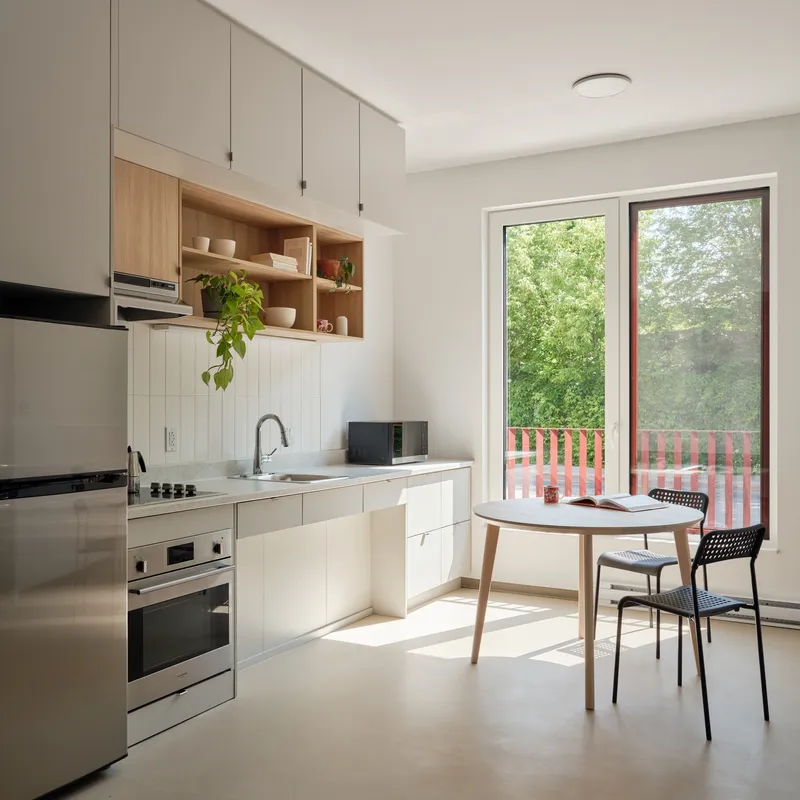
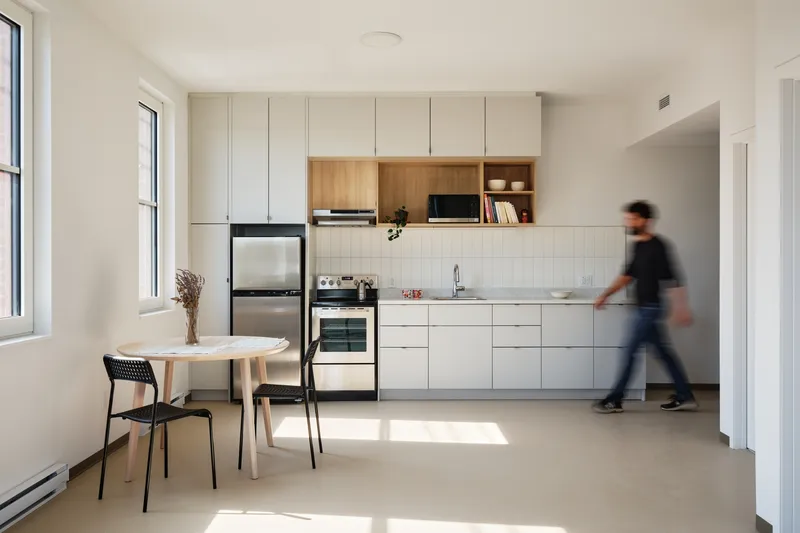
Each of the 18 units, whether a studio or one of the five larger 3½ apartments designed for couples, contains a full kitchen and a private bathroom. That sentence should not need to be remarkable, but in permanent supportive housing it often is. The studio units are compact galley arrangements with pale wood cabinetry and glazed doors opening onto balconies with vertical red railings. Daylight enters generously. The kitchens have open shelving and enough counter space for actual cooking, not merely reheating.
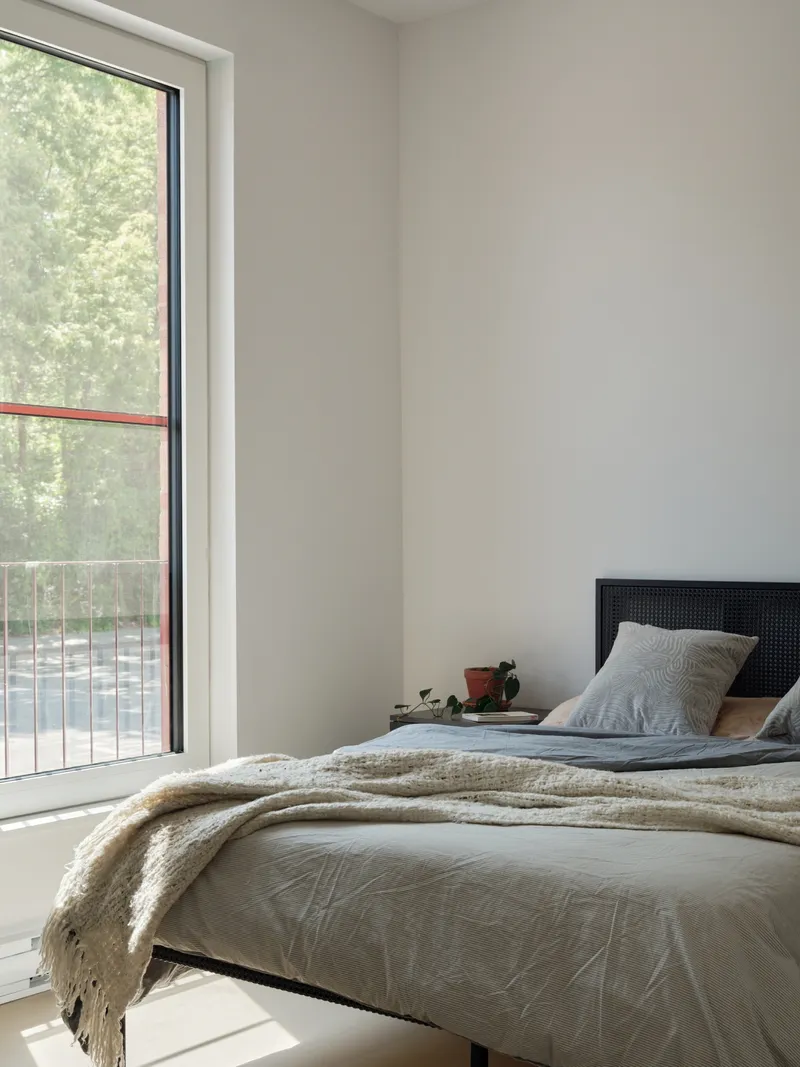
The bedrooms, where the program provides them, are oriented toward the balcony and the trees beyond. Tall windows bring soft light deep into the rooms. Nothing about these interiors signals austerity. They are modest in size but generous in finish, a distinction that matters for residents rebuilding a sense of self.
Corridors and Accessibility
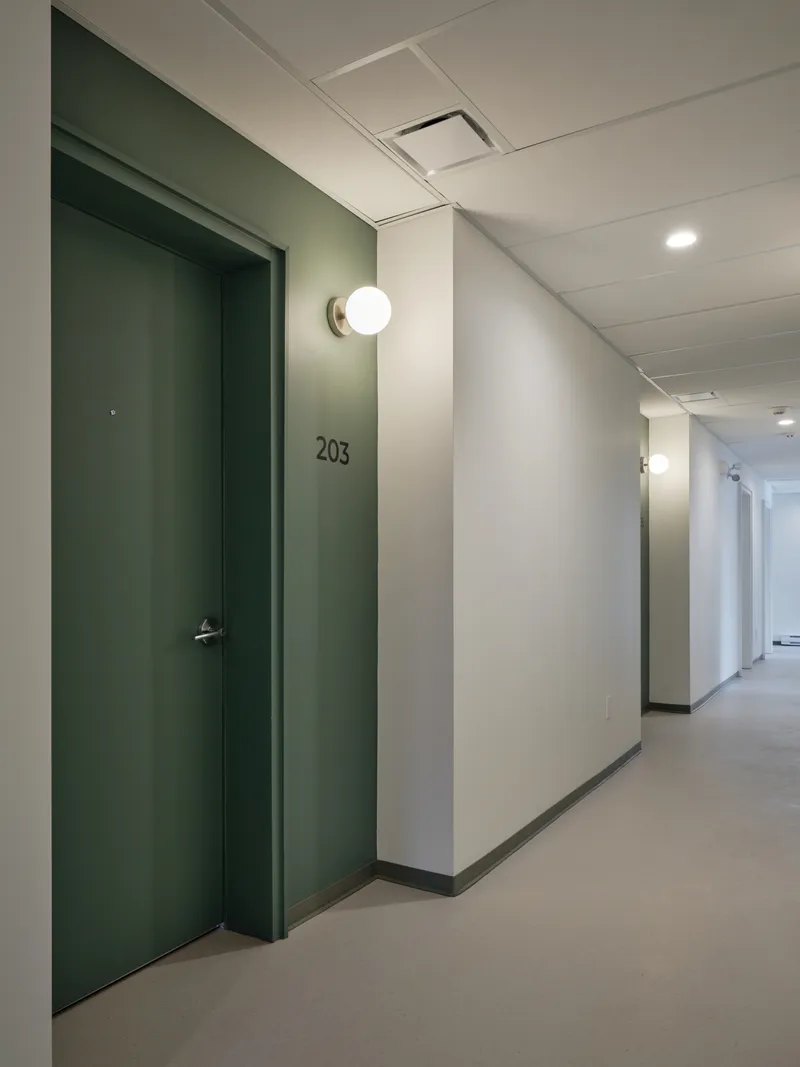
Corridors in social housing often betray the budget first. Here, green painted doors and white sphere light fixtures give the hallways a residential warmth that avoids both the clinical feel of institutional design and the false cheer of bright accent walls. The numbering is clear, the lighting is even, and the proportions are human.
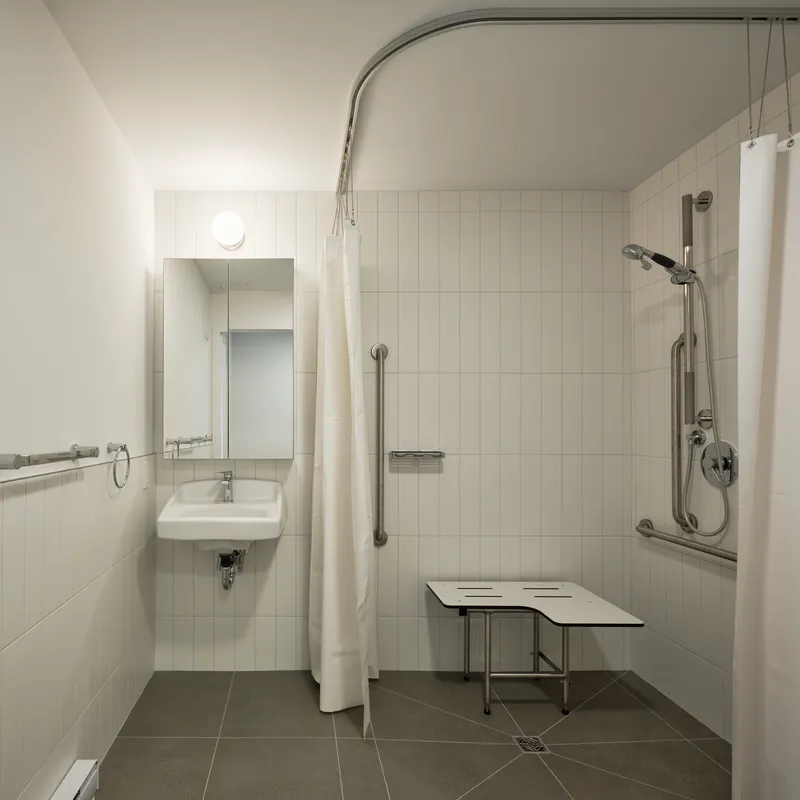
The accessible bathrooms are thoughtfully equipped with wall-mounted sinks, curved curtain rails, grab bars, and fold-down shower benches. These are not afterthought adaptations bolted onto a standard layout; they read as integrated from the outset. Across the corridor, a resident moves through a sunlit unit in soft blur, the motion itself a kind of evidence that the space works.
The Common Room as Social Anchor
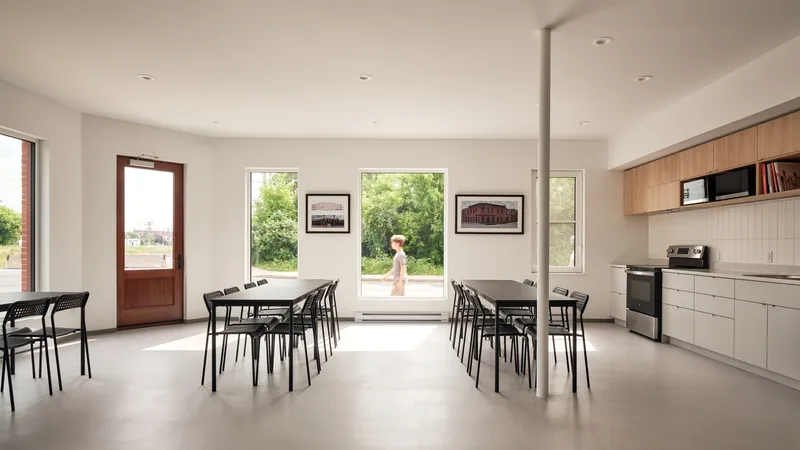
The former tavern's footprint has been reborn as a communal dining and meeting room, operated by Old Brewery Mission staff who provide psychosocial support on site. Large picture windows frame green foliage outside, and the room feels more like a neighborhood café than a service center. This is deliberate. For residents leaving homelessness, the ability to share a meal in a room with good light and garden views is not a luxury. It is architecture doing its most basic work: making people feel that they have arrived somewhere worth staying.
The green space adjacent to the common room extends this social logic outdoors, giving residents a semi-private garden that mediates between the building and the larger public parks nearby. The landscape is modest in scale but clearly designed, not leftover space between the buildings.
Plans and Drawings
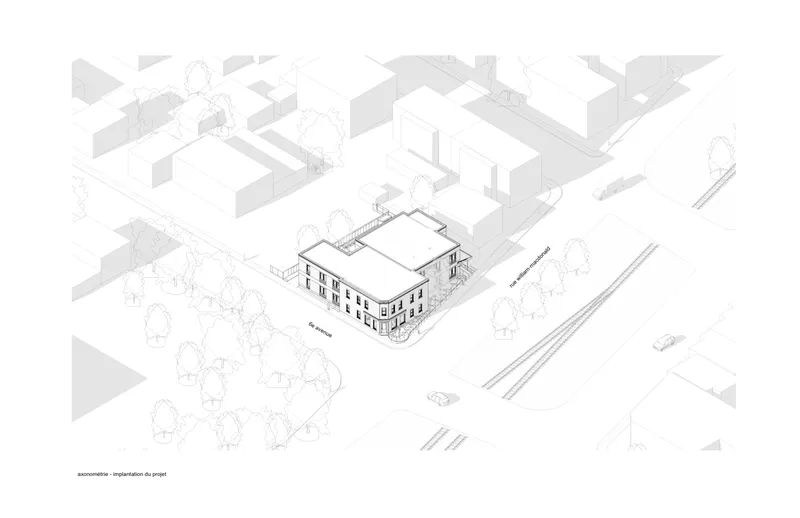
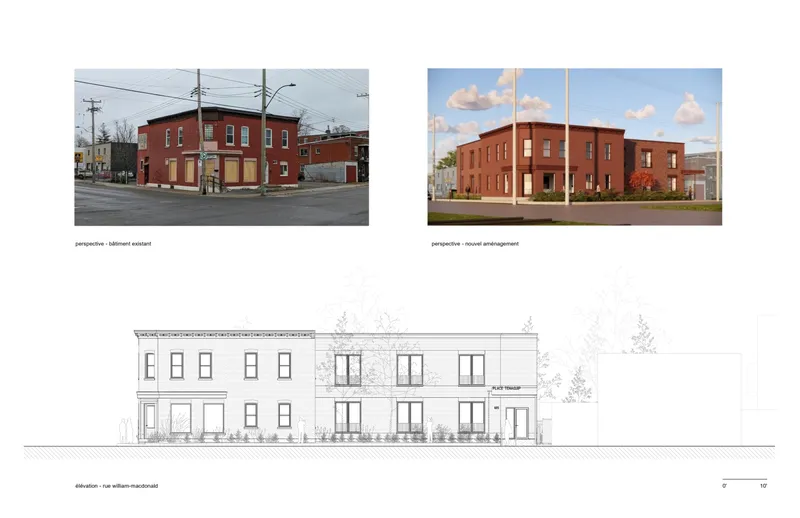
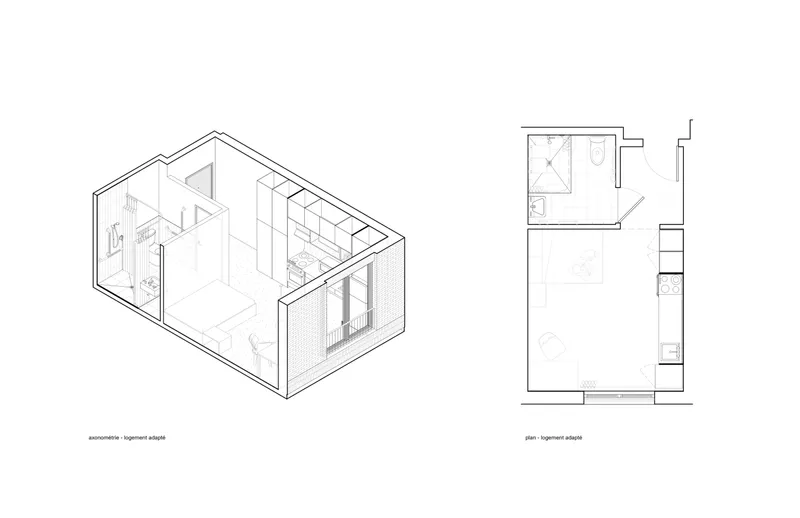
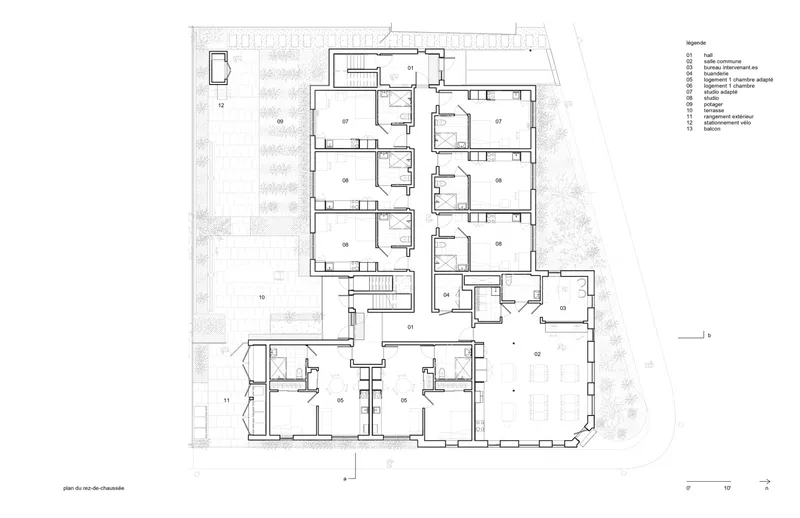
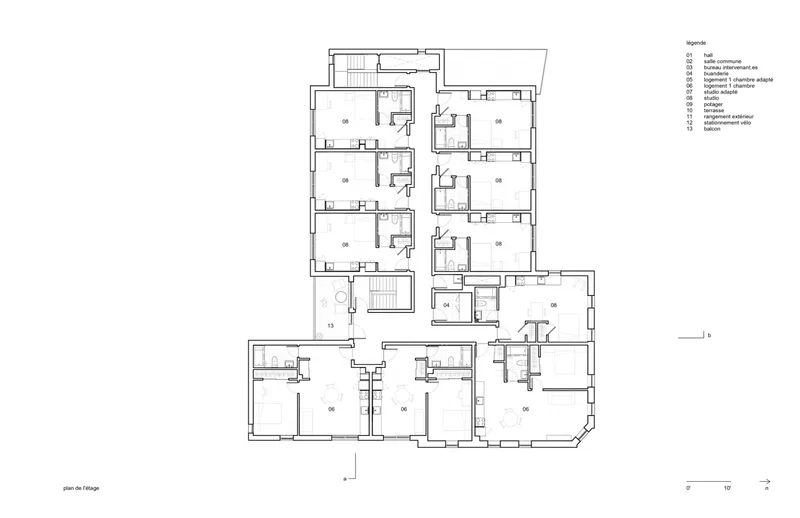
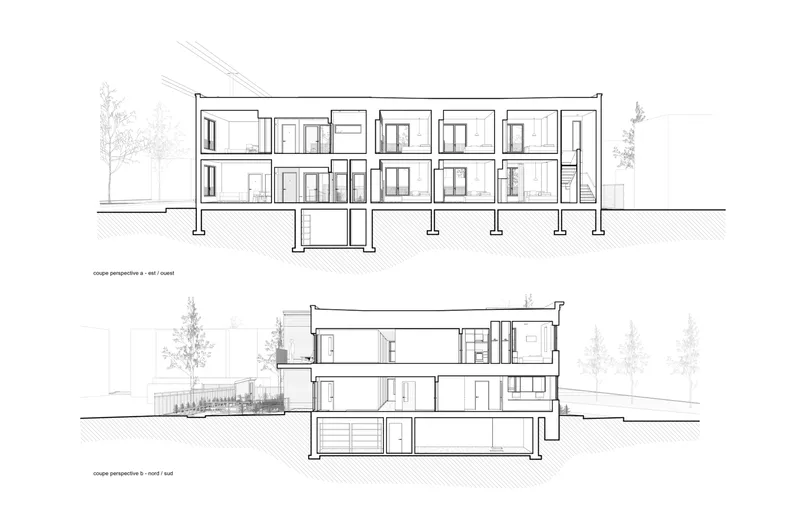
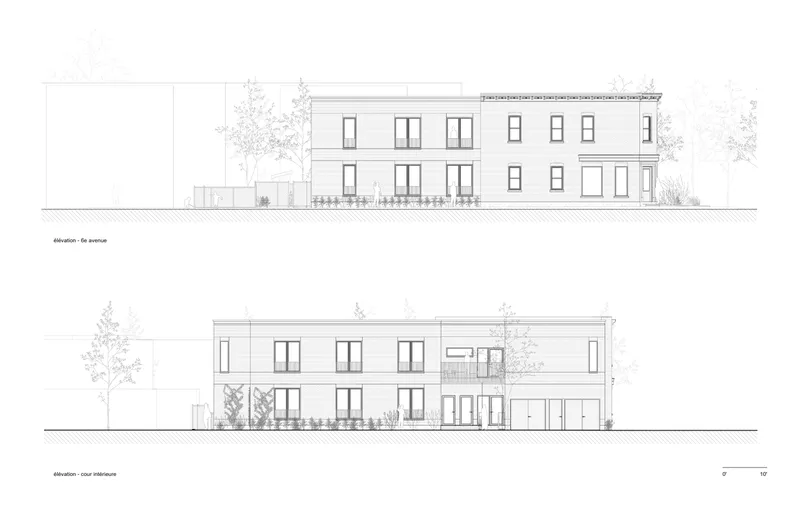
The axonometric drawing reveals how the project negotiates its corner condition: the reconstructed building anchors the intersection while the two new wings extend along each street, defining a courtyard between them. Ground floor plans show the 13 studios and 5 one-bedroom units arranged along a central corridor, with the common room and staff office occupying the reconstructed volume. The section drawings expose a three-story building with basement parking beneath, and the elevation drawings confirm the regularity of the window pattern, a rhythm that gives the facades their calm domestic presence.
The individual unit axonometric is worth studying. It shows how a compact studio manages to fit a full kitchen, private bathroom, closet, and living/sleeping area into a plan that still breathes. The glazed balcony door is the unit's release valve, connecting every resident to daylight and open air regardless of unit size.
Why This Project Matters
Place Tenaquip matters because it demonstrates that social housing and good architecture are not separate conversations. Every decision here, from the varied brick bonds to the accessible bathroom fittings to the communal room's picture windows, serves the same goal: giving people who have been without a home a place that respects them. L. McComber has done this without spectacle, without formal pyrotechnics, and without pretending that the building is anything other than what it is. It is housing. It is permanent. It is careful.
In a Montreal housing market where affordability is disappearing and Lachine East is rapidly redeveloping, the project also makes an argument about what neighborhood transformation can look like. Instead of erasing the memory of a corner tavern, the architects rebuilt it as the social heart of a new residential community. The contaminated soil that could have justified a blank-slate approach became the occasion for a more considered response. That kind of thinking, where constraint produces specificity rather than compromise, is precisely what affordable housing needs more of.
Place Tenaquip by L. McComber, Montreal, Canada. 18 residential units. Completed 2025. Photography by Ulysse Lemerise.
About the Studio
Share Your Own Work on uni.xyz
If projects like this are the kind of work you want to make, uni.xyz is a place to publish your own, find collaborators, and enter design competitions.


Popular Articles
Popular articles from the community


Jaramillo Van Sluys Arquitectura and Urbanismo Turn a Demolished Registry Lot in Quito into an Orchard Plaza
In Quito's Centro Histórico, a 2,800 m² plaza exposes the San Agustín convent wall and redraws its lost Augustinian orchard in volcanic stone.

U.GA Architects Wraps an Oval Rooftop Pool in Curved Board-Formed Concrete on Busan's Jeollidan-gil
In Busan's Jeonpo-dong, a 454 m² mixed-use block stacks a neighborhood facility, guest rooms and an oval rooftop pool inside spiraling concrete walls.

David Ortega Stacks a Two-Story Mexico City Penthouse Around a Steel Stair and a Pergola-Shaded Roof Terrace
In Colonia Roma, a 300 m² penthouse uses oak joinery, a planted steel stair and a slatted roof pergola to make a new-build apartment feel like a house.

GROUP A Strips a 1969 Rotterdam Harbor Headquarters to Its Frame and Wraps It in Timber Louvers
In Rotterdam's M4H harbor district, Ferro Offices reuses a 1969 frame, adds one timber storey and reaches BREEAM-NL Outstanding.

Similar Reads
You might also enjoy these articles


LAVA Architecten Gives Vocational Education a Sawtooth-Roofed Face on a Mechelen School Campus
In Mechelen, Belgium, a 2,053 m² STEM school on a 6×6 m grid turns workshops and classrooms into rooms that can be rearranged as teaching changes.

KEMA Studio Turns a Derelict Marvila Attic into a 60 m² Lighthouse Apartment Above Lisbon
In Lisbon's Marvila district, a rebuilt roof, four skylights and two plywood volumes turn an unlivable attic into a bright home facing the Tagus.

Pixel Gardens: One Repeated Module Stacked Into a Terraced Social Housing Tower for Famagusta
Salem Bader's shortlisted housing tower builds a vertical neighbourhood from one repeated module, offsetting units to carve terraces, light and air.

Bao Huynh Watercolor Atelier: A Serene Art Retreat in Hội An
Bao Huynh Watercolor Atelier in Hội An blends multifunctional art spaces, sustainable design, local materials, and family-friendly living in a serene environment.

Explore Community Housing Competitions
Discover active competitions in this discipline

Challenge to design luxury tourism on rails

VR headsets Storefront design competition

Designing a staircase for a client
Comments (0)
Please login or sign up to add comments
No comments yet. Be the first to comment!