
Menjue Architects Scatters a Corrugated Metal Village Across a Chinese Lake Peninsula
A cluster of gabled pavilions on a narrow spit of land transforms rural hospitality into something quietly monumental.


Somewhere in China's lake country, a narrow peninsula juts into still water, its banks lined with willows and vineyard rows. Menjue Architects treated this slender landform not as a site for a single building but as a territory for a small settlement: a constellation of white, corrugated metal pavilions whose gabled roofs cluster and overlap like a fishing village that materialized overnight. It is a homestay, but the ambition here goes well beyond hospitality. The project proposes that rural accommodation in China can be architecturally rigorous without being alien to its landscape.
What makes the project genuinely interesting is its refusal to consolidate. Instead of packing program into one efficient mass, Menjue breaks it apart into discrete volumes connected by courtyards, pools, and garden thresholds. The result is a compound that reads differently at every scale: from the air, it looks like an abstract diagram of a traditional Chinese water town; from the ground, each pavilion feels intimate, scaled to the body rather than to the ego of a grand resort. The corrugated metal cladding, so often a marker of economy, is deployed here as a deliberate material choice that catches light, casts shadow, and ages alongside the willows.
An Island Compound

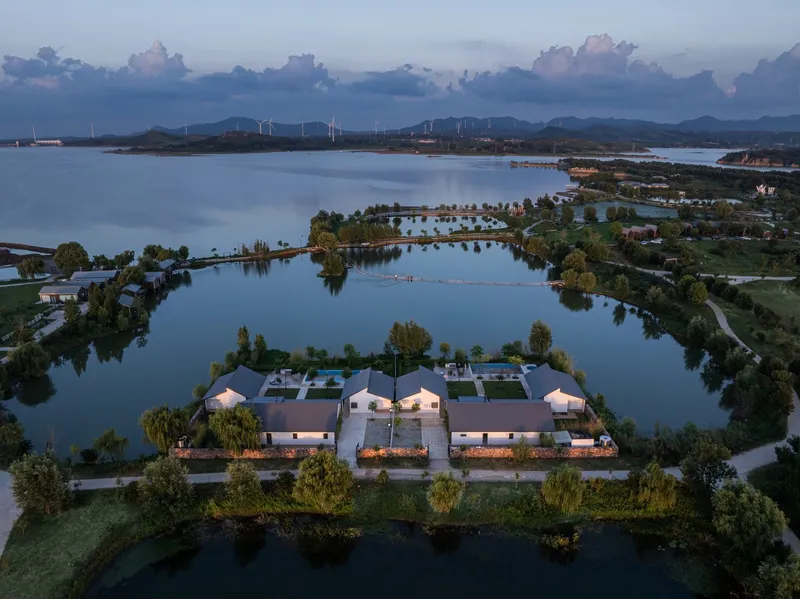

Seen from above at dusk, the compound registers as a luminous archipelago. The buildings occupy a peninsular spit that is almost entirely surrounded by water, giving the project a natural moat. Distant mountains form a low horizon line, and the surrounding agricultural landscape, vineyard rows and fish ponds, frames the architecture as one element within a productive territory rather than an intrusion upon it.
The site strategy is remarkably clear. Buildings are organized along the spine of the peninsula, leaving the edges free for planting and water access. No single volume dominates; instead, the roofscape creates a rhythmic profile that shifts with the viewer's position. It is a composition calibrated for the oblique view, which is exactly how most guests will first encounter it: approaching by road across flat terrain, seeing rooflines appear above the treeline.
Corrugated Metal as Language
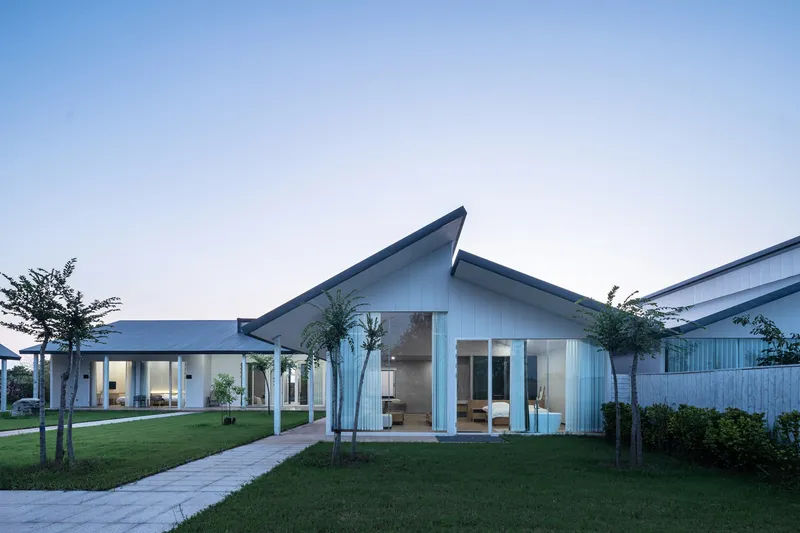
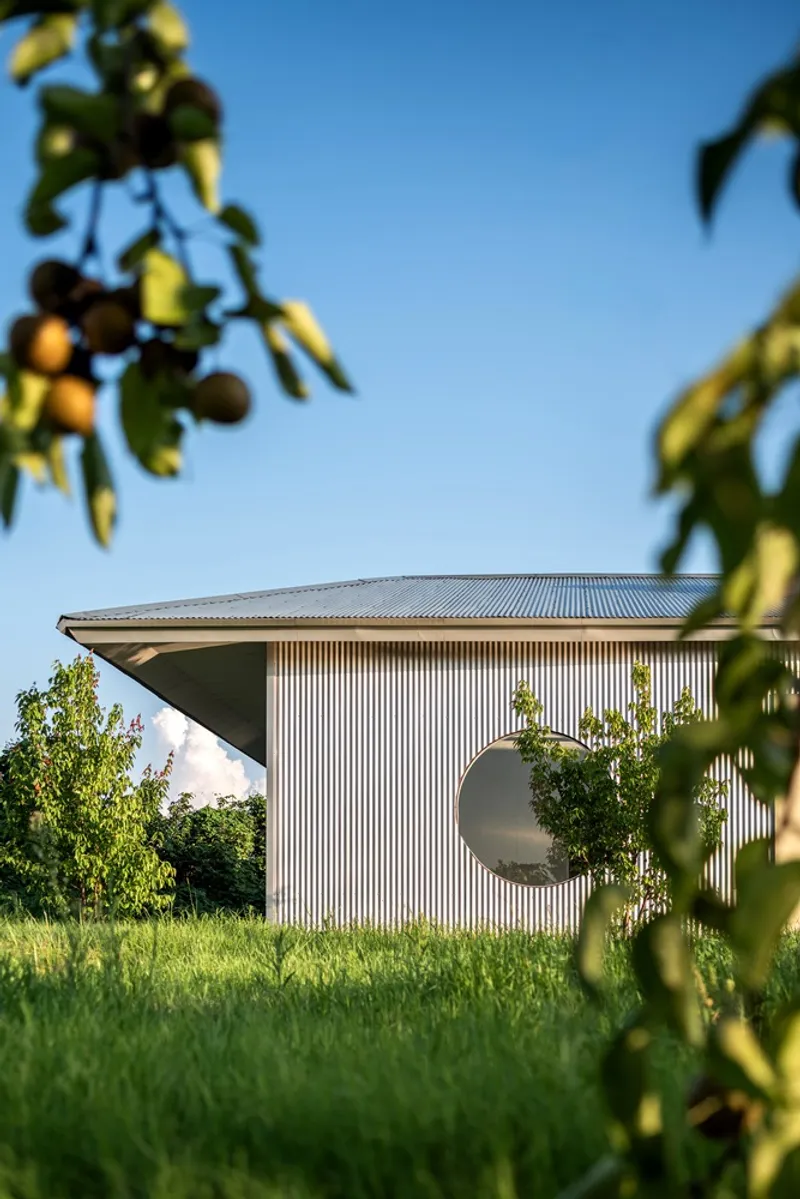
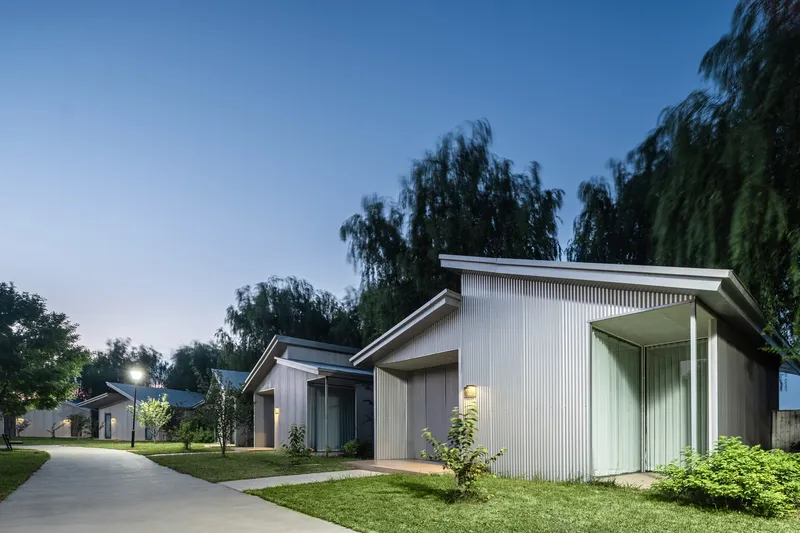
The facades are uniformly clad in white corrugated metal panels, oriented vertically and sometimes punctuated by circular windows that function as compositional anchors. The material is industrial, inexpensive, and surprisingly photogenic. At twilight the ribbed surfaces glow with a soft diffusion; in direct sun they cast fine parallel shadows that animate otherwise flat planes. Menjue appears to have understood that corrugated metal has a tectonic expressiveness that smoother claddings lack.
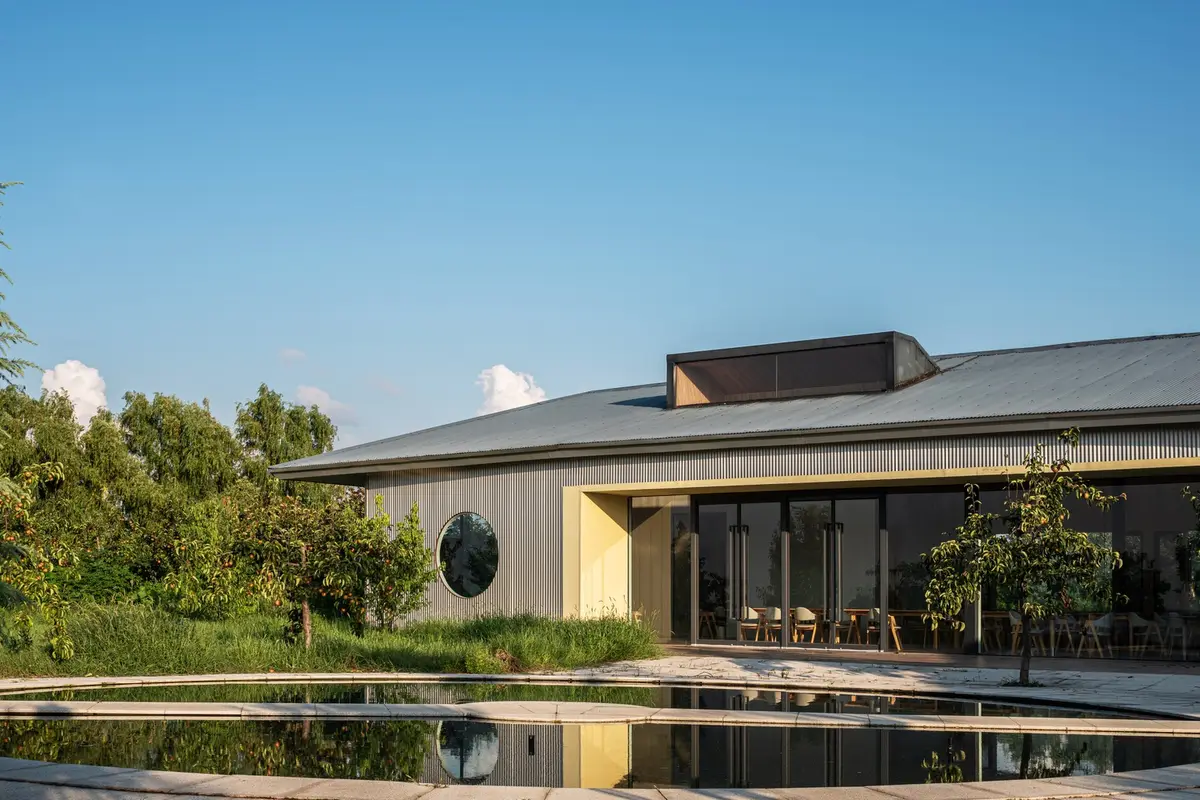
The circular window is a recurring motif, appearing on gable ends and side facades alike. Against the strict geometry of the pitched roofs and vertical ribs, these oculi introduce a playful counterpoint. One image frames a circular opening through the branches of a fruit tree, collapsing foreground and facade into a single plane. It is a simple move, but it reveals a careful attention to how each building will be perceived from specific positions within the landscape.
Between Buildings
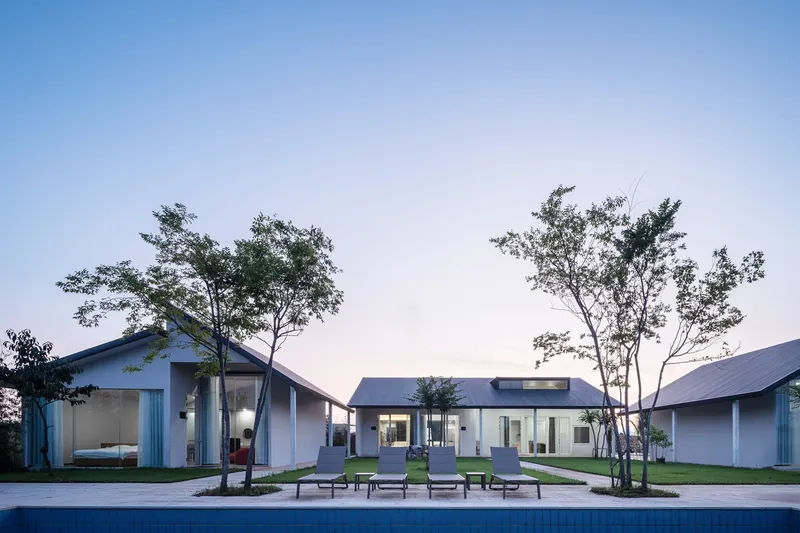
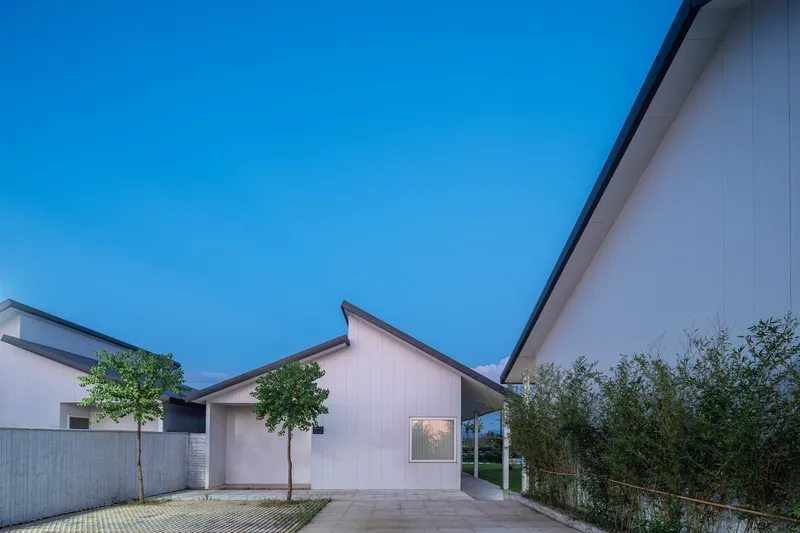
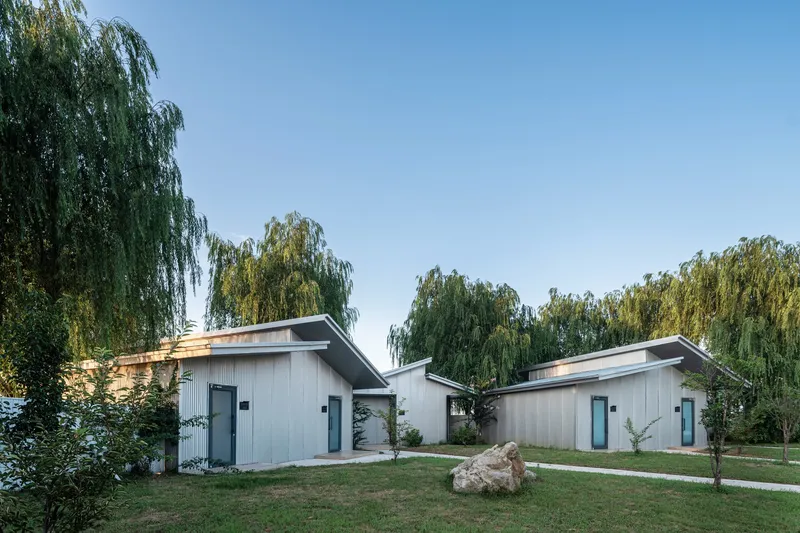
The spaces between the pavilions carry as much weight as the interiors. A courtyard with a rectangular pool and lounge chairs sits between two gabled volumes, framed by young trees whose canopies will eventually knit together overhead. A bamboo-lined driveway separates another pair of buildings, creating a procession that stretches time and heightens anticipation. These in-between zones are where the project's village logic becomes experiential rather than diagrammatic.
Willow trees, wildflowers, and unmown grass are allowed to press right up against the buildings. Menjue does not manicure the boundary between architecture and landscape; instead, the two blur. A curved roof overhang hovers above a meadow of wildflowers, supported by an angular steel column that looks almost provisional. This looseness is deliberate. It signals that the architecture is comfortable with impermanence, with the gradual softening that comes from inhabiting a place over seasons.
Water and Reflection
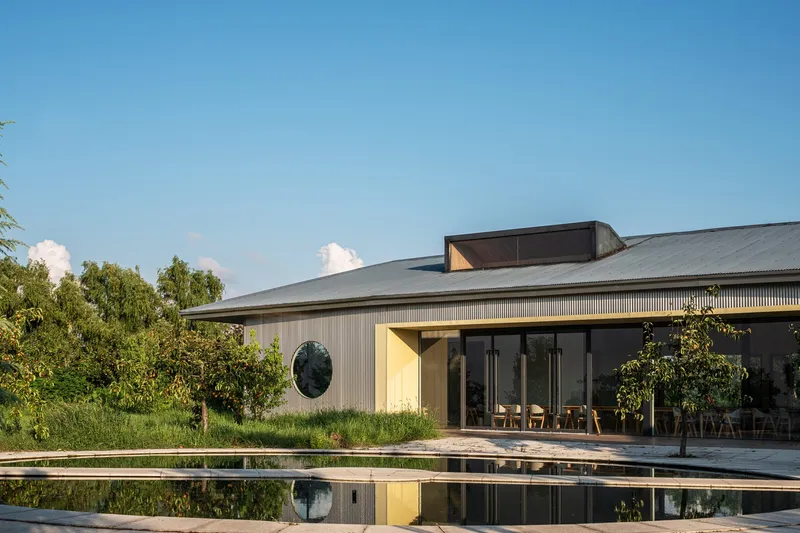
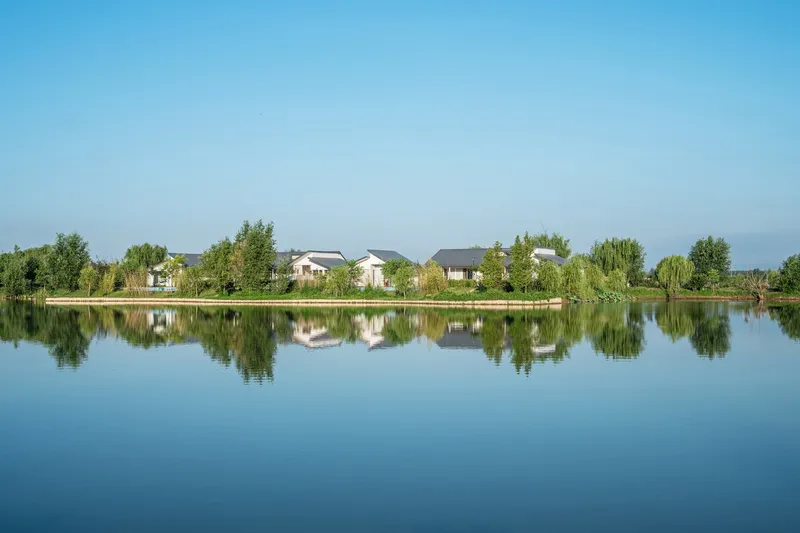
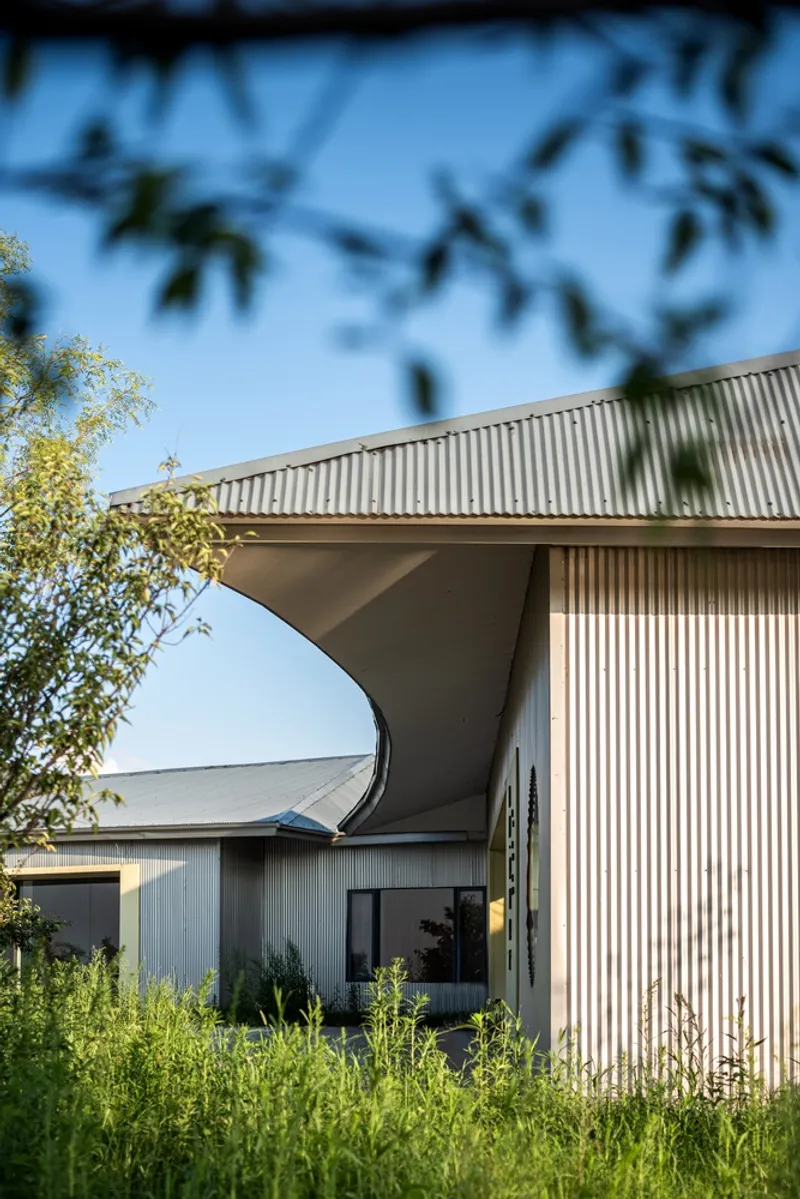
Water is the project's constant companion. Ponds, channels, and the lake itself surround the buildings, and nearly every exterior photograph includes a reflected image of the architecture. The poolside shot of a corrugated pavilion, its circular window perfectly doubled in the water's surface, is the project's most arresting image. It compresses the building into a symmetrical abstraction that is simultaneously real and fictional.
The relationship to water also shapes orientation. Buildings face outward toward the lake edge or inward toward courtyard pools, but they are never indifferent to water. This is more than scenographic; it is environmental. The surrounding water bodies moderate temperatures, redirect breezes, and create a microclimate that makes outdoor occupation comfortable through much of the year.
Timber Ceilings and Concrete Frames
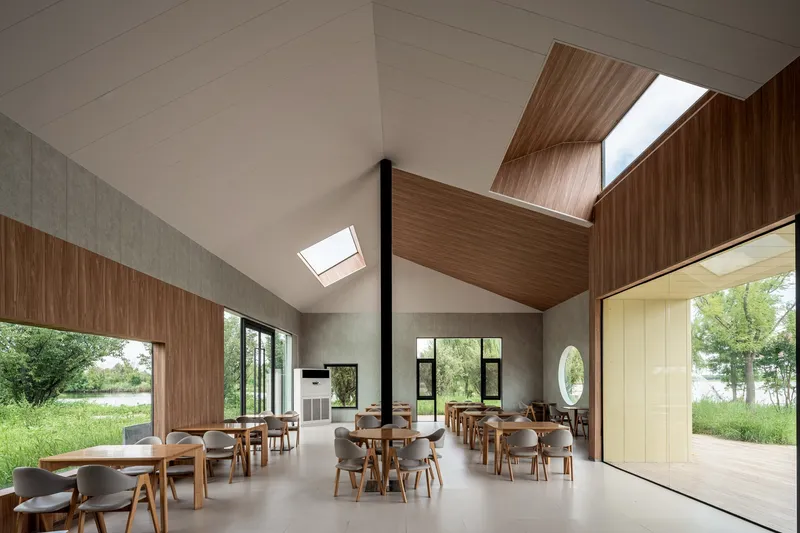
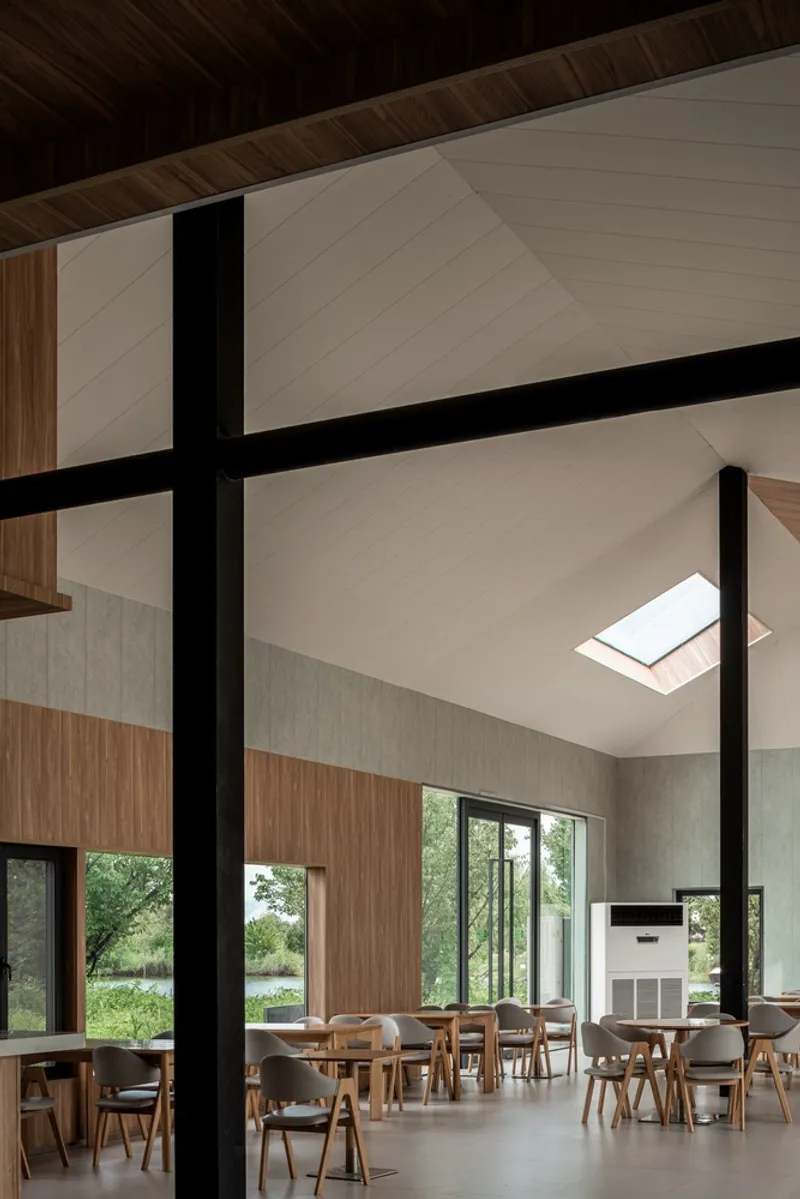

Inside, the material palette shifts to timber and concrete. The dining halls are the most spatially ambitious interiors: double-height volumes with exposed black steel columns, pyramidal skylights, and warm timber-clad ceiling panels that follow the pitch of the roof. Light drops in from above, giving these communal spaces a top-lit quality that recalls both barn architecture and contemporary gallery design. The polished concrete floors anchor the rooms and provide thermal mass.
An open-plan living space demonstrates how Menjue handles the transition from public to private. Concrete ceiling planes define the lower zone; above, a timber volume projects outward, creating a loft-like quality. Floor-to-ceiling glazing on one side erases the boundary with the garden, while the opposing wall remains solid. The interior reads as a series of nested enclosures rather than a single open room, offering choice and variability within a modest footprint.
Private Rooms Facing the Water
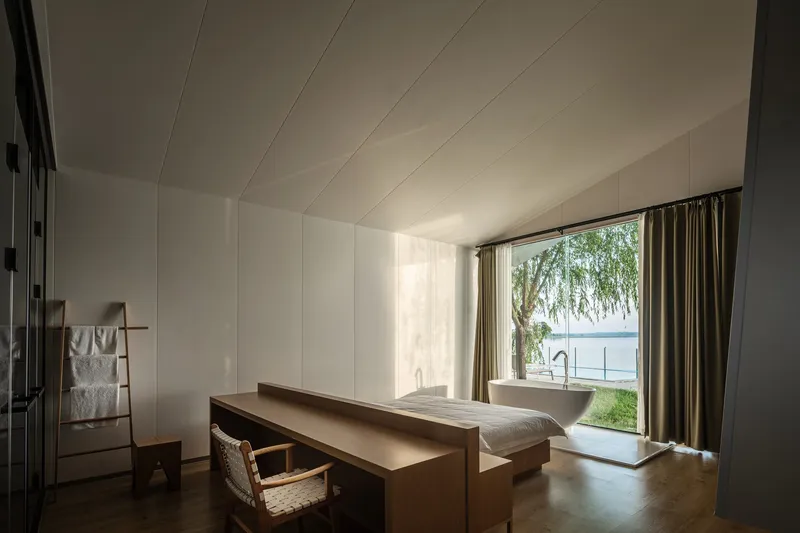
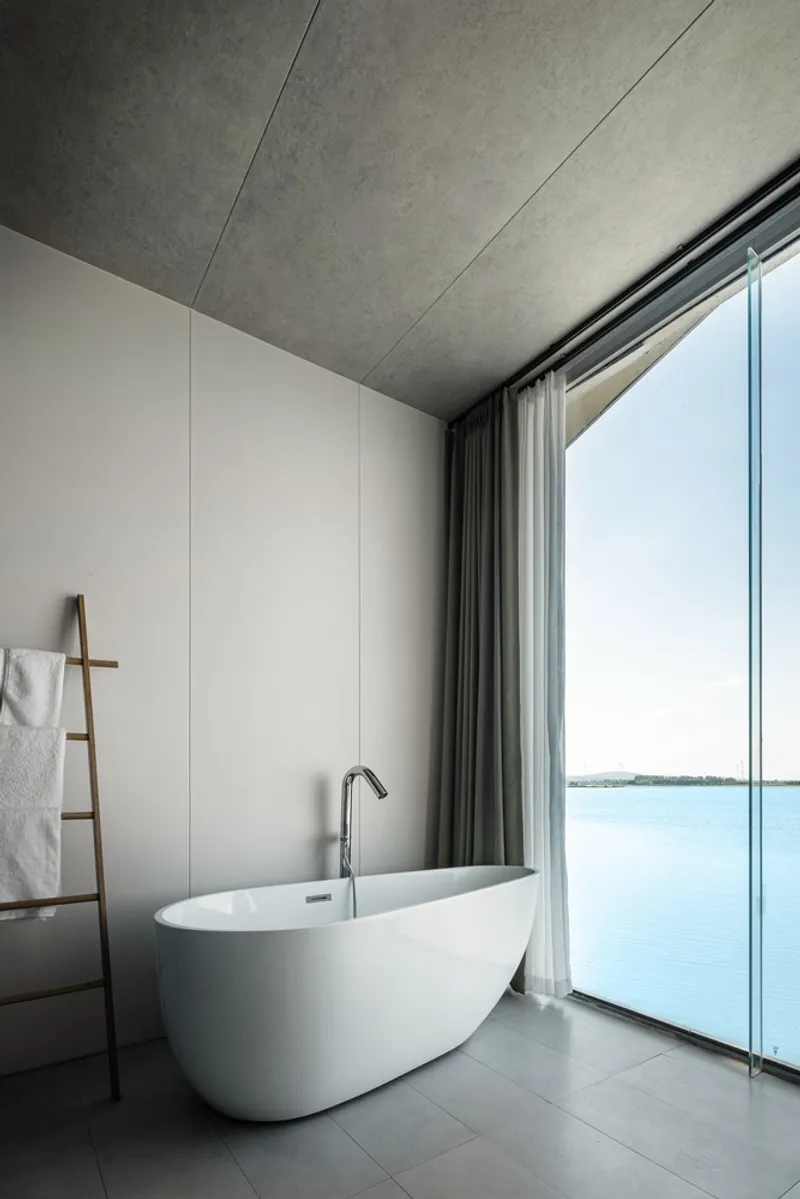
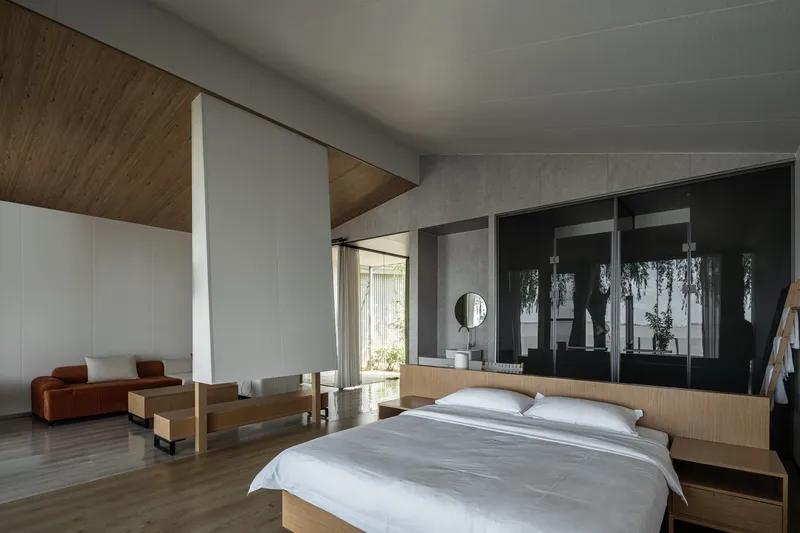
The guest rooms are oriented to place the bed or the bath directly against a window overlooking water or garden. One bedroom positions a timber desk in front of a full-height window; the lake fills the frame. Another places a freestanding bathtub beside glass that opens onto a calm blue expanse. These are not luxury gestures for their own sake. They are spatial decisions that acknowledge why someone travels to a lakeside retreat: to be close to water, to watch light move across a surface.
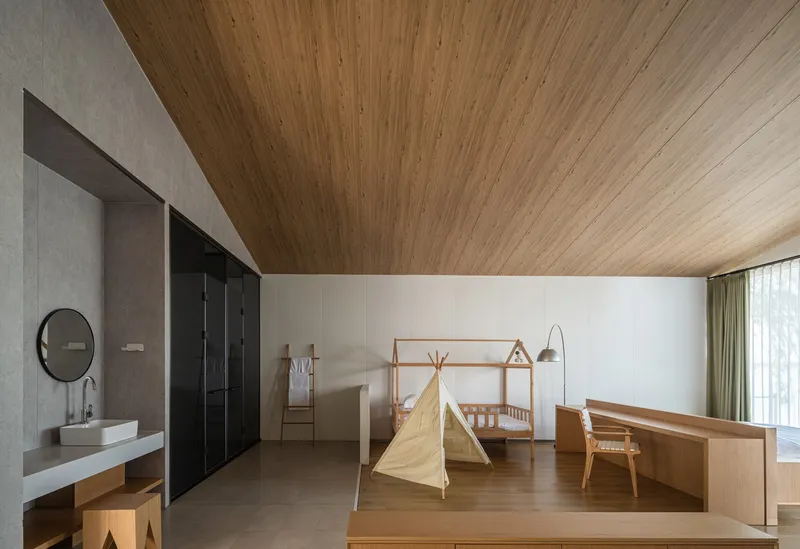
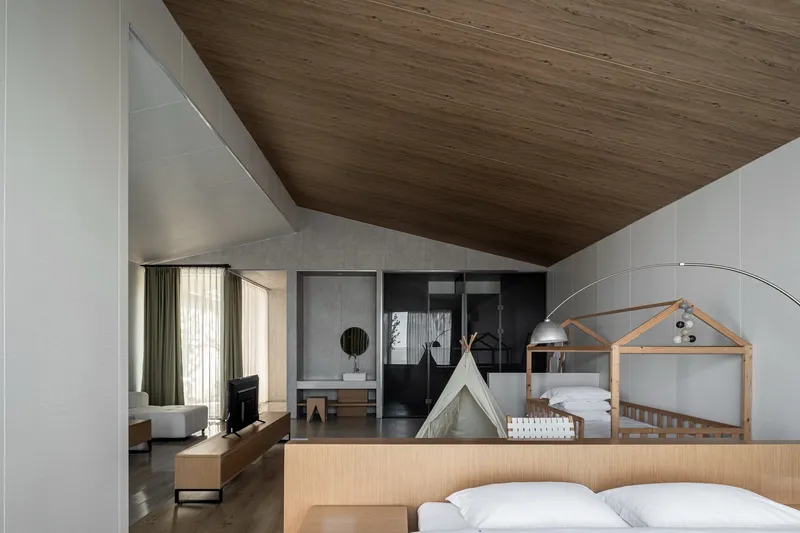

The children's room, with its slatted timber ceiling, black wardrobe partition, and play tent on a wood floor, shows a lighter touch. Sleeping lofts and multi-zone bedrooms accommodate families without resorting to the generic suite format common to most hospitality projects. Ceilings slope and twist following the roof geometry, giving every room a unique section. Menjue clearly designed from the inside out as much as from the outside in.
Material Encounters
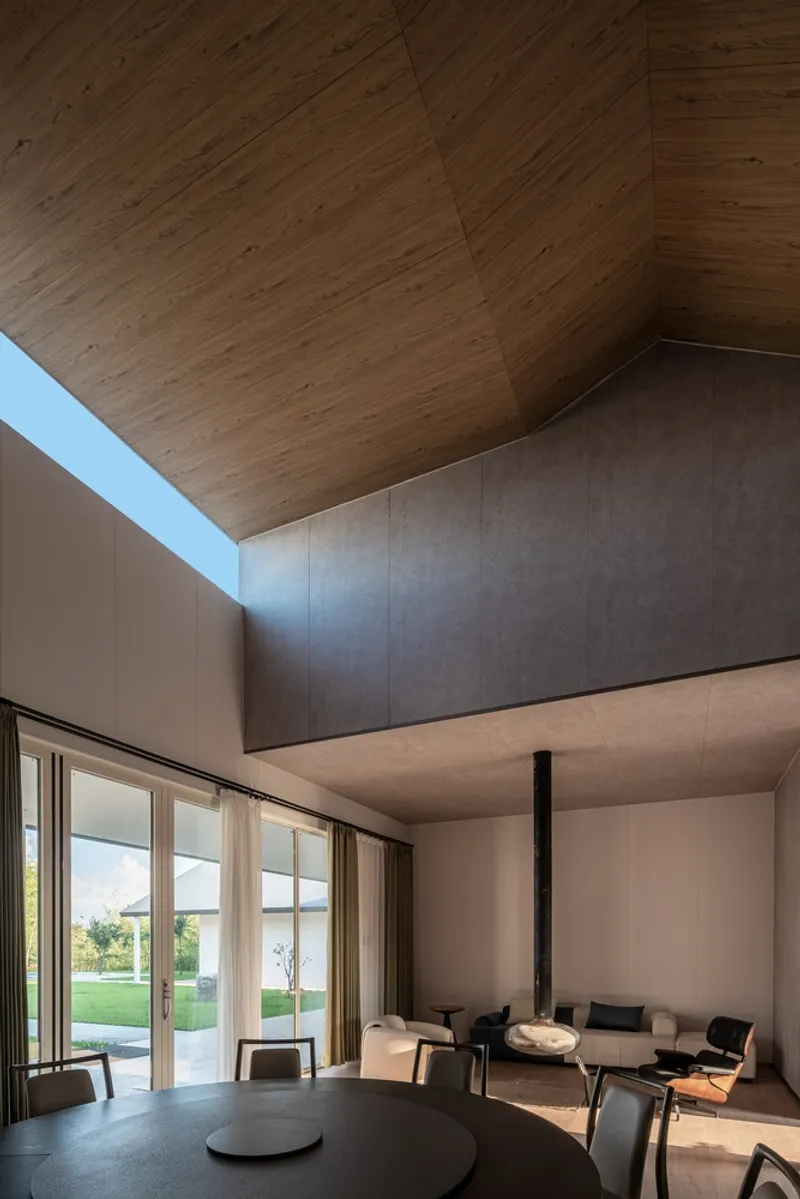
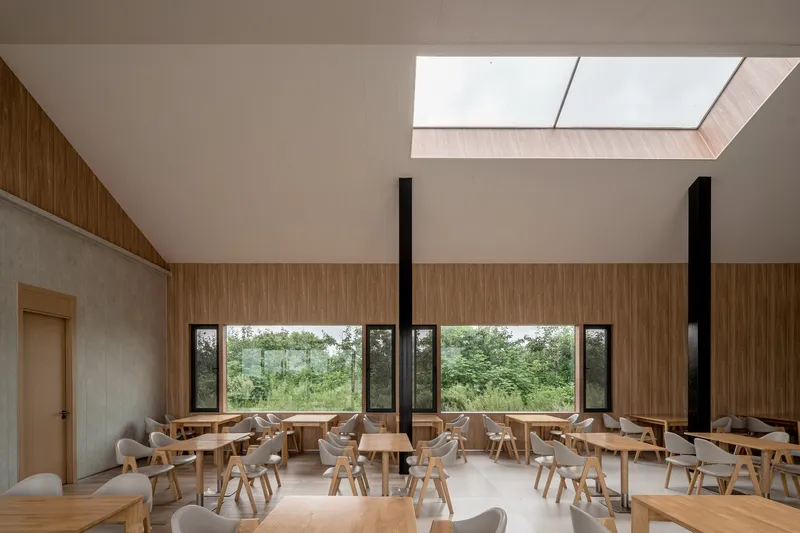
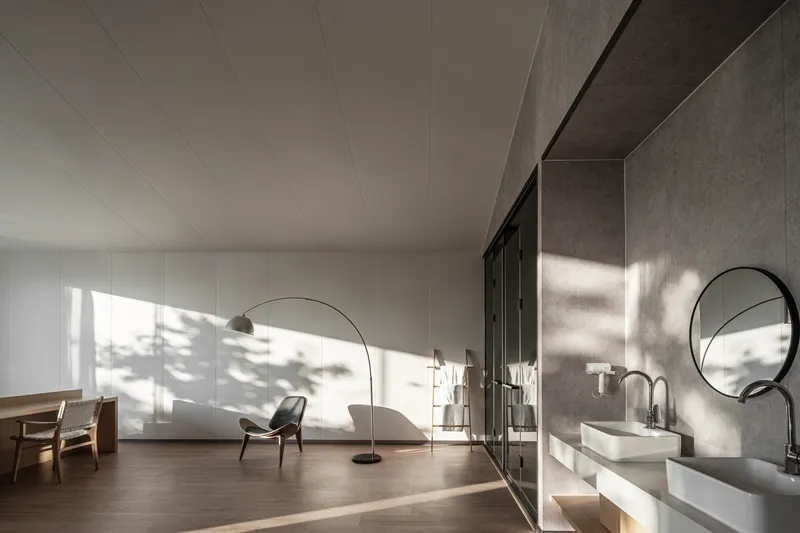
A dining space with a timber-clad vaulted ceiling and clerestory skylight above painted walls reveals how Menjue handles junctions. The timber stops cleanly at the wall line; the painted surface below reads as a separate register. Ribbon windows bring in horizontal light, and rectangular skylights punch vertical shafts into the room. A bathroom with a concrete wall, round mirror, and white basin uses afternoon sun and branch shadows as decoration. The material restraint lets light do most of the work.
Landscape at Scale
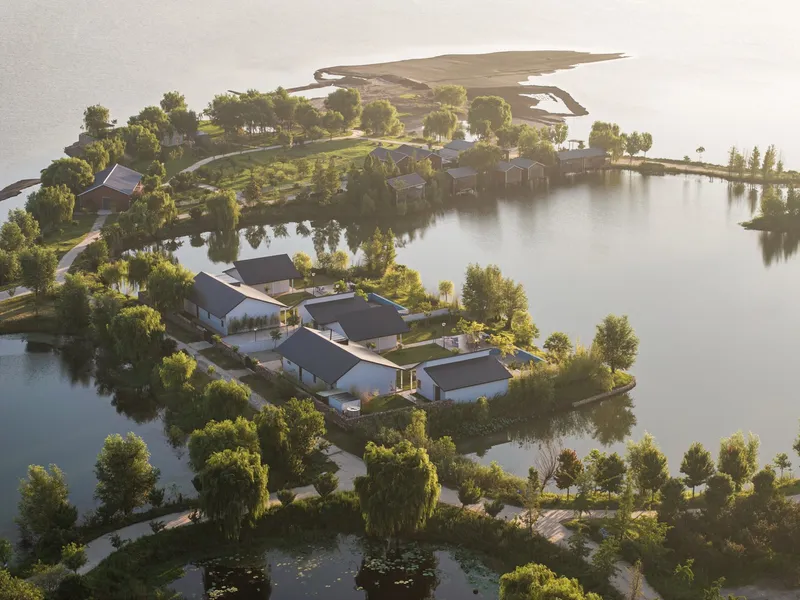
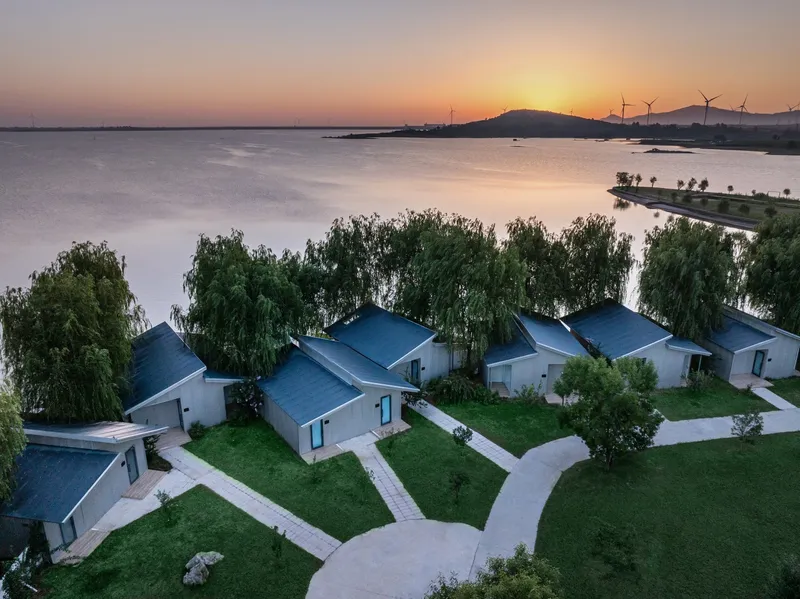
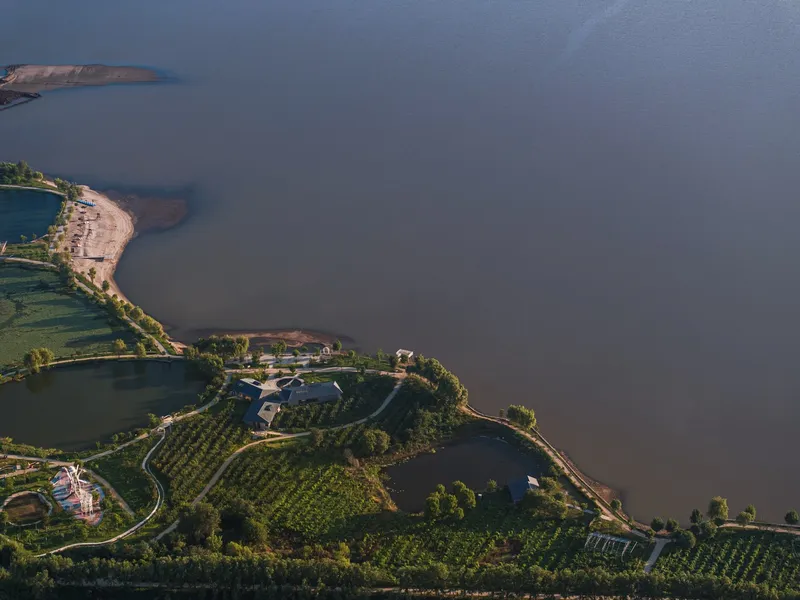
The aerial views taken during golden hour are worth studying for what they reveal about the project's relationship to its agricultural context. Vineyard rows run right up to the water's edge, establishing a geometric order that the buildings echo in their parallel roof ridges. At sunset, the roofs darken to silhouettes against the glowing lake surface, and the compound reads as a contemporary extension of the cultivated landscape rather than an imported object.
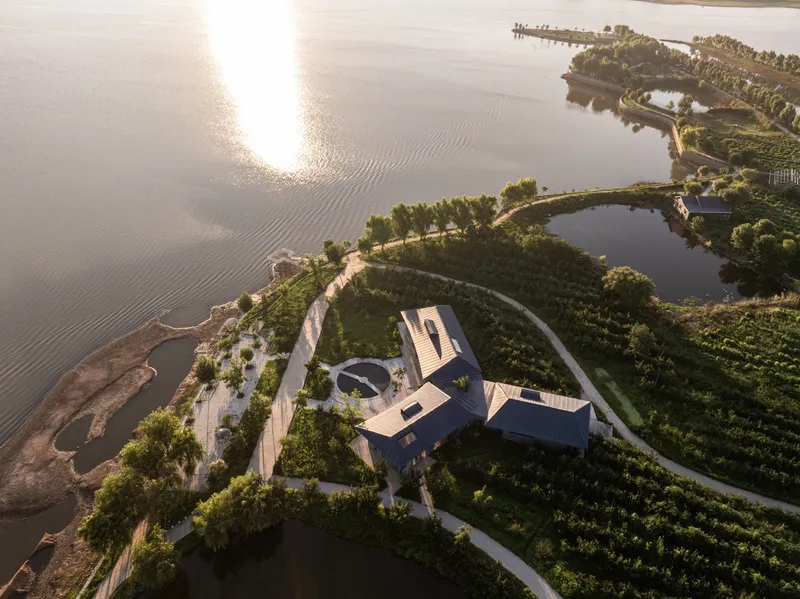

From the drone perspective, the white roofs nestle into the waterfront spit with a compactness that belies the apparent looseness of the ground-level experience. The vineyard terraces, the curving shoreline, and the repetitive roof forms create a three-part composition that is legible and satisfying at the territorial scale. Closer in, a corrugated facade framed by a weeping willow demonstrates that the buildings are equally considered at the scale of a single branch.
Plans and Drawings
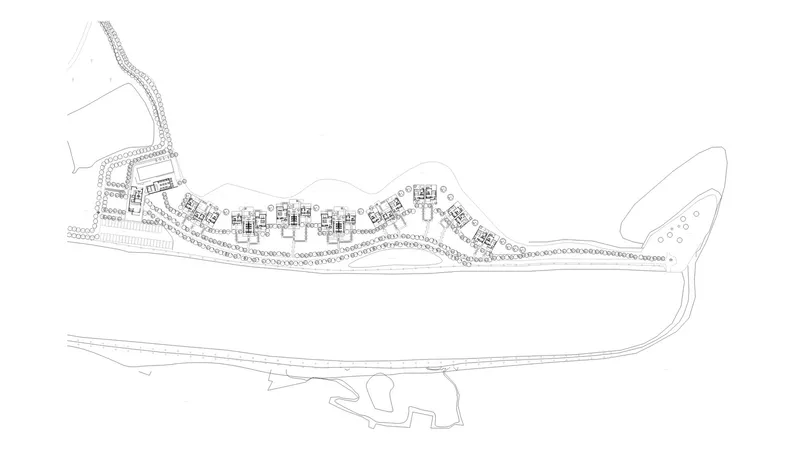
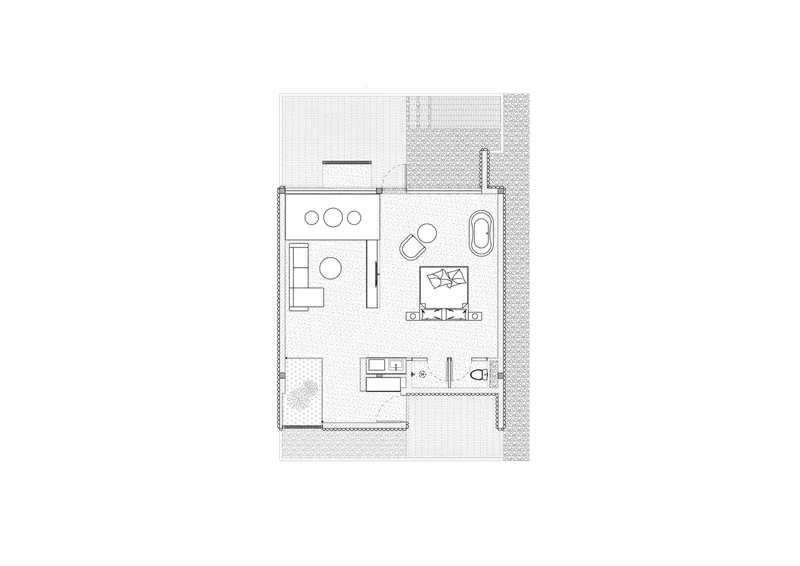
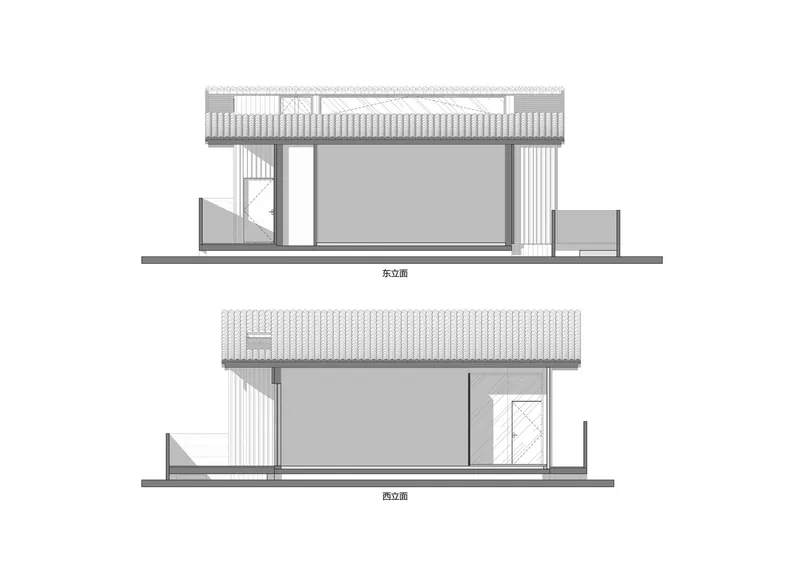

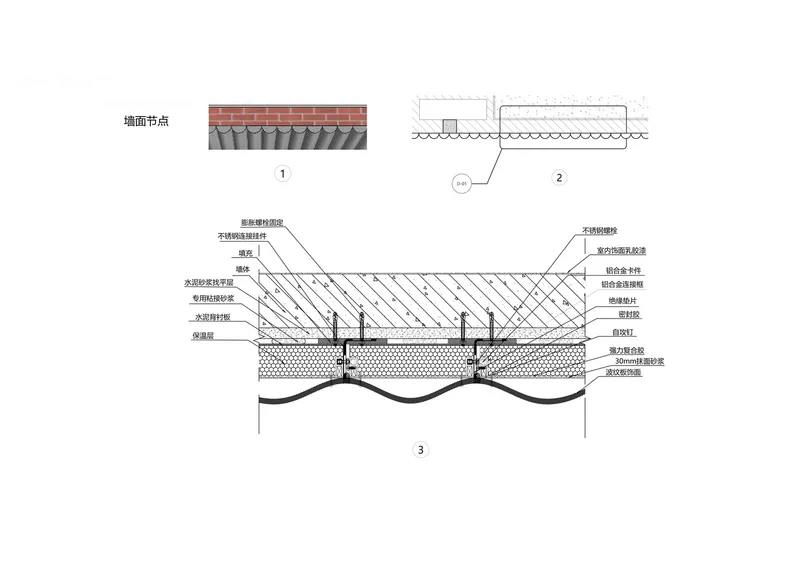
The site plan confirms what the aerials suggest: the buildings follow the curving spine of the peninsula, organized into clusters that create distinct precincts. The floor plan of a single residence reveals a compact but generous layout with living areas opening onto an outdoor terrace. Elevation drawings show how the corrugated metal roofing sits above vertical slatted screening, creating a layered facade system that modulates light and privacy. Construction detail sections illustrate a carefully engineered floor assembly with insulation, waterproofing, and structural framing, evidence that the apparent simplicity of the architecture is undergirded by technical rigor.
Why This Project Matters
China's rural hospitality sector has produced a remarkable quantity of architecture over the past decade, much of it visually striking but conceptually thin. Menjue's lakeside homestay stands apart because its formal strategy, the disaggregated village, is not a nostalgic gesture but a spatial argument. By breaking the program into small pavilions, the architects create a gradient of social intensity that no single building could achieve. Guests move between solitude and community by moving between buildings, and the landscape occupies the gaps. The corrugated metal cladding unifies the complex without homogenizing it, and the material's industrial associations prevent the project from tipping into pastoral fantasy.
What stays with you is the project's comfort with its own restraint. There are no heroic cantilevers, no gratuitous curves, no sculptural exhibitionism. The roofs pitch and the walls stand upright. The windows are round or rectangular. The trees are willows and fruit trees. Everything is ordinary, and yet the cumulative effect is anything but. Menjue demonstrates that the work of architecture is not always to invent new forms but to arrange familiar ones with enough precision and generosity that they produce something genuinely new: a place you want to be in, and a place that wants you to stay.
Lakeside Countryside Homestay by Menjue Architects, China. Photography by Ming Chen.
About the Studio
Share Your Own Work on uni.xyz
If projects like this are the kind of work you want to make, uni.xyz is a place to publish your own, find collaborators, and enter design competitions.


Popular Articles
Popular articles from the community


Co-life: Sustainable Architecture for Age-Friendly Community Living
Co-life reimagines sustainable architecture for seniors through courtyards, rammed earth, shared gardens, and spaces designed for belonging.

Little Red Riding Hood: Architectural Design as a Journey Through Fear, Light, and Storytelling
Little Red Riding Hood reimagines the fairy tale through architectural design shaped by fear, light, scale, memory, uncertainty, and choice.

Play: Fragments of Their World
Familiar architecture becomes modular playground design, creating safe spaces where displaced children can learn, connect, imagine and play.

ALGAL REALM: A Bio-Integrated Lunar Habitat Design for Life Beyond Earth
ALGAL REALM reimagines lunar habitat design with algae-powered life support, 3D-printed regolith, and vertical living for a lunar future.

Similar Reads
You might also enjoy these articles


Hodi-Mandai Geram
Project Function: Preservation and revitalization of the Intangible heritage and socio-spatial identity of the Hodi by Housing, Cultural Memory Center, Sacred Grove, landscape, local tourism economy


Olio Towers: A Mid-Rise for Performers That Fuses Housing, Rehearsal, and Stage
Located blocks from Houston's Theater District, this modular tower stacks living units around a central performance atrium.

Oasis: Modular Green Housing Carved into Dhaka's Urban Fabric
A shortlisted Plugin Housing entry reclaims unauthorized settlements in Dhaka with stepped concrete volumes, green roofs, and ventilation-driven design.

Black Hole: A Floating Megastructure for the Post-Physical Era
Emiliano Mazzarotto envisions a spherical, self-scaling arena where e-sports, digital hotels, and holographic stadiums replace traditional public space.

Explore Architecture Competitions
Discover active competitions in this discipline

Challenge to reimagine the Iron Throne

Photograph architecture without architects

Illustrate the lost glory of Angkor Wat - Render Challenge

Design challenge to reuse E-waste
Comments (0)
Please login or sign up to add comments
No comments yet. Be the first to comment!