

A Y-Shaped Home That Opens Three Ways to Detroit's Edge
Disbrow Iannuzzi's Lakeside Residence uses a branching plan to dissolve the boundary between domestic life and a River Rouge parkland site.


Most single-family houses in the northern suburbs of Detroit take a straightforward posture toward their lots: front door facing the street, backyard behind. The Lakeside Residence by Disbrow Iannuzzi refuses that convention entirely. Organized as a Y-shaped plan on a generous, park-like site along the River Rouge, the 4,000-square-foot home splits into three wings that each address a different landscape condition. The result is a house that feels less like a contained object and more like a series of framed encounters with its surroundings.
What makes this project genuinely compelling is its material discipline. Where many residential projects of this scale pile on finishes to signal luxury, Disbrow Iannuzzi builds the entire architectural argument around three or four materials deployed with real conviction: stacked slate, reclaimed white brick, plywood, and glass. Every decision about form follows from the landscape, and every surface choice serves to connect inside to outside or to weather gracefully alongside the mature deciduous trees that surround it.
Three Wings, Three Landscapes
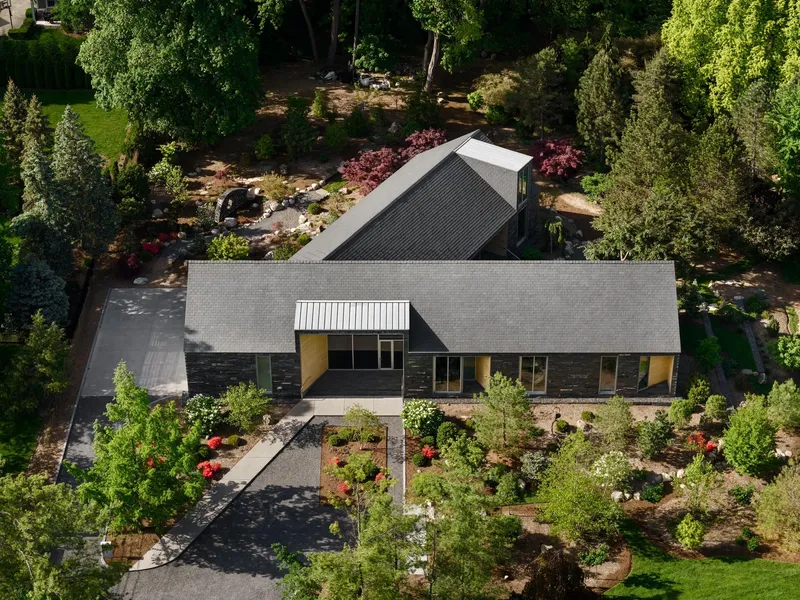
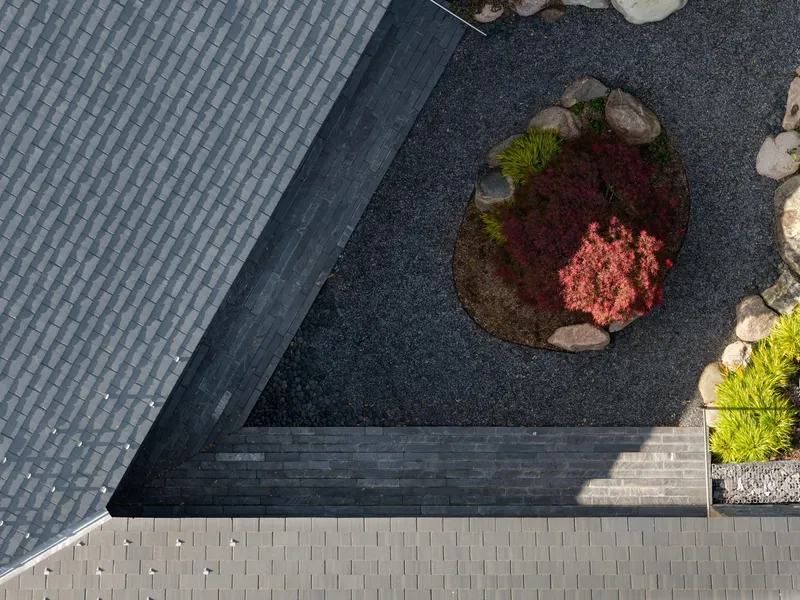
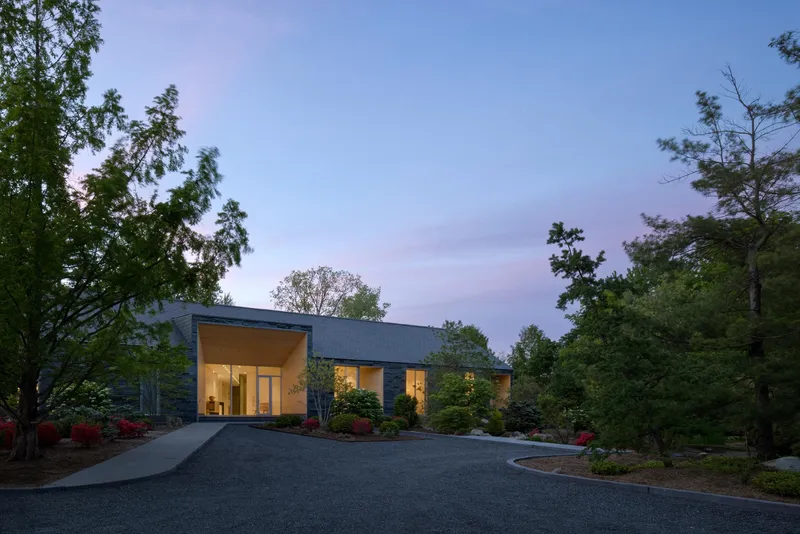
Seen from above, the logic of the Y-plan becomes legible. The three wings splay outward from a central entry zone, creating wedge-shaped exterior spaces between them: a gravel courtyard with planted beds and boulders, an approach garden, and the long view toward the river. The angled geometry means that no wing looks directly at another. Each terminates in its own private relationship with the site.
The single-storey massing keeps the roofline low, nearly disappearing beneath the canopy of mature trees. A cantilevered entry canopy extends from the slate-clad facade to greet visitors without ceremony, while the gabled forms visible from the air give each wing a discrete identity. It is a house that wants to be discovered in parts, not comprehended in a single glance.
Slate and Stone as Living Skin
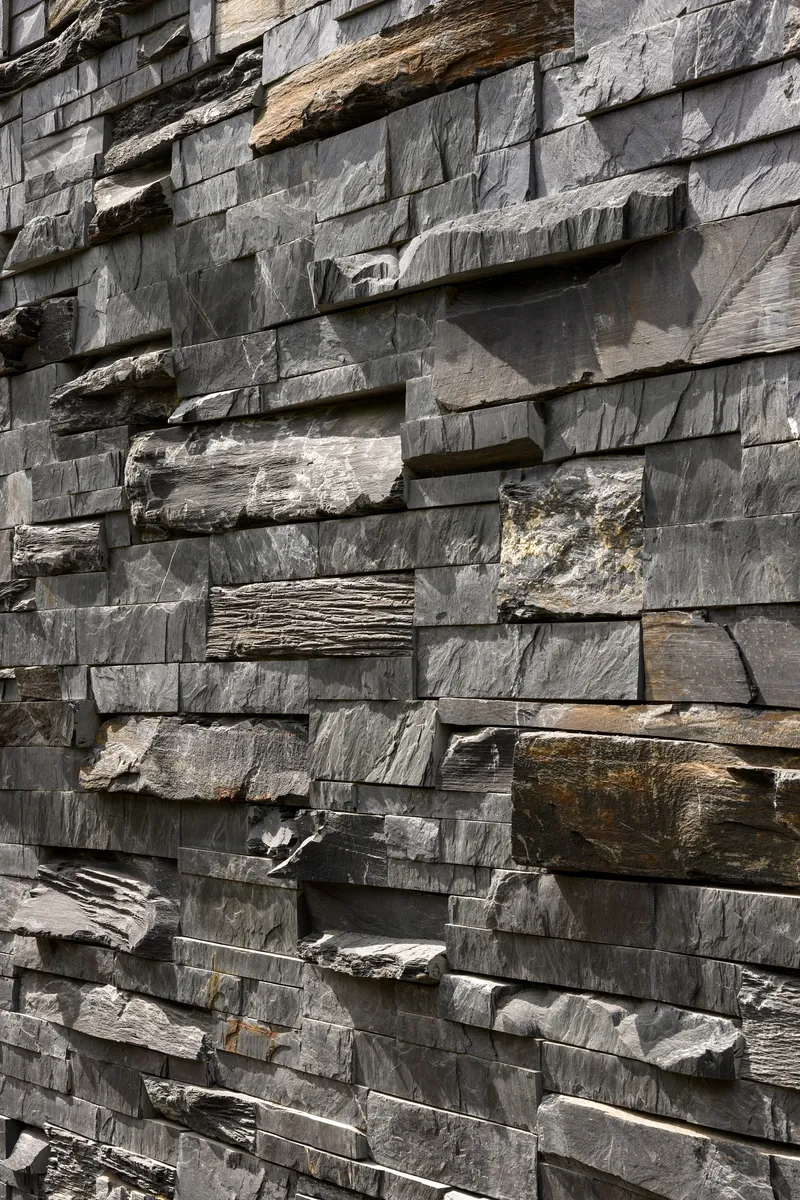
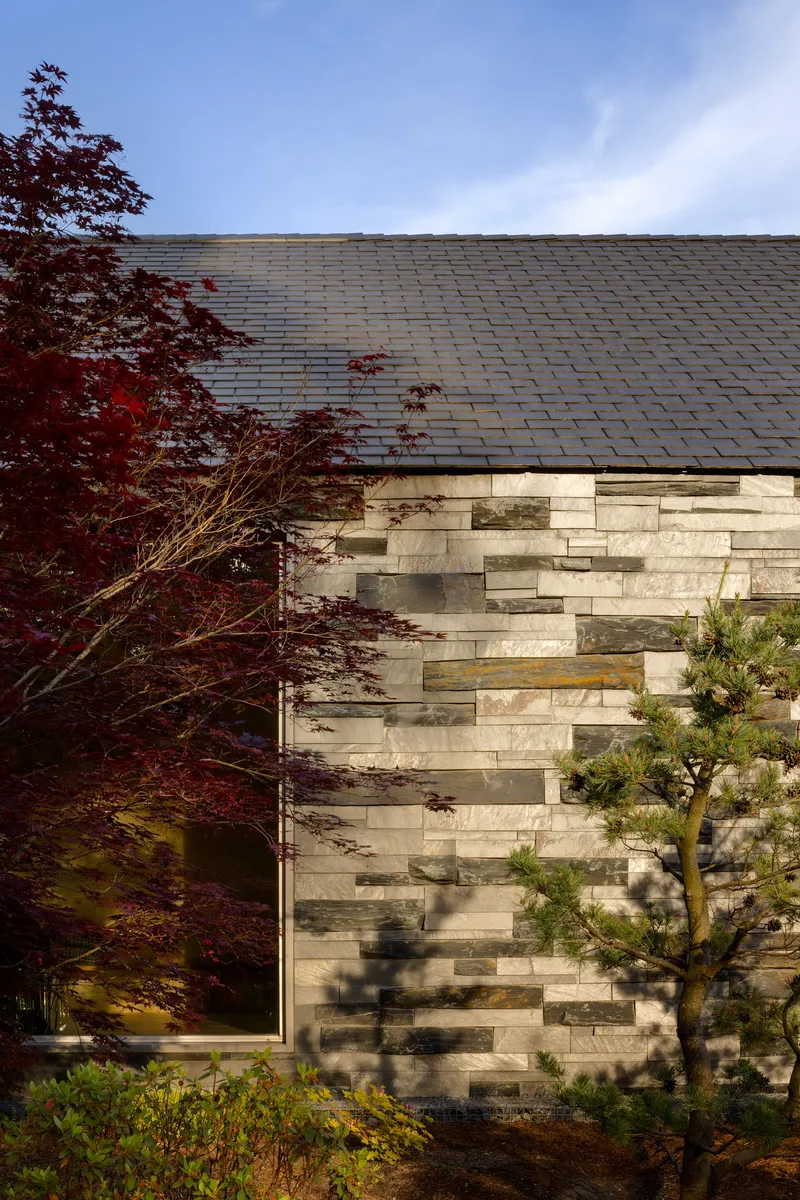
The exterior cladding deserves close inspection. Stacked slate with rough-hewn edges wraps both walls and roof planes, blurring the line between facade and fifth elevation. The variation in grey and brown tones gives the surface a geological quality, as though the house were an outcropping rather than a construction. Where the slate roof meets the horizontal stone wall, the transition is handled without flashing or trim details that would break the continuity.
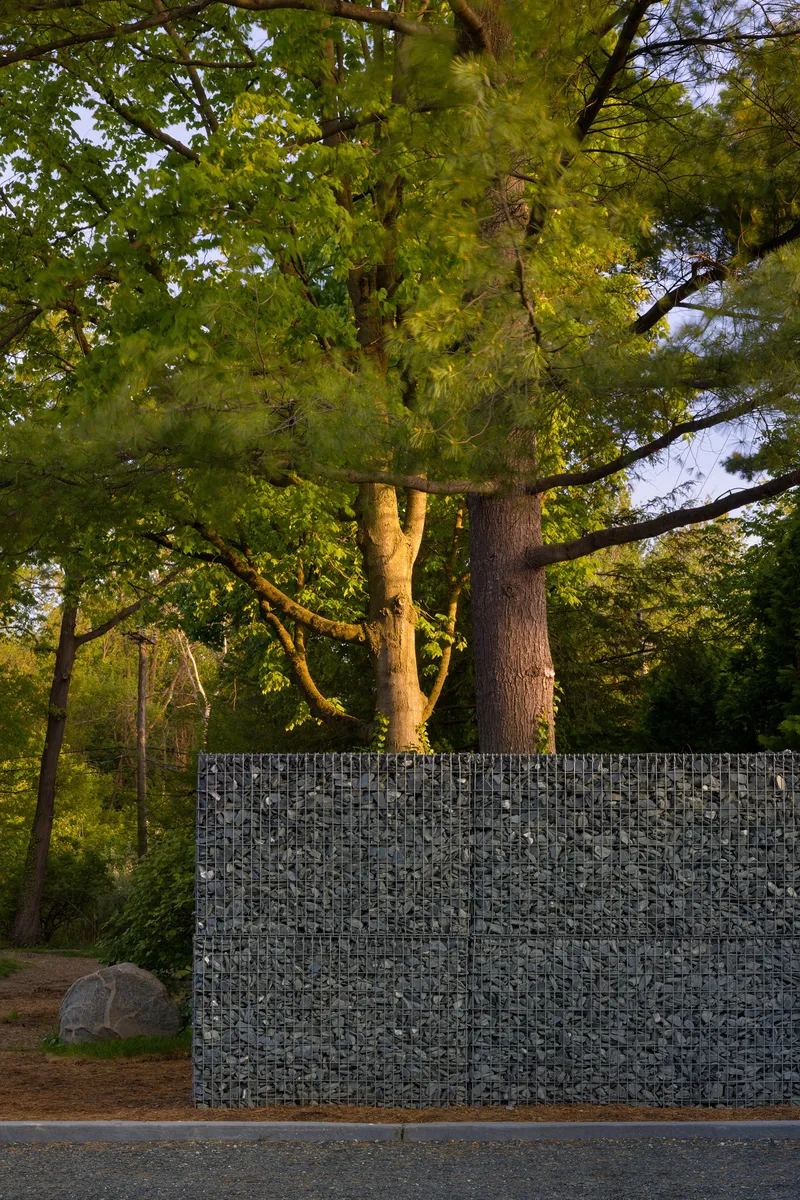
Gabion walls filled with grey stone extend the material language into the landscape, acting as retaining elements and garden boundaries. Under low evening light, these walls take on a warm amber tone that connects them visually to the mature trees behind. The choice is deliberate: this is a house designed to look better as it ages, gaining patina alongside the seasonal cycles of the River Rouge corridor.
Brick and Gable as Memory
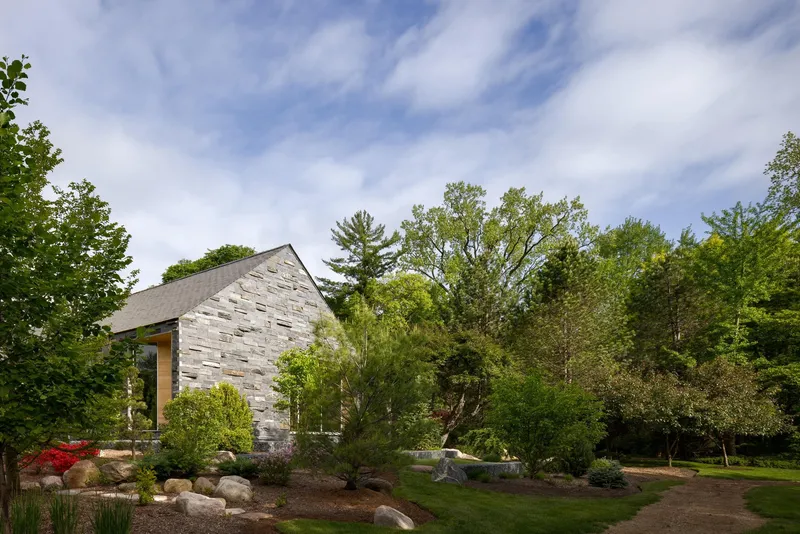
Not everything here is slate. One gable end rises in reclaimed white brick, a quiet nod to the vernacular building traditions of metropolitan Detroit. Against the charcoal and grey palette of the rest of the house, this pale surface reads almost like a found fragment, something preserved from an earlier structure. It softens the overall composition and introduces a sense of history into what is otherwise a resolutely contemporary project.
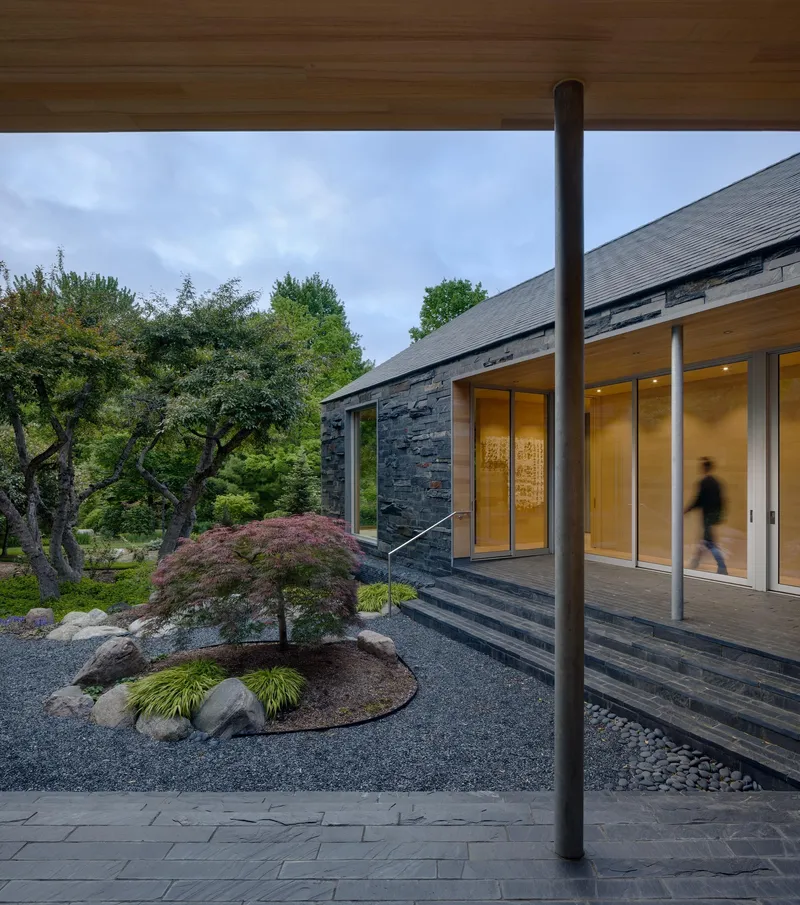
At the covered entry terrace, a Japanese maple and ornamental grasses occupy a planted bed that separates the arrival sequence from the glazed living spaces beyond. The planting here is curated with the same precision as the architecture, using texture and seasonal color to animate a threshold that could otherwise feel stark.
Interior Warmth Through Plywood and Light
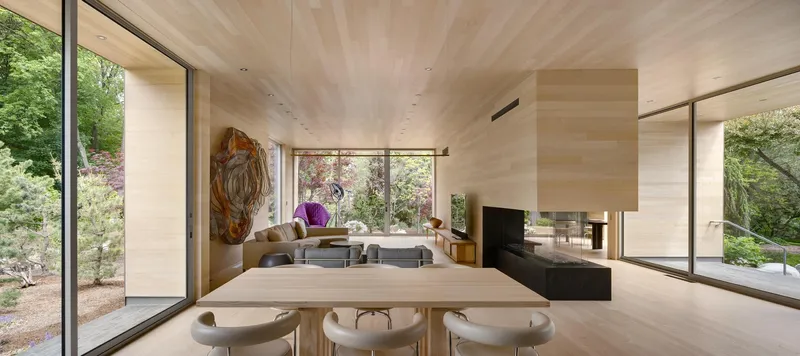
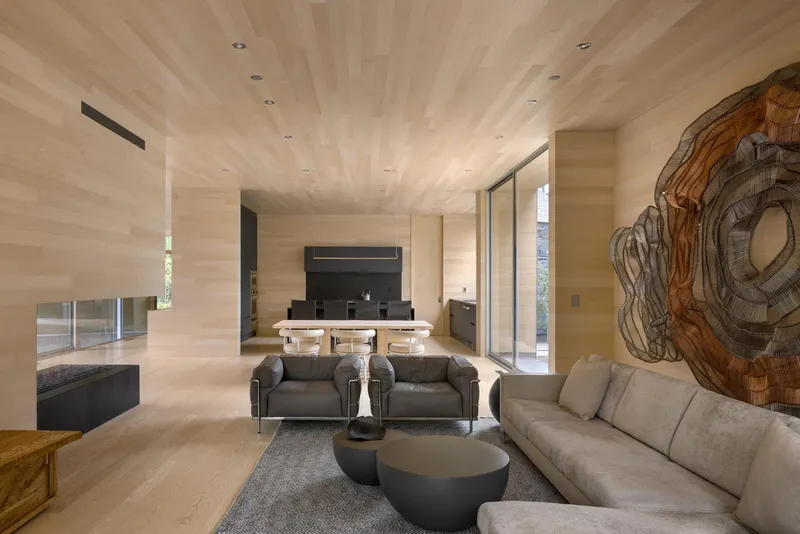
Step inside and the palette shifts from mineral to timber. Plywood panels line the ceilings and walls of the main living spaces, creating a warm, continuous enclosure that contrasts with the rugged exterior. The open living and dining area benefits from floor-to-ceiling glazing on two sides, flooding the room with diffuse light and pulling the garden into every sightline. A fireplace anchors the living room without dominating it, positioned so that views through to the courtyard remain uninterrupted.
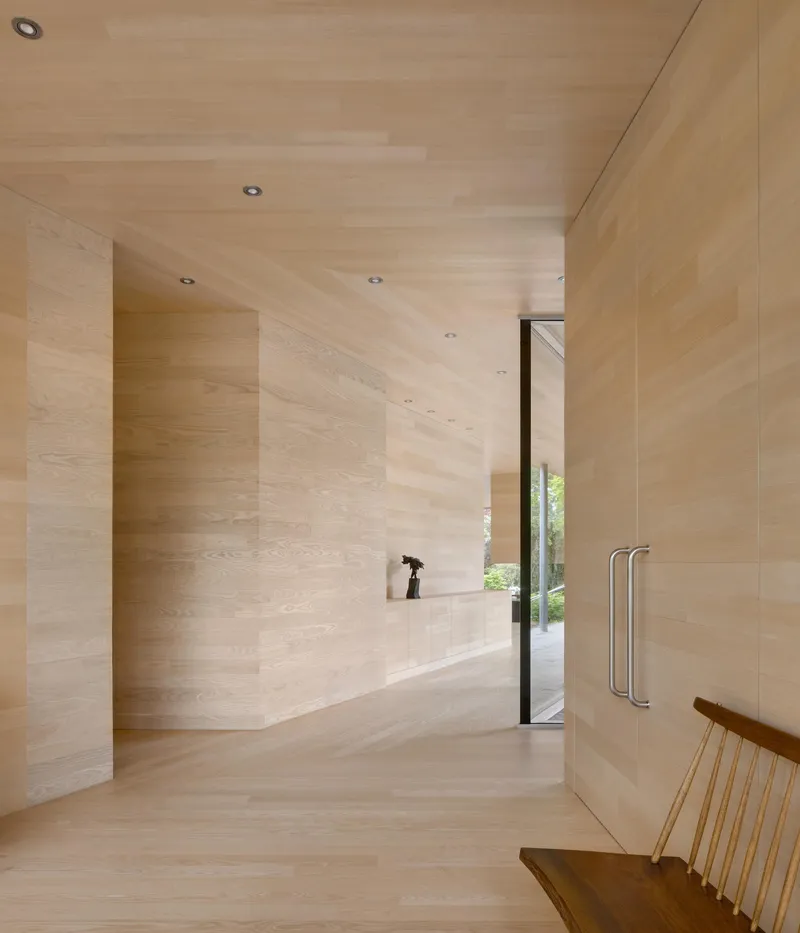
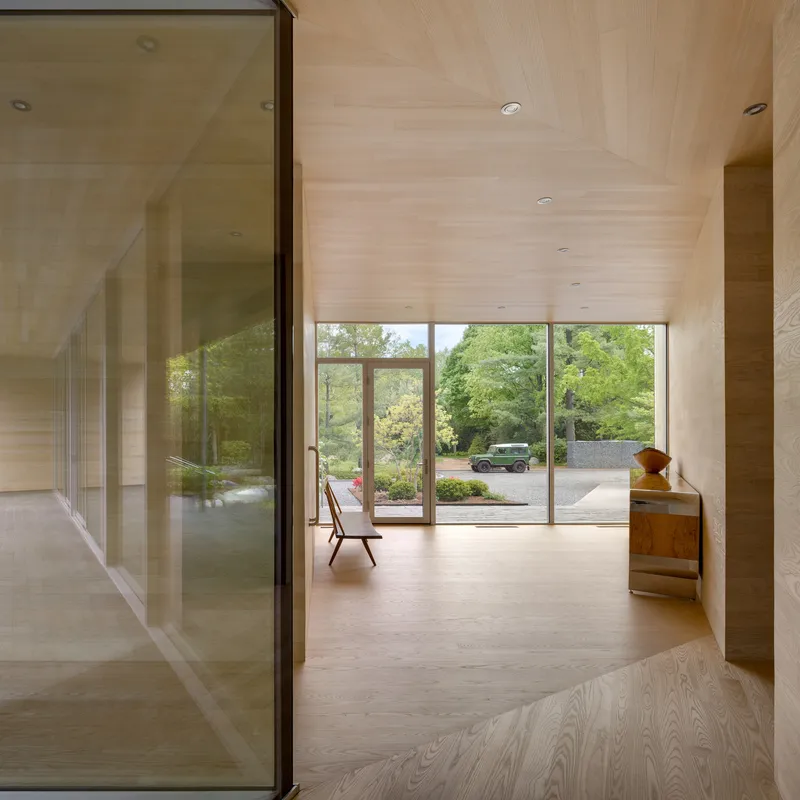
The entry hallway uses light-toned wood cladding and recessed lighting to compress the spatial experience before it opens into the generous living wing. It is a classic architectural move, but it works here because the transition from narrow corridor to expansive glass wall feels genuinely earned.
Courtyards as Rooms Without Roofs
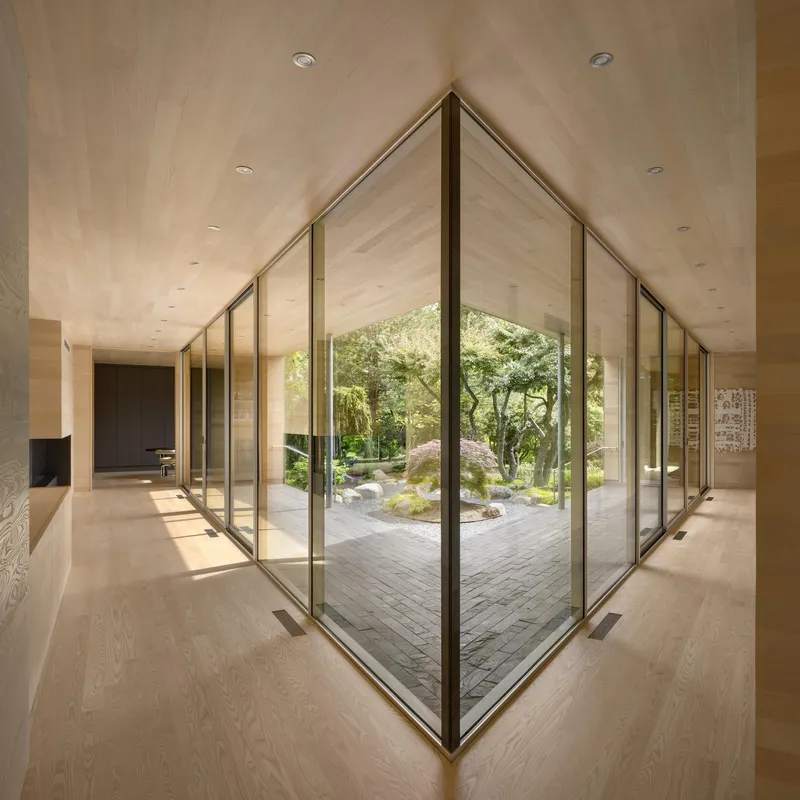
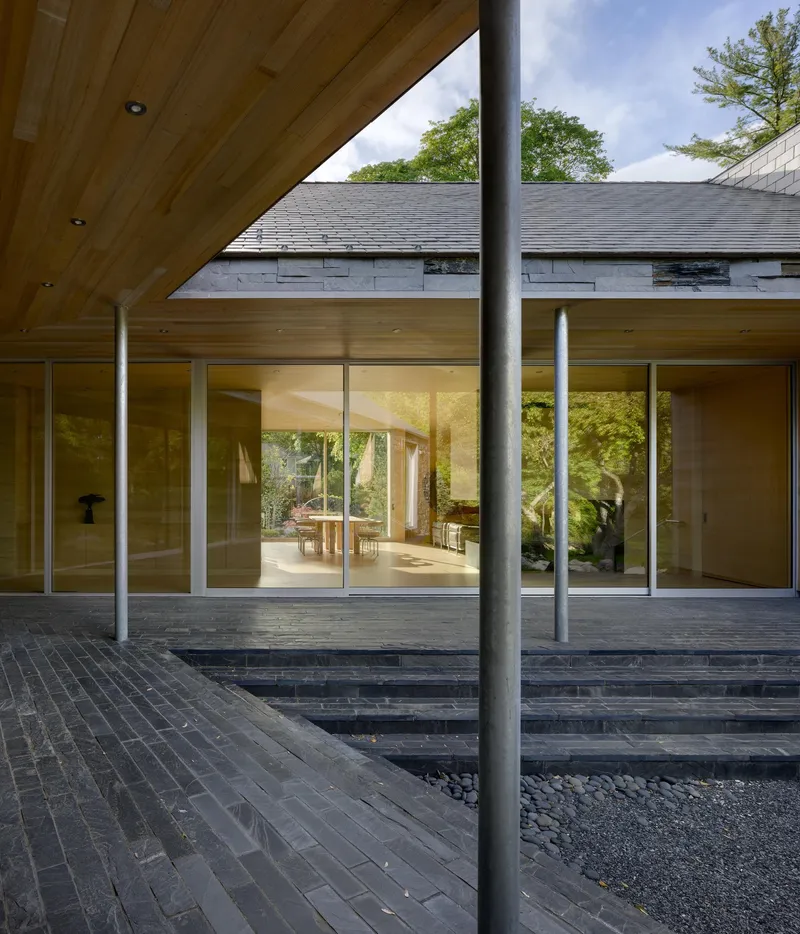
The Y-plan generates interstitial spaces that function as outdoor rooms. A courtyard defined by corner glass walls and charcoal brick paving captures dappled light through the tree canopy, with moss allowed to grow in the joints. A covered terrace with a timber ceiling and steel column creates a transitional zone between inside and out, its brick paving extending the ground plane of the courtyard into the domestic interior.
These in-between spaces give the house its character. They mean that moving from the bedroom wing to the living wing is never a purely interior experience; you are always aware of the garden, the sky, the time of day. A wood-lined corridor with a glass partition captures reflections of the landscaped driveway beyond, doubling the sense of depth in what is, by plan, a modest width.
Private Spaces That Stay Connected
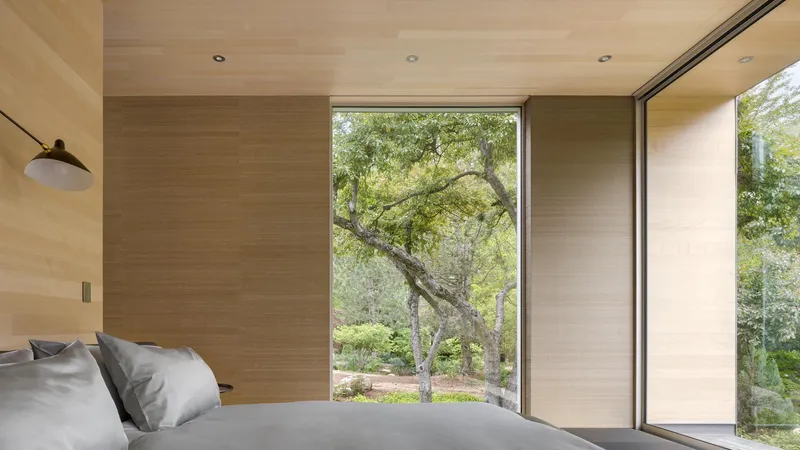
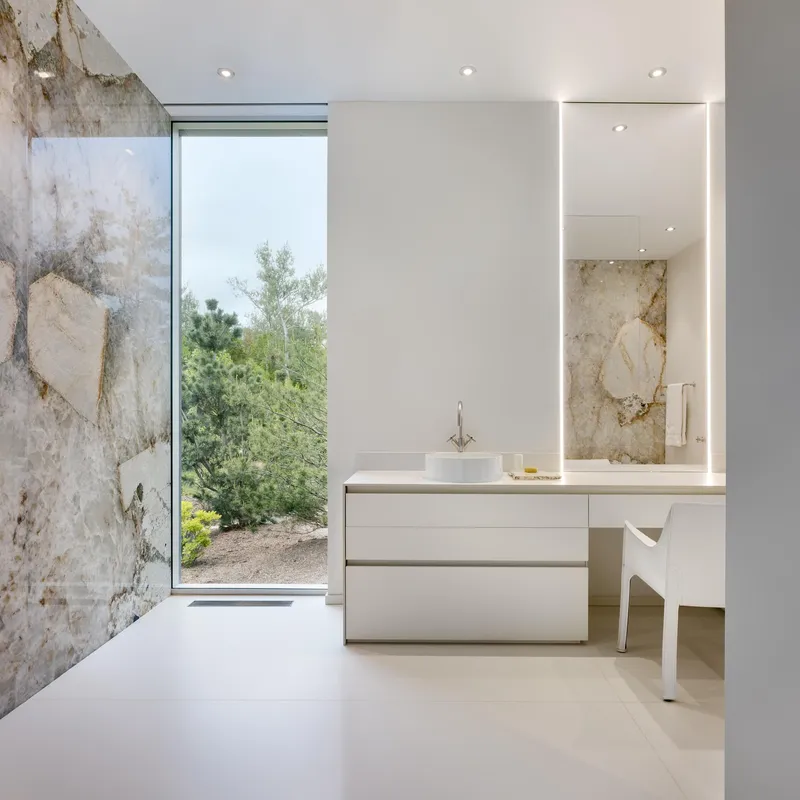
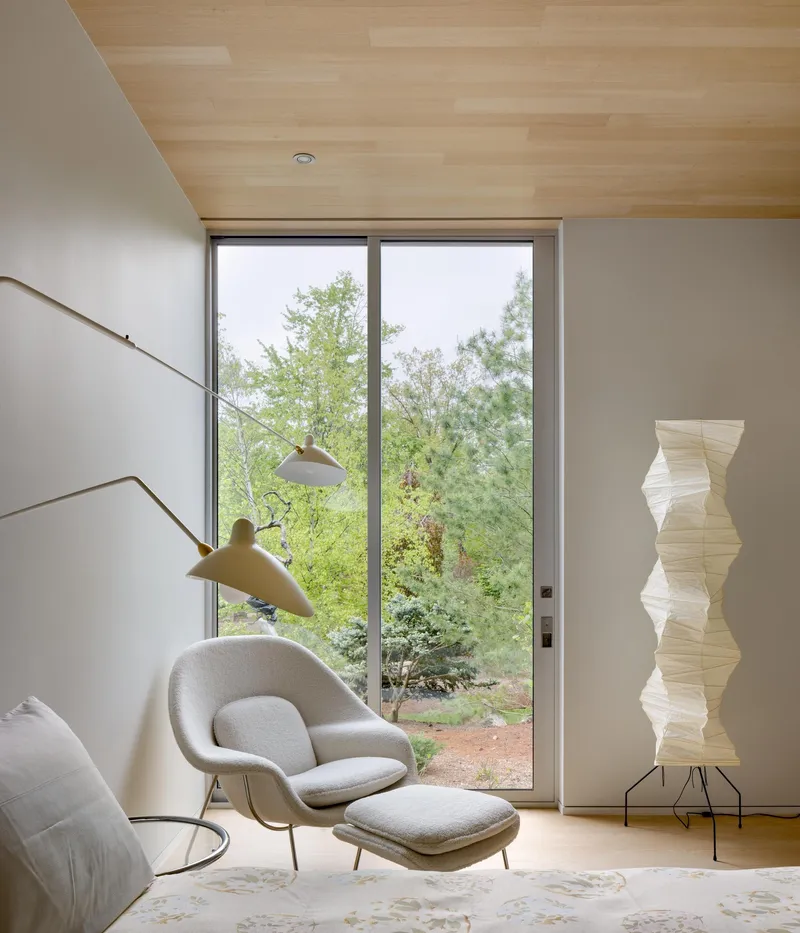
The bedrooms and bathrooms occupy the quieter wings of the plan, but they never feel isolated. A bedroom with plywood wall panels opens through sliding glass doors directly to the tree line, collapsing the distance between sleeping and the outdoors. The bathroom takes this further: a weathered stone accent wall faces a floor-to-ceiling window overlooking the green landscape, with a white vanity and backlit mirror providing just enough contrast to keep the room from feeling like a cave.
A seating nook with a generous picture window and wood ceiling plane offers a place of retreat that still participates in the garden. These moments of calibrated intimacy distinguish the Lakeside Residence from larger homes that simply accumulate square footage without spatial intelligence.
Plans and Drawings
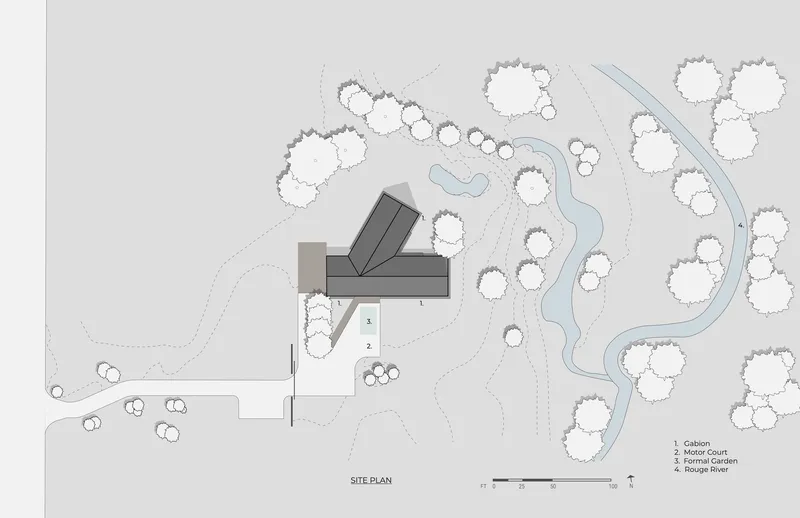
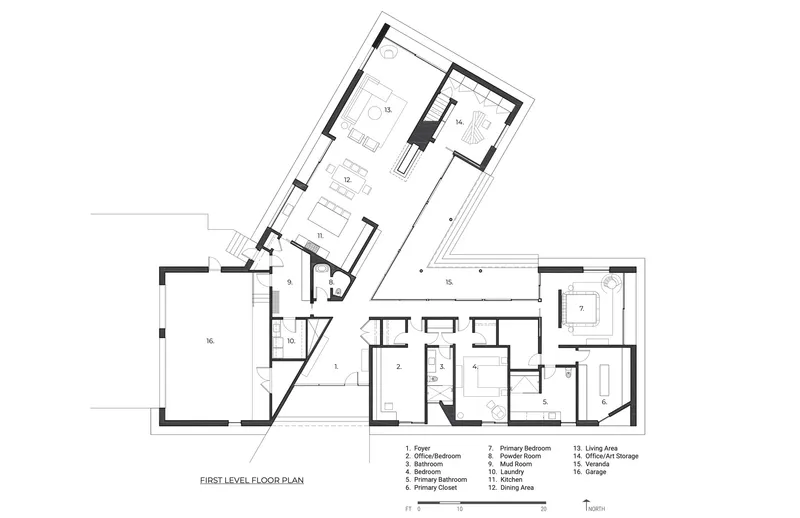
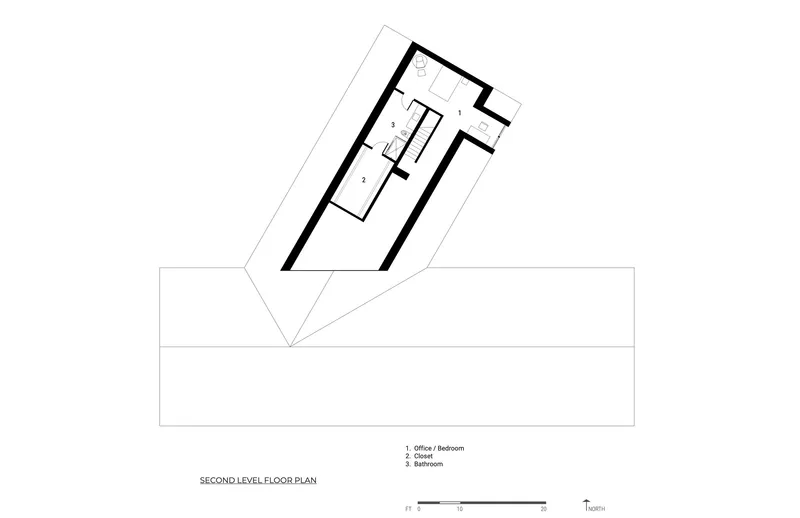
The site plan reveals the full relationship between the angular building volumes and the winding course of the River Rouge, with scattered trees establishing the parkland context. The first-level floor plan shows how the angled living and bedroom zones radiate from a central entry, generating the courtyard spaces that define the plan's character. A second level, compact by comparison, accommodates an office and additional bedroom above a linear cantilevered plane, adding a vertical dimension without disrupting the low-slung profile.
Why This Project Matters
The Lakeside Residence offers a persuasive counter-argument to the prevailing logic of suburban house design in the American Midwest. Rather than treating the site as a neutral platform for a rectangular box, Disbrow Iannuzzi worked backward from the landscape to generate a form that is specific, site-locked, and irreproducible elsewhere. The Y-plan is not a gimmick; it is a strategy for multiplying the number of moments where architecture and nature overlap.
More broadly, the project demonstrates that material restraint and spatial generosity can coexist. With a limited palette of slate, brick, plywood, and glass, the architects created a house that is rich in texture and experience without ever feeling overwrought. In a market saturated with houses designed to photograph well from one angle, this is a home that rewards the walk-through, the seasonal return, and the slow accumulation of time.
Lakeside Residence by Disbrow Iannuzzi. Birmingham, United States. 4,000 sq ft. Completed 2025. Photography by Rafael Gamo.
About the Studio
Share Your Own Work on uni.xyz
If projects like this are the kind of work you want to make, uni.xyz is a place to publish your own, find collaborators, and enter design competitions.


Popular Articles
Popular articles from the community


Cloaked Colonization: A Mobile Underwater Habitat That Moves Like a Fish
Micah Abaya's shortlisted EHC Pacific entry reimagines ocean settlement as a dispersed network of self-sustaining architectural organisms.

The Amber Palace Opera: A Geological Fiction Surfaces on Tallinn's Baltic Waterfront
Pierre Brillard reimagines a Baltic legend as a public landscape, opera house, and waterfront promenade rooted in Tallinn's coastal identity.

Tsunami Convergenics: Turning Catastrophic Ocean Forces into Underwater Housing Infrastructure
A speculative underwater settlement off the coast of Onagawa, Japan, treats tsunamis and typhoons as energy sources rather than threats.
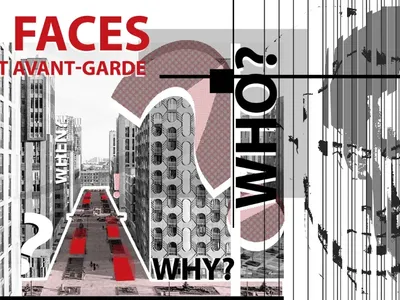
Faces of the Soviet Avant-Garde: Turning Moscow's Street Names into an Open-Air Museum
A network of sculptural installations across a Moscow residential district transforms forgotten architect names into spatial encounters with cultural memor

Similar Reads
You might also enjoy these articles

Pixel Gardens: One Repeated Module Stacked Into a Terraced Social Housing Tower for Famagusta
Salem Bader's shortlisted housing tower builds a vertical neighbourhood from one repeated module, offsetting units to carve terraces, light and air.

Bao Huynh Watercolor Atelier: A Serene Art Retreat in Hội An
Bao Huynh Watercolor Atelier in Hội An blends multifunctional art spaces, sustainable design, local materials, and family-friendly living in a serene environment.

Atelier Macri Concept Store Interior Design by CASE-REAL
Atelier Macri store features a "ko" counter, walnut wood details, cork displays, blending retail, gallery, and seamless customer experiences.

Manuel Vargas Izquierdo Stadium and High-Performance Sports Center: Architectural Excellence in Jalpa de Méndez
The Manuel Vargas Izquierdo Stadium blends sustainable design, inclusive sports facilities, and cultural-inspired architecture, revitalizing Jalpa de Méndez’s public spaces.


Comments (0)
Please login or sign up to add comments
No comments yet. Be the first to comment!