
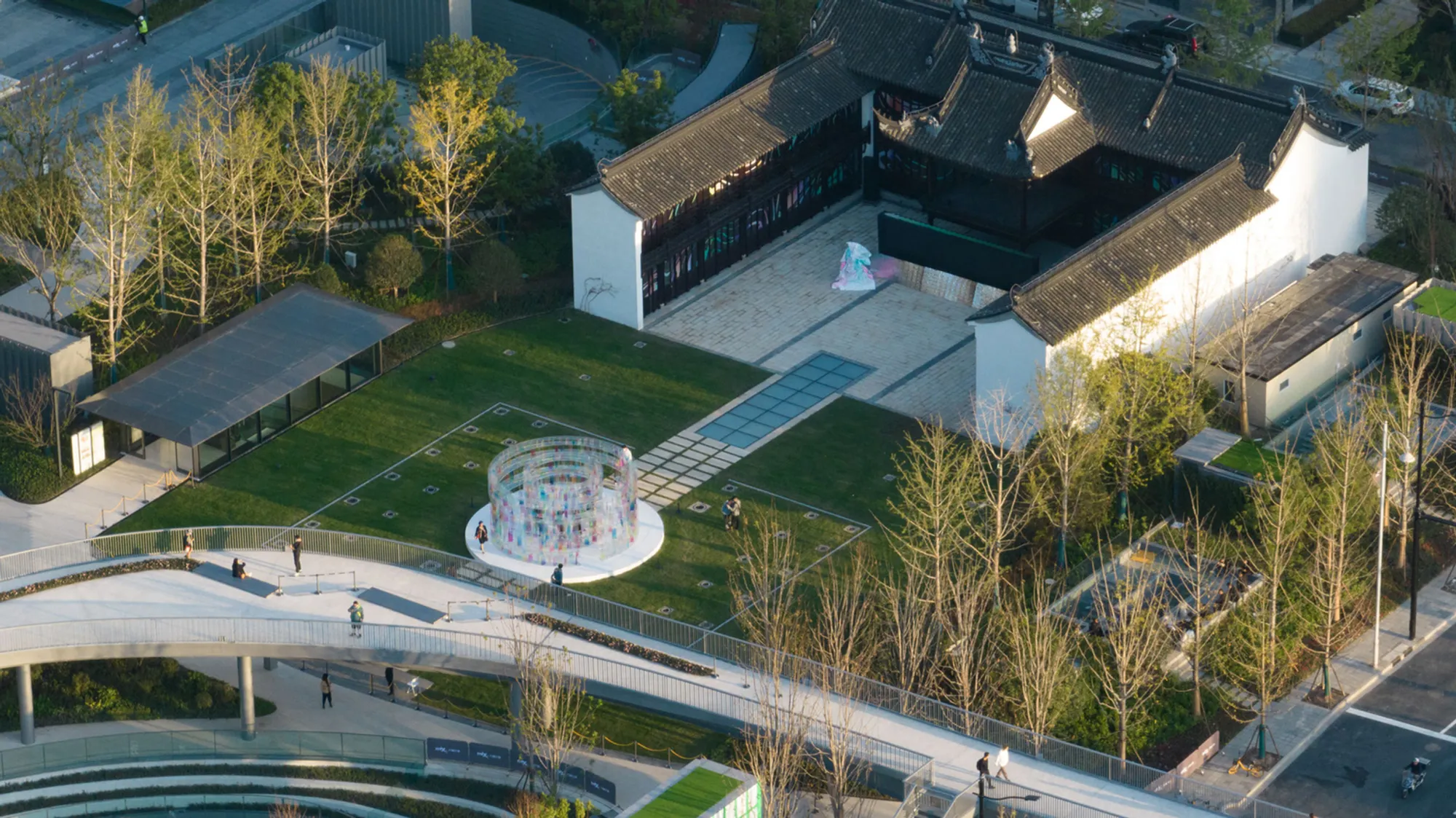
Lab D+H Carves a Green Valley into Shanghai's Densest Urban Fabric at Suhe MixC World
A 42,000-square-meter landscape along Suzhou Creek folds parkland over sunken commercial space while preserving lilong heritage.


Shanghai's northern bank of Suzhou Creek has long been a collision point: metro infrastructure, heritage lilong housing, a Thean Hou Temple, and the pressure of high-density commercial development all compete for the same ground. The landscape for Suhe MixC World, completed in 2022 by Lab D+H, treats that collision as a design opportunity rather than a problem to solve. Across 42,000 square meters of new public green land, the firm implements what it calls an "urban valley," using stepped slopes and pebble-shaped openings to merge a subterranean commercial zone with a continuous surface park. The result is a landscape that functions simultaneously as a civic green, a commercial threshold, and a memorial to the site's layered past.
What makes the project genuinely compelling is a deliberate inversion of priority. The ground floor, normally the most commercially lucrative plane, is given over almost entirely to public space. Entrances to the sunken retail areas are weakened on purpose, absorbed into planted slopes and organic openings so that the dominant experience at grade is one of greenery, not storefronts. Six overground apertures puncture the park surface to bring daylight below and draw people down, but they do so on the landscape's terms, not the retailer's. Pedestrian bridges, a four-story gateway building by Kokaistudios, and a footbridge over Fujian North Road stitch together a site that roads had previously fractured, creating a unified ground plane for walking.
The Urban Valley: Folding Commerce Beneath the Park
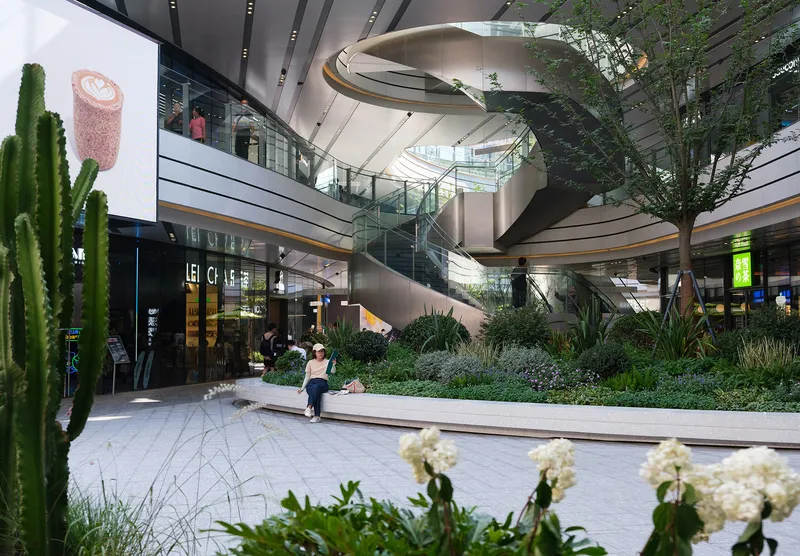
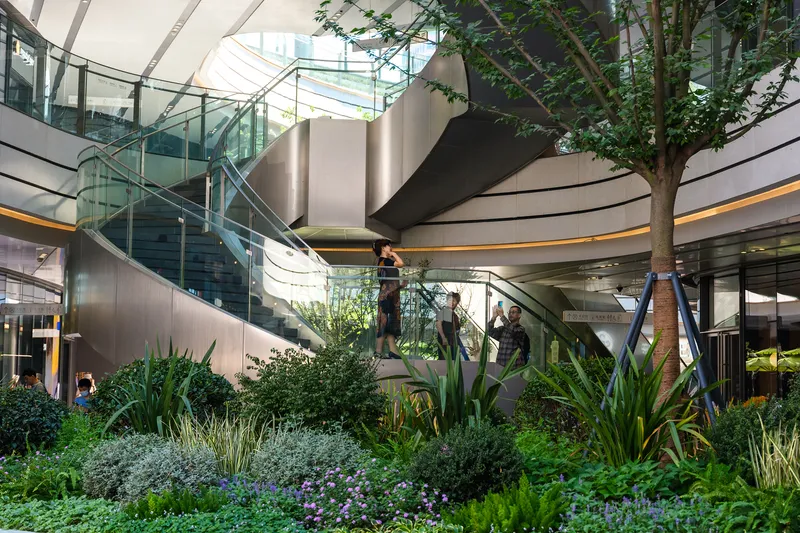
The central spatial move here is sectional. Lab D+H sculpts stepped slopes that descend from the park surface into the commercial levels below, blurring the boundary between landscape and architecture. The multi-level atrium spaces reveal how this works in practice: sculptural steel staircases wind through planted courtyards, and glazed skylights overhead ensure the underground zones receive generous natural light. Trees and flowering beds are not decorative afterthoughts but structural elements of the section, occupying every viable pocket of space both above and below grade.
The planting strategy extends the valley metaphor. Rather than a flat park sitting atop a box of retail, the terrain undulates. Transplanted mature trees provide immediate shade and scale, while carefully selected species populate the sloped transitions, with occasional seating nooks and coffee shops tucked into the gradient. The effect is closer to a sculpted topography than a conventional podium landscape.
Heritage Embedded in the Ground Plane
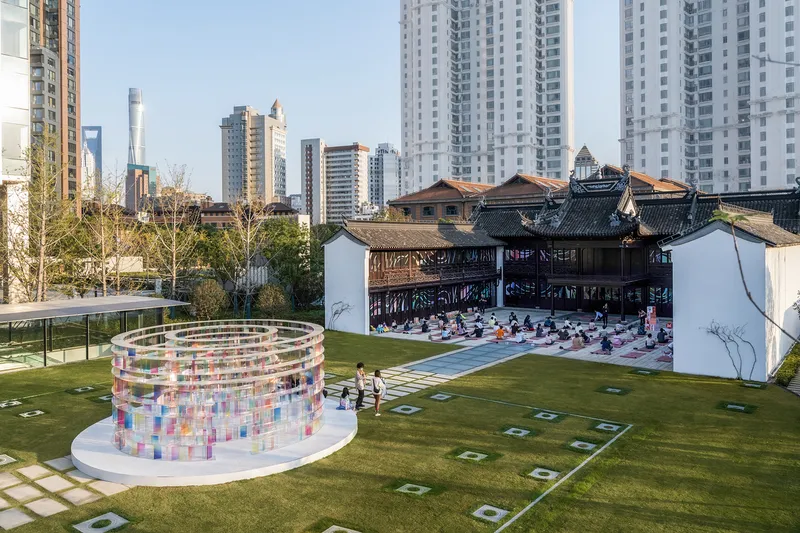
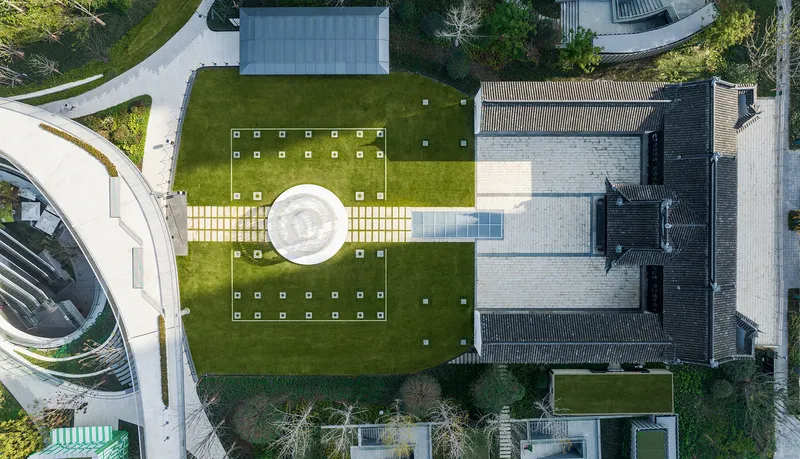
The site preserves two significant heritage artifacts: the Shenyu Li lilong group and the only official Thean Hou Temple in downtown Shanghai. Lab D+H's approach to these elements is restrained and clever. The lawn in front of Tianhou Palace retains the spot positions of the original building's pillars, turning an absence into a subtle memorial. Near Shenyuli, a combination of skylights and lawn patterns traces the plan of traditional Shikumen architecture, projecting the footprint of vanished houses onto the contemporary surface.
A circular pavilion with translucent colored panels sits on a lawn adjacent to the restored timber buildings, acting as a contemporary counterpoint that neither mimics nor ignores the historical language. Viewed from above, the pavilion becomes a focal point centered between traditional courtyard structures, holding its own geometry against the older grain. Below ground, the commercial areas incorporate elements of the lilong houses directly, blending glass roof windows with wooden rafters in a hybridized interior.
Bridges and Connections Across a Fragmented Site
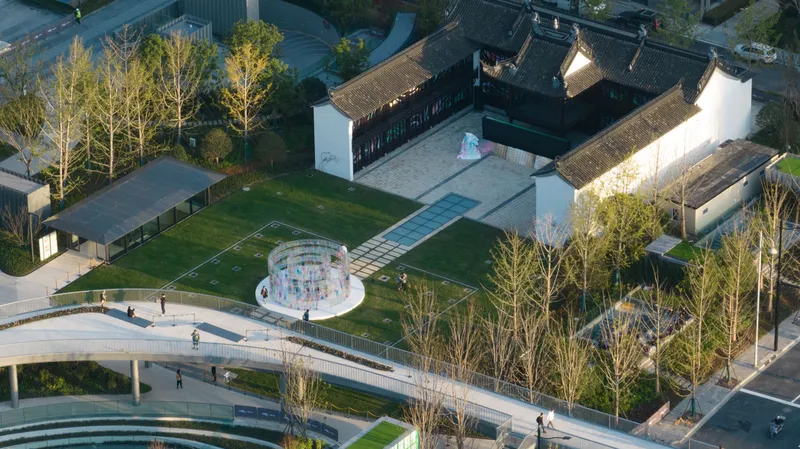
Before the intervention, roads bisected the site and severed pedestrian continuity. The aerial view reveals how Lab D+H resolves this: pedestrian bridges span the bisecting road, connecting lawn areas on either side with a unified design language. The bridges are not afterthoughts bolted onto the landscape; they use the same material palette and planting logic as the ground plane, so the crossing feels like an extension of the park rather than a piece of infrastructure.
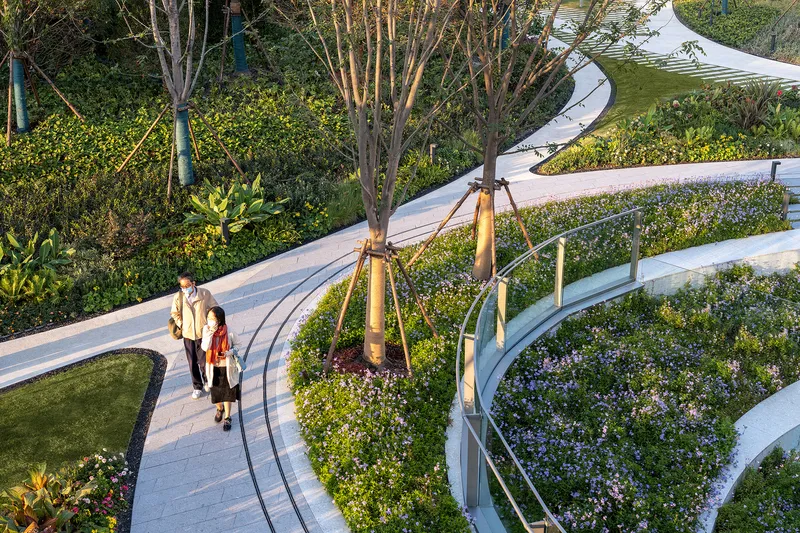
A curving elevated walkway with planted beds reinforces this strategy at a more intimate scale. Two people strolling along it in afternoon light could be walking through a garden, not navigating between commercial blocks. The pebble-shaped openings that puncture the surface on either side of the road serve double duty, marking entrances to the underground retail while acting as orientation landmarks within the park.
Surface Life: Activating the Green Layer
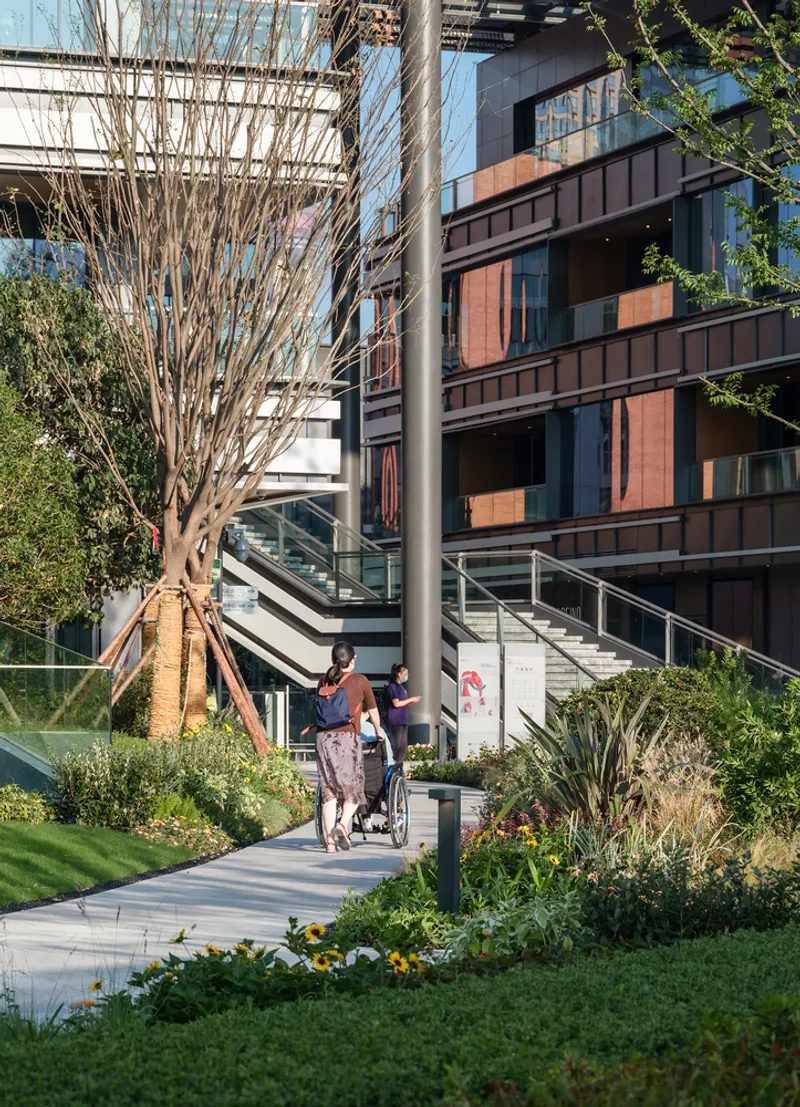
At ground level, the park earns its keep through everyday use. A landscaped walkway flanked by planted beds and a copper-paneled facade shows visitors and families passing through at ease, the stroller and the casual pace suggesting that this is genuinely public territory, not a curated commercial forecourt. Lab D+H's planting selections create layered green walls that soften the boundary between the park and the adjacent architecture by Kokaistudios.
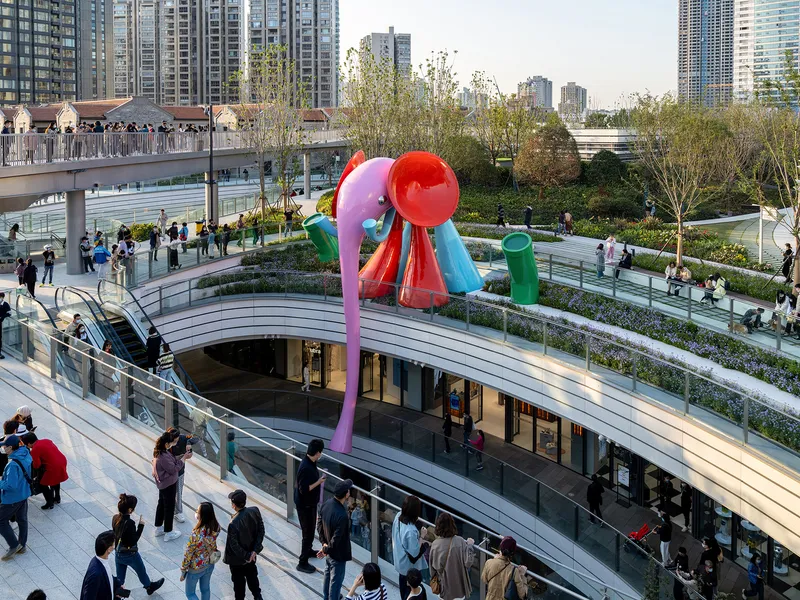
The rooftop terrace captures a different energy: a colorful inflatable sculpture hovers above a sunken courtyard with stepped landscaping, suggesting the kind of programmatic flexibility the design enables. The stepped geometry reappears here as a social amphitheater, proving that the valley section is not just a one-off trick but a repeatable spatial logic applied across the project. The landscape becomes a platform for temporary activations without sacrificing its permanent green infrastructure.
Why This Project Matters
Suhe MixC World matters because it demonstrates, at significant scale, that the most valuable thing a developer can do with ground-floor real estate is give it away. By subordinating commercial entrances to public green space, Lab D+H creates a landscape that people actually want to occupy, which in turn generates the foot traffic that sustains the retail below. The urban valley concept is not just a formal gesture; it is an economic argument for prioritizing civic generosity over direct frontage.
The heritage strategy deserves equal attention. Rather than freezing the lilong and temple fragments behind glass, the design absorbs their memory into the living surface of the park. Pillar footprints become lawn markers, Shikumen plans become skylight patterns, and timber rafters reappear in commercial interiors. It is a model for how Chinese cities can hold their past without turning it into a museum, embedding history into the texture of daily life along a river that Shanghai is finally learning to face again.
Landscape Design of Shanghai Suhe MixC World by Lab D+H. Architecture by Kokaistudios. Structural consultant: Arup. Location: Suzhou Creek, Shanghai, China. Area: 42,000 sqm landscape; approximately 60,000 sqm commercial GFA. Completed: 2022. Clients: China Resources Land Limited, Shun Tak Holdings.
About the Studio
Share Your Own Work on uni.xyz
If projects like this are the kind of work you want to make, uni.xyz is a place to publish your own, find collaborators, and enter design competitions.




Popular Articles
Popular articles from the community


The Ocean Hive: Sustainable Architecture for a Self-Sufficient Civilization at Sea
The Ocean Hive imagines sustainable architecture at sea, where modular habitats, algae, wave power and ocean waste sustain a growing colony.

The Earth Pod: 3D Printed Homes for Resilient Refugee Communities
The Earth Pod reimagines refugee housing through 3D printed homes made from clay, combining resilience, self-sufficiency, and rapid shelter.

Riyadh For All: Intergenerational Urban Design for Active Aging in Rabat
Riyadh For All reimagines urban design in Rabat with intergenerational co-living, adaptive courtyards, and Moroccan cultural exchange today.

Co-Life: Senior Housing Design That Reconnects Older Adults With the City
Co-Life reimagines senior housing design through healing gardens, shared streets, workshops, and a sustainable community across generations.

Similar Reads
You might also enjoy these articles


Hodi-Mandai Geram
Project Function: Preservation and revitalization of the Intangible heritage and socio-spatial identity of the Hodi by Housing, Cultural Memory Center, Sacred Grove, landscape, local tourism economy


Olio Towers: A Mid-Rise for Performers That Fuses Housing, Rehearsal, and Stage
Located blocks from Houston's Theater District, this modular tower stacks living units around a central performance atrium.

Oasis: Modular Green Housing Carved into Dhaka's Urban Fabric
A shortlisted Plugin Housing entry reclaims unauthorized settlements in Dhaka with stepped concrete volumes, green roofs, and ventilation-driven design.

Black Hole: A Floating Megastructure for the Post-Physical Era
Emiliano Mazzarotto envisions a spherical, self-scaling arena where e-sports, digital hotels, and holographic stadiums replace traditional public space.


Explore Landscape Design Competitions
Discover active competitions in this discipline



Challenge to reimagine the Iron Throne


Photograph architecture without architects


Illustrate the lost glory of Angkor Wat - Render Challenge


Design challenge to reuse E-waste
Comments (0)
Please login or sign up to add comments
No comments yet. Be the first to comment!