

Late Vamanrao Pitambare College by Amruta Daulatabadkar Architects: Open, Contextual, and Student-Centric Design
Open, student-centric college with staggered massing, shaded terraces, natural ventilation, and biophilic design fostering learning, interaction, and contextual engagement.


Situated on the outskirts of Chhatrapati Sambhaji Nagar, India, Late Vamanrao Pitambare College by Amruta Daulatabadkar Architects (adaa) is a thoughtfully designed educational institution spanning 27,345 ft². Completed in 2022, the college caters to higher secondary and undergraduate students from Aurangabad and neighboring villages. Positioned adjacent to a highway, the site features a sparsely built neighborhood with scattered residential and commercial structures, unbuilt plots, and natural vegetation, offering expansive views of distant hills and greenery.


The architectural concept embraces openness and connectivity, responding to its contextual surroundings. The institute is composed of overlapping horizontal planes and cuboidal blocks connected through bold vertical and horizontal elements, creating a dynamic visual rhythm. This composition ensures ample shading, natural breezes, and glare-free sunlight, particularly along the north-facing façade. Communal spaces such as the central courtyard and shaded terraces encourage student interaction while providing comfortable, thermally regulated environments.

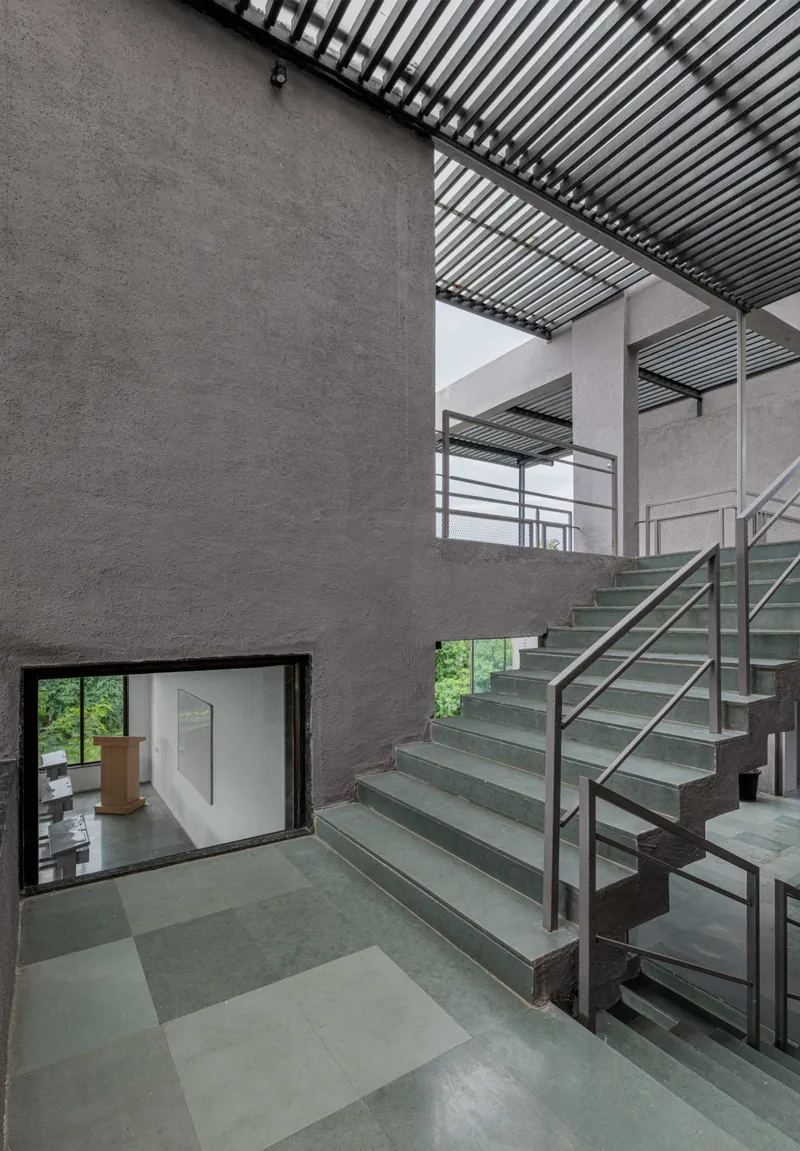
A wide staircase welcomes visitors and leads directly to the courtyard-level first floor, establishing a grand, inviting entry that seamlessly integrates the outdoors. Functional spaces are organized around this central courtyard, with two staircases and a corridor forming an east-west circulation spine. Key areas include a library on the southeast corner, capturing morning light through large windows and skylights, and the principal’s cabin, a transparent glass box overlooking the courtyard. The administrative block, surrounded by corridors on all sides, promotes student-staff engagement. Classrooms occupy the upper floors, featuring large north-facing windows and breakout terraces with amphitheater-style seating and cultural elements like a Saraswati statue. The stilt and basement floors provide additional learning and gathering spaces.


Spatial choreography is central to the design philosophy. Students traverse a sequence of frames that capture glimpses of surrounding trees, colorful foliage, and distant hills, fostering a continuous dialogue between interior and exterior environments. This visual and spatial connection enhances engagement, promotes interactions, and offers moments of respite in a rigorous academic setting.


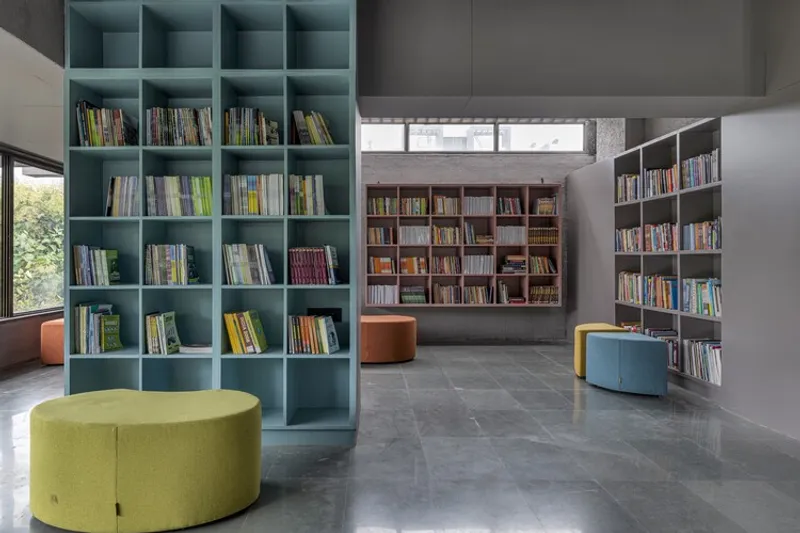
The building’s massing blocks vary in height, punctuated by large windows, skylights, and strategic openings to optimize natural light and ventilation. Horizontal planes, including courtyards and terraces, incorporate flexible seating and landscaped areas to encourage informal occupancy. Core staircases visually link spaces vertically while doubling as breakout areas for student gatherings. The material palette is deliberately minimal, combining unfinished concrete, kota stone, and plaster finishes, providing a raw yet sophisticated aesthetic. Pops of color through furnishings, artwork, and landscaping inject vibrancy, creating an inspiring and dynamic learning environment.

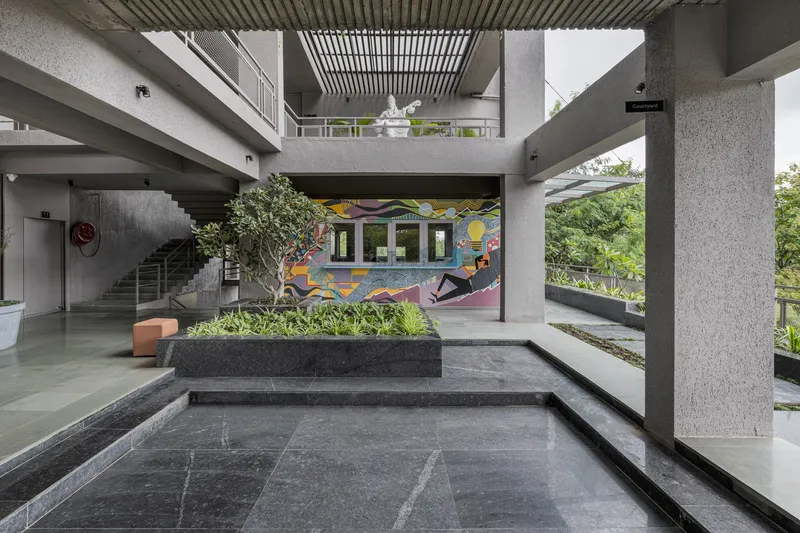
Overall, Late Vamanrao Pitambare College exemplifies a context-sensitive, student-focused educational architecture that seamlessly integrates indoor and outdoor experiences. The design fosters connectivity, engagement, and well-being, establishing an environment where learning extends beyond classrooms to a holistic spatial experience.




Popular Articles
Popular articles from the community


Riyadh For All: Intergenerational Urban Design for Active Aging in Rabat
Riyadh For All reimagines urban design in Rabat with intergenerational co-living, adaptive courtyards, and Moroccan cultural exchange today.
EW PARK: Sustainable Architecture Reimagines the Future of Urban Parking
EW PARK reimagines city parking as a modular wooden tower combining automation, solar energy, electric mobility, and adaptable urban design.

The Earth Pod: 3D Printed Homes for Resilient Refugee Communities
The Earth Pod reimagines refugee housing through 3D printed homes made from clay, combining resilience, self-sufficiency, and rapid shelter.

The Musturak Paradise: Senior Living Architecture for a Connected Future in Temara, Morocco
The Musturak Paradise reimagines senior living architecture in Temara via private homes, social spaces, culture, community, and shared care.

Similar Reads
You might also enjoy these articles

Bamboo Housing Challenge 2026: Design Affordable, Sustainable Homes Using Bamboo
An international design competition by Bamboo U and IBUKU inviting architects and designers to reimagine affordable housing using bamboo — with the winning design built full-scale in Bali.

Computational Design & Education: Beegraphy Design Awards Introduces 7th Category (Featuring Jiyun's Innovative Approach)
Dive into Beegraphy’s 7th Design Awards category, where computational design meets education to create immersive, interactive learning tools, inspired by Jiyun’s work.
From Parametric Lighting to Urban Furniture: Join the 2nd Workshop in Beegraphy’s Computational Design Series
Dive into Cutting-Edge Design Techniques and Practical Applications with Industry Experts

Last Call: Unleash Your Architectural Genius in SHAK's Kindergarten Design Competition
Urgent call for architects to join SHAK's kindergarten design competition before the looming deadline


Explore Architecture Competitions
Discover active competitions in this discipline



Challenge to design public laboratory


Challenge to reimagine the Iron Throne


Photograph architecture without architects


Illustrate the lost glory of Angkor Wat - Render Challenge
Comments (0)
Please login or sign up to add comments
No comments yet. Be the first to comment!