
Leo Romano Stacks Two Concrete Monoliths Over a Forest Canopy in Goiânia
TP House pairs raw concrete volumes with warm timber screens, cascading down a lush hillside in Jardins Munique, Brazil.


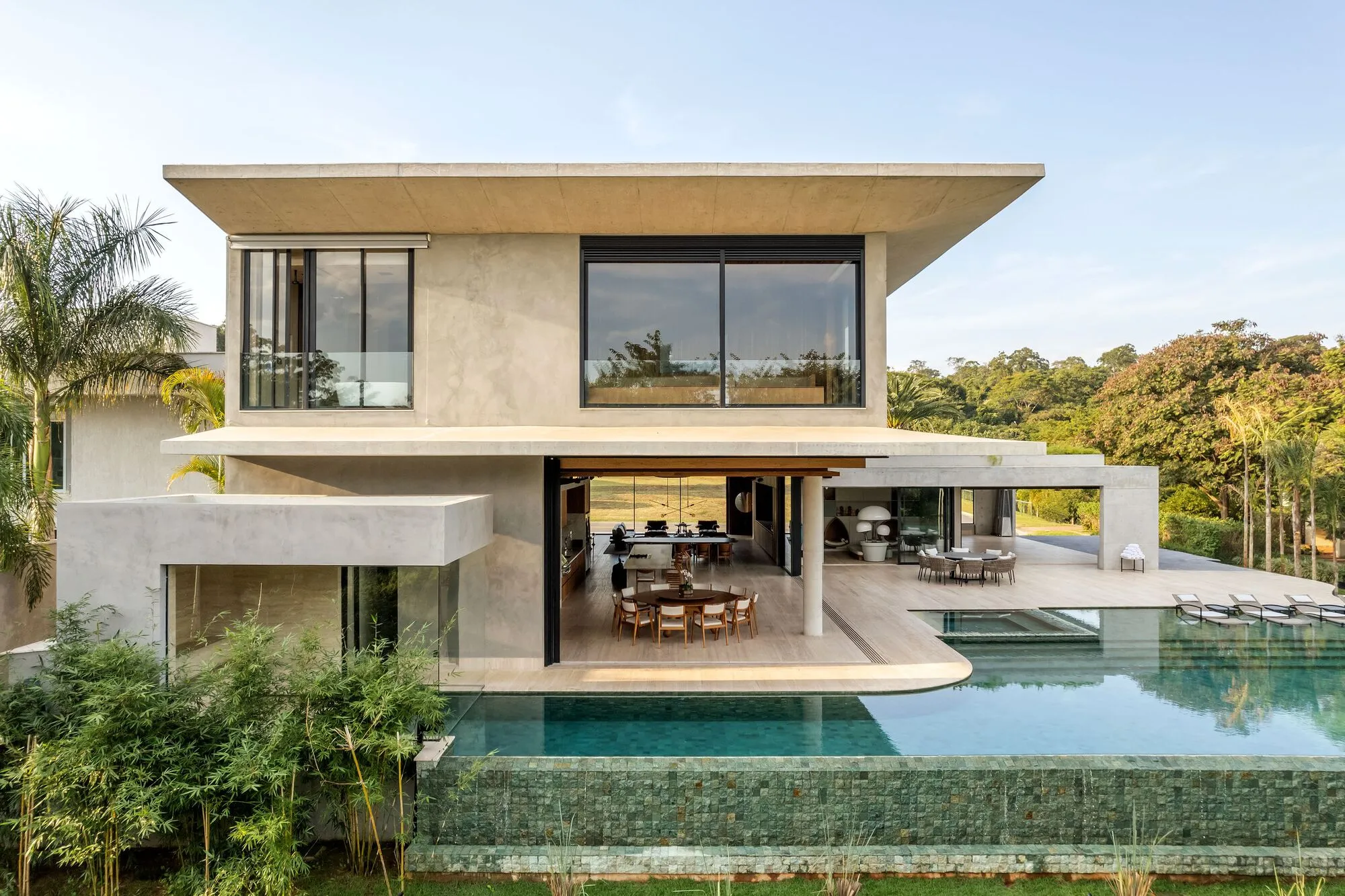
From the street, TP House reads as a collision of two massive concrete blocks, their weight softened only by timber slat screens and the graceful lean of a single palm tree. From the rear, the house reveals its real ambition: a cascade of cantilevered terraces, split pool levels, and open living pavilions that step down toward a dense forest canopy. Designed by Leo Romano and completed in 2022 in Goiânia's Jardins Munique neighborhood, the 672 m² residence is an exercise in managing contradictions. It wants to feel monolithic and yet dissolve into the landscape, to be formally pure yet materially rich.
What makes the project compelling is the precision of its duality. The front facade presents a near-opaque fortress, interlocking volumes that reveal almost nothing about the life inside. Turn the corner to the garden side and the house opens completely: floor-to-ceiling glass, continuous timber ceilings that run from interior to exterior without interruption, and an infinity pool that seems to pour into the treetops below. The strategy is not new, but Romano executes it with a material discipline that gives the house genuine presence.
A Street Face Built on Restraint


The front elevation is deliberately reticent. Two interlocking concrete volumes, one clad in timber slats and the other left exposed, create a composition that withholds more than it reveals. The chamfered edges on both blocks prevent the facade from reading as a flat wall. Instead, the volumes appear to slide past each other, generating shadow and depth without resorting to decorative gesture. A single mature palm in the forecourt is the only softening element, its vertical trunk rhyming with the slat rhythms behind it.
Privacy on the street side is total. The timber screens admit light and air but block sightlines, meaning the house can afford to be almost entirely transparent on its garden face without sacrificing intimacy. It is a well-worn tropical strategy, but the scale of the concrete here, the sheer mass of those cantilevered slabs, gives it weight beyond the typical screened-box formula.
The Rear Elevation and the Forest


The rear of the house is where the project genuinely comes alive. Stacked concrete terraces cantilever outward toward the hillside, and the pool stretches to meet the tree line as an infinity edge that blurs the boundary between architecture and landscape. The cantilevered concrete overhangs serve a dual purpose: they shade the terraces below while giving the upper floor a deep outdoor room with unobstructed views of the surrounding vegetation.
Romano positions the pool at the far end of the lot, a deliberate decision that draws occupants through the full length of the house before reaching the primary leisure space. From the gourmet area and living room, the view is unrestricted: a continuous visual field that moves from polished interior floor through the pool surface and out to the canopy. The afternoon light, filtered through the trees, gives the concrete soffits a warm glow that counteracts their material coolness.
Timber as a Unifying Interior Language

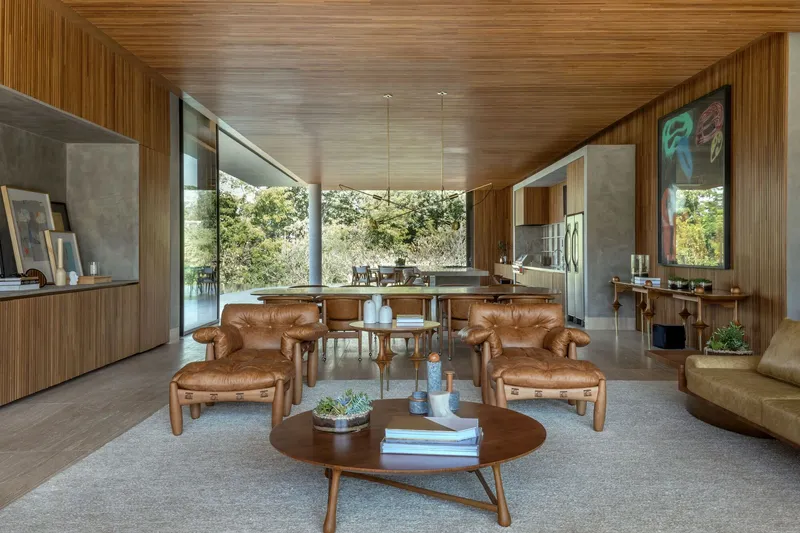

Inside, timber slats run across ceilings and walls to create a continuous warm surface that wraps the main living spaces. The effect is almost textile: the fine repetition of vertical and horizontal members softens the concrete structure beneath and brings a domestic scale to rooms that might otherwise feel cavernous. Cylindrical concrete columns punctuate the open plan without interrupting it, carrying the roof slab while allowing furniture arrangements to define program rather than walls.
The open-plan ground floor integrates living, dining, and gourmet kitchen into a single spatial field. Rather than subdividing by function, Romano uses ceiling height changes, column placement, and shifts in flooring material to subtly differentiate zones. A recessed concrete niche anchors the media wall on one side, its raw surface contrasting sharply with the warm timber envelope surrounding it. The result is a room that feels both generous and grounded.
Courtyards and Interior Green
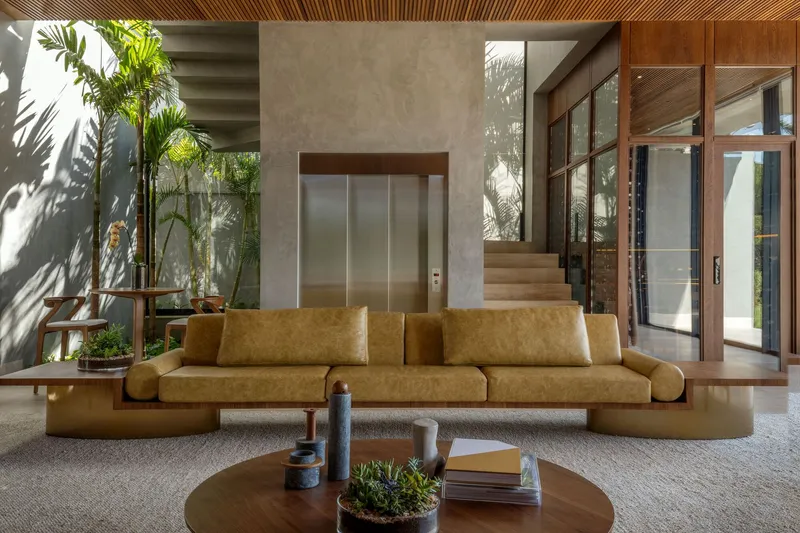

Internal courtyards punch light and greenery into the deep plan. Planted beds at the base of concrete walls introduce palms and tropical understory plants that cast dappled shadows across glass doors and polished floors. These pockets of vegetation are not decorative afterthoughts; they are the mechanism by which Romano ventilates the center of a house whose perimeter alternates between opaque concrete and open glass.
The elevator core sits adjacent to one of these courtyards, a pragmatic element given a contemplative setting. Moving between floors, one passes planted walls and filtered daylight rather than the typical service corridor. It is a small detail, but it signals the degree of attention Romano brings to the transition spaces that other architects leave as pure infrastructure.
The Pool as Landscape Element

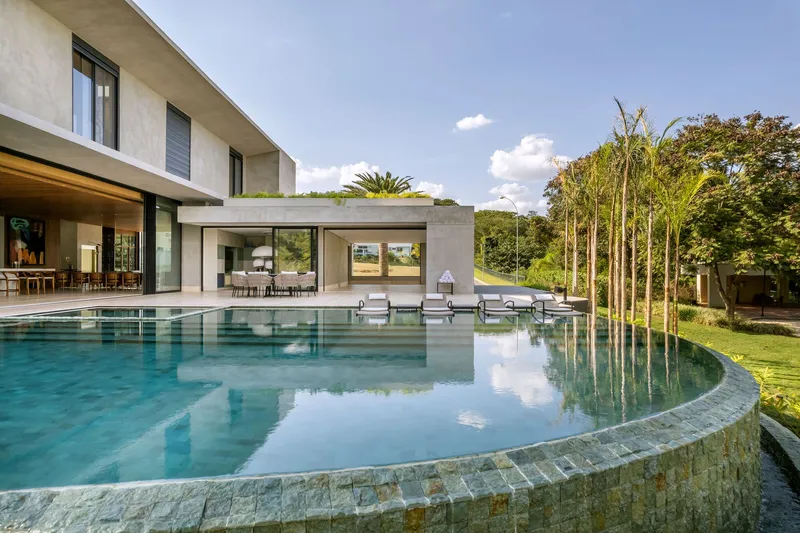

The curved pool wraps around the corner of the living pavilion, reflecting sky and trees in a surface that reads as much as a landscape feature as a recreational amenity. Submerged steps and an organic plan shape give the pool a sculptural quality that complements the orthogonal concrete volumes above. Its stone tile edge is level with the surrounding deck, eliminating the visual barrier of a raised coping and allowing the water surface to merge seamlessly with the terrace.
From above, the pool's relationship to the house becomes clearer: it occupies the space between the cantilevered concrete canopy and the forest edge, acting as a reflective threshold. The infinity edge facing the hillside ensures that the pool never reads as a contained basin; it always implies continuation into the landscape beyond.
Upper Floor: Bedrooms at the Canopy Line


The intimate program occupies the upper floor, where bedrooms open through floor-to-ceiling glazing onto the green hillside. At this elevation, occupants are essentially at the same height as the surrounding tree canopy, a deliberate siting decision that transforms sleep and bathing spaces into treehouse-like retreats. Slatted wood ceilings carry over from the public spaces below, maintaining material consistency across programs.
The primary bathroom takes full advantage of the site's topography: a freestanding tub and a steel-framed glass shower enclosure sit against windows overlooking the treetops. It is one of those rare moments where a luxury gesture, the panoramic bath, is genuinely earned by the architecture rather than imposed as a lifestyle signifier. An attic bedroom with a sloped white ceiling and pendant lights suggests flexibility for children or guests, its lower ceiling creating a contrasting intimacy after the double-height spaces below.
Material Details and Custom Elements


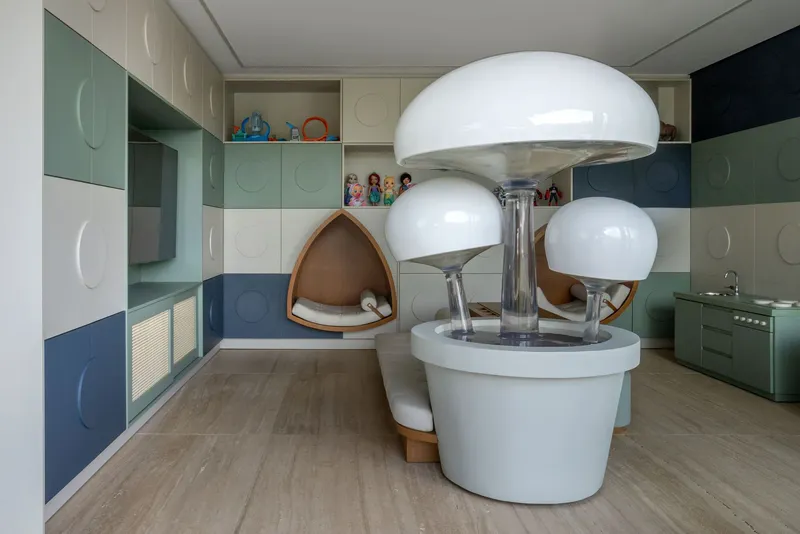
Romano's detailing rewards close attention. Bathroom vanities in travertine with bronze fixtures sit below ribbed timber wall cladding, creating a palette where every material is allowed its own texture without competing for dominance. A children's room features multi-toned circular panel cabinetry and a sculptural pod seating element, a playful departure from the house's otherwise restrained material vocabulary that signals genuine engagement with how the space will be used.
Throughout the house, the joint between concrete and timber is handled with care. Where slats meet exposed structure, shadow gaps maintain the visual independence of each material system. The concrete is board-formed in places, its grain echoing the timber elsewhere, a subtle but effective strategy for making two dominant materials feel like relatives rather than strangers.
Plans and Drawings

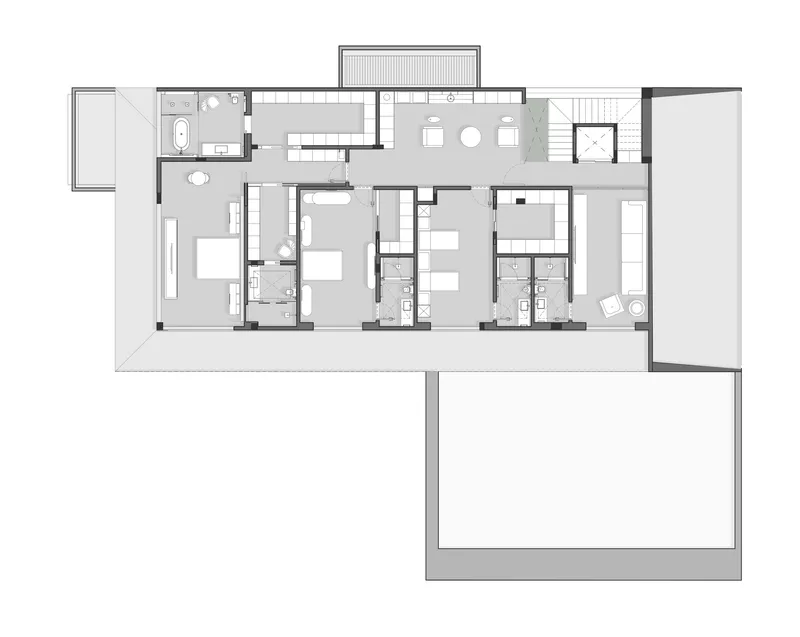


The ground floor plan confirms the organizational logic: a deep parking garage at one end, an expansive open living zone at the center, and the curved pool wrapping the garden-facing corner. The upper floor plan reveals bedroom suites arranged around a central corridor that terminates at the pool terrace, giving every room a direct relationship to the outdoor landscape. Section drawings make the cantilever strategy legible, showing how the upper volume projects past the lower to create shaded outdoor rooms at both levels. The split-level arrangement follows the site's natural slope, allowing the house to step down toward the forest without requiring heavy earthworks.
Why This Project Matters
TP House belongs to a lineage of Brazilian residential architecture that treats concrete as both structure and expression, but Romano avoids the trap of letting material spectacle substitute for spatial intelligence. The house works because its formal moves, the dual monoliths on the street, the cascading terraces at the rear, the wrapped timber interiors, are each in service of a specific experiential goal: privacy from the public realm, connection to the forest, and warmth within the domestic core.
In a market where luxury residential design often defaults to open plans and infinity pools as generic signifiers of quality, TP House earns these elements through site strategy and material commitment. The pool is not a rectangle dropped onto a flat terrace; it is a curved basin that mediates between architecture and topography. The open plan is not an empty loft; it is a carefully calibrated sequence of concrete columns, timber ceilings, and internal gardens that give each zone its own character. Romano demonstrates that formal restraint and spatial generosity are not opposing ambitions but reinforcing ones.
TP House, designed by Leo Romano, Jardins Munique, Goiânia, Brazil. 672 m². Completed 2022. Photography by Edgard Ceasr.
About the Studio
Share Your Own Work on uni.xyz
If projects like this are the kind of work you want to make, uni.xyz is a place to publish your own, find collaborators, and enter design competitions.



Popular Articles
Popular articles from the community


Hill & Cross Opera: Sculptural Opera House Architecture Shaped by Tallinn’s Landscape and Identity
Hill & Cross Opera reimagines opera house architecture in Tallinn through its sculptural hill, civic plaza, glass wave and a luminous cross.

Co-life: Sustainable Architecture for Age-Friendly Community Living
Co-life reimagines sustainable architecture for seniors through courtyards, rammed earth, shared gardens, and spaces designed for belonging.
EW PARK: Sustainable Architecture Reimagines the Future of Urban Parking
EW PARK reimagines city parking as a modular wooden tower combining automation, solar energy, electric mobility, and adaptable urban design.

AL-JANNAH: Sustainable Architecture and Permaculture for Afghan Widows
AL-JANNAH uses sustainable architecture and permaculture to create resilient oasis of housing, learning, work and renewal for Afghan widows.

Similar Reads
You might also enjoy these articles

Bao Huynh Watercolor Atelier: A Serene Art Retreat in Hội An
Bao Huynh Watercolor Atelier in Hội An blends multifunctional art spaces, sustainable design, local materials, and family-friendly living in a serene environment.

Atelier Macri Concept Store Interior Design by CASE-REAL
Atelier Macri store features a "ko" counter, walnut wood details, cork displays, blending retail, gallery, and seamless customer experiences.

Manuel Vargas Izquierdo Stadium and High-Performance Sports Center: Architectural Excellence in Jalpa de Méndez
The Manuel Vargas Izquierdo Stadium blends sustainable design, inclusive sports facilities, and cultural-inspired architecture, revitalizing Jalpa de Méndez’s public spaces.

KAKR Buluh Awar Hall: Revitalizing Community and Ecology Through Bamboo Architecture
Community built bamboo hall revitalizes Buluh Awar village, empowering youth, restoring ecology, celebrating vernacular craftsmanship through sustainable architecture and culture.




Comments (0)
Please login or sign up to add comments
No comments yet. Be the first to comment!