
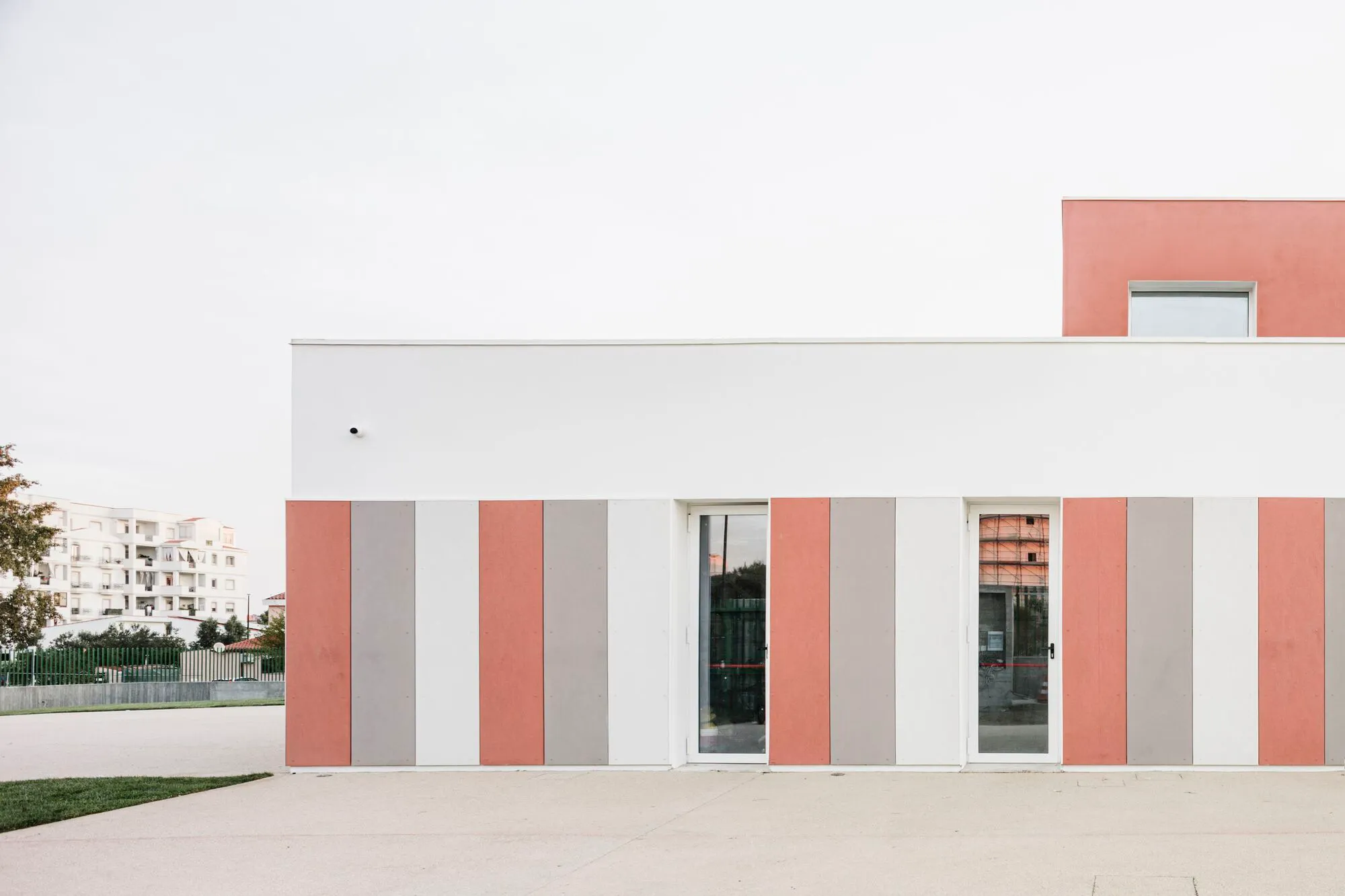
LERUA Studio Wraps an Olbian Nursery in Terracotta Stripes and Civic Ambition
A 719-square-meter kindergarten in Olbia, Sardinia, uses staggered volumes and courtyard play to rethink early childhood architecture.


Building a nursery school is, on paper, one of the most straightforward briefs an architect can receive: small bodies, low furniture, bright colors, soft edges. But LERUA Studio's new kindergarten on Via dell'Acquamarina in Olbia treats the program as something more consequential. Completed in 2025, the 719-square-meter school reads less like a cheerful box and more like a considered piece of urban infrastructure, a civic building that happens to serve children between the ages of zero and six.
What makes the project genuinely interesting is its refusal to choose between modesty and presence. The building is low, horizontal, and quiet in its massing, yet its facades announce themselves with a rigorous system of vertical panels in terracotta, grey, and white. The result is a structure that belongs to its Sardinian context without mimicking anything in particular. It is an architecture of restraint that still manages to be visually generous.
A Striped Civic Face
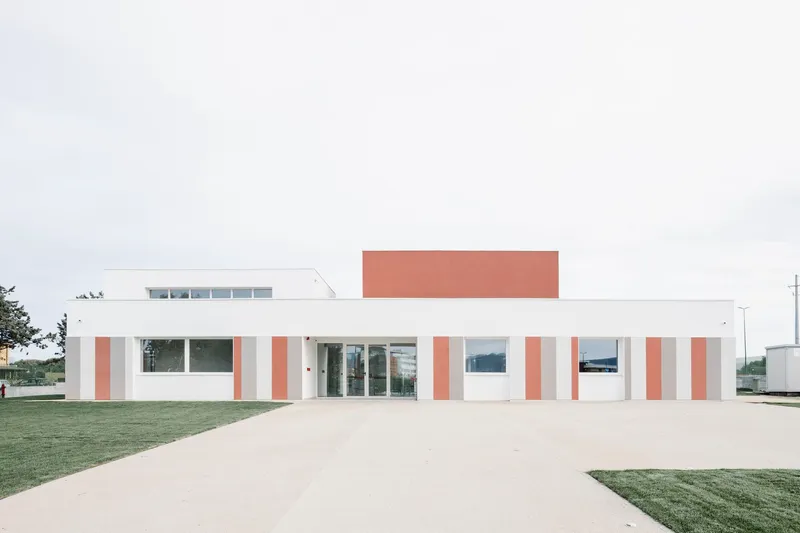
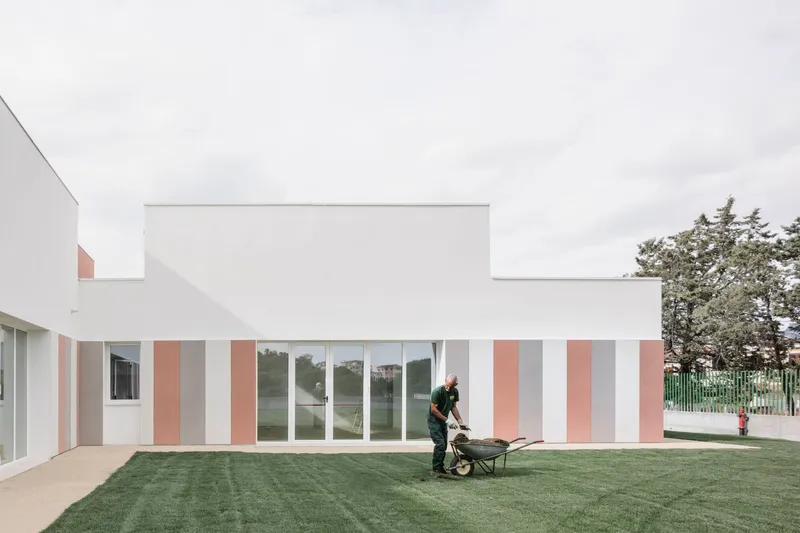

The most immediately recognizable move is the facade treatment: alternating vertical bands of terracotta, warm grey, and white cladding panels that wrap the exterior in a rhythm that feels both disciplined and playful. From a distance, the stripes flatten the building's mass and make it read as a single, confident gesture. Up close, the panels reveal depth, shadow lines, and material variation. The terracotta elements, in particular, connect the school to the earthy palette of Sardinian construction without resorting to pastiche.
LERUA Studio has clearly thought about how the building addresses the street. The entrance facade frames glazed doors between the vertical bands, creating a threshold that is legible and welcoming without the usual semiotic crutches of primary colors or oversized signage. It reads as a public building. That distinction matters in a peripheral urban context where nurseries are often treated as afterthoughts.
Staggered Volumes and Roofline Play


The building is not a single box but a cluster of staggered white volumes set at varying heights. Seen from the side, the massing breaks down into discrete elements that step up and pull apart, introducing gaps, covered walkways, and moments of visual relief. A raised terracotta volume punctuates the roofline, signaling the main interior event below without resorting to a monumental gesture.
The stepping strategy is more than compositional. It allows the architects to differentiate interior ceiling heights, modulate natural light, and create sheltered outdoor passages alongside the building. The covered walkway that runs along the lawn, framed by the striped panels, is one of the quieter pleasures of the design: a transitional space where children can be outside without being fully exposed, a threshold between classroom and garden.
Interior Light and Acoustic Control


Inside, the nursery is defined by light. Floor-to-ceiling glazing and clerestory windows appear in nearly every room, flooding the polished concrete and light wood floors with diffused daylight. The double-height room, with its circular acoustic ceiling panels suspended like lily pads, is the standout space. It manages to feel generous and intimate simultaneously, a trick that comes down to proportion and the restrained material palette of white walls, timber, and perforated panels.
The acoustic strategy deserves mention. Early childhood environments are notoriously loud, and the circular ceiling panels serve a clear functional purpose beyond their visual softness. Combined with the drop-ceiling panels visible in other rooms, they suggest a building where acoustic comfort has been treated as a design priority rather than an afterthought. Rhythmic glazed doors in the main spaces allow rooms to open onto each other or onto the courtyard, giving teachers flexibility in how they configure the day.
Courtyard as a Pedagogical Center

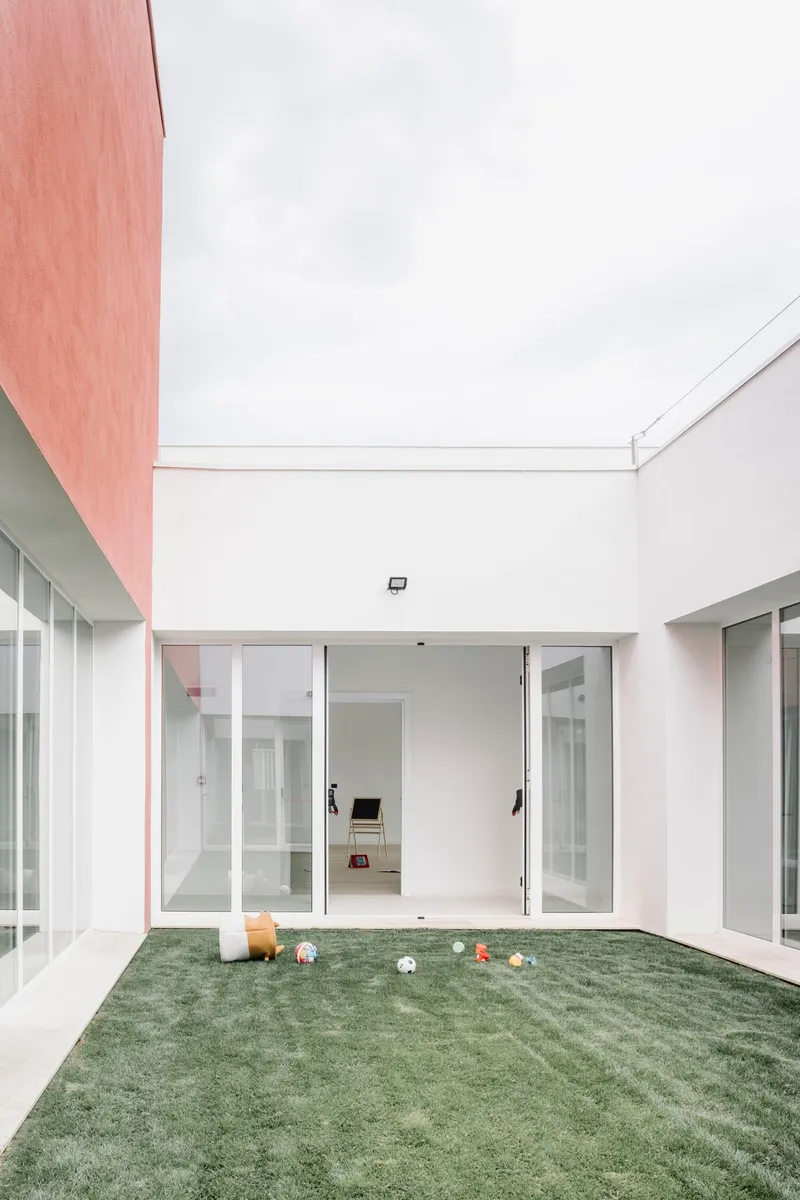

The plan organizes itself around a central courtyard, and the photographs make it clear that this outdoor room is the social heart of the school. White walls surround it on three sides, glazed doors open directly onto it, and the striped lawn, scattered with plastic toys, suggests a space designed for daily, unsupervised play rather than ceremonial display. Nine-panel glazed walls dissolve the boundary between inside and out, allowing even the youngest children a continuous visual connection to the exterior.
There is a long tradition in Italian nursery design, stretching back to the Reggio Emilia approach, that treats the environment itself as a teacher. LERUA Studio seems aware of this lineage. The courtyard is not merely leftover space between volumes; it is the organizing device that gives every classroom orientation, light, and a relationship to the outdoors. The covered passage along its edge extends the usable hours of the space across Sardinia's variable seasons.
Plans and Drawings


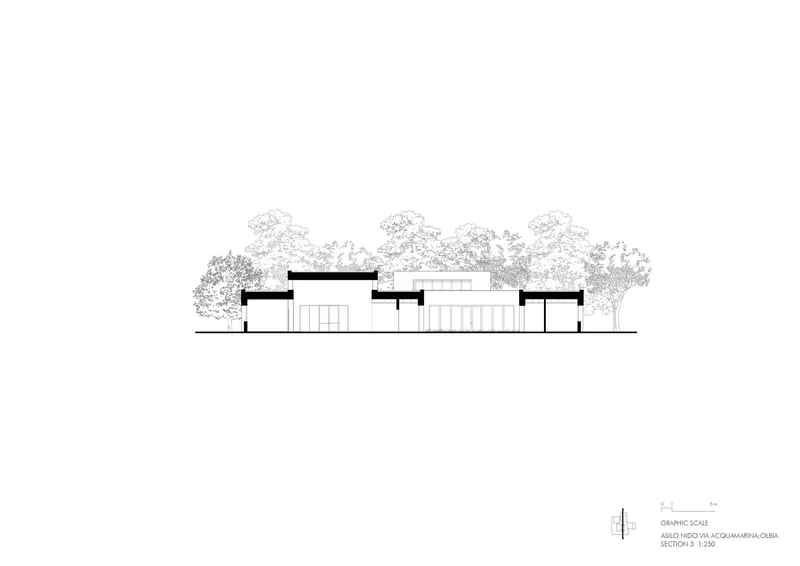
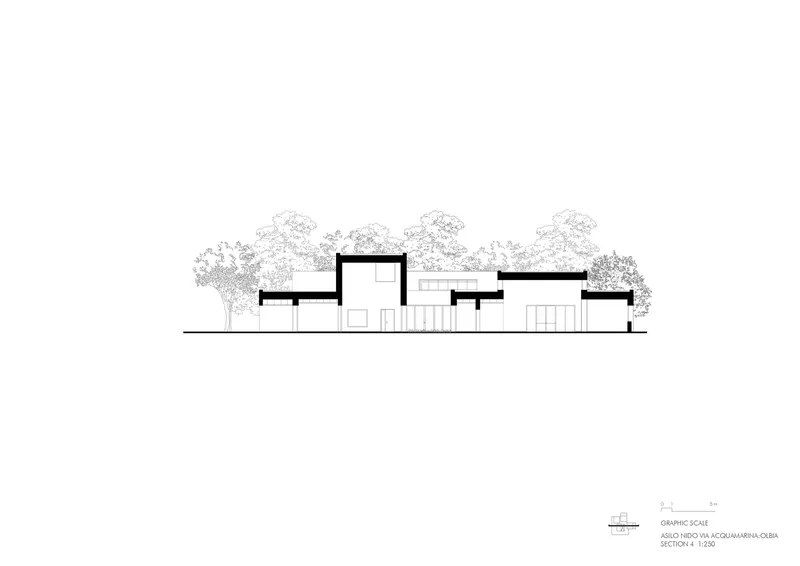


The site plans reveal what the photographs only hint at: the building sits within a tree-lined plot that buffers it from neighboring structures, and its plan geometry incorporates curved edges that soften the orthogonal logic of the interior rooms. The ground floor plan confirms the courtyard-centric organization, with interconnected rooms wrapping around a central void. Crucially, there is no single corridor spine; circulation happens through the rooms themselves and along the perimeter passages, giving the plan a porosity that supports the fluid movement patterns of very young children.
The section drawings are the most revealing. They show how the flat-roofed volumes step up and down to create the clerestory conditions visible in the interior photographs. A central double-height entry volume anchors the composition, while lower wings extend outward beneath the surrounding tree canopy. The elevations present the building as a calm, horizontal composition, its cubic masses reading as a cluster rather than a monolith. The tree canopy that appears in every drawing is not decorative; it is an active participant in the environmental strategy, providing shade and filtering the Sardinian light.
Why This Project Matters
Nursery schools are under-discussed in architectural culture, partly because they are small and partly because they tend to get filed under "social infrastructure" and left at that. LERUA Studio's project in Olbia pushes back against that neglect by treating the kindergarten as a building type worthy of genuine formal and material ambition. The terracotta-striped facades, the courtyard plan, the calibrated light: none of these moves are extravagant, but all of them are deliberate. The building refuses to be merely adequate.
More broadly, the project is a reminder that civic architecture does not require a civic scale. At 719 square meters, this is a modest building in a peripheral Sardinian city, yet it carries itself with the seriousness and care of a much larger institution. That gap between program size and architectural commitment is exactly where the best public buildings live. If a city's values are legible in its schools, Olbia has reason to be proud of this one.
New Nursery School on Via dell'Acquamarina by LERUA Studio. Located in Olbia, Italy. 719 m². Completed in 2025. Photography by Cédric Dasesson.
About the Studio
Share Your Own Work on uni.xyz
If projects like this are the kind of work you want to make, uni.xyz is a place to publish your own, find collaborators, and enter design competitions.



Popular Articles
Popular articles from the community


Co-Life: Senior Housing Design That Reconnects Older Adults With the City
Co-Life reimagines senior housing design through healing gardens, shared streets, workshops, and a sustainable community across generations.

AL-JANNAH: Sustainable Architecture and Permaculture for Afghan Widows
AL-JANNAH uses sustainable architecture and permaculture to create resilient oasis of housing, learning, work and renewal for Afghan widows.

EW PARK: Sustainable Architecture Reimagines the Future of Urban Parking
EW PARK reimagines city parking as a modular wooden tower combining automation, solar energy, electric mobility, and adaptable urban design.

The Musturak Paradise: Senior Living Architecture for a Connected Future in Temara, Morocco
The Musturak Paradise reimagines senior living architecture in Temara via private homes, social spaces, culture, community, and shared care.


Similar Reads
You might also enjoy these articles

Bao Huynh Watercolor Atelier: A Serene Art Retreat in Hội An
Bao Huynh Watercolor Atelier in Hội An blends multifunctional art spaces, sustainable design, local materials, and family-friendly living in a serene environment.

Atelier Macri Concept Store Interior Design by CASE-REAL
Atelier Macri store features a "ko" counter, walnut wood details, cork displays, blending retail, gallery, and seamless customer experiences.

Manuel Vargas Izquierdo Stadium and High-Performance Sports Center: Architectural Excellence in Jalpa de Méndez
The Manuel Vargas Izquierdo Stadium blends sustainable design, inclusive sports facilities, and cultural-inspired architecture, revitalizing Jalpa de Méndez’s public spaces.

KAKR Buluh Awar Hall: Revitalizing Community and Ecology Through Bamboo Architecture
Community built bamboo hall revitalizes Buluh Awar village, empowering youth, restoring ecology, celebrating vernacular craftsmanship through sustainable architecture and culture.





Comments (0)
Please login or sign up to add comments
No comments yet. Be the first to comment!