

A Former Inn Becomes Červený Kostelec's New Library
Papundekl Architects transform a historic Czech inn into a flexible, joyful public library with mobile furniture and illustrated ceilings.


Small towns rarely get library projects this ambitious. In Červený Kostelec, a town in northeastern Czechia, the Břetislav Kafka Library now occupies a former inn on the main street, reworked by Papundekl Architects into 285 square meters of reading rooms, children's spaces, and flexible exhibition areas. The building's history is visible in its symmetrical street facade and thick masonry walls, but everything behind the coral entrance doors has been reimagined with a confidence that feels almost radical for a municipal commission this size.
What makes this project genuinely interesting is the tension between restraint and exuberance. The exterior barely whispers: cream plaster, regular windows, a quiet presence on the block. Step inside, and you encounter scalloped illustrated ceilings, mobile pink bookshelves on casters, rubber flooring in warm coral, and plywood surfaces that glow under carefully placed lighting. It is a building designed to be reconfigured by its users, not preserved behind glass. That philosophy, applied to a heritage structure, is where the real architectural argument lives.
A Facade That Refuses to Shout
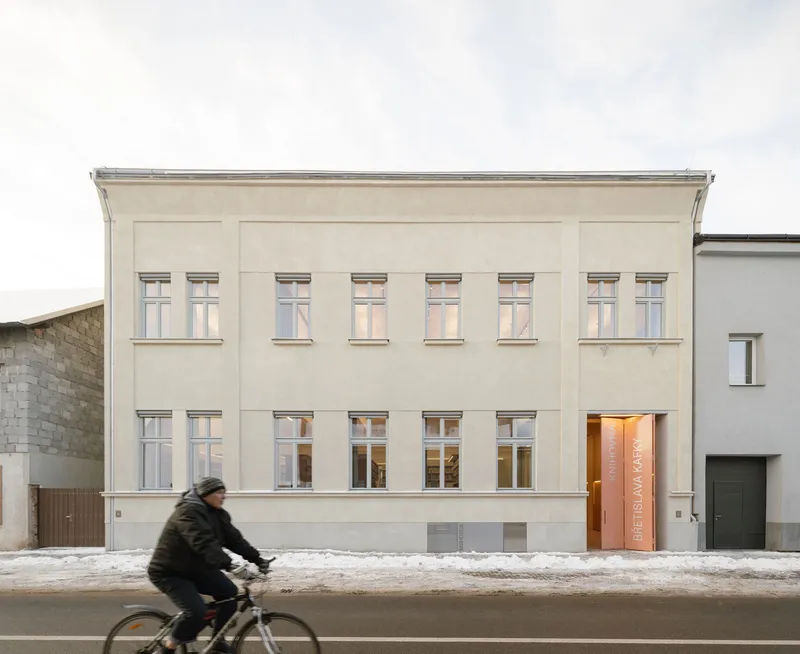
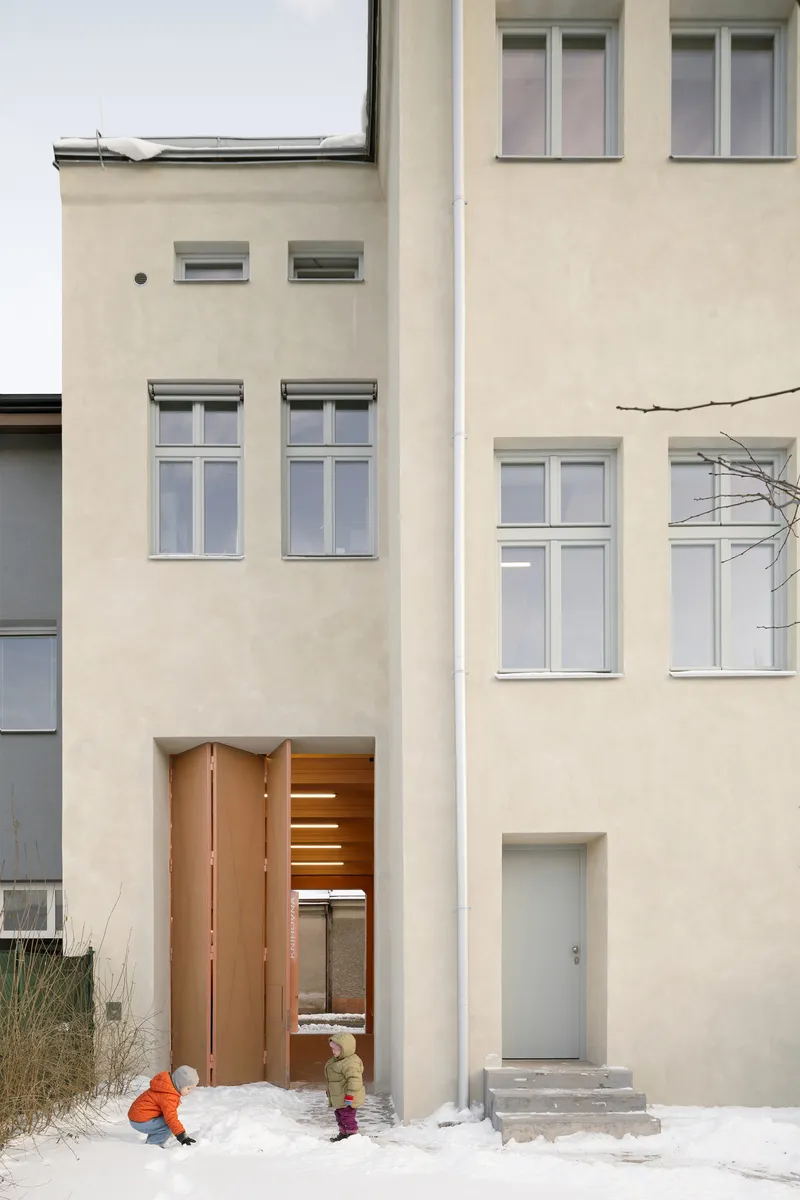
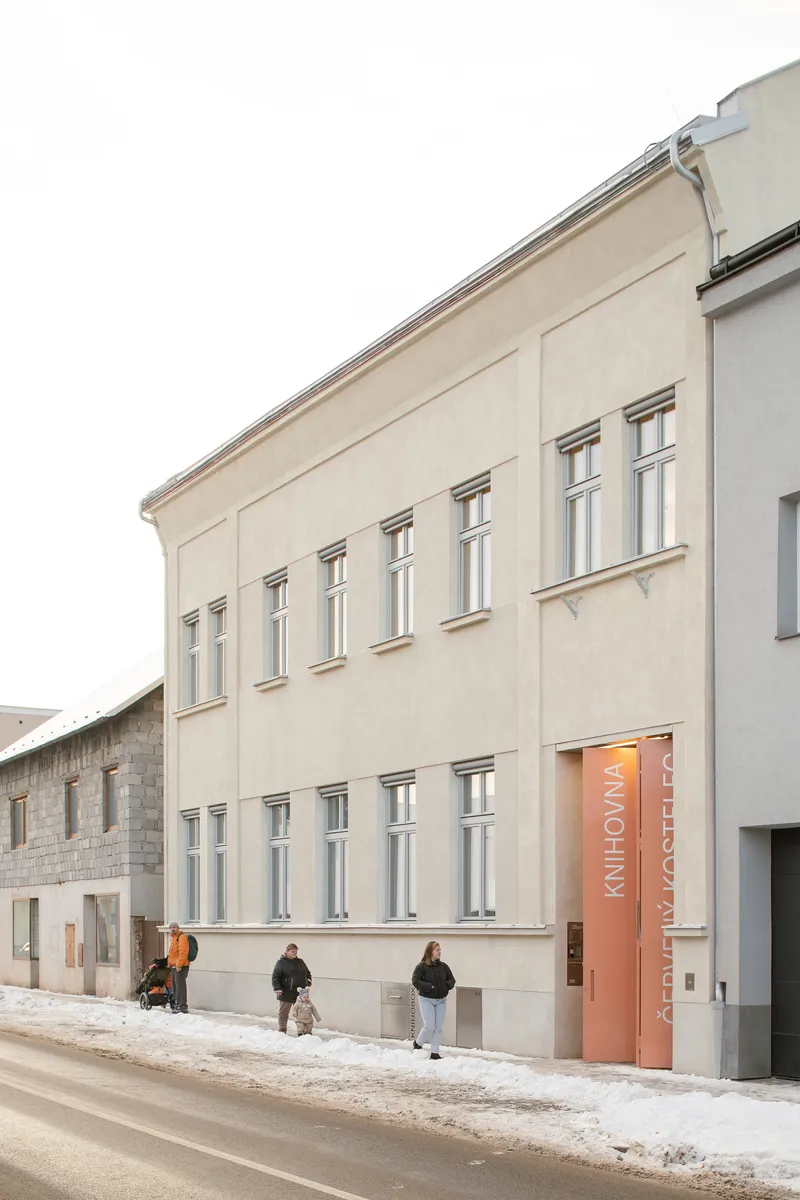
The street elevation could pass for an unrenovated townhouse if you didn't notice the tall coral doors and the orange banners. Papundekl made a deliberate choice to preserve the building's civic anonymity: pale plaster, symmetrical windows, a two-story massing that sits comfortably among its neighbors. There is no cantilevered volume screaming "public institution" here.
That understatement works. A library in a town of this scale benefits from feeling like a continuation of the streetscape rather than an interruption of it. The winter photographs, with snow on the ground and children playing in front, show how naturally the building integrates into daily life. Its identity comes not from formal gestures but from the warmth that leaks out through those tall windows.
Entering Through Plywood and Bronze
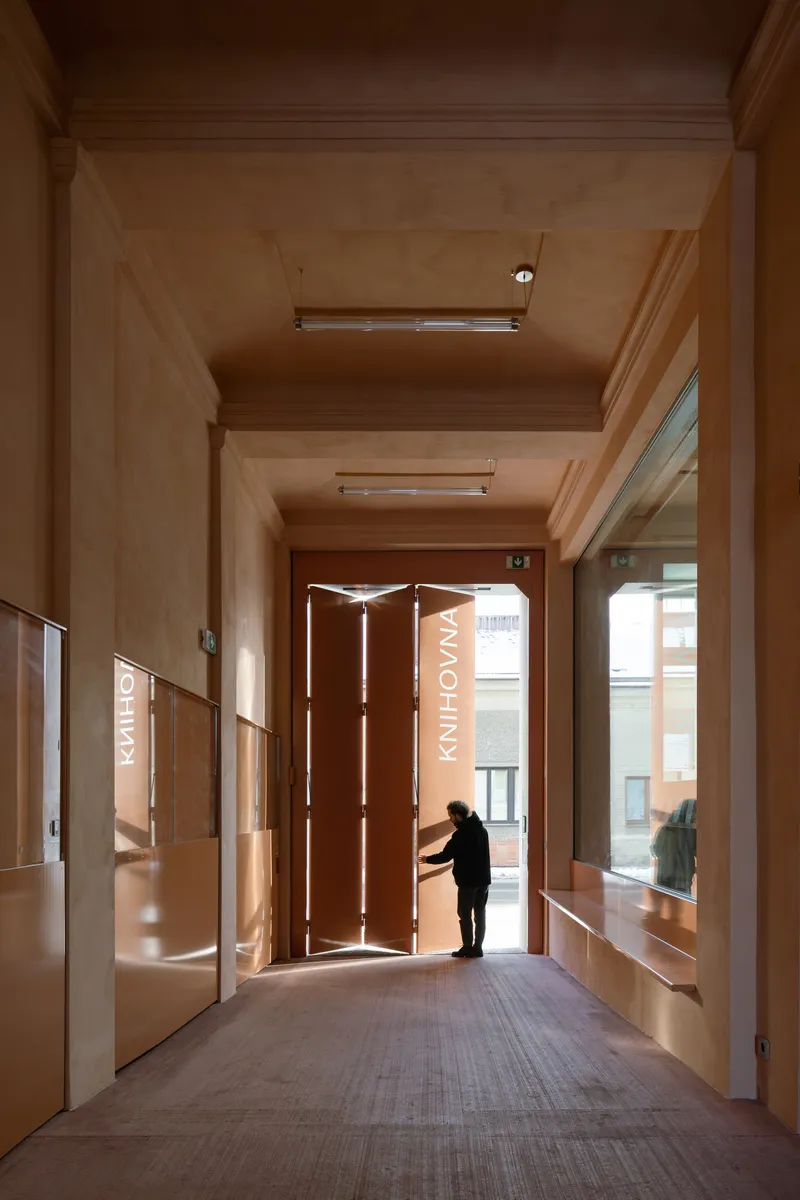
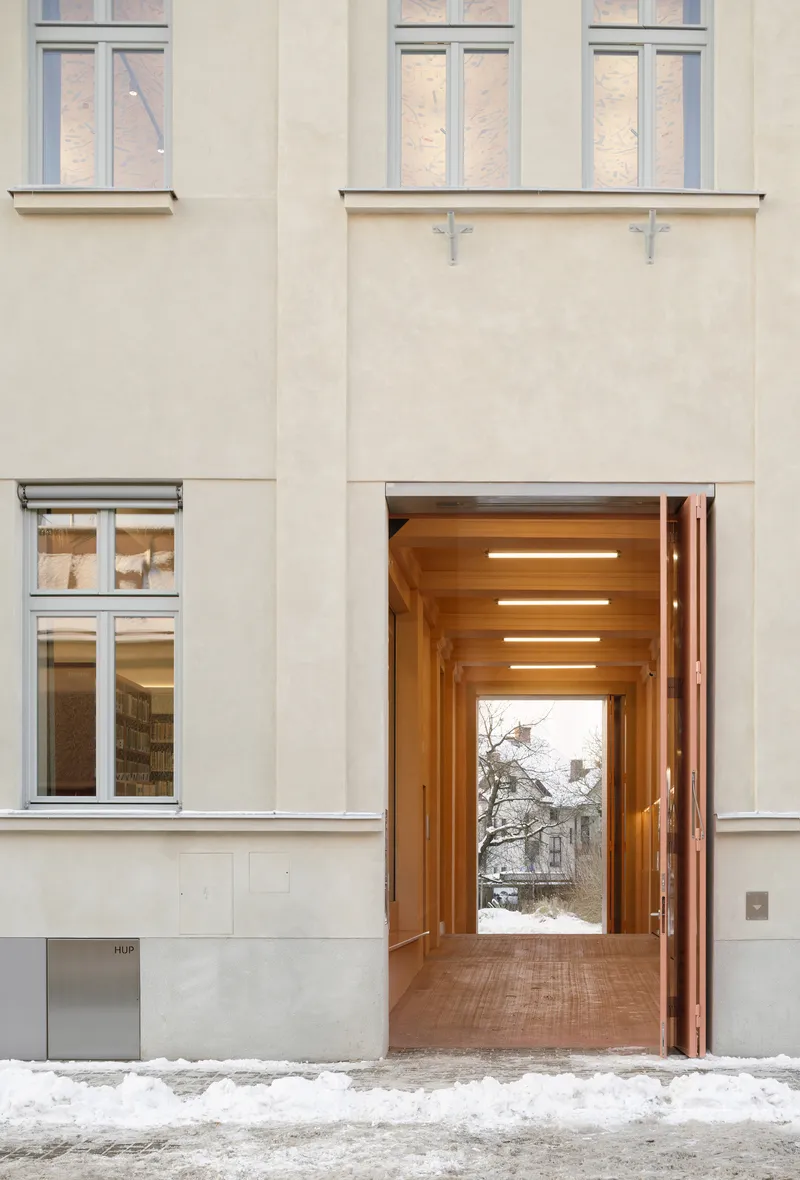
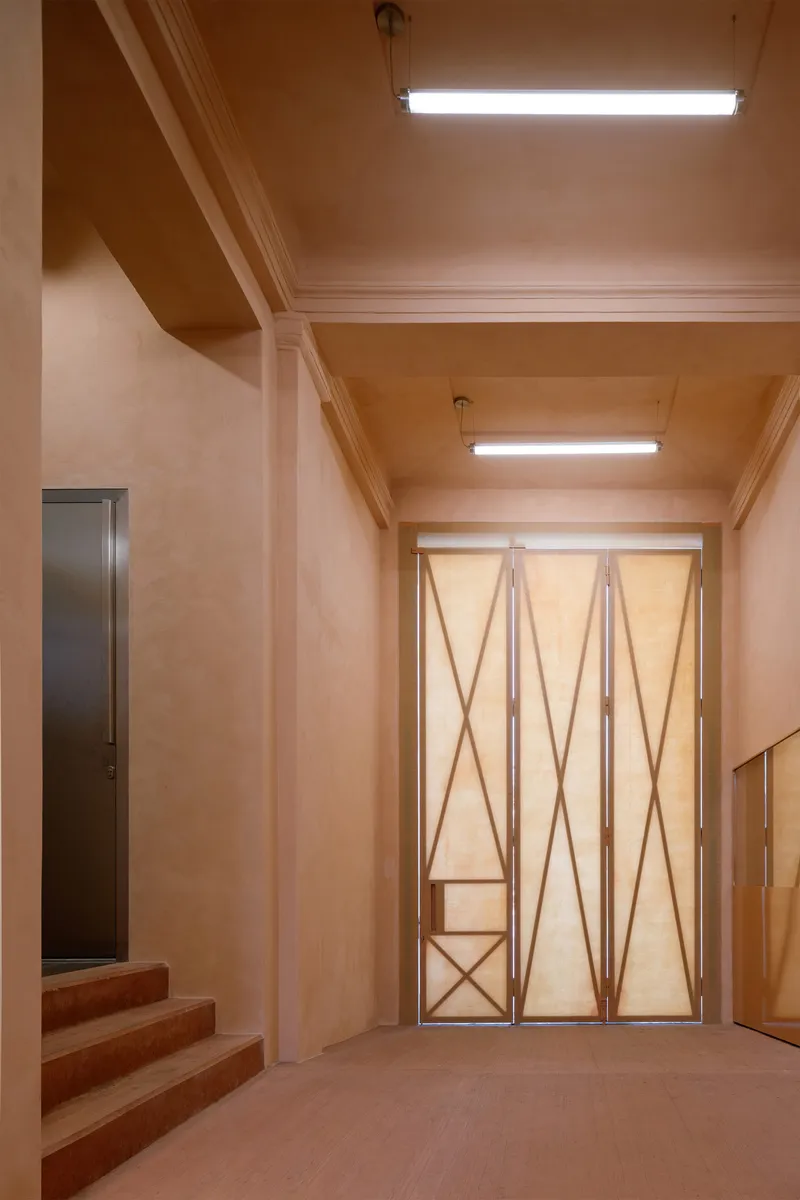
The entry sequence is handled with real care. Folding bronze doors, patterned with diagonal bracing, open into a vestibule lined entirely in plywood: walls, ceiling, and the coffered panels above. The effect is a compression of space and material warmth before the library opens up beyond. Linear ceiling lights run the length of the passage, pulling your eye through to the courtyard or into the reading rooms.
What stands out is how the threshold negotiates between the old masonry shell and the new interior world. The arched openings remain, framing views to a stainless steel elevator cab and the terracotta floors beyond. It is an honest meeting of eras: the plywood doesn't pretend to be old, and the stone arches don't pretend to be new.
Corridors and In-Between Spaces
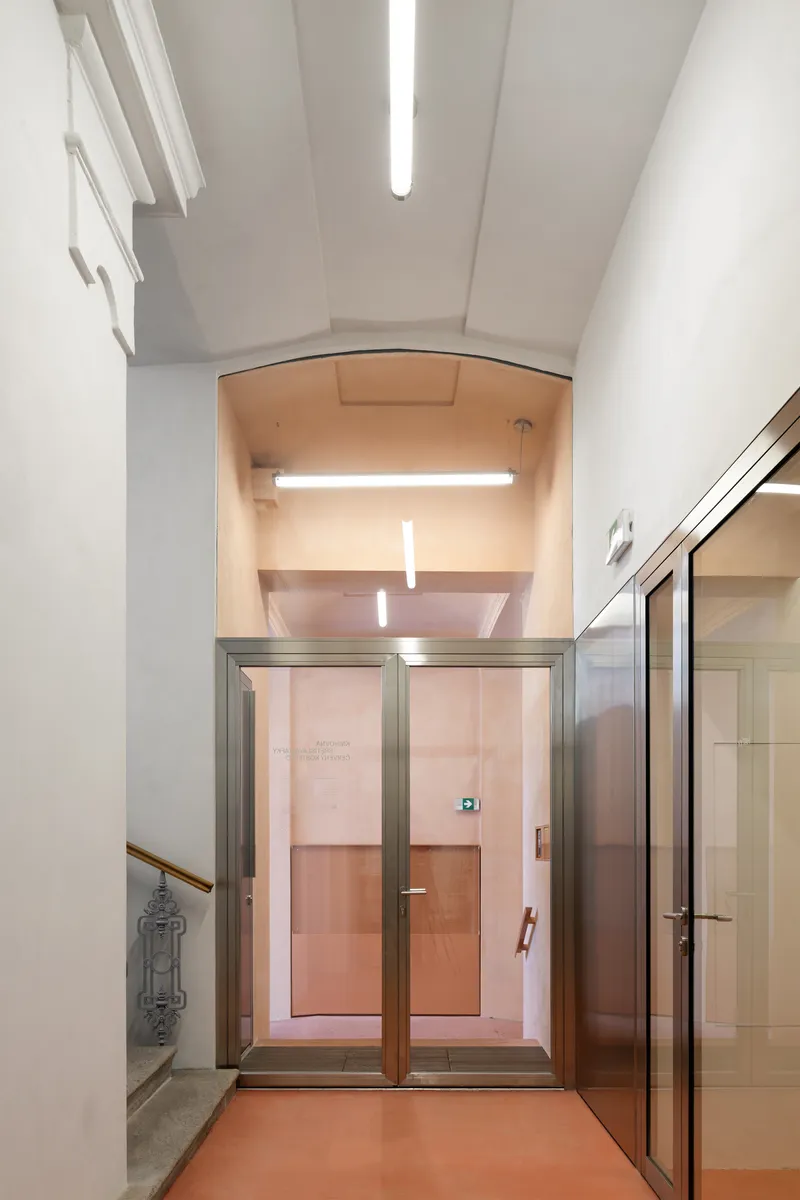
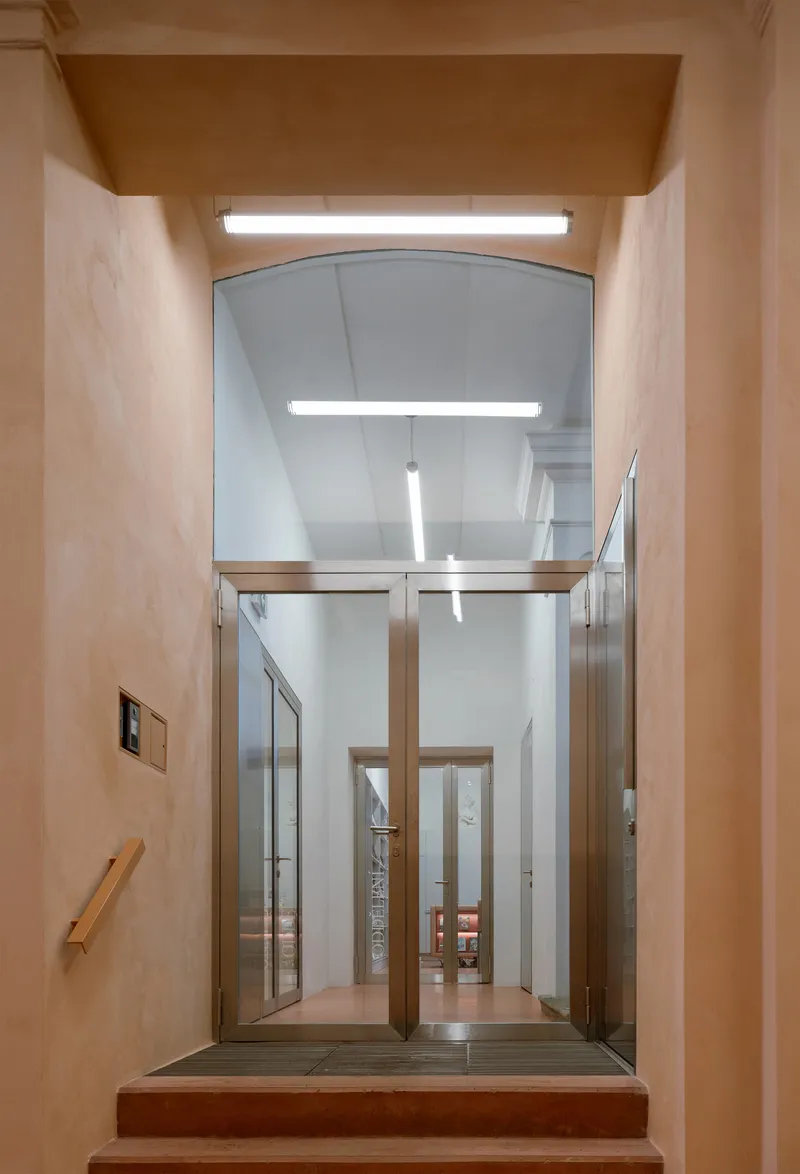
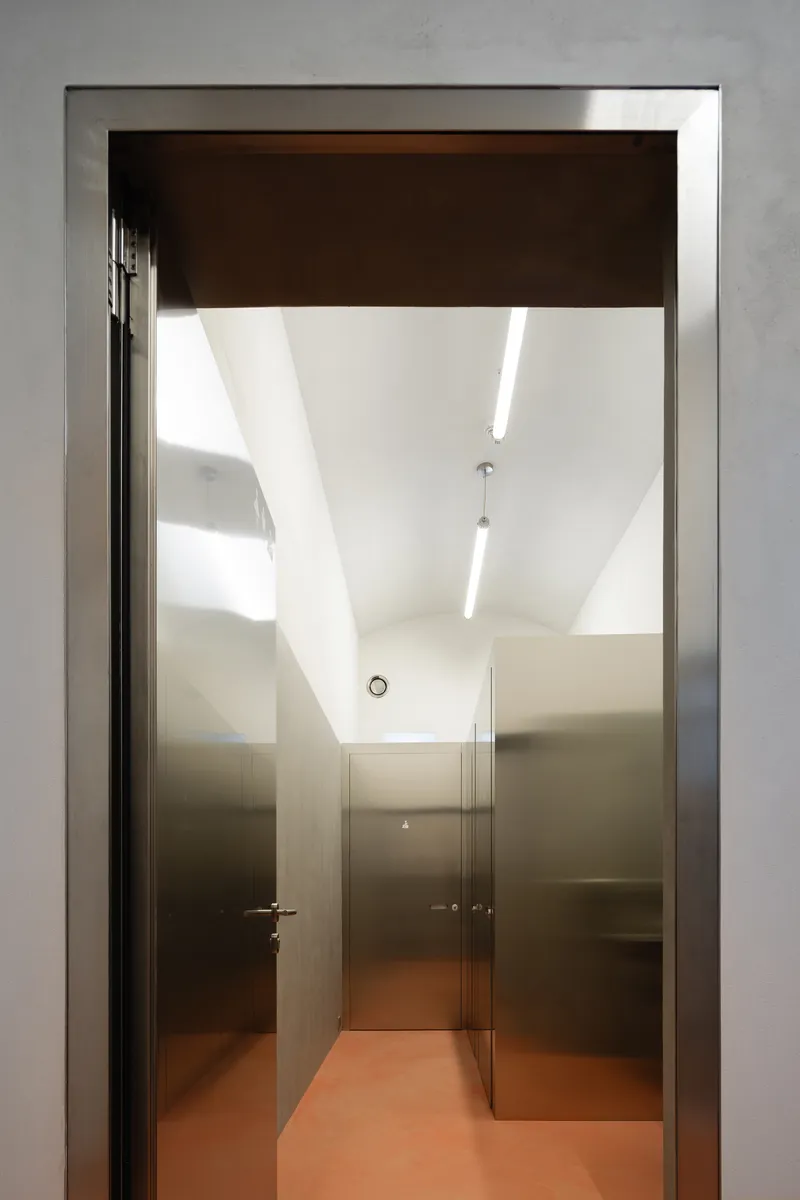
Libraries often neglect their circulation zones, treating corridors as mere connective tissue. Here, even the hallways carry intention. A polished stainless steel wall catches reflections of the terracotta floor; an arched doorway frames a glazed elevator cab nestled under plywood cladding. These moments of material contrast, steel against warm clay, keep you visually engaged as you move through the building.
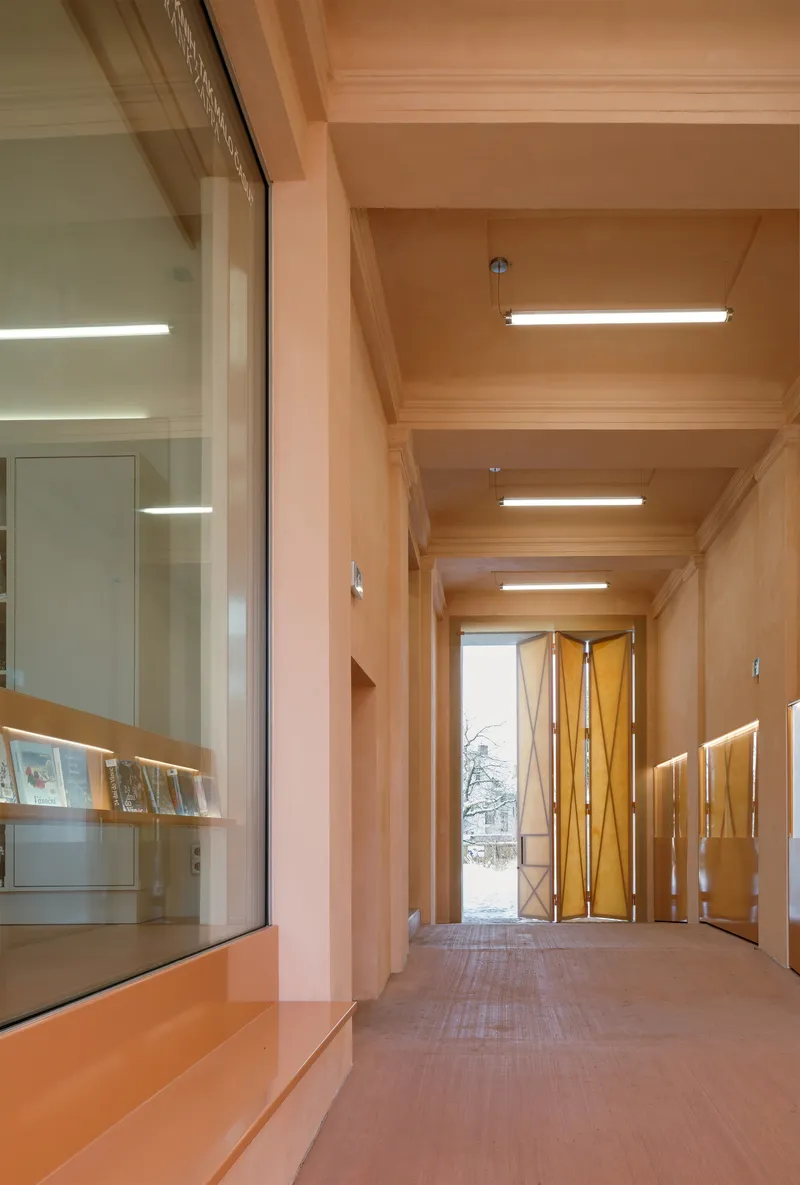
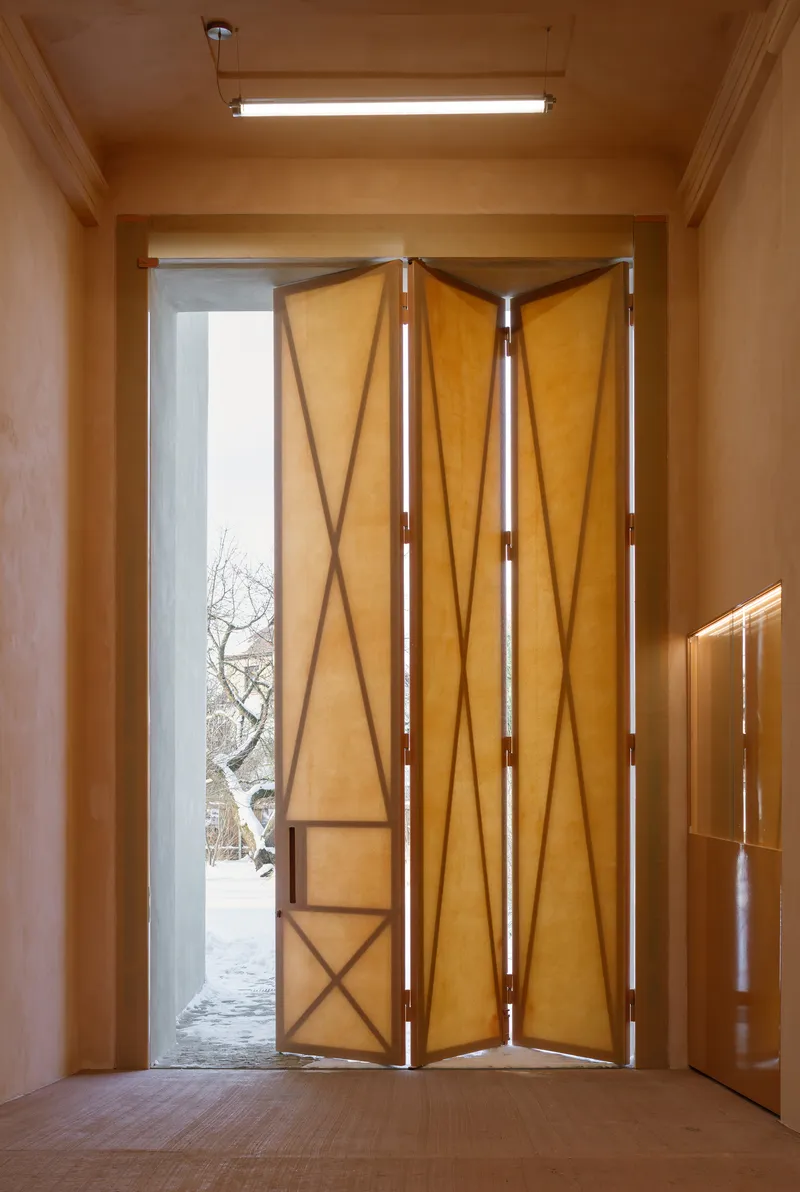
The folding timber door that opens to the snowy courtyard and the exposed beam corridor leading back to the copper entry doors reinforce a sense of crafted domesticity. The building never feels institutional. It feels like someone's very well-organized house, which is exactly the right register for a town library.
Mobile Furniture as Architectural Strategy
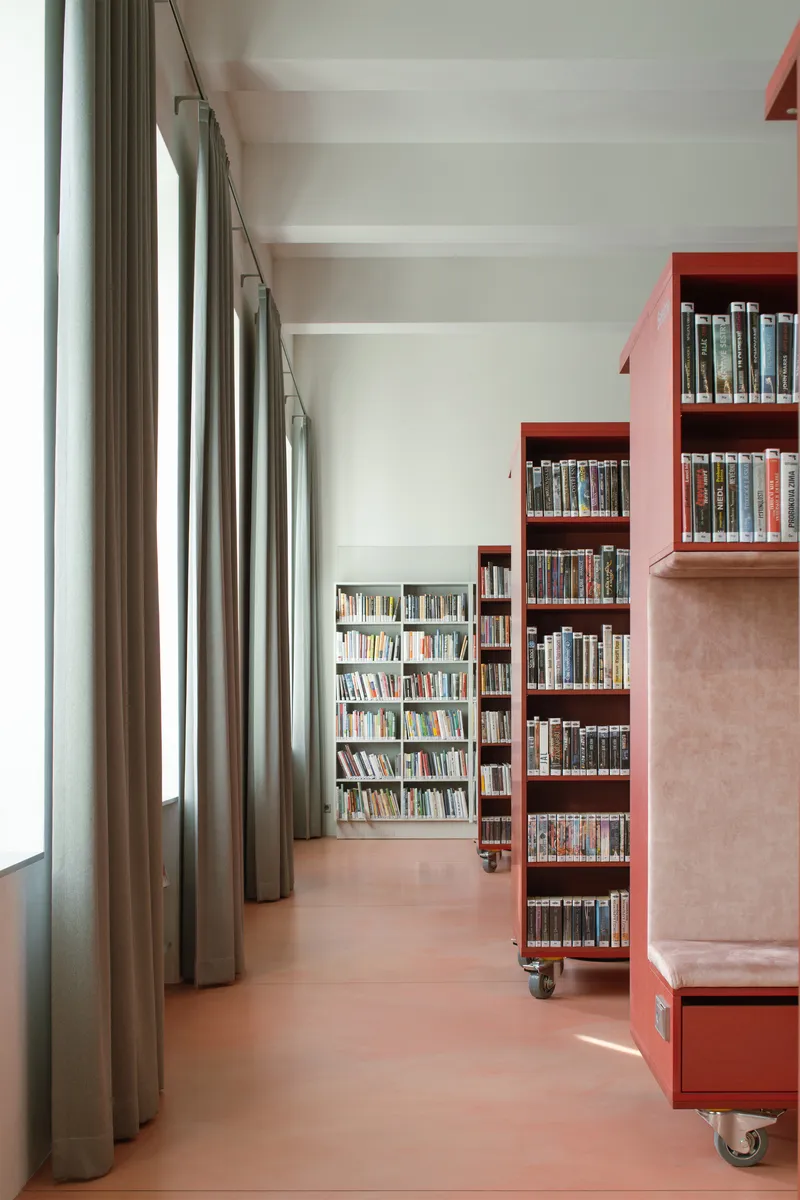
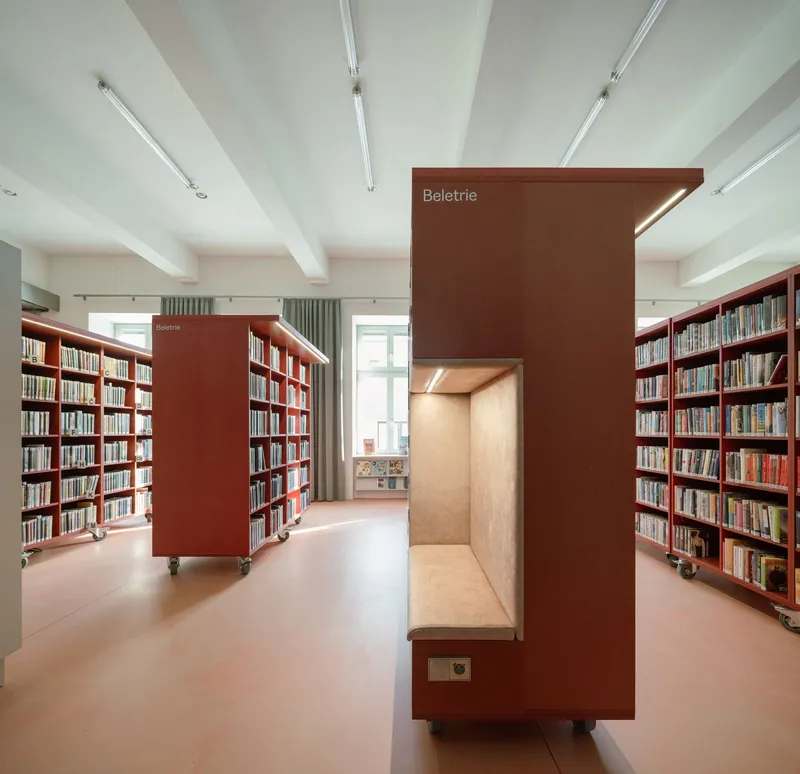
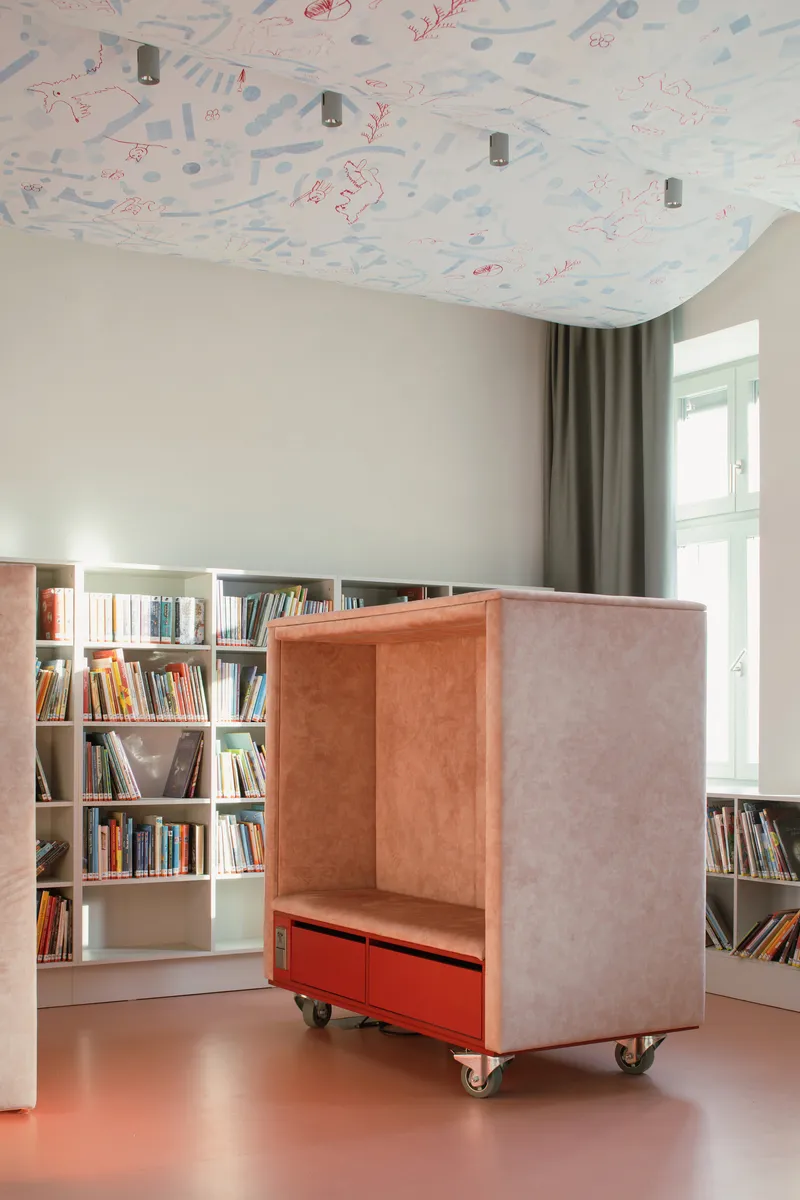
The pink mobile shelving units on casters are the project's signature move. They allow the reading rooms to be reconfigured for events, exhibitions, or simply different reading moods on different days. Paired with floor-to-ceiling grey curtains that can subdivide the open plan, the library offers a level of spatial flexibility rarely seen at this budget level.
The freestanding coral booth with its integrated bench, the upholstered reading nook on wheels, the tan leather sofa with book storage tucked beneath: each piece of furniture acts as a micro-architecture within the larger room. They define zones without walls, inviting occupation rather than directing it. For a public space that serves readers of all ages, this open-ended approach is far more useful than a fixed layout could ever be.
The Reading Rooms
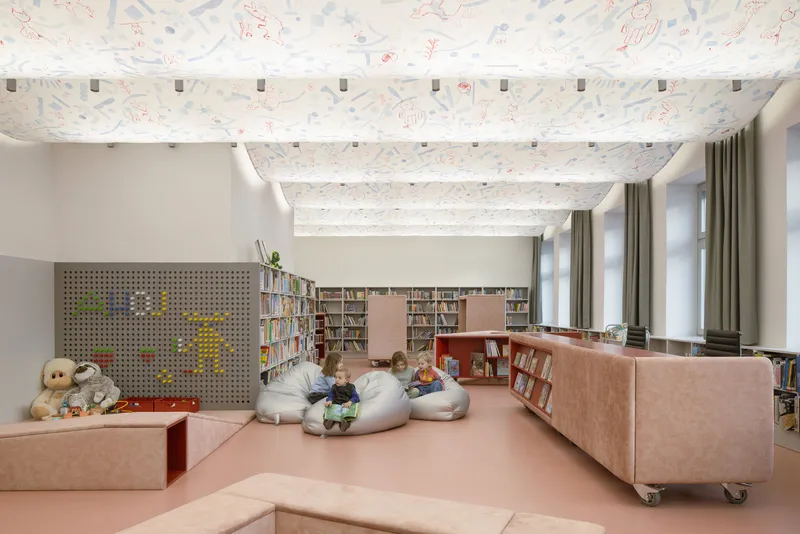
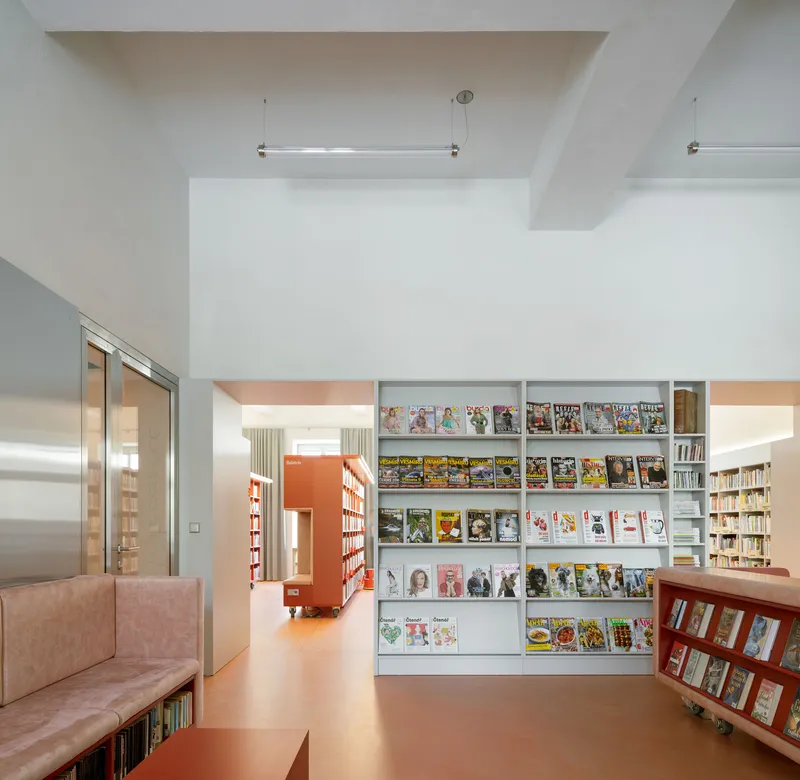
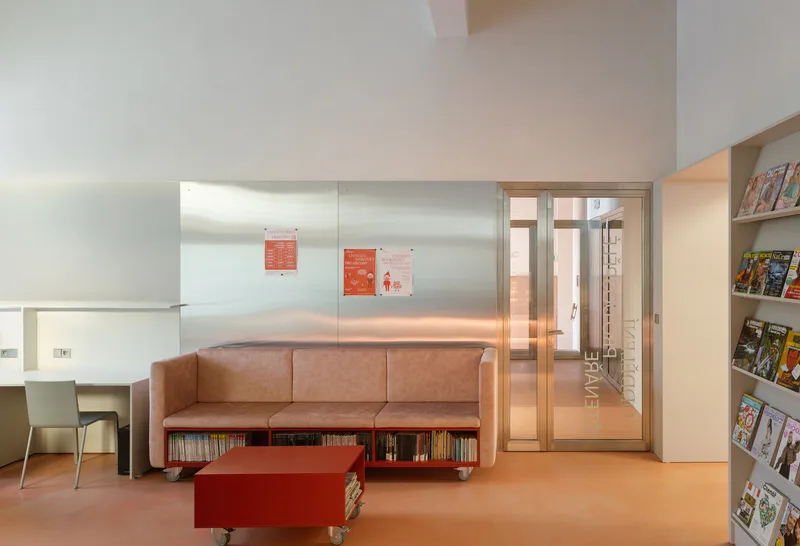
Exposed white beams overhead, natural light pouring through generous windows, and bean bag seating scattered across the floor: the main reading areas achieve that rare quality of feeling both structured and relaxed. Magazine display shelves along one wall sit under warm daylight, while the coral rubber flooring ties the palette together. A translucent glass partition separates quieter zones without blocking light.
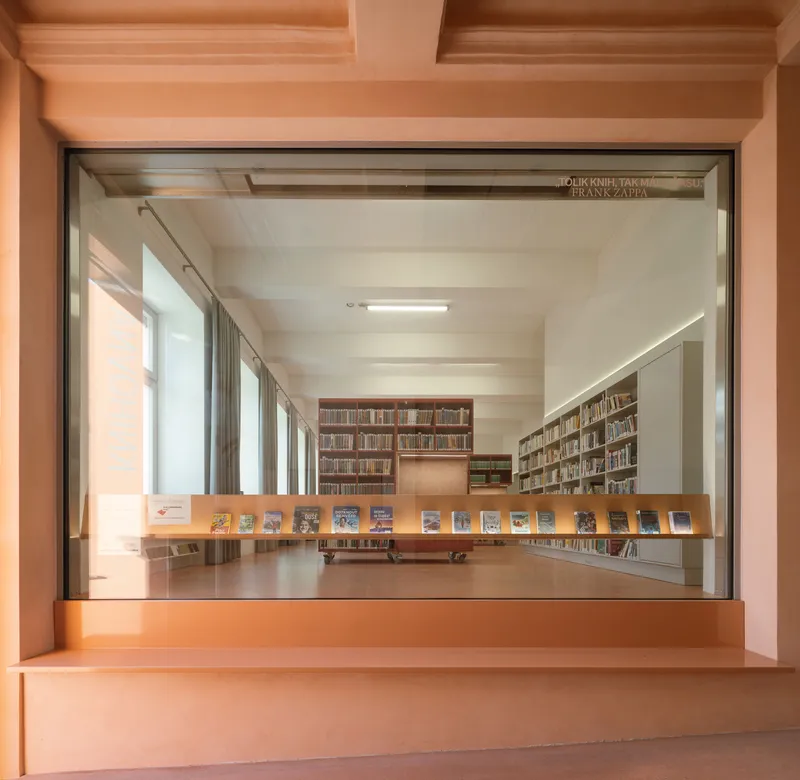
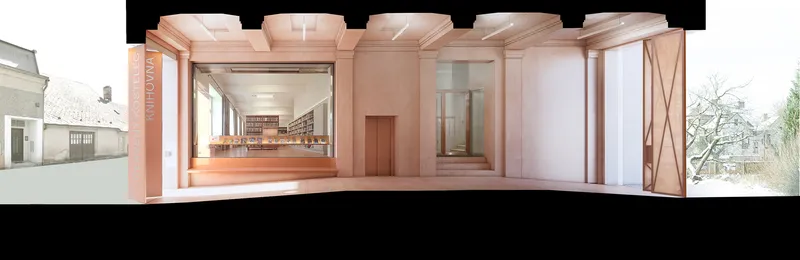
Views through timber-framed openings connect adjacent rooms visually, offering glimpses of coffered ceilings and book display ledges. The architects understood that a library's pleasure comes partly from seeing other readers absorbed in their own worlds. These framed apertures create a gentle voyeurism that encourages lingering.
A Children's World Under Illustrated Ceilings
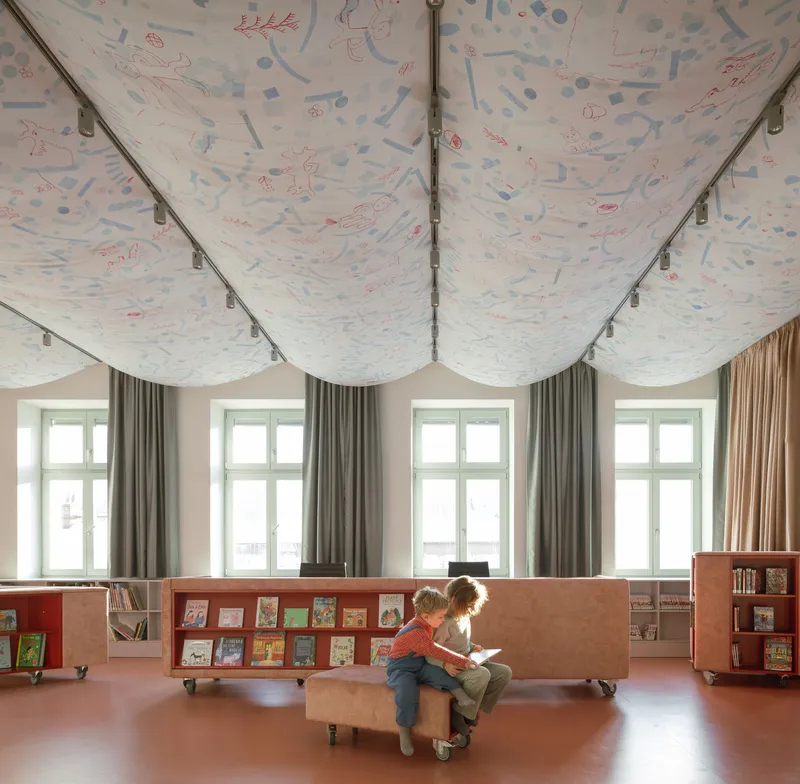
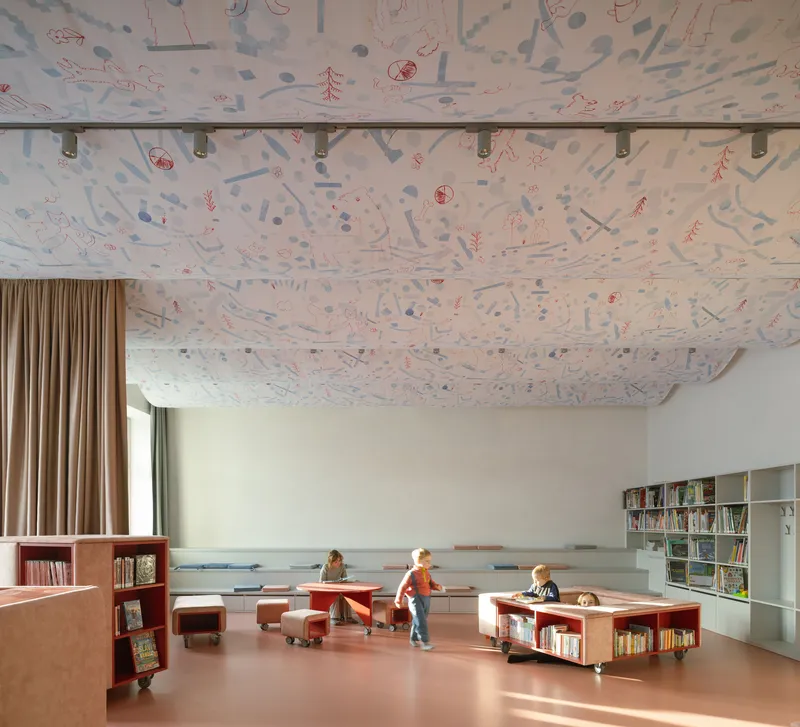
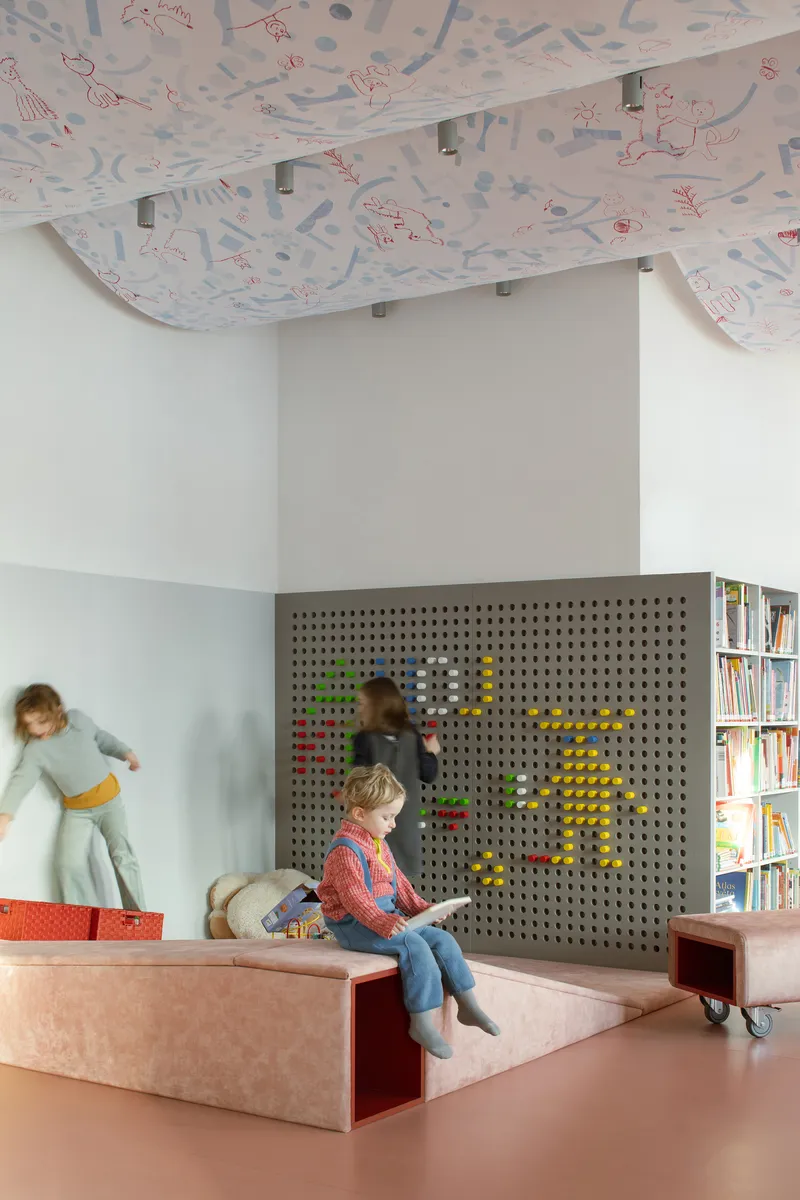
The children's section is where the project truly lets loose. Suspended fabric panels carry hand-drawn illustrations in blue and coral, creating a scalloped canopy overhead that transforms the room into something between a tent and a storybook. Below, a pegboard wall holds colored toys, and stepped platforms provide places to sit, climb, and play. The palette shifts from the restrained tones of the adult spaces to something more vivid and more permissive.
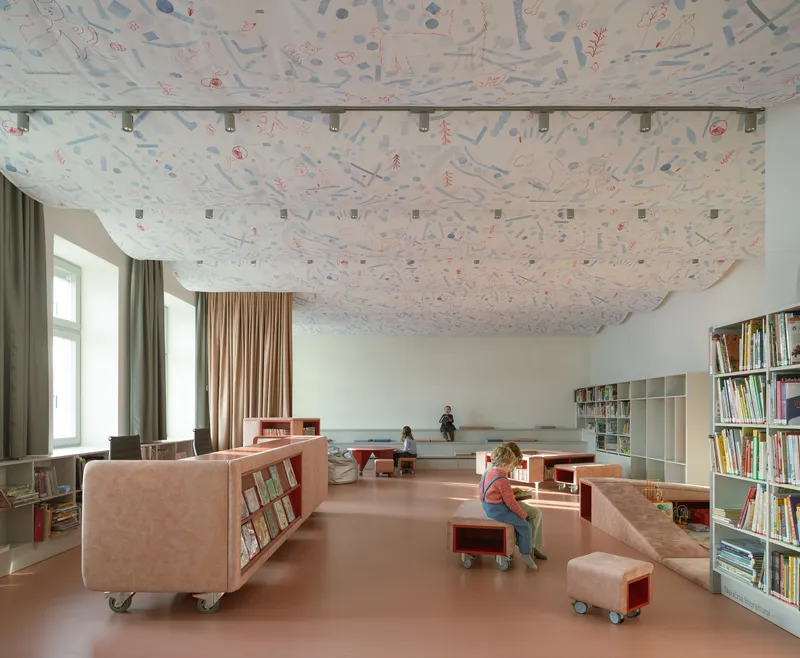
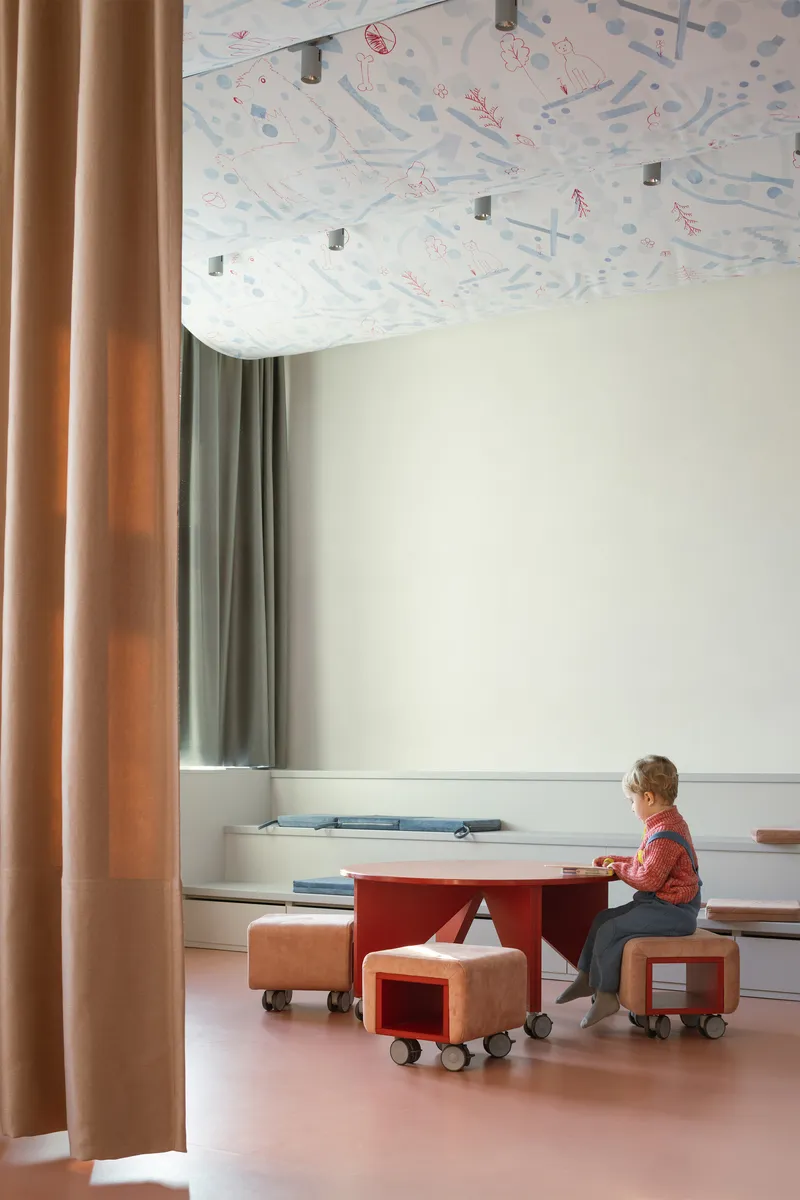
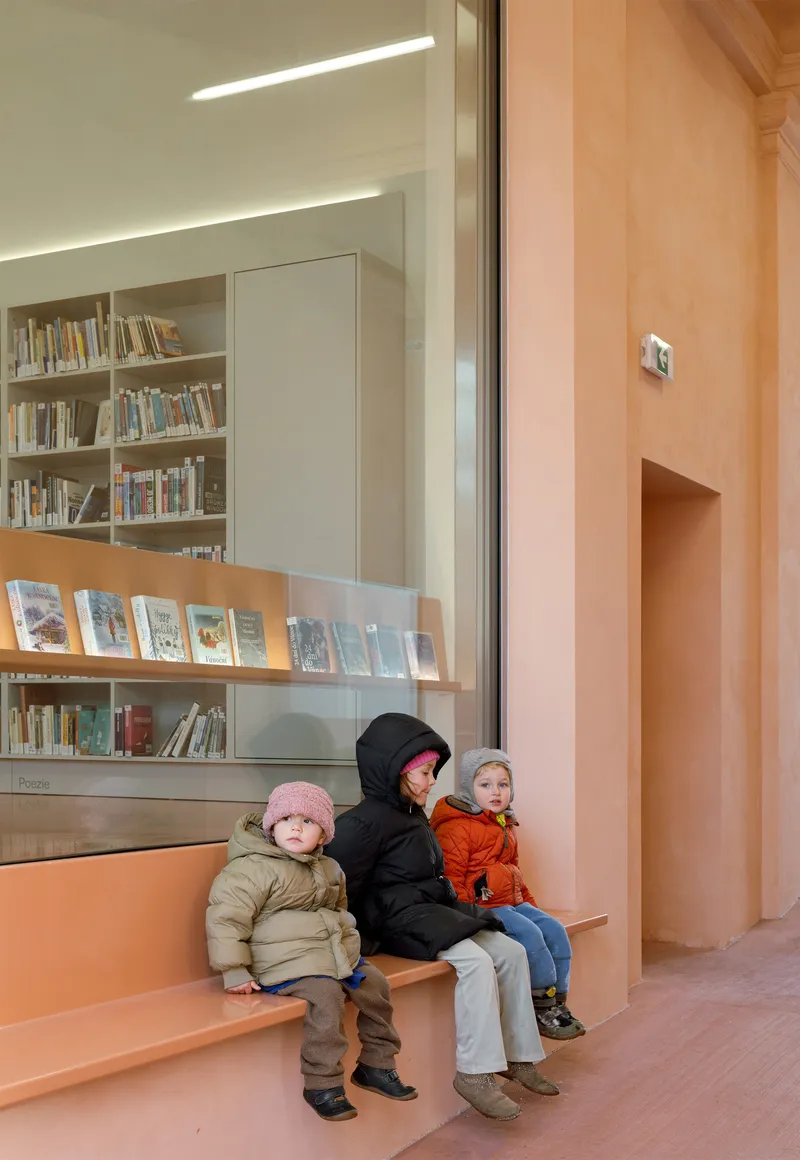
Children reading on the terracotta floor beneath patterned ceilings, or seated at red tables framed by beige and green curtains, or perched on a pink built-in bench beside a glass display case: every photograph of this zone shows bodies at ease in space. That is the hardest thing for architecture to produce, and the simplest test of whether it has succeeded. These rooms pass the test.
Quiet Details
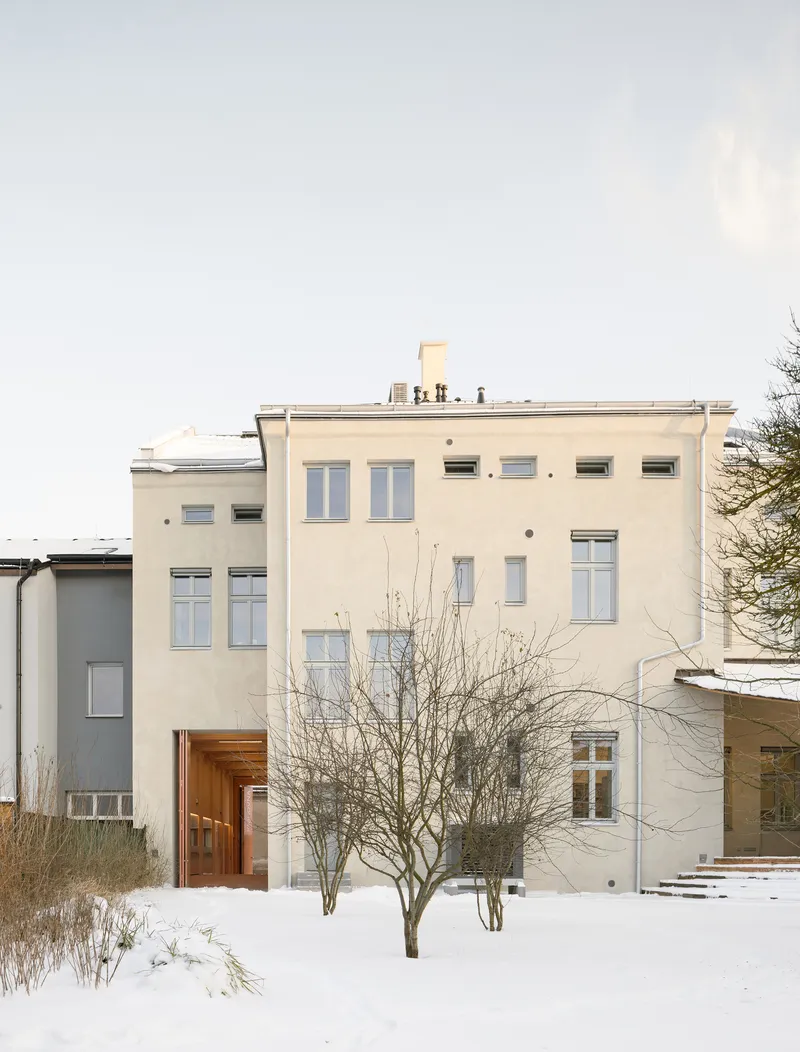
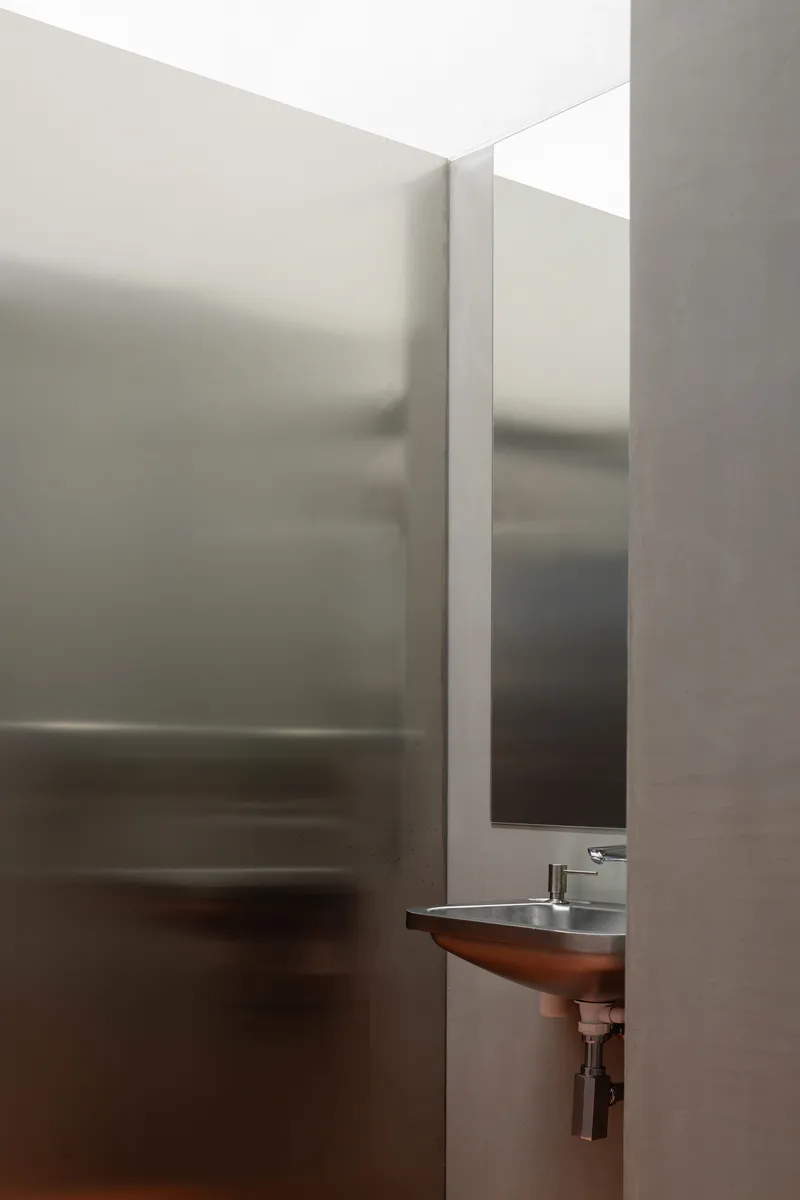
The rear elevation, visible against bare winter trees, shows the variety of window sizes that the renovation introduced, each responding to the room behind it rather than conforming to a grid. Inside, even the bathroom receives attention: a translucent glass partition, a wall-mounted sink, and a vertical mirror slot that turns a utilitarian room into a considered composition. These details signal that the architects treated every square meter with equal seriousness, not just the showcase spaces.
Plans and Drawings
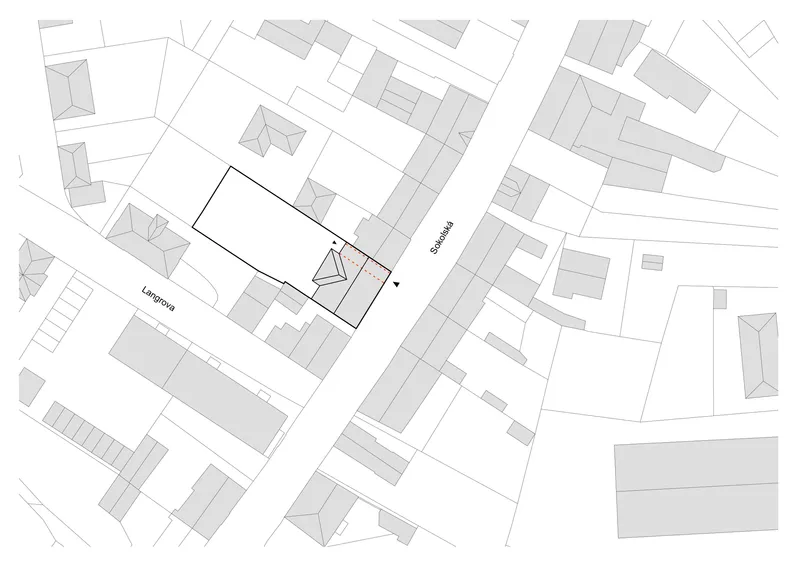
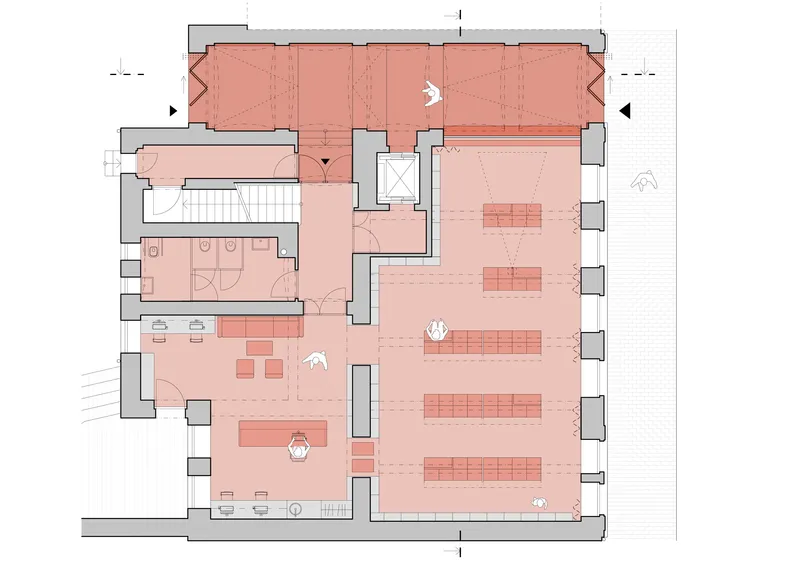
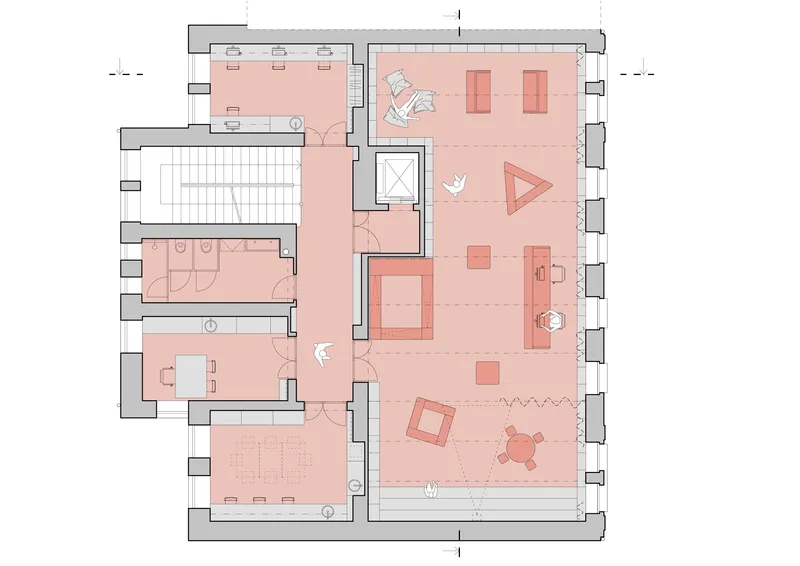
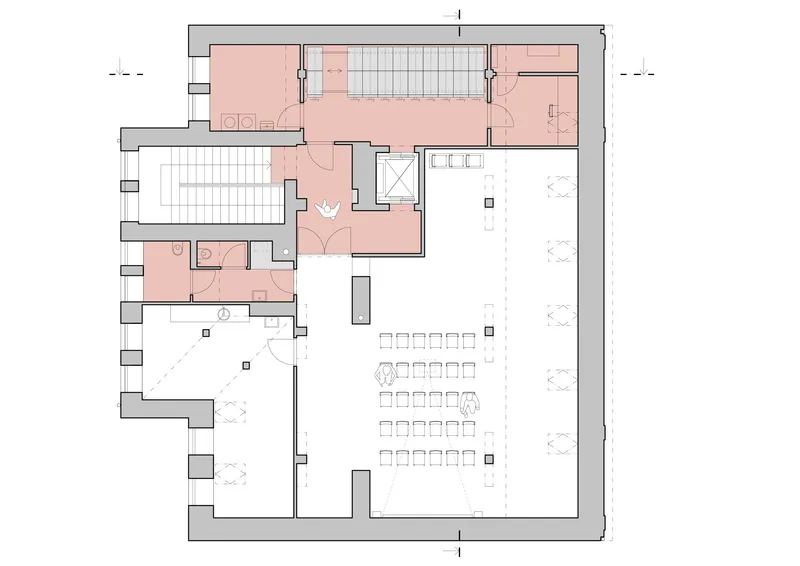
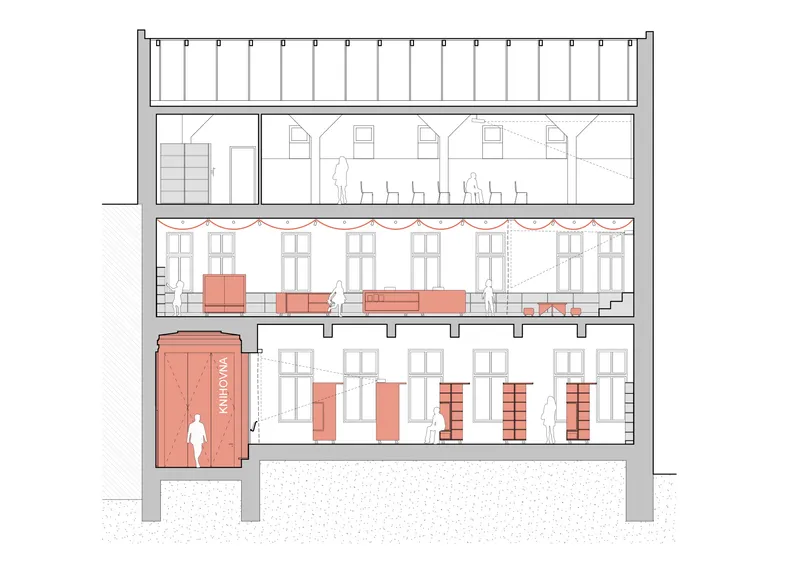
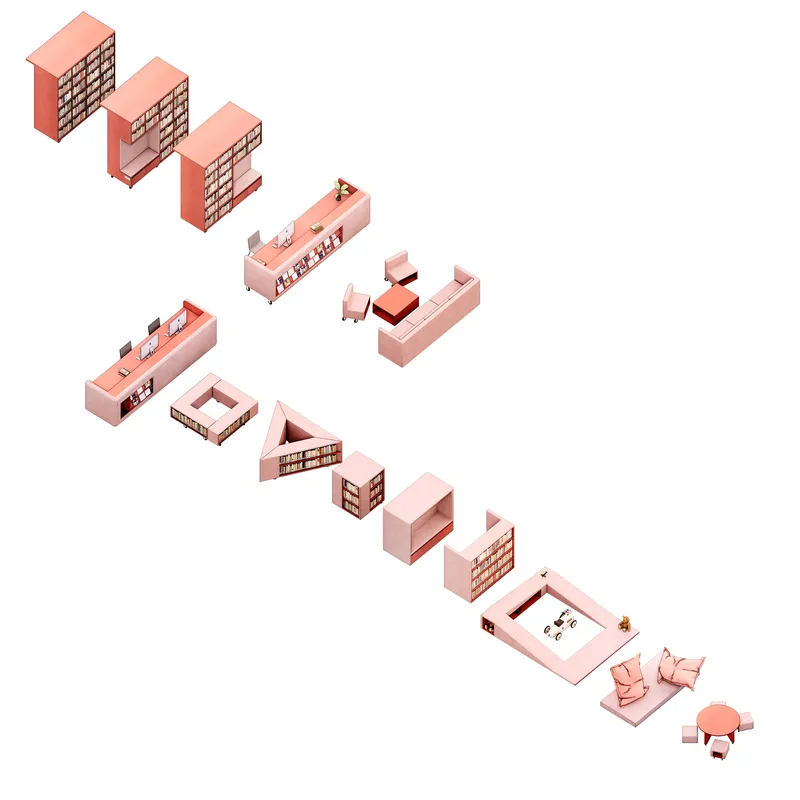
The site plan reveals how tightly the building sits within its urban block, sharing party walls on multiple sides. The floor plans, shaded in pink to distinguish programmed areas, show the clear logic of a central stair core with reading and exhibition spaces wrapping around it. The section drawing cuts through four stories, exposing tall proportions inherited from the inn's original structure and confirming that the architects worked with, not against, the existing vertical generosity.
The exploded axonometric is particularly revealing. It separates the mobile shelving units, service counters, and seating elements from the shell, making visible the project's fundamental idea: a robust historic envelope populated by lightweight, movable program elements. Architecture as framework, furniture as inhabitation.
Why This Project Matters
Adaptive reuse projects often fall into two camps: the reverential restoration that turns a building into a museum of itself, or the aggressive insertion that treats the old shell as little more than a container. Papundekl's library in Červený Kostelec charts a more interesting course. It respects the inn's masonry bones and street presence while filling its rooms with an entirely contemporary language of mobile furniture, illustrated fabric ceilings, and warm material contrasts. Neither nostalgic nor confrontational, it simply makes an old building work for a new purpose with clarity and pleasure.
More broadly, this project is evidence that small-town public architecture in Central Europe is experiencing a quiet renaissance. The 285 square meter footprint is modest; the ambition is not. By treating flexibility as a core design principle rather than an afterthought, and by investing in the sensory experience of every room, Papundekl have produced a library that will likely outlast its own moment. Buildings that invite people to rearrange them tend to age well, because they belong to their users from day one.
Library in Červený Kostelec by Papundekl Architects. Červený Kostelec, Czechia. 285 m². Completed 2025. Photography by Alex Shoots Buildings.
About the Studio
Share Your Own Work on uni.xyz
If projects like this are the kind of work you want to make, uni.xyz is a place to publish your own, find collaborators, and enter design competitions.


Popular Articles
Popular articles from the community


Opera by the Sea Estonia: Three Shells Dissolving Architecture into Tallinn's Coastline
A winning opera house proposal replaces monumental form with interconnected shells that blur the boundary between building, park and Baltic Sea.

The Amber Palace Opera: A Geological Fiction Surfaces on Tallinn's Baltic Waterfront
Pierre Brillard reimagines a Baltic legend as a public landscape, opera house, and waterfront promenade rooted in Tallinn's coastal identity.
Tsunami Convergenics: Turning Catastrophic Ocean Forces into Underwater Housing Infrastructure
A speculative underwater settlement off the coast of Onagawa, Japan, treats tsunamis and typhoons as energy sources rather than threats.

Temporary Home for Dogs: A Reversed Zoo Rethinks Animal Shelter Architecture
In Bucharest, a sinuous corridor and freed landscape flip the logic of containment, designing a shelter that works to make itself unnecessary.

Similar Reads
You might also enjoy these articles

Pixel Gardens: One Repeated Module Stacked Into a Terraced Social Housing Tower for Famagusta
Salem Bader's shortlisted housing tower builds a vertical neighbourhood from one repeated module, offsetting units to carve terraces, light and air.

Bao Huynh Watercolor Atelier: A Serene Art Retreat in Hội An
Bao Huynh Watercolor Atelier in Hội An blends multifunctional art spaces, sustainable design, local materials, and family-friendly living in a serene environment.

Atelier Macri Concept Store Interior Design by CASE-REAL
Atelier Macri store features a "ko" counter, walnut wood details, cork displays, blending retail, gallery, and seamless customer experiences.

Manuel Vargas Izquierdo Stadium and High-Performance Sports Center: Architectural Excellence in Jalpa de Méndez
The Manuel Vargas Izquierdo Stadium blends sustainable design, inclusive sports facilities, and cultural-inspired architecture, revitalizing Jalpa de Méndez’s public spaces.

Explore Archip Prague Competitions
Discover active competitions in this discipline

Challenge to design public laboratory

Bring back Drive In's
Comments (0)
Please login or sign up to add comments
No comments yet. Be the first to comment!