

Linear City: Modular AI-Driven Urbanism Where Pods Replace Buildings
A speculative linear metropolis of 3D-printed recyclable pods, drone ports, and an intelligent spine connecting Asian megacities by monorail.


What happens to a city when the workforce that built it no longer needs offices, factories, or commutes? Linear City starts from that question and arrives at something genuinely provocative: an entire urban model organized not around static land plots but around a single expandable spine of infrastructure, with 3D-printed recyclable pods clipped into place like cartridges. Living units, robotic production hubs, VR meeting rooms, and vertical farms all occupy the same structural frame, swappable as demand shifts. The city itself becomes a machine that learns.
Designed by Kevin Goldstein, the project received an Honorable Mention in the Breaking Work competition, which challenged entrants to rethink architecture's relationship to labor in an era of automation. Goldstein's response is ambitious in scope: a linear megastructure conceived to bridge terrain, span highways, and eventually connect major Asian urban centers like Tokyo, Shanghai, Beijing, and Singapore via a high-speed monorail spine. The proposal is speculative, certainly, but it grounds its speculation in specific material choices, programmatic logic, and structural systems that reward close reading.
A Turquoise Ribbon Clipped to the Rails
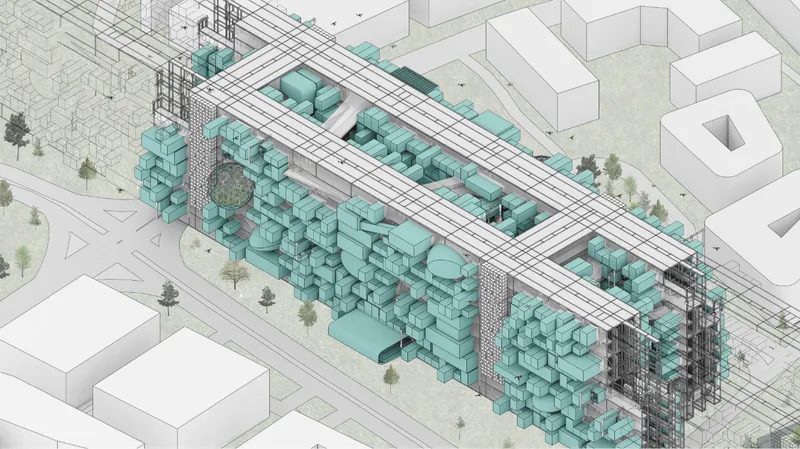
The axonometric drawing immediately communicates scale and intent. Modular housing blocks rendered in turquoise stretch along rail tracks, their repetitive geometry contrasting sharply with the irregular fabric of surrounding context buildings. The color distinction is deliberate: it separates Linear City's system from the existing city, emphasizing its identity as an insertable infrastructure rather than a conventional neighborhood. The rail corridor is not an afterthought but the organizing datum, the line from which everything grows.
What makes the drawing convincing is the surrounding context. Goldstein places the linear structure in relation to roads, existing blocks, and landscape, suggesting that this is not a clean-slate utopia but a parasitic system designed to slot alongside what already exists. The implication is clear: the city does not demolish to build, it extends.
Four Systems, One Frame: Pods, Spine, Circulation, and Membrane
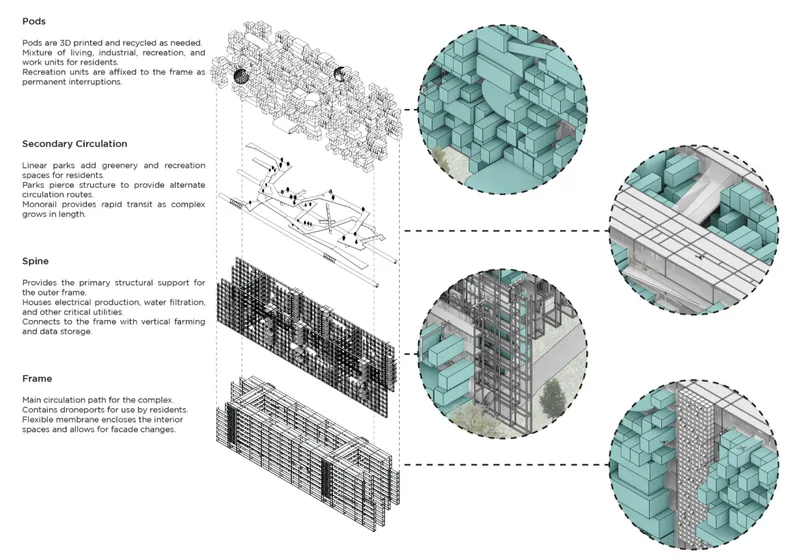
The exploded axonometric diagram breaks Linear City into its four constituent systems. Pods are the interchangeable modules that carry program: living units with retractable furniture and telescopic walls, industrial units driven by robotics for rapid prototyping, and work units featuring VR immersion meeting pods and rentable micro-offices for freelancers. The Spine forms the structural backbone, housing power generation, water filtration, and vertical farming. Secondary Circulation layers in linear parks, green corridors, and monorail lines. The Frame handles movement at a different scale, incorporating drone ports and flexible membranes that allow the facade to transform in response to environmental conditions.
Circular callout details in the diagram zoom into specific junctions, revealing how these four layers nest together. The logic is genuinely modular: outdated pods can be dismantled and their materials recycled for new growth. In non-urban stretches, Goldstein proposes locally sourced materials such as hybrid wood composites or ocean-extracted biomaterials. The architecture treats its own obsolescence as a design parameter, not a failure.
Living in Section: Balconies, Cores, and Oval Communal Terraces
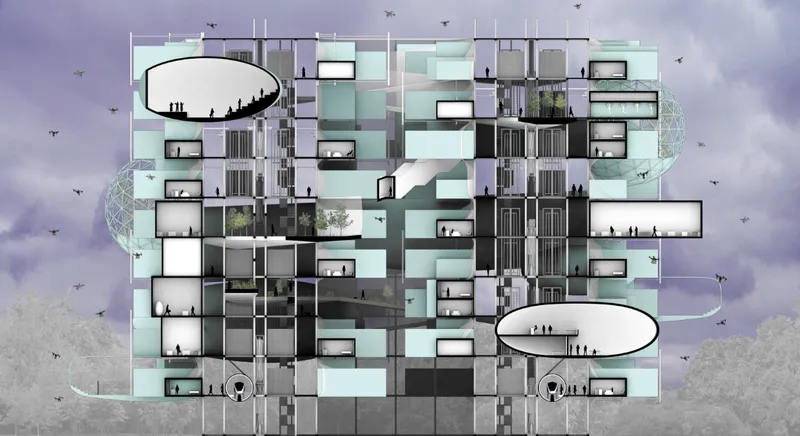
The section drawing shifts the conversation from system to experience. Residential units appear stacked with generous balconies, flanked by vertical circulation cores that provide access without disrupting the living modules. The most striking feature is the series of oval-shaped communal terraces punctuating the section. These are not leftover voids; they read as deliberate social condensers, shared spaces where the inhabitants of a city defined by pods and automation can actually encounter one another.
Against a backdrop of cloudy sky, the section anchors the speculative program in something tactile. Compact living units with biometric access and retractable furniture could feel alienating in plan, but in section they gain depth: light enters, greenery appears on terraces, and the vertical farm layers within the spine become visible. The drawing argues that density and adaptability need not come at the cost of livability.
Territorial Ambition: The Site Plan as Expansion Strategy
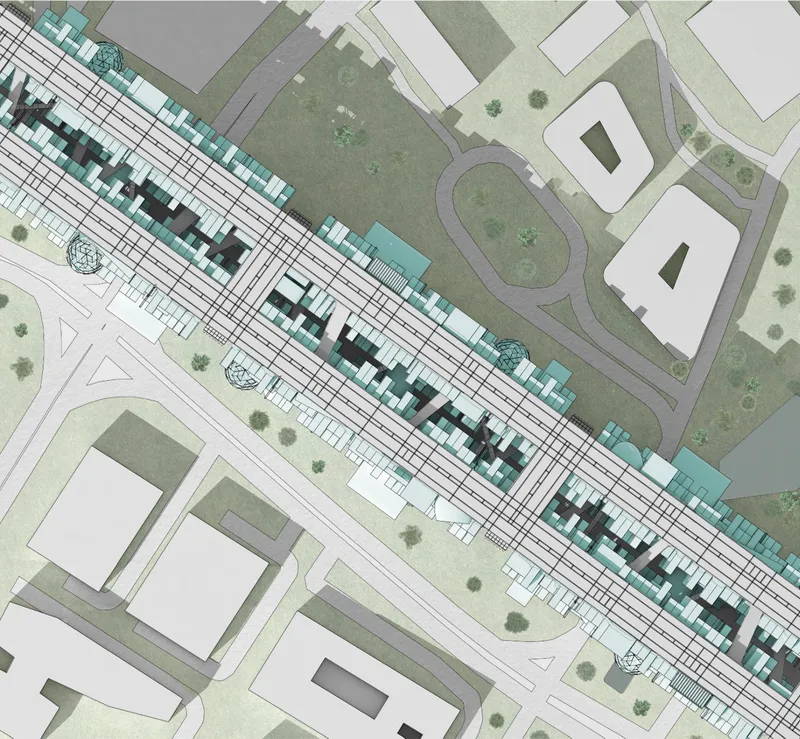
Pulled back to the site plan, the project reveals its territorial ambition. Linear housing blocks run parallel to rail infrastructure, with adjacent green spaces acting as buffers between the new system and existing buildings. The plan makes explicit what the axonometric hinted at: Linear City is not a destination, it is a corridor. Its value increases with length, each new segment extending connectivity and programmatic diversity.
Goldstein envisions this corridor eventually bridging rivers, spanning highways, and integrating with mountainous terrain as it connects megacities across Asia. The site plan, grounded in a specific local condition, is simultaneously a template for replication. That dual reading, local insertion and global network, is the project's most compelling spatial argument.
Why This Project Matters
Most speculative projects about AI and architecture fall into one of two traps: they either render sleek parametric forms without explaining how anyone would live in them, or they write exhaustive technical briefs without producing architecture worth inhabiting. Linear City manages to navigate between the two. Its four-system framework is legible and logical, its pod typologies are specific enough to evaluate, and its drawings move between scales with clarity. The oval communal terraces, the drone-port frame, the retractable walls inside living pods: these are not generic futurism but design decisions that can be critiqued, refined, and tested.
The deeper provocation lies in the project's premise that cities should be designed for their own continuous transformation. If AI will indeed displace entire categories of labor, architecture's response cannot be a single building or even a single masterplan. It must be a system that absorbs change at the scale of a module and propagates it at the scale of a continent. Linear City takes that challenge seriously, and Goldstein's Honorable Mention in Breaking Work is well earned.
View the Full Project
About the Designers
Designer: Kevin Goldstein
Enter a Design Competition on uni.xyz
uni.xyz runs architecture and design competitions year-round that reward proposals with spatial conviction and real site intelligence.
Project credits: Linear City by Kevin Goldstein Breaking Work (uni.xyz).


Popular Articles
Popular articles from the community


Opera by the Sea Estonia: Three Shells Dissolving Architecture into Tallinn's Coastline
A winning opera house proposal replaces monumental form with interconnected shells that blur the boundary between building, park and Baltic Sea.
Temporary Home for Dogs: A Reversed Zoo Rethinks Animal Shelter Architecture
In Bucharest, a sinuous corridor and freed landscape flip the logic of containment, designing a shelter that works to make itself unnecessary.

Opera on the Sea: Driftwood Logic Shapes a Timber Opera House on Estonia's Coast
Trevor Orgill's opera house translates the entangled drift of floating timber into a civic building where wood, water, and music converge.
Cloaked Colonization: A Mobile Underwater Habitat That Moves Like a Fish
Micah Abaya's shortlisted EHC Pacific entry reimagines ocean settlement as a dispersed network of self-sustaining architectural organisms.

Similar Reads
You might also enjoy these articles

The Amber Palace Opera: A Geological Fiction Surfaces on Tallinn's Baltic Waterfront
Pierre Brillard reimagines a Baltic legend as a public landscape, opera house, and waterfront promenade rooted in Tallinn's coastal identity.
Dynamic Modules Shelter: A Telescopic Ring for Mountain Pilgrimage
A circular modular framework of steel, bamboo, and fabric grows vertically with demand, wrapping communal ground in adaptable shelter.

Singing Woman: Contemporary Architecture Inspired by Estonia’s Voice and the Sea
Singing Woman turns Estonia’s song culture into flowing opera house architecture, blending public life, landscape, sea, and national memory.
HYPERBLOCK: Flexible Urban Design for Barcelona’s Future City
HYPERBLOCK reimagines Barcelona as flexible urban design, layering density, daylight, public space and adaptable housing above Cerdà’s grid.

Comments (0)
Please login or sign up to add comments
No comments yet. Be the first to comment!