
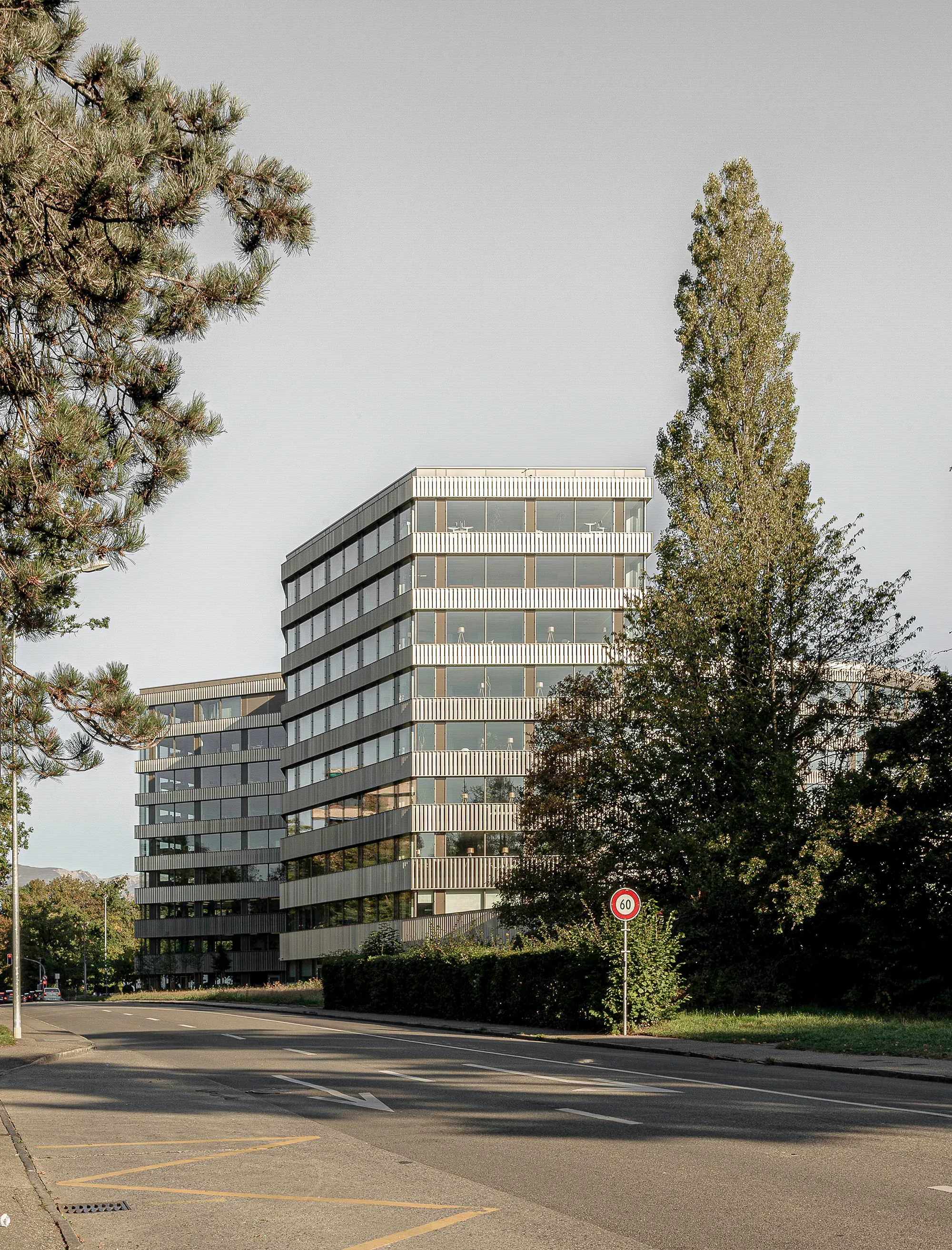
LRS Architectes Folds a 17,000 m² Headquarters into Geneva's Diplomatic Parkland
The Global Fund's new home in Le Grand-Saconnex uses angled geometry and anodized aluminum to dissolve a massive office volume among the trees.


Geneva's Route de Ferney is one of the densest corridors of international governance on the planet. The World Health Organization, the International Labour Organization, the UN European headquarters, and the World Intellectual Property Organization all sit within walking distance of each other, strung along a tree-lined road that runs northwest from the city center. When the Global Fund to Fight AIDS, Tuberculosis and Malaria needed a permanent home here, the challenge was not simply programmatic. It was scalar: how do you slot a 17,000 m² headquarters for 1,400 people into a parkland setting without producing another monolith?
LRS Architectes won a 2010 competition with an answer that treats geometry as camouflage. Their building is not one rectangular slab but a folded, Y-shaped form whose three wings radiate from a central circulation core. The angled contours break the perceived mass into a sequence of facets that reveal themselves gradually as you move along the street, and a skin of slightly diagonal anodized aluminum blades makes the facade shift in tone with the light and your own position. The result is a CHF 140 million campus that manages to feel like a stand-alone object rather than a complex, even while housing offices, an auditorium, seminar rooms, a cafeteria, and a library.
A Folded Volume in the Trees
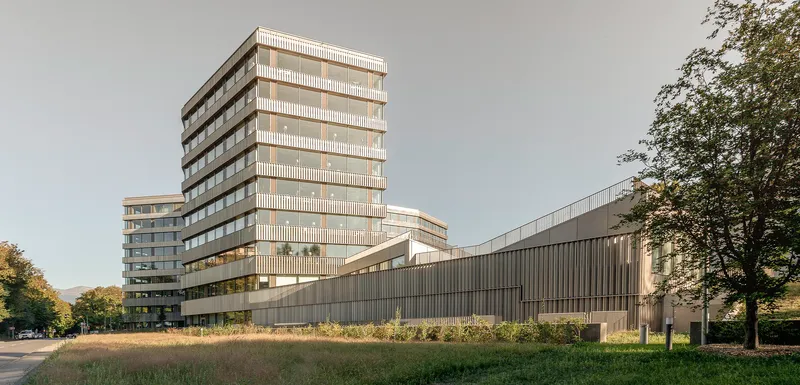
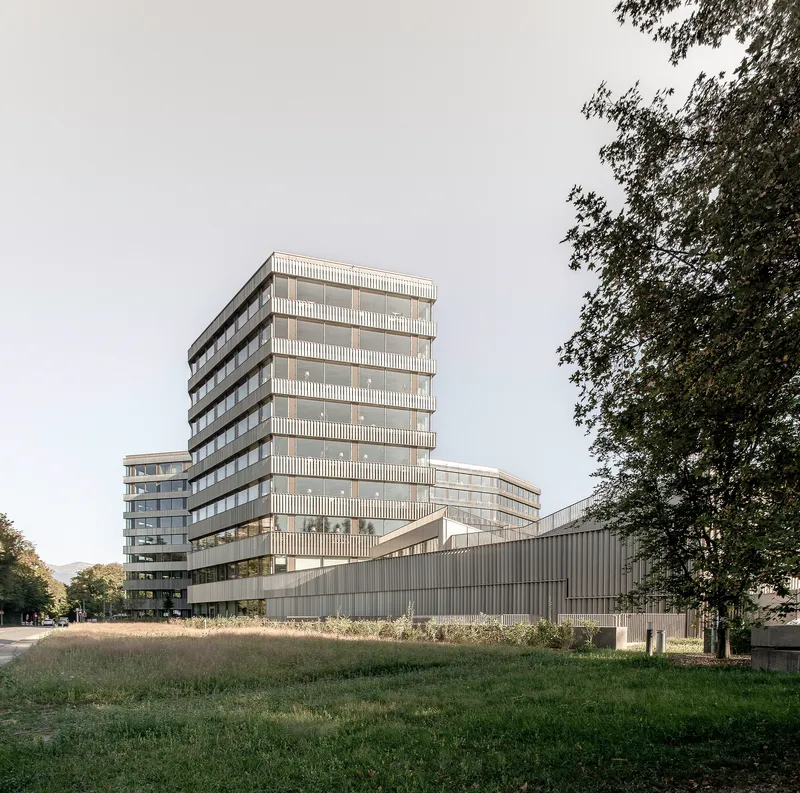

From the south, the building presents a tall louvered tower rising behind a lower, horizontally ribbed podium. Walk a few meters and the whole composition pivots. A second wing emerges from behind the first. A few meters more and a third wing appears. LRS exploited the corner site at Route de Ferney and Chemin du Pommier to set the building at angles that make its full extent impossible to read from any single vantage point, a deliberate tactic for blurring the true scale of 40,000 m² of gross floor area (including basements).
Existing mature trees were kept and new ones planted so that the facades are almost always partially screened by canopy. The wildflower meadow in front of the main elevation reinforces the sense that the building is emerging from a landscape rather than imposed upon one, an important diplomatic gesture in a neighborhood where the architecture of international institutions often defaults to fortress mode.
The Anodized Aluminum Skin
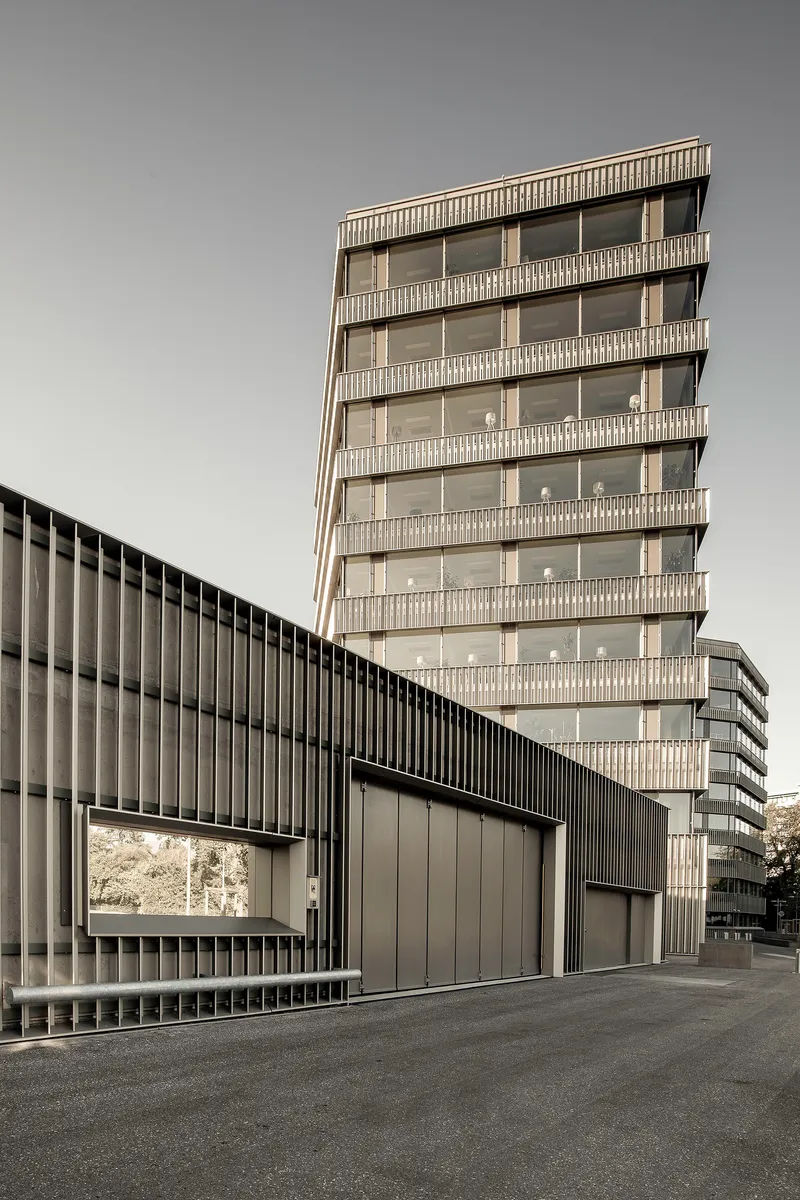
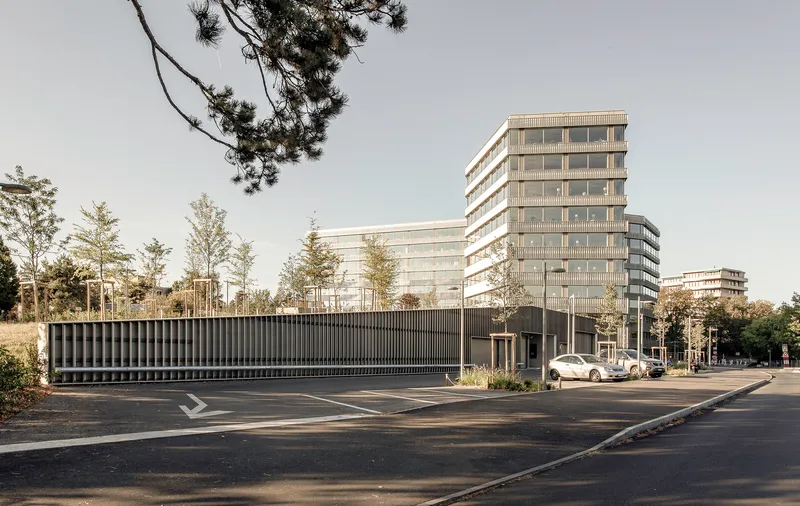
The vertical blades that clad the upper seven office levels are the building's signature material move. Each blade is set at a slight angle to its neighbor, and the anodized aluminum finish is highly reflective without being mirrored. As a result, the facade absorbs color from its surroundings: the green of the trees, the grey of an overcast sky, the gold of late afternoon light. The effect is that the building never quite looks the same twice.
These blades are not merely decorative. They serve as visual barriers that allow generous glazing behind them while providing privacy for workstations facing the street. It is a pragmatic solution to a real problem: office buildings for international organizations need transparency in principle but security and discretion in practice. The blades give both. The lower podium, by contrast, uses a tighter horizontal banding that anchors the composition and differentiates the semi-public ground floor functions from the office levels above.
Public Ground, Private Sky


The sectional logic is cleanly legible. The ground floor gathers all semi-public and representative programs: the entrance sequence, the auditorium, seminar rooms, the cafeteria, and a library. These spaces open broadly onto the surrounding landscape, reinforcing the idea that the building's base belongs to the park as much as to the institution. Above, seven levels of offices occupy the three wings, arranged in open-plan configurations that can be subdivided to match whatever organizational structure the Global Fund needs.
Inside, the office floors are understated. Suspended ceiling panels modulate acoustics in the open-plan zones, and full-height glazed partitions bring daylight deep into meeting rooms without fragmenting the floor plate. The switchback staircase, with its vertical black metal balustrades and timber handrails, is one of the few moments where the interior permits itself a graphic gesture. Otherwise, the architecture stays out of the way and lets the workspace function.
Plans and Drawings
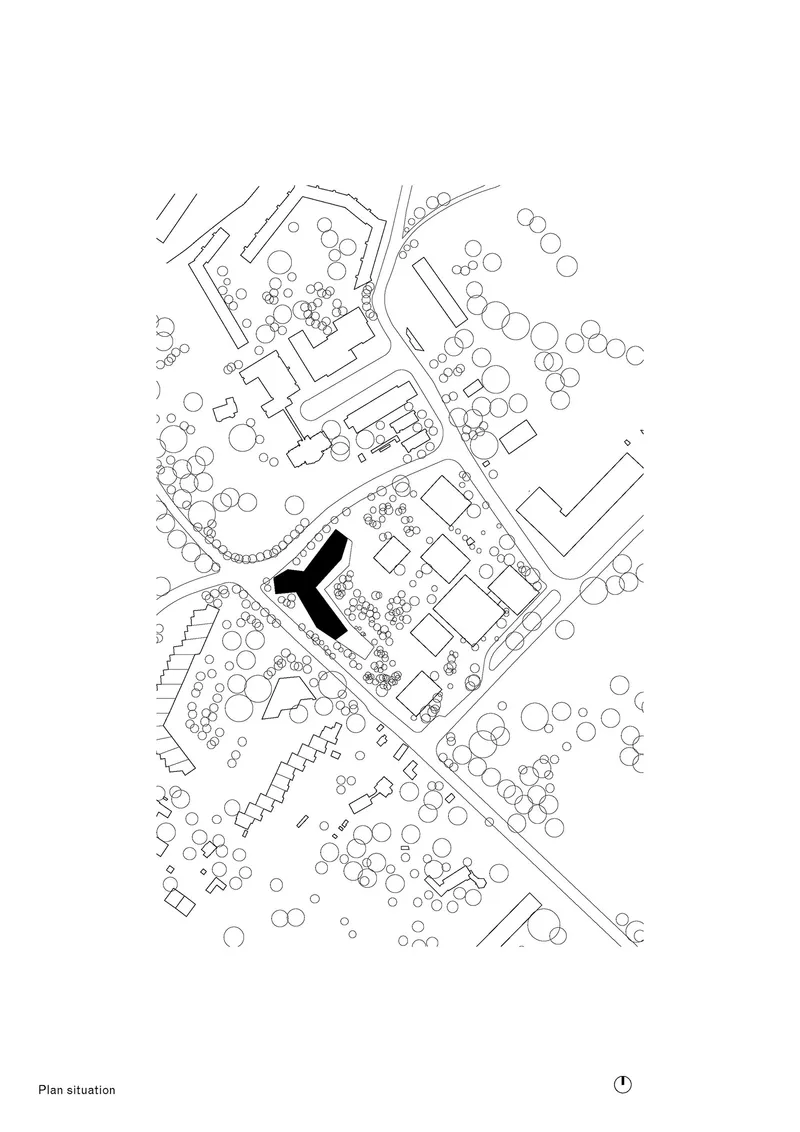


The site plan reveals the building's relationship to the broader diplomatic quarter: isolated on its plot, surrounded by tree canopy, with the Y-shaped footprint oriented to address both the street corner and the park edge. The ground floor plan shows how the three wings splay to create sheltered exterior pockets between them, while the central node holds vertical circulation and services.
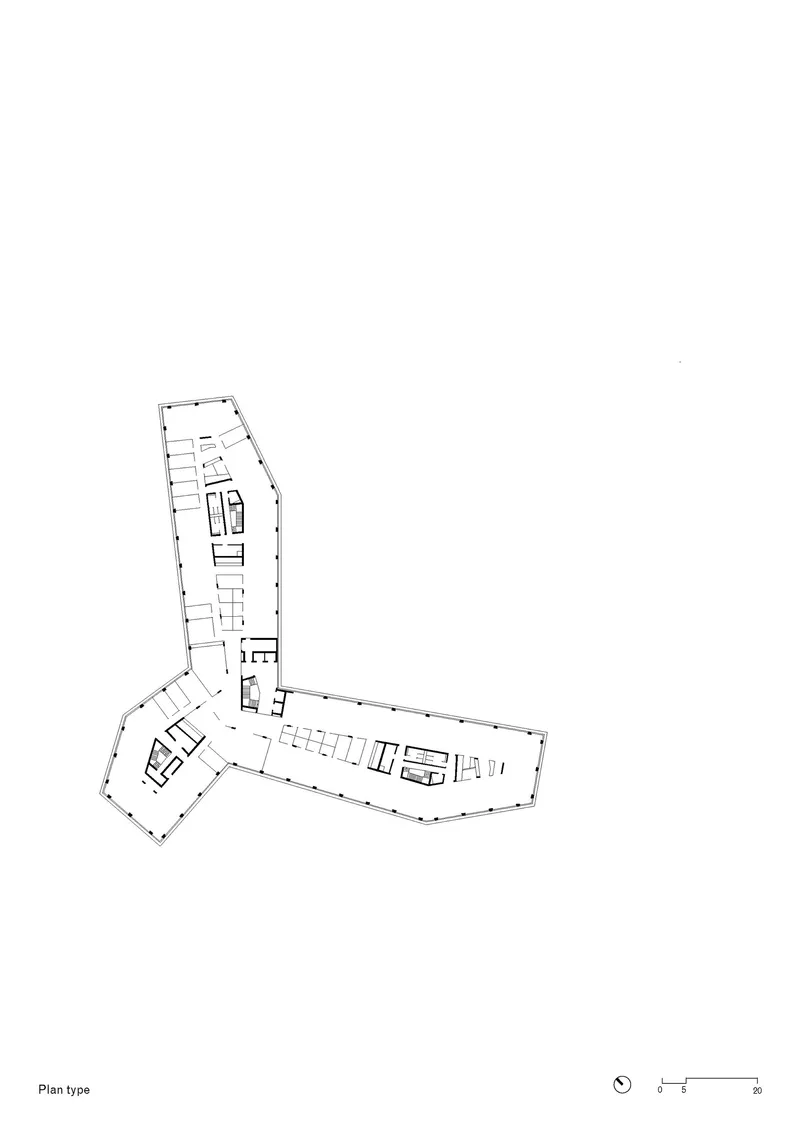
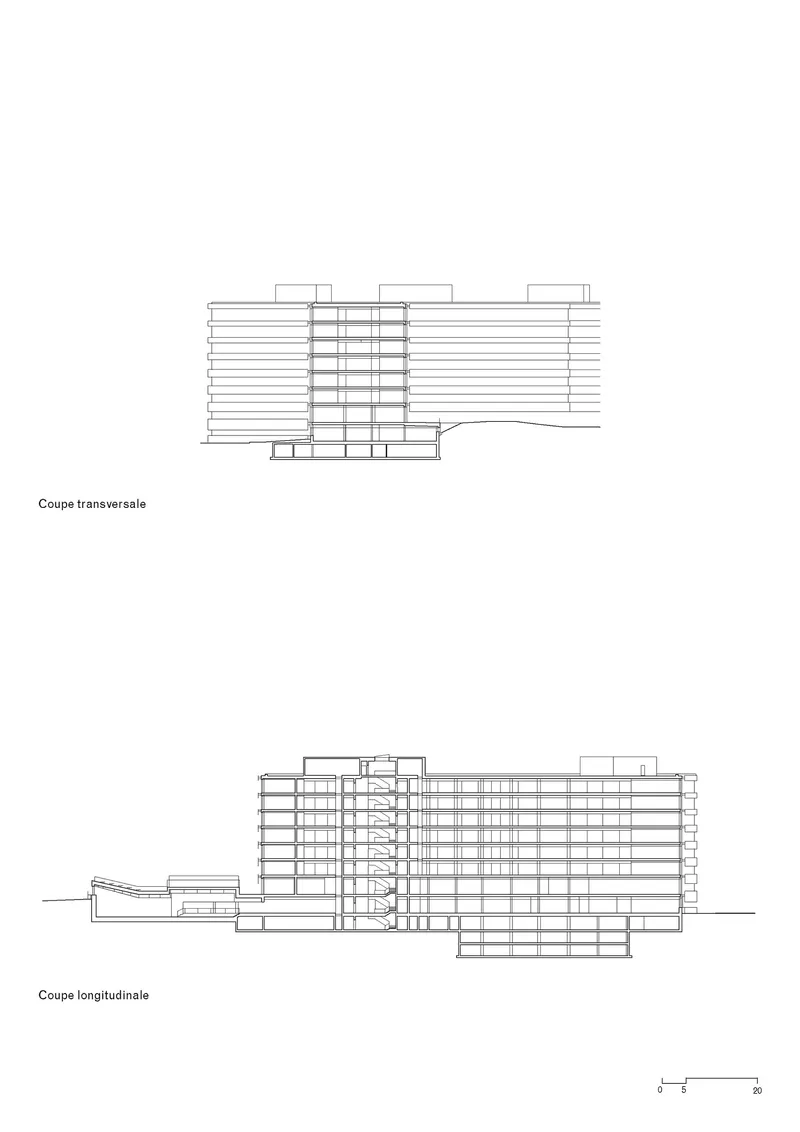
The typical floor plan makes the structural clarity of the scheme evident. Three arms extend from a central hub, each wide enough for open-plan office layouts but narrow enough to ensure that no desk is far from natural light. The section drawings confirm the datum line between podium and tower, and show how the central element rises above the wings to give the building a vertical accent without resorting to a conventional tower form. Rooftop gardens on the lower wing roofs provide outdoor amenity and soften the view from the upper floors.
Why This Project Matters
Institutional headquarters for global organizations carry an outsized symbolic burden. They need to project authority without arrogance, openness without vulnerability, and permanence without rigidity. Too many buildings in Geneva's international zone settle for generic curtain-wall slabs that telegraph power through sheer mass. LRS Architectes took a different route: they fragmented the volume, activated the facade, and embedded the building in its landscape. The result is a headquarters that earns its presence through intelligence rather than scale.
The project also demonstrates that a single, well-considered move, in this case the folded Y-plan, can solve multiple problems simultaneously. The geometry breaks down perceived bulk, creates sheltered outdoor spaces between the wings, ensures short distances from core to perimeter for daylight, and gives the building a kinetic quality when viewed in motion from the street. That kind of economy, where form does more than one job, is what separates a competent office building from a genuinely good one.
Siège du Fonds Mondial Offices by LRS Architectes. Le Grand-Saconnex, Switzerland. 17,000 m². Completed 2018. Photography by Joel Tettamanti.
About the Studio
Share Your Own Work on uni.xyz
If projects like this are the kind of work you want to make, uni.xyz is a place to publish your own, find collaborators, and enter design competitions.


Popular Articles
Popular articles from the community


Conexión: Biophilic Design Reimagines High-Rise Living in Hong Kong
Conexión reimagines high-rise living in Hong Kong through biophilic design, green facades, shared spaces, daylight, water and nature within.

Co-Life: Senior Housing Design That Reconnects Older Adults With the City
Co-Life reimagines senior housing design through healing gardens, shared streets, workshops, and a sustainable community across generations.

The Earth Pod: 3D Printed Homes for Resilient Refugee Communities
The Earth Pod reimagines refugee housing through 3D printed homes made from clay, combining resilience, self-sufficiency, and rapid shelter.

The Musturak Paradise: Senior Living Architecture for a Connected Future in Temara, Morocco
The Musturak Paradise reimagines senior living architecture in Temara via private homes, social spaces, culture, community, and shared care.
Similar Reads
You might also enjoy these articles

Bao Huynh Watercolor Atelier: A Serene Art Retreat in Hội An
Bao Huynh Watercolor Atelier in Hội An blends multifunctional art spaces, sustainable design, local materials, and family-friendly living in a serene environment.

Atelier Macri Concept Store Interior Design by CASE-REAL
Atelier Macri store features a "ko" counter, walnut wood details, cork displays, blending retail, gallery, and seamless customer experiences.

Manuel Vargas Izquierdo Stadium and High-Performance Sports Center: Architectural Excellence in Jalpa de Méndez
The Manuel Vargas Izquierdo Stadium blends sustainable design, inclusive sports facilities, and cultural-inspired architecture, revitalizing Jalpa de Méndez’s public spaces.

KAKR Buluh Awar Hall: Revitalizing Community and Ecology Through Bamboo Architecture
Community built bamboo hall revitalizes Buluh Awar village, empowering youth, restoring ecology, celebrating vernacular craftsmanship through sustainable architecture and culture.
Explore Architecture Competitions
Discover active competitions in this discipline



Challenge to reimagine the Iron Throne


Photograph architecture without architects


Illustrate the lost glory of Angkor Wat - Render Challenge


Design challenge to reuse E-waste
Comments (0)
Please login or sign up to add comments
No comments yet. Be the first to comment!