

Luigi Rosselli Architects Brings a Sydney Pole House Down to Earth with Rammed Earth and Harbor Views
A four-storey Mosman residence burrows into a rocky hillside, replacing stilts with rammed earth walls that anchor the home to its landscape.


The pole house is a familiar species along Sydney's harbor ridgelines: a lightweight frame perched on stilts above a steep, craggy site, hovering over the landscape rather than engaging it. Luigi Rosselli Architects saw a different future for one such house in Mosman. Rather than demolish the original two-storey structure, the studio added two storeys below it, driving the building into the rock and soil until the whole thing finally made contact with its own garden. The result is Earth-Ship House, a residence that replaces the anxious separation of a stilt house with the gravitational confidence of rammed earth.
What makes this project compelling is its refusal to treat the steep site as a problem to be bridged. The house descends through four levels, each one stepping closer to the ground, with a central staircase acting as the spine. Nautical references surface in the tiered terrace decks and horizontal railings, giving the harbor-facing facade the profile of a ship's superstructure. But the material palette pulls hard in the opposite direction: thick rammed earth walls, travertine stone, American White Oak joinery. The tension between those shipboard lines and the earthen mass of the walls is what gives the house its character.
Rammed Earth as Structural Identity


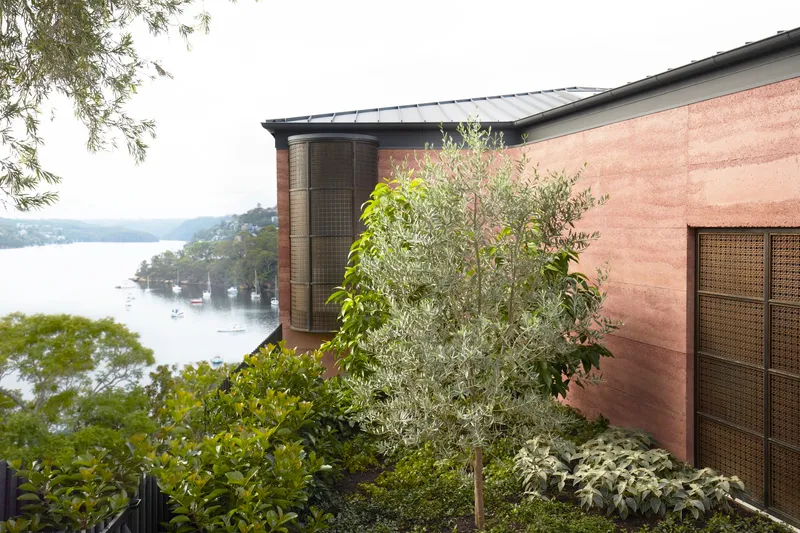
The rammed earth walls, constructed by Earth Dwellings Australia, are not decorative cladding. They are the building's load-bearing skeleton and its primary visual language. At the entry level, a curving rammed earth wall with a recessed glass door greets you with the horizontal striations of compacted soil, each layer a geological record of the construction process. Perforated metal sliding doors and stepping stones through low ground cover planting keep the arrival sequence restrained, letting the materiality do the talking.
From the planted slope above, the house reads as an extension of the hillside itself. The earth tones of the walls merge with the rocky terrain, while the tree canopy frames glimpses of the harbor beyond. It is a deliberate inversion of the pole house logic: instead of floating above the site, the building is planted in it.
The Central Stair as Vertical Spine

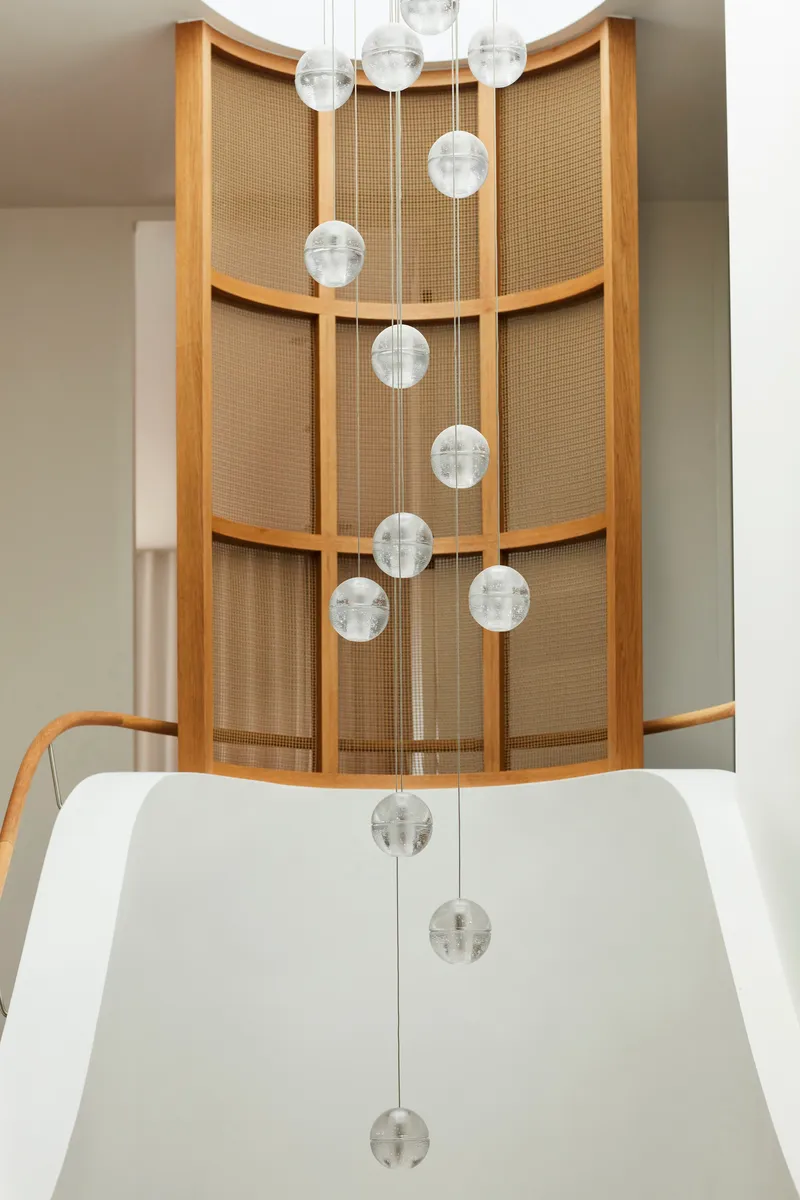
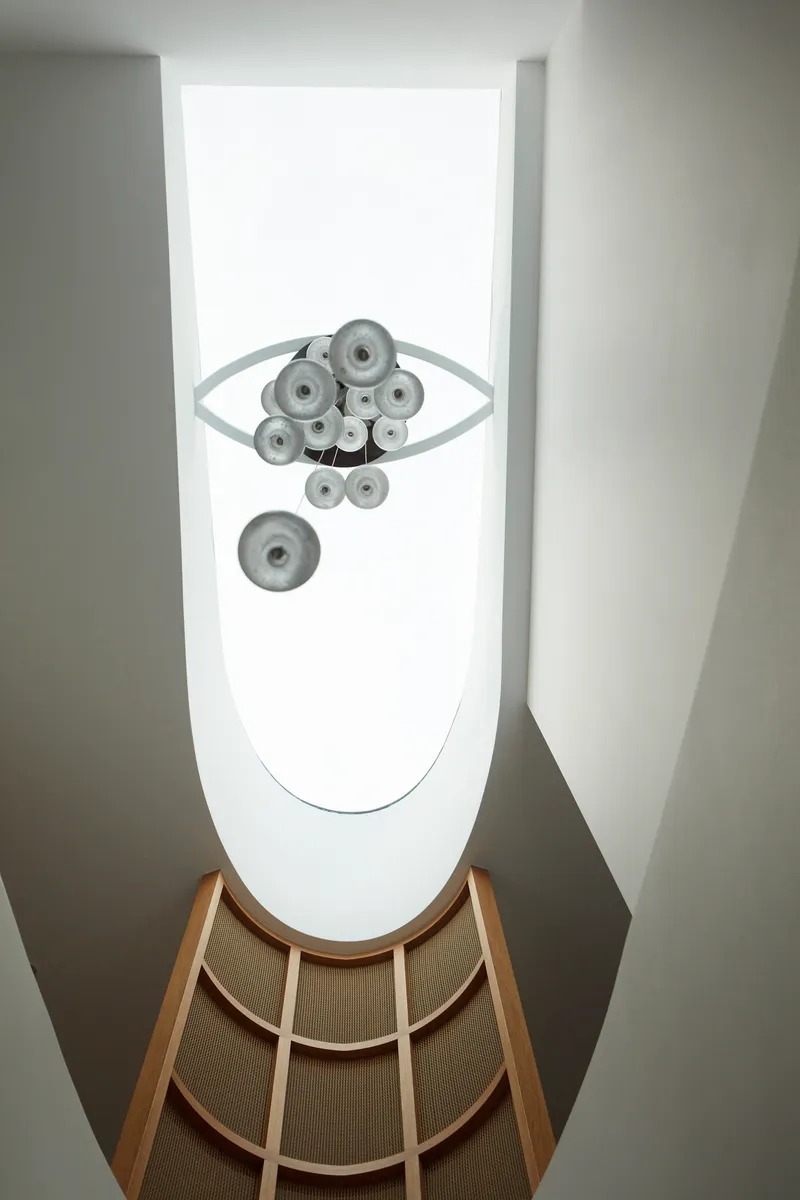
A large skylight crowns the stairwell, pouring daylight down through four storeys. The stair itself is a sculptural object: white-painted treads, a sinuous brass handrail, and curving walls clad in a warm terracotta finish. Glass sphere pendants cascade through the void, catching light at different heights and lending the vertical space a sense of ceremony without formality.
Oak-framed woven cane screens line portions of the balustrade, filtering views between levels and softening what could otherwise be a stark shaft. The stair is not just circulation; it is the device that organizes every floor plan and distributes natural light to the deepest rooms. In a house that descends into a hillside, keeping the interior luminous is a serious architectural problem, and Rosselli solves it here with generosity and spatial drama.
Living with the Harbor
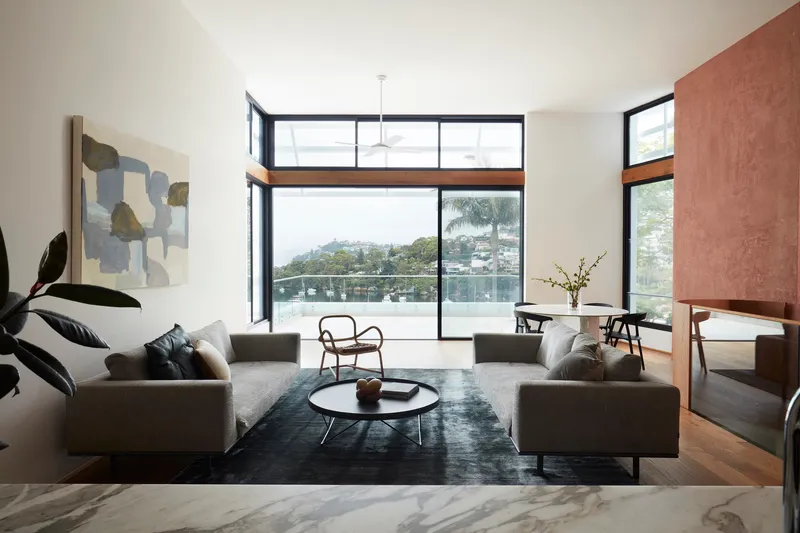

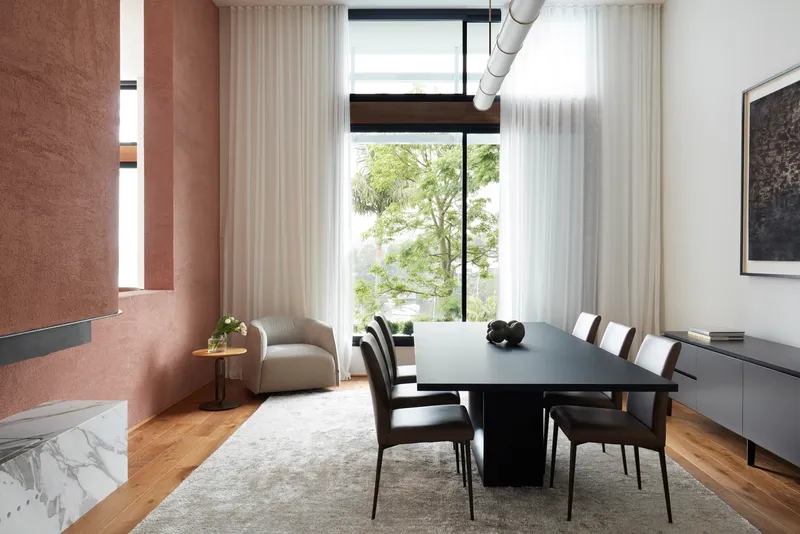
The main living level occupies the first descent from the street entry, placing the kitchen, dining, and living spaces at a height that optimizes views over the water. A cylindrical rammed earth column anchors the dining area, doubling as a structural element and a spatial landmark. Floor-to-ceiling glazing frames the harbor without the black-framed windows feeling overwrought; they are simple, thin, and they recede behind what they reveal.
Sheer curtains filter light from the garden-facing windows, giving the rammed earth fireplace wall a soft, diffused glow. The color palette throughout these rooms, muted earth tones against white plaster and warm timber, recalls the Casa Malaparte villa on Capri that Rosselli cites as an inspiration. It is a Mediterranean warmth transplanted to the sandstone edges of Sydney Harbour, and it works because the rammed earth provides an authentic material anchor rather than a purely aesthetic one.
Oak, Marble, and the Craft of the Interior
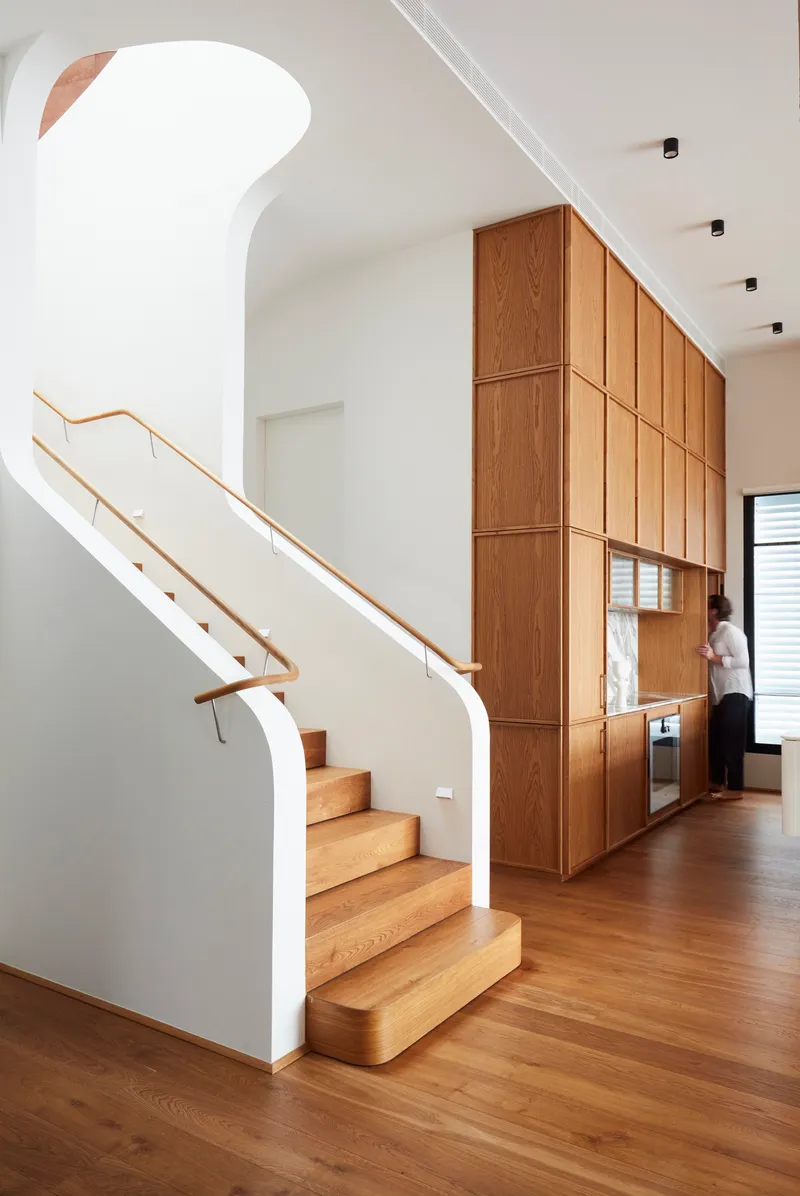


The joinery by Corelli Joinery deserves attention on its own terms. Full-height American White Oak cabinetry runs wall to wall in the kitchen, with integrated appliances disappearing behind the veneer. A marble backsplash, Vestri Silver Travertine from Granite & Marble Works, introduces a cooler mineral counterpoint to all that warmth. The effect is calibrated: rich but not opulent, detailed but not busy.
A cylindrical rammed earth fireplace with a marble hearth anchors the stair landing on one level, paired with the same oak cabinetry that defines the kitchen. The curved forms, the serpentine balustrade, the rounded mirrors at landings, recur throughout. Rosselli treats the curve not as an occasional gesture but as a discipline, and the consistency pays off in a house that feels continuous rather than assembled from competing ideas.
Intimate Rooms and Material Detail

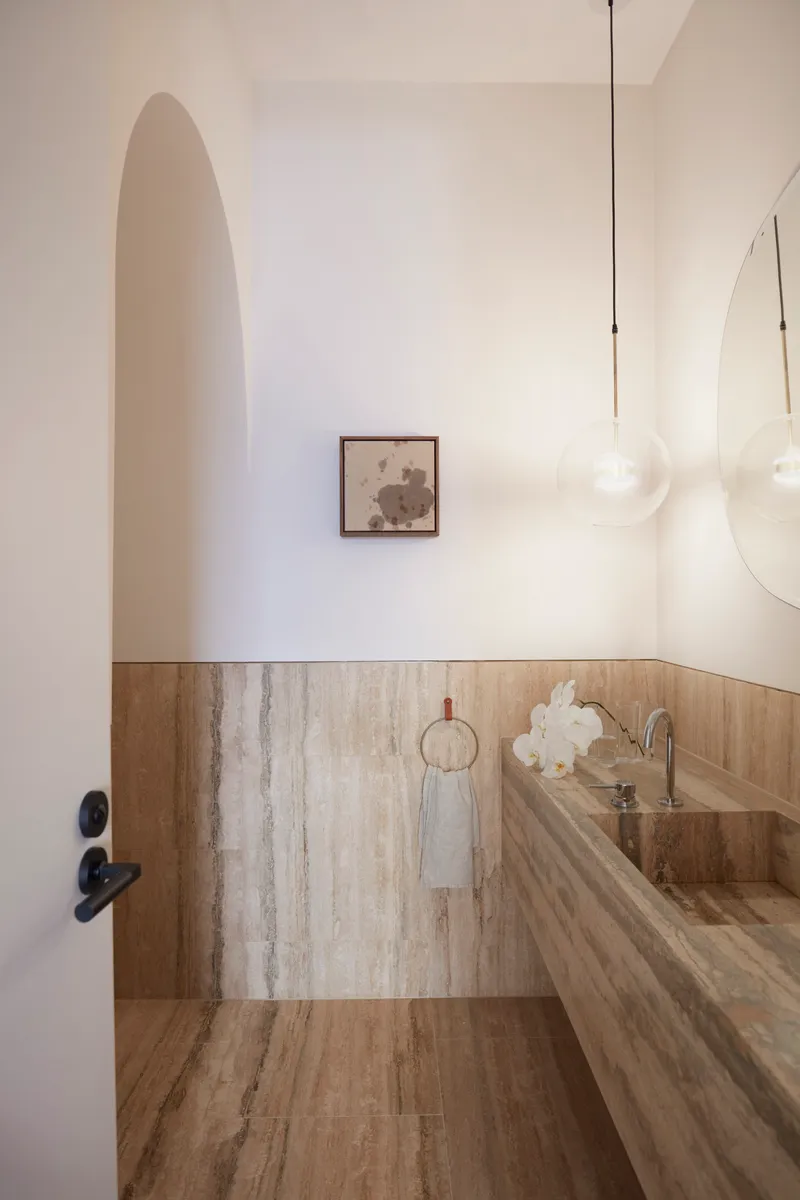
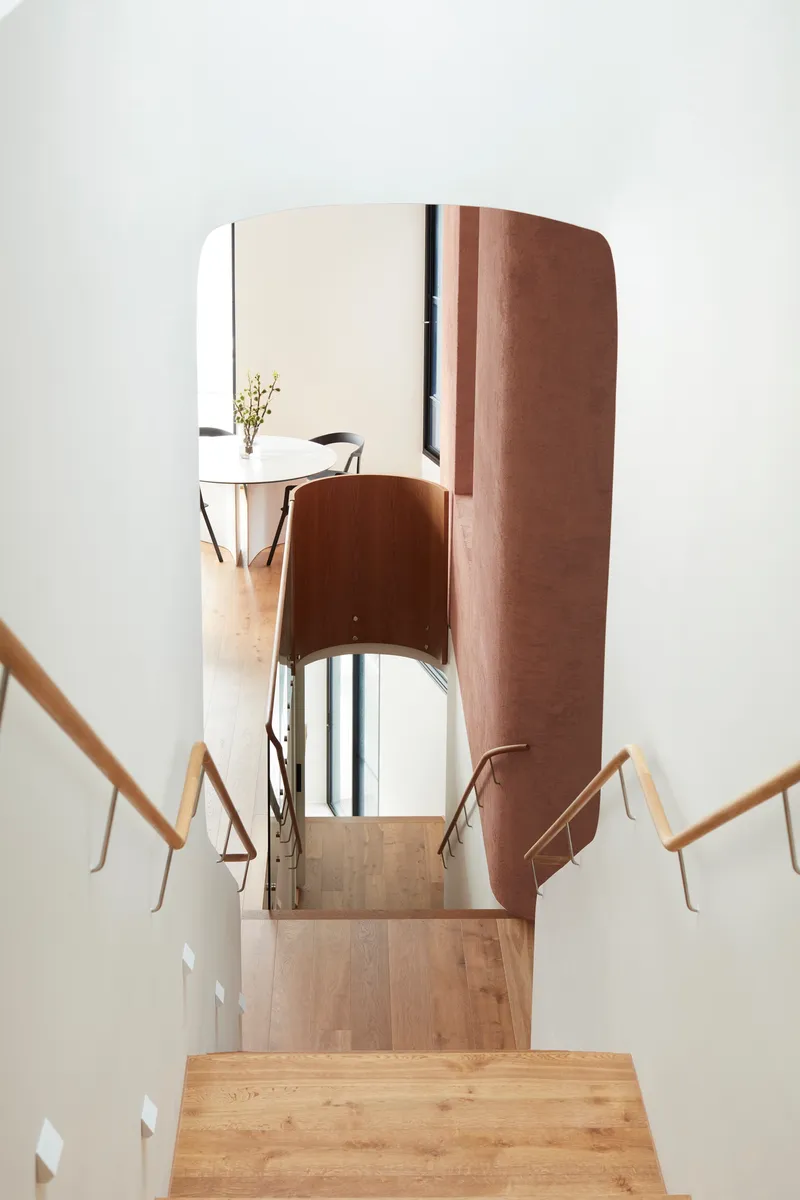
The smaller rooms carry the same material commitment as the public spaces. A bathroom on a lower level wraps rammed earth walls around a freestanding bathtub, with a curved window framing daylight in a way that makes the room feel less like a utility and more like a retreat. A powder room uses travertine wainscoting and an arched doorway, a small move that echoes the larger curved geometries elsewhere in the house.
Looking down the timber staircase from above, the curving terracotta-clad walls and the rounded mirror at the landing compress into a layered composition of material and geometry. These are not spaces designed to be photographed from a single vantage point; they reward movement, revealing new relationships between surfaces as you descend.
Terraces, Pool, and the Ship Metaphor
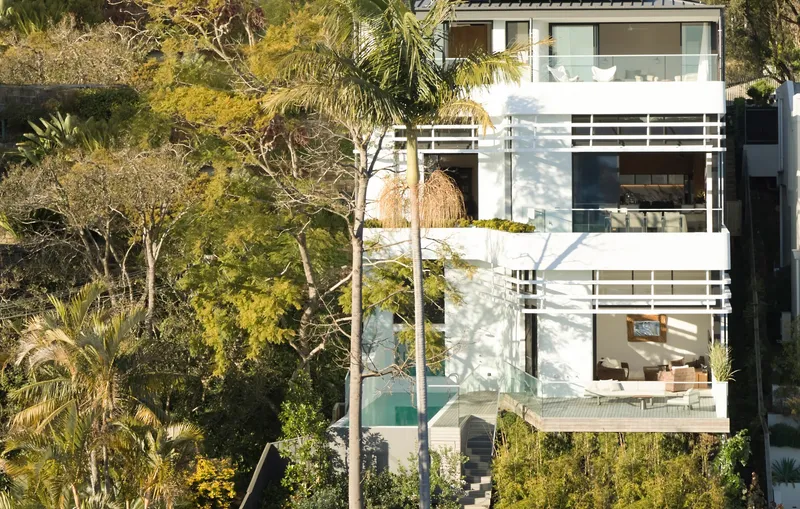
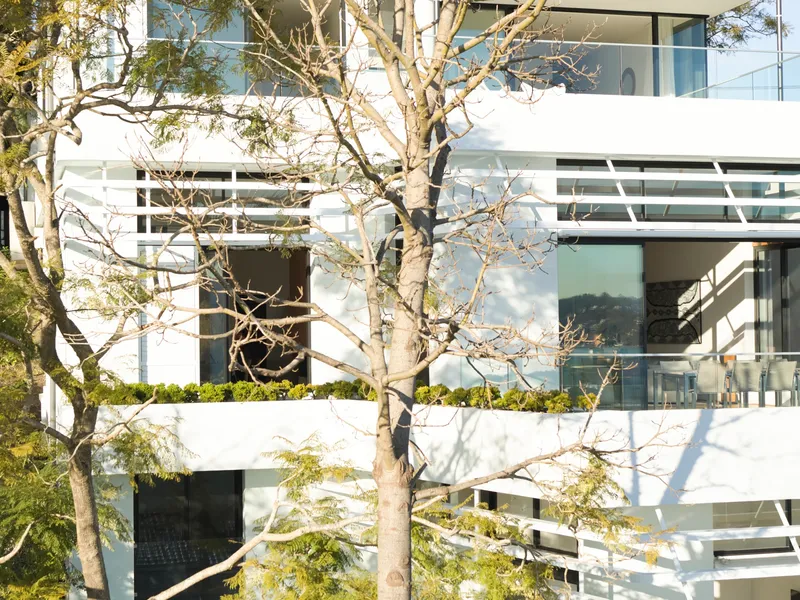

From the harbor side, Earth-Ship House earns its name. White stacked balconies with horizontal railings emerge from the hillside vegetation, looking for all the world like the decks of an ocean liner nudging through a canopy of mature trees. The nautical metaphor is legible without being cartoonish; the tiered profile is a natural consequence of stepping the building down the slope, and the railings reinforce the horizontal datum lines.
A curved perforated metal screen tower rises against the rammed earth wall on the uphill side, mediating between the solidity of the earth construction and the lightness of the harbor-facing decks. The landscape, designed by Will Dangar of Dangar Barin Smith, uses tall trees and dense planting to soften the ship-like appearance, ensuring the house never overwhelms its neighbours.


The courtyard pool sits on an elevated terrace with a glass balustrade, timber decking, and a tiled mural by L.A.R.T that adds an unexpected burst of figuration to the otherwise restrained palette. From above, the aerial view reveals how the rooftop pool and terraces nestle within the tree canopy, reading as a clearing in the forest rather than an imposition on it. The landscape strategy is critical: without the mature trees pressing in on all sides, the terraces would look exposed and the ship metaphor would become uncomfortably literal.
Plans and Drawings
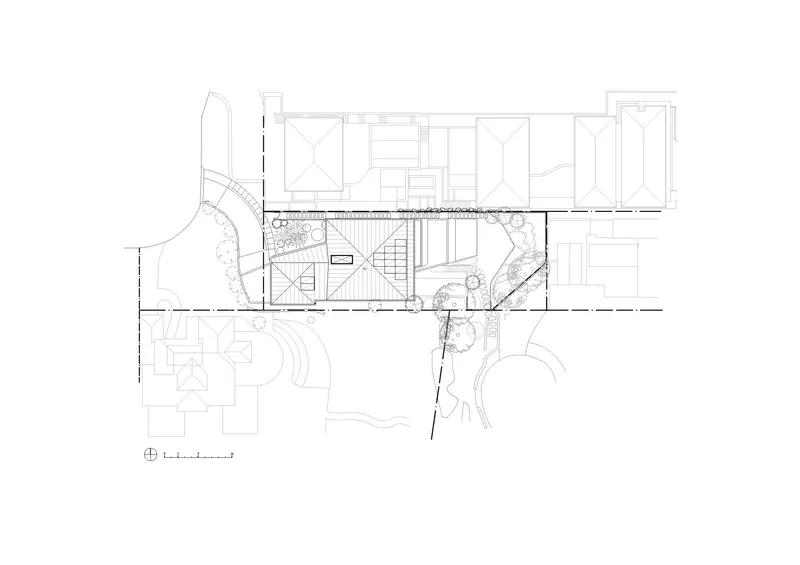


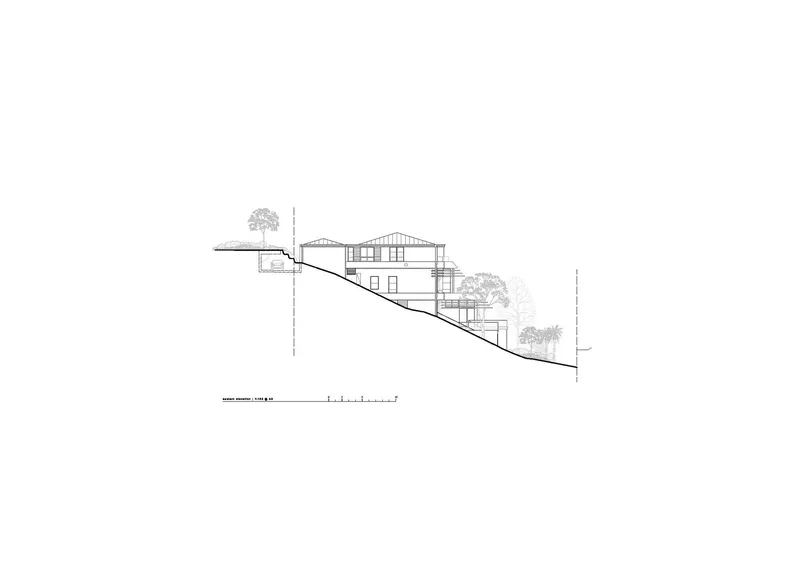


The floor plans confirm what the experience suggests: the central staircase is the organizing element, with flanking planted courtyards on the upper levels and rooms arranged along a linear corridor as you descend. The section drawings are the most revealing documents here, showing three and four levels stepping down the steep hillside with a clarity that photographs cannot quite communicate. The gradient is severe; the original pole house was essentially a platform suspended over a cliff. Rosselli's intervention fills that void with inhabitable space, and the sections show how each level gains its own relationship to the ground, from the paved courtyard at the top to the garden rooms at the base.
The street elevation drawing places Earth-Ship House in context between its neighbours, and the restraint of the entry facade becomes apparent. From the road, you see a modest rammed earth wall and a palm tree. The drama is all below and behind, cascading toward the water. It is an effective piece of urban manners: the house gives almost nothing away from the public realm.
Why This Project Matters
Earth-Ship House is a case study in adaptive reuse applied to the domestic scale. Rather than demolishing an existing structure and starting fresh, Luigi Rosselli kept the original two storeys and built down, literally grounding a building that had been floating above its site for decades. The rammed earth construction is not a sustainability badge but a structural and philosophical choice: it connects the house to the terrain it occupies, giving it a mass and permanence that pole houses, by definition, lack. The 2023 Mosman Design Awards People's Choice recognition suggests the neighbours agree.
More broadly, the project challenges the assumption that waterfront houses on steep sites must be lightweight, cantilevered, or transparent. Rosselli proposes the opposite: a heavy, earthen building that descends into the rock and arrives at the garden on its own terms. The nautical imagery of the terraces provides levity, but the real story is in the ground. Bringing a house down to earth, on a site this precipitous, turns out to be the most radical move available.
Earth-Ship House by Luigi Rosselli Architects, located in Mosman, Australia. Completed in 2022. Photography by Prue Ruscoe. Landscape architecture by Will Dangar of Dangar Barin Smith. Builder: TC Build. Rammed earth construction: Earth Dwellings Australia.
About the Studio
Share Your Own Work on uni.xyz
If projects like this are the kind of work you want to make, uni.xyz is a place to publish your own, find collaborators, and enter design competitions.


Popular Articles
Popular articles from the community


Opera by the Sea Estonia: Three Shells Dissolving Architecture into Tallinn's Coastline
A winning opera house proposal replaces monumental form with interconnected shells that blur the boundary between building, park and Baltic Sea.

Manzana Morphosis: Stretching Barcelona's Grid into a Living Landscape for 2050
A radical reworking of the Eixample manzana turns density into a tool for generous public space, vertical ecology, and environmental performance.
Opera on the Sea: Driftwood Logic Shapes a Timber Opera House on Estonia's Coast
Trevor Orgill's opera house translates the entangled drift of floating timber into a civic building where wood, water, and music converge.
Tsunami Convergenics: Turning Catastrophic Ocean Forces into Underwater Housing Infrastructure
A speculative underwater settlement off the coast of Onagawa, Japan, treats tsunamis and typhoons as energy sources rather than threats.

Similar Reads
You might also enjoy these articles

Pixel Gardens: One Repeated Module Stacked Into a Terraced Social Housing Tower for Famagusta
Salem Bader's shortlisted housing tower builds a vertical neighbourhood from one repeated module, offsetting units to carve terraces, light and air.

Bao Huynh Watercolor Atelier: A Serene Art Retreat in Hội An
Bao Huynh Watercolor Atelier in Hội An blends multifunctional art spaces, sustainable design, local materials, and family-friendly living in a serene environment.

Atelier Macri Concept Store Interior Design by CASE-REAL
Atelier Macri store features a "ko" counter, walnut wood details, cork displays, blending retail, gallery, and seamless customer experiences.

Manuel Vargas Izquierdo Stadium and High-Performance Sports Center: Architectural Excellence in Jalpa de Méndez
The Manuel Vargas Izquierdo Stadium blends sustainable design, inclusive sports facilities, and cultural-inspired architecture, revitalizing Jalpa de Méndez’s public spaces.

Explore Space Shipyard Competitions
Discover active competitions in this discipline

Challenge to design mud housing for contemporary communities

Design challenge to reuse E-waste
Comments (0)
Please login or sign up to add comments
No comments yet. Be the first to comment!