

Jorge Garibay Arquitectos Carves Two Concrete Volumes That Never Touch in Querétaro
Lujambio House in Juriquilla deploys board-formed concrete and timber to stage a taut dialogue between solid and void.


There is something quietly radical about a house built around the principle of separation. At Lujambio House, Jorge Garibay Arquitectos positions two abstract concrete volumes so they approach each other, repeat each other's proportions, and yet never make contact. The gap between them is not leftover space; it is the organizing logic of the entire 452-square-meter residence in Juriquilla, a residential suburb north of Querétaro, Mexico. Into that gap the architects pour light, water, a young tree, and the daily life of a family.
What makes the project genuinely compelling is how it treats brutalist mass with a warmth that feels specifically Mexican. Board-formed concrete, tinted to a rose-gray hue and scored with horizontal striations, forms the primary structure. But nearly every interior surface is lined with timber paneling, turning what could be an austere monolith into something inviting and tactile. The tension between those two conditions, monolithic outside and warm inside, drives every design decision in the house.
The Courtyard as Connective Tissue
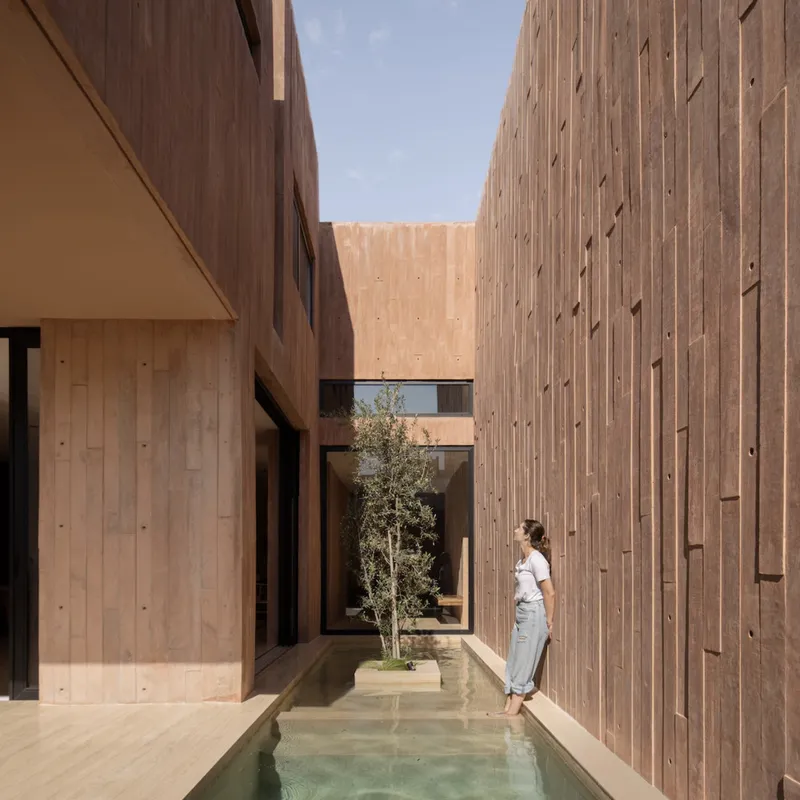
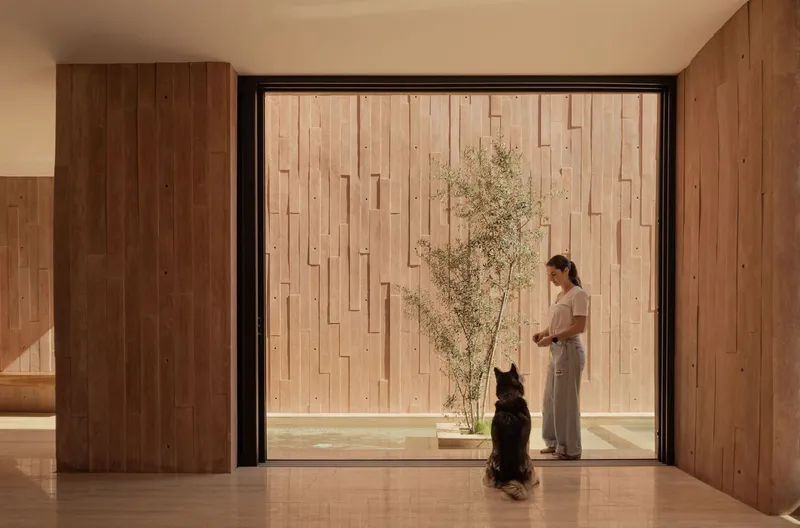
The two volumes frame an L-shaped courtyard organized around a shallow pool and a single young tree. It is the first thing you encounter upon entering: a hallway that terminates not in a room but in open sky, water, and greenery. The courtyard does double duty as a climate device and a spatial anchor, pulling cross-ventilation through the house while giving every major room a curated view inward rather than toward the street.
At dusk the pool becomes reflective, doubling the concrete walls and timber screens in its surface. The effect is that the void between the volumes reads as deeper and more spacious than its actual footprint suggests. It is a classic courtyard-house move, but the precision of the proportions and the restraint of the planting keep it from feeling generic.
Timber Corridors That Frame the Approach
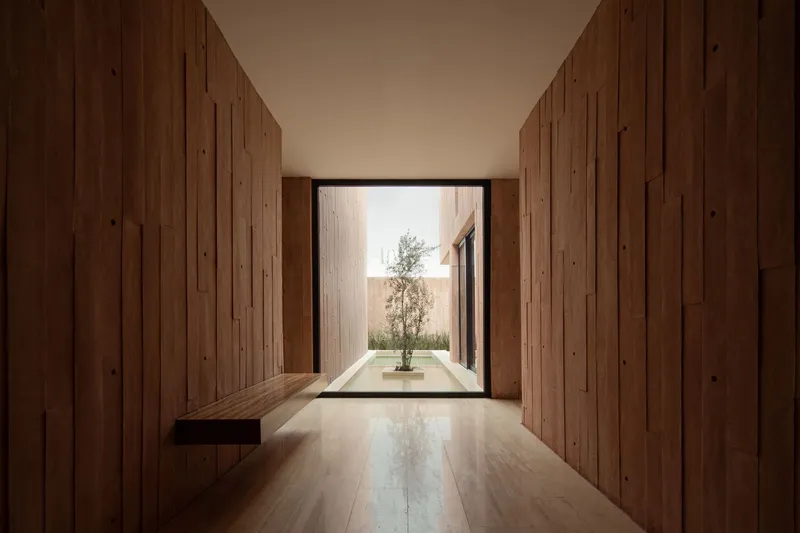
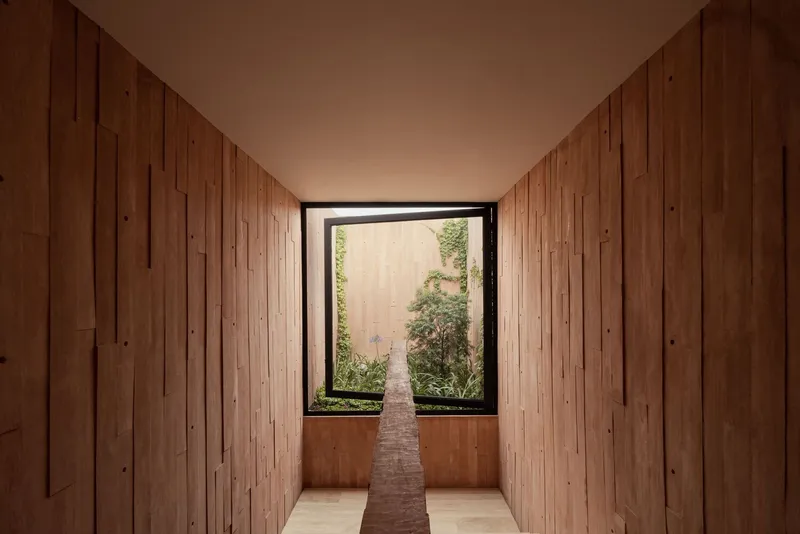
The house's circulation corridors function as compression chambers. Narrow, timber-lined, and dimly lit, they funnel your gaze toward a single glazed opening at the far end. The technique is cinematic: you see the planted garden or the courtyard tree long before you reach it, and the passage amplifies the release of stepping into the open volume beyond.
Notice how the timber cladding runs floor to ceiling and wall to wall in these passages, erasing material transitions and creating a continuous warm envelope. The wood grain itself introduces a fine-grained texture that contrasts with the coarse horizontal striations of the concrete exterior, reinforcing the distinction between inside and outside.
Living Spaces That Dissolve the Threshold
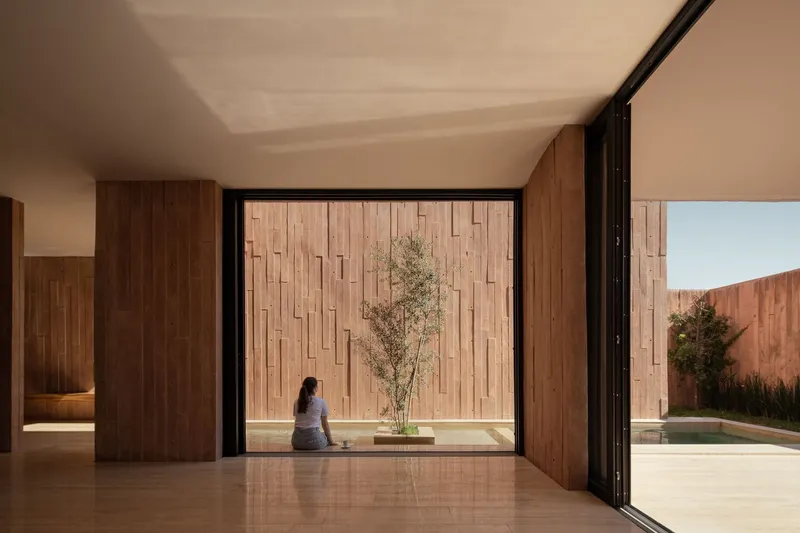
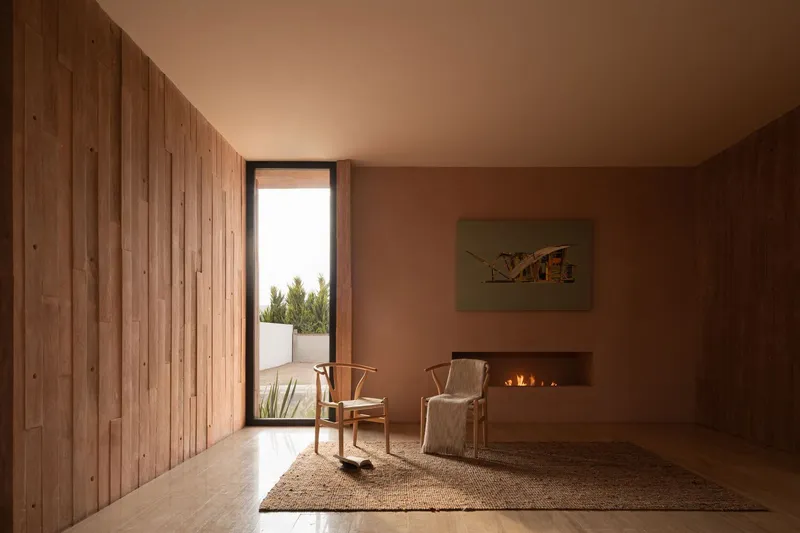
The open-plan living and dining area on the ground floor is where the house's geometry pays off most clearly. Floor-to-ceiling glazing on two sides folds the courtyard into the room, and the concrete ceiling slab extends beyond the glass line to form an overhang that shades the interior from direct sun. The result is a living room that feels genuinely outdoor without suffering from glare or heat gain.
A recessed fireplace set into a vertical timber wall anchors one end of the room, while the opposite wall opens fully to a planted terrace. The material palette stays deliberately tight: timber, concrete, glass, and a few pieces of dark-toned furniture. There is no moment where the architecture competes with the view it has so carefully constructed. The restraint is the point.
Light as the Final Material
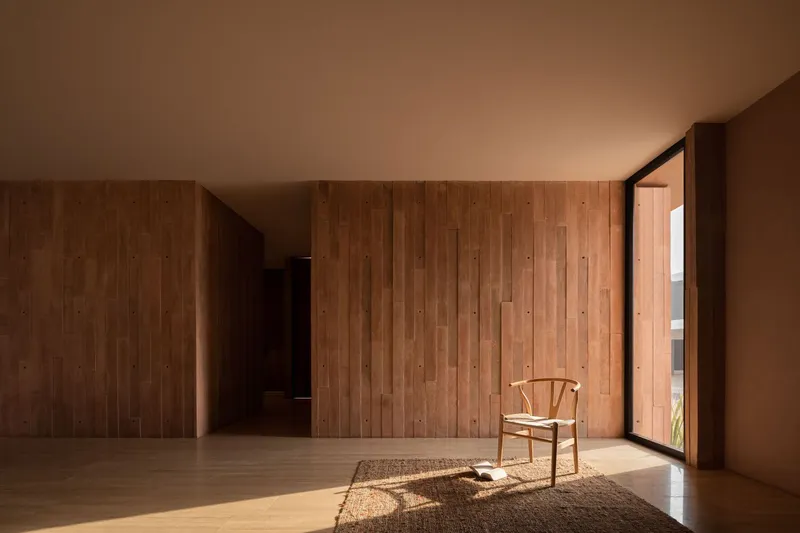
A single chair on a woven rug, caught in a parallelogram of afternoon sun: this is the image that reveals how carefully Garibay has calibrated the openings. The house uses a limited number of large, precisely placed windows rather than continuous glazing. Each one is sized and oriented to admit a specific quality of light at a specific time of day. The large square window at the stair landing, for instance, frames a garden view while pouring a column of light down the double-height volume.
The strategy avoids the common trap of glass houses that overheat or feel exposed. By alternating between solid concrete walls and generous openings, the architects create a rhythm of brightness and shadow that changes as you move through the house. Privacy, light control, and thermal comfort are resolved with one move rather than three.
Why This Project Matters
Lujambio House succeeds because it refuses to choose between brutalist discipline and domestic warmth. The board-formed concrete reads as honest, weighty, and rooted in Mexican building traditions, while the timber interiors and courtyard landscape make the house generous and inviting. That both conditions coexist without compromise is the real achievement here.
At a moment when residential architecture often oscillates between slick minimalism and performative complexity, Garibay's approach is refreshingly direct. Two volumes, three materials, one courtyard. The geometry is strict, the palette is limited, and the spatial experience is rich precisely because nothing is competing for attention. It is proof that constraint, not addition, remains the most powerful tool an architect has.
Lujambio House by Jorge Garibay Arquitectos, Juriquilla, Querétaro, Mexico. 452 m². Photography by César Belio.
About the Studio
Share Your Own Work on uni.xyz
If projects like this are the kind of work you want to make, uni.xyz is a place to publish your own, find collaborators, and enter design competitions.


Popular Articles
Popular articles from the community


longwave studio Reorganizes a 112 m² Tainan Apartment Around the Daily Routines of a Family and Two Cats
In Tainan, Taiwan, birch plywood, rust-red furniture and a freestanding plaster wall link arrival, storage, work and family life in one apartment.

LT2A and OPEN Architectes Thread a Brick and Glass High School Through a Wooded Belgian Campus
In Braine-l'Alleud, a 3,000 m² wing for Collège Cardinal Mercier pairs pale brick with a glazed colonnade, deferring to a small chapel and a dense wood.

Jaramillo Van Sluys Arquitectura and Urbanismo Turn a Demolished Registry Lot in Quito into an Orchard Plaza
In Quito's Centro Histórico, a 2,800 m² plaza exposes the San Agustín convent wall and redraws its lost Augustinian orchard in volcanic stone.

Architekt Andreas Gruber Scatters 23 Dark Timber Chalets Across a South Tyrolean Forest Edge
In Molini di Tures, Amonti Chalets breaks a resort into a hamlet of gabled timber houses, with parking, storage and services pushed into the slope.

Similar Reads
You might also enjoy these articles


Hodi-Mandai Geram
Project Function: Preservation and revitalization of the Intangible heritage and socio-spatial identity of the Hodi by Housing, Cultural Memory Center, Sacred Grove, landscape, local tourism economy


Olio Towers: A Mid-Rise for Performers That Fuses Housing, Rehearsal, and Stage
Located blocks from Houston's Theater District, this modular tower stacks living units around a central performance atrium.

Oasis: Modular Green Housing Carved into Dhaka's Urban Fabric
A shortlisted Plugin Housing entry reclaims unauthorized settlements in Dhaka with stepped concrete volumes, green roofs, and ventilation-driven design.

Black Hole: A Floating Megastructure for the Post-Physical Era
Emiliano Mazzarotto envisions a spherical, self-scaling arena where e-sports, digital hotels, and holographic stadiums replace traditional public space.

Explore Mexican Design Competitions
Discover active competitions in this discipline

Challenge to reimagine the Iron Throne

Photograph architecture without architects

Illustrate the lost glory of Angkor Wat - Render Challenge

Design challenge to reuse E-waste
Comments (0)
Please login or sign up to add comments
No comments yet. Be the first to comment!