

Lukkaroinen Architects Build a School That Doubles as Kerava's Living Room
A geothermally heated timber and brick campus for 1,000 students opens its doors to an entire Finnish river valley community.


Schools in Finland carry a heavier civic load than the word "school" typically implies. They host community events, shelter after-hours recreation, and serve as the social nucleus of small cities. The Keravanjoki Multifunctional Building, completed in 2021 by Lukkaroinen Architects, takes that expectation seriously: 11,100 square meters of concrete, light brick, and timber cladding organized around a central lobby that can shift from student restaurant to public auditorium within a single afternoon.
What makes the project worth studying is not its size but the precision of its adaptability. Nearly every major space in the building, from the dining hall to the sports hall to the four learning-area lobbies, is designed to reconfigure for different users, different hours of the day, and different decades of the building's life. Lukkaroinen didn't simply add a gymnasium to a school. They treated programmatic flexibility as the organizing principle of the plan, the section, and the facade.
A Civic Face in Brick and Timber

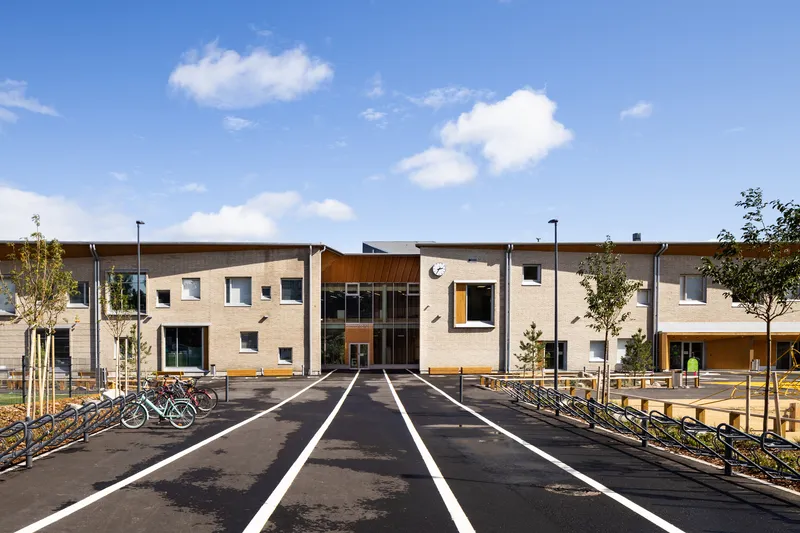

The building reads as two materials in dialogue. Cream-colored brick volumes anchor the corners, conveying permanence, while sweeping curves of vertical timber cladding wrap the entry zone and link the masses together. The effect is neither austere nor flashy. It simply reads as a public building that belongs on this site, which sits in the scenic Kerava River Valley. The curved timber section is generous enough to register from a distance, giving the school a recognizable identity without resorting to formal gymnastics.
At ground level, a glass entry vestibule mediates between the two cladding systems, inviting visitors into a space that feels like a threshold rather than a barrier. Wooden benches outside and armchairs inside signal that this is a place to linger. The building is accessible from three directions, which means it has no single "front door" hierarchy. That porosity is deliberate: a school that also serves the public cannot funnel everyone through one chokepoint.
The Dining Hall as Democratic Core


The double-height dining hall sits at the heart of the plan, and it is the most spatially ambitious room in the building. Timber columns rise through the volume, supporting a slatted ceiling punctuated by skylights that pull natural light deep into the center of the floor plate. White tables scatter across the polished concrete floor, but the room is clearly built to accommodate far more than lunch. This is the space Lukkaroinen calls the main lobby, and it transforms into the stage for school events, community gatherings, and exhibitions.
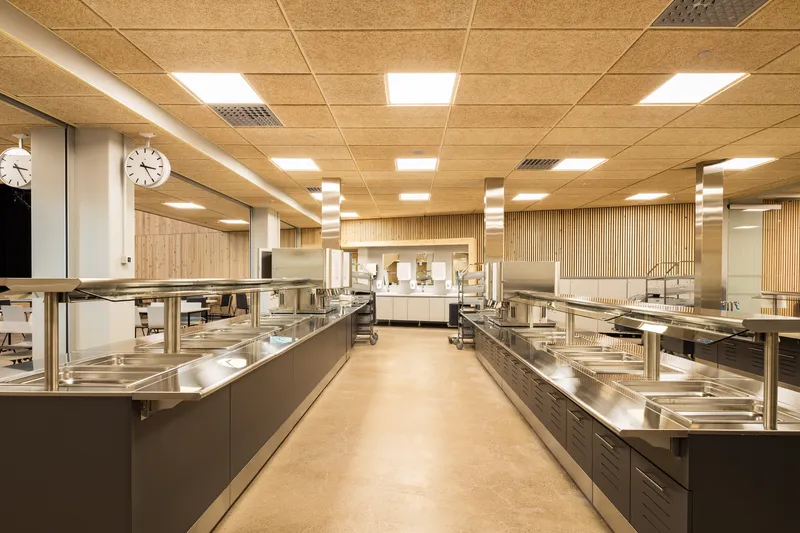
Adjacent to it is the "Höntsäsali," a multipurpose hall with retractable auditorium seating. Between these two rooms, the building can host formal presentations and casual dinners simultaneously or combine the two into a single large venue. The commercial kitchen behind glass sneeze guards handles the logistics of feeding nearly a thousand students daily while also serving catered events.
Learning Zones That Refuse to Be Static


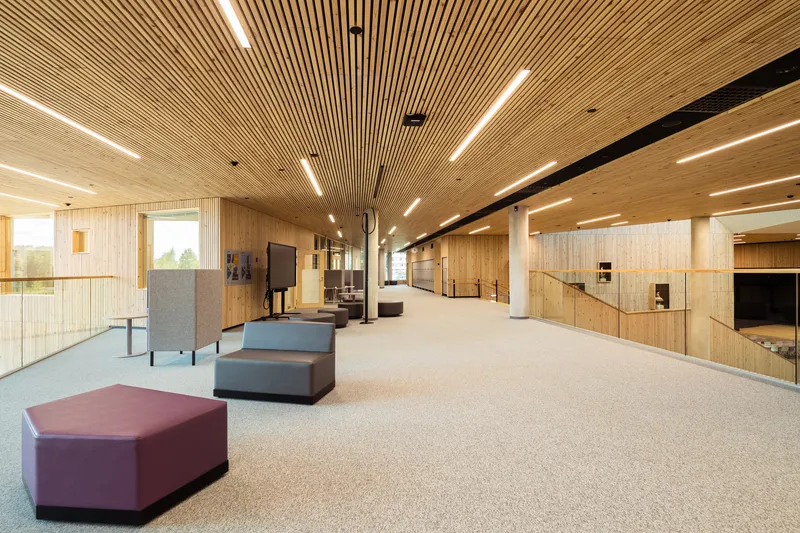
The square plan is divided into four learning areas, each organized around its own multipurpose cellular lobby. Classrooms ring the perimeter, while small group rooms and breakout spaces fill the interstitial zones. The classrooms themselves are straightforward: white tables, generous glazing to the landscape, and timber-framed partitions that allow visual connection between rooms. Nothing heroic, but everything is tuned for the three modes the school is designed to support: quiet focused work, group collaboration, and self-directed learning.
The breakout spaces are more playful. House-shaped acoustic booths sit against vertical slatted walls, offering students defined pockets of privacy without closing them off from the corridor. Modular soft seating in corridors provides overflow capacity for collaborative moments. Pale locker banks line the walls without dominating the visual field. The cumulative impression is of a building that trusts its occupants to find the right space for the right task.
A Timber Ceiling as Unifying Thread
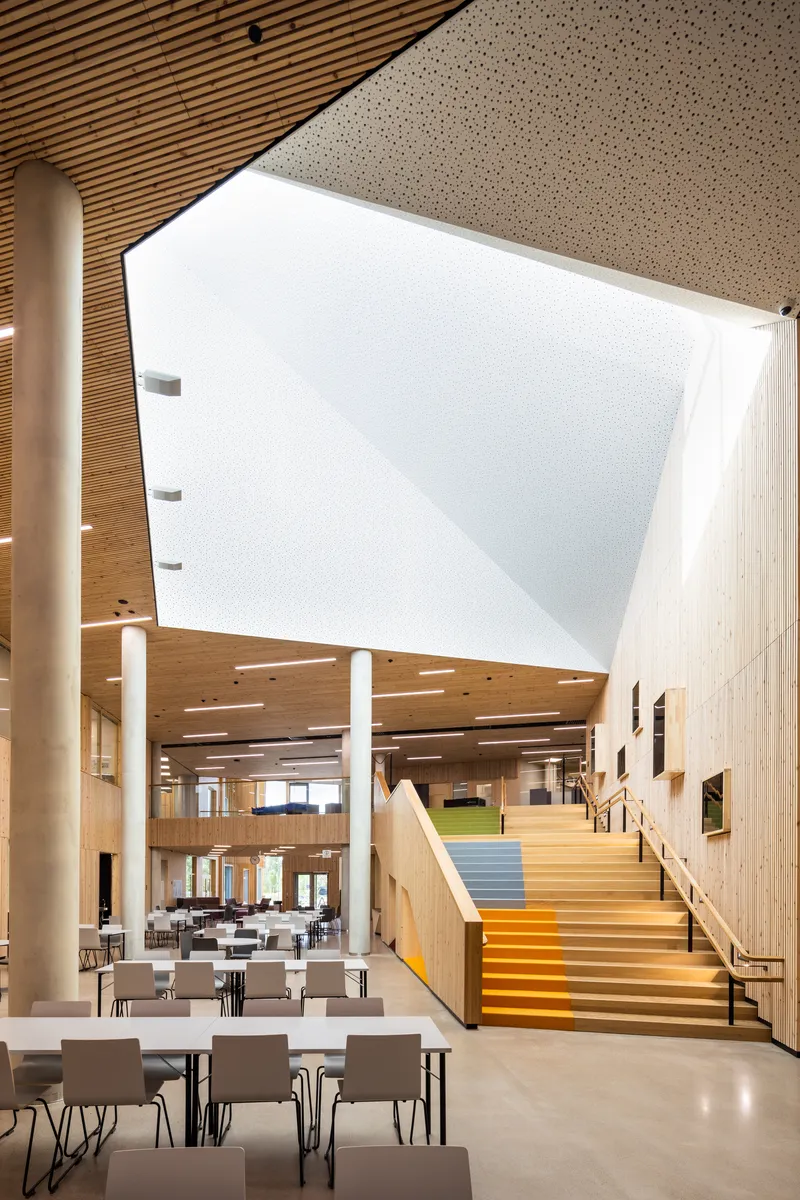
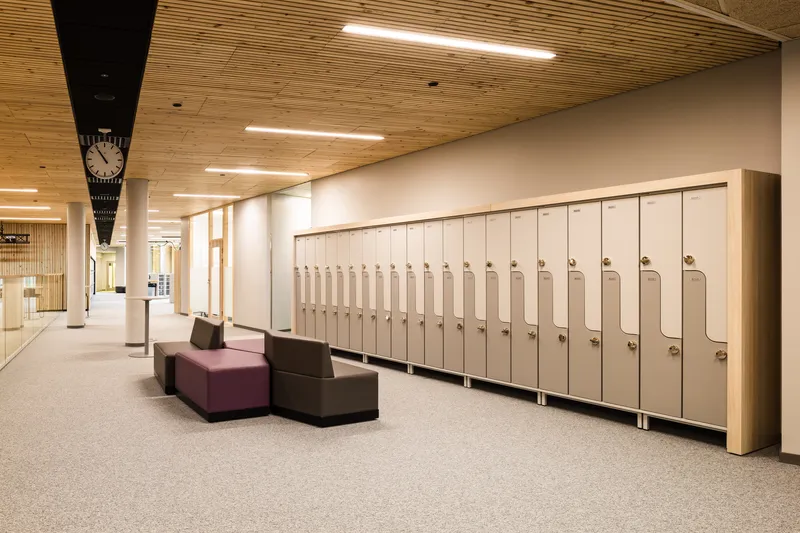
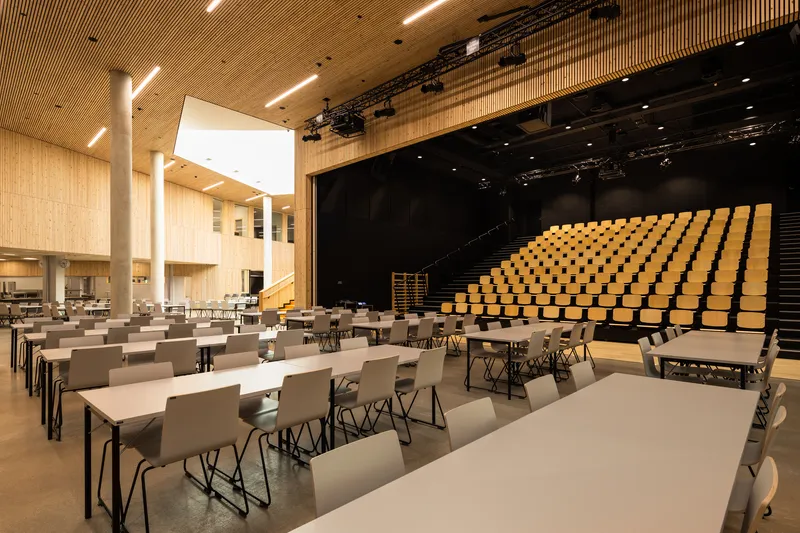
Strip wood cladding runs across ceilings and walls in nearly every interior space: the atrium, the corridors, the multipurpose hall. It is the material that stitches the building's diverse programs into a coherent interior experience. In the central atrium, the timber staircase and slatted ceiling work together beneath an angled white skylight, creating a moment of genuine warmth in what could easily be a utilitarian circulation space.
The multipurpose hall with retractable seating uses the same slatted ceiling language, but here the skylights are wider and the room's proportions shift to accommodate performances and assemblies. The consistency of the timber palette means students and visitors read these different rooms as belonging to the same family, even when their functions diverge sharply.
Sports and Landscape as Shared Infrastructure


The aerial views reveal a campus strategy that extends well beyond the building footprint. Sports fields occupy the north side, bounded by a noise wall that shields them from the adjacent motorway. Courtyards and playgrounds cluster on the west side, protected from road noise and oriented toward the river valley. The sports field is open to all Kerava residents, not just students, reinforcing the building's public mandate.
Inside, a full sports hall with retractable basketball hoops and a marked floor handles formal athletics. Timber wainscoting below the exposed mechanical ceiling keeps the room visually connected to the rest of the school while acknowledging the ceiling's pragmatic demands. The roofscape itself is productive: a solar power plant generates electricity for the pumps that run the geothermal heating system, which draws from 22 wells drilled more than 300 meters into a nearby meadow. The energy strategy is invisible but consequential.
Courtyard Landscapes and Microclimate
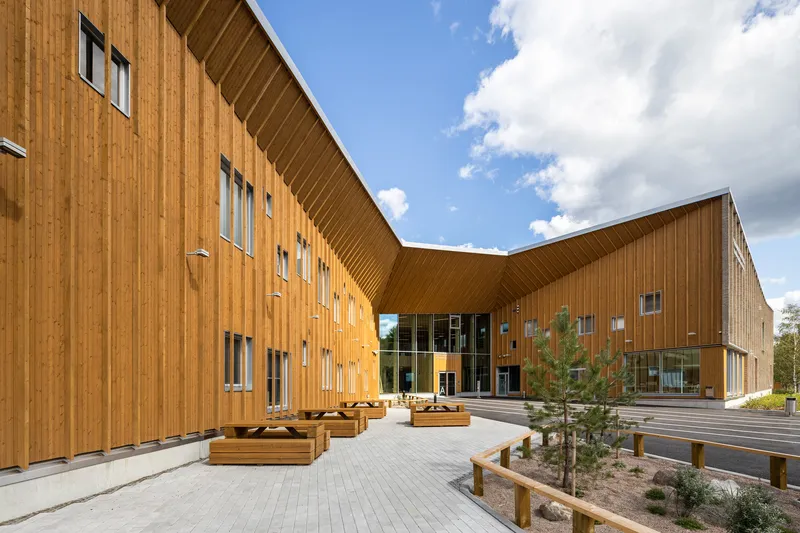

The courtyard elevations reveal the folded soffit where timber cladding meets the underside of projecting volumes, creating sheltered zones at the building's edge. Planted beds and young pines introduce greenery into what are essentially outdoor rooms for students. These courtyards will become more enclosed and shaded as the plantings mature, which gives the campus a built-in trajectory of change over the coming decades. Lukkaroinen clearly designed with time in mind, not just the delivery date.
Plans and Drawings
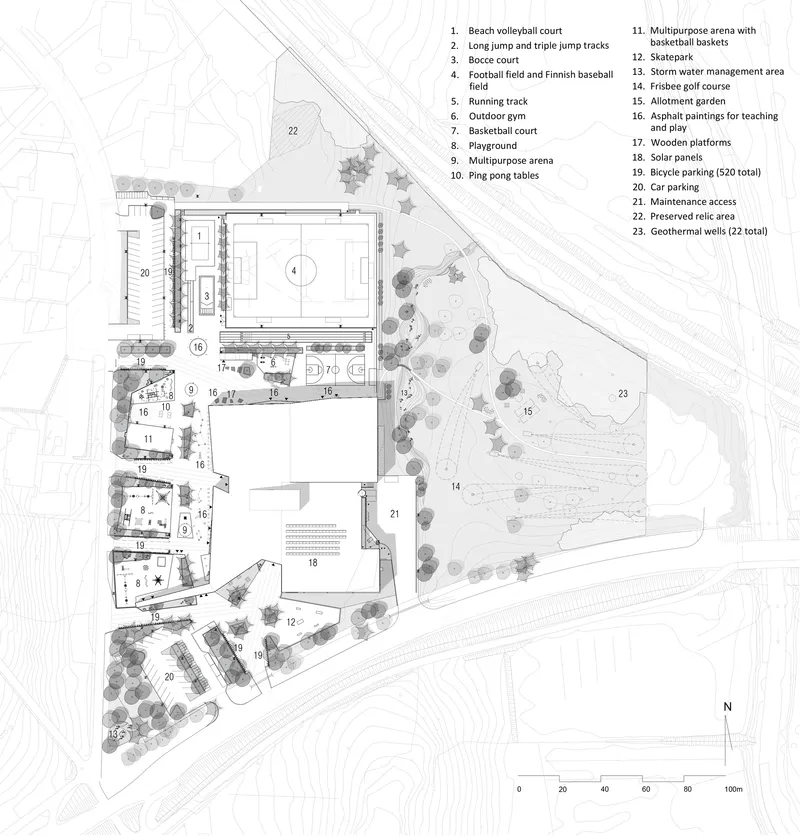

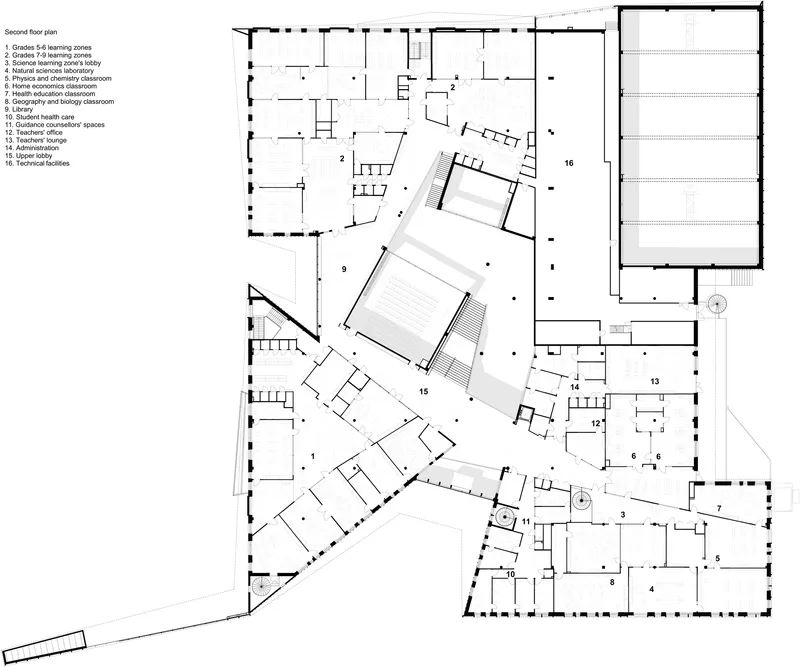

The site plan makes the noise-mitigation strategy legible: the sports courts buffer the building from the motorway to the east, while tree planting reinforces the acoustic barrier along the river edge. The first and second floor plans show how the four learning zones are distributed symmetrically around the central lobby, with the gymnasium and multipurpose hall forming a distinct wing. The exploded axonometric is particularly instructive, pulling the three floor levels apart to reveal how the central atrium space stitches all levels together vertically.
What the drawings make clear is that the compact massing is not a constraint but a strategy. By keeping the footprint tight and the plan square, Lukkaroinen minimized circulation distances and maximized the ratio of usable program to corridor space. The angular circulation paths visible in the floor plans avoid the institutional monotony of double-loaded corridors while still delivering efficient wayfinding.
Why This Project Matters
The Keravanjoki Multifunctional Building replaces two demolished school buildings with a single structure that serves a broader mandate. It is a comprehensive school for nearly a thousand pupils and a civic center for a Finnish river valley community, and it handles both roles without architectural schizophrenia. The key move is treating flexibility not as an afterthought, with a few moveable partitions, but as the generative logic of the plan. Every major room is designed to do more than one thing, and the building's energy systems are calibrated for a lifespan far longer than most schools expect.
In a moment when many municipalities are building schools that will need renovation within fifteen years, Lukkaroinen's approach offers a more durable model. The geothermal wells, the solar canopy, the adaptable interiors, and the landscape strategy that improves with age: these are not gestures of sustainability branding. They are decisions that reduce long-term cost and increase long-term relevance. The building is not trying to impress. It is trying to last, and to be useful for people who have not yet been born. That ambition is more radical than it sounds.
Keravanjoki Multifunctional Building by Lukkaroinen Architects, Kerava, Finland. 11,100 m², completed 2021. Photography by Aukusti Heinonen and Jarkko Översti.
About the Studio
Share Your Own Work on uni.xyz
If projects like this are the kind of work you want to make, uni.xyz is a place to publish your own, find collaborators, and enter design competitions.


Popular Articles
Popular articles from the community


Faces of the Soviet Avant-Garde: Turning Moscow's Street Names into an Open-Air Museum
A network of sculptural installations across a Moscow residential district transforms forgotten architect names into spatial encounters with cultural memor
Opera by the Sea Estonia: Three Shells Dissolving Architecture into Tallinn's Coastline
A winning opera house proposal replaces monumental form with interconnected shells that blur the boundary between building, park and Baltic Sea.

Singing Woman: An Opera House That Performs Before the Curtain Rises
Ovidiu Cristian Pavel's conceptual opera house translates Estonia's choral identity into a sculpted waterfront landmark facing the Baltic Sea.
Cloaked Colonization: A Mobile Underwater Habitat That Moves Like a Fish
Micah Abaya's shortlisted EHC Pacific entry reimagines ocean settlement as a dispersed network of self-sustaining architectural organisms.

Similar Reads
You might also enjoy these articles

Pixel Gardens: One Repeated Module Stacked Into a Terraced Social Housing Tower for Famagusta
Salem Bader's shortlisted housing tower builds a vertical neighbourhood from one repeated module, offsetting units to carve terraces, light and air.

Bao Huynh Watercolor Atelier: A Serene Art Retreat in Hội An
Bao Huynh Watercolor Atelier in Hội An blends multifunctional art spaces, sustainable design, local materials, and family-friendly living in a serene environment.

Atelier Macri Concept Store Interior Design by CASE-REAL
Atelier Macri store features a "ko" counter, walnut wood details, cork displays, blending retail, gallery, and seamless customer experiences.

Manuel Vargas Izquierdo Stadium and High-Performance Sports Center: Architectural Excellence in Jalpa de Méndez
The Manuel Vargas Izquierdo Stadium blends sustainable design, inclusive sports facilities, and cultural-inspired architecture, revitalizing Jalpa de Méndez’s public spaces.

Explore Multi-Functional Competitions
Discover active competitions in this discipline

Challenge to reimagine the Iron Throne

Photograph architecture without architects

Illustrate the lost glory of Angkor Wat - Render Challenge

Design challenge to reuse E-waste
Comments (0)
Please login or sign up to add comments
No comments yet. Be the first to comment!