
TRIPTYQUE Revives Villeurbanne's Industrial Logic with a Three-Volume Productive City Block
The M45 Building in Lyon's Mansart district splits 5,000 square meters into reversible workshops and offices linked by open walkways.


Villeurbanne's Mansart district has always been a place where things get made. Warehouses, workshops, and production sheds define its grain, a satellite city northeast of Lyon that never fully shed its industrial DNA. The M45 Building by TRIPTYQUE does not attempt to override that character. Instead, it absorbs it: three concrete volumes organized around courtyards, housing artisan workshops at the base and flexible office space above, all connected by external steel walkways that double as emergency circulation. The result is a 5,000 square meter block that reads as both new and deeply familiar to its surroundings.
What makes M45 genuinely interesting is its refusal to perform novelty. The concept of the "Productive City," where commercial, craft, and office functions coexist in a single structure, has been discussed in European urbanism for years. Few projects deliver on it with this level of architectural restraint. TRIPTYQUE's strategy revolves around continuity rather than contrast with the existing industrial logic. The building is designed to be disassembled and reconfigured over time, a principle the studio calls "reversible architecture." Nothing here is decorative. The material palette of concrete, steel, glass, and Profilit translucent channel glass is chosen for longevity and frankness, not style.
Three Volumes, One Urban Strategy
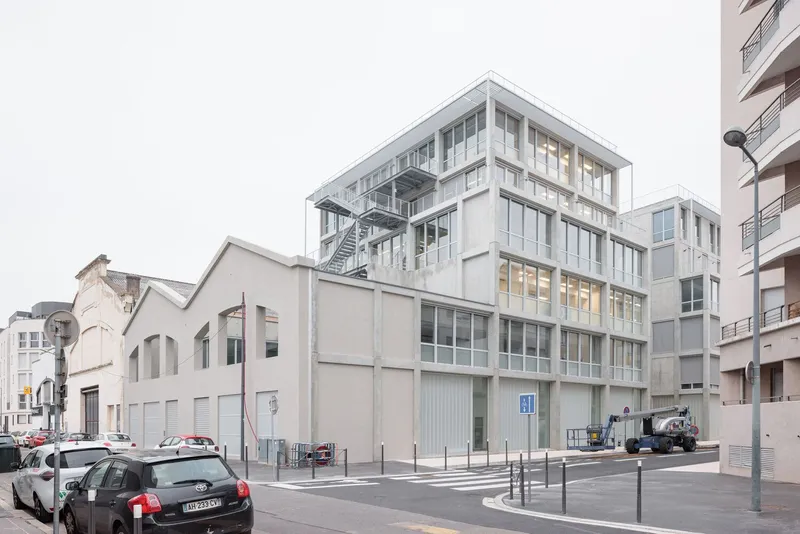
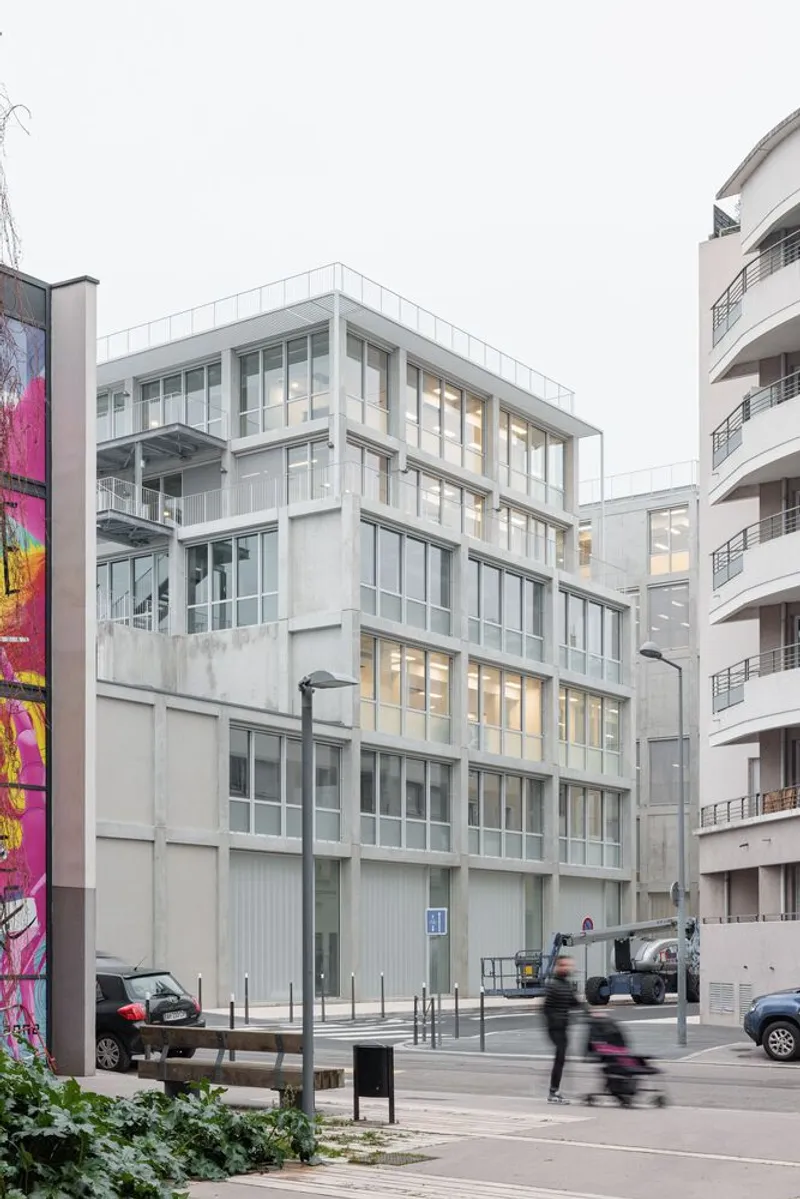
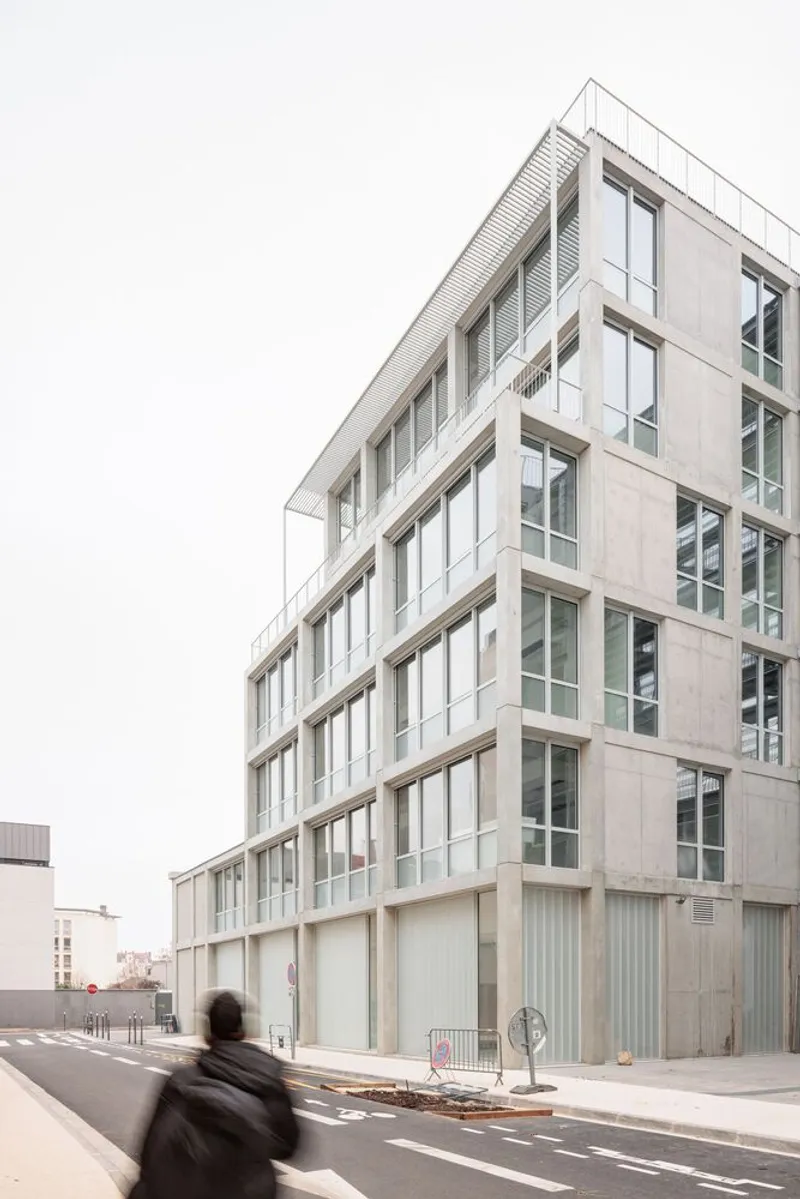
The building's massing splits into three distinct blocks, each with a lean circulation core that avoids eating into usable floor area. From the street, the facades read as a staggered composition of concrete panels and stacked glazing, a rhythm that echoes the warehouse typologies already present in the Mansart district. The ground floors are recessed, pulling the building line back from the curb and creating a covered threshold that softens the transition between public sidewalk and interior program.
The corner condition is handled with particular care. Rather than rounding off or chamfering, TRIPTYQUE lets the concrete panels and glass meet at a clean right angle, giving the building a robust presence that holds its own against the utilitarian character of the surrounding streets. The overcast Lyon sky only reinforces the quiet confidence of this material palette.
Walkways as Connective Tissue
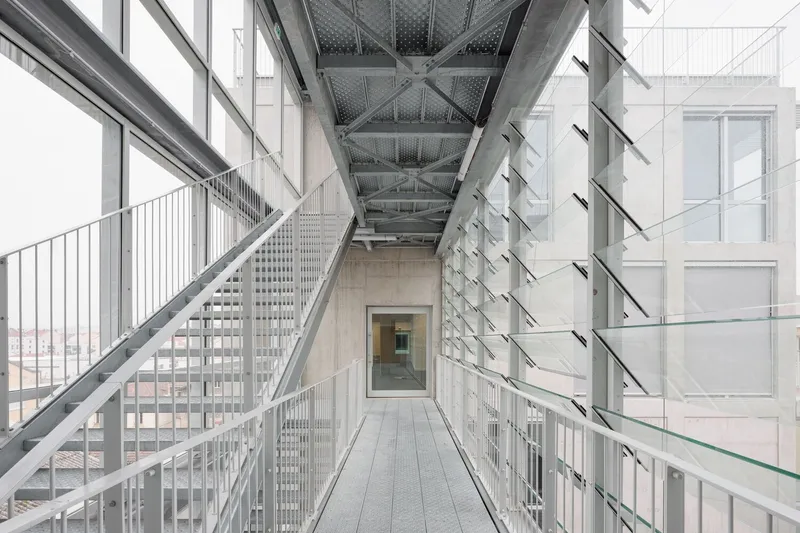
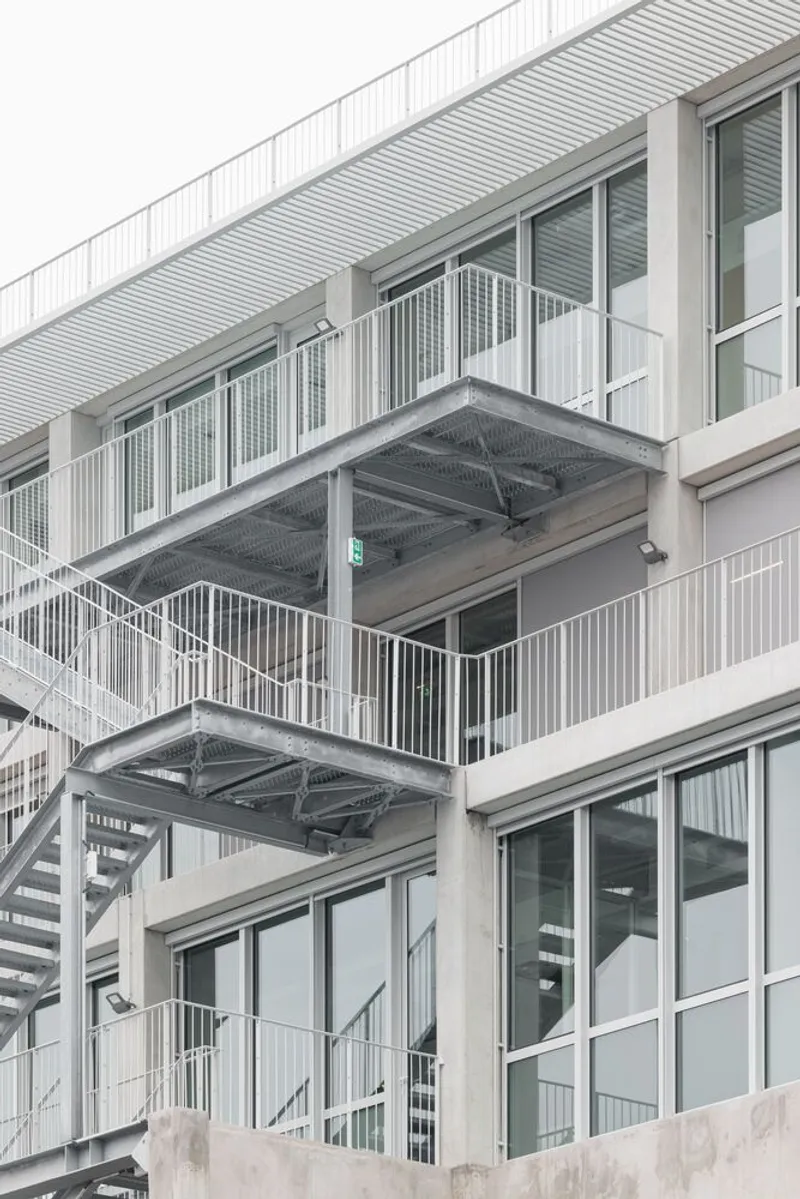
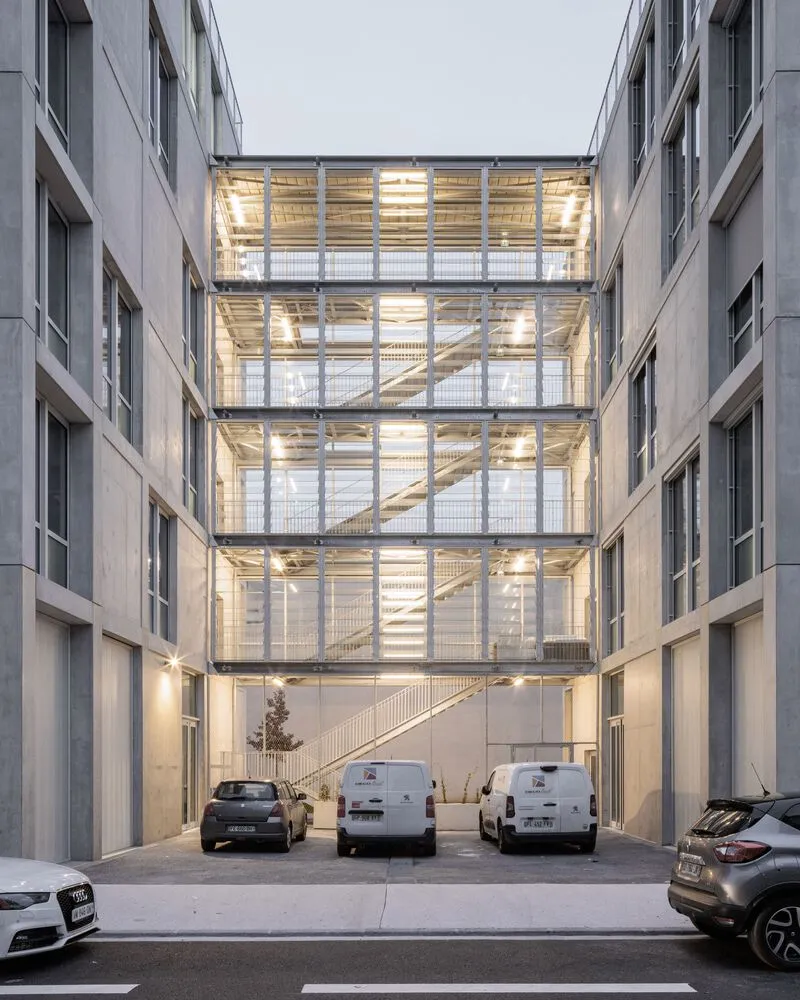
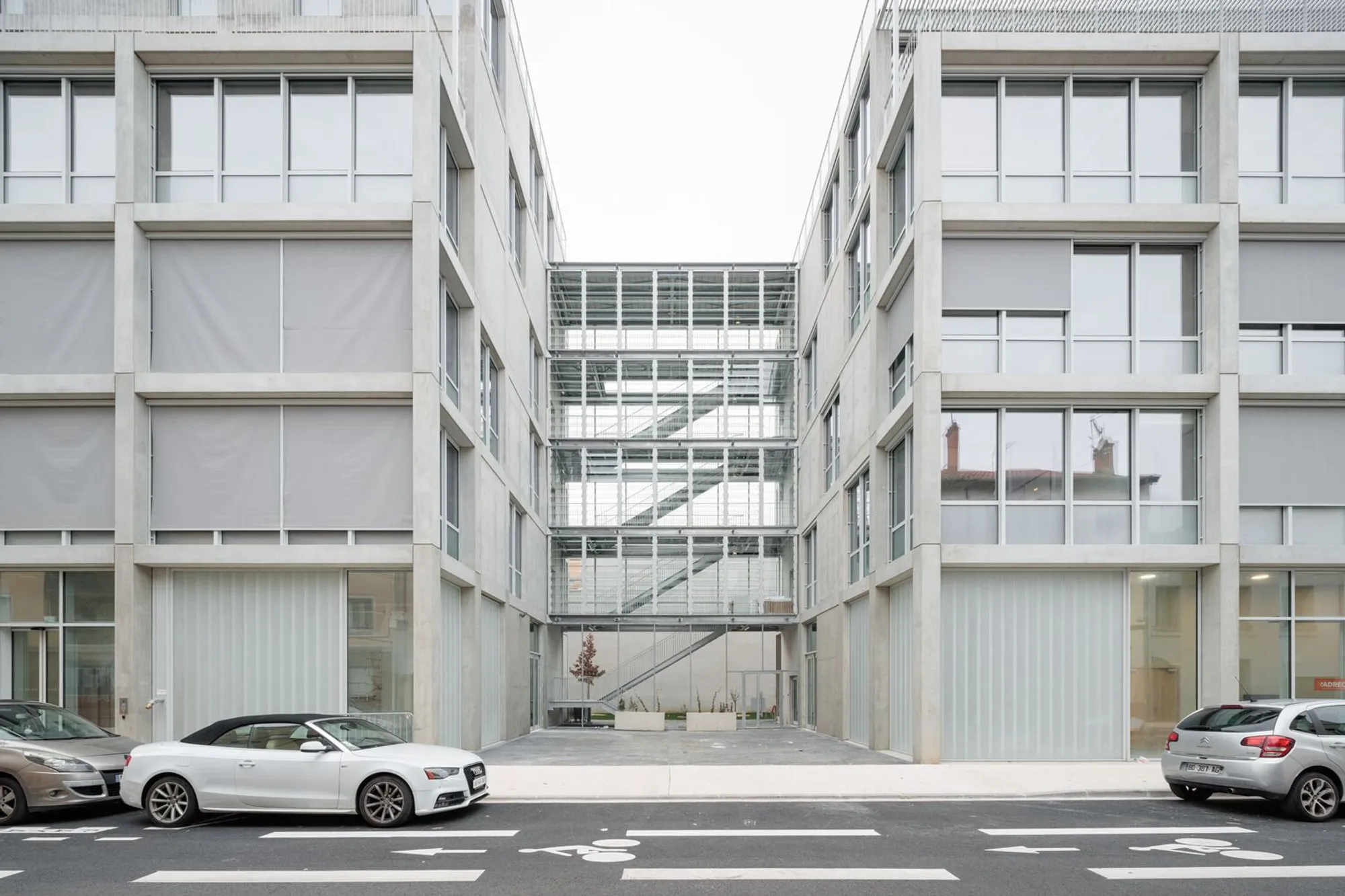
The external walkways are the project's most legible move, and arguably its smartest. By mutualizing emergency exits across the three volumes and integrating them into steel-and-glass bridges, TRIPTYQUE frees up interior floor plates from the burden of redundant staircases and corridors. The walkways span between volumes with perforated metal ceilings and white railings, creating a visual rhythm in the delivery courtyards while opening up sightlines to the heart of the block.
At dusk, the glass-enclosed stairwells glow from within, turning circulation into a lantern effect that animates the courtyards. The diagonal stair runs beneath corrugated cladding recall industrial fire escapes, but here they are integrated as primary architectural elements rather than afterthoughts. This is infrastructure treated as design, not concealed behind it.
Courtyards and Interior Porosity
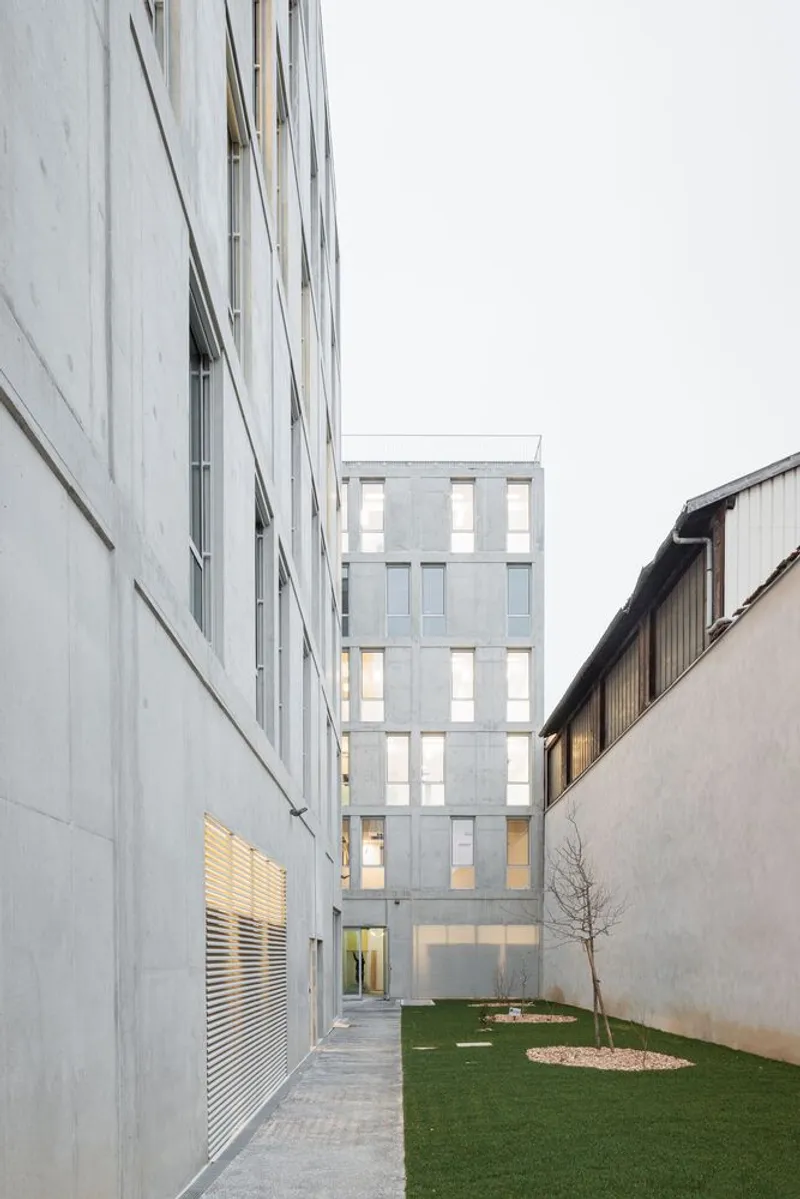
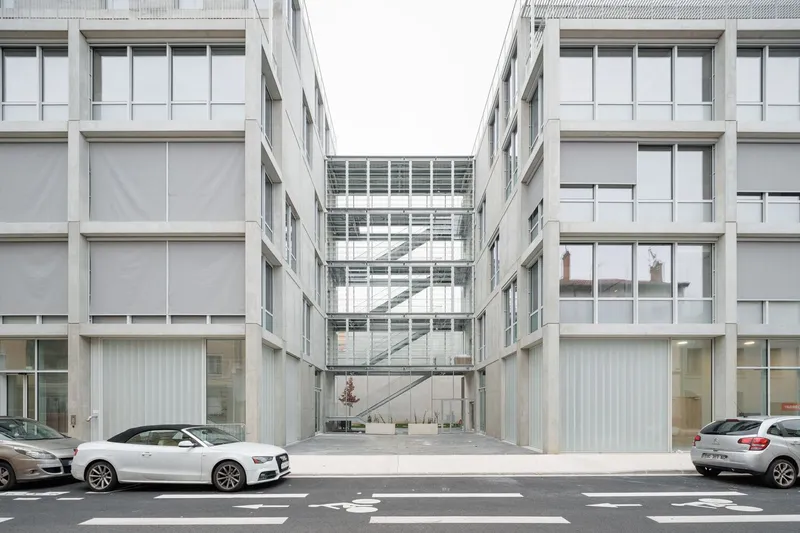
The courtyards are where M45's urban ambition becomes tangible. The symmetrical view through two flanking wings, connected by a glazed bridge overhead, frames a communal open-air space that is neither fully private nor fully public. Small grass lawns at ground level introduce a modest landscape element without resorting to the usual green-washing gestures. These are working courtyards: vehicles park below, walkways criss-cross above, and the facades of all three volumes face inward, ensuring that every unit has a relationship to the shared center.
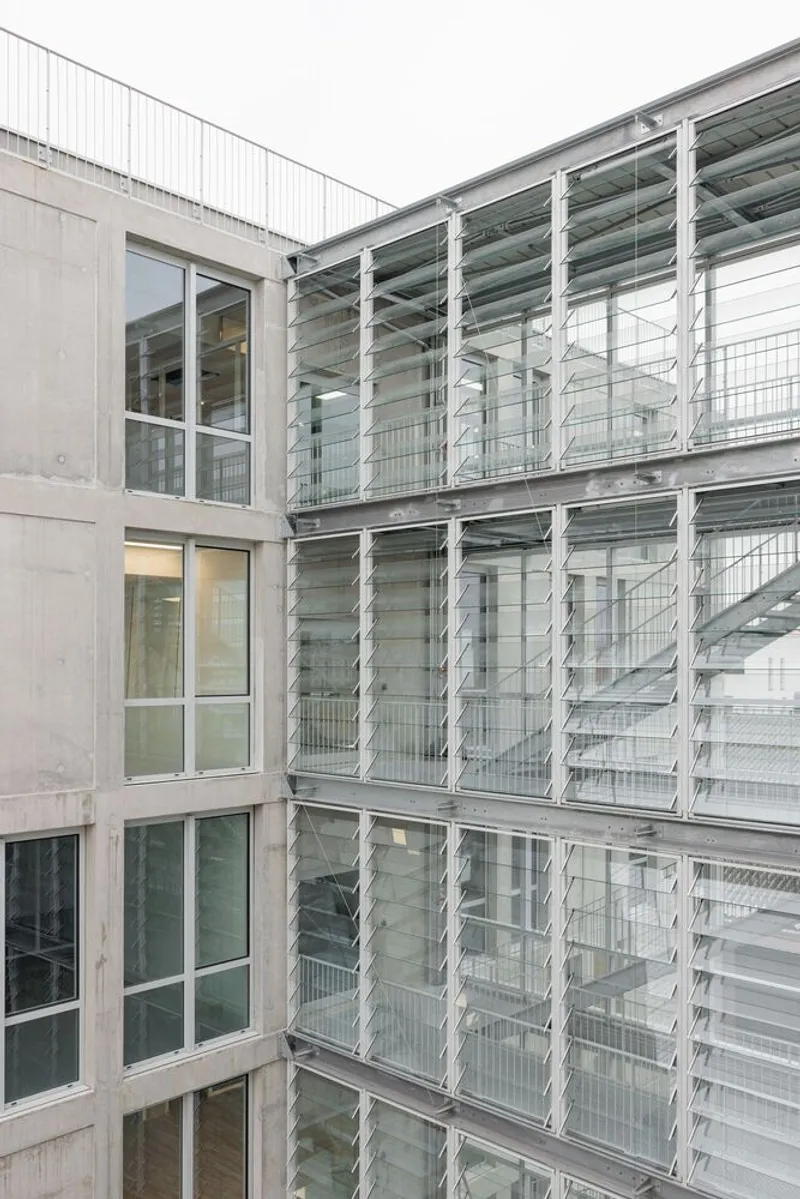
The interior courtyard facing facades combine perforated metal stairs with operable glass louvres, creating layers of transparency and ventilation that reduce dependence on mechanical systems. At night, the illuminated windows against the concrete volumes produce a quiet warmth that transforms the block's character entirely.
Climate and Material Honesty
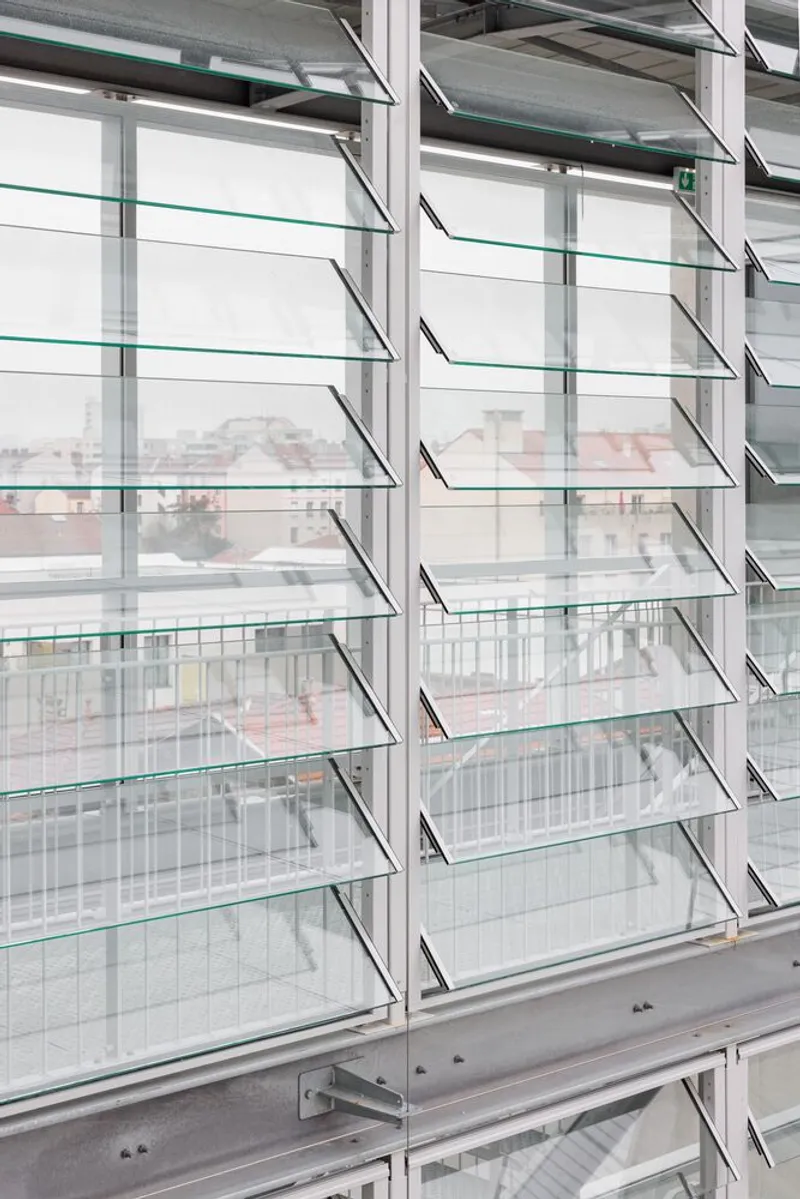
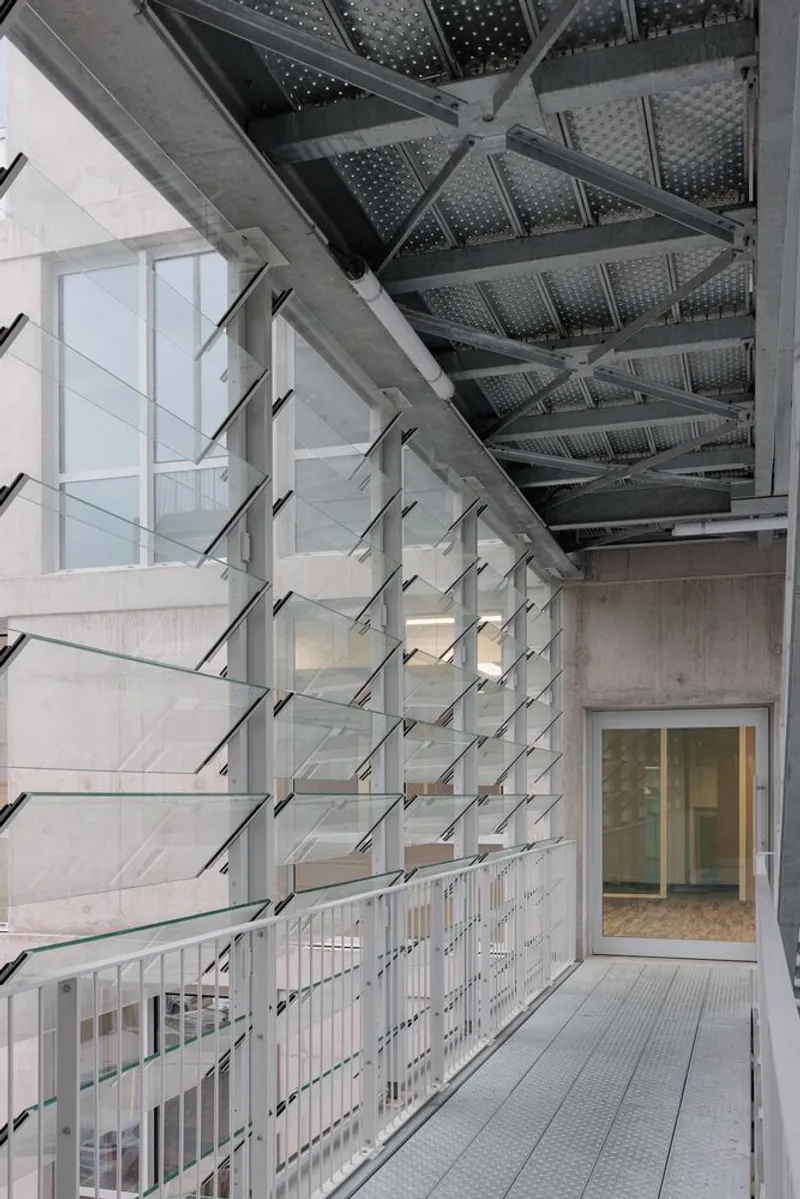
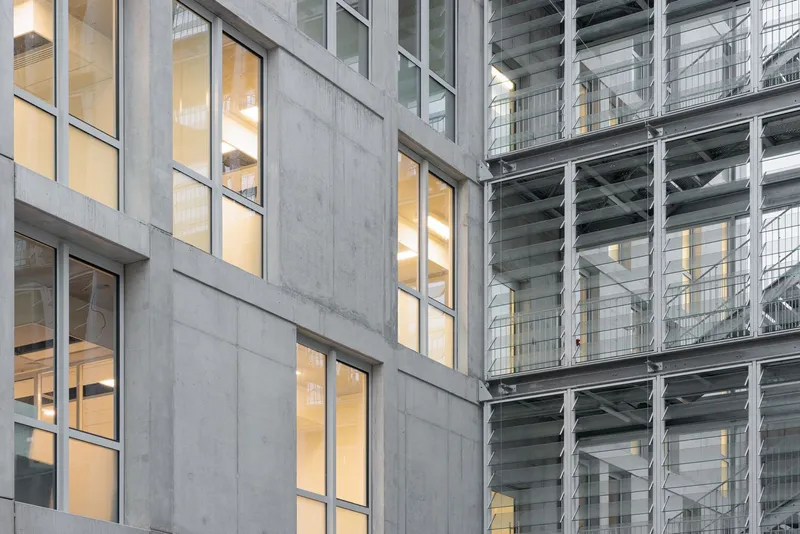
The hinged glass louvres with aluminium frames are one of the project's key passive strategies, allowing occupants to control natural ventilation at the facade level. Combined with the compact building form that minimizes surface area relative to volume, M45 achieves its BREEAM Very Good certification without relying heavily on active systems. The VRV heating and cooling system handles what passive measures cannot, but the architectural envelope does significant work on its own.
Detailing throughout is deliberately exposed. The perforated steel underside of balconies, the junction between concrete panels and the steel structure, the Profilit channel glass: all of it is visible and legible. There is no cladding system here pretending to be something it is not. The 50mm technical plenum and 2.70m clear ceiling height in office spaces speak to an essentialist approach where every centimeter is accountable. Green roofs cap the volumes, contributing to thermal performance and stormwater management without announcing themselves to the street.
Street Presence and Urban Scale
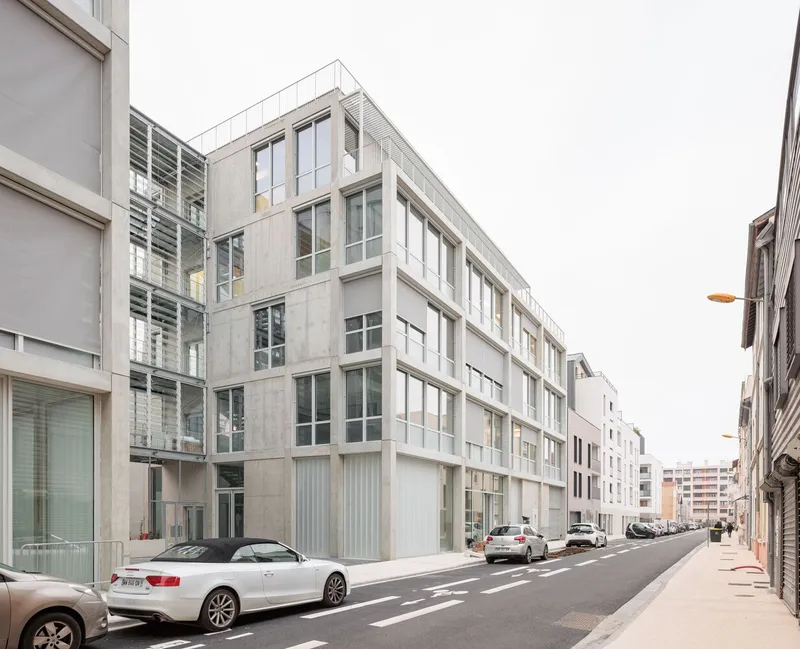
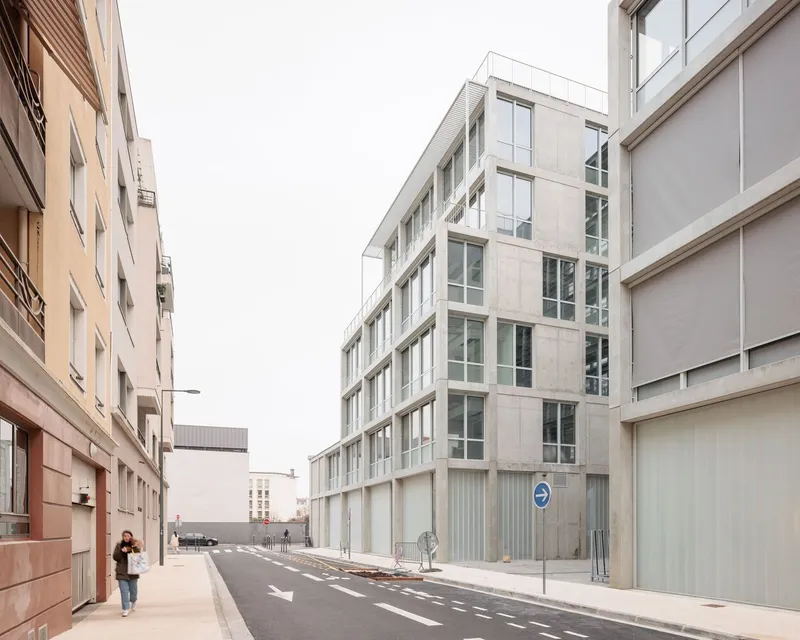
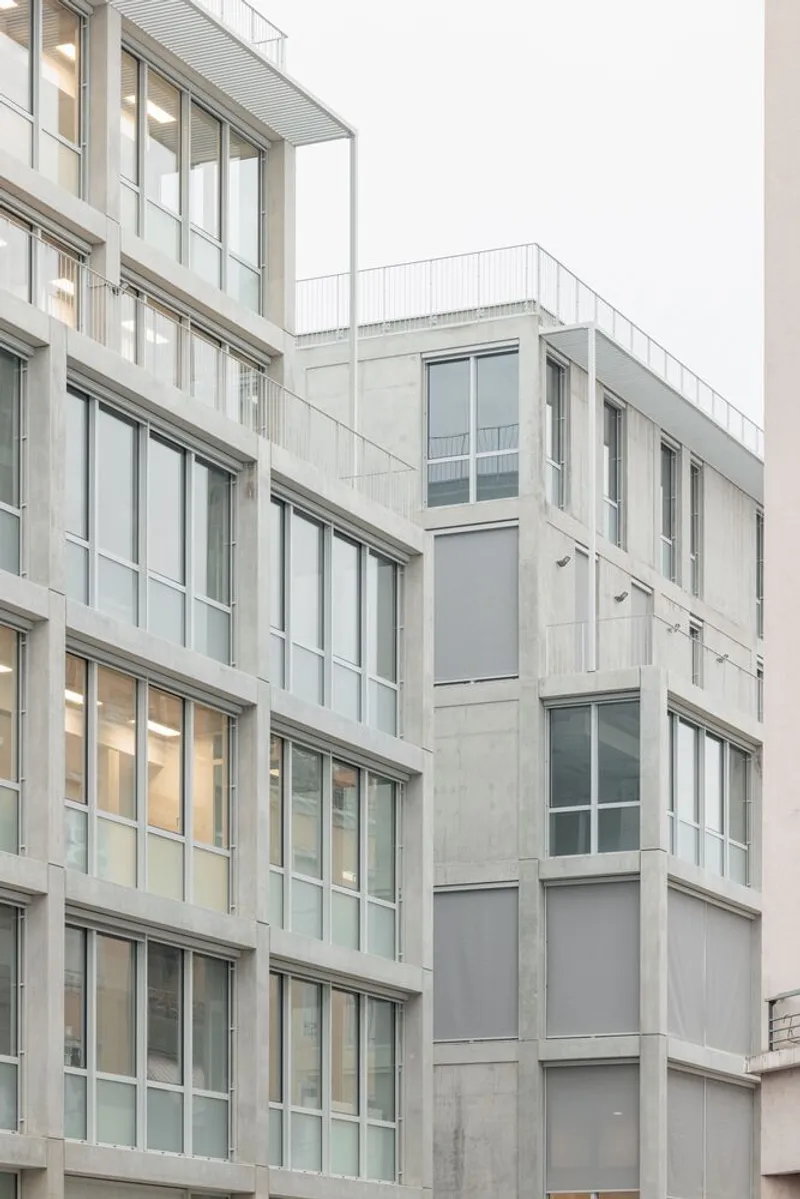
From multiple street approaches, M45 presents a consistent but not monotonous face. The concrete base grounds the building in the block's industrial character, while the glazed upper floors lighten the mass and allow daylight deep into the office spaces. The building's subdivision into smaller units is legible in the facade rhythm: each bay corresponds to a lettable module, giving the elevation an honest expression of its internal organization.
Pedestrians, cyclists, and parked cars share the streetscape in these photographs with an ease that suggests M45 has already settled into its context. That quiet integration is the point. TRIPTYQUE did not set out to create a landmark in the conventional sense. They set out to build a piece of productive city fabric that could absorb change over decades without requiring demolition and reconstruction.
Balconies and the Roofscape
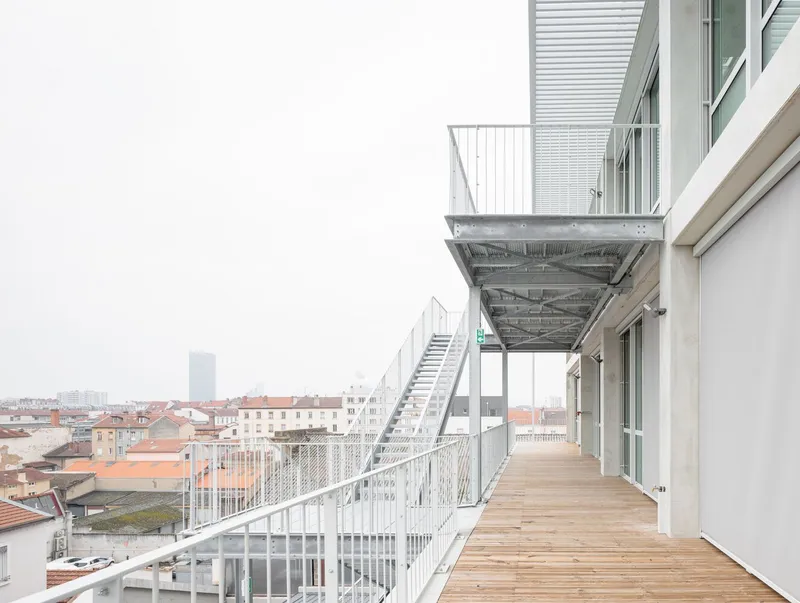
The timber deck balconies at the upper levels offer views across Villeurbanne's rooftops, providing outdoor amenity space for the office tenants above. With metal railings and a restrained material vocabulary, these outdoor spaces feel utilitarian rather than luxurious, consistent with the building's working-city ethos. They are generous enough to be genuinely useful and restrained enough to avoid competing with the building's primary architectural moves.
Plans and Drawings
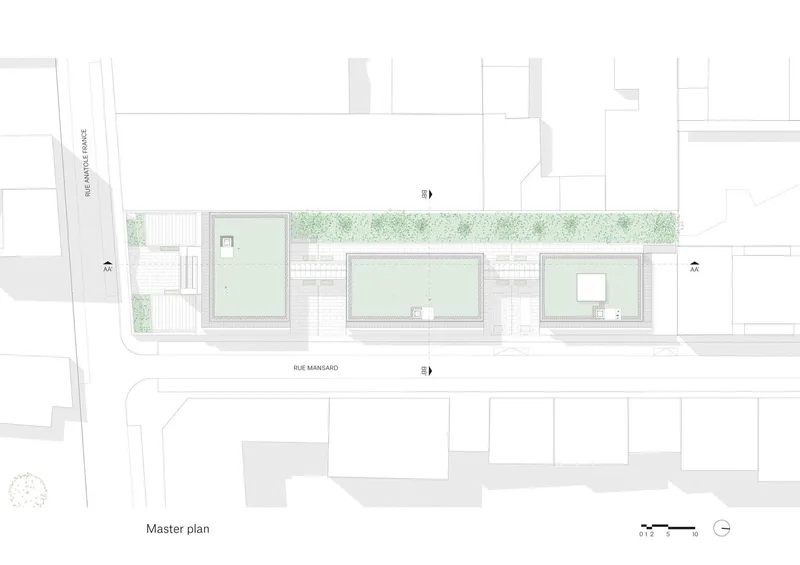
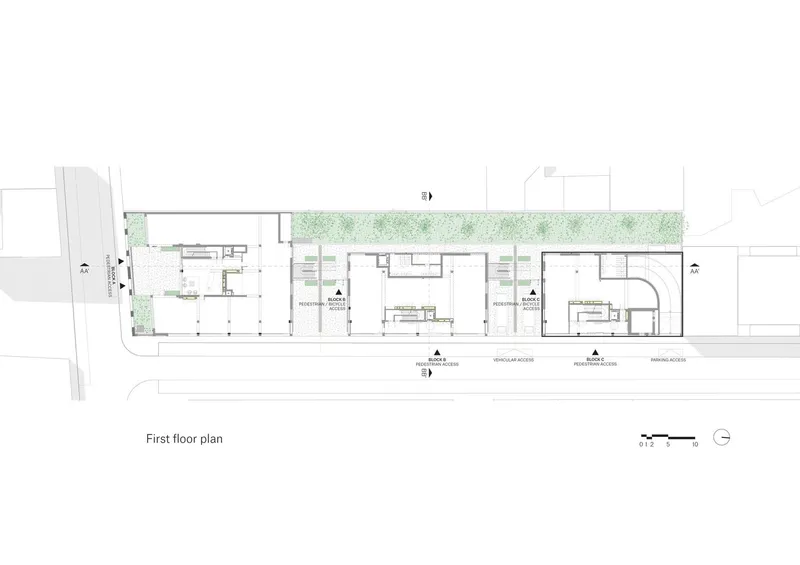
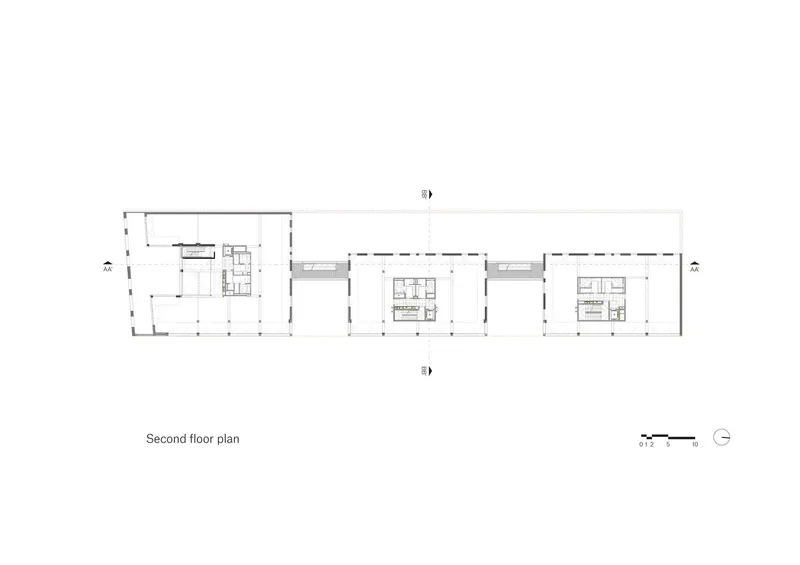
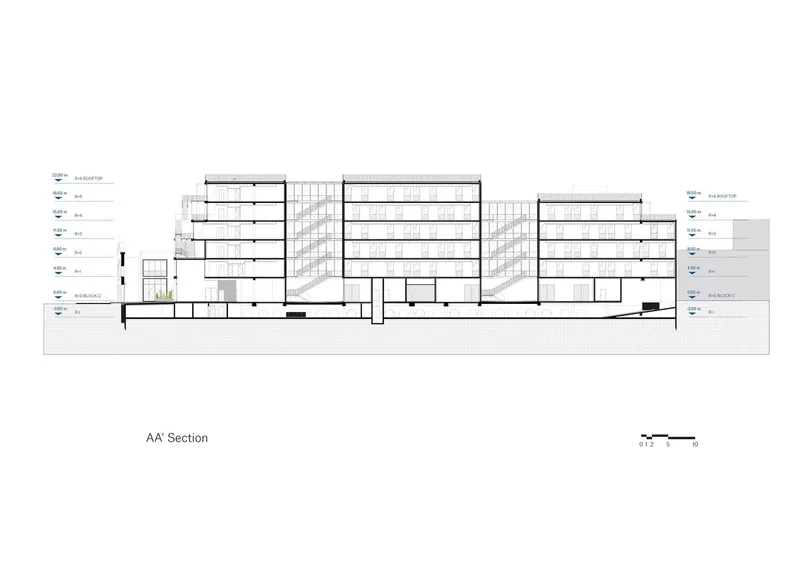
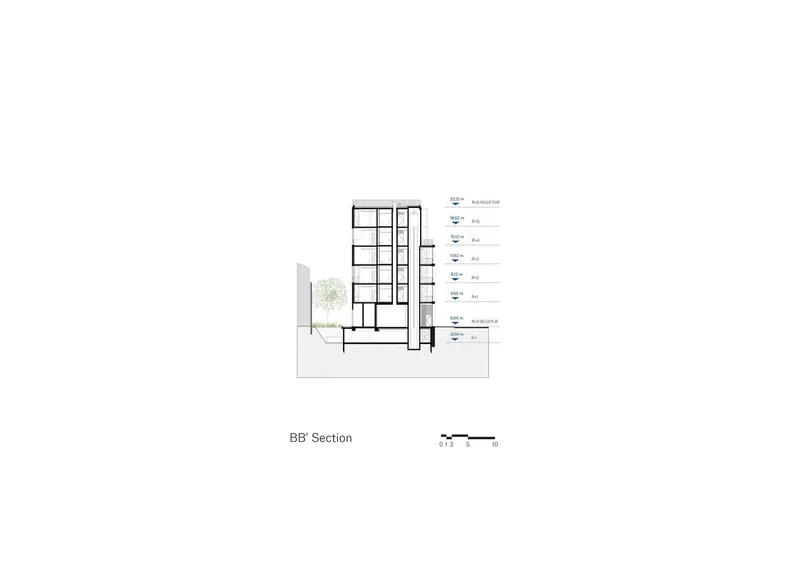
The master plan reveals the project's tripartite logic clearly: three courtyards structured by three volumes, with surrounding streets defining a permeable perimeter. The first and second floor plans show how the reduced cores push usable area to the edges, with enclosed bridges connecting volumes only where necessary. The linear green space along one edge reads as a modest but deliberate landscape gesture.
The sections are perhaps the most revealing drawings. They expose the stepped relationship between the three blocks, the gridded facades, and the generous floor-to-floor heights that allow for future adaptation. The tree-planted courtyard visible in one section confirms that landscape is treated as an integral part of the section, not an afterthought applied to leftover ground. The open-plan structural framework is evident throughout: column grids are regular, spans are generous, and the interior partitions are clearly non-structural, reinforcing the reversibility principle.
Why This Project Matters
The concept of reversible architecture is easy to theorize and difficult to build. M45 earns its claims by making specific decisions: mutualized emergency exits that eliminate redundant cores, building assemblies designed for disassembly, open-plan structures that accommodate workshop, office, and commercial functions interchangeably. TRIPTYQUE has not produced a manifesto building. They have produced a working prototype for how European industrial districts can densify and diversify without erasing the spatial and material culture that made them interesting in the first place.
In a moment when many cities are reaching for flashy mixed-use towers or converting old factories into lifestyle brands, M45 offers a quieter proposition. It says that the productive city does not need to be reinvented from scratch. It needs buildings that are robust enough to last, flexible enough to change, and humble enough to belong. Villeurbanne's Mansart district has another good building on its block, and that is exactly the ambition.
M45 Building, Villeurbanne, France. Designed by TRIPTYQUE. 5,000 m². Completed 2023. Photographs by Salem Mostefaoui.
About the Studio
Share Your Own Work on uni.xyz
If projects like this are the kind of work you want to make, uni.xyz is a place to publish your own, find collaborators, and enter design competitions.



Popular Articles
Popular articles from the community


Hill & Cross Opera: Sculptural Opera House Architecture Shaped by Tallinn’s Landscape and Identity
Hill & Cross Opera reimagines opera house architecture in Tallinn through its sculptural hill, civic plaza, glass wave and a luminous cross.

The Musturak Paradise: Senior Living Architecture for a Connected Future in Temara, Morocco
The Musturak Paradise reimagines senior living architecture in Temara via private homes, social spaces, culture, community, and shared care.

Conexión: Biophilic Design Reimagines High-Rise Living in Hong Kong
Conexión reimagines high-rise living in Hong Kong through biophilic design, green facades, shared spaces, daylight, water and nature within.

Co-life: Sustainable Architecture for Age-Friendly Community Living
Co-life reimagines sustainable architecture for seniors through courtyards, rammed earth, shared gardens, and spaces designed for belonging.

Similar Reads
You might also enjoy these articles

Bamboo Housing Challenge 2026: Design Affordable, Sustainable Homes Using Bamboo
An international design competition by Bamboo U and IBUKU inviting architects and designers to reimagine affordable housing using bamboo — with the winning design built full-scale in Bali.

Computational Design & Education: Beegraphy Design Awards Introduces 7th Category (Featuring Jiyun's Innovative Approach)
Dive into Beegraphy’s 7th Design Awards category, where computational design meets education to create immersive, interactive learning tools, inspired by Jiyun’s work.
From Parametric Lighting to Urban Furniture: Join the 2nd Workshop in Beegraphy’s Computational Design Series
Dive into Cutting-Edge Design Techniques and Practical Applications with Industry Experts

Last Call: Unleash Your Architectural Genius in SHAK's Kindergarten Design Competition
Urgent call for architects to join SHAK's kindergarten design competition before the looming deadline


Explore Architecture Competitions
Discover active competitions in this discipline



Challenge to reimagine the Iron Throne


Photograph architecture without architects


Illustrate the lost glory of Angkor Wat - Render Challenge


Design challenge to reuse E-waste
Comments (0)
Please login or sign up to add comments
No comments yet. Be the first to comment!