

VEIVE Architects Builds a Mountain Hostel That Disappears into a Hangzhou Hillside
On the Huihang Ancient Trail in Xiangjian Village, a shelter of wood, steel, and rammed earth roots itself in the rural landscape.


Xiangjian Village sits at a crossroads of the Huihang Ancient Trail, a historic route connecting Anhui and Zhejiang provinces through some of China's most dramatic mountain terrain. It is the kind of place where architecture either competes with the landscape or learns to be quiet. VEIVE Architects chose the latter with CHIN's Hostel, a 395-square-meter lodging that embeds itself into a forested slope so thoroughly that at dusk it reads less as a building and more as a clearing in the canopy.
What makes this project genuinely interesting is not its modesty but the precision of its restraint. The hostel deploys a material vocabulary of wood, glass, steel, and rammed earth, assembling these into a stepped volume that follows the gradient of the terrain rather than fighting it. The architects quote Yoshio Taniguchi's remark about architecture as a container, and the analogy holds: the real content here is the misty mountain panorama, the sound of wind through dense tree cover, the texture of red sandstone underfoot. The building is a frame for all of it.
Anchored to the Slope
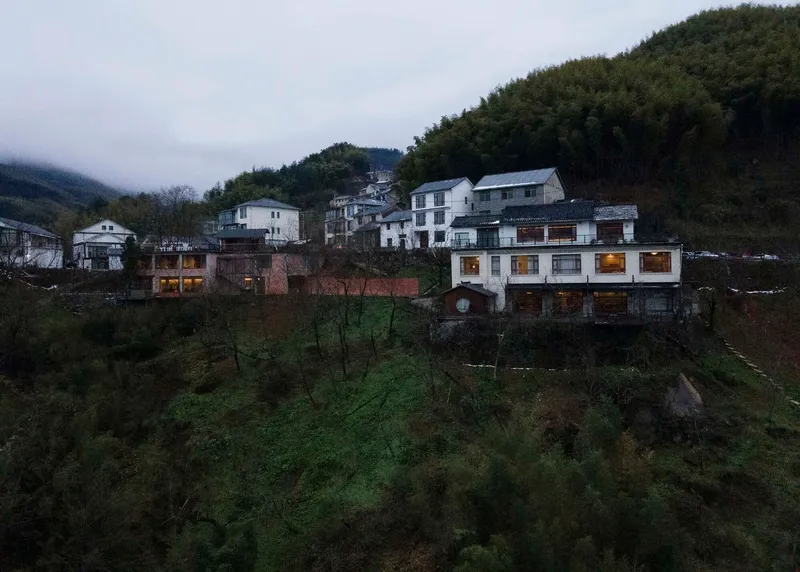


The hostel occupies a tight site on a wooded hillside, surrounded by the low-slung vernacular houses of Xiangjian Village. From above, the flat timber deck roof nearly vanishes into the canopy, punctuated only by the sinuous curve of a rammed earth wall. At eye level from the village path, the white-painted timber frame and illuminated windows give the building a lantern-like presence at dusk, warm but understated against the dark foliage.
The concrete base lifts the timber pavilion above the terrain, a pragmatic move on a steep site that also lends the structure a lightness it would lose if planted directly in the ground. Exposed wood columns and a gridded facade organize the elevations into a rhythm that feels almost domestic in scale, never overwhelming its neighbors.
A Threshold of Red Stone

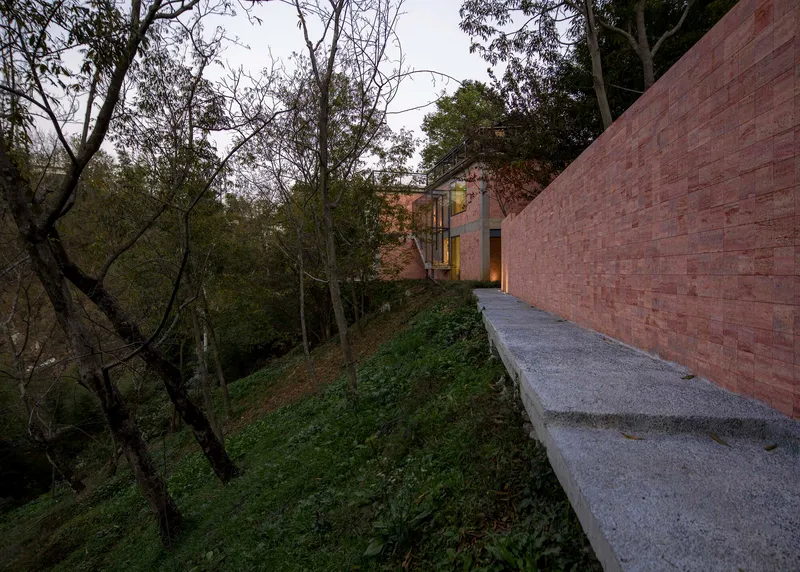

The entrance sequence is the project's strongest architectural gesture. A curved passage lined with red sandstone walls channels visitors through a compressed, almost cave-like corridor before releasing them into the interior. Scattered leaves on the pavement and the warm glow of concealed lighting give this threshold a temporal quality, shifting character with the seasons.
An elevated concrete walkway runs alongside the red stone facade, tracing the hillside and connecting the building's two primary volumes. The black steel canopy over the glass entry door marks a deliberate shift in materiality: from the rough, geological character of the rammed earth tiles to the precision of industrial steel and glass. It is a small detail, but it signals the transition from landscape to shelter with clarity.
Framing the View


Inside, the lounge is the building's social heart. Exposed concrete beams span the ceiling, and a large wood-framed window opens directly onto a panorama of misty mountains. The furnishing is deliberately sparse: black track lighting, a few low seats, nothing that competes with what is outside. The room functions as a viewing device, its proportions calibrated to the landscape beyond.
The glass facade on the opposite side reflects the rammed earth tile wall and surrounding branches, collapsing the boundary between interior and exterior. On overcast days, the building absorbs the gray light and seems to dissolve into the hillside, its reflections merging with the muted palette of bark and stone.
Sleeping in the Canopy
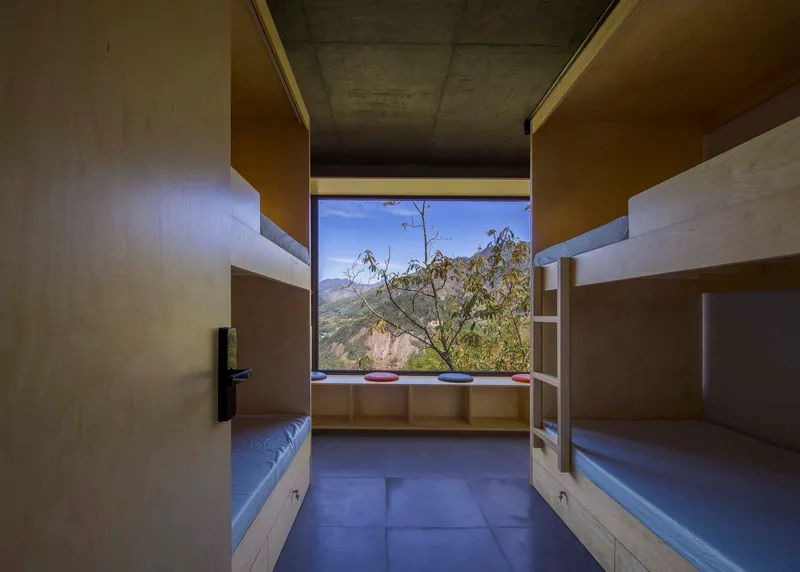
The dormitory rooms are compact and well-resolved. Built-in timber bunk beds line the walls, and a window seat at the end of each room provides a private perch overlooking the distant mountains. There is no visual clutter: the material palette stays within the same register of pale wood and white plaster that defines the rest of the building.
For a hostel of just 395 square meters, the spatial economy is notable. Every room earns its presence through a direct relationship with the landscape. You are not simply housed; you are positioned within the terrain, with sightlines that extend well beyond the building's footprint. It is a generous move in a small package.
Plans and Drawings


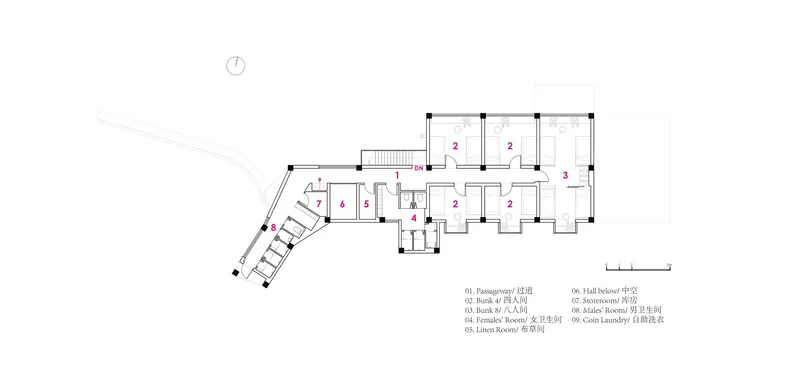


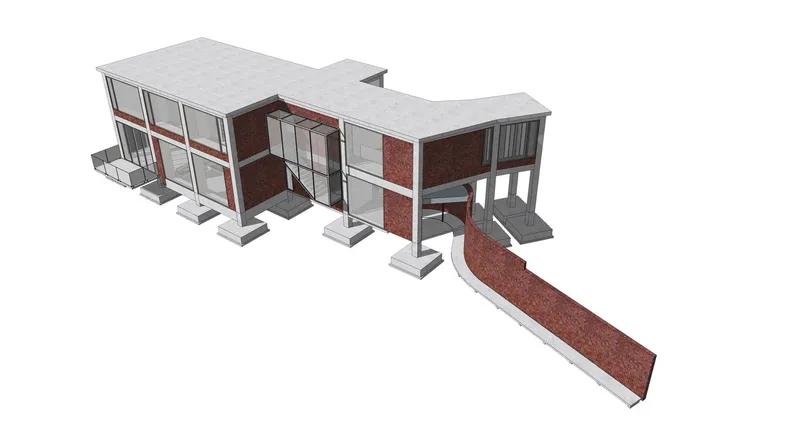


The site plan reveals the hostel's strategy of embedding stepped volumes into the natural slope, preserving the surrounding tree canopy rather than clearing it. Public spaces radiate from a central stair and entrance hall on one level, while the dormitory wing organizes sleeping rooms along a linear corridor on the other. The axonometric drawings are particularly revealing: red brick infill panels alternate with glazed openings within a white structural frame, producing a facade that reads as both solid and permeable depending on the angle.
The sections show how a diagonal staircase stitches the two levels together through a double-height void, creating interior sightlines that prevent the compact plan from feeling claustrophobic. The angled brick ramp extending from the main volume, visible in the overhead axonometric, serves as a landscape connector, blurring the line between constructed path and natural terrain. The structural logic is legible throughout: concrete piers, a steel and timber frame, and a flat roof that reads as a fifth elevation when seen from the trails above.
Why This Project Matters
Rural hospitality projects in China have proliferated rapidly over the past decade, and many of them share a weakness: they import urban aesthetics wholesale into the countryside, producing buildings that look striking in photographs but feel alien on the ground. CHIN's Hostel avoids this trap by grounding its design in the specific materials and topography of its site. The rammed earth, the red sandstone, the timber frame, and the concrete base all belong to a regional construction logic rather than a generic minimalist playbook.
The real achievement here is tonal. VEIVE Architects understood that a hostel on an ancient trail is not a destination but a pause, a place where travelers rest before continuing through the mountains. The building's quiet materiality and calibrated views serve that purpose without asserting itself as a spectacle. In a discipline increasingly drawn to the photogenic, that kind of discipline is worth noticing.
CHIN's Hostel, designed by VEIVE Architects, Xiangjian Village, Lin'an, Hangzhou, China. 395 m², completed 2022. Photography by Yuqing Wang and Hongliang Zhu.
About the Studio
Share Your Own Work on uni.xyz
If projects like this are the kind of work you want to make, uni.xyz is a place to publish your own, find collaborators, and enter design competitions.


Popular Articles
Popular articles from the community


Temporary Home for Dogs: A Reversed Zoo Rethinks Animal Shelter Architecture
In Bucharest, a sinuous corridor and freed landscape flip the logic of containment, designing a shelter that works to make itself unnecessary.

Opera by the Sea Estonia: Three Shells Dissolving Architecture into Tallinn's Coastline
A winning opera house proposal replaces monumental form with interconnected shells that blur the boundary between building, park and Baltic Sea.

Opera on the Sea: Driftwood Logic Shapes a Timber Opera House on Estonia's Coast
Trevor Orgill's opera house translates the entangled drift of floating timber into a civic building where wood, water, and music converge.

Manzana Morphosis: Stretching Barcelona's Grid into a Living Landscape for 2050
A radical reworking of the Eixample manzana turns density into a tool for generous public space, vertical ecology, and environmental performance.

Similar Reads
You might also enjoy these articles

Bao Huynh Watercolor Atelier: A Serene Art Retreat in Hội An
Bao Huynh Watercolor Atelier in Hội An blends multifunctional art spaces, sustainable design, local materials, and family-friendly living in a serene environment.

Atelier Macri Concept Store Interior Design by CASE-REAL
Atelier Macri store features a "ko" counter, walnut wood details, cork displays, blending retail, gallery, and seamless customer experiences.

Manuel Vargas Izquierdo Stadium and High-Performance Sports Center: Architectural Excellence in Jalpa de Méndez
The Manuel Vargas Izquierdo Stadium blends sustainable design, inclusive sports facilities, and cultural-inspired architecture, revitalizing Jalpa de Méndez’s public spaces.
KAKR Buluh Awar Hall: Revitalizing Community and Ecology Through Bamboo Architecture
Community built bamboo hall revitalizes Buluh Awar village, empowering youth, restoring ecology, celebrating vernacular craftsmanship through sustainable architecture and culture.


Comments (0)
Please login or sign up to add comments
No comments yet. Be the first to comment!