

Magnet: A Magnetic Transit Network as Architecture
A network of hybrid skyscrapers connected by magnetic levitation pods, replacing roads and rail with a clean, silent, airborne transit system.


A magnet attracts. That is the premise. Magnet, a network of hybrid skyscrapers designed by Mavis Huang and Hong Chen, proposes towers that attract people, energy, transport, and ecology toward themselves. The buildings use magnetic levitation technology to generate clean energy, move transport pods between structures, and create vertical parks that draw residents upward into the sky.
The project received an Honorable Mention in the Hybrid Futures '19: Work x Fly competition on uni.xyz. Set in 2070, it imagines a network of self-sustaining towers distributed across a coastal city, each one a node in a magnetic transit system that replaces conventional ground-level infrastructure.
The Network: A City of Magnetic Nodes
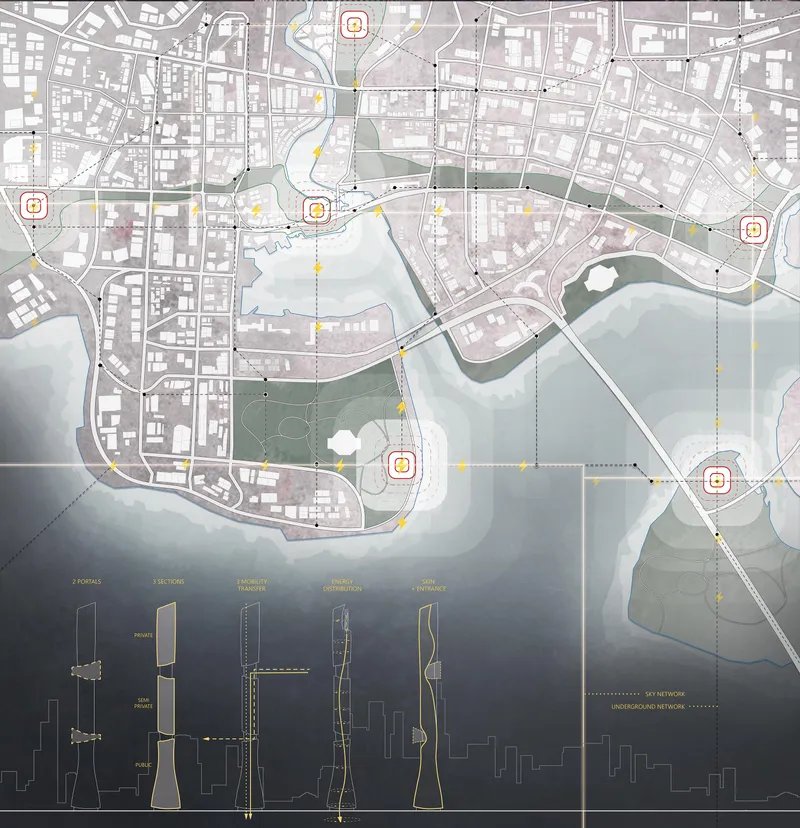
The masterplan is the project's most informative board. It maps the tower locations across an existing coastal city, showing how each Magnet tower relates to its neighbours, to the waterfront, and to the underground transport network below. The tower typology silhouettes at the bottom reveal that no two towers are identical. Each is shaped by its site, its programme, and its position in the network.
This distributed model is the project's structural idea. A single tower is a building. A network of towers connected by magnetic transit is an infrastructure. The distinction matters because it means the project is not proposing a landmark. It is proposing a system that replaces roads, rail, and power grids with a single magnetic framework.
The Tower: Vertical Gardens and Floating Pods
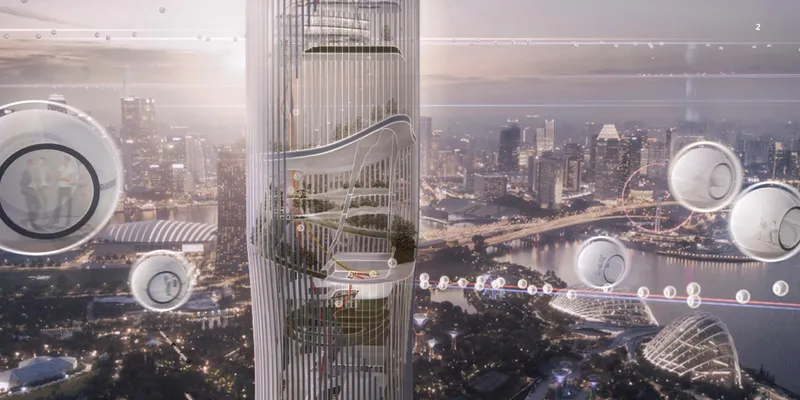
The hero render shows a single Magnet tower in its urban context. The tower rises from a dense city with vertical gardens cascading down its facade, open green terraces punctuating the section, and transparent magnetic transport pods floating between the tower and its neighbours. The pods follow cable routes, suspended by magnetic levitation, carrying passengers without engines, fuel, or emissions.
The form is elegant. The tower widens and narrows along its height, creating bulges where the sky parks are largest and pinches where the structure is most efficient. It reads as something organic, which is appropriate: the building grows from its site the way a tree grows toward light.
Sky Parks: Landscape in the Air


The sky parks are the project's most developed interior spaces. The aerial view shows a green platform suspended inside the tower's glass shell: a spiral ramp winds around a central glass cylinder, mature trees grow in deep soil beds, and a landscaped terrain of hills and paths creates an outdoor experience hundreds of metres above the ground.
The ground-level park render confirms the same quality at the base. Terraced grass, trees, spiral ramps overhead, and a bright, naturally lit atrium create a public space that feels like a park rather than a lobby. People walk, sit, and gather. The architecture disappears behind the landscape, which is exactly what a good park does.
Interior: Where Technology Meets Nature
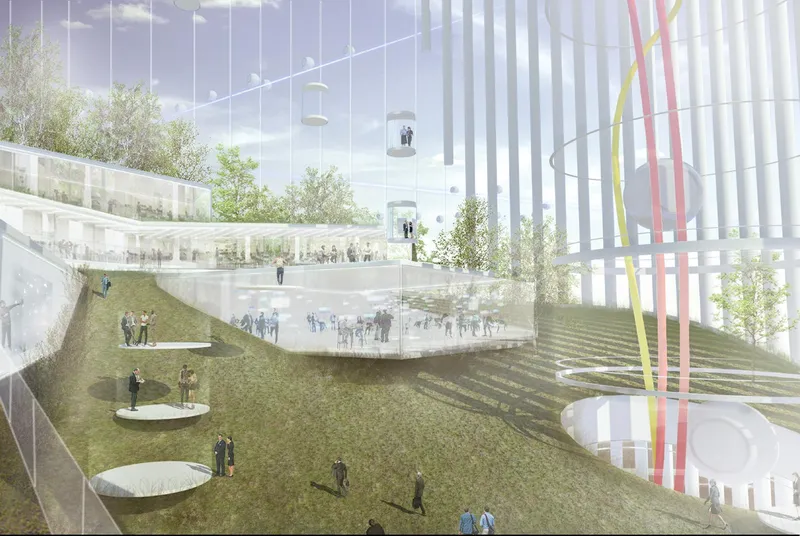
The interior sky garden render shows a different spatial quality: a reflective pool, a grassed slope, coloured structural pylons, and trees growing inside a glass-walled volume. The light is diffused. The materials are natural. The technology is invisible. You would not know you are inside a magnetic levitation tower unless someone told you.
This invisibility is a design achievement. The most advanced technology in the building, the maglev system, the energy generation, the smart shading, is embedded in the structure and the facade. The interior is given over entirely to human experience. This is the correct priority for a building that people live and work in.
Why This Project Matters
The Hybrid Futures competition produced entries that ranged from airports in towers to walking creatures to space elevators. Magnet occupies a different position: it is the most urban of the entries. It does not propose a single spectacular building. It proposes a network that replaces urban infrastructure with a cleaner, quieter, more connected system.
For anyone studying networked urbanism, magnetic transit, or vertical landscape design, Magnet demonstrates how a speculative technology (maglev) can be the organising principle for an entire city rather than just a feature of a single building. The parks prove that technology and nature are not opposed. The network proves that buildings can be infrastructure.
View the Full Project
About the Designers
Designers: Mavis Huang, Hong Chen
Enter a Design Competition on uni.xyz
If networked urbanism, vertical landscape, or speculative transit design is the kind of work you want to pursue, uni.xyz runs competitions year-round that reward systems-level thinking.
Project credits: Magnet by Mavis Huang and Hong Chen. Honorable Mention, Hybrid Futures '19: Work x Fly (uni.xyz).


Popular Articles
Popular articles from the community


Manzana Morphosis: Stretching Barcelona's Grid into a Living Landscape for 2050
A radical reworking of the Eixample manzana turns density into a tool for generous public space, vertical ecology, and environmental performance.


Cube Design Draws an Ecological Corridor Between Two Shenzhen Hills with the Nankai Building
Beside Shenzhen's container docks, the Nankai Building pairs stacked balconies with a climbing green screen to connect two hillsides across its height.

Opera on the Sea: Driftwood Logic Shapes a Timber Opera House on Estonia's Coast
Trevor Orgill's opera house translates the entangled drift of floating timber into a civic building where wood, water, and music converge.

Aquadapt: An Underwater Habitat That Rewrites Its Rooms by the Hour
Curved modules ring the seabed while one shell shifts from breakfast room to cinema, farm and football pitch as residents' needs change.

Similar Reads
You might also enjoy these articles

Vereda Arquitetos Renovates a 40-Square-Meter Apartment Inside Niemeyer's Copan Building
A compact unit in São Paulo's most iconic residential tower gets a material overhaul that pairs exposed concrete with bold blue Formica.

Shakur's House: Exposed Brick as an Interior Organiser in a 168 m² Mashhad Residence
Brick moves indoors in this Mashhad residence, where masonry walls, glass partitions and teal planes sequence a compact home without closing it off.

Day and Night Park: A Time-Based Urban Newsstand in Beijing
A temporary urban newsstand in Beijing blending travel, light, and reading through poetic colors, compact form, and community-focused design.

Modernist Patio Renovation in El Masnou, Barcelona by Oliver Segura Arquitectura + Cebrià Arquitectura
Modernist patio renovation blending tradition and innovation with a movable pool, leveled floors, and Catalan materials in El Masnou.

Comments (0)
Please login or sign up to add comments
No comments yet. Be the first to comment!