

Zoom Design Atelier Wraps a Taiwanese Cultural Campus in Hollow Brickwork Borrowed from Pig Houses
Mailiao Community Education Park channels rural Yunlin County's vernacular brick traditions into a library and living art center on 2.4 hectares of coastal


Mailiao Township sits on the western coast of Taiwan's Yunlin County, where flat agricultural land meets an industrial corridor shaped by the nearby Formosa Plastics petrochemical complex. The northeast monsoon tears across the landscape every winter with little to break its path. Into this charged context, Zoom Design Atelier has placed two buildings, a living art center and a public library, arranged to shield one another and the community space between them from that wind. The 5,404 square meter campus, completed in 2023 and donated by Formosa Plastics for shared use by several surrounding townships, is a rare piece of civic architecture in an area that rarely gets any.
What makes the project worth studying is not the program (community libraries and exhibition halls exist everywhere) but the degree to which the architects treated material, climate, and section as a single design problem. The two buildings are oriented to create a sheltered egg-shaped courtyard, their upper halves wrapped in red brick screens that reference the hollow brickwork once used in traditional Taiwanese pig houses for passive ventilation. Below, the ground floors are compressed and glazed, pulling landscape into the interiors and emphasizing a horizontal datum that ties the campus to the flat surrounding fields. The result is a project that performs as well as it signals: deep shading on the west, skylights under sweeping roofs, double-wall insulation, and a section in the library that drops visitors down into a sunken reading core. Every move has a reason.
Two Buildings, One Courtyard
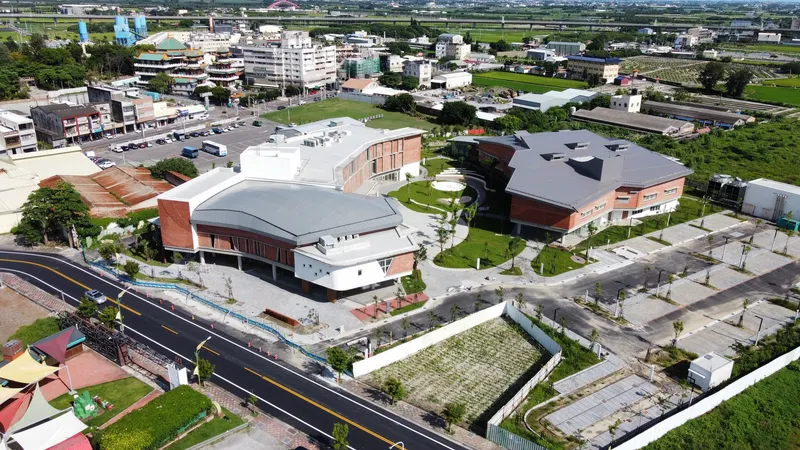
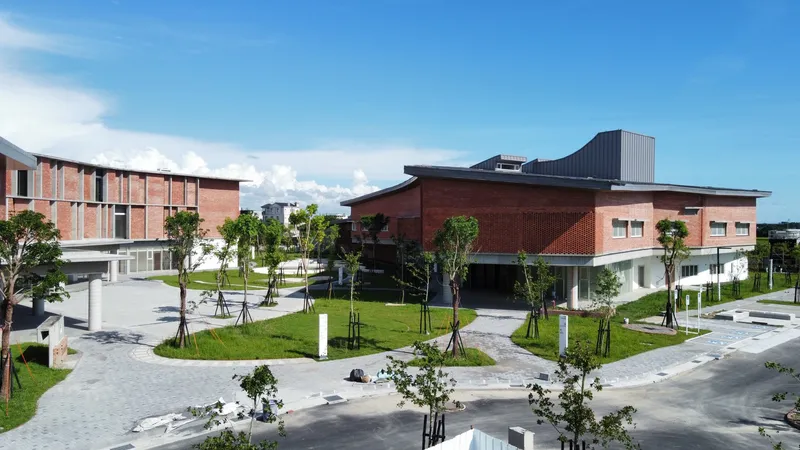
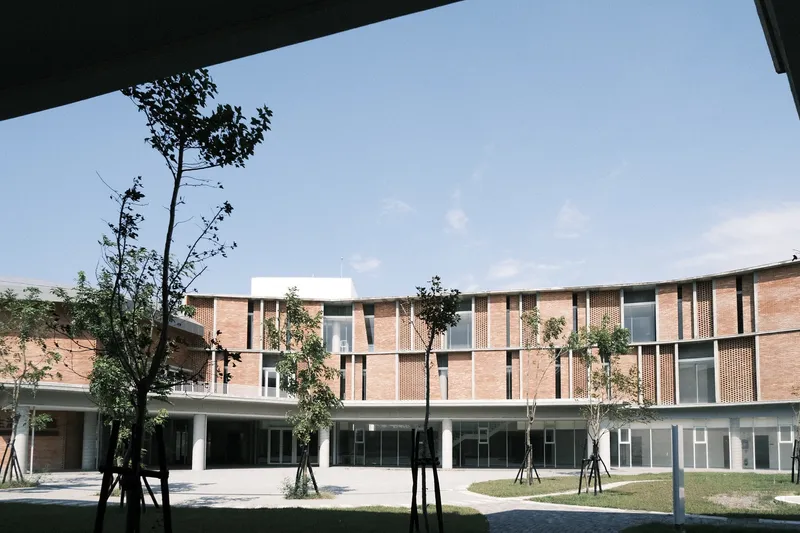
Seen from above, the campus reads as two elongated volumes, one curved and one more rectilinear, cradling a central green between them. Zoom Design Atelier calls this the "aesthetic incubation square," a name that sounds like committee language but describes a real spatial condition: the egg-shaped void funnels views, directs pedestrian flow, and provides a protected outdoor room for performances and children's play. Paved pathways cut across planted lawns, connecting the two buildings at ground level while keeping the courtyard permeable to the adjacent streets and farmland.
The orientation is deliberate. The buildings' massing blocks the fierce winter monsoon from the northeast, turning the courtyard into a calm pocket during the coldest months. In summer, the open ends of the egg allow breezes to circulate. It is a simple site strategy executed with enough precision that it defines the entire experience of arrival.
Brick as Memory and Machine
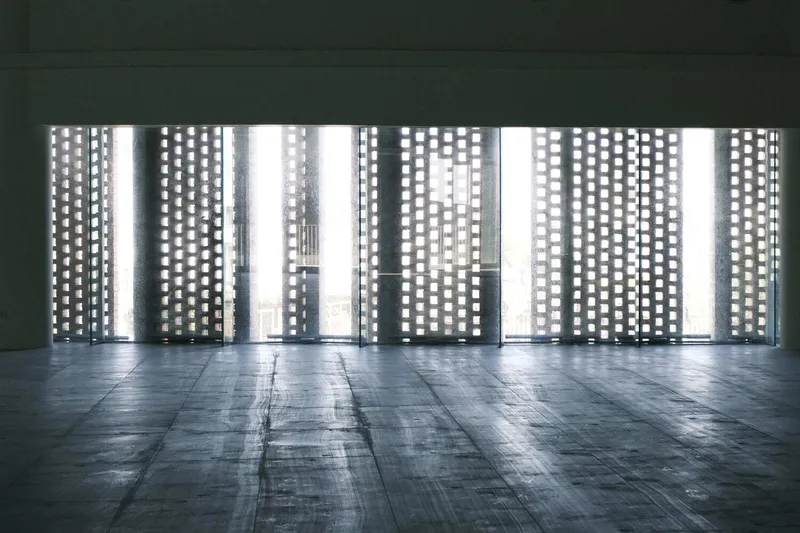
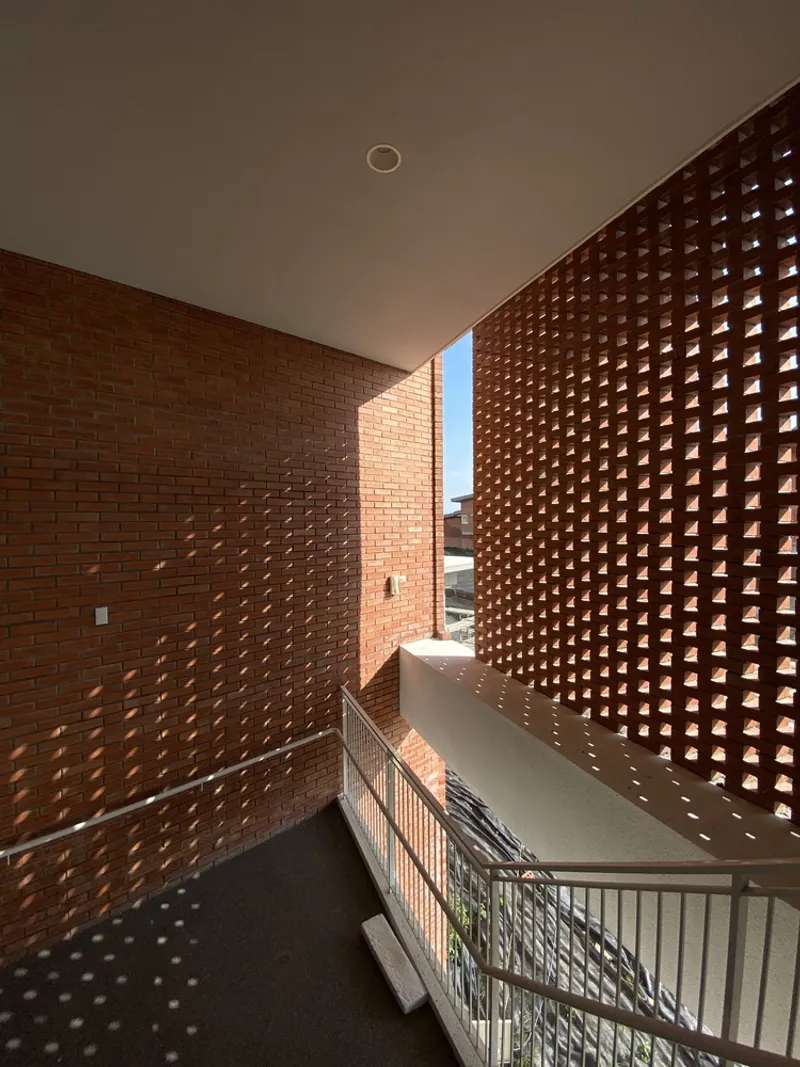
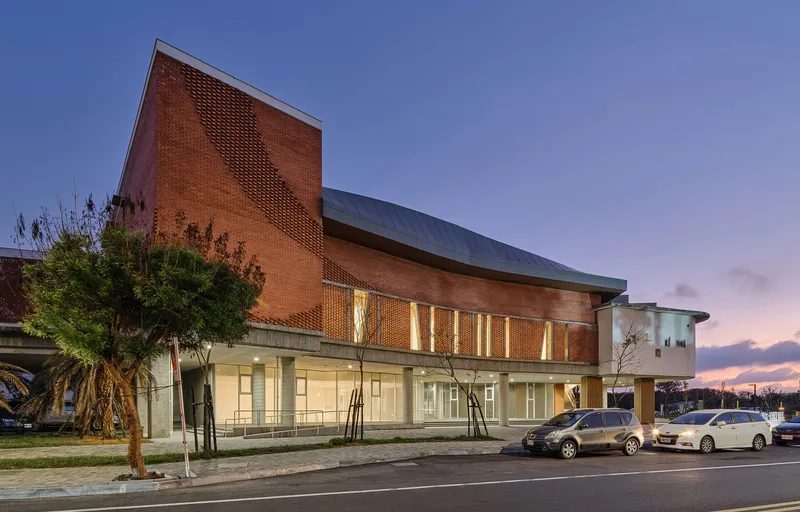
Red brick buildings were once ubiquitous in the Taiwanese countryside. Modernization erased most of them, but the material still carries deep associations for people in Yunlin County. Zoom Design Atelier leaned into that affection, cladding the upper facades in brick and, more inventively, deploying perforated brick screens that filter daylight into corridors and stairwells. The technique is borrowed directly from the hollow brickwork traditionally used in pig houses, where gaps between bricks allowed air to circulate through livestock enclosures. Here, the same principle manages solar gain on the west-facing facade and creates interiors washed with shifting patterns of light.
The perforated tower visible at dusk is the most striking expression of this strategy. Illuminated from within, the brick screen glows like a lantern, advertising the building's logic to anyone driving past. During the day, from inside, the same wall transforms sunlight into a textured scrim that changes character by the hour. It is the kind of detail that costs relatively little but delivers disproportionate spatial reward.
The Compressed Ground Floor
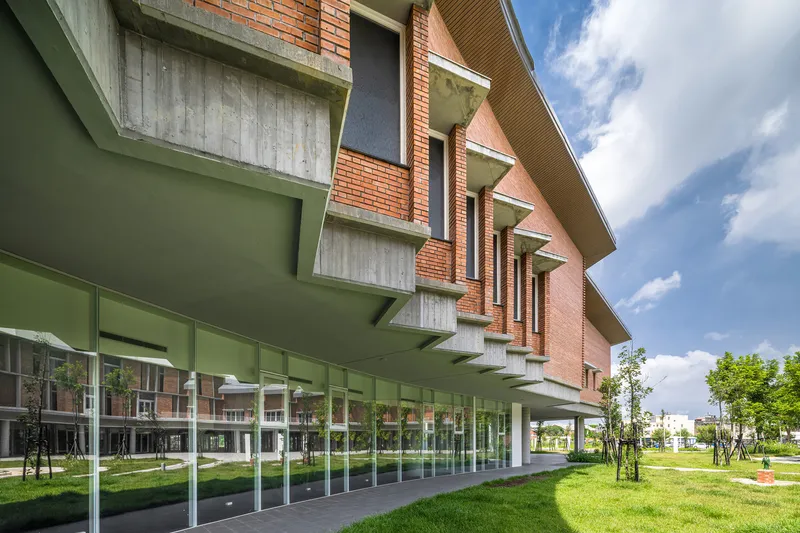
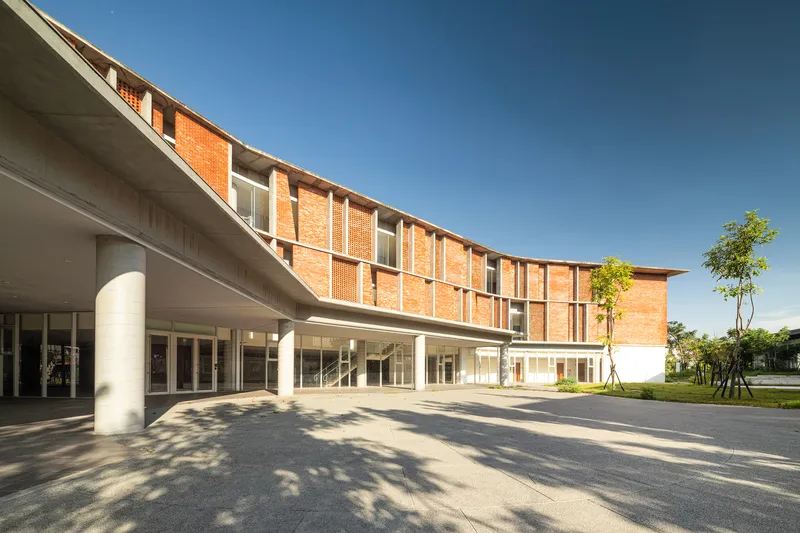
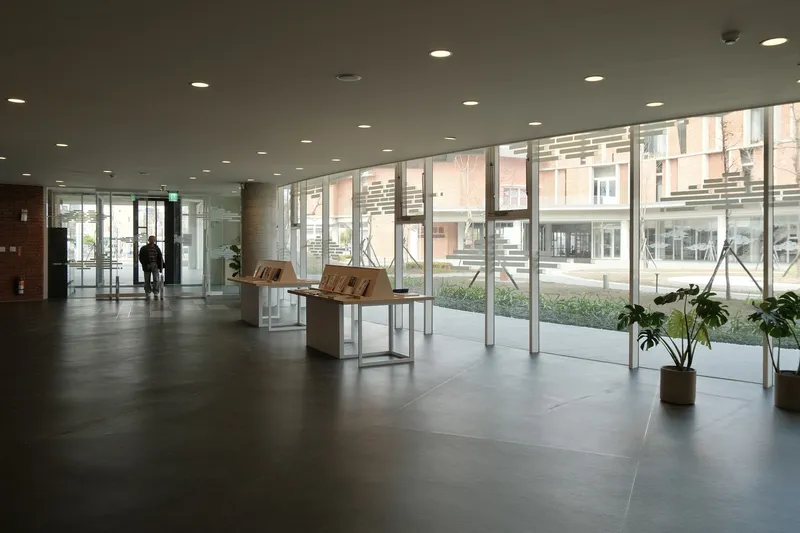
At ground level, the brick disappears. The architects pulled the facade back behind a colonnade of paired concrete buttresses and cylindrical columns, inserting floor-to-ceiling glass beneath a deep soffit painted in a quiet green. The effect is a horizontal compression that makes the upper brick volume feel like it is floating, while simultaneously dissolving the boundary between the paved plaza and the interior lobby. Large format grey floor tiles extend from inside to out, reinforcing the blurred threshold.
The deep overhangs created by recessing the glass are not decorative. They shade the ground floor from direct sun, reduce glare in the reading and exhibition spaces, and keep rain off the entries. For a building in a subtropical coastal climate, this kind of passive shading is the single most effective energy strategy available, and Zoom Design Atelier makes it do structural, spatial, and aesthetic work all at once.
The Library Section
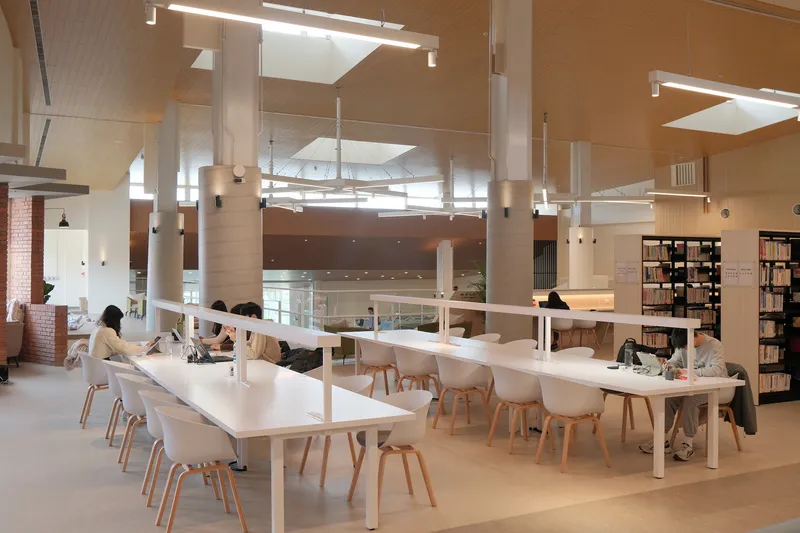
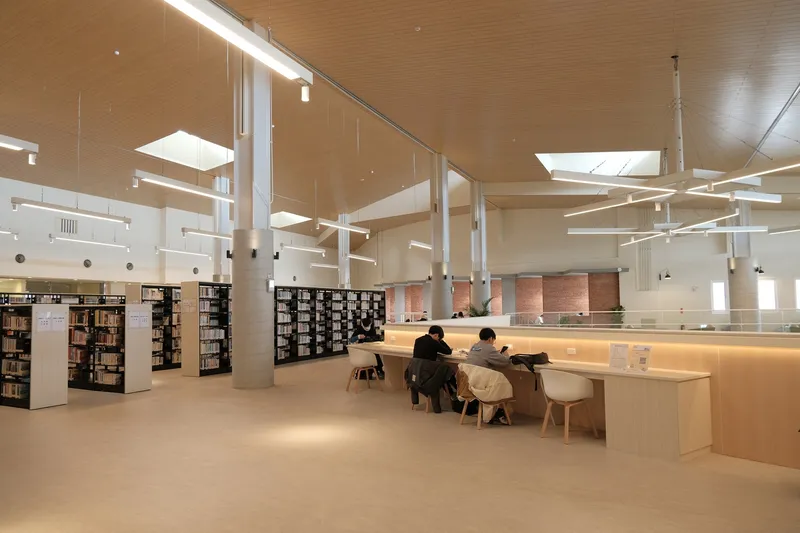
The library's most interesting move is sectional. Instead of entering at grade and climbing up, visitors descend from the entrance into a sunken core designed specifically for elderly readers and children. This inversion is subtle but significant: it places the quietest, most protected reading spaces at the lowest point, buffered from street noise and sheltered under the mass of the building above. A digital reading area occupies a mezzanine split-level, connected to the lower floor by stairs that use height differences to differentiate zones without walls.
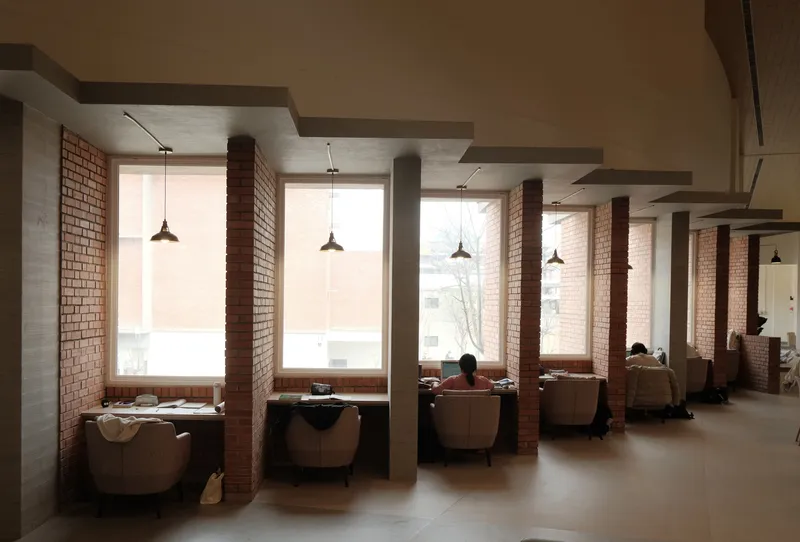
The ceiling tells the story. Tongue-and-groove timber panels slope upward toward skylights that wash the reading tables in diffused natural light, while suspended linear fixtures provide even illumination on overcast days. White columns punctuate the open floor plate, and black bookshelves define edges without enclosing them. Reading alcoves between red brick columns, fitted with leather armchairs and tall windows overlooking bare winter trees, offer the kind of intimate pockets that make people stay longer than they planned.
Interior Character and Material Warmth
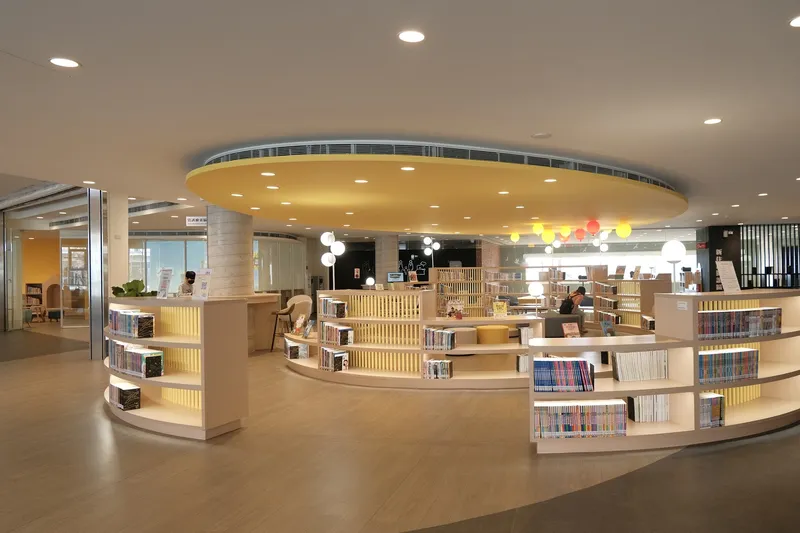
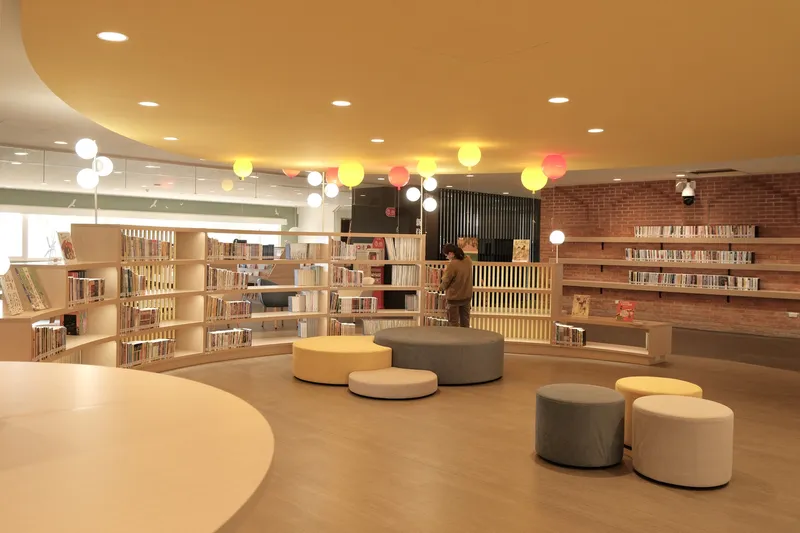
The interiors avoid the sterile minimalism that plagues so many civic libraries. At the circulation desk, curved plywood shelving wraps beneath a circular yellow ceiling soffit that signals the heart of the building without shouting. A children's reading area nearby deploys colorful balloon pendant lights and circular upholstered seating, calibrated in scale and color for its youngest users. These are not whimsical gestures; they are programmatic signals embedded in the architecture, telling visitors where they are and who the space is for.
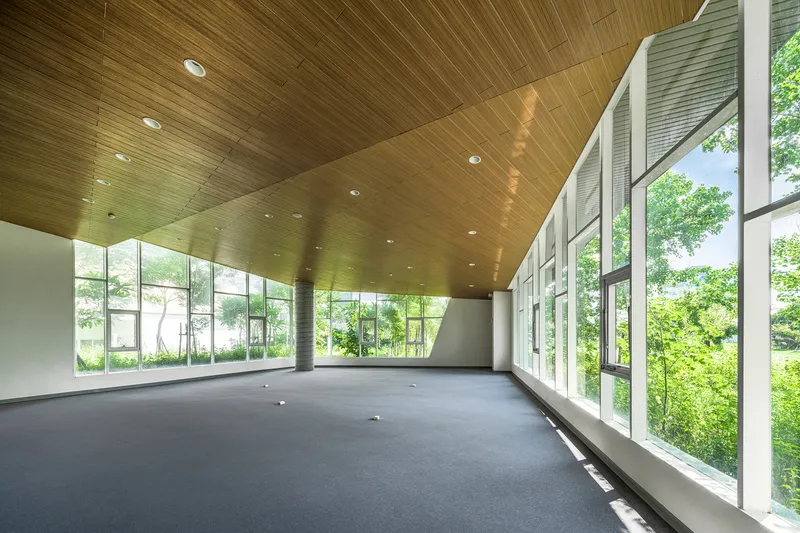
Elsewhere, a curved corridor with timber slatted ceiling and floor-to-ceiling glazing frames dense summer foliage, turning the landscape into a green wall that shifts with the seasons. The palette throughout, exposed brick, plywood, timber ceiling panels, grey tile, is restrained but warm, avoiding both austerity and kitsch.
The Living Art Center and Vertical Circulation
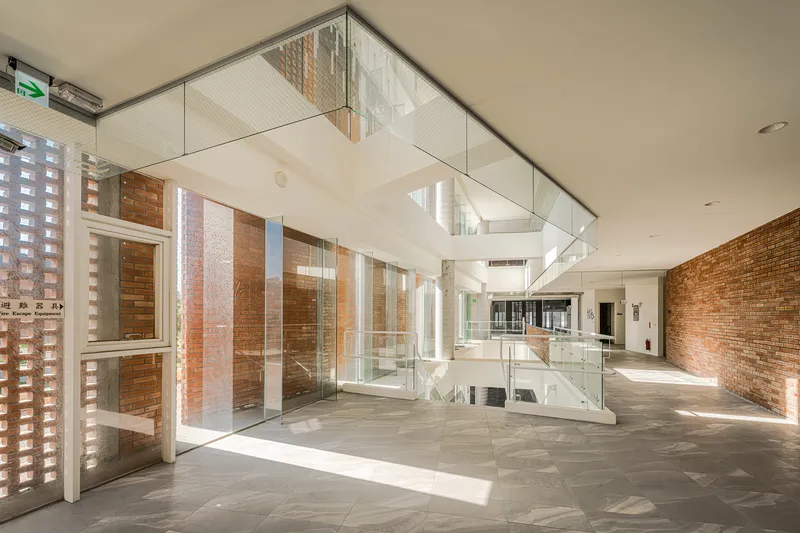
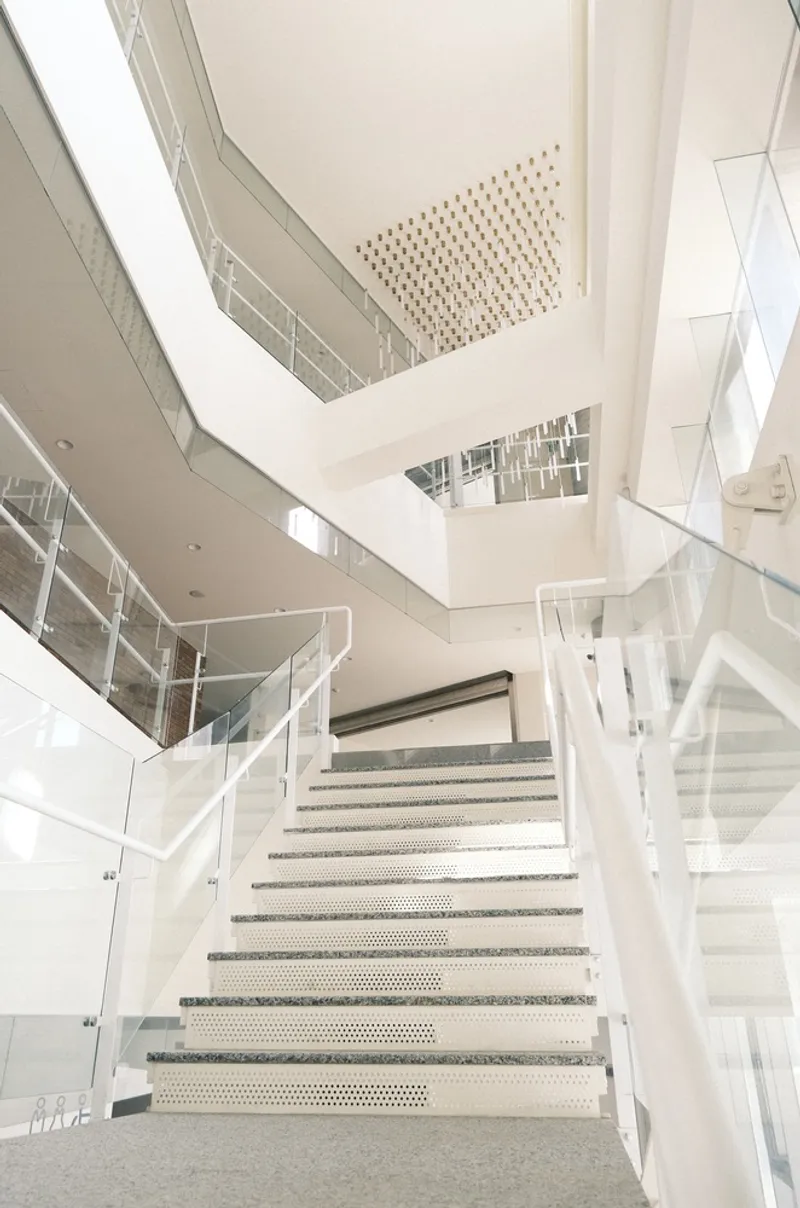
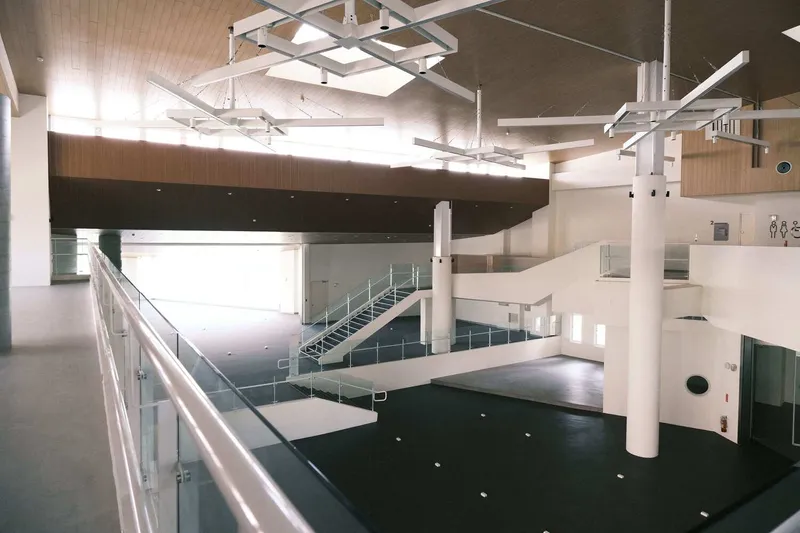
The living art center organizes its exhibition halls and classrooms around an atrium that serves as the building's connective tissue. A glass-enclosed stairwell rises through the atrium with brick walls and stone floors catching afternoon sun, creating a vertical promenade that links all levels. Perforated metal stairs and glass balustrades keep sightlines open across the multi-story void, so visitors on the mezzanine can see activity below and vice versa.
The concept is straightforward: movement through the building should feel continuous, not segmented by corridors and closed doors. The atrium gathers light from above and distributes it downward, reducing artificial lighting loads during the day and reinforcing the sensation that interior and exterior are part of the same spatial continuum.
Facade and Massing at Dusk
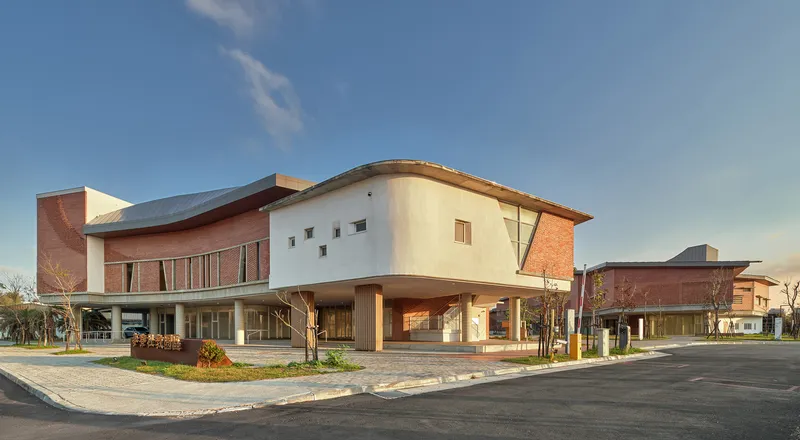
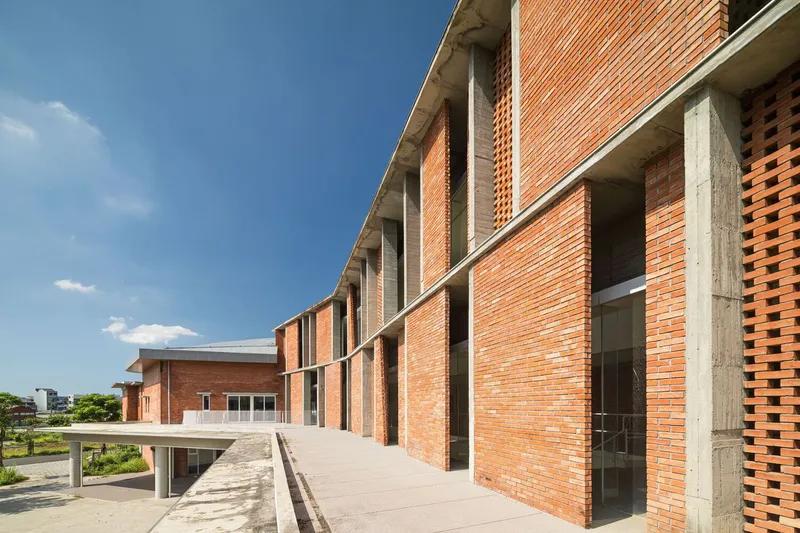
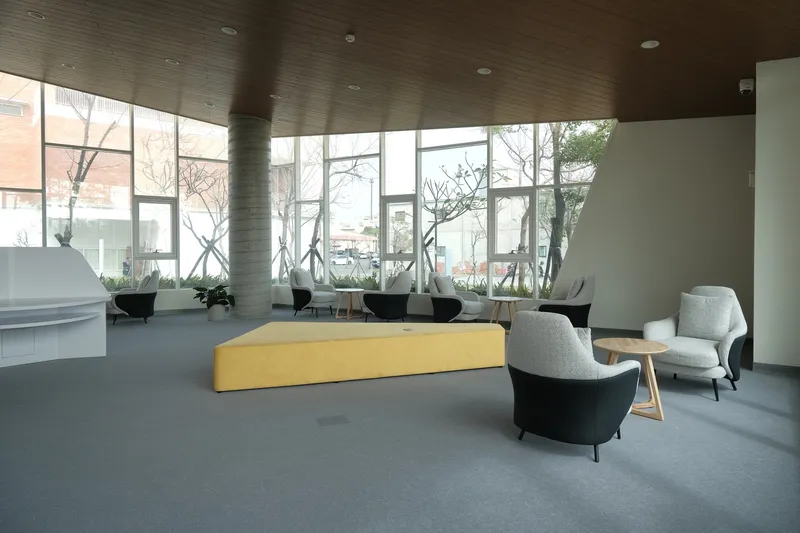
Under evening light, the campus reveals its dual character. The curved and rectilinear volumes read as complementary figures, their red brick upper halves warm against the cooling sky, their glazed ground floors glowing from within. The upper level walkway with its vertical window openings and exposed concrete columns has a civic solidity that anchors the building in its small-town context without condescending to it. Inside, a lounge area with yellow bench seating and cross-braced glazed walls offers a more relaxed register, a place to sit and look out rather than move through.
The architects describe the living art center as expressing "time" and the library as expressing "space." The distinction is conceptual rather than visible, but the two buildings do feel different: one more vertical and event-driven, the other more horizontal and contemplative. Together they bracket a range of public activities that a single building could not comfortably hold.
Plans and Drawings
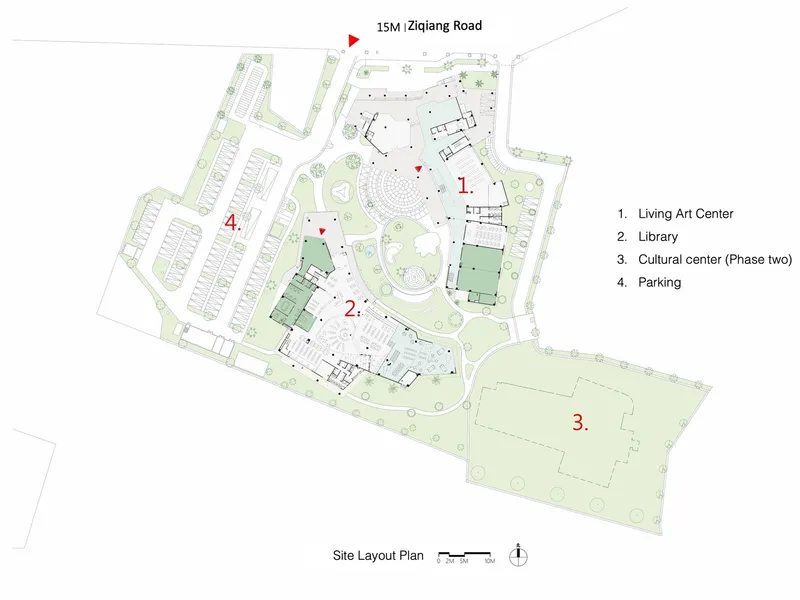
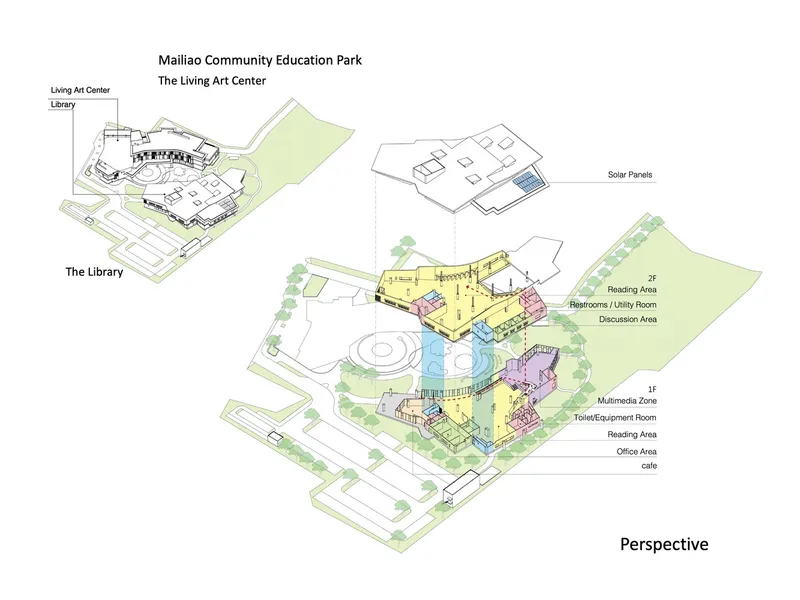
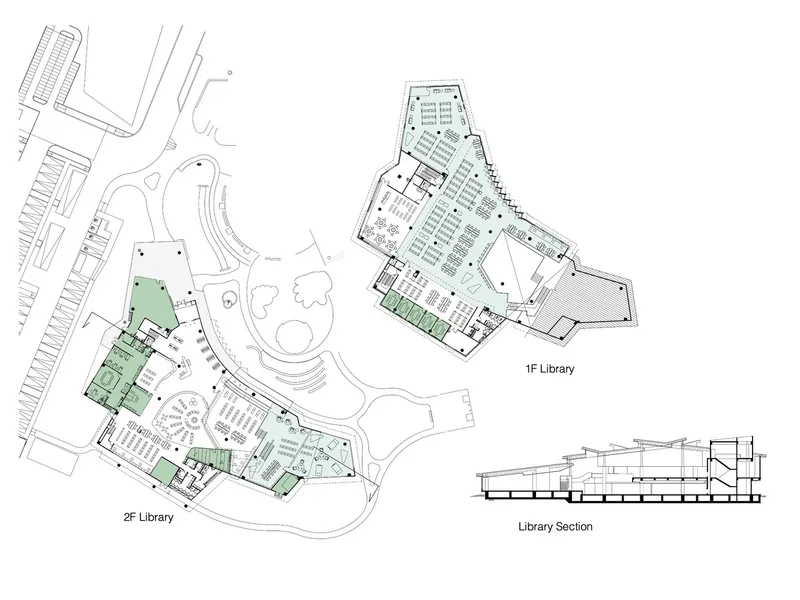
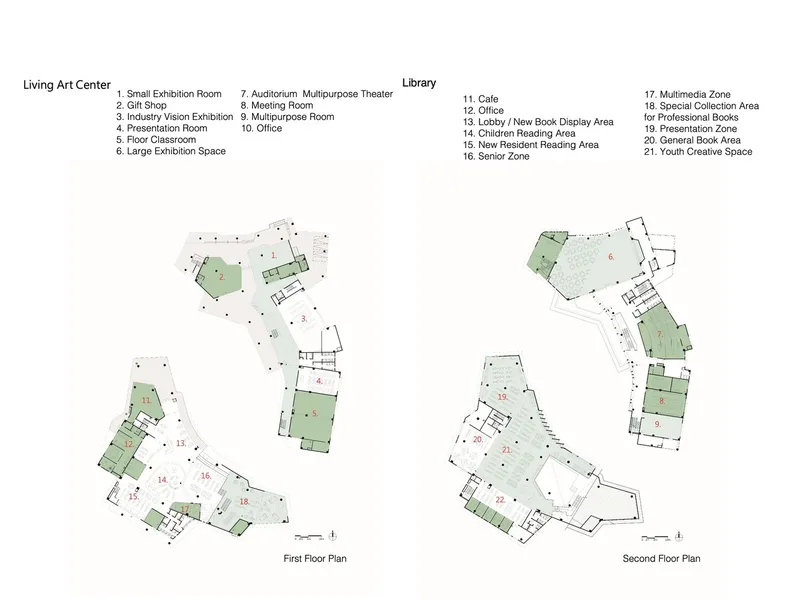
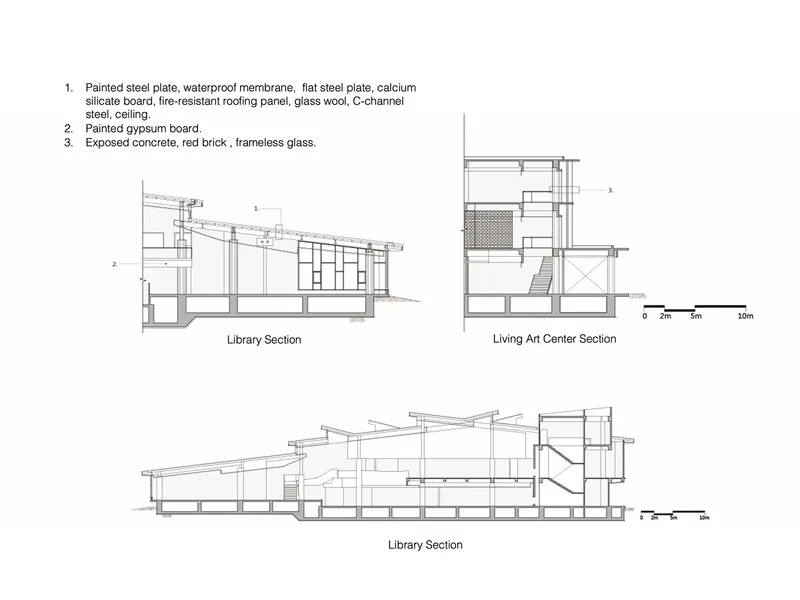
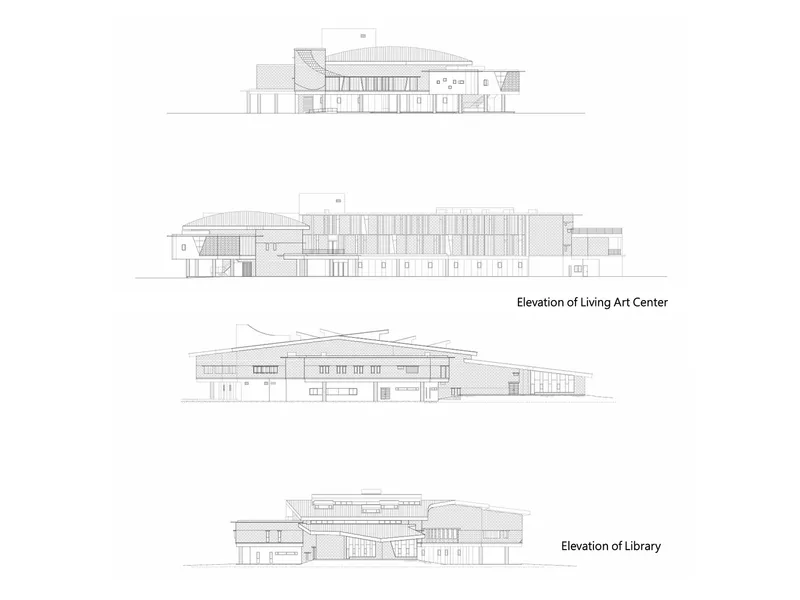
The site plan confirms what the aerial photograph suggests: four volumes arranged around the central egg-shaped courtyard, with parking pushed to the periphery and landscape buffers softening the edges. The axonometric drawing is particularly revealing, showing color-coded programmatic zones radiating outward from the central atrium of each building. Sections through both the library and living art center illustrate the roof assembly layers, the relationship between the sloping timber ceiling and the skylights above, and the split-level strategy that creates diverse reading environments within a compact footprint. Elevations emphasize the long horizontal datum that unifies the campus, with varied rooflines breaking the silhouette just enough to distinguish the two buildings.
Why This Project Matters
Mailiao Community Education Park matters because it demonstrates that civic architecture in a small Taiwanese township can be rigorous, climate-responsive, and culturally grounded without importing a single trendy material or formal gesture from abroad. The hollow brickwork borrowed from pig houses is not nostalgia; it is a tested ventilation technique repurposed for a new building type. The sunken library entrance is not an aesthetic choice; it is an accessibility strategy for elderly and young readers. Every visible decision traces back to a performance requirement, which is what separates genuine design intelligence from surface styling.
For communities in similar coastal, agricultural, and semi-industrial contexts across Asia and beyond, this project offers a replicable lesson: work with the wind, not against it; use local materials for their thermal and cultural properties simultaneously; and organize the section before you decorate the facade. Zoom Design Atelier has produced a building that will age well, both physically in its durable brick skin and programmatically in its flexible, light-filled interiors. That is a harder achievement than it looks.
Mailiao Community Education Park by Zoom Design Atelier. Mailiao Township, Yunlin County, Taiwan. 5,404 m². 2023.
About the Studio
Share Your Own Work on uni.xyz
If projects like this are the kind of work you want to make, uni.xyz is a place to publish your own, find collaborators, and enter design competitions.


Popular Articles
Popular articles from the community


David Ortega Stacks a Two-Story Mexico City Penthouse Around a Steel Stair and a Pergola-Shaded Roof Terrace
In Colonia Roma, a 300 m² penthouse uses oak joinery, a planted steel stair and a slatted roof pergola to make a new-build apartment feel like a house.

LT2A and OPEN Architectes Thread a Brick and Glass High School Through a Wooded Belgian Campus
In Braine-l'Alleud, a 3,000 m² wing for Collège Cardinal Mercier pairs pale brick with a glazed colonnade, deferring to a small chapel and a dense wood.

David Macias Steps a Doorless Stone and Plaster House Down a Tropical Colombian Hillside
In the humid hills of Colombia, Threshold House replaces the front door with an open void and terraces its 850 m² down the slope instead of fighting it.

longwave studio Reorganizes a 112 m² Tainan Apartment Around the Daily Routines of a Family and Two Cats
In Tainan, Taiwan, birch plywood, rust-red furniture and a freestanding plaster wall link arrival, storage, work and family life in one apartment.

Similar Reads
You might also enjoy these articles

Bamboo Housing Challenge 2026: Design Affordable, Sustainable Homes Using Bamboo
An international design competition by Bamboo U and IBUKU inviting architects and designers to reimagine affordable housing using bamboo — with the winning design built full-scale in Bali.

Computational Design & Education: Beegraphy Design Awards Introduces 7th Category (Featuring Jiyun's Innovative Approach)
Dive into Beegraphy’s 7th Design Awards category, where computational design meets education to create immersive, interactive learning tools, inspired by Jiyun’s work.
From Parametric Lighting to Urban Furniture: Join the 2nd Workshop in Beegraphy’s Computational Design Series
Dive into Cutting-Edge Design Techniques and Practical Applications with Industry Experts

Last Call: Unleash Your Architectural Genius in SHAK's Kindergarten Design Competition
Urgent call for architects to join SHAK's kindergarten design competition before the looming deadline

Explore Architecture Competitions
Discover active competitions in this discipline

Challenge to reimagine the Iron Throne

Photograph architecture without architects

Illustrate the lost glory of Angkor Wat - Render Challenge

Design challenge to reuse E-waste
Comments (0)
Please login or sign up to add comments
No comments yet. Be the first to comment!