
Manuelle Gautrand Wraps Two Airport Hotels in a Single Gradient Facade at Paris CDG
A 14,000 m² dual-hotel complex near Roissy Terminal 1 uses color-shifting aluminium panels to dissolve the monotony of airport architecture.


Airport hotels occupy a peculiar zone in the architectural imagination: functionally necessary, spatially constrained, and almost always forgettable. Manuelle Gautrand Architecture took on that problem directly with the Marriott Paris CDG Airport Hotels, a 14,000 m² dual-hotel complex delivered in 2022 on the eastern fringe of the Roissy renewal master plan. The site sits close to Terminal 1 on a plot designated as the 'Pôle Hôtelier,' a hospitality cluster that will eventually include several hotels and office buildings along a new urban axis. Gautrand's response is to treat the two hotels, a 229-room Courtyard and a 106-room Residence Inn, not as separate buildings but as two volumes that slip behind one another and fuse at the base, sharing restaurants, a bar, a business center, a fitness center, and underground parking.
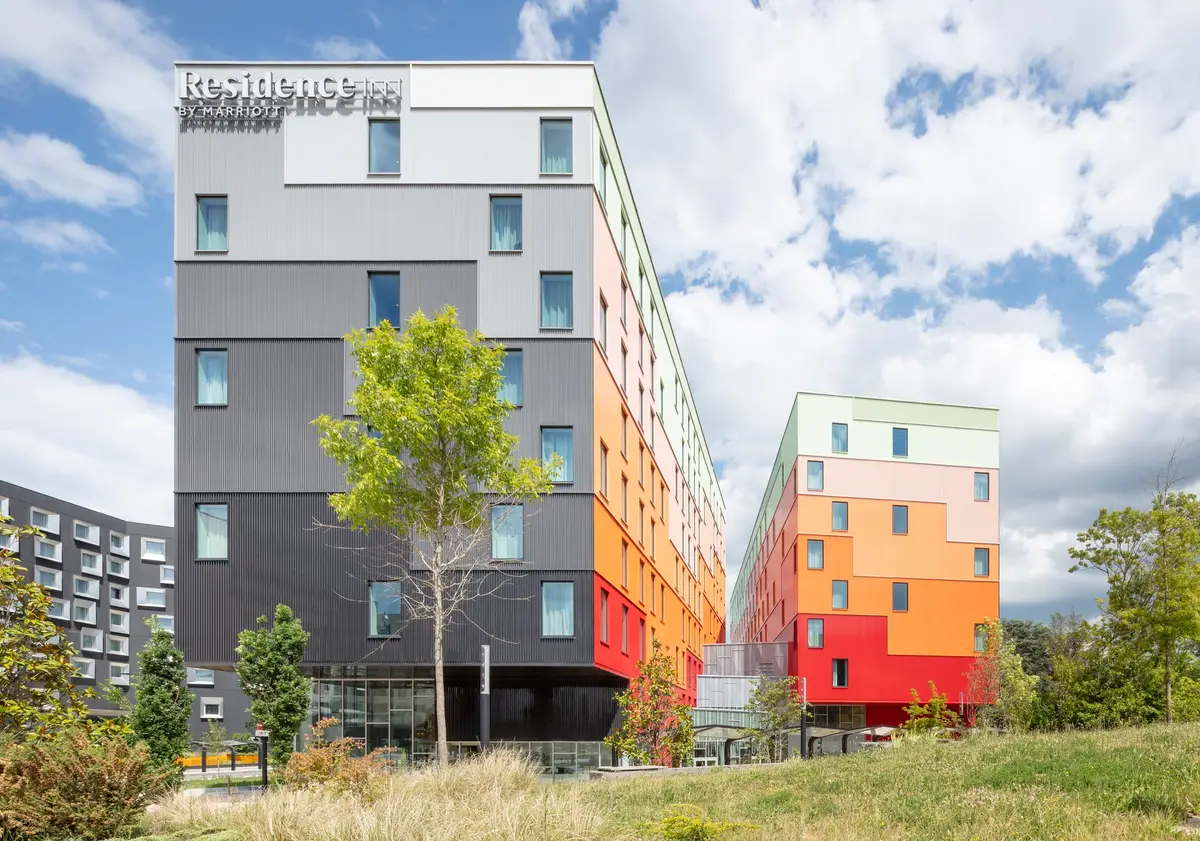
What makes the project genuinely interesting is the facade strategy. The two parallel volumes present a black-and-white palette to the public side and a full polychromatic gradient on the courtyard-facing elevations, moving from dark red at ground level through pinks and beiges to green tones at the roofline. Powder-coated aluminium panels produce this chromatic shift, and the effect is less decorative gesture than spatial instrument: the gradient dissolves the visual bulk of the massing, gives each floor a distinct identity from within, and turns the narrow courtyard into a surprisingly colorful interstitial space. For an airport precinct where most buildings defer to grey, the move is pointed.
A Gradient That Does More Than Decorate
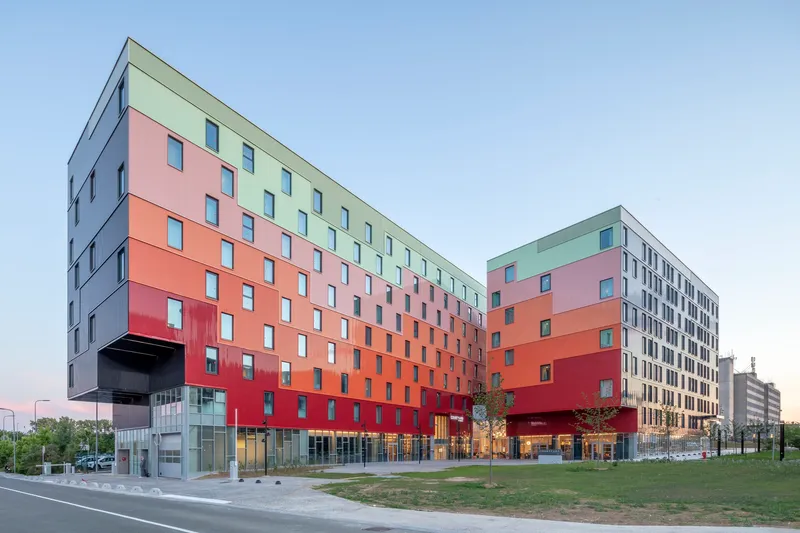
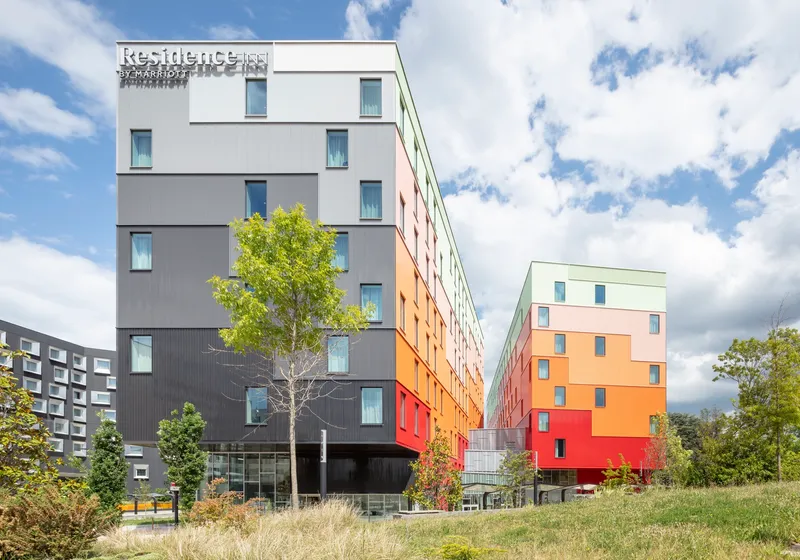
The facade's tonal graduation, darker at the base and lighter as it rises, serves an optical purpose beyond surface appeal. By anchoring the building visually to the ground with deeper reds and dissolving the upper floors into pale greens and near-whites, Gautrand counteracts the typical slab-like reading of a hotel block. Seen from the urban axis with its tramway, dual carriageway, and planted esplanades, the two volumes read as lighter than their actual mass. The aluminium panels are powder-coated, meaning the color is integral to the material rather than applied, which matters for longevity in the particulate-heavy air near an active runway.
The decision to split the color language into two registers, monochrome on the public faces and polychromatic on the courtyard elevations, is a smart reading of context. Toward the street, the buildings maintain a composed urban front. Between them, the colorful surfaces create an almost private atmosphere for guests arriving from the forecourt. Young trees planted in this gap reinforce the sense that the courtyard is a decompression zone between two programmatically distinct hotels.
Two Hotels, One Building Logic
The 'combo' typology, two branded hotels grafted onto a shared base, is a Marriott corporate format, but Gautrand turns the constraint into an architectural proposition. The room masses are compact and efficiently organized with central circulation and rooms on either side, while the shared common areas at the lower levels are fluid, fully glazed, and open to the outside. Cantilevers at the extremities of each volume create sheltered arrival zones and signal the two distinct identities without splitting the building into separate objects. Neither volume exceeds 80 meters in a single stretch along the urban axis, a disciplined response to the master plan's guidelines that also prevents the complex from reading as a wall.
The low-carbon concrete structure and BREEAM Good certification point to a sustainability ambition that, while not radical, is above the baseline for airport-adjacent hospitality. For a building type that often treats environmental performance as an afterthought, the choices at least register as deliberate. The structural engineers at VCF and contractor Campenon Bernard Construction (CBC) delivered the project with a material palette of concrete, glass, stainless steel, and those aluminium panels, a restrained kit that lets the color do the heavy lifting.
Why This Project Matters
Airport precincts are among the most architecturally neglected zones in contemporary urbanism. They generate enormous footfall but almost no spatial ambition, defaulting to curtain-wall boxes surrounded by asphalt. Gautrand's Marriott complex does not pretend to be a civic monument, but it proves that even within a tightly programmed commercial brief, considered massing and a well-executed material strategy can produce a building worth remembering. The gradient facade is not a gimmick; it actively reshapes how the volumes sit in the landscape and how guests experience the transition from public street to private courtyard.
More broadly, the project demonstrates that the 'combo hotel' format, often a cost-driven decision, can yield spatial dividends when the shared base is treated as a generous, glazed public zone rather than a leftover connector. As the Roissy Pôle Hôtelier fills in around it, this complex will set the standard for what the cluster can be. Whether neighboring buildings rise to that challenge is another question, but at least the benchmark has color.
Marriott Paris CDG Airport Hotels, designed by Manuelle Gautrand Architecture, Roissy-en-France, France. 14,000 m², completed 2022. Photography by Luc Boegly.
About the Studio
Share Your Own Work on uni.xyz
If projects like this are the kind of work you want to make, uni.xyz is a place to publish your own, find collaborators, and enter design competitions.


Popular Articles
Popular articles from the community


Singing Woman: An Opera House That Performs Before the Curtain Rises
Ovidiu Cristian Pavel's conceptual opera house translates Estonia's choral identity into a sculpted waterfront landmark facing the Baltic Sea.


FCC Arquitectura Expands a Portuguese Granite House with a Board-Marked Concrete Wing
In Portugal, JV House pairs a cleaned-up whitewashed and granite dwelling with a timber-shuttered concrete extension, courtyards and a garden pool.

Manzana Morphosis: Stretching Barcelona's Grid into a Living Landscape for 2050
A radical reworking of the Eixample manzana turns density into a tool for generous public space, vertical ecology, and environmental performance.

ETEH Reworks the Shared Spaces of São Domingos School in Brazil Around Timber, Color and Hanging Plants
At São Domingos School in Brazil, 436 m² of hall, refectory and library are recast with timber joinery, a yellow and blue code and trailing greenery.

Similar Reads
You might also enjoy these articles

LAVA Architecten Gives Vocational Education a Sawtooth-Roofed Face on a Mechelen School Campus
In Mechelen, Belgium, a 2,053 m² STEM school on a 6×6 m grid turns workshops and classrooms into rooms that can be rearranged as teaching changes.

KEMA Studio Turns a Derelict Marvila Attic into a 60 m² Lighthouse Apartment Above Lisbon
In Lisbon's Marvila district, a rebuilt roof, four skylights and two plywood volumes turn an unlivable attic into a bright home facing the Tagus.

Pixel Gardens: One Repeated Module Stacked Into a Terraced Social Housing Tower for Famagusta
Salem Bader's shortlisted housing tower builds a vertical neighbourhood from one repeated module, offsetting units to carve terraces, light and air.

Bao Huynh Watercolor Atelier: A Serene Art Retreat in Hội An
Bao Huynh Watercolor Atelier in Hội An blends multifunctional art spaces, sustainable design, local materials, and family-friendly living in a serene environment.

Comments (0)
Please login or sign up to add comments
No comments yet. Be the first to comment!