

Restoring the Antioquian House Without Nostalgia
Trópico Arquitectura revives a traditional courtyard house in Támesis, Colombia, proving that renovation can honor craft without embalming it.


In the mountainous southwest of Antioquia, the town of Támesis holds onto a building tradition that most Colombian cities discarded decades ago: single-story courtyard houses with timber frames, clay tile roofs, and a spatial logic organized around open-air centers. The Margaritas House is one of these structures, and its renovation by Trópico Arquitectura, led by Candelaria Posada and María José Arango, treats that inheritance with precision rather than sentimentality.
What makes this project worth studying is not a dramatic before-and-after transformation but rather its discipline. The architects chose to work within the existing footprint, reinforcing and revealing the material logic of the original house rather than overwriting it. At 280 square meters, the house is modest by renovation standards, yet the sequence of spaces, from shaded verandas to the vine-covered central courtyard, produces an experience that feels generous and deeply calibrated to its warm climate.
The Courtyard as Climate Machine
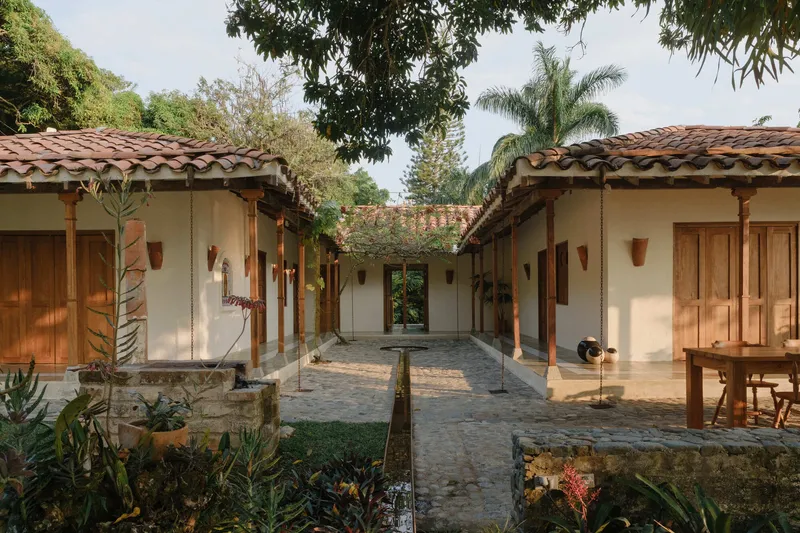
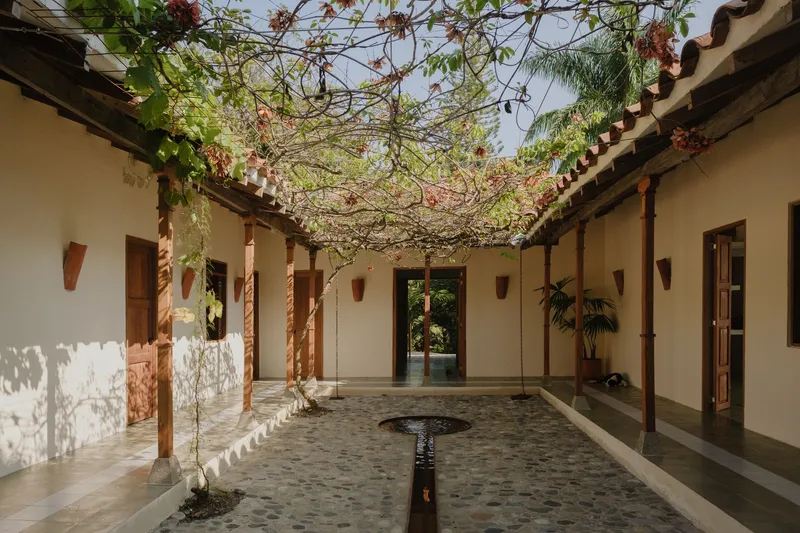
The plan is direct: a square structure wrapped around a central courtyard. There is nothing experimental about this layout, and that is the point. The courtyard creates a microclimate, pulling warm air upward and drawing cooler air through the surrounding rooms. Flowering vines on a trellis overhead filter sunlight without blocking it entirely, and a terrazzo floor provides thermal mass that stays cool through the afternoon.
Stone paving, tropical planting, and the absence of glass between inside and outside all reinforce a system of passive cooling that predates mechanical air conditioning by centuries. The architects understood that the best thing they could do was get out of the way of a strategy that already works.
Timber Structure on Full Display
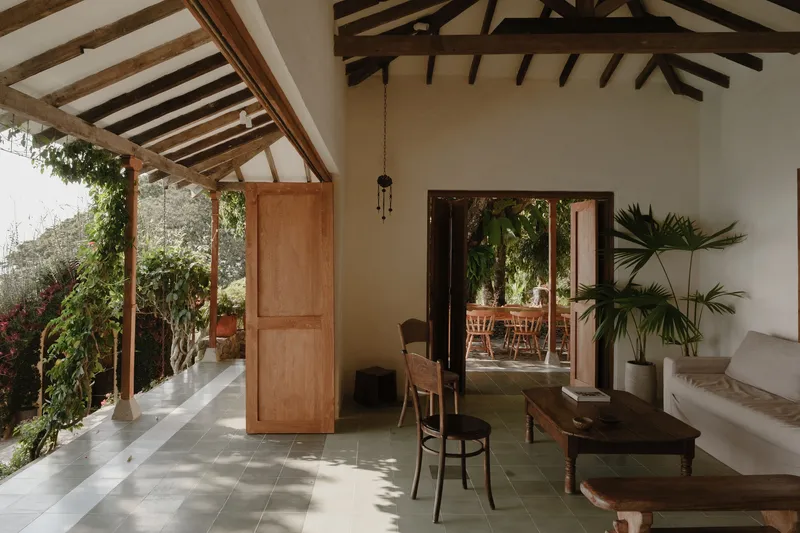
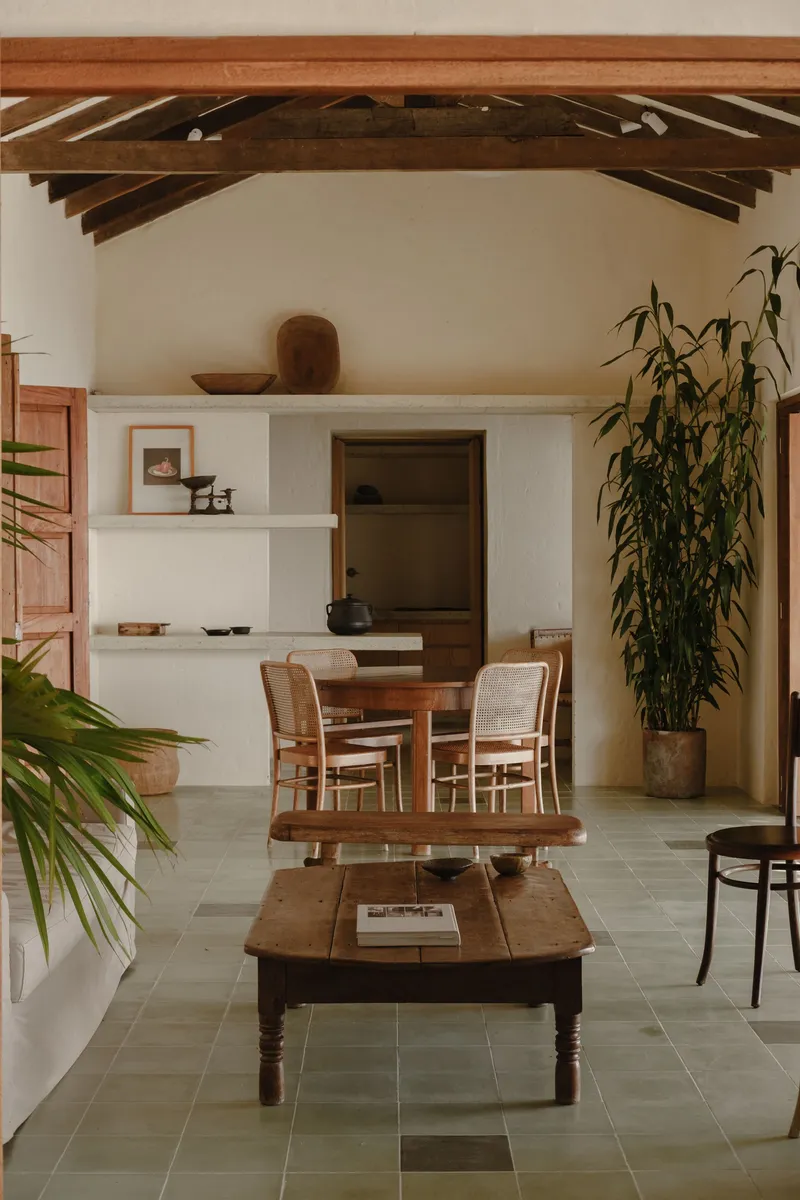
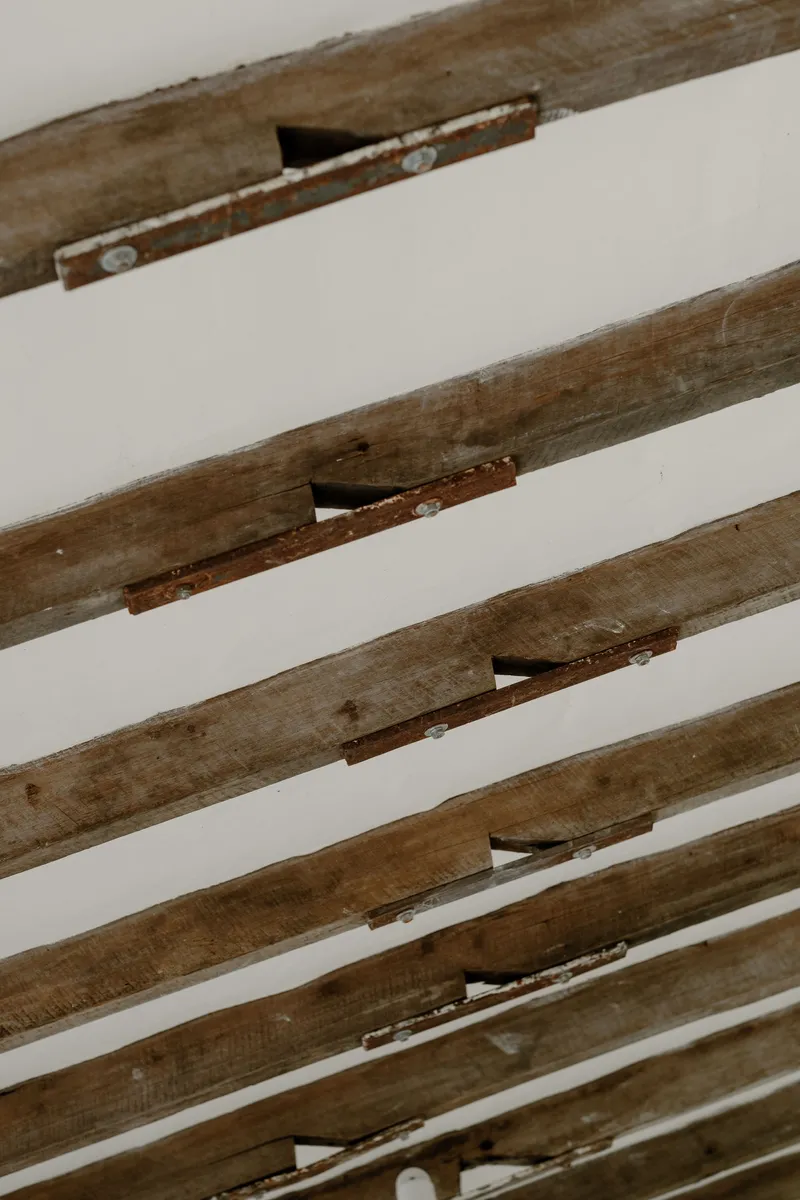
Throughout the house, the exposed timber roof trusses and ceiling beams tell the story of the building more honestly than any plaque could. The renovation stripped back layers that had concealed the structural skeleton, revealing beautifully weathered joinery: mortise-and-tenon connections, hand-cut rafters, and metal fasteners stained with age. Rather than replacing these elements, the architects cleaned and reinforced them, allowing rust, patina, and grain to remain visible.
In the living spaces, the exposed trusses establish a rhythm overhead that organizes the rooms below. Built-in shelving and simple furnishings defer to the structural order. There is a lesson here about renovation budgets: spend the money on what is already there, and the new elements can be minimal.
The Veranda and Its Thresholds
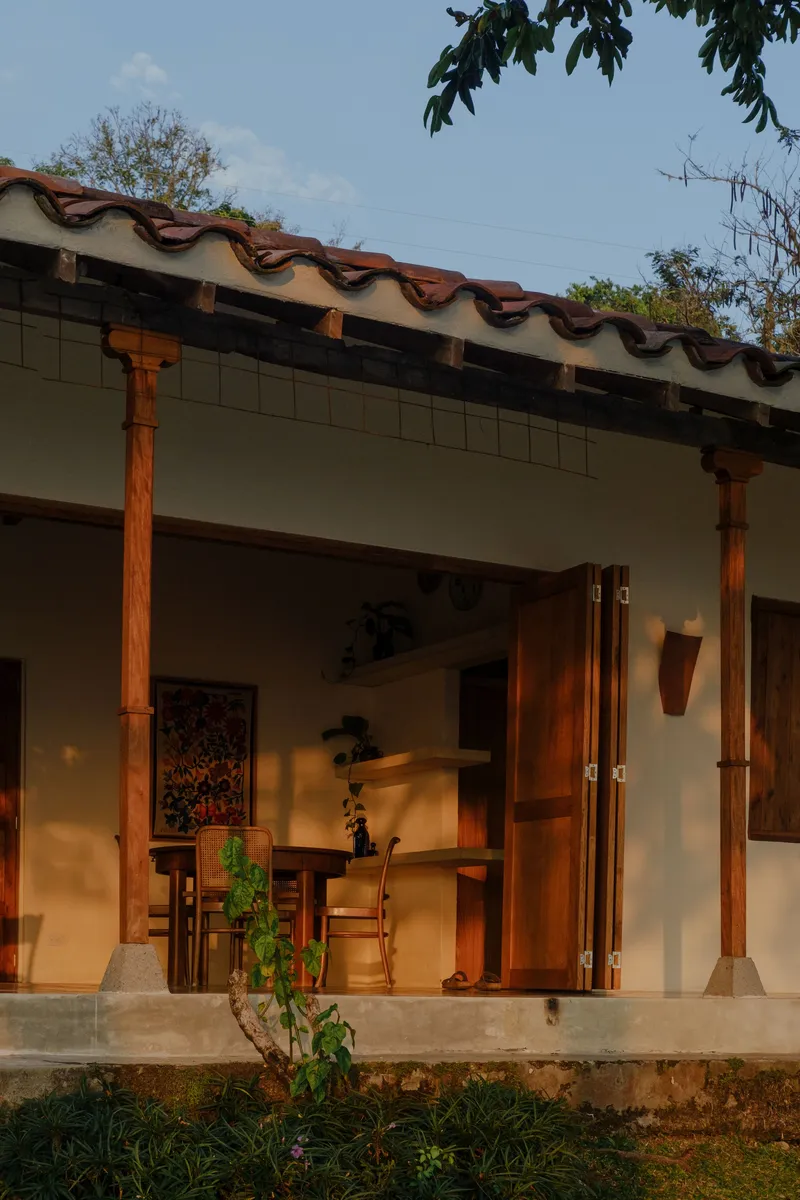
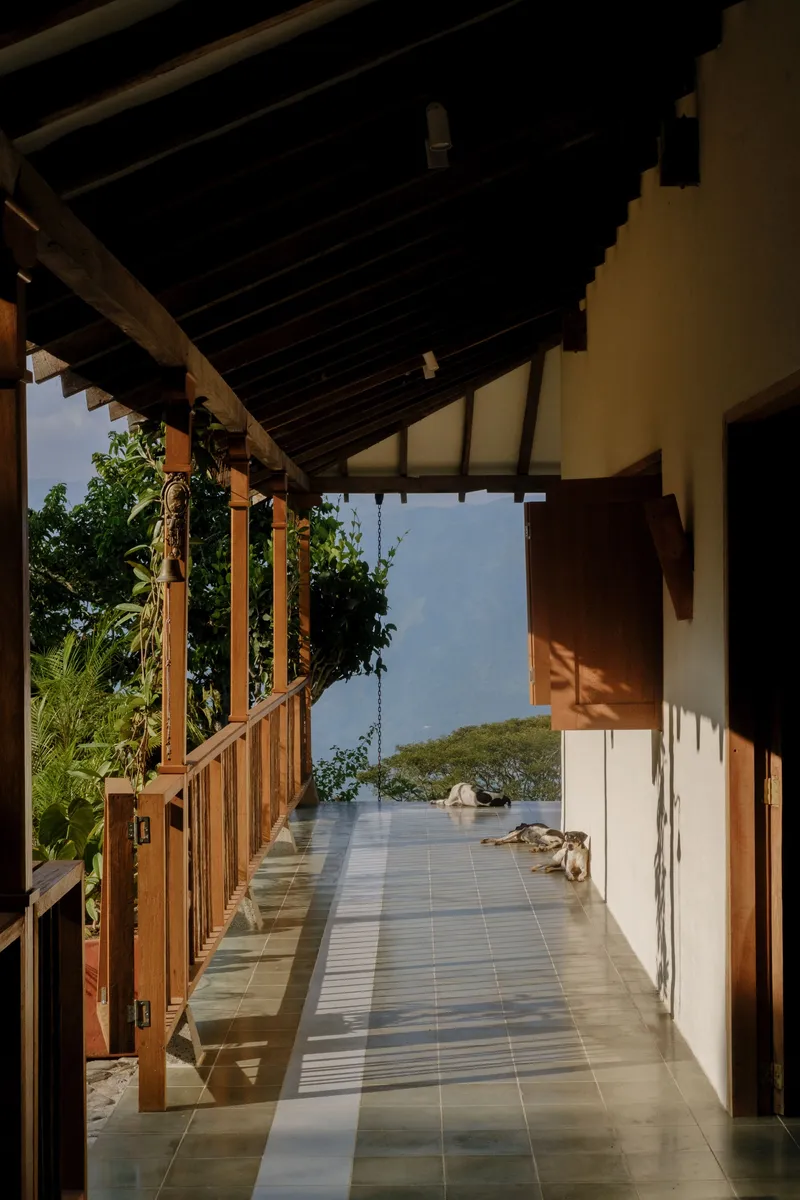
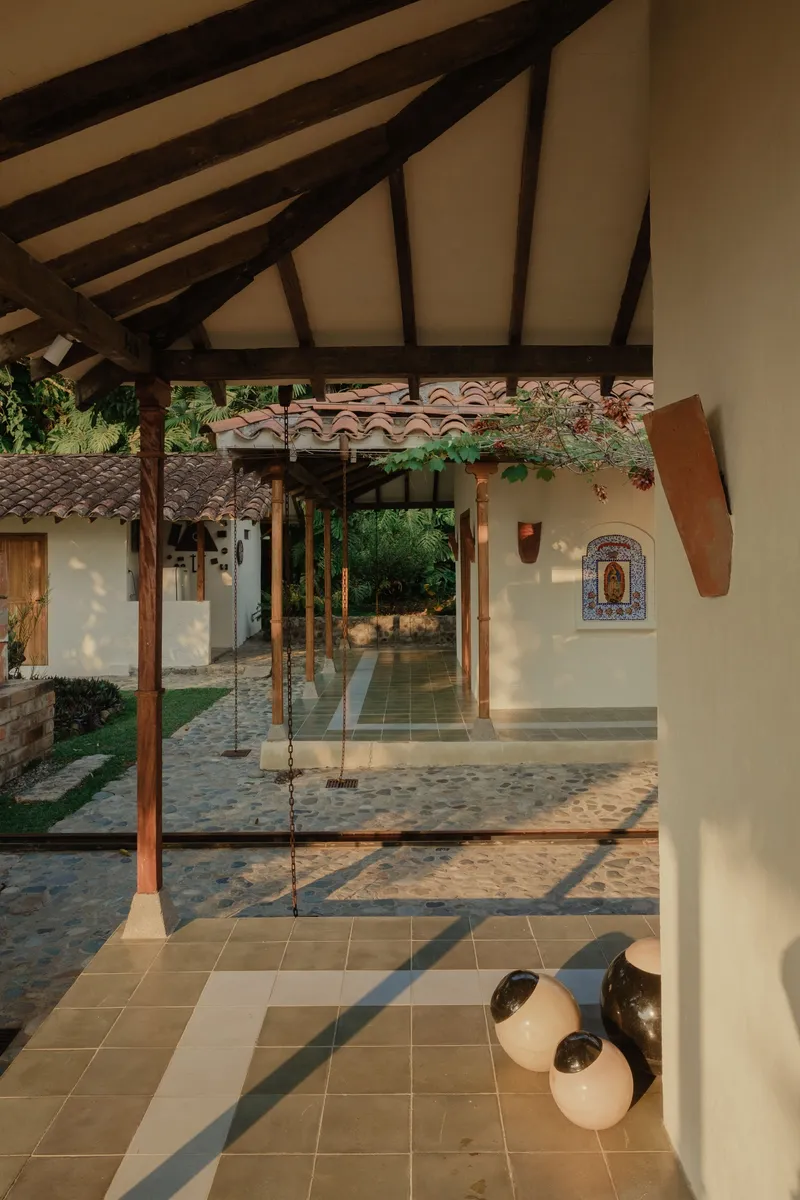
The covered walkways that ring the courtyard and face the landscape do more work than any single room in the house. They are simultaneously circulation, living space, and climate buffer. Timber columns at regular intervals create a colonnade that frames views of the distant mountains and, on at least one side, water in the valley below. The clay tile paving extends from interior rooms out through the veranda, dissolving the threshold between inside and outside.
At dusk, the verandas glow with reflected light from the terracotta roof tiles. The shadows cast by the timber rafters shift through the afternoon, marking time more effectively than any clock. These are not decorative porches attached to a house; they are the house, or at least the spaces where daily life actually happens in a warm climate.
Materiality: Stone, Clay, and Plaster
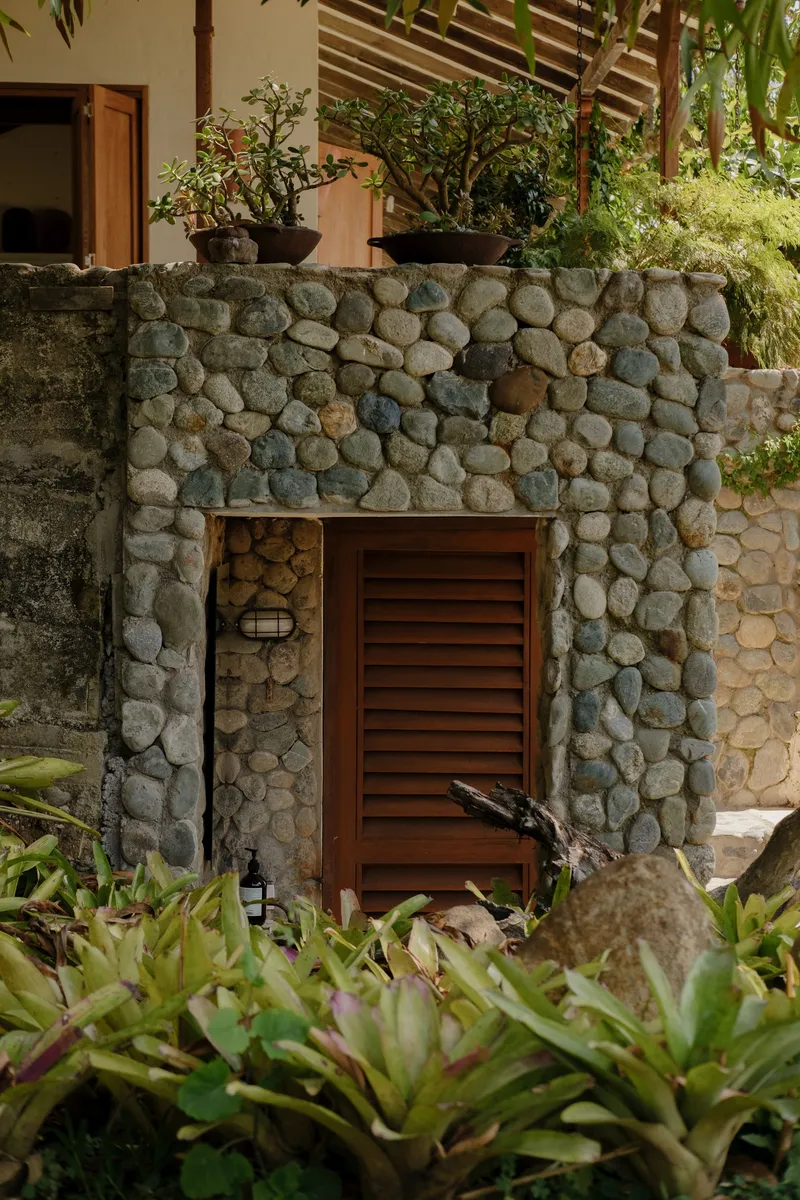
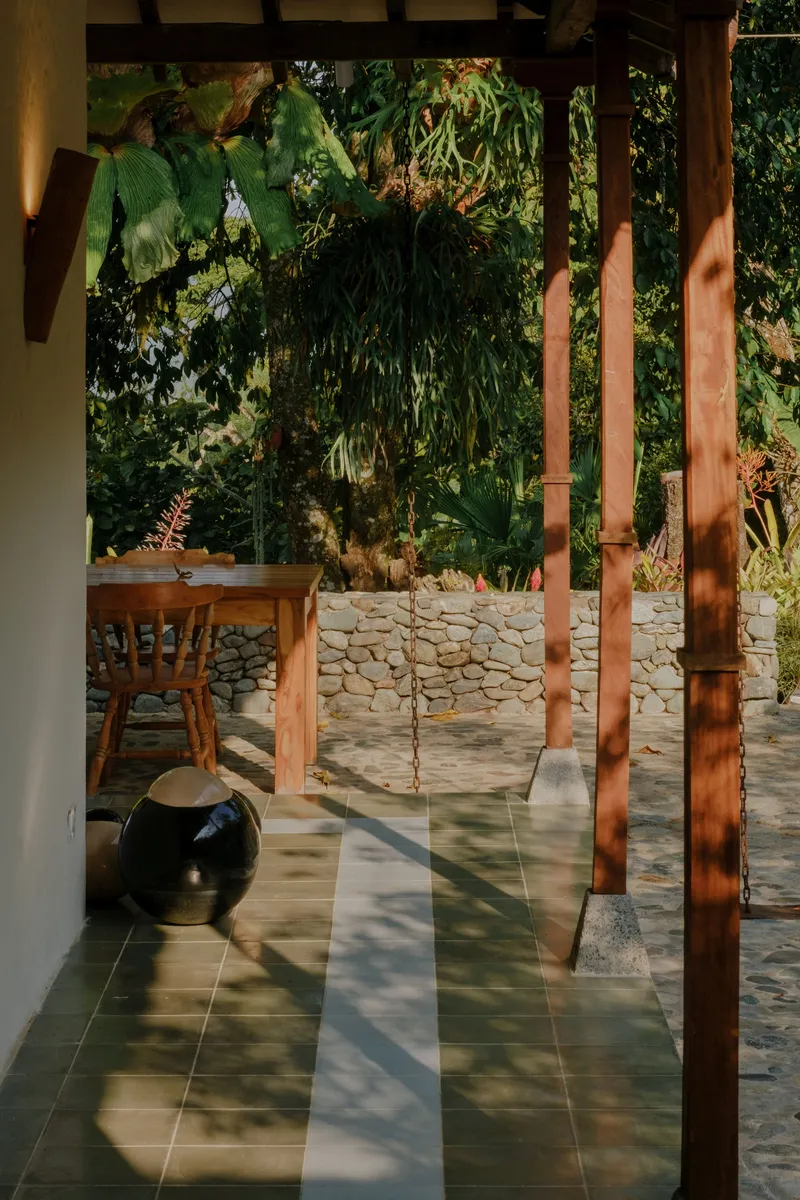
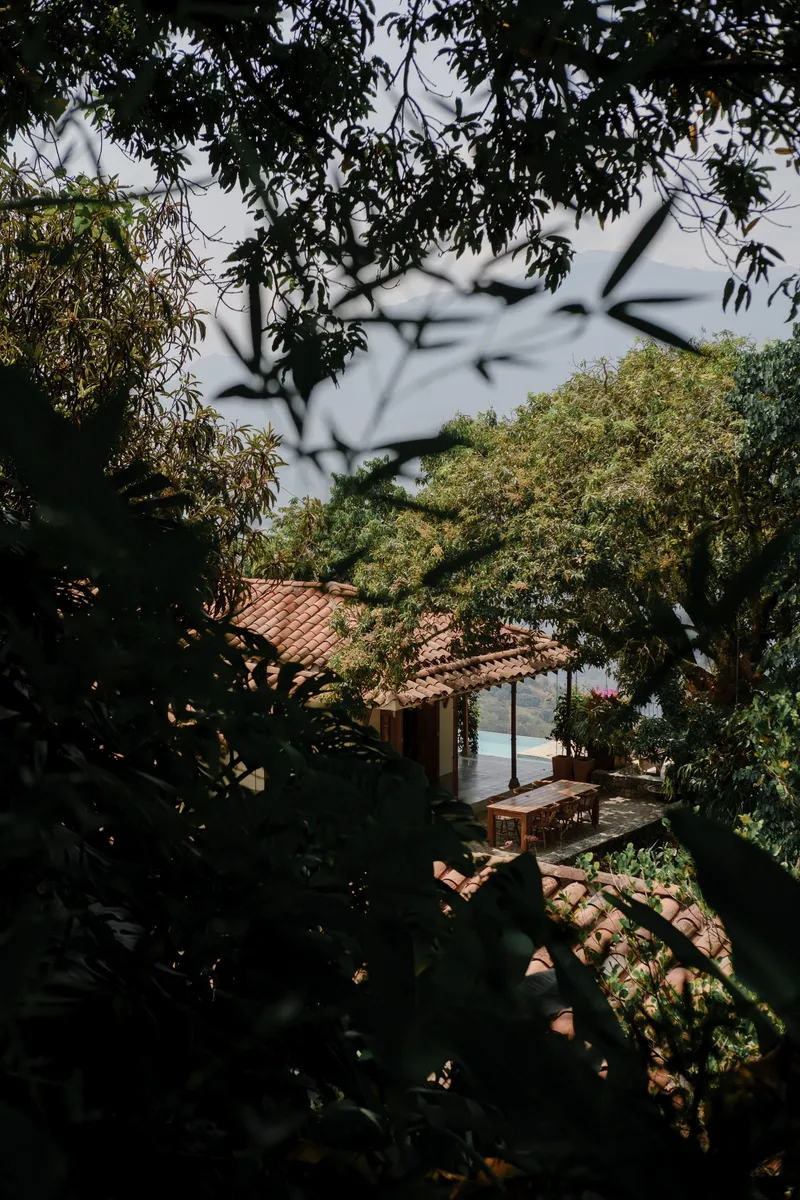
A river stone wall along the perimeter grounds the house in its site with geological force. The stones are not decorative cladding; they are structural, holding back the sloping terrain and forming the base on which the lighter timber and plaster structure sits. Against this rough surface, louvered timber doors and planted beds of succulents create a hierarchy of textures that reads as both rugged and precise.
The terracotta roof tiles, visible from the garden and partially obscured by overhanging branches, complete a material palette that is entirely local. Plaster walls, left in pale tones without applied color, act as reflectors for ambient light. Nothing here was shipped from a catalog. The restraint is not a style choice; it is a consequence of building with what the region provides.
Framed Views and Interior Details
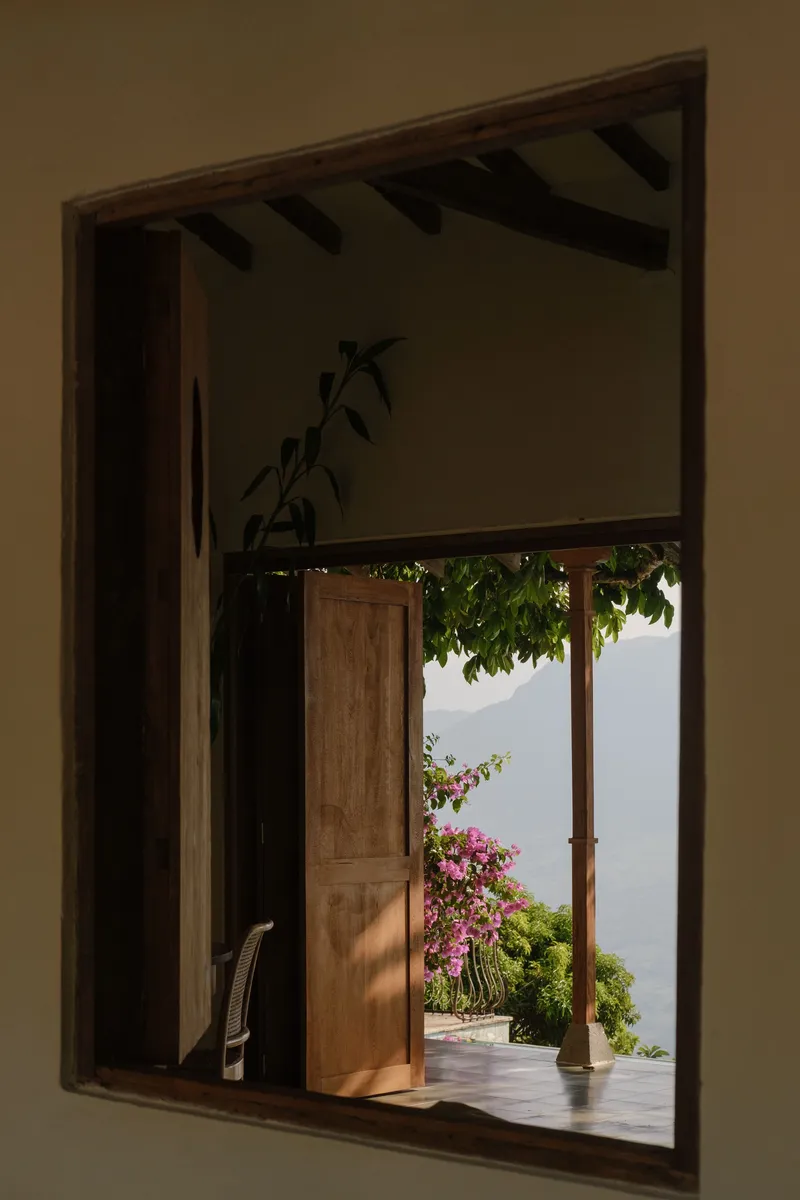
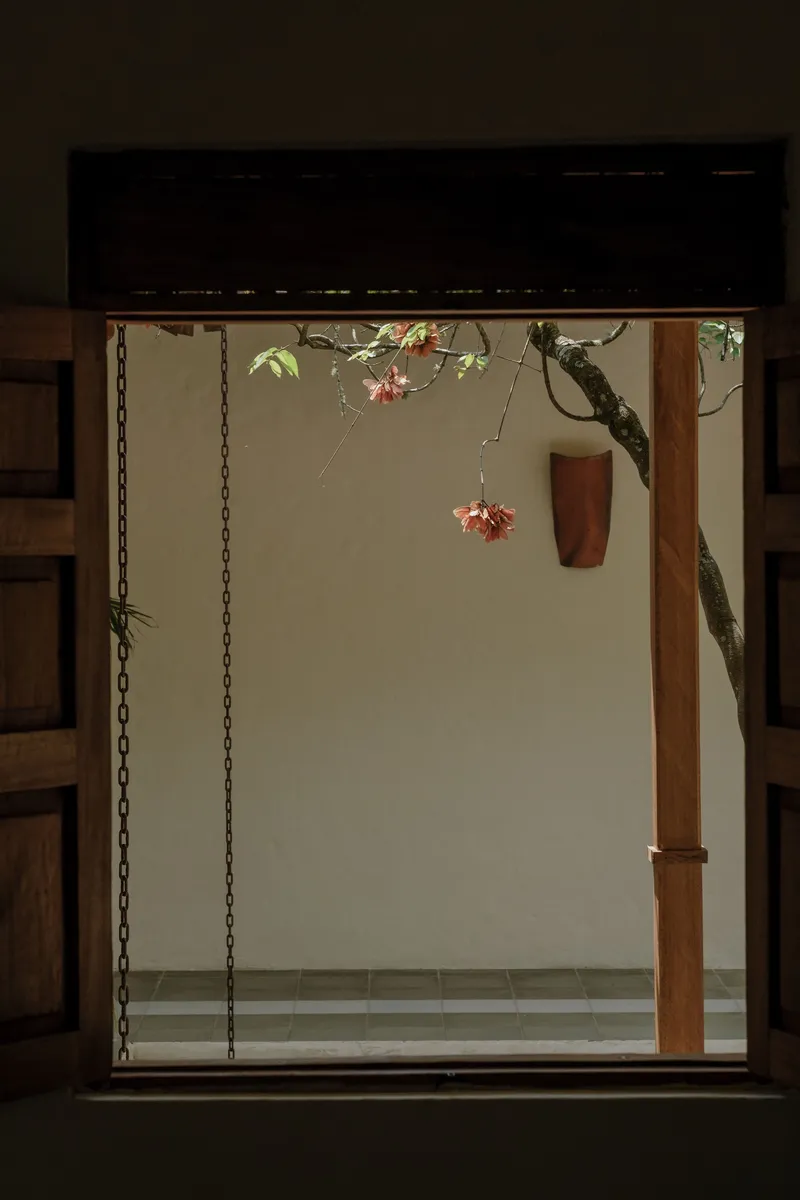
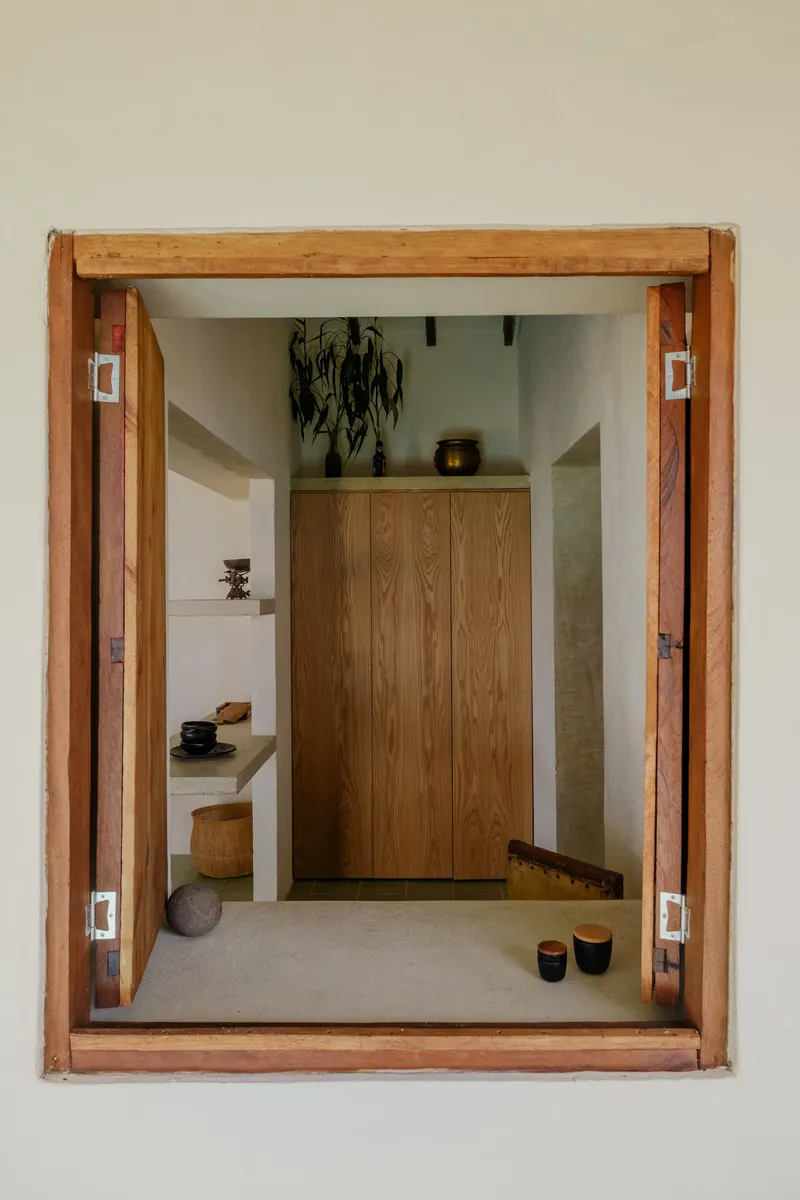
The architects use window openings as deliberate compositions. Through a timber frame, you catch a terrace draped in bougainvillea with a misty landscape dissolving behind it. Through another, a single column and a flowering branch are isolated against a pale wall like elements of a still life. These are not accidental snapshots; each opening has been calibrated to select exactly what the eye should settle on.
Inside, the details are quiet: a wooden cabinet beneath a framed window, cast iron pans hung from an exposed beam wall, candle sconces that suggest the house existed before electricity and is comfortable acknowledging that history. The interiors resist the urge to fill every surface. Emptiness, here, is a material.
Doors, Shadows, and Passages
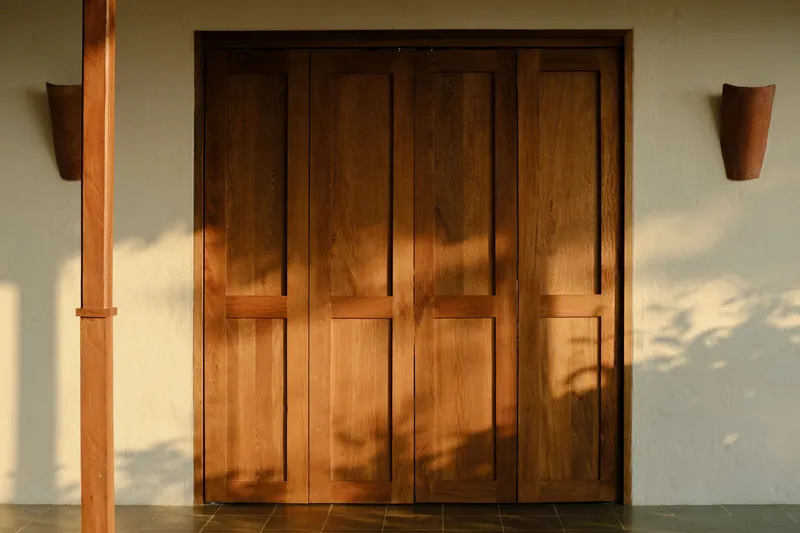
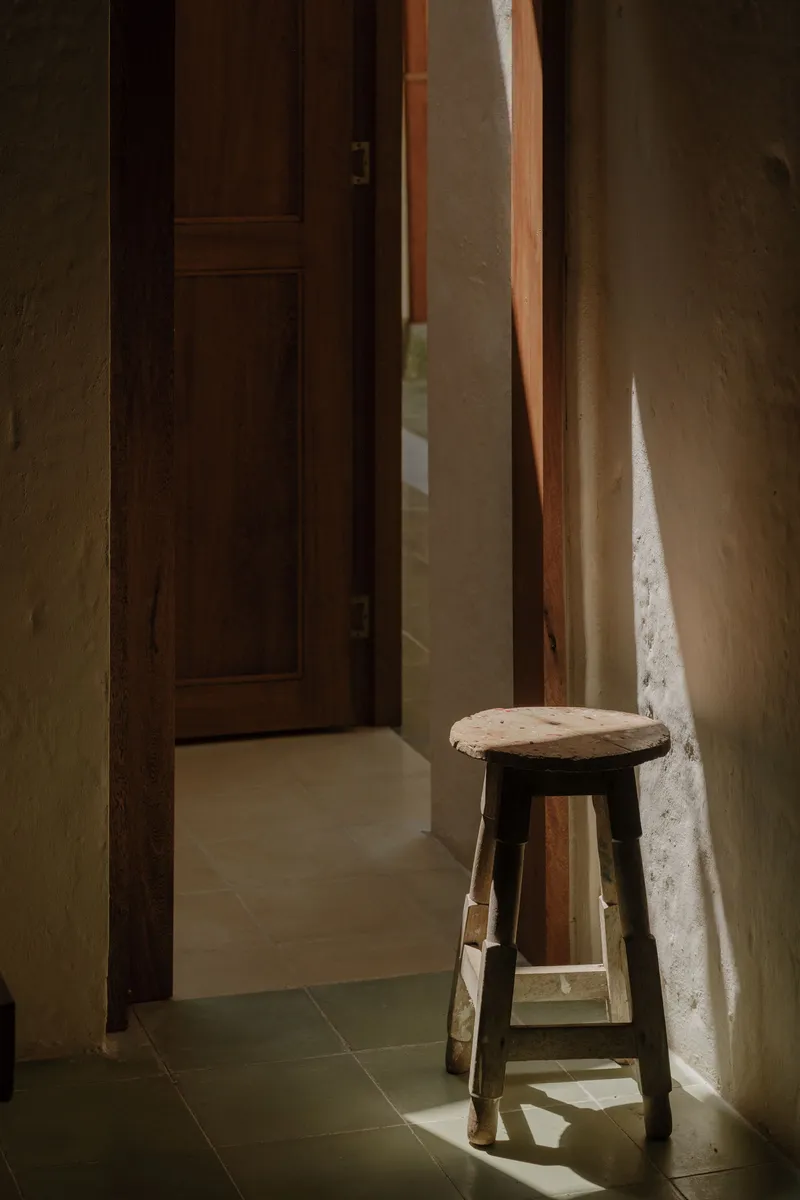
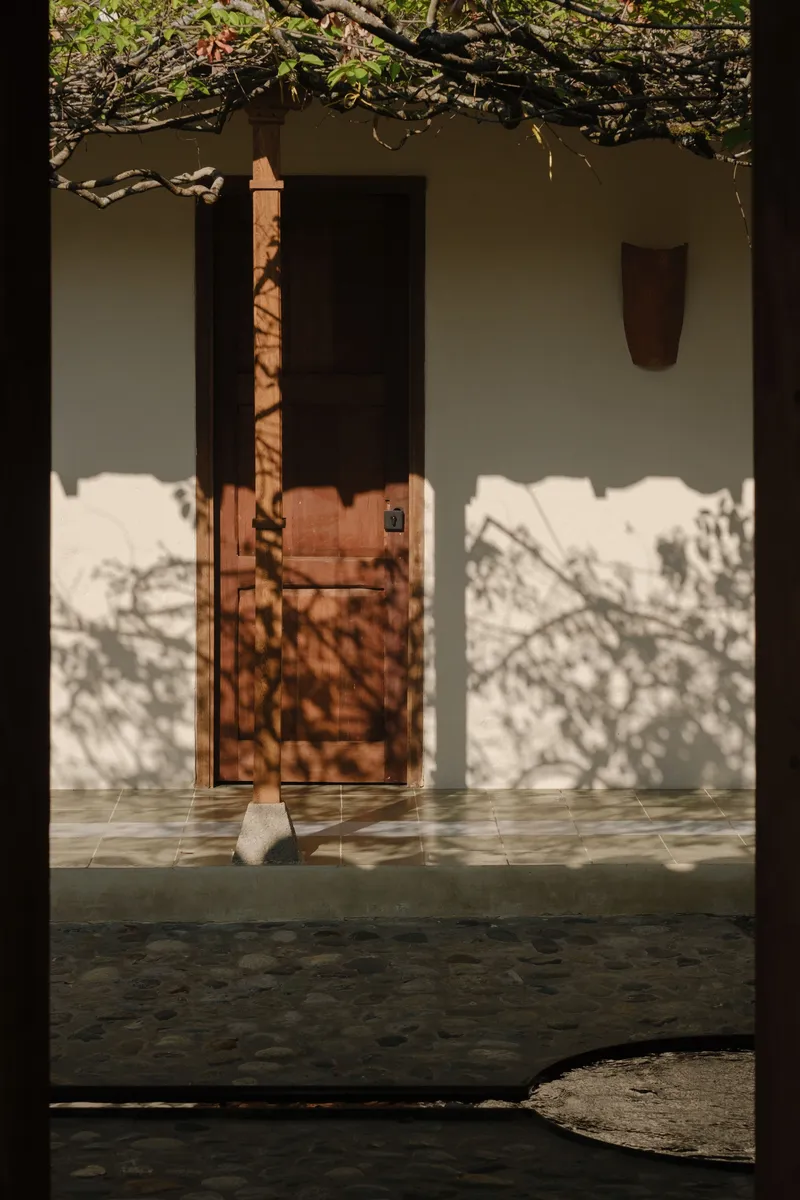
Four-panel timber folding doors, narrow sunlit passages, and dark doorways framing bright porches beyond: the house is experienced as a sequence of compressions and releases. You move from shadow into light and back again, and the transitions are always mediated by a physical element, a column, a screen, a step. The effect is cinematic without trying to be.
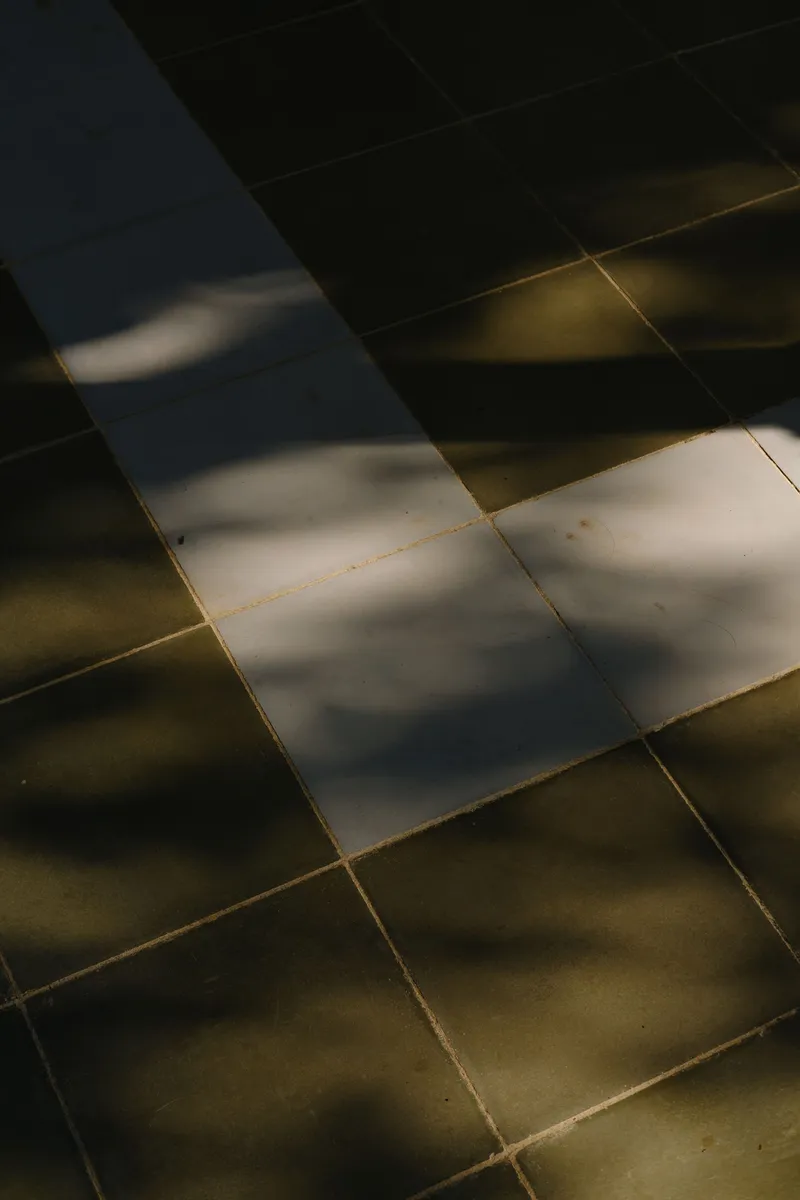
Dappled tree shadows play across plastered walls, and the gridded stone floor picks up diagonal afternoon light in patterns that shift by the hour. The renovation did not create these effects; it simply ensured that nothing would obstruct them. Sometimes the most important design decision is what you choose not to build.
The Wall as Artifact
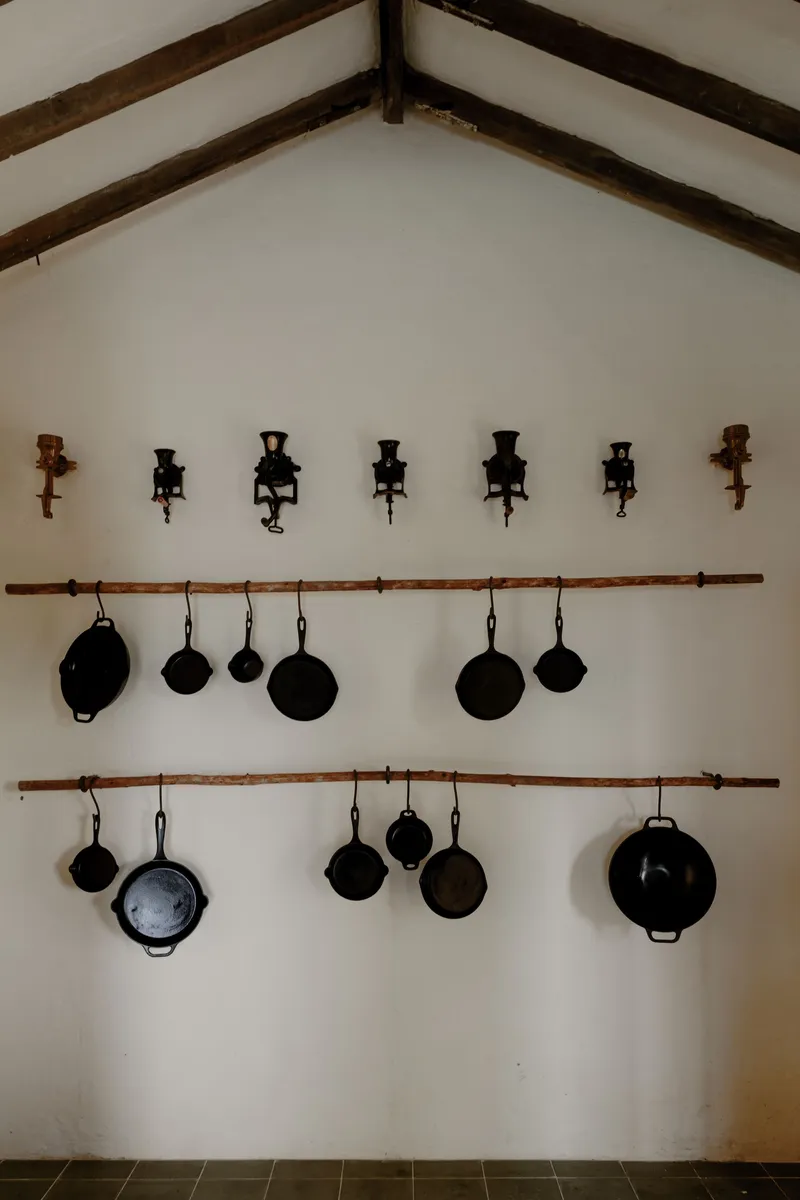
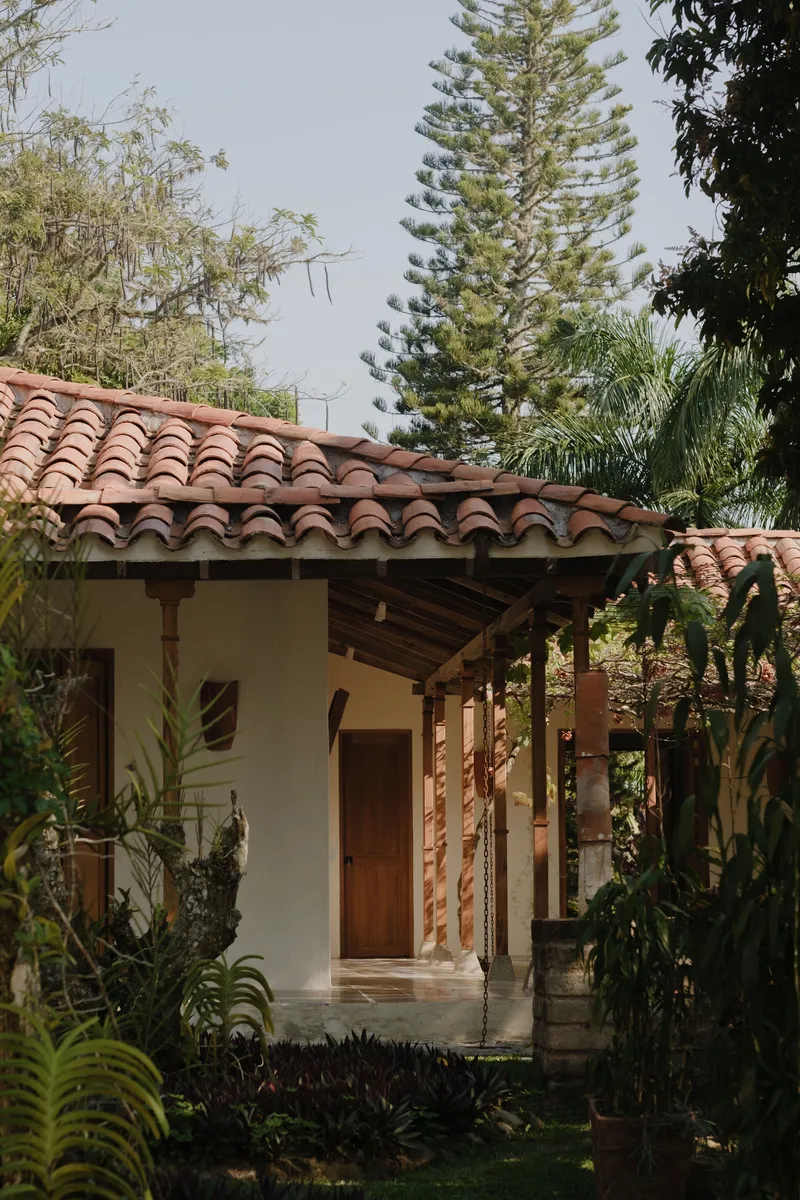
One vaulted interior wall stands out as a kind of domestic museum: exposed timber beams overhead, hanging cast iron cookware, and wall-mounted candle sconces arranged with the care of a gallery installation. It is a functional wall in a functioning kitchen, but it communicates a relationship to tools and craft that most contemporary houses have abandoned. The entry facade, with its clay tile roof and timber porch columns framed by tropical planting, extends this ethos outward. The house presents itself honestly from the street: this is what it is made of, and that is enough.
Plans and Drawings
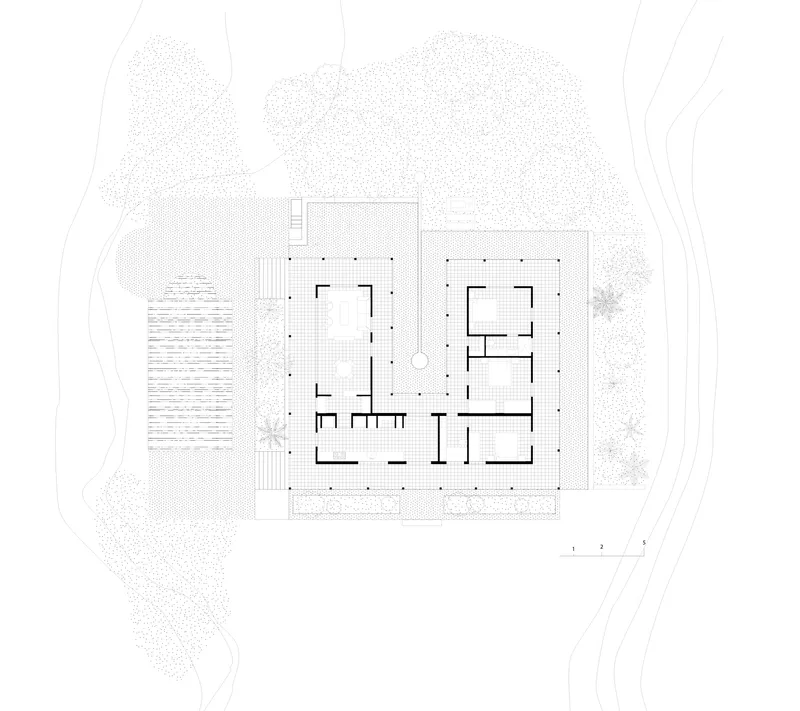
The floor plan confirms what the photographs suggest: a compact square volume organized around the central courtyard, with rooms arranged along the perimeter and the landscape pressing in from all sides. The trees drawn around the building are not ornamental; they are structural to the thermal performance of the house, providing shade that reduces heat gain on the roof and walls. The clarity of the plan, one diagram that explains everything, reflects the clarity of the intervention itself.
Why This Project Matters
The Margaritas House is a corrective to two common mistakes in renovation work. The first is demolishing vernacular structures and replacing them with something that performs worse in its climate. The second is preserving them as frozen artifacts, museum pieces that no one actually lives in. Trópico Arquitectura avoids both traps by treating the existing house as a living system, one that needs repair and reinforcement, not reinvention.
In a moment when Colombian architecture is gaining international attention for its bold civic projects, this small domestic renovation makes a quieter but equally important argument. The courtyard house, with its timber frame, clay tiles, and passive ventilation, is not a relic. It is an advanced technology for living in a warm climate, and the best thing an architect can do is learn from it rather than replace it.
The Margaritas House by Trópico Arquitectura (Candelaria Posada, María José Arango). Támesis, Colombia. 280 m². Completed 2023. Photography by Teodoro Posada.
About the Studio
Share Your Own Work on uni.xyz
If projects like this are the kind of work you want to make, uni.xyz is a place to publish your own, find collaborators, and enter design competitions.


Popular Articles
Popular articles from the community


The Amber Palace Opera: A Geological Fiction Surfaces on Tallinn's Baltic Waterfront
Pierre Brillard reimagines a Baltic legend as a public landscape, opera house, and waterfront promenade rooted in Tallinn's coastal identity.

Manzana Morphosis: Stretching Barcelona's Grid into a Living Landscape for 2050
A radical reworking of the Eixample manzana turns density into a tool for generous public space, vertical ecology, and environmental performance.


graciastudio Turns a Viewless Tijuana Lot Inward Around a Courtyard of Concrete, Timber and Trees
In Tijuana, Jorge Gracia's GA2 House stacks a timber-clad private floor over exposed concrete and replaces a missing view with a planted interior patio.

Cube Design Draws an Ecological Corridor Between Two Shenzhen Hills with the Nankai Building
Beside Shenzhen's container docks, the Nankai Building pairs stacked balconies with a climbing green screen to connect two hillsides across its height.

Similar Reads
You might also enjoy these articles

LAVA Architecten Gives Vocational Education a Sawtooth-Roofed Face on a Mechelen School Campus
In Mechelen, Belgium, a 2,053 m² STEM school on a 6×6 m grid turns workshops and classrooms into rooms that can be rearranged as teaching changes.

KEMA Studio Turns a Derelict Marvila Attic into a 60 m² Lighthouse Apartment Above Lisbon
In Lisbon's Marvila district, a rebuilt roof, four skylights and two plywood volumes turn an unlivable attic into a bright home facing the Tagus.

Pixel Gardens: One Repeated Module Stacked Into a Terraced Social Housing Tower for Famagusta
Salem Bader's shortlisted housing tower builds a vertical neighbourhood from one repeated module, offsetting units to carve terraces, light and air.

Bao Huynh Watercolor Atelier: A Serene Art Retreat in Hội An
Bao Huynh Watercolor Atelier in Hội An blends multifunctional art spaces, sustainable design, local materials, and family-friendly living in a serene environment.

Explore Interior Design Competitions
Discover active competitions in this discipline

Challenge to design mud housing for contemporary communities

Challenge to design luxury tourism on rails

VR headsets Storefront design competition

Designing a staircase for a client
Comments (0)
Please login or sign up to add comments
No comments yet. Be the first to comment!