
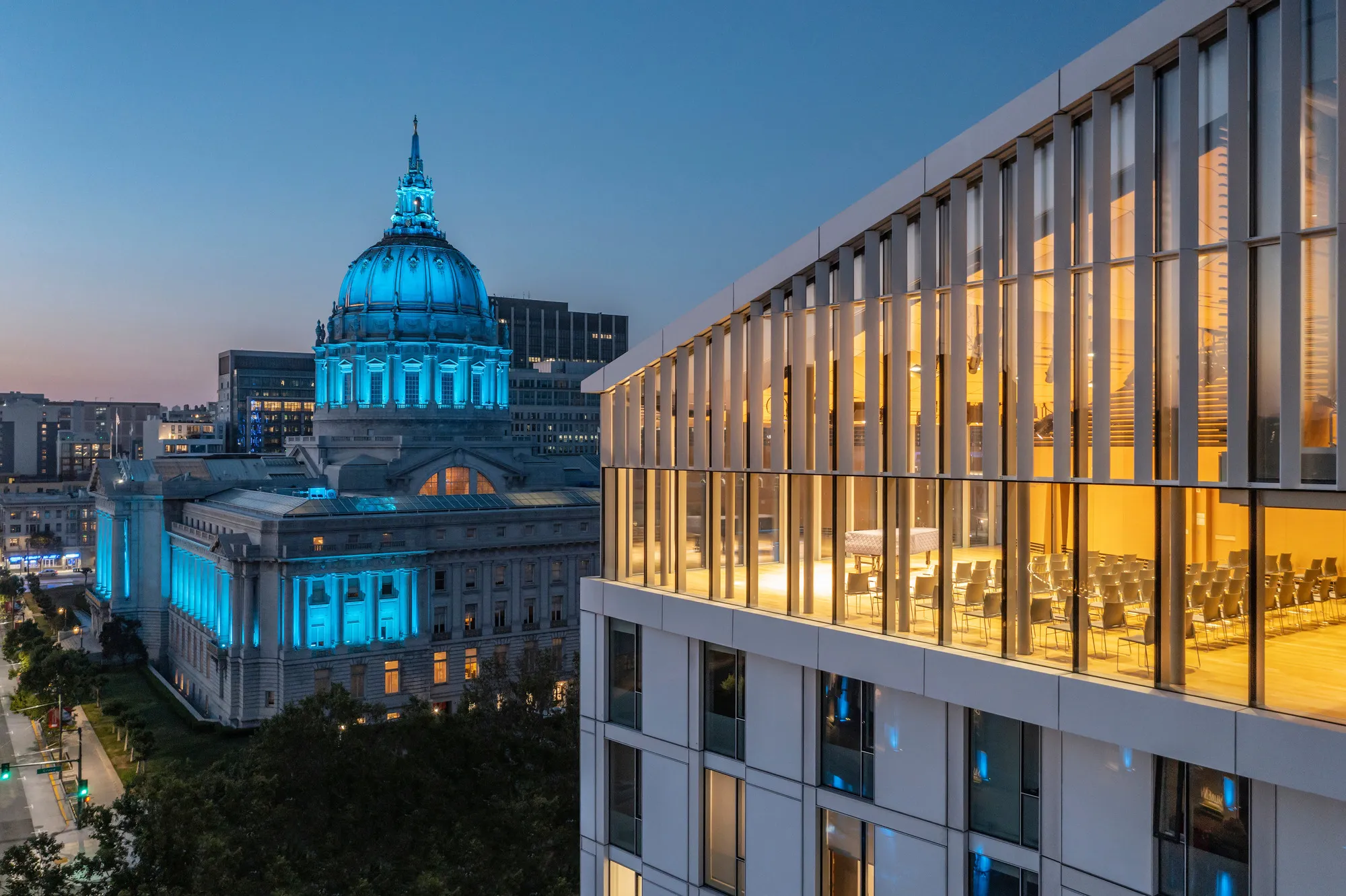
Mark Cavagnero Associates Stacks an Entire Music Campus into a 12-Story Glass Tower on Van Ness Avenue
A $200 million vertical conservatory in San Francisco's Civic Center district layers housing, recital halls, and classrooms behind a luminous glass facade.


Building a conservatory in the middle of a dense performing arts district is one challenge. Stacking it twelve stories high, with 420 student beds, two recital halls, recording studios, a café, and a rooftop terrace all under one address, is something else entirely. The Ute and William K. Bowes, Jr. Center for the San Francisco Conservatory of Music, designed by Mark Cavagnero Associates, occupies a single lot at 200 Van Ness Avenue, directly across from Davies Symphony Hall and within sight of City Hall's illuminated dome. At 134 feet tall and 170,000 square feet, it is a "vertical campus" born of necessity: San Francisco's land costs left no room to spread out, so the architects went up.
What makes the building genuinely interesting is not its height but its acoustic ambition. A conservatory is one of the noisiest building types imaginable: dozens of practice rooms, two performance halls, a recording studio, and a black box theater all need to coexist with residential units on the floors above and a busy urban avenue below. Cavagnero's response is a rigorous box-in-box construction strategy, floating structural slabs, walls exceeding 18 inches in thickness, and barrier ceilings suspended on springs. The result is a tower where a pianist on the top floor and a drummer three stories down can both perform without hearing each other, and where a student sleeping on the ninth floor can remain oblivious to a recital happening directly beneath.
A Glass Base That Belongs to the Street


The decision to make the ground floor almost entirely transparent is the building's most public gesture. Highly transparent low-iron glass strips the base away, exposing the lobby, the café, and a glass-enclosed recital hall to passersby on Van Ness Avenue and Hayes Street. At dusk, the illuminated interiors turn the sidewalk into an informal audience: you can watch a rehearsal through the storefront the way you might glance into a shop window. It is a deliberate act of porosity, transforming what could have been a fortress of practice rooms into an extension of the surrounding arts district.
The timber-paneled ceilings visible through the glass give the interior a warmth that the white-paneled upper floors do not promise from the outside. That contrast is productive. The base reads as civic, generous, and inviting; the tower above reads as institutional and precise. Together, they communicate that this building is both a private school and a public asset.
The White Skin and the Acoustic Problem
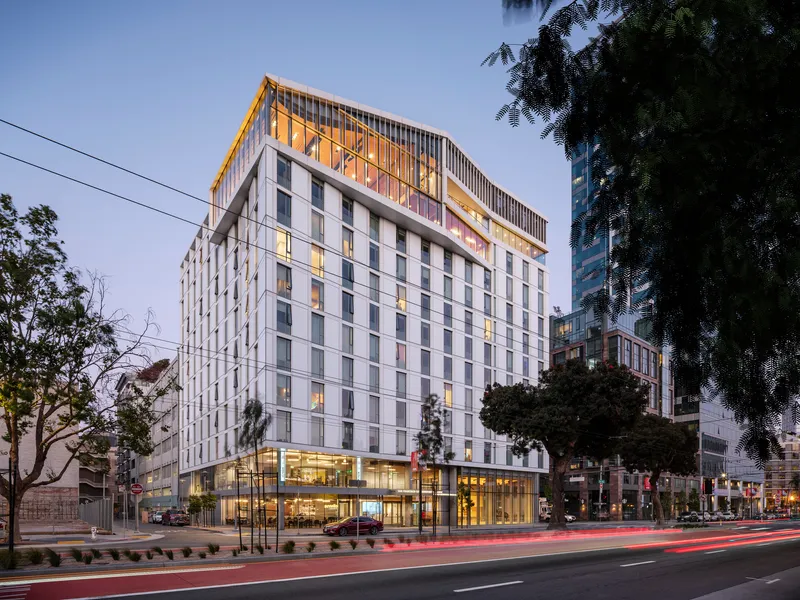

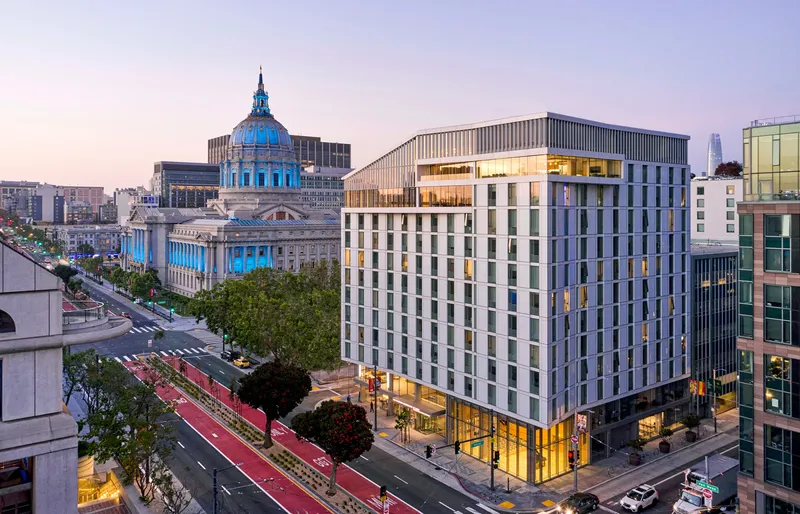
Above the glass base, the facade shifts to a double-glazed system of white and transparent panels framed by vertical fins. This is not simply an aesthetic move. The double skin provides a thermal buffer, manages solar glare, and, critically, contributes to the acoustic isolation of the performance and residential spaces within. The fins create a rhythm of solid and void that echoes, without mimicking, the classical orders of the Beaux Arts buildings nearby. It is a contemporary facade that is contextually literate without being nostalgic.
The cantilevered portion of the upper floors, where the Barbro Osher Recital Hall pushes slightly past the Van Ness Avenue building line, is visible from below as a dramatic overhang of white and glass panels. Structurally, it signals the presence of the 32-foot-tall performance hall at the building's crown. The custom curtainwall, fabricated by CS Erectors and developed in collaboration with Kirkegaard Associates and Tipping Structural Engineers, integrates acoustic performance into a seamless envelope. From the street, you see a clean tower. What you do not see is the layered complexity behind it.
Performance Spaces Tuned Like Instruments


The two named recital halls, the Cha Chi Ming (seating over 100) and the Barbro Osher (seating 200), are the acoustic heart of the project. Both feature sculpted wood walls and ceilings designed in close collaboration with Kirkegaard Associates. The Cha Chi Ming hall includes sprung floors for dance and high-elasticity performances, while its walls conceal variable acoustic banners, fixed absorptive and diffusive elements, mechanical return air systems, and AV technologies behind timber latticework. These are not generic concert boxes; they are precision instruments wrapped in warm material.
The Barbro Osher Recital Hall, perched on the top floor, benefits from floor-to-ceiling glazing that frames panoramic views of the city, including City Hall's dome. The image of a chamber recital happening with San Francisco's skyline as the backdrop is striking, but the engineering behind it is what deserves attention. Floating concrete subfloors decouple the performance space from the superstructure. Barrier ceilings of multiple gypsum board layers hang on springs. The result is a hall that is simultaneously open to the sky and sealed from every vibration the city can produce.
Living Above the Music


Floors three through eleven contain one, two, and three-bedroom housing units for up to 420 students, while the twelfth floor provides short-term faculty apartments. This is a rare typological hybrid: a high-rise dormitory sitting directly on top of active performance and rehearsal spaces. The building's light-filled atria and common areas, dispersed throughout the residential floors, prevent the tower from feeling like a stack of isolated cells. A rooftop terrace with timber decking and planters offers an event platform with views across to City Hall, functioning as an outdoor extension of the conservatory's communal life.
There is also a social conscience embedded in the program. The site previously held 27 apartments, and the project provides replacement housing at rent-stabilized rates on the third and fourth floors. In a city where any new construction is scrutinized for its displacement effects, the decision to maintain affordable units within the same structure is notable, even if it is sometimes overlooked in the architecture coverage.
Why This Project Matters
The Bowes Center is a proof of concept for the vertical campus model in one of the most expensive real estate markets in the world. Rather than acquiring a sprawling suburban site, Mark Cavagnero Associates compressed classrooms, practice rooms, two recital halls, a recording studio, a black box theater, student housing, faculty housing, a café, and a rooftop terrace into a single 134-foot tower. The building succeeds not because it does everything, but because the acoustic engineering is rigorous enough to let all of these uses coexist without compromise. Box-in-box construction, floating slabs, and spring-mounted ceilings are not glamorous details, but they are the reason the building works.
More broadly, the project argues that a school of music can also be a civic building. The transparent ground floor, the cantilevered recital hall visible from Van Ness Avenue, and the rooftop terrace overlooking City Hall all assert the conservatory's place in the public life of San Francisco's Civic Center. At a time when many institutions retreat behind secure lobbies and controlled access, the Bowes Center puts its rehearsals on display. That openness, more than any material choice, is the project's most consequential move.
San Francisco Conservatory of Music Ute and William K. Bowes, Jr. Center, designed by Mark Cavagnero Associates. Located in San Francisco, United States. 170,000 square feet. Completed in 2021. Photography by Tim Griffith and Kyle Jeffers.
About the Studio
Share Your Own Work on uni.xyz
If projects like this are the kind of work you want to make, uni.xyz is a place to publish your own, find collaborators, and enter design competitions.




Popular Articles
Popular articles from the community


The Ocean Hive: Sustainable Architecture for a Self-Sufficient Civilization at Sea
The Ocean Hive imagines sustainable architecture at sea, where modular habitats, algae, wave power and ocean waste sustain a growing colony.

Co-Life: Senior Housing Design That Reconnects Older Adults With the City
Co-Life reimagines senior housing design through healing gardens, shared streets, workshops, and a sustainable community across generations.

Hill & Cross Opera: Sculptural Opera House Architecture Shaped by Tallinn’s Landscape and Identity
Hill & Cross Opera reimagines opera house architecture in Tallinn through its sculptural hill, civic plaza, glass wave and a luminous cross.

Conexión: Biophilic Design Reimagines High-Rise Living in Hong Kong
Conexión reimagines high-rise living in Hong Kong through biophilic design, green facades, shared spaces, daylight, water and nature within.


Similar Reads
You might also enjoy these articles

Bao Huynh Watercolor Atelier: A Serene Art Retreat in Hội An
Bao Huynh Watercolor Atelier in Hội An blends multifunctional art spaces, sustainable design, local materials, and family-friendly living in a serene environment.

Atelier Macri Concept Store Interior Design by CASE-REAL
Atelier Macri store features a "ko" counter, walnut wood details, cork displays, blending retail, gallery, and seamless customer experiences.

Manuel Vargas Izquierdo Stadium and High-Performance Sports Center: Architectural Excellence in Jalpa de Méndez
The Manuel Vargas Izquierdo Stadium blends sustainable design, inclusive sports facilities, and cultural-inspired architecture, revitalizing Jalpa de Méndez’s public spaces.

KAKR Buluh Awar Hall: Revitalizing Community and Ecology Through Bamboo Architecture
Community built bamboo hall revitalizes Buluh Awar village, empowering youth, restoring ecology, celebrating vernacular craftsmanship through sustainable architecture and culture.


Explore Architecture Competitions
Discover active competitions in this discipline



Challenge to reimagine the Iron Throne


Photograph architecture without architects


Illustrate the lost glory of Angkor Wat - Render Challenge


Design challenge to reuse E-waste
Comments (0)
Please login or sign up to add comments
No comments yet. Be the first to comment!