
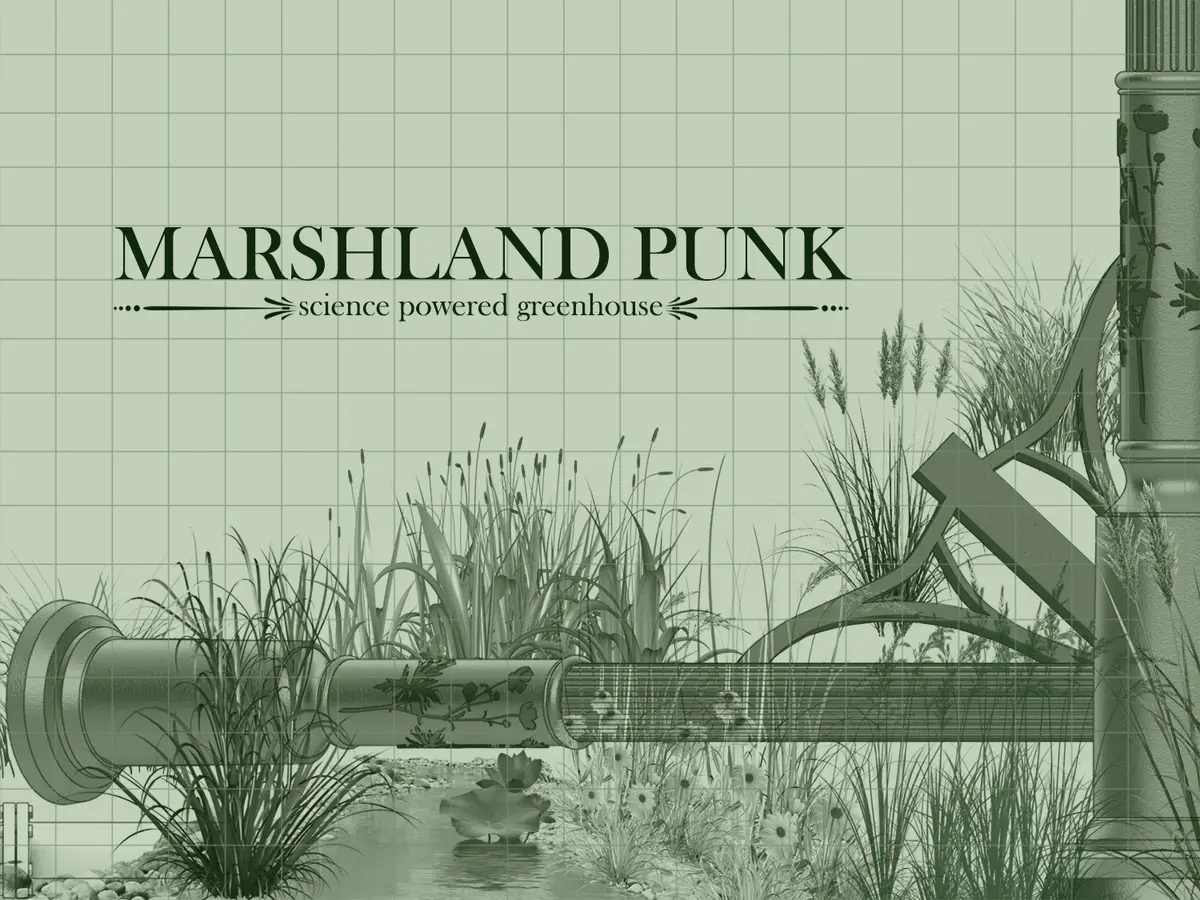
Marshland Punk
Science powered greenhouse

The Story Behind the Concept
While doing research about our location and its nearby surroundings, there was a lot that came to mind as a starting point– the history, The Industrial Revolution, industrial cities, the way humans and their negligence have a way of reshaping the natural landscape and lastly nature’s instinct to recover from (or rebel against) the man made conditions, etc. The idea of nature's rebellion is a great reminder, especially in this context of England and the industrial revolution, of another striking moment in British culture - punk.
Punk is a mostly musical movement that emerged in the working class, empowering people who have been, much like the nature surrounding our location, devastated by upper class’ greed. This movement is driven by a very strong ideology. Although punk looks very rough and tough, its ideas, are in their core very humane and freeing – in short, the ideas are considerate of human rights, ecology and animal rights.
Multiple similarities between the state of our site and punk ideas can be drawn, thus further research into punk ideologies was conducted.
Punk ideas go beyond the punk subculture and other subcultures that have emerged because of it. These ideas can be found in literary and artistic movements both before and after punk was not dead. What all of these movements have in common lays in the suffix punk which refers to the punk attitudes of the characters in the stories fighting whatever system and timeframe they are in.
Two movements that have been most inspiring for me are Steampunk and Solarpunk. These movements, although literary and artistic and also mutually very aesthetically different share the same core ideas as the original punk.
The Concept
The concept was built around the two literary and artistic movements mentioned earlier. Steampunk mostly inspired the structure of the project, while Solarpunk mostly inspired the objective of the project.
Steampunk stories were commonly set in the Victorian era, so naturally there was a lot of reference to Victorian architecture. Certain elements of Victorian architecture were a starting point for the design. Arches and pillars were used to build the space and helped with recognizing the character of the ambient early on in the process.
One of the most recognizable aspects of Victorian architecture were greenhouses. This tied in with the main objective of the project (which will be explained later) and they were the starting point in designing the project.
Solarpunk is a literary movement that had a very positive outlook on the future. The main idea was saving the mankind and the nature by using technologies, both modern and ancient, to help heal the current state of the earth. This positive outlook was very useful in defining how the project could help our site and its surroundings. The idea was to introduce a laboratory for in vitro propagation of plants which will allow creating a large number of plants that naturally grow on and around our site. Plants that came out of the lab would be planted on our site, both as a way to heal the nature and as a way to create an interpretation center that will educate the visitors and create a pleasant space for relaxation.
Architecture
Since nature of the Tame Valley Wetlands is one of the main motives of this project, the architectural form should reflect that. In order to show the significance of wetland’s flora, there is a circular form situated in the center of the site located north of the road.
The circular form represents the main glasshouse with an artificial pond in the middle. The pond is a space for plants whose roots grow under water. The bottom of the pond is slanted so that visitors can actually walk into the water and get their feet wet and get in touch with nature in a more direct way.
In one half of the circular form divided by a sloped bridge (a ramp) an amphitheater is located. The levels of the amphitheater are slanted in way that allows all levels to connect and form a platform (which is at the same height and slope as the bridge) for relaxing and overlooking the pond and the plants around it. The amphitheater can also be used for public lectures. In order to form a scene from which the lecturers present, one half of the artificial pond is covered by glass.
Surrounding the pond, there are spaces designated for plants that grow near water, and around these spaces the arboretum starts to form. By positioning plants like this, a gradation from water to treetops is created.
In the other half of the circular form, the arboretum is located. There is a small gallery covered by a playful construction located between the main circular space and the open air arboretum. The trees of the arboretum are planted between the rows of columns that are growing away from the center form following the circular raster.
Surrounding the central circle, there are a lot smaller glasshouses that serve different functions such as administration, classroom, library and a restaurant, but also the laboratory, the glasshouse with a space for hydroponic tubes and a glasshouse used for acclimatization of the plants that came from the laboratory. The laboratory is located underground and can only be accessed by the people who work there, but the ceiling of the laboratory is glass so that visitors can see the process behind in vitro plant propagation.
On the very north and south there are two points connected by the bridge.
The north point is a Water tower – tall viewpoint, and, in order to get to the top, visitors need to climb up the circular ramp. Its roof is designed in a way that, when enough water is collected, it opens up and the water splashes the ramps and visitors using it.
At the very south, the ramp accesses a café hidden in the trees. This café can be used as a checkpoint for visitors exploring the untouched nature.
The Aim of the Project
The use of modern technologies for plant propagation in this project serves simply as a help to nature’s rebellion – to make it stronger and to prevent from any possible future scenarios where the wildlife and landscape could be in risk of destruction. By combining the conveniences of modern scientific approaches in plant production and nature’s punk attitude (its ability to constantly fight for itself), a strong and a sustainable system for environmental protection is set.
The structure inspired by Steampunk (and its Victorian architecture) is a connotation on cultural phenomenon that is punk and its ideas and it serves as a reminder of core punk ideas that are always on the side of nature, animals and people.
Nature’s rebellion against everything that tries to disrupt its course is a reminder that, we all have, in our own nature, a punk attitude.

Popular Articles
Popular articles from the community


Architekt Andreas Gruber Scatters 23 Dark Timber Chalets Across a South Tyrolean Forest Edge
In Molini di Tures, Amonti Chalets breaks a resort into a hamlet of gabled timber houses, with parking, storage and services pushed into the slope.

Juan García Correa, John González and Claudia Rueda Sink a Circular Amphitheater into a Manizales Engineering Building
On the La Nubia campus in Manizales, Colombia, the S1 Building folds labs and offices into a hillside of ramped lawns that double as a campus route.

David Ortega Stacks a Two-Story Mexico City Penthouse Around a Steel Stair and a Pergola-Shaded Roof Terrace
In Colonia Roma, a 300 m² penthouse uses oak joinery, a planted steel stair and a slatted roof pergola to make a new-build apartment feel like a house.

LT2A and OPEN Architectes Thread a Brick and Glass High School Through a Wooded Belgian Campus
In Braine-l'Alleud, a 3,000 m² wing for Collège Cardinal Mercier pairs pale brick with a glazed colonnade, deferring to a small chapel and a dense wood.

Similar Reads
You might also enjoy these articles

The Rhythm of Seasons
A Farmers' Market Connecting Nature and the City

More Than a Building-Designing a Living System
More Than a Building-Designing a Living System
Base Beyond
DESERT COMPOUND ARID: TOURISM OF ABSENCE AND ABUNDANCE


Comments (0)
Please login or sign up to add comments
No comments yet. Be the first to comment!